FREE THEMES
1 Instituto de Humanidades Artes e Ciências, Universidade Federal da Bahia. R. Barão de Jeremoabo S/N/PAF IV, Ondina. 40170-115 Salvador BA Brasil. [email protected]
Is there a relationship between students’ knowledge of HIV/AIDS
ways of transmission and their responses regarding
their proximity to people living with HIV/AIDS?
Abstract This paper aims to identify college stu-dents’ knowledge of HIV ways of transmission and correlate it with their answers concerning the proximity to people living with HIV/AIDS. We applied a questionnaire from the Brazilian Ministry of Health to 591 health undergraduate students. We analyzed the 10 questions about the virus ways of transmission, evaluating the num-ber of correct answers and verifying the associa-tion between the number of correct answers and questions related to the proximity to people living with HIV/AIDS. Most students (96%) answered correctly 7 to 10 questions related to HIV ways of transmission (Group A) and 4% answered correctly 3 to 6 questions (Group B). Correlat-ing these two subgroups and the answers about the non-acceptance of proximity to people living with HIV/AIDS, we found significant association between Group B and the agreement that the em-ployer should fire an employee living with HIV and the statement that they would feel uncom-fortable if a child living with HIV/AIDS studied at the same school as their own children. Negative opinions concerning the proximity to people liv-ing with HIV/AIDS were less prevalent, but were correlated to the lower knowledge of HIV ways of transmission.
Key words HIV, AIDS, Students, University
Vanessa Prado Santos 1
Maria Thereza Ávila Dantas Coelho 1
Estéfani Lima Macário 1
Sant Introduction
Thirty-five million people worldwide were living with human immunodeficiency virus (HIV) by
the end of 20131. In the same year, an
estimat-ed 2.1 million new cases of HIV infection were reported, a decrease of 38% compared to 2001. The number of deaths related to the disease is also declining. In 2013, 1.5 million people died of AIDS-related diseases annually, a fall of 35% when compared to 2005. However, the statistical data of this pandemic are not shown in a
uni-form way in different countries of the world1.
In Sub-Saharan Africa, about 24.7 million people are living with HIV/AIDS, which is the location most affected by the epidemic when compared to the global distribution of people
living with HIV/AIDS1. The average figure is 4.8
million in the Pacific and Asia regions. In Lat-in America, the estimate is 16.6 million people, highlighting the fact that 75% of the cases are distributed between Brazil, Colombia, Venezuela
and the Bolivian Republic1. With regard to new
infection cases, a slow decline occurred in Latin America, with a decrease of 39% in the number of new infections in Mexico, while Brazil
record-ed an increase of 11%1.
According to the 2014 Epidemiological Bul-letin of the STD, AIDS and Viral Hepatitis De-partment, Health Surveillance Secretariat, Minis-try of Health, approximately 734,000 people are living with HIV/AIDS in Brazil, corresponding to
a prevalence of 0.4% of the national population2.
Among young people, in the period 2004-2013, there was an increase in the number of new cases of the disease in both genders. Among men, there is an increased incidence in the 15-24 years age group, observing that, among those aged 15-19 years, there was an increase of 120%; and among those aged 20-24 years, 75.9%. Among women, the significant increased trend is among those in the 15-19 years age group, with an increase of
10.5%2.
Despite the spread of information about the disease in the media, the higher incidence of AIDS among young Brazilians shows that there may still be misinformation about these trans-mission routes. According to Dziekaniak and
Rover3, information is the basic input for the
de-velopment of knowledge, and knowledge is the added value to information, “what is done with it”, the differential that will lead to successful decision making, the “know how to do”. While knowledge does not necessarily imply a
behav-ioral change4,5, disinformation, according to
lit-erature, can facilitate prejudice and hamper the
fight against stereotyped ideas about the disease6.
Several studies evaluate knowledge about health
issues through the most diverse questionnaires7,8.
However, authors who evaluated a group in two stages, before and after an educational activity, demonstrated that, while there were more correct answers in the second stage, some incorrect an-swers persisted. That is, the acquisition of
knowl-edge did not occur uniformly across the sample9.
In literature and daily practice, we can observe that there are multiple and complex factors that interfere in knowledge and that it is difficult to evaluate it through direct and timely measures.
In this context, this study aims to find out whether university students have knowledge of HIV/AIDS ways of transmission, what their an-swers are about their proximity to people living with HIV/AIDS and to verify whether there is a correlation between knowledge of HIV/AIDS ways of transmission and such responses.
Methods
This study is part of a research that analyzes health and disease concepts and practices among university students. In Brazil, there is still little research that addresses this issue among faculty members and university students in the field of health. In this quantitative phase, we investigated knowledge about HIV/AIDS ways of transmis-sion and the responses on the interaction with people living with HIV/AIDS among health un-dergraduate students. We included in the sample all students enrolled in the respective course in the years 2012, 2013 and 2014, through the Na-tional High School Examination (ENEM), who attended the first two teaching weeks, that is, newly admitted to the University, and accepted to participate in the study by signing the Informed Consent Form (ICF). We applied a 50-question questionnaire developed by the Ministry of
Health10 to evaluate programs for the
in-e C
ole
tiv
a,
22(8):2745-2752,
2017
strument included questions related to the ways of transmission, opinion, prevention and virus
infection diagnostic tests10.
Our sample consisted of 591 university stu-dents who signed an ICF, agreeing to participate in the research, confirming that they were aware that questionnaires were anonymous and data would be analyzed without their personal iden-tification. Research was conducted in accordance with the directives and norms regulating re-search involving human beings, as per Resolution
196/96, later replaced by Resolution 466/1211,12
and approved by the Research Ethics Committee, State Health Secretariat of Bahia.
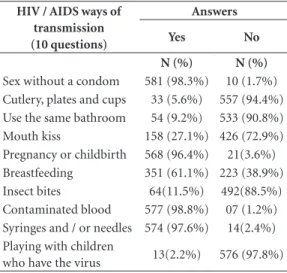
The ten questions from the questionnaire on HIV/AIDS ways of transmission and the five questions of the instrument on women’s rights and proximity to people living with HIV/AIDS were analyzed at this stage of the study, which are detailed in Tables 1 and 2. There were only two possible answers, YES (Y) or NO (N) for the 10 questions about the ways of transmission, as well as for the five other questions (YES, if they agreed with the statement, NO, if they disagreed) about opinions and the proximity to people liv-ing with HIV/AIDS. Responses were tabulated in a spreadsheet, evaluating the frequencies of positive (YES) or negative (NO) responses. After a first analysis of the answers regarding the 10 questions about HIV/AIDS ways of transmission, students were divided into two groups according to the number of correct answers: 3-6 correct answers (Group A) and 7-10 correct answers (Group B), aiming at correlating the number of
correct answers and prejudiced responses. An-swers to the five questions of the questionnaire that contained possible relations with prejudice, about the social interaction with people living with HIV/AIDS had their frequency studied and described as a proportion of the sample.
In order to study the possible relation be-tween knowledge of the ways of transmission, evaluated by the number of correct answers, and the responses regarding proximity to people liv-ing with HIV/AIDS, we analyzed comparatively students of the two different groups (A and B)
Table 1. Answers from students when asked about HIV
/ AIDS ways of transmission.
HIV / AIDS ways of transmission (10 questions)
Answers
Yes No
N (%) N (%)
Sex without a condom 581 (98.3%) 10 (1.7%)
Cutlery, plates and cups 33 (5.6%) 557 (94.4%)
Use the same bathroom 54 (9.2%) 533 (90.8%)
Mouth kiss 158 (27.1%) 426 (72.9%)
Pregnancy or childbirth 568 (96.4%) 21(3.6%)
Breastfeeding 351 (61.1%) 223 (38.9%)
Insect bites 64(11.5%) 492(88.5%)
Contaminated blood 577 (98.8%) 07 (1.2%)
Syringes and / or needles 574 (97.6%) 14(2.4%)
Playing with children
who have the virus 13(2.2%) 576 (97.8%)
Table 2. Correlation between the students’ knowledge of HIV / AIDS ways of transmission (groups A and B) and
responses that are contrary to their proximity to people living with HIV.
Statements
GROUP A* GROUP B**
p-value
(24 students) (567 students)
N (%) N (%)
They agreed that they would be bothered if a child living with
AIDS studied at their children’s school. 06 (25%) 30 (5.4%) 0.002
They agreed that the employer should fire a person living
with AIDS to protect himself and his co-workers 02 (8.7%) 05 (0.9%) 0.027
They agreed that they would be bothered if a neighboring
house became a home for people living with AIDS 03 (13%) 38 (6.8%) 0.21
Sant to verify whether there was a correlation between
a lower knowledge and responses that denoted the non-acceptance of the proximity to people living with HIV/AIDS. Statistical analysis was performed in the EPI-INFO 2005 program. For the study of the possible associations between the qualitative variables (Groups A and B, according to the number of correct answers and biased an-swers) we used Fisher’s Exact Test, considering
the level of p ≤ 0.05 as significant.
Results
Our study sample consisted of 591 university health students who answered the questionnaire, of which 190 (32%) declared themselves male and 401 (68%), female. Mean age was 22.9 years.
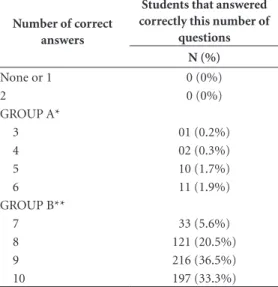
When the ten questions about HIV/AIDS ways of transmission were analyzed, most uni-versity students revealed a high knowledge of the disease. Ninety-eight percent of students an-swered that sex without a condom is a ways of transmission; 96% stated that pregnancy and childbirth of mothers living with HIV/AIDS are also ways of transmission; 99% reported con-taminated blood as a way of contracting HIV and 98% responded that contaminated syringes and needles are ways of transmission. Ninety-eight percent of participants answered that playing with children living with HIV/AIDS is not a way of transmission; 94% revealed that cutlery, dish-es and glassdish-es are not ways of contracting HIV; 91% said that using the same bathroom was also not a way of transmission, and 89% said that insect bites are not a way of contracting AIDS. The two questions with the highest proportion of incorrect answers were: 27% of the students answered that kissing in the mouth is a form of contracting AIDS and 39% answered that breast-feeding is not an HIV/AIDS way of transmission (Table 1). When we considered the number of students’ correct answers to the ten questions in this stage of the questionnaire, 4% (24 students) on the sample answered correctly 3-6 questions (Group A), while 96% (567 students) of the sam-ple answered correctly 7-10 questions (Group B). No student answered correctly fewer than three questions from this section of the questionnaire, which contained 10 questions about virus ways of transmission (Table 3).
We also evaluated the responses that indicat-ed non-acceptance of proximity to people living with HIV/AIDS. The questions in the question-naire investigated: “Would you mind if a child living with HIV/AIDS studied at your children’s
school?”, 93.8% said NO; “Do you think your em-ployer should fire someone living with HIV/AIDS to protect you and your co-workers?”, 98.8% of survey participants said NO; and “Would you mind if a house next to yours turned into a home for people living with HIV/AIDS?”, 93% said NO.
Correlating the number of students’ correct answers (subdivided into the two groups A and B) with answers that showed the non-acceptance of proximity to people living with HIV/AIDS, we found a statistically significant difference in relation to two out of three questions. Students with fewer correct answers on HIV ways of trans-mission (3-6 correct answers/Group A) agreed in greater numbers to the statements that “the employer should fire someone living with HIV/ AIDS and that “he/she would be bothered if a child living with HIV/AIDS studied at their chil-dren’s school.” The correlation between knowl-edge about HIV/AIDS ways of transmission (cat-egorized in Groups A and B) and the responses of non-acceptance of the proximity to people living with HIV/AIDS are detailed in Table 2.
Table 3. Number of correct answers of the 591
students regarding the 10 questions about HIV / AIDS ways of transmission.
Number of correct answers
Students that answered correctly this number of
questions N (%)
None or 1 0 (0%)
2 0 (0%)
GROUP A*
3 01 (0.2%)
4 02 (0.3%)
5 10 (1.7%)
6 11 (1.9%)
GROUP B**
7 33 (5.6%)
8 121 (20.5%)
9 216 (36.5%)
10 197 (33.3%)
e C
ole
tiv
a,
22(8):2745-2752,
2017
Discussion
Literature shows that young people have a good knowledge of HIV/AIDS ways of
transmis-sion13,14. In our research, with more than 500
uni-versity students, we found that more than 95% of them know the virus ways of transmission through sexual intercourse, contaminated blood, syringes and needles, pregnancy and childbirth, denoting knowledge of the subject. Much of this information is often conveyed in media cam-paigns. However, we still had a high number of incorrect answers when it came to the possibil-ity of transmission by kissing in the mouth and transmission through breastfeeding.
The various studies have samples of different characteristics, but all of them reveal that there is still some lack of knowledge about HIV/AIDS
ways of transmission among young people15,16.
A study with students from a university in rural São Paulo revealed that 90% of young people said that transmission may occur through inject-able drugs; 84% said through blood transfusion; 67%, said through sexual secretions; and 22%
said through saliva16. However, literature shows
that many young people still have doubts about vertical transmission and transmission through
saliva and insect bites16,17. Although data
collec-tion instruments are different in the research on the subject, some of the questions about ways of
transmission are seen in all of them16,17.
The relationship between knowledge about the ways of transmission and responses of non-acceptance of the proximity to people liv-ing with HIVAIDS is controversial in literature. Studies with young people of other nationalities diverged in demonstrating the relation between
knowledge and prejudice15,17,18. A study by
Tavoo-si et al.15 carried out with high school students
found that young people with less knowledge about the disease had more negative attitudes about people living with HIV/AIDS, and about half of students believed that someone living with HIV/AIDS should not study at the other stu-dents’ school. In a study carried out with North American secondary school students, Holtzman
et al.17 did not find a correlation between
knowl-edge about HIV and young people’s behavior. In Greece, youngsters from 13 technical and profes-sional schools had high knowledge about HIV ways of transmission, and 76% would still be friends of someone living with HIV/AIDS; but only 19% of students would like their classmates
to know of a possible HIV positive diagnosis14.
In our study with university students who also had a good knowledge about HIV/AIDS ways of transmission, we found that few students demonstrated the non-acceptance of proximi-ty to people living with HIV/AIDS. In Brazil, a
study by Seidl et al.6 carried out at the University
of Brasília (UnB) revealed that health students tend to have less exclusionary positions when compared to students of humanities and exact sciences with regard to people living with HIV/ AIDS right to education and work. One of the reasons attributed to this difference would be a greater knowledge about the subject by students of health courses, based on the very context of
the area6.
Regarding the questions applied in our study, few students stated that their employer should fire someone living with HIV/AIDS for their pro-tection and that of their co-workers. Also in the university environment of the study by Seidl et
al.6, about a quarter of the sample studied agreed
with this statement. However, our work did not compare students from different areas and found responses of non-acceptance of proximity to people living with HIV/AIDS at a slightly lower
frequency than the study by Seidl et al.6, where
about 8.2% of the sample fully agreed with the statement that the employer should fire someone living with HIV/AIDS to protect other work-ers and 7.8% agreed in part, with a percentage of about 15% of the sample agreeing with this statement, in a gradual scale of agreement, which was not used in our study. In another study, in-dividuals living with HIV/AIDS participating in a survey revealed that they feared that the dis-covery of infection by co-workers might create prejudice or discomfort in the exercise of their
own profession19. Some of the participants have
resigned from work because they were afraid of being exposed by being HIV carriers; others were fired due to prejudice; and there were still those who gave up looking for jobs for fear of
undergo-ing admission tests19.
Prejudice is considered as the attitude of an individual toward a particular group, based on the belief that that specific group would have
negative features20. Prejudice is influenced by
multiple factors, including cultural, cognitive, historical, economic, and personality factors. Prejudice’s destruction process would not occur through the inhibition of only one factor, but of
an action on the various factors20. It is not just the
in-Sant dividuals and their social relationships, which
develop through the family environment, school and communication networks, and can act in dif-ferent spheres that will facilitate or hinder their
emergence21. According to Galvão22, while AIDS
is not associated with “physical death” anymore, the carrier experiences a “social death” due to the stigma that HIV positive status generates in in-terpersonal and intergroup relations.
In our study, the question with the greatest number of answers that could denote some level of prejudice, since they reveal the non-acceptance of the proximity to people living with HIV/AIDS was in relation to the annoyance of a neighbor-ing residence becomneighbor-ing a center for people livneighbor-ing with AIDS. However, for this question, there was no significant difference between the two groups of young people with a lower and greater knowl-edge of the disease’s ways of transmission, show-ing that the idea of cohabitshow-ing aroused a negative response in both groups.
In Brasilia, authors investigated the exis-tence of prejudice in relation to people living with HIV/AIDS in two university spheres
(pub-lic and private)22. With the creation of a “Social
Distance Scale”, the objective was to measure the discomfort in relation to HIV carriers. With a sample of 169 university students, different so-cial stakeholders with more or less proximity were studied, such as friends, relatives, neighbors, acquaintances living with HIV/AIDS and others. Results revealed that the discomfort was great-er when thgreat-ere wgreat-ere closgreat-er relations (friendship or kinship) when compared to formal relation-ships, without affective coexistence. The sample analyzed revealed a feeling of discomfort in the
very close social relationships22. When they know
their diagnosis, adolescent HIV carriers wish that no one else were aware of it, probably for fear of prejudice and discrimination associated with the
disease23. Only family members and sometimes
partners could know it, because adolescents re-port that friends have a habit of questioning
changes in appearance secondary to disease23.
According to our results, lower knowledge was significantly associated with negative re-sponses about proximity, although they were also appeared, less frequently, among young people with the highest number of correct an-swers regarding the virus ways of transmission.
Tavoosi et al.15 also found this correlation, and
after having applied questionnaires to more than four thousand students, revealed a higher frequency of negative attitudes vis-à-vis people living with HIV/AIDS among students with
low-er knowledge, whlow-ere 23% said that they would not shake the hand of someone living with HIV/ AIDS, if they knew about the disease. In a study conducted with Malaysian medical students,
Chew & Cheong24 found no correlation between
knowledge and negative attitudes, but 50% of the sample responded that partners of people living with HIV/AIDS should be informed even with-out the patient’s consent, and 49% agreed that all patients admitted to a hospital should perform serology for HIV.
The questions that denoted negative attitudes toward people living with HIV/AIDS were not similar in the various studies and there is still no universally accepted instrument in the literature for assessing young people’s behavior in relation to HIV/AIDS. The scales to correlate knowledge and prejudice revealing-attitude also differ in the studies; however, samples consist of adolescents that are mostly with high knowledge of the dis-ease and participate in multiple sectors of soci-ety, with answers that indicate prejudice in part
of the researched literature6,14,15,17.
In our study, although the responses that were contrary to the proximity to people living with HIV/AIDS were not frequent, two of the three questions showed a correlation between them and a lower knowledge about the ways of transmission of the disease, suggesting that a greater debate on this theme with young people can make some contribution in the fight against prejudice. However, the low prevalence of opin-ions that denoted prejudice may be related to the implemented methodology, since the ques-tionnaire applied requested a direct and timely response, with only two options, which may not represent a daily behavior of university students. However, the anonymous nature of the question-naire allows for a more direct and free response. Another aspect to be considered is that our newly enrolled students in the University are acquiring new knowledge to discuss and review their atti-tudes and opinions, and it is up to society and Universities to broaden their space to debate these issues.
e C
ole
tiv
a,
22(8):2745-2752,
2017
investment in health education actions could aid in combating prejudice in contemporary society.
Collaborations
Sant References
1. Joint United Nations Programme on HIV/AIDS (UN-AIDS). The Gap Report 2014. [acessado 2015 abr 3]. Disponível em: http://www.unaids.org/en/resources/ documents/2014/20140716_UNAIDS_gap_report 2. Brasil. Ministério da Saúde (MS). Boletim
epidemio-lógico DST/AIDS 2014. Ano III - nº 01. [acessado 2015 abr 1]. Disponível em: http://www.aids.gov.br/ sites/default/files/anexos/publicacao/2014/56677/bole-tim_2014_1_pdf_60254.pdf
3. Dziekaniak G, Rover A. Sociedade do Conhecimento: características, demandas e requisitos. Revista de Infor-mação 2011; 12(5):1-9.
4. Almeida MCC, Aquino EML, Gaffikinb L, Magnani RJ. Uso de contracepção por adolescentes de escolas públi-cas na Bahia. Rev Saude Publica 2003; 37(5):566-575. 5. Silveira MF, Béria JU, Horta BL, Tomasi E.
Autopercep-ção de vulnerabilidade às doenças sexualmente trans-missíveis e Aids em mulheres. Rev Saude Publica 2002; 36(6):670-677.
6. Seidl EMF, Ribeiro TRA, Galinkin AL. Opiniões de jo-vens universitários sobre pessoas com HIV/AIDS: um estudo exploratório sobre preconceito. Psico USF 2010; 15(1):103-112.
7. Bastos AJ, Vilela EM, Henrique MN, Daibert PC, Fer-nandes LFMC, Paula DAA, Chaves MGAM, Bastos MG. Avaliação do conhecimento sobre doença perio-dontal em uma amostra de nefrologistas e enfermeiros que atuam com doença renal crônica pré-dialítica. J Bras Nefrol 2011; 33(4):431-435.
8. Monteschi M, Vedana KGG, Miasso AI. Terapêutica medicamentosa: conhecimento e dificuldades de fami-liares de pessoas idosas com transtorno afetivo bipolar. Texto Contexto Enferm 2010; 19(4):709-718.
9. Stina APN, Zamarioli CM, Carvalho EC. Efeito de ví-deo educativo no conhecimento do aluno sobre higie-ne bucal de pacientes em quimioterapia. Esc Anna Nery 2015; 19(2):220-225.
10. Brasil. Ministério da Saúde (MS). Questionário para avaliação de programas de prevenção das DST/AIDS. [acessado 2012 jul 10]. Disponível em: http://bvsms. saude.gov.br/bvs/publicacoes/141questionario.pdf 11. Brasil. Conselho Nacional de Saúde. Resolução no 196
de 10 de outubro de 1996. Aprova as diretrizes e nor-mas regulamentadoras de pesquisas envolvendo seres humanos. Diário Oficial da União 1996; 16 out. 12. Brasil. Resolução no 466, de 12 de dezembro de 2012.
Aprova as diretrizes e normas regulamentadoras de pesquisas envolvendo seres humanos. Diário Oficial da União 2013; 13 jun.
13. Martins LBM, Paiva LHSC, Oasis MJD, Sousa MH, Neto AMP, Tadini V. Fatores associados ao uso de pre-servativo masculino e ao conhecimento sobre DST/ AIDS em adolescentes de escolas públicas e privadas do Município de São Paulo, Brasil. Cad Saude Publica 2006; 22(2):315-323.
14. Merakou K, Costopoulos C, Marcopoulou J, Kourea-Kremastinou J. Knowledge, attitudes and be-haviour after 15 years of HIV/AIDS prevention in schools. Eur J Public Health 2002; 12(2):90-93. 15. Tavoosi A, Zeferani A, Enzevaei A, Tajik P,
Ahmadine-zhad Z. Knowledge and attitude towards HIV/AIDS among Iranian students. BMC Public Health 2004; 4:17. 16. Cano MAT, Zaia JE, Neves FRA, Neves LAS. O conhe-cimento de jovens universitários sobre AIDS e sua pre-venção. Rev Eletrônica de Enferm 2007; 9(3):748-758. 17. Holtzman D, Lowry R, Kann L, Collins JL, Kolbe LJ.
Changes in HIV-Related information sources, instruc-tion, knowledge, and behaviors among US High School students, 1989 and 1990. Am J Public Health 1994; 84(3):388-393.
18. Morton AD, McManus IC. Attitudes to and knowledge about the acquired immune deficiency syndrome: lack of a correlation. Br Med J 1986; 293(6556):1212. 19. Freitas JG, Galvão MTG, Araujo MFM, Costa E, Lima
ICV. Enfrentamentos experienciados por homens que vivem com HIV/Aids no ambiente de trabalho. Rev. Esc. Enferm. USP 2012; 46(3):720-726.
20. Allport G. The nature of prejudice. Cambridge: Addi-son-Wesley; 1954.
21. Crochick JL. Preconceito, Indivíduo e Cultura. 3ª ed. São Paulo: Casa da Psicologia; 2006.
22. Galvão AC. Os muros (in)visíveis do preconceito: um estudo das representações sociais das pessoas que vivem com HIV/AIDS [dissertação]. Brasília: Universidade de Brasília; 2009.
23. Ribeiro AC, Padoin SMM, Paula CC, Terra MG. O Co-tidiano do Adolescente que tem HIV/AIDS: Impesso-alidade e Disposição ao Temor. Texto Contexto Enferm 2013; 22(3):680-686.
24. Chew BH, Cheong AT. Assessing HIV/AIDS knowledge and stigmatizing attitudes among medical students in Universiti Putra Malaysia. Med J Malaysia 2013; 68(1):24-29.
Article submitted 12/06/2015 Approved 21/03/2016