The effect of canine disimpaction performed with temporary
anchorage devices (TADs) before comprehensive orthodontic
treatment to avoid root resorption of adjacent teeth
Farzin Heravi1, Hooman Shafaee2, Ali Forouzanfar3, Seyed Hossein Hoseini Zarch4, Mohsen Merati5
Objective: The aim of this study was to evaluate the movement of impacted canines away from the roots of neighboring teeth before full-mouth bracket placement, performed by means of TADs to decrease undesired side effects on adjacent teeth. Meth-ods: The study sample consisted of 34 palatally impacted canines, being 19 in the experimental group and 15 in the control group. In the experimental group, before placement of brackets, the impacted canine was erupted by means of miniscrews. In the control group, after initiation of comprehensive orthodontics, canine disimpaction was performed by means of a cantilever spring soldered to a palatal bar. At the end of treatment, volume of lateral incisors and canine root resorption were measured and compared by means of a CBCT-derived tridimensional model. Visual Analogue Scale (VAS) score, bleeding on probing (BOP) and gingival index (GI) were recorded. Clinical success rate was also calculated. Results: The volume of root resorption of lateral teeth in the control group was significantly greater than in the experimental group (p < 0.001). At the end of treatment, VAS score, GI and BOP were not significantly different between the two groups. Conclusion: Based on our results, it seems that disimpaction of canines and moving them to the arch can be done successfully carried out with minimal side effects by means of skeletal anchorage.
Keywords: TADs. Impacted canine. CBCT.
1 Professor, Mashhad University of Medical Sciences, Dental Research Center,
Department of Orthodontics, School of Dentistry, Mashhad, Iran.
2 Assistant professor, Mashhad University of Medical Sciences, Oral and
Maxillofacial Diseases Research Center, Department of Orthodontics, School of Dentistry, Mashhad, Iran.
3 Assistant professor, Mashhad University of Medical Sciences, Dental Research
Center, Department of Periodontics, School of Dentistry, Mashhad, Iran.
4 Associate professor, Mashhad University of Medical Sciences, Dental Materials
Research Center, Department of Oral and Maxillofacial Radiology, School of Dentistry, Mashhad, Iran.
5 Assistant professor, Shahed University of Medical Sciences, Tehran, Iran.
Contact address: Dr. Hooman Shafaee E-mail: [email protected]
DOI: http://dx.doi.org/10.1590/2177-6709.21.2.065-072.oar
How to cite this article: Heravi F, Shafaee H, Forouzanfar A, Zarch SHH, Merati M. The effect of canine disimpaction performed with temporary anchor-age devices (TADs) before comprehensive orthodontic treatment to avoid root resorption of adjacent teeth. Dental Press J Orthod. 2016 Mar-Apr;21(2):65-72. DOI: http://dx.doi.org/10.1590/2177-6709.21.2.065-072.oar
Submitted: March 13, 2015 - Revised and accepted: July 28, 2015
» The authors report no commercial, proprietary or financial interest in the products or companies described in this article.
» Patients displayed in this article previously approved the use of their facial and in-traoral photographs.
Objetivo: o objetivo do presente estudo foi avaliar o uso de dispositivos de ancoragem temporária (DATs) para a movimentação de caninos impactados, afastando-os das raízes dos dentes vizinhos, antes da colagem dos braquetes em todos os dentes, com o objetivo de minimizar os efeitos colaterais indesejáveis nesses dentes adjacentes. Métodos: a amostra consistiu de 34 caninos impactados por palatino,
sendo 19 no grupo experimental e 15 no grupo controle. No grupo experimental, antes da colagem dos braquetes, os caninos impactados foram tracionados utilizando-se mini-implantes. No grupo controle, após o início do tratamento ortodôntico, a desimpacção dos caninos foi realizada com uma mola em cantiléver soldada a uma barra transpalatina. Ao fim do tratamento, os valores referentes à reabsorção radicular nos incisivos laterais e caninos foram medidos e comparados por meio de modelos tridimensionais reconstruídos a partir de TCFCs. Foram também registrados os escores relativos à dor sentida pelos pacientes, usando uma escala visual analógica (VAS); além do Índice de Sangra-mento à Sondagem (ISS) e do Índice Gengival (IG). O índice de sucesso clínico também foi calculado. Resultados: o volume de reabsorção radicular nos incisivos laterais no grupo controle foi significativamente maior do que no grupo experimental (p < 0,001). Ao fim do trata-mento, não houve diferença significativa entre os dois grupos quanto aos escores relativos à VAS, ao IG e ISS. Conclusão: esses resultados sugerem que a desimpacção de caninos e a movimentação deles para a arcada dentária podem ser realizadas, com sucesso e com mínimos efeitos colaterais, por meio da ancoragem esquelética.
INTRODUCTION
Impaction of maxillary permanent canines is a
com-mon clinical problem in the dental oice.1 Ericson and
Kurol2 reported that the incidence of maxillary canine
impaction is 1.7%.2 Moreover, it is estimated that the
incidence of palatal impaction is two or three times
greater than labial impaction.3 Maxillary canines play
an important aesthetic and functional role; therefore, in this regard, treatment is essential; however, impacted canines are more diicult and time-consuming to treat. Furthermore, impacted canines have a variable axial inclination and location and can lead to resorption of
neighboring teeth, especially lateral incisors.4
Diagnosis of canine impaction is based on clinical
and radiographic evaluations.5 Assessing the
condi-tion of the lateral incisor root is crucial, since in 80% of cases the roots resorbed by impacted canines were
those of lateral incisors.4
Two-dimensional imaging modalities can obscure the presence of resorption, and its severity may also be underestimated because of structural
superimpo-sition.6 However, 3D techniques are more sensitive
when compared to 2D methods. The proximity of impacted canines to neighboring lateral incisors can be easily evaluated, both quantitatively and qualita-tively by means of 3D imaging, such as cone-beam
computed tomography (CBCT).7 The use of CBCT
improves diagnostic capabilities as well as the chances
of success in more difficult cases.8
Management of palatally impacted canines re-quires surgical and orthodontic interventions. In the conventional method for managing impacted maxil-lary canines, comprehensive orthodontic treatment with fixed appliances is carried out. First, teeth are aligned and then a relatively stiff rectangular arch wire is inserted to minimize undesirable reactive
movements of anchor teeth.5 However, this method
may cause more root resorption of adjacent teeth during alignment and consolidation of anchor teeth,
and may also lead to anchorage loss.7
Skeletal anchorage is required if we were to move only impacted teeth before ixed-appliance orthodontic treatment onset. TADs have become popular because of their ease of placement and removal, minimal need for
patient compliance and relatively low cost.9 The
advan-tages of TADs are that they remain relatively stationary in the bone, they are able to increase anchorage capacity
and have no adverse efects or complications that could
hinder health or treatment outcomes.10 Also, they
facili-tate diicult orthodontic tooth movements.11,12 Koscis
and Seres13 suggested that miniscrew anchorage should
be taken into consideration when extrusion of an im-pacted canine is planned.
The aim of this study was to use TADs to palatally move impacted canines away from the root of neigh-boring teeth before bracket placement, and to compare both the amount of root resorption and clinical success rate to the conventional procedure.
MATERIAL AND METHODS
This was a non-randomized parallel-designed clinical controlled trial study. It was first performed as a pilot study on four patients and, based on the re-sults, sample size was calculated (at least 11 patients
for each group; α = 5% and power = 80%, effect
size = 1.920). A total of 26 patients (15 in the experi-mental group and 11 in the control group) with 34 palatally impacted canines participated in this study. The experimental group consisted of 19 palatally im-pacted canines while the control group consisted of 15 palatally impacted canines. Patients were screened by panoramic radiograph, and impacted canines with axial inclinations < 45° were included in this study. Exclusion criteria were: history of orthodontic treat-ment, systemic disease, labially impacted canines and lack of proximity of canine and lateral incisor. All pa-tients were females with a mean age of 15.6 ± 2.1 years old, and they all filled out and signed an informed consent form. The consent form was also signed by patients’ parents. This study was approved by the Ethical Committee of Mashhad University of Medi-cal Sciences (# 92/27712).
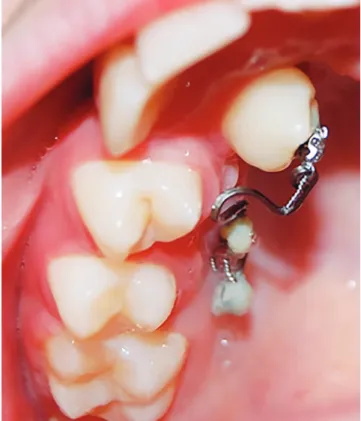
CBCT scans (Planmeca, Promax 3D Max, Helsinki, Finland) were taken from all patients (Fig 1). The scans were evaluated by an expert radiologist, and if the ca-nine tooth was not in close approximation to lateral in-cisors root, the case was excluded from the study. Ater a thorough assessment of the experimental group, two miniscrews (Jeil, Seoul, South Korea) were inserted in the palatal region for each impacted tooth: one between the irst and second premolar and another between the second premolar and irst molar (Fig 2).
mini-screws was 5 mm from the embrasure; right angle to the palate. Two miniscrews were placed for anchorage reinforcement. Patients were then referred to a perio-dontist for surgical exposure of the impacted canine. After 10 days, periodontal dressing was removed and a bracket was bonded to the exposed surface of the canine. Subsequently, a 50-g force was applied to the bracket through a palatal cantilever spring made of 0.017 x 0.025-in TMA wire (Ormco, Glendora, California, USA). The cantilever spring was inserted into the slot of miniscrews 0.018 x 0.025-in and li-gated with ligature wire. Miniscrews were covered by flowable composite resin. Every three weeks, force was adjusted until the canine erupted into the oral cavity (Fig 3). The miniscrews were then removed and comprehensive fixed orthodontic treatment be-gan (Roth prescription 0.018-in slot Dentaurum, Pforzheim, Germany). After leveling and alignment were carried out with NiTi wires and sufficient space was gained, the erupted canine was guided to the line of occlusion using NiTi overlay. Patient’s pain expe-rience was measured by means of VAS (0 to 10) three weeks after initial loading and at the end of disimpac-tion treatment.
At the end of treatment, another CBCT scan was taken to evaluate the resorption of canine and lateral incisors. Moreover, gingival index (GI) and bleeding on probing (BOP) were recorded for the erupted canine. Unerupted canines were reported as failure, and clinical success rate was calculated. The percentage of stable miniscrews was reported as survival rate of miniscrews.
In the control group, comprehensive orthodon-tic treatment with ixed appliances was initially per-formed (Roth prescription 0.018-in slot, Dentauram, Germany). Ater initial leveling and alignment with NiTi wires, and ater suicient space was gained, a 0.016 x 0.022-in stainless steel arch wire was inserted and a transpalatal arch (TPA) was placed. Then the palatally impacted canine was erupted into the oral cavity by a cantilever spring made of 0.016 x 0.022-in stainless steel soldered to the palatal bar. This method was considered to be the safest method for
disimpac-tion of palatally impacted canines.14 The erupted
ca-nine was guided to the arch with the aid of NiTi over-lay. In both groups, the direction of force was initially away from the lateral incisors root.
Figure 1 - Pretreatment CBCT image. Coronal Sagittal Axial
Figure 3 - Four months after initiation of force application.
Group Tooth Time Mean n SD T-test result
Test
Canine T0 449.1958 19 20.49983 0.000
T1 447.1368 19 21.20202
Lateral T0 265.5984 19 21.43632 0.000
T1 264.0774 19 21.32348
Control
Canine T0 456.1160 15 14.77856 0.000
T1 454.3047 15 14.39192
Lateral T0 265.2040 15 12.16210 0.000
T1 259.2980 15 11.89779
Table 1 - Tooth volume (mm3) of canine and lateral incisor from T 0 to T1.
Root resorption measurement
All CBCT scans were obtained by the same device at the following settings: exposures were made with 7 mA and 88 kV; and exposure time was of 12 seconds with a vowel size of 0.1 mm.
DICOM data sets of patients were imported into Amira sotware (Visage Imaging, Berlin, Ger-many). This sotware manually segments tissues ac-cording to Hounsield units (HU). CBCT data were reconstructed with surface and volume rendering, and the volumetric image was manipulated to display the teeth from various orientations. Threshold values were set individually for each patient. The same HU were used for segmentation. On these 3D images, lateral in-cisor and canine were segmented. Ater segmentation, lateral incisor and canine were separated from other teeth, the volume of each tooth was measured and the two measurements (tooth volume loss and percentage of teeth volume loss) were calculated. Tooth volume
loss was the diference between pretreatment (T0) and
post-treatment (T1) tooth volumes. To calculate the
method error, the volume of ive canines and ive lat-eral incisors was measured again by the same
radiolo-gist (r = 0.9, p = 0.001).
The radiologist who measured the volume of root resorption was blinded to the study. Data were analyzed by independent t-test, paired t-test and Mann-Whitney test (α = 0.05).
RESULTS
After a three-week period, patients in the con-trol group experienced higher pain levels than in
the experimental group (p = 0.012); but, at the end
of treatment, this difference was not statistically
significant (p = 0.769). Moreover, in the
experi-mental group, pain level was determined one day after placement of miniscrews, and mean value was 2.1 at this point in time.
given in Table 1. For both canine and lateral incisors,
the mean root volumes decreased from T0 to T1.
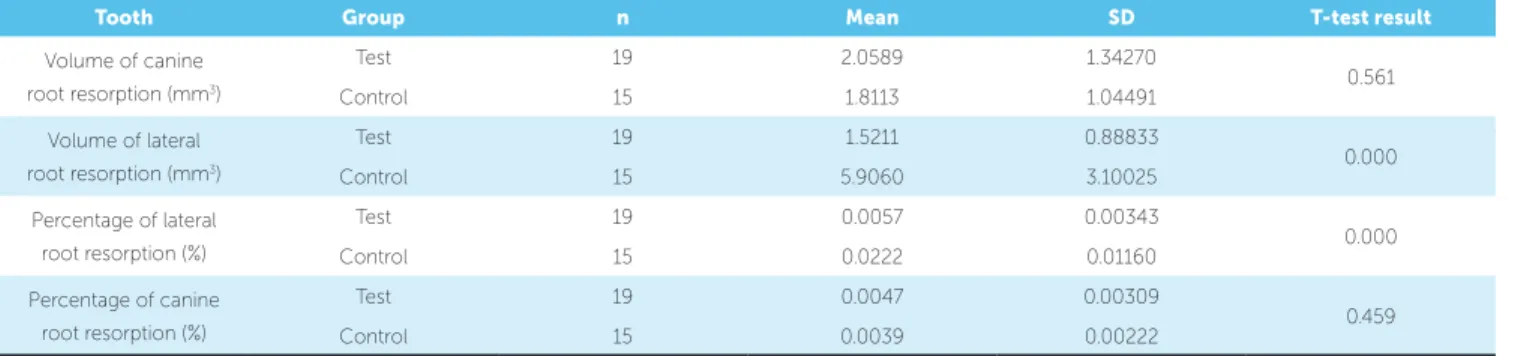
The volume of canine root resorption between con-trol and experimental groups showed no statistically sig-niicant diference. However, the volume of lateral inci-sor root reinci-sorption in the control group was signiicantly greater than in the experimental group (nearly four-fold), as shown in Table 2. Gingival index of erupted canines did not show statistically signiicant diference
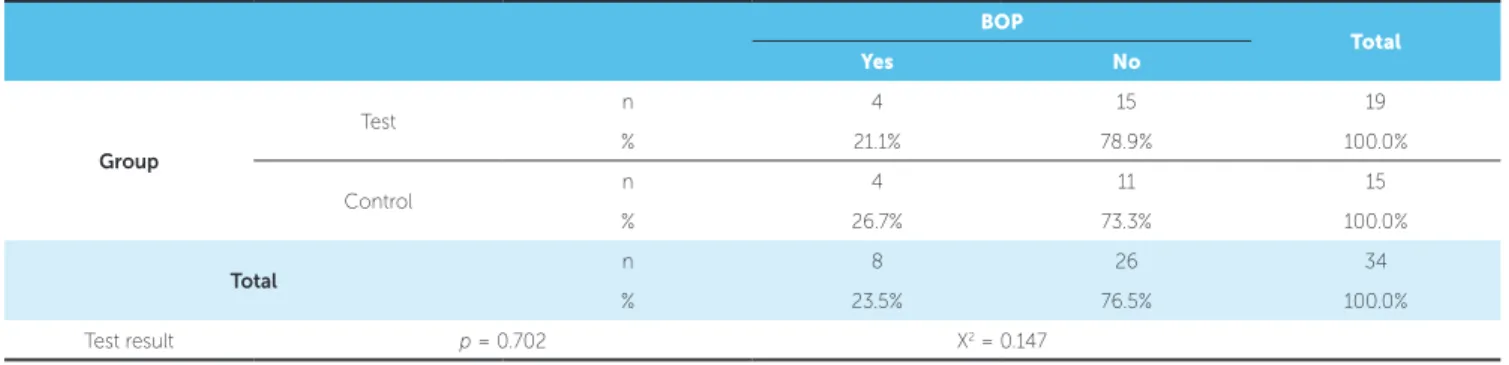
between the two groups (p = 0.937). BOP test was also
performed for erupted canines and it was not signiicant diferent between the two groups (Table 3).
The mean duration of forced eruption was 5.2 months in the control group and 5.1 months in the ex-perimental group, with no statistically signiicant
difer-ence between these two groups (p = 0.125).
In both groups, all impacted canines erupted into the oral cavity; therefore, clinical success rate was 100%. In the experimental group, two out of 38 miniscrews failed and were replaced. Therefore, survival rate was 94.7%.
DISCUSSION
Palatally impacted canines are a clinical problem
frequently encountered.10 Impacted canines have
dei-nite complications, such as root resorption on adjacent lateral incisors, and their disimpaction requires special techniques of which many have certain disadvantages. The traditional technique requires initial alignment and placement of heavy rectangular base arch wires to
neu-tralize reaction forces.5 Although this approach is
com-monly used, it has several disadvantages. First, place-ment of brackets on the adjacent lateral incisor may lead its apex to be closer to the resorptive follicle of the impacted canine. Second, when rectangular wires are inserted, torque is expressed and it may cause further resorption of adjacent lateral incisors. Third, this pro-cess is time consuming, while the resorptive follicle of
the impacted canine remains active.7 It seems logical in
clinical practice to move impacted canines away from the roots of adjacent teeth before comprehensive arch orthodontic setup. Therefore, we decided to evaluate
Table 2 - Comparison of the volume of root resorption in both groups.
Tooth Group n Mean SD T-test result
Volume of canine root resorption (mm3)
Test 19 2.0589 1.34270
0.561
Control 15 1.8113 1.04491
Volume of lateral root resorption (mm3)
Test 19 1.5211 0.88833
0.000
Control 15 5.9060 3.10025
Percentage of lateral root resorption (%)
Test 19 0.0057 0.00343
0.000
Control 15 0.0222 0.01160
Percentage of canine root resorption (%)
Test 19 0.0047 0.00309
0.459
Table 3 - Bleeding on probing (BOP).
BOP
Total
Yes No
Group
Test n 4 15 19
% 21.1% 78.9% 100.0%
Control n 4 11 15
% 26.7% 73.3% 100.0%
Total n 8 26 34
% 23.5% 76.5% 100.0%
Test result p = 0.702 X2 = 0.147
the efect of canine disimpaction before initiation of comprehensive orthodontic treatment on the root re-sorption of adjacent teeth in comparison to the afore-mentioned conventional technique. Disimpaction of canine without the aid of neighboring teeth require bone anchorage; therefore, we used two miniscrews to
provide anchorage for canine eruption.15
In this study, GI, BOP, volumetric root resorption and success rate in the experimental group were com-pared to the traditional technique group in which, ater anchorage preparation, we used a transpalatal arch to bring impacted teeth to the dental arch.
In both groups, patients’ age (p = 0.625) and initial
tooth volumes (canine p = 0.28; lateral incisor p = 0.947)
were comparable, and the axial inclination of all canines was < 45°. Moreover, the results of the study showed no signiicant diference in mean duration of canine forced
eruption between the two groups (p = 0.856).
Hu et al16 showed that TADs will not cause
dis-comfort and pain during placement and treatment. This study conirms our indings. TADs mechanics is entirely based on their stability. Many studies have shown that the survival rate of TADs is greater than 80%.17,18,19 In our study, two of the 38 TADs failed (sur-vival rate = 94.7%). All TADs in our study were placed in the palate, which may explain the higher survival rate.
Root resorption ater orthodontic treatment has been evaluated by diferent devices, such as conven-tional radiograph and light microscopy or electron
mi-croscopy;20,21 although conventional 2D radiograph has
many limitations for revealing root resorption.22,23 Chan
and Darendeliler24 concluded that 2D radiographs are
good diagnostic tools; however, quantitative evaluation should be avoided. An alternative to 2D radiograph is
CBCT which is particularly useful in the evaluation of root resorption ater orthodontic treatment; its
nondis-torted images allow thorough assessment of the root.25
CBCT gives us high-quality images with the same radiation dose of conventional radiograph. Only a few studies in the literature have measured tooth volume
using CBCT. Wang et al26 compared the accuracy of
CBCT for volumetric measurement of teeth by means of micro CT as the gold standard. They concluded that the accuracy of the CBCT method for volumetric
mea-surement of teeth in vivo is comparable to the micro CT
method in vitro. Therefore, the CBCT method has the
potential to be applied in studies on root resorption
as-sociated with orthodontic treatment. Li et al27 showed
volume measurement using CBCT which was able to evaluate root resorption caused by miniscrews
intru-sion.27 Walker et al28 showed that 3D techniques are
more sensitive than 2D techniques.
In the current study, total tooth volumes were cal-culated based on CBCT scans. Tridimensional recon-struction of the tooth allowed us to study volume loss. Mean volumes of canine and lateral incisors were not
signiicantly diferent at T0; thus, both groups were
ho-mogenous before treatment. Ater treatment, resorption of canines did not have statistically signiicant diference between groups. However, resorption of lateral teeth was almost four times greater in the control group than
in the experimental group (p < 0.0001). In the control
group, tooth alignments were performed irst, which might have been responsible for further root resorption.
In this study, mean root volume was found to
de-crease in all examined teeth within groups from to T0
to T1. This fact may be due to the efect of orthodontic
In the control group, tooth alignment was performed before canine forced eruption; however, in the experi-mental group, initially, canines moved away from the root of neighboring teeth due to our technique, which may explain signiicantly lower lateral root resorption. It seems that guiding palatally impacted canine away from the root of lateral incisors before bracket placement on other teeth is essential in impacted canine treatment.
Oberoie et al29 evaluated root resorption of the lateral
incisor adjacent to impacted canines. Qualitatively, 40.4% had no root resorption, 35.7% showed slight root resorp-tion, 14.2% showed moderate resorption and 4% showed severe root resorption of the adjacent lateral incisor.
Due to concerns about oral hygiene and gingivitis caused by the presence of miniscrews, GI and BOP of impacted canines were determined ater forced eruption and compared between the two groups. Results showed no signiicant diference between the two groups, and this may indicate that the presence of miniscrews will not lead to gingivitis. All impacted canines erupted into the oral cavity; thus, clinical success rate was 100%.
As the root is a 3D structure, using tridimensional imaging modalities to evaluate orthodontic root resorp-tion is very useful. Although micro CT is the best tool, it cannot be used in clinical studies. We recommend us-ing CBCT instead of 2D imagus-ing techniques for evalu-ating orthodontic root resorption in clinical situations.
CONCLUSION
Disimpaction of palatally impacted canines be-fore alignment of teeth may decrease root resorption. This illustrates that the use of TADs allows a more con-trolled movement of the impacted tooth. Another ad-vantage of this method is that the maxillary arch may not be bracketed until canine disimpaction, and ankylo-sis can be ruled out. Patients’ pain experience measured by VAS score was not diferent between the two groups.
Acknowledgment
1. Elefteriadis JN, Athanasiou AE. Evaluation of impacted canines by means of computerized tomography. Int J Adult Orthodon Orthognath Surg. 1996;11(3):257-64.
2. Ericson S, Kurol J. Longitudinal study and analysis of clinical supervision of maxillary canine eruption. Community Dent Oral Epidemiol. 1986 Jun;14(3):172-6.
3. Fournier A, Turcotte JY, Bernard C. Orthodontic considerations in the treatment of maxillary impacted canines. Am J Orthod. 1982 Mar;81(3):236-9.
4. Ericson S, Kurol J. Incisor resorption caused by maxillary cuspids. A radiographic study. Angle Orthod. 1987 Oct;57(4):332-46.
5. Bishara SE. Impacted maxillary canines: a review. Am J Orthod Dentofacial Orthop. 1992 Feb;101(2):159-71.
6. Bodner L, Bar-Ziv J, Becker A. Image accuracy of plain ilm radiography and computerized tomography in assessing morphological abnormality of impacted teeth. Am J Orthod Dentofacial Orthop. 2001 Dec;120(6):623-8. 7. Mah JK, Alexandroni S, editors. Cone-beam computed tomography in the
management of impacted canines. Semin Orthod. 2010;16(3):199-204. 8. Alqerban A, Jacobs R, Van Keirsbilck P, Aly M, Swinnen S, Fieuws S, et al.
The efect of using CBCT in the diagnosis of canine impaction and its impact on the orthodontic treatment outcome. J Orthod Sci. 2014 Apr;3(2):34-40. 9. Papadopoulos MA, Tarawneh F. The use of miniscrew implants for
temporary skeletal anchorage in orthodontics: a comprehensive review. Oral Surg Oral Med Oral Pathol Oral Radiol Endod. 2007 May;103(5):e6-15. 10. Liou EJ, Pai BC, Lin JC. Do miniscrews remain stationary under orthodontic
forces? Am J Orthod Dentofacial Orthop. 2004 Jul;126(1):42-7. 11. Heravi F, Bayani S, Madani AS, Radvar M, Anbiaee N. Intrusion of
supra-erupted molars using miniscrews: clinical success and root resorption. Am J Orthod Dentofacial Orthop. 2011 Apr;139(4 Suppl):S170-5.
12. Kuroda S, Sugawara Y, Tamamura N, Takano-Yamamoto T. Anterior open bite with temporomandibular disorder treated with titanium screw anchorage: evaluation of morphological and functional improvement. Am J Orthod Dentofacial Orthop. 2007 Apr;131(4):550-60.
13. Kocsis A, Seres L. Orthodontic screws to extrude impacted maxillary canines. J Orofac Orthop. 2012 Jan;73(1):19-27.
14. Nanda R. Biomechanics in clinical orthodontics: WB Saunders; 1997. 107 p. 15. Heravi F, Shafaee H, Forouzanfar A, Zarch SH, Merati M. Forced eruption of palatally impacted canines using bracket-head miniscrews. J Clin Orthod. 2014 Sep;48(9):576-80.
REFERENCES
16. Hu QW, Tao L, Zhao N. Acceptance rate of miniscrew application during orthodontic treatment. Shanghai Kou Qiang Yi Xue. 2010 Dec;19(6):590-3. 17. Cheng SJ, Tseng IY, Lee JJ, Kok SH. A prospective study of the risk factors associated with failure of mini-implants used for orthodontic anchorage. Int J Oral Maxillofac Implants. 2004 Jan-Feb;19(1):100-6.
18. Kravitz ND, Kusnoto B. Risks and complications of orthodontic miniscrews. Am J Orthod Dentofacial Orthop. 2007 Apr;131(4 Suppl):S43-51. 19. Park HS, Jeong SH, Kwon OW. Factors afecting the clinical success of
screw implants used as orthodontic anchorage. Am J Orthod Dentofacial Orthop. 2006 Jul;130(1):18-25.
20. Barber AF, Sims MR. Rapid maxillary expansion and external root resorption in man: a scanning electron microscope study. Am J Orthod. 1981 Jun;79(6):630-52.
21. Reitan K. Initial tissue behavior during apical root resorption. Angle Orthod. 1974;44(1):68-82.
22. Ericson S, Kurol PJ. Resorption of incisors after ectopic eruption of maxillary canines: a CT study. Angle Orthod. 2000 Dec;70(6):415-23.
23. Heimisdottir K, Bosshardt D, Ruf S. Can the severity of root resorption be accurately judged by means of radiographs? Am J Orthod Dentofacial Orthop. 2005 July;128(1):106-9.
24. Chan EK, Darendeliler MA. Exploring the third dimension in root resorption. Orthod Craniofac Res. 2004 May;7(2):64-70.
25. Dudic A, Giannopoulou C, Leuzinger M, Kiliaridis S. Detection of apical root resorption after orthodontic treatment by using panoramic radiography and cone-beam computed tomography of super-high resolution. Am J Orthod Dentofacial Orthop. 2009 Apr;135(4):434-7.
26. Wang Y, He S, Yu L, Li J, Chen S. Accuracy of volumetric measurement of teeth in vivo based on cone beam computer tomography. Orthod Craniofac Res. 2011 Nov;14(4):206-12.
27. Li W, Chen F, Zhang F, Ding W, Ye Q, Shi J, et al. Volumetric measurement of root resorption following molar mini-screw implant intrusion using cone beam computed tomography. PLoS One. 2013 Apr 9;8(4):e60962. 28. Walker L, Enciso R, Mah J. Tridimensional localization of maxillary canines
with cone-beam computed tomography. Am J Orthod Dentofacial Orthop. 2005 Oct;128(4):418-23.