Interview with
Tiziano Baccetti
The only child of a small family in Florence, Tiziano Baccetti grew up surrounded by the most important works of art of the Italian Renaissence. He always enjoyed writing and, in youth, worked as a reporter for a university newsletter. However, he ended up entering the University of Florence to study Dentistry. Nothing raised his interest much until the day when he started studying facial growth. At that time, he decided to go deep into it, and set out to take his PhD in the same university. Professor Baccetti’s passion for Dentofacial Orthopedics may still be felt today by those that attend any of his courses in dozens of countries around the world. In 1995, he started a partnership with the University of Michigan, where he is a visiting professor, without, however, resigning as a professor of the University of Florence. The talent of this professional, recognized as one of the best lecturers today, combined with his gift for writing resulted in the production of over 200 articles for major journals, 20 book chapters, as well as posters and abstracts published in conference annals. This year, he received one more award during the American Association of Orthodontics Annual Session. He gave the “Salzmann Lecture”, a space reserved for the leading exponents in the field. He is not only the youngest lecturer, but also the first Italian to have such honor. A great admirer of Brazil, he has been to this country four times and, just after returning from his last visit, is already planning to come back to Rio de Janeiro in 2012. His favorite topics, in addition to his six-year-old son Vittorio, are dental anomalies and the orthopedic treatment of Class II and III malocclusions, with special interest in optimal treatment timing, which led him to develop the cervical vertebral maturation (CVM) method to accurately determine the stages of skeletal development. With the help of four renowned professors, who contributed with questions, we have the opportunity to know a little more about this great professor, whose charisma and friendliness have rarely been surpassed in Orthodontics.
José Augusto M. Miguel
• Assistant Professor and Researcher, Department of Orthodontics, University of Florence, Florence, Italy.
• FullProfessor,DentofacialOrthopedics,SchoolofDentistry,UniversityofFlor -ence, Flor-ence, Italy.
• T.M.GraberVisitingProfessor,DepartmentofOrthodonticsandPediatricDen -tistry, University of Michigan, Ann Harbor, MI.
• Adhocreviewerofthefollowingjournals:AngleOrthodontist,AmericanJournal of Orthodontics and Dentofacial Orthopedics, European Journal of Orthodontics, Journal of Clinical Periodontology, Journal of Biomechanics, European Journal of Oral Sciences, Orthodontics and Dentofacial Research.
• AssociateEditorofProgressinOrthodontics.
What do you see as the greatest clinical and
scientiic contribution of your studies? José Augusto M. Miguel
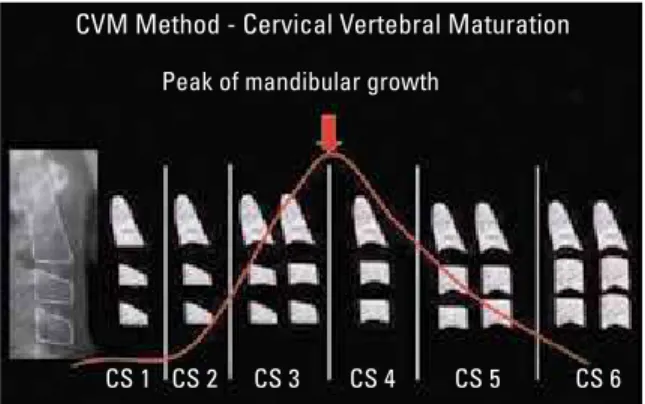
The most remarkable aspect of my work was probably the definition of an optimal time to treat malocclusions of many different types. In general, orthodontists conduct treatments in three dimen-sions (sagittal, transversal and vertical), and my effort was towards showing the importance of a fourth dimension, which is the optimal treatment timing. When treating growing patients, particularly when the objective is to achieve not only orthodontic, but also orthopedic changes, timing may be more signifi-cant than the appliance chosen for the treatment. Optimal timing depends on the skeletal maturation of each individual, which can be accurately
deter-mined by using the CVM method1 (Figs 1 and 2).
Other fundamental areas of my knowledge include the long-term comparison of different types of treat-ment to correct Class II and III malocclusions and transverse deficiencies, as well as the studies and scientific evidence about impacted canines.
Because of the dificulties in controlling man
-dibular growth, which orthodontists still face in the treatment of Class III malocclusions, what, in your opinion, should be further in
-vestigated, taking into consideration that the treatment of Class II malocclusions is more predictable?
Gerson Ribeiro
The results of treatments of Class III malocclu-sions are also predictable, and, in 2004, our study team published a method to predict the success of treatment using rapid maxillary expansion together
with face mask therapy.2 However, regardless of
the type of approach, 20% to 25% of all patients with Class III malocclusion will need orthognathic surgery. It is important to note that, at the same time, early orthopedic intervention will give the surgeon the opportunity to produce a more stable result at the end of growth and reduce the amount of skeletal discrepancy (Fig 3).
FIGURE 1 - Using the cervical vertebral maturation (CVM) method devel-oped by Baccetti T, Franchi L and McNamara Jr.1 in 2005, optimal timing
for changes in mandibular growth is defined. In this case, ideal phases are CS3 and CS4, and the CS5 phase may also be favorable if mandibular protrusion appliances are used.
FIGURE 2 - Using the CVM method, optimal timing for changes in maxil-lary growth is defined. In this case, the ideal phases for treatment are CS1 to CS3.
FIGURE 3 - Discriminating craniometrical measurements to predict success or failure of orthopedic treatment of Class III malocclusion using rapid maxil-lary expansion and face mask therapy in patients 6-10 years of age. After the sum of 3 measures is multiplied by a constant, an individual score is calculated. The cut-off point for this measure is 30; lower values indicate a favorable prognosis, and greater values, a poor prognosis (Baccetti, Franchi and McNamara Jr,2 AJODO 2004).
CVM Method - Cervical Vertebral Maturation
Maxillary growth
craniometric measurements
Calculation of individual score
Co-Goi x 0.3 +
Ba-T-SBL x 0.2 +
Mand.P.–SBL x 0.1 =
Individual score
Ba
Goi Co
T SBL
Me Mand.P
.
pubertal
(Melsen, 1972, 1974; Baccetti et al., 2001) CS 1
CS 1 CS 2
CS 2 CS 3
CS 3 CS 4
CS 4
CS 5
CS 5
Postpubertal Prepubertal
Midpalatal and pterygo-maxillary sutures
Midpalatal and pterygo-maxillary sutures
Open Closed
Pubertal
CS 6
CS 6 Peak of mandibular growth
For the treatment with maxillary expansion, with or without face mask therapy, you al
-ways use bonded, and not banded, expand
-ers. Is there any advantage in that? Marcos Alan Vieira Bittencourt
Not, not really. In the long-term, the effects of the two types of expanders are indistinguish-able, both transversely and vertically. However, the presence of stops may be very helpful when treating occlusal blocks due to tooth interference, such as those due to deciduous canines, in the treatment of transverse deficiencies during mixed dentition. I take the chance here to remind my colleagues that one of the fundamental measures to avoid relapse after rapid maxillary expansion is to keep the expander set passively for at least five months after the screw has been locked.
Today, you are one of the lecturers with the most international reach and engagements in four continents. How do you see contem
-porary orthodontics and what are its future trends? Weber Ursi
Orthodontics is going through a phase that I classify as “schizophrenic”, which we might perceive as either pessimistic or optimistic. The pessimistic view may be associated with the worldwide academic crisis, particularly in the US, where there are fewer professors and researchers willing to dedicate their lives to this specialty. One of the consequences is that we are losing a global perspective of facial growth and its anoma-lies because new professors are only interested in segmented aspects of our profession. Another negative aspect of contemporary orthodontics is the supremacy of commerce in science. Univer-sities have become poorer, and researchers have been weakened; therefore, we have experienced a reverse reality, in which companies dictate or control results, rather than the opposite and sup-posedly proper direction. The optimist aspects include ideas and efforts towards new solutions for old problems. In that sense, some of the best
examples are the trends and possibilities of Class II malocclusion treatment, with new horizons in both orthopedics and surgery. Finally, I would like to highlight the fact that products and protocols in orthodontics follow a cyclic pattern, in which an initial phase of wild enthusiasm is followed by scientific trials and disillusionment that eventu-ally leads to a plateau of reality. This is going on right now for microscrews, self-ligating brackets with low frictional resistance, and 3D imaging. These topics will be less popular in the next five years because they have been excessively valued in the last five years. In contrast, biological aspects applied to diagnosis and treatment planning, such as biomarkers and genetic markers, will replace previous topics in the near future.
You mentioned orthopedic treatment with rapid maxillary expansion and face mask therapy. Are there new promising alterna
-tives for patients with Class III malocclu
-sion?
Marcos Alan Vieira Bittencourt
Today, we clearly understand that Class III is a challenge to orthodontists, and that a high relapse rate may be expected among patients treated dur-ing growth. Therefore, it is extremely important to adopt overcorrection. Recently, some methods have been suggested to increase the effectiveness of treatment results, such as the use of skeletal anchorage for maxillary teeth to enable the use of Class III mechanics. These techniques have varia-tions, as seen in the studies conducted by Wilmes et al,3 Kircelli and Pektas,4 and De Clerck et al.5
However, they are all based on the principle of skeletal anchorage to minimize the dental effects of orthopedic treatment (Fig 4). Moreover, the effects of the use of the face mask may be even greater than those reported so far because they have been recently expanded, as seen in the pub-lication of studies that used alternate maxillary ex-pansion and constriction (Alt-RAMEC) to achieve
In contrast, in case these approaches are not suc-cessful and patients need to undergo orthodontic surgery, some selected patients may benefit from faster treatments by means of early surgery or, also, anticipated benefits, areas in which I be-lieve some centers in Brazil have already gained experience.
How do you see long-term results when comparing your maxillary expansion and protraction method with face mask therapy and the use of skeletal anchorage as pre
-scribed by professor Hugo De Clerck, in the treatment of Class III malocclusions?
Gerson Ribeiro
Long-term results in patients treated with expansion and face mask therapy will be avail-able soon, as the manuscript of a study that we conducted about it has been accepted for publication in AJODO, and postpubertal results have also been published. At the same time, we cannot expect much from the De Clerck protocol in terms of data generation. As far as I know, no prospective studies are underway to collect long-term data for that type of treatment.
Why did orthodontics took so long, when compared to medicine, to adopt a science-based treatment that takes into consider
-ation the growth spurt and the optimal tim
-ing to initiate treatment? Gerson Ribeiro
The fundamental role of the pubertal growth spurt to increase treatment results in Class II malocclusion using functional and orthopedic appliances has been highlighted in international literature since the 1970s. Since 1969, several experimental trials conducted by Petrovic and Stutzmann have drawn attention to the sig-nificant impact of the pubertal growth spurt on the mandible and the final results of Class II malocclusion treatment. This information has been neglected, particularly when functional appliances were introduced in the US as “first
phase” appliances. This has generated misunder-standings and improper treatments until today. I hope our research efforts contribute to bringing orthodontists back in track to analyze optimal timing to initiate treatment in the different types of malocclusion. I often say that adequate timing to treat growing patients may be more important than the type of appliance used in treatment.
Parallel to the studies about orthopedics, you have always dedicated some time to studying dental anomalies and the associa
-tions between them. What characteristic do you consider fundamental for the success of the treatment of impacted canines?
David Normando
Primarily, the ability to avoid canine impac-tion using interceptive treatment. The purpose of treatment is to avoid that a misplaced canine becomes impacted, which may be achieved by molar distalization, maxillary expansion and/or extraction of deciduous canines and, in addition, the use of space maintainers (transmaxillary arch). Using this method, it is possible to “save” FIGURE 4 - The use of Class III mechanics together with skeletal anchor-age, as suggested by De Clerck5 and other authors, produces a more
about 80% of the displaced canines and avoid
their impaction.7 In case surgery is necessary,
one of its main objectives should be not only to achieve orthodontic success, but also to preserve periodontal health. For that purpose, the tunnel technique may be recommended, which ensures that the canine will erupt in the center of the al-veolar ridge, with the gingiva inserted around it.8
How do you see long-term results when comparing your maxillary expansion and protraction method with the use of face mask therapy and beta-titanium intraoral springs, as prescribed by professor Eric Liou, in the treatment of Class III malocclu
-sions? Gerson Ribeiro
The protocol prescribed by Dr. Liou deserves close attention. The limitation of his studies, however, is the use of this approach in the treat-ment of children aged 11 to 13 years, often not the most favorable phase for the orthopedic movement of the maxilla. Moreover, the forces used on permanent teeth may be harmful for the periodontal health of anchorage teeth. Therefore, we have been conducting a RCT in the University of Florence using Alt-RAMEC followed by face mask therapy in children with deciduous or early mixed dentition, at about age 5 to 7 years, in an attempt to act on the prepubertal phases (CS1 and CS2). Preliminary results of this approach seem to be very interesting and effective.
In Brazil, it is relatively common to use func
-tional orthopedic appliances, such as the Bionator and Twin Block. Do you prefer ei
-ther of them? Would you deine an order of effectiveness and eficiency when they are used in the orthopedic treatment of Class II malocclusions?
Marcos Alan Vieira Bittencourt
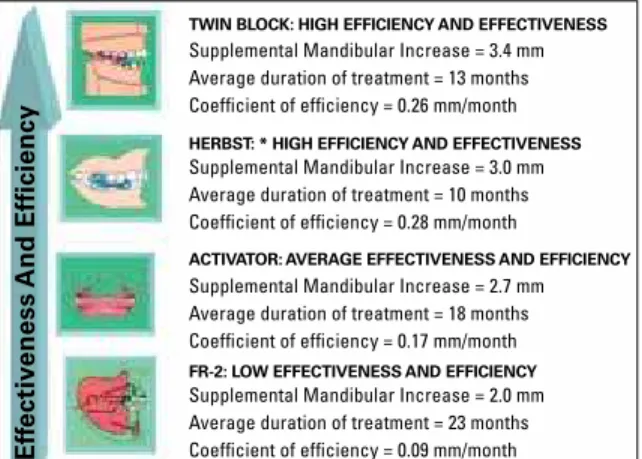
A systematic review conducted by Cozza
et al,9 in 2006 and published in the AJODO
determined an efficiency scale for this type of
treatment (Fig 5). At the bottom of this scale is the use of FR-2, which takes about two years to correct malocclusion and has an effectiveness of about 2 millimeters more than in the control patients. One level above in this scale are the ac-tivators, such as the Bionator, which takes about one year and a half for the correction and which produces an increase of about 2.5 to 3 millime-ters in supplementary mandibular length. And, at the top of the scale, we find Twin Block and Herbst appliances, which produce more than 3 millimeters of mandibular growth during a treat-ment of about one year. Special consideration has been given to the fact that the Herbst does not require patient collaboration, similarly to the Twin Block, which is bonded. According to recent evidence, functional treatments should not be shorter than nine months to achieve true orthopedic changes with a low recurrence rate. We cannot forget to mention that the results of such treatments depend substantially on their timing, as they should initiate during or a little after the growth spurt. Moreover, patients should be carefully selected and should have a balanced
gonionangle(Co-Go-Me<123degrees,orthe
so-called fifth dimension).
FIGURE 5 - Efficiency scale of therapies for Class II treatment according to Cozza et al,9 2006.
TWIN BLOCK: HIGH EFFICIENCY AND EFFECTIVENESS
Ef
fectiv
eness And
Efficiency
Supplemental Mandibular Increase = 3.4 mm
Supplemental Mandibular Increase = 2.0 mm Supplemental Mandibular Increase = 2.7 mm Supplemental Mandibular Increase = 3.0 mm Average duration of treatment = 13 months
Average duration of treatment = 23 months Average duration of treatment = 18 months Average duration of treatment = 10 months Coefficient of efficiency = 0.26 mm/month
Coefficient of efficiency = 0.09 mm/month Coefficient of efficiency = 0.17 mm/month Coefficient of efficiency = 0.28 mm/month HERBST: * HIGH EFFICIENCY AND EFFECTIVENESS
ACTIVATOR: AVERAGE EFFECTIVENESS AND EFFICIENCY
Do you see any sense in separating orthodon
-tics from facial orthopedics as two distinct specialties, a separation currently adopted by the Federal Board of Dentistry in Brazil? José Augusto M. Miguel
The separation of teeth, alveolar bone and skeletal base was created in the 1970s and 1980s for teaching purposes. Almost all our orthodontic interventions have impacts that go beyond teeth and periodontium. Recent systematic reviews showed that there are significant dental effects when func-tional appliances, such as the Herbst, are used, and skeletal mandibular effects have been found with the use of extraoral appliances. To separate specialists to work with orthodontics or orthopedics would be the same as hiring a chef for the entrée only and another for the main course or dessert.
In the studies about the effectiveness and eficiency of orthopedic appliances, how should the group of dropouts be analyzed? David Normando
One of the greatest errors in a prospective or retrospective study is not to include all patients in data analysis. In general, all groups will have cases with better or worse results and with more or less collaboration, which reflects, therefore, the reality of different treatments. In this case, dropouts should be those that do not return to follow-up. In American literature, this is reported as “picking cherries”.
What is your opinion about the unlimited use of protocols based on randomized con
-trolled trials (RCTs)? Aren’t there other methods, less sophisticated but equally use
-ful? Weber Ursi
The concept that studies in orthodontics are not reliable because they are not double-blinded (that is, neither patients or researches know what type of appliance is used) seems to be undue be-cause our specialty does not use pills; it is, rather, an art and a passion, and we provide treatment
to improve function and esthetics. As Sheldon Baumrind said in the past, the general RCT rules in other areas of medicine and pharmacol-ogy are limited for use in orthodontics because the major factor in treatment effectiveness is the sincere conviction of the professionals that they are offering the best that can be offered to that patient. Valid alternatives to classical RCT in orthodontics may be the use of consecutively treated cases compared with adequate control cases, that is, with characteristics that are similar to those of the individuals that receive the treat-ment under study. Moreover, we may also use discrimination analysis to detect borderline cases when comparing different treatment strategies, as described by Paquette et al.10
As you publish with several authors from several countries, what is your opinion about Brazilian orthodontists in the global scenario from both a scientiic and a clinical perspective? Gerson Ribeiro
REFERENCES
Gerson Luiz Ulema Ribeiro
- MSc and PhD in Orthodontics, UFRJ.
- Professor, Graduate and Postgraduate courses, UFSC. - Diplomate, Brazilian Board of Orthodontics and Facial
Orthopedics.
José Augusto M. Miguel
- Specialist in Orthodontics, UERJ. - PhD and MSc in Dentistry, UERJ.
- Associate Professor of Orthodontics, UERJ.
- Coordinator of the Master Course in Orthodontics at UERJ.
David Normando
- Doctor in Dentistry, UERJ. - MSc in Integrated Clinic, FOUSP.
- Specialist in Orthodontics, PROFIS-USP/Bauru. - Professor of Orthodontics at UFPA.
- Coordinator of the Specialization Course in Orthodontics, EAP / ABO-PA.
Weber Ursi
- MSc and PhD in Orthodontics, Bauru, USP. - Chairman - UNESP - São José dos Campos. - Head of the Specialization Program in Orthodontics,
APCD - São José dos Campos, Brazil.
Marcos Alan Vieira Bittencourt
- PhD and MSc in Orthodontics, UFRJ. - Radiology Specialist, UFBA.
- Associate Professor of Orthodontics, UFBA. - Coordinator of the Specialization Course in
Orthodontics, UFBA.
- Diplomate, Brazilian Board of Orthodontics and Dentofacial Orthopedics.
Contact address
Tiziano Baccetti [email protected] 1. Baccetti T, Franchi L, McNamara JA Jr. The Cervical Vertebral
Maturation (CVM) method for the assessment of optimal treatment timing in dentofacial orthopedics. Semin Orthod. 2005;11(3):119-29.
2. Baccetti T, Franchi L, McNamara JA Jr. Cephalometric variables predicting the longterm success of failure of combined rapid maxillary expansion and facial mask therapy. Am J Orthod Dentofacial Orthop. 2004;126(1):16-22.
3. Wilmes B, Nienkemper M, Ludwig B, Kau CH, Drescher D. Early Class III treatment with a hybrid hyrax-mentoplate combination. J Clin Orthod. 2011;45(1):15-21.
4. Kircelli BH, Pektas ZO. Midfacial protraction with skeletally anchored face mask therapy: a novel approach and preliminary results. Am J Orthod Dentofacial Orthop. 2008;133(3):440-9. 5. De Clerck HJ, Cornelis MA, Cevidanes LH, Heymann GC,
Tulloch CJ. Orthopedic traction of the maxilla with miniplates: a new perspective for treatment of midface deiciency. J Oral Maxillofac Surg. 2009 Oct;67(10):2123-9.
6. Liou EJ. Effective maxillary orthopedic protraction for growing Class III patients: a clinical application simulates distraction osteogenesis. Prog Orthod. 2005;6(2):154-71.
7. Sigler LM, Baccetti T, McNamara JA Jr. Effect of rapid maxillary expansion and transpalatal arch treatment associated with deciduous canine extraction on the eruption of palatally displaced canines: a 2-center prospective study. Am J Orthod Dentofacial Orthop. 2011 Mar;139(3):e235-44.
8. Crescini A, Baccetti T, Rotundo R, Mancini EA, Prato GP. Tunnel technique for the treatment of impacted mandibular canines. Int J Periodontics Restorative Dent. 2009 Apr;29(2):213-8. 9. Cozza P, Baccetti T, Franchi L, De Toffol L, McNamara JA Jr.
Mandibular changes produced by functional appliances in Class II malocclusion: a systematic review. Am J Orthod Dentofacial Orthop. 2006 May;129(5):599.e1-12; discussion e1-6. 10. Paquette DE, Beattie JR, Johnston LE Jr. A long-term