VISCOSITY AND QUALITY OF IMAGES OF THICKENED
LIQUID AFTER ADDING BARIUM CONTRAST
FOR SWALLOW STUDIES
Viscosidade e qualidade da imagem do líquido espessado
para videodeofluoroscopia de deglutiçãocom acréscimo
do contraste de bário
Camila Ribeiro Gomide Queiroz (1), Suely Prieto de Barros (1), Hilton Coimbra Borgo (1),
Viviane Cristina de Castro Marino (2), Jeniffer de Cássia Rillo Dutka (1)
(1) Hospital de Reabilitação de Anomalias Craniofaciais da
Universidade de São Paulo, Bauru, SP, Brasil.
(2) Faculdade de Filosoia e Ciências da Universidade Esta
-dual Paulista, UNESP, Marília, SP, Brasil.
Aid source: CAPES Master’s stipend and PROAP-USP funding Conlict of interest: non-existent
exam often determines the need to supply the basic nutritional and necessary hydration through feeding alternatives that may involve the recommendation
for changes in food consistency2. Videoluoroscopy
in Brazil requires the ingestion of food plus a Barium contrast in different consistencies permitting the evaluation of the oral and pharyngeal stages with
greater effectiveness3,4, with maximum accuracy
in capturing2,5 and in the least time of exposure to
radiation6. The contrast used during the exam is
Barium sulfate (BaSO4) at 100%. Its characteristics
are those of an ideal radiological contrast with high radiological density, low viscosity, high luidity, great stability and good adherence to mucosa. Use of the contrast permits a more precise and immediate visualization of the swallowing dynamic before,
INTRODUCTION
Besides being important for explaining the
presence of aspiration or micro aspiration1, the study of swallowing using a radiological technique (Videodeglutogram or Videoluoroscopy of Swallowing) optimizes the identiication of the safest way to feed a patient with dysphagia. The
ABSTRACT
Purpose: study the viscosity of baby formula thickened at the swallow study after adding Barium. Methods: glasses with 200ml of formula were thickened to nectar, honey and pudding consistencies
using seven different thickeners. Mean viscosity was veriied with a viscometer at room temperature and after warming above 40ºC and also after adding Barium contrast at concentrations of 50%, 25% and 12,5%. The prepared formula was exposed to luoroscopy and the images were evaluated regarding visualization of the formula at different consistencies, concentrations of barium and
thickeners. Results: when comparing mean centipoise (cps) measures the viscosity was signiicantly
lower for the temperature above 40ºC than room temperature. When Barium contrast was added to the formula thickened to nectar and to pudding consistencies a signiicant change into honey consistency was veriied. There were no differences in quality of the images between the formula with
Barium concentrations at 50% and 25%. Conclusion: signiicant changes in viscosity of nectar and
pudding can occur after adding Barium to thickened baby formula. Reduction of Barium concentration to 25% did not result in signiicant changes in quality of images. Findings suggest importance of standardization of formula preparation for swallow studies regarding viscosity and concentration of Barium to assure consistency of the exam, prevent incorrect diagnose while optimizing orientation regarding diet modiication in infant with dysphagia.
revealed a signiicant difference in rheological param
-eters between the use of the liquid Barium contrast with thickened baby formula and with anti-relux baby formula. Authors also reported that Barium mixed
with foods alters its natural characteristics6. In the
literature consulted, no standardization of viscosity was found in the formula offered to babies after adding the Barium contrast and thickening agents for
videoluoroscopy 10,14.
In this study’s clinical practice, in the video
-luoroscopy exam run on babies with craniofacial anomalies and swallowing disorders, Barium (Bariogel 100%) diluted to 50% and a thickening agent available at the institution (brands may vary) were used. They were added to the milk used by the child or available at the institution. Standardizing the starting formula in relation to consistency and to the minimum amount of contrast to be used in videoluoroscopy is necessary to guarantee exam reproducibility and to control quality in terms of visualization of the food ingested during the exam. Use of the minimal amount of Barium possible can
avoid changes in lavor and texture of the prepa
-ration, optimizing baby collaboration during the exam. However, reducing the amount of Barium can affect the interpretation of images obtained during luoroscopy leading to an increase in exposure time when new images need to be obtained or resulting in incorrect interpretations of the exam, in this case the penetration or aspiration of the preparation
cannot be observed.
Considering that verifying the relation between Barium dilution and viscosity of the preparation
used in the videoluoroscopy is essential for estab
-lishing the smallest quantity of contrast that can be administered during the exam, and considering that the caretakers should replicate the safest form of food presentation, this study was elaborated with the objectives: to study the viscosity of the thickened starting formula (milk) and to evaluate changes in preparation viscosity and in exam quality after adding the Barium contrast.
METHODS
This study was conducted at the USP Hospital for the Rehabilitation of Craniofacial Anomalies (HRAC/SP) with the approval of the Research Ethics Committee (protocol no. 376/2011 - SVAPEPE-CEP). This is a prospective study that
involved the manipulation of seven brands of thick
-ening agents, three amounts of Barium contrast and a starting baby formula at two temperatures for each of the three consistencies studied (Nectar=N, Honey=M, Pudding=P), as illustrated in Figure The bolus trajectory is visualized in real time and,
thus, use of the contrast optimizes obtaining a high sensitivity and speciicity exam in diagnosing
tracheal aspiration4. And the exam is recorded for
subsequent analysis2,4,7.
Information from the videoluoroscopy plus that obtained from the clinical evaluation of swallowing is essential in investigating oral and pharyngeal
dysphagia4. A care plan can be established based
on the clinical and instrumental indings, including a nutritional plan that aims to avoid caloric-protein malnutrition, dehydration and aspiration pneumonia, translating the results obtained in the exams into nutritious, tasty foods that promote safe swallowing.
Thickening of liquids can promote safer swallowing, because with it the oropharyngeal
transit time can be increased, creating more
cohesive bolus, thus compensating some deicits
in swallowing and reducing the risk of aspiration8,9.
The use of thickeners, in turn, alters food viscosity.
This can be expressed in centipoises (cP) 8,10 and
it offers a physical correlation of consistency for a
given preparation.
Scholars11 observed that infant formulas dissolved
with oat cereals revealed big changes in viscosity compared to formulas thickened with other types of thickeners. It was concluded that the use of different thickening agents can result in a big variation in food viscosity. This information reproduces the literature conirming that the type of thickening agent used affects the viscosity of the liquid in question. Due to the lack of standardization for modiied diets incorporating thickening agents, the American
Dietetic Association (ADA)12, in 2002, established the National Dysphagia Diet (NDD), with a guide for thickened food supplements. The NDD proposes a viscosity index of thin (1-50cP), nectar (51-350cP), honey (351-1750cP) and pudding (>1750cP), thus
creating a standardization13,14.
During videoluoroscopy, selected foods are
combined with the Barium contrast and the thick
-eners. One speciic study15 suggested the need
to standardize the consistencies tested during the videoluoroscopy with the consistencies indicated in
the patients’ nutritional treatment. Another study10
revealed it is possible to offer formulas with repro
-ducible viscosities with and without the Barium contrast, in the radiological evaluation as well as the nutritional therapy, minimizing reproduction failures between evaluation and therapy.
Since videoluoroscopy uses ionizing radiation, it is necessary to optimize the technique adjusting consistency to a minimum amount of the Barium
contrast, permitting a quality image, without inter
formula were prepared at 15% (170 ml of water with 30g of powder) at room temperature, which varied between 21ºC and 26ºC. Then, the thickening agent was added with teaspoons as the measuring unit
for a nectar consistency in the three cups18. After
10 minutes, preparation viscosity was checked in the viscometer (Brookield, model DV-E), according
to the literature index12. Four measurements of
viscosity were made over an average period of 30 minutes after thickening to obtain average viscosity for each cup, because the milk is a non-Newtonian, time dependent and thixotropic liquid that tends to change viscosity during analysis.
After these markings, the preparations were heated in the microwave to a temperature over 40ºC, veriied with a thermometer. The measure of
viscosity was conducted in minutes and the temper
-ature checked again after inal measurement. The same procedure was conducted for all consistencies (N, M, P) and all thickening agents (E1, E2, E3, E4,
E5, E6, E7).
Finally, 100 ml of Barium contrast were added to 100 ml of milk (50%), 50 ml of Barium contrast to 150 ml of milk (25%), followed by 25 ml of Barium contrast to 175 ml of milk (12.5%), at the different consistencies (N, M, P) with viscosity measured again, this time only at temperatures over 40ºC. 1. The thickening agents used and the selected
starting formula are the products used in the video
-luoroscopy on babies with cleft lip and palate and/or other associated anomalies that receive specialized care at the institution of origin.
During the videoluoroscopy exam conducted by a speech pathologist from the Speech Pathology Sector of this hospital, an amount of Barium contrast equal to the amount of formula (diluted to 50%, as used in other centers in the country) is used. This study evaluated the possibility to reduce the amount of Barium contrast added to the formula in the various viscosities and at two temperatures to avoid to the utmost any change in lavor of the milk offered the baby, but maintaining a visible image of
the formula during the exam, without altering prepa
-ration consistency. The experiment was conducted
using dilutions of 25% and 12.5% of contrast,
besides the dilution routinely used at HRAC-USP, which is, 50%.
Seven brands of thickening agents were
tested, named E1, E2, E3, E4, E5, E6 and E7.
Composition E1, E3 and E7 was a modiied starch base and maltodextrin; E2, E4 and E6 were only modiied starch and E5 was xanthan gum. For each of these thickening agents, the test was run in triplicate, that is, three 200ml cups of starting
Preparation of 3 cups of starting formula
Thickengin of formula in Nectar with E1 at temperature between 21-26º C
Measuring viscosity (cps) 4 times in each preparation (average)
R
epl
ic
at
ed
in
H
oney
and
P
uddi
ng
c
ons
is
tenc
ies
R
epl
ic
at
ed
w
it
h
6
thi
c
k
eni
ng
agent
s
E
2
,
E
3
, E
4
,
E
5
, E
6
,
E
7
Heating of preparation over 40º C
Measuring viscosity 4 times (average) before Barium and
after Barium in 3 different dilutions
R
epl
ic
at
ed
af
ter
addi
ng
B
ar
ium
50%
,
25%
,
12.
5%
Syringes prepared with formula in each
dilution, consistency and thickening agent
Obtained scopy and filed agent
Evaluation of image quality presented in computer replicating videodeglutogram
analysis
the average viscosities at the room temperature and at the temperature over 40ºC was shown on a table and compared using the Mann-Whitney statistical
test (p<0.05). Average viscosities for preparations
at the three consistencies with and without Barium
contrast at dilutions to 50%, 25% and 12.5%, at
a temperature over 40ºC, were calculated and shown on tables. The differences in viscosity between with and without Barium conditions and at the three dilutions were established using ADA
values (2002)12 indicating changes in consistency after adding Barium in tables. Speech pathology observations after analysis of syringe images were described in the text.
RESULTS
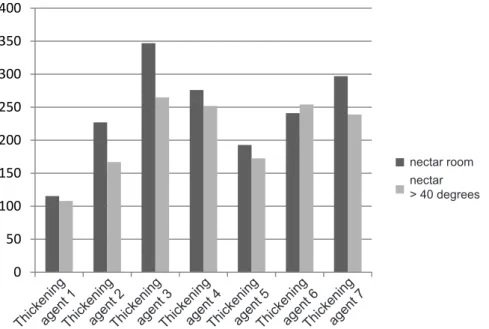
Figures 3, 4 and 5 show the average viscosity values for the three consistencies studied (N, M, P), respectively, with the seven thickening agents (E1, E2, E3, E4, E5, E6, E7) and at the two temperatures
(ambient and over 40ºC). For the majority of thick
-ening agents there was a reduction in viscosity after heating in the three consistencies (as expected) with the exception of thickening agent E6 at the nectar consistency and E4 at the pudding consistency.
Table 1 demonstrates the reduction in viscosity in percentage, as the temperature increased in all conditions, with the exception of N-E6 and P-E4, when there was an increase in viscosity. Table 2 shows results from the Mann-Whitney test
comparing median values in centipoise in the three
consistencies, and two temperatures evaluated, observing that viscosity at the pudding consistency was signiicantly less at the temperature over 40 degrees than at room temperature.
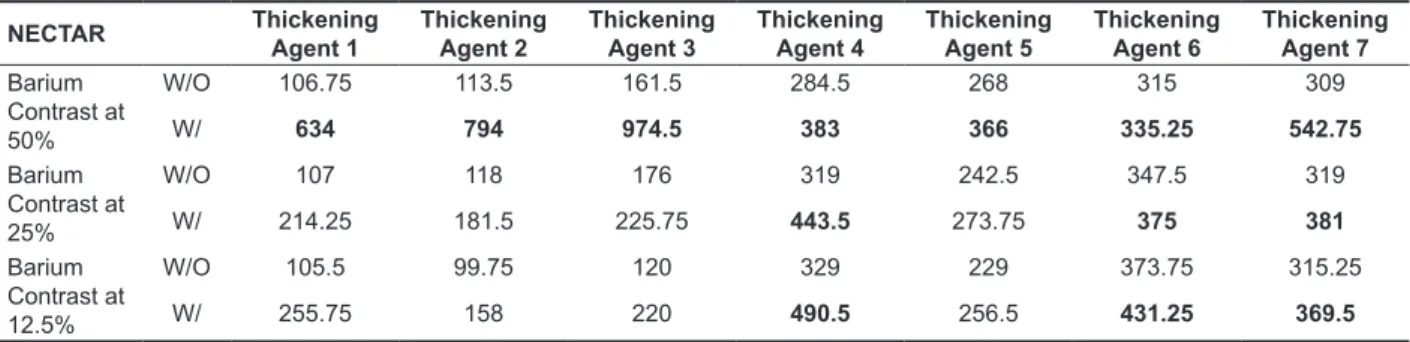
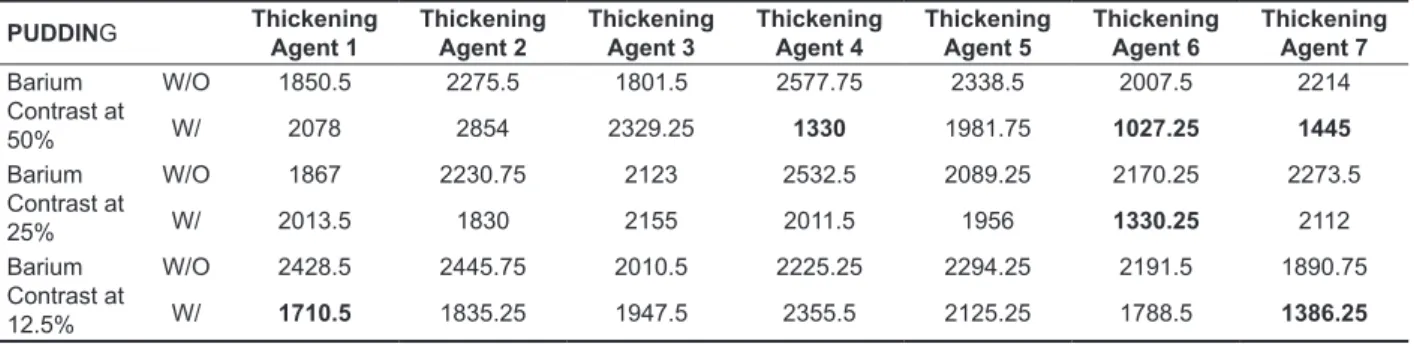
Tables 3, 4 and 5 show average viscosities with and without Barium contrast in the three dilutions
proposed, in the nectar, honey and pudding consis
-tencies, respectively. For interpreting the changes in viscosity after adding Barium, the index suggested
by the ADA (2002)12 was used. It shows the minimum
and maximum extension in centipoise (cP), where nectar is deined as liquids thickened between 51 and 350 cP; honey between 351 and 1750 cP
and pudding over 1750 cP. Variations in desired
consistency above the maximum value or below the minimum value were interpreted as signiicant
changes since another substituted desired consis
-tency. In the nectar and pudding consistencies, a variation in viscosity values suggests a change in consistency with some thickening agents, as indicated in the values in bold in Tables 3, 4 and 5. In the honey consistency, no clinically signiicant change was veriied.
identiied in terms of thickening agent, Barium dilution and consistency used. The investigation did not involve exposure of beings and, the three syringes with the preparations at dilutions to 50% (a), 25% (b) and 12.5% (c) of Barium, at a same consistency and same thickening agent, were positioned temporarily in the radioscopy device’s image intensiier. After identiication and positioning, the syringes were irradiated and the images captured and recorded on DVD by the technician from the HRAC radiology section, under the supervision of the physician and
speech pathologist responsible for the videoluo
-roscopy exams at the institution. Figure 2 illustrates the image obtained after syringe scopy with the preparation at the nectar (N) consistency obtained with thickening agent E1 at Barium dilutions to 50%, 25% and 12.5%. The same image was obtained at consistency N with 6 other thickening agents and the procedure repeated at consistencies M and P for each of the 7 thickening agents at the 3 dilutions. The iled images were presented on a computer screen, as used for interpretation of the videoluoroscopy, and two speech pathologists analyzed the images through visual inspection. Consensually, the speech pathologists indicated whether the preparations in the syringes were visible or not, and if, even visible, there was a difference in image quality among the three Barium dilutions (50%, 25% and 12.5%).
Average viscosity values in the three consis
-tencies tested, at the two temperatures (room temperature and over 40 degrees) and with the seven brands of thickening agents were established
Figure 3 - Average values of viscosities in Nectar consistency at two tested temperatures (room temperature and over 40 degrees) with the seven brands of thickening agents
Figure 4 - Average values of viscosities in Honey consistency at two tested temperatures (room temperature and over 40 degrees) with the seven brands of thickening agents
0 50 100 150 200 250 300 350 400
néctar amb néctar > 40 graus
Thicke ning
agen t 1 Thicke
ning
agen t 2
Thicke ning
agen t 3
Thicke ning
agen t 4 Thicke
ning
agen t 5
Thicke ning
agen t 6 Thicke
ning
agen t 7
nectar room nectar > 40 degrees
0 200 400 600 800 1000 1200 1400 1600 1800
mel amb mel > 40 graus
Thicke ning
agen t 1
Thicke ning
agen t 2
Thicke ning
agen t 3
Thicke ning
agen t 4
Thicke ning
agen t 5 Thicke
ning
agen t 6
Thicke ning
agen t 7
Figure 5 - Average values of viscosities in Pudding consistency at two tested temperatures (room temperature and over 40 degrees) with the seven brands of thickening agents
0 500 1000 1500 2000 2500 3000 3500
pudim amb pudim > 40 graus
Thicke ning
agen t 1 Thicke
ning
agen t 2
Thicke ning
agen t 3
Thicke ning
agen t 4 Thicke
ning
agen t 5
Thicke ning
agen t 6 Thicke
ning
agen t 7
pudding room pudding > 40 degrees
Table 1 - Variation of viscosity in percentage with the increase from room temperature to a temperature over 40ºC with the seven thickening agents at the three consistencies
Thickening Agent 1
Thickening Agent 2
Thickening Agent 3
Thickening Agent 4
Thickening Agent 5
Thickening Agent 6
Thickening Agent 7
Nectar 6% 26.40% 23.60% 8.70% 10.50% 5%* 19.50%
Honey 13.70% 16.20% 15% 20% 8.10% 20.20% 34.40%
Pudiding 27.20% 14% 7% 2%* 8.80% 20.10% 30.50%
* The values illustrate the percentage reduction of viscosity after heating in all conditions except N-E6 and P-E4 when there was an increase in viscosity
Table 2 - Statistical comparison of average viscosities (cP) for the three consistencies at the two tested temperatures
Room.Temp. > 40º C
p Value
Average Average
Nectar 240.9 238.9 0.383
Honey 987.9 861.5 0.383
Pudding 2391 2011.3 0.017*
Mann-Whitney Test * p < 0.05
Table 3 - Average viscosity for the combined preparation at Nectar consistency with and without Barium contrast at 50%, 25% and 12.5% at a temperature over 40ºC
NECTAR Thickening
Agent 1
Thickening Agent 2
Thickening Agent 3
Thickening Agent 4
Thickening Agent 5
Thickening Agent 6
Thickening Agent 7 Barium
Contrast at 50%
W/O 106.75 113.5 161.5 284.5 268 315 309
W/ 634 794 974.5 383 366 335.25 542.75
Barium Contrast at 25%
W/O 107 118 176 319 242.5 347.5 319
W/ 214.25 181.5 225.75 443.5 273.75 375 381
Barium Contrast at 12.5%
W/O 105.5 99.75 120 329 229 373.75 315.25
contrast concentration added to the milk used in the videoluoroscopy. Several factors may affect viscosity, including enzyme degradation and pH of
foods, such as temperature and preparation19. One
study20, in particular, revealed there is a difference in
food viscosity in the nectar and honey consistencies at different temperatures, proving the Arrhenius ratio, in which the increase in temperature generally causes suspensions of gelatinized starches leading to a decrease in viscosity, as in this study for the
majority of thickening agents in the three consis
-tencies. In general, the graphs in Figures 3, 4 and 5 show that, as there was an increase in temperature, viscosity decreased for most thickening agents studied. Only with thickening agent 6 at the nectar consistency (N-E6) and thickening agent 4 at the pudding consistency(P-E4) was there an increase of 5% and 2%, respectively, of viscosity with the increase in temperature. While the reduction in viscosity was expected, its increase goes against
the Arrhenius ratio, since in N-E6 and P-E4 condi
-tions, heating led to the swelling of granules of starch and they gelatinized more, differing from the expected.
Thickening agents available in Brazil (and, therefore, tested in this study) are mostly modiied starch with or without the addition of maltodextrin, After analysis of the syringe images in the various
conditions established, the speech pathologists indicated that the visualization of the preparations diluted to 25% was very similar to that observed with the dilution at 50%. With the dilution at 12.5%, it was also possible to visualize the preparation, however, there was dificulty due to image quality (lighter tone), as reported by the speech pathologists.
DISCUSSION
Despite the frequent number of studies showing the importance of videoluoroscopy in studying
swallowing4,5,10,14,17,19 the literature is limited to
studies showing the standardization of the amount of Barium contrast added to baby formula used in these exams in babies. In several countries, there is already a standardization of Barium at diverse consistencies for foods used in exams on adults. The
amount of Barium is important for obtaining good
image resolution during scopy, but it could affect
food lavor and viscosity10,14,15,17 This study shows
viscosity values for a thickened starting formula (milk) at nectar, honey and pudding consistencies, at two temperatures and with seven thickening agents. The indings reveal there may be a change in viscosity values depending on temperature and
Table 4 - Average viscosity for the combined preparation at Honey consistency with and without Barium contrast at 50%, 25% and 12.5% 40ºC
HONEY Thickening
Agent 1
Thickening Agent 2
Thickening Agent 3
Thickening Agent 4
Thickening Agent 5
Thickening Agent 6
Thickening Agent 7 Barium
Contrast at 50%
W/O 982.5 559 513 938 1084 850.5 913.5
W/ 707.25 830.25 1199 890 1085 570 809.75
Barium Contrast at 25%
W/O 647.75 730.5 638 1251 1042.5 810 1042.5
W/ 689.25 921.5 704 1296 970.5 947 989.5
Barium Contrast at 12.5%
W/O 470 981 476 1355.75 1208.5 1030 1117
W/ 440.5 1261 718 1334.25 1108.75 1027.5 1097.75
Table 5 - Average viscosity for the combined preparation at Pudding consistency with and without Barium contrast at 50%, 25% and 12.5% 40ºC
PUDDING Thickening
Agent 1
Thickening Agent 2
Thickening Agent 3
Thickening Agent 4
Thickening Agent 5
Thickening Agent 6
Thickening Agent 7 Barium
Contrast at 50%
W/O 1850.5 2275.5 1801.5 2577.75 2338.5 2007.5 2214
W/ 2078 2854 2329.25 1330 1981.75 1027.25 1445
Barium Contrast at 25%
W/O 1867 2230.75 2123 2532.5 2089.25 2170.25 2273.5
W/ 2013.5 1830 2155 2011.5 1956 1330.25 2112
Barium Contrast at 12.5%
W/O 2428.5 2445.75 2010.5 2225.25 2294.25 2191.5 1890.75
thickening agents, with the exception of E6. Even with the E6 thickening agent, the viscosity found was very near the maximum limit of 350 cP for the nectar category, which places the preparation with this thickening agent almost at a “thin honey or thick nectar” category. In the same dilutions of Barium, still in the nectar consistency, the changes in consistency occurred at a smaller number; however, always revealing an increase in viscosity, especially
for E4, E6 and E7, at a dilution of 25% and 12.5%,
where once again the preparation in nectar consis
-tency became honey after adding Barium. When
pudding consistency was tested, there was a sufi
-cient reduction in viscosity to change the pudding to honey in thickening agents E4, E6 and E7 diluted
at 50%, E6 diluted at 25% and E1 and E7 diluted
at 12.5%. In other words, signiicant changes in thickened liquid consistency occur with the addition of Barium, especially diluted at 50%.
Seeking to relect on the possibility of reducing Barium dilution in preparations for videoluoroscopy,
images with the thickened liquid in various consis
-tencies and dilutions were analyzed by two speech pathologists experienced in conducting the exam.
There was no dificulty in visualizing the prepara
-tions with the Barium dilution at 25%; however, the professionals questioned whether the dilution at 12.5% could make the preparation resolution closer to the resolution of soft tissues, complicating the
interpretation of the exam, particularly the identii
-cation of aspiration of small quantities of material.
Considering that use of the contrast has the objective of optimizing exam interpretation, it is important to consider that reductions in Barium dilution should be studied by the team in charge of the exam, since various factors can affect the image obtained. For example, device age has a direct relation on image quality and certainly will affect the quantity of Barium used by a given team. Maintenance of thickened liquid consistency and adjustment of the best Barium dilution for a given machine can be optimized on a multidisciplinary team where the speech pathologist, the nutritionist, the physician and the radiology technician together assume the role of caring for exam quality and accuracy.
The indings of this study with the data reported in literature suggest the importance of speciic care with the consistency of preparations for conducting the videoluoroscopy and for orienting caretakers, particularly after recommending modiied diets. The elaboration of an instructions manual for thickening liquids with Barium can improve management of patients at risk for aspiration.
them more stable. However, even with varied compo
-sitions (only modiied starch, starch and malto
-dextrin, xanthan gum and maltodextrin) the tested thickening agents revealed variations in viscosity with an increase in temperature. Thickening agents E1, E3, E7 are modiied starch and maltodextrin, the E2, E4 and 6 are only modiied starch, and E5 is xanthan gum, the only one in the three consistencies to maintain a more constant variation in viscosity (ranging from 8.1% to 10.5%). Thickening agents E4 and E6 in this study, particularly, are made only with modiied starch, without maltodextrin, and the unexpected indings of an increase in viscosity after
an increase in temperature need to be better
inves-tigated in a study that allows greater control of the thickening agent composition.
In one study21, starch-based thickening agents
were observed to have time-dependent behavior, because there is a decrease in viscosity between 1 and 4 hours after food preparation. Thickening agents with maltodextrin did not present any decrease in viscosity and the luid becomes thicker 30 minutes after preparation. Thus, this type of thickening agent is considered more consistent and stable with time when compared to starch-based thickening agents.
In another study17thickened cow milk-based infant
formula presented 1.3 times less viscosity when
cooled naturally for 30 minutes. Another study20
also reported that in 2% milk, thickening agents behave a little differently from other liquids tested (water and juice), because it contains fats that can interfere in starch granulation. As explained in the referred study, at low temperatures, the fat molecule is in its solid state and it can create blocks of space in the starch structure, swelling it less and reducing viscosity.
Table 2 shows the average viscosities in the three consistencies tested indicating statistical signiicance when comparing indings for the pudding consistency at the two temperatures. Although the increase in temperature causes a statistically signiicant reduction in viscosity in the pudding consistency, after heating the preparation, it still maintained the viscosity values within the extension stipulated in literature for the consistency
in question12. However, clinically, changes of up to 30% in viscosity with the change in temperature, as illustrated in Table 1, may require some care in preparing the recommended thickened diet, since the thickened liquids are part of a broad category, and that small changes in viscosity can cause
changes in swallowing22.
and the reduction in viscosity from pudding also to honey. The most frequent changes were with
Barium diluted to 50% and with some types of thick
-ening agents. The images obtained diluting Barium to 25% provided similar quality to those obtained with the dilution at 50%.
CONCLUSION
Analysis of indings reveal signiicant changes in preparing milk and Barium with the increase in nectar viscosity to the point of making it honey
RESUMO
Objetivos: estudar a viscosidade da fórmula de partida espessada para os exames de videoluoros -copia de deglutição após acréscimo de contraste de Bário. Métodos: copos de 200 ml de leite foram
preparados em três consistências com sete espessantes. A viscosidade média foi veriicada com viscosímetro nas temperaturas ambiente e acima de 40ºC, e após acrescentar o contraste de Bário em diluições a 50%, 25% e 12,5%. Os preparados foram expostos à luoroscopia para obtenção de imagens que foram avaliadas quanto à visualização do preparado nas diferentes consistências,
diluições e espessantes. Resultados: comparando valores médios em centipoise(cP), observou-se
que a viscosidade na consistência pudim foi signiicantemente menor na temperatura acima de 40ºC do que na temperatura ambiente. Nas consistências néctar e pudim o acréscimo de Bário resultou em mudança signiicante da viscosidade para mel. Não houve mudança na qualidade das imagens
entre as diluições de Bário à 50% e 25%. Conclusão: o acréscimo do Bário resulta em mudanças nos
valores de viscosidade que afetaram a consistência do preparado espessado para néctar e pudim. Uma redução da diluição do contraste para 25% não resulta em mudança clinicamente signiicante na qualidade da imagem. Os achados sugerem a importância da padronização do preparado para a luoroscopia em relação à viscosidade e diluição do Bário visando garantir a reprodutibilidade do exame, prevenir falhas diagnósticas e otimizar as orientações para modiicações da dieta na disfagia
orofaríngea infantil.
DESCRITORES: Deglutição; Transtornos da Deglutição; Bário; Viscosidade; Fluoroscopia.
REFERENCES
1. Alnassar M, Oudjhane K, Davila J. Nasogastric tubes and videoluoroscopic swallowing studies in children. Pediatr Radiol. 2011;41(3):317-21.
2. Gonçalves MIR, Vidigal MLN. Avaliação
videoluoroscópica das disfagias. In: Furkim AM,
Santini CS. Disfagias Orofaríngeas. Carapicuíba: Pró Fono; 1999. P.189-95.
3. Pikus L, Levine MS, Yang Y, Rubesin SE, Katzka DA, Laufer I et al. Videoluoroscopic studies of swallowing dysfunction and the relative risk of
pneumonia. AJR. 2003;180(6):1613-6.
4. Anéas GCG, Dantas RO. A videoluoroscopia
da deglutição na investigação da disfagia oral e
faringeana. GE J Port Gastrenterol. 2014. Ahead of
5. Rofes L, Arreola V, Almirall J, Cabré M, Campins L, Garcia-Peris P et al. Diagnosis and management
of oropharyngeal dysphagia and its nutritional
and respiratory complications in the elderly.
Gastroenterol Res Pract. 2011;(1):1-13.
6. Ko MJ, Kang MJ, Ko KJ, Ki YO, Chang HJ, Kwon JY. Clinical Usefulness of Schedule for Oral-Motor Assessment (SOMA) in Children with Dysphagia. Ann Rehabil Med. 2011;35(4):477-84.
7. Costa MMBC, Nova JLL, Canevaro LV.
Efeito da iltração adicional nas doses de
radiação e na qualidade das imagens nos
exames videoluoroscópicos. Radiol Bras.
2009;42(6):379-87.
8. Pagno CH. Desenvolvimento de espessante alimentar para líquidos com valor nutricional agregado, destinados a indivíduos disfágicos.
[dissertação]. Porto Alegre (RS): Instituto de Ciência
em Tecnologia e Alimentos, Universidade Federal do Rio Grande do Sul; 2009.
9. Hanson B, Cox B, Kaliviotis E, Smith CH. Effects of saliva on starch-thickened drinks with acid and neutral pH.Dysphagia. 2012;27(3):427-35.
10. Costa MMB, Almeida JT, Sant’Anna E,
interjudge reliability using a free and directed search. Dysphagia. 2012;27(1):53-63.
17. Cichero J, Nicholson T, Dodrill P. Liquid Barium is not representative of infant formula: characterization of rheological and material properties. Dysphagia.
2011;26(3):264-71.
18. Barros SP, Manzano FM, Silva LBC. Manual de receitas para disfágicos. São Paulo: Scortecci; 2010.
19. Souza BB, Martins C, Campos DJ, Balsini
I, Meyer LR. Nutrição & Disfagia: guia para proissionais. Curitiba: Nutroclínica; 2003.
20. Garcia JM, Chambers IV E, Matta Z, Clark M. Serving temperature viscosity measurements of néctar and honey thick liquids. Dysphagia.
2008;23(1):65-75.
21. Sordi M, Mourão LF, Silva LBC. Comportamento reológico e nomenclatura dos alimentos utilizados por fonoaudiólogos de serviços de disfagia. Rev CEFAC. 2012;14(5).925-32.
22. Dewar RJ, Joyce MJ. Time-dependent rheology of starch thickeners and the clinical implications for dysphagia therapy. Dysphagia. 2006;21(4):264-9. therapy of dysphagic patients. ArqGastroenterol.
2007;44(4):297-303.
11. Stuart S, Motz JM. Viscosity in infant dysphagia management: comparison of viscosity of thickened liquids used in assessment and thickened liquids used in treatment. Dysphagia. 2009;24(4):412-22.
12. American Dietetic Association (ADA), National
Dysphagia Diet Task Force. National Dysphagia Diet: Standardization for Optimal Care. Chigago,
2002.
13. Garcia JM, Chambers IV E, Matta Z, Clark M. Viscosity measurements of néctar and honey-thick liquids: product, liquid and time comparisons. Dysphagia. 2005;20(4):325-35.
14. Strowd L, Kyzima J, Pillsbury D, Valley T, Rubin Br. Dysphagia dietary guidelines and the reology of nutritional feeds and barium test feeds. Chest.
2008;133(6):1397-401.
15. Glassburn DL, Deem JF. Thickener viscosity in dysphagia management: variability among
speech-language pathologists. Dysphagia.
1998;13(4):218-22.
Received on: February 20, 2014
Accepted on: September 02, 2014
Mailing address:
Camila Ribeiro Gomide Queiroz
Rua Sílvio Marchione 3-20
Bauru – SP – Brazil CEP: 7012-900