320
ANALYSIS OF TECHNICAL LOSSES IN ELECTRICAL POWER
SYSTEM (NIGERIAN 330KV NETWORK AS A CASE STUDY)
M. C. Anumaka
Department Of Electrical Electronic Engineering, Faculty of Engineering, Imo State University, Owerri, Imo State, Nigeria
Email: [email protected]
ABSTRACT
In recent year, electric power demand has increased drastically due to superiority of electric energy to all other forms of energy and the expansion of power generation and transmission has been severely limited sequel to limited resources, environmental restrictions and lack of privatization as can be found in the developing countries of the world like Nigeria, Togo, India, etc.
No matter how the power system is designed, losses are unavoidable and must be modeled before accurate representation can be calculated. This paper focuses on the mathematical analysis of losses that occur in electric power system. The Depezo loss formula, loss factor, use of system parameters for evaluating the system losses, the differential power loss and power flow methods are explicitly illustrated. The B-losses coefficient, which expresses the transmission losses as a function of outputs of all generation, is also explained.
Keywords: Dopazo Formula, B-losses co-efficient, System parameters, Loss factor.
1. INTRODUCTION
The Nigerian power system network, like all other power system, waves about the entire country and it is by far the largest interconnection of a dynamic system in existence to date. No matter how carefully the system is designed, losses are present. Electric power losses are wasteful energy caused by external factors or internal factors, and energy dissipated in the system [6, 8, 10]. They include losses due to resistance, atmospheric conditions, theft, miscalculations, etc, and losses incurred between sources of supply to load centre (or consumers). Loss minimization and quantification is very vital in all human endeavour. In power system, it can lead to more economic operation of the system. If we know how the losses occur, we can take steps to limit and minimize the losses . Consequently, this will lead to effective and efficient operation of the system. Therefore, the existing power generation and transmission can be effectively used without having the need to build new installations and at the same time save cost of losses.
Basically, losses in electrical power system can be identified as those losses caused by internal factors known as Technical losses and those cause by external factors are called non-technical losses.
The Nigerian electricity grid has a large proportion of transmission and distribution losses - whopping 40%. This is attributed to technical losses and non-technical losses. Due to the size of the area the power system serves, the majority of the power systems are dedicated to power transmission.
Generally, system losses increase the operating cost of electric utilities and consequently result in high cost of electricity.
Therefore, reduction of system losses is of paramount importance because of its financial, economic and socio-economic values to the utility company, customers and the host country. However, low losses in transmission system could be achieved by installing generating stations near the load centers.
2. ANALYSIS OF TECHNICAL LOSSES IN POWER SYSTEM
Losses in electrical system can be determined in different ways. Electric technical losses occur as current flows through resistive materials and the magnetizing energy in the lines transformers and motors. However, the losses incurred in resistance materials can be reduced by adopting the following means [1] .
a. Reducing the current
b. Reducing the resistance and the impedance c. Minimizing voltages.
Electrical power system losses can be computed using several formulae in consideration of pattern of generation and loads, [2] by means of any of the following methods:
321 4. Analyzing system parameters
5. By using B-loss coefficient formula 6. Load flow simulation
3. COMPUTATION OF I2R
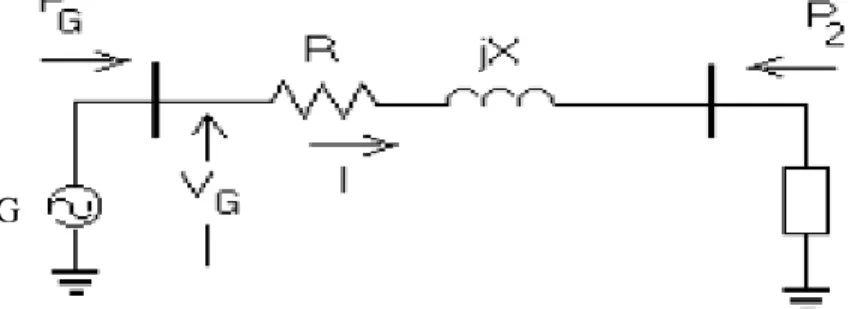
Let us consider a simple three-phase radial transmission line between two points of generating/source and receiving/load as illustrated in one line diagram of fig. 1.0, comprising the generated power PG, line resistance , reactive jx and the load.
Figure 1.0: one line diagram with one generation and one load We can deduce that the line loss is
I2R ………(1)
where I = the current
R = Resistance of the conductor In 3 phase,
Where;
R is the resistance of the line in ohms per phase. The current I can be obtained thus:
Where;
PG is the generated power (load power and losses)
VG is the magnitude of the generated voltage (line-to-line)
cosΦG is the generator power factor
Combining the above two equations, we have:
Assuming fixed generator voltage and power factor, we can write the losses as:
where in this case
4. USING B-LOSS COEFFICIENT
Losses are thus approximated as a second order function of generation. If a second power generation is present to supply the load as shown in Figure 2.0, we can express the transmission losses as a function of the two plant loadings
--- (3)
--- (2)
--- (4)
G
--- (5)
322
Figure 2.0 radial systems with one additional generation to load bus Losses can now be expressed by the equation:
Where B = the loss coefficients.
Transmission losses become a major factor to be considered when it is needed to transmit electric energy over long distances or in the case of relatively low load density over a vast area. The active power losses may amount to 20 to 30 % of total generation in some situations [3].
In industrial system the losses are made up of complex combination system of fixed (core and corona) and variable (I2 dependent) losses.
Thus PL = B0 + B1PG2
where;
B0 represents fixed loss
B1 represent variable loss
PG is the generated power
Thus, the calculation of B-loss coefficientsis morecomplex in large industrial systems.
5. DIFFERENTIAL POWER LOSS METHOD
Power loss can also be expressed as the difference between the transmitted power and received power. i.e. Ploss = PowerSent– PowerReceived
The relationship between the power sent, power received and associated losses in the power system is illustrated in fig 3.0
P
sent preceiveFig. 3.0 The relationship between power sent and power received The efficiency of transmission = [4] is given as efficiency,
ɳ = Power received (per unit value) ………..(10)
Power sent = Power sent-power loss in line Power sent = 1 – Power loss in line………..(11)
Power sent = 1 – 2I2R (2 wire system)……….(12)
--- (7)
--- (9)
--- (8)
323 V1 (power sent)
As in [5]
Efficiency ɳ in transmission =
P
outI
–
P
lossP
sent
P
receiveP
sent+ P
lossP
sent+ P
loss6. COMPUTATIONS OF LINE FLOWS
Computation of power losses given as in [6]. Fig. 4.0 shows a line connecting ith and kth buses. Here we assume the normal
representation of transmission line current flowing from bus i towards bus kWhere
V
i andV
k are the bus voltages at the buses i and k respectively. The power flow in the line i-k at bus i is given as
* *
* * 0...(
15
)
*
ik i i yik k i i
ik i
ik ik ik
y
V
V
V
V
V
I
V
Q
P
S
Similarly, the power flow in the line i-k at the bus k is given as
*0 * *
*
ki k k ik i k k
ki
V
V
V
y
V
V
y
S
….. (16)Thus power flows over all the lines can be computed.
In (i-k)th lines the power losses are given by sum of the power flows determined from above equations (15) and (16) this implies that power losses in the (i-k) line =
S
ik
S
ki.
Total transmission losses can be computed by summing all the line flows(
i
.
e
.,
S
ik
S
kifor
all
i
,
k
).
Also, the slack bus power can also be determined by summing the power flows on the lines terminating at the slack bus.
7. DOPEZO TRANSMISSION LOSS FORMULA
In [7], Dopezo et al. have derived an exact formula for calculating transmission losses by making use of the bus powers and the system parameters. Let
S
i be the total injected bus power at bus i and is equal to the generatedik
y
0
ik
y
y
ki0i
BUS
BUS
k
0
.
4
.
Re
Fig
Buses
Two
Between
Line
a
of
on
presentati
i k
ik iyik0...
...(
14
)
ikV
V
y
V
I
324
power minus the load at bus i. The summation of all such powers over all the buses gives the total losses of the system, i.e. * * 1 1 bus T bus i n i i n i i L
L
jQ
S
V
I
V
I
P
………(17)
Here
P
LandQ
L are the real and reactive power loss of the system.V
bus andI
bus are the column vectors of voltages and currents of all the buses,Now
V
bus
Z
busI
bus …….(18)Where
Z
bus is the bus impedance matrix of the transmission network and is given by
nn n n n i n nn n n n i n busr
x
x
x
x
x
x
x
x
j
r
r
r
r
r
r
r
r
r
jX
R
Z
2 1 2 22 2 1 12 11 2 1 2 22 2 1 12 11From equations (17) and (18)
* bus T bus T bus L
L
jQ
I
Z
I
P
* bus T bus T
bus
Z
I
I
…………..(19)From last step can be written because
Z
bus is a symmetric matrix and, therefore,b u s T
b u s
Z
Z
The bus current vector
I
buscan also be written as the sum of a real and reactive component of current vectors, i.e., qn q q pn p p q p bus I I I j I I I jI I I 2 1 2 1
The equation for the loss can be written as
T
p q
q p
L
L
jQ
I
jI
R
jX
I
jI
P
Separating out the real part
P
L from the above matrix product, we gotp T q q T q q T P P T P
L
I
RI
I
XI
I
RI
I
XI
P
Since X is a symmetric matrix,
p T p q
T
p
XI
I
XI
I
Hence
P
L
I
TpRI
p
I
qTRI
q …..(20)This expression (20) can be rewritten by using index notation as
n k i qk qj pk pj jkL
r
I
I
I
I
P
1 1…... (21)
From the above the transmission loss has been expressed in terms of bus currents. Since the power plant, the bus powers and the nodal voltages are known by the system operators. Therefore, it is more practical to express
P
L in terms of these quantities.For bus powers at bus I we have,
pi qi
i
i i
pi qi
i i
i i
i
jQ
V
I
V
I
jI
V
j
I
jI
P
*
cos
sin
325
i qi i pi i i
i
V
I
V
I
P
cos
sin
and
Q
i
V
iI
pisin
i
V
iI
qicos
iSolving for
I
piandI
qi' we get
i i i i
i
pi
P
Q
V
I
1
cos
sin
i i i i
i
qi
P
Q
V
I
1
sin
cos
We have expressed here the real and imaginary components of bus currents in terms of bus powers and the bus voltages.
8. LOSS FACTOR APPROACH
For economic reasons, the conductor size should be considered. The most economic conductor size can be calculated considered by application of Kelvin’s law. The current in the feeder is at the maximum value only at certain times. At all other times the current is less than the maximum current and it is necessary to use a factor to account for this fact.
Loss factor is defined in [7] as
load peak at loss power
powerless average
factor
Loss ………(22)
The actual power loss is
Loss = 3
I
max
2R
(loss factor)If the load is constant throughout, the loss factor is one. In actual practice the load varies with time of the day. If the actual load curve is known, the loss factor can be calculated. An approximate value of loss factor can be found from the following equation [7]
Loss factor = (0.3 × Load factor) + (0.7) (Load factor) 2 Where the load factor is the ratio of average load to peak load.
9. SYSTEM PARAMETERS
When current flows in a transmission line, the characteristics exhibited are explained in terms of magnetic and electric field interaction. The phenomenon that results from field interactions is represented by circuit elements or parameters. A transmission line consists of four parameters which directly affect its ability to transfer power efficiently [7, 8, 9, 10, 15]. These elements are combined to form an equivalent circuit representation of the transmission line which can be used to determine some of the transmission losses.
10. SHUNT CONDUCTANCE
The parameter associated with the dielectric losses that occur is represented as a shunt conductance. [11] Conductance from line to line or a line to ground accounts for losses which occur due to the leakage current at the cable insulation and the insulators between overhead lines. The conductance of the line is affected by many unpredictable factors, such as atmospheric pressure, and is not uniformly distributed along the line. [12, 6] The influence of these factors does not allow for accurate measurements of conductance values. Fortunately, the leakage in the overhead lines is negligible, even in detailed transient analysis. This fact allows this parameter to be completely neglected.
11. RESISTANCE
The primary source of losses incurred in a transmission system is in the resistance of the conductors. For a certain section of a line, the power dissipated in the form of useless head as the current attempts to overcome the ohmic resistance of the line, and is directly proportional to the square of the rms current traveling through the line (I2R) [6]. In dc [13] resistance of conductor is given by
R = pl a
Where p = resistivity of the conductor Ω –m, l = length in meter
326 a = cross sectional area in m2
Change in temperature also affects the line resistance for small changes in temperature, the resistance increases linearly with temperature and resistance at a temperature t is given as
Rt = R0(1 + α0t)………(24)
Where Rt = resistance at t0C
R0 = resistance at 0C
α0 = temperature coefficient of resistance 0C
the temperature increase between two intermediate temperature is
R
2R
1Where: R1 = 1st resistance
R2 = 2
nd
resistance
α = temperature coefficient t1 = 1st temperature
t2 = 2nd temperature
Also, in (8, 9) the temperature difference can be found using
R
2
R
1R2 = R1
T and α0 = constant temperature that depends on the material.
It directly follows that the losses due to the line resistance can be substantially lowered by raising the transmission voltage level, but there is a limit at which the cost of the transformers and insulators will exceed the savings. [14]
The efficiency of a transmission line is defined as
P
RP
RPs P
R+ P
LossWhere PR is the load power and PL is the net sum of the power lost in the transmission system.
As the transmission dissipates power in the form of heat energy, the resistance value of the line change. The line resistance will vary, subject to
Maximum and minimum constraints. In a linear fashion. If we let R be the resistance at some temperature, T1, and
R2 be the resistance at time T2, then
235 + T
2235 + T
1If T1 and T2 are given in degrees Centigrade. [12]
12. CAPACITANCE
The capacitance of a transmission line comes about due to the interaction between the electric fields from conductor to conductor and from conductor to ground. The alternating voltages transmitted on the conductor causes the charge present at any point along the line to increase and decrease with the instantaneous changes in the voltages between conductors or the conductors and ground. This flow of charge is known as charging current and is present even when the transmission line is terminated by an open circuit [8].
13. INDUCTANCE
When the alternating currents present in a transmission system they are accompanied by alternating magnetic fields the lines of force of the magnetic fields are concentric circles having their center’s at the centre of the conductor and are arranged in planes perpendicular to the conductors. The interaction of these magnetic fields between conductors in relative proximity creates flux linkage. These changing magnetic fields induce voltages in parallel conductors
1 + αt
21 + αt
1=
1/α
0+ t
21/α
0+ t
1=
T + t
2T + t
1x
=
ŋ
=
(27)
………..(28
)
R
2= R
1………(25)
327
which are equal to the time rate of change of the flux linkages of the line. [8] This voltage induced is also proportional to the time rate of change of the current flowing in the line and it is given as
dλ dλ di L di dt di dt dt
Where λ = the number of flux linkages, in weber-turns,
dλ = inductance in henrys. di
If the flux linkage vary linearly with current,
L = λ, H I
If the current is sinusoidal, having r.m.s value I, the flux linkages are also sinusoidal and of r.m.s value Ψ then the inductance is given as
L = , H
Due to the relative positioning of the lines, the mutual coupling will cause voltages to be induced. The induced voltage will add vectorally with the line voltages and cause the phases to become unbalanced. When a three phase set is unbalanced the lines do not equally share the current. Looking at only the simple resistive losses in the circuit, and recalling that the power loss is directly proportional to the square of the magnitude of the current flowing in the line, it is easy to see that the losses in one line will increase significantly more than the reduction of losses in the other lines. These suggest that a simple way to minimize the total 12R losses is to maintain a balanced set of voltages. A second note is that the mutual coupling also increases the total line reactance. The line reactance further adds to the loses because it affects the power factor on that line.
The affect of this mutual coupling is often reduced by performing a transposition of the transmission lines at set intervals. [12] The transposition governs the relative positioning of the transmission lines. Each phase is allowed to occupy a position, relative to other two phases, for only one third of a distance. When the phases are rotated their position, relative to one another, changed. By proper rotation of the lines, a net effect of significantly reduced, the mutual inductance is realized. The actual phase transposition usually does not take place between the transmission towers. A certain safe distance must be maintained between the phases and, because of the difficulty in maintaining the required distances between the phases, transposition is most likely to take place at a substation.
14. CONCLUSION
Different methods can be used to compute the value of technical losses dissipated in the electrical power system depending on the situation and purpose. Although the 12R method is frequently used for determining the power loss, but it may not augur well for the industrial situations that involve complex losses. So, the B-loss coefficient and Depazo methods can be used to obtain dependable results.
REFERENCES
[1]. D. Lukman, K. Walsh and T. R. Blackburn, “Loss minimization in industrial power system operation. www.itee-Uq.edu.au/aupec/00/lukmanoo.pdf.2002
[2]. B. J. Cory “Electric Power Systems, John Wiley & Sons Sussex, England.
[3]. J. D. Glover, M. S. Sarma, T. J. Overbye and N. P. Pasly, “Power System Analysis and Design” Cangage Learning, United State, 2001.
[4]. A. Symonds “Electrical Power Equipment and Measurement”, McGraw-Hill, St. Louis, 1981.
[5]. O. S. Onohaebi and P. A. Kuale “Estimation of Technical Losses in the Nigerian 330kv Transmission
Network”. International Journal of Electric Engineering Vol 1(4) 402 – 409, 2007. [6]. J. B. Gupta, “A course in power systems. S. K. Kataria & Sons, New Delhi, 2008.
[7]. Depazo et al “An optionization technique for real and reactive power allocation, Proc. IEEE. Nov, 1967. [8]. B. R. Gupta “Power system analysis and design. S. Chand, New Delhi, 2007.
[9]. H. Sadat, “Power system analysis. Mc-Graw-Hill. New Delhi, 2005.
[10]. C. L. Wadwah “Electric Power System” Chennai, New Age International. Publisher Ltd, 2006. [11]. Zaborszky & Rittenhouse “Electric Power Transmission”. New York, 1969.
[12]. W. D. Sterenson Jr. “Elements of Power System Analysis”. Fourth Edition. New York. 1982. [13]. E. L. Donnelly “Electrical Installation theory and Practice. Sixth Ed. Harrap Ltd. London.
[14]. Westing Electric Corp. “Transmission and Distribution Reference. Fourth Edition. New York. 1982. [15]. V. K. Mehta and R. Mehta “Principles of Power System. S. Chand, New Delhi, 2004.
[16]. PHCN Generator Control Centre Oshogbo, 2005. Generation and Transmission Grid Operation. Annual Technical Report for 2004.