117
Communication/Comunicação
Revista da Sociedade Brasileira de Medicina Tropical 45(1):117-119, jan-fev, 2012
1. Faculdade de Medicina, Universidade do Sul de Santa Catarina, Tubarão, SC. 2. Grupo de Pesquisa em Pneumologia e Semiologia, Universidade do Sul de Santa Catarina, Tubarão, SC. 3. Unidade de Pesquisa em Virologia, Universidade do Sul de Santa Catarina, Tubarão, SC. 4. Centro de Pesquisa em Virologia, Faculdade de Medicina, Universidade de São Paulo, Ribeirão Preto, SP. 5. Programa de Pós-Graduação em Imunologia Básica e Aplicada, Faculdade de Medicina, Universidade de São Paulo, Ribeirão Preto, SP. 6. Departamento de Clínica Médica, Faculdade de Medicina, Universidade de São Paulo, Ribeirão Preto, SP. 7.Laboratório de Pesquisas em Virologia e Imunologia, Instituto de Ciências Biológicas e da Saúde, Universidade Federal de Alagoas, Maceió, AL.
Address to: Dra. Alessandra Abel Borges. Lab. Pesquisas Virologia e Imunologia/ICBS/
UFAL. Pça Afrânio Jorge s/n, Prado, 57010-020 Maceió, AL, Brasil. Phone: 55 82 3336-3444 r: 223; Fax: 55 82 3221-2501
e-mail: [email protected] Received in 27/10/2010
Accepted in 17/02/2011
Prevalence of serum antibodies to hantavirus in a rural population from
the Southern State of Santa Catarina, Brazil
Prevalência de anticorpos séricos para hantavírus em população rural do extremo sul do Estado
de Santa Catarina, Brasil
Gregório Wrublevski Pereira
1,2,3, André Martins Teixeira
1,3, Mirela Silva de Souza
1,3, Alixandre Dias Braga
1,3,
Gilberto Sabino dos Santos Junior
4,5, Glauciane Garcia de Figueiredo
4,5, Luiz Tadeu Moraes Figueiredo
4,6and Alessandra Abel Borges
3,7ABSTACT
Introduction: Rodent-borne hantaviruses cause severe human diseases. We completed a serological survey of hantavirus infection in rural inhabitants of Turvo County, in the southern State of Santa Catarina, Brazil, in which seropositivity for hantavirus was correlated to previous disease in the participants. Methods: he levels of IgG antibodies to hantavirus Araraquara
in the sera of 257 individuals were determined using an immunoenzymatic assay. Results: IgG antibodies to hantavirus were found in 2.3% of the participants. All seropositive participants reported previous disease with symptoms suggestive of hantavirus cardiopulmonary syndrome.
Conclusions: Human infections causing unreported cardiopulmonary syndrome probably occur in the southern State of Santa Catarina.
Keywords: Hantavirus. Seroepidemiological studies. Hantavirus pulmonary syndrome.
RESUMO
Introdução: Hantaviroses são zoonoses de roedores silvestres que causam doenças graves em seres humanos. Este trabalho mostra inquérito sorológico para hantavírus em população rural e periurbana do município de Turvo, Estado de Santa Catarina e a correlação da presença de anticorpos anti-hantavírus com a história mórbida pregressa dos indivíduos. Métodos:
Investigaram-seos257 participantes do estudo quanto à presença de anticorpos IgG séricos anti-hantavírus Araraquara, por método imunoenzimático. Resultados: A prevalência de anticorpos anti-hantavírus na população foi de 2,3%. Os soropositivos possuíam antecedente nosológico sugestivo de hantavirose pregressa. Conclusões: Os achados mostram a ocorrência de infecções por hantavírus no extremo sul de Santa Catarina.
Palavras-chaves: Hantavirus. Estudos soroepidemiológico. Síndrome pulmonar por hantavirus.
Hantaviruses are zoonotic diseases transmited to humans by the excreta of rodents, the natural reservoirs of these viruses. In
the Americas, hantaviruses are associated with the Sigmodontinae
subfamily of Muridae rodents1,2.
Different species of hantavirus have been identified as the etiological agents responsible for two human diseases: hemorrhagic fever with renal syndrome (HFRS) in Asia and Europe and hantavirus pulmonary syndrome (HPS) in the Americas3. HPS was irst reported
in 1993, and through May 2010, a total of 1,253 cases of HPS have been reported in Brazil, with a case-fatality rate of 39%4,5.
In the State of Santa Catarina (SC), located in the South Region of Brazil, 211 cases of HPS have been recorded since 1999, with 54 human deaths (case-fatality rate of 25.4%)5.he incidence of HPS
in SC has increased each year. Currently, SC ranks second among Brazilian states with respect to the number of HPS cases5. Hantavirus
infections in SC have been documented in the western and central regions of the state, and cases have not been reported in the southern region. However, the antibody levels to hantavirus in the population in the southern region are unknown, and there is no evidence that hantavirus infections do not occur in the southern part of SC6.
Herein, we report the results of a serological survey for hantavirus among individuals living in the rural area of Turvo County in the southern region of SC. his study was approved by the Research Ethics Commitee of the University of South of Santa Catarina, process number 08.057.4.01.III. A total of 257 participants voluntarily consented to participate in the study ater a brief explanation about its aim. he participants were interviewed individually to obtain information about their past medical history. Data for one participant were also obtained from medical records. In total, 149 (57.9%) men and 108 (42%) women, mostly adults younger than 60 years old, participated in the study. Among them, 223 reported exposure to rodents or their excreta at work. Ater the interview, the blood of the participants was collected, and their sera were tested for hantavirus-speciic IgG antibodies.
Sera were tested using an indirect IgG ELISA using the N
recombinant (rN) protein of the Araraquara hantavirus (AAV)
as the antigen. his technique has been previously described by Figueiredo et al7. Briely, polystyrene microtiter plates (Greiner
118
Pereira GW et al - Serological survey for hantavirus in the southern State of Santa Catarina
ACKNOWLEDGMENTS
he authors declare that there is no conlict of interest.
CONFLICT OF INTEREST
FINANCIAL SUPPORT
control antigen (puriied plasmid pET200D with no insert - lines E to H). hen the microplate wells were washed six times with PBST (phosphate-bufered saline [PBS]-1% Tween 20) and incubated with a blocking solution (10% skim milk powder in PBST) at 37ºC for 2h. Ater washing the plates six times with wash bufer, the samples were diluted 1:100 in blocking solution and added to the plates at a volume of 50uL/well. he plates were incubated for 1h at 37ºC and washed, and then peroxidase-labeled ainity-puriied goat anti-human IgG antibody (Sigma, USA) diluted 1:2,000 in blocking solution was added (50uL/well). Ater incubation for 1 h at 37ºC, the plates were washed, and 50uL/well of 2,2'-azinobis (3-ethylbenzthiazoline-6-sulfonic acid)(ABTS) substrate (KPL®, EUA) was added. Ater appearance of the color, the plates were read in a spectrophotometer (Flow, Finland) at 405nm. Values were expressed as the optical density (OD) obtained with AAV rN antigen minus the OD values for the control antigens. he cut-of value of the test was determined by the mean plus three standard deviations of the ODs obtained from at least four negative control serum samples. Seropositive samples were titered from dilutions of 1:100 to 1: 25,600.
Six participants had IgG antibodies to hantavirus (2.3% seropositivity). his prevalence is similar to that observed in previous studies in areas of Brazil with HPS reported cases8,9. he titers of
the positive sera were 800, 1,600 and 3,200. hese serum titers can be considered high, although they did not allow the determination of the time elapsed since infection. In a similar study performed in
Jardinópolis county, State of São Paulo, the highest serum titers for hantavirus were 40010.
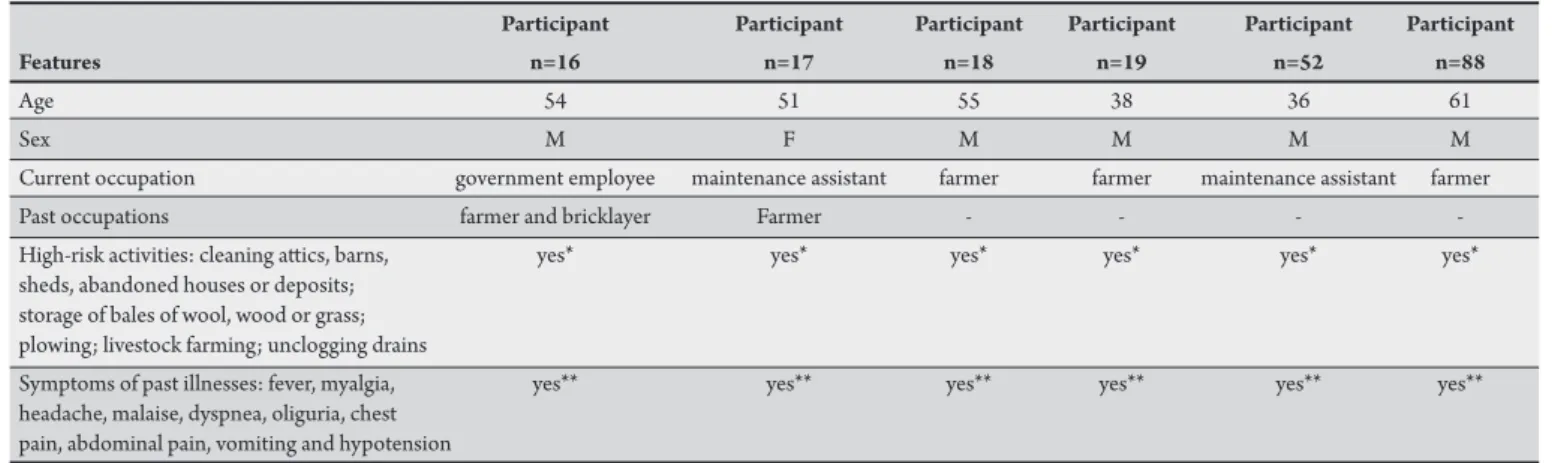
All six hantavirus-seropositive participants lived in rural or peri-urban areas, and three of them were farmers. Except for one, they all performed high-risk activities and had contact with rodents as part of their work. Two of the positive individuals cleaned silos and bunkers and reported having killed more than 60 rodents on some occasions. In addition, all seropositive participants reported a previous acute febrile illnesses that could have been caused by hantavirus. hese data are shown in Table 1.
he only female among the seropositive subjects reported a previous disease that supposedly happened one week ater being biten by rats. his woman was 41 years old, a farmer and a housewife. She was admitted to the hospital of Turvo County in October 1999 complaining of dyspnea and fever. She reported intense and
TABLE 1 - Data for the 6 individuals seropositive for hantavirus from Turvo, State of Santa Catarina, Brazil.
Participant Participant Participant Participant Participant Participant
Features n=16 n=17 n=18 n=19 n=52 n=88
Age 54 51 55 38 36 61
Sex M F M M M M
Current occupation government employee maintenance assistant farmer farmer maintenance assistant farmer
Past occupations farmer and bricklayer Farmer - - -
-High-risk activities: cleaning atics, barns, yes* yes* yes* yes* yes* yes*
sheds, abandoned houses or deposits; storage of bales of wool, wood or grass; plowing; livestock farming; unclogging drains
Symptoms of past illnesses: fever, myalgia, yes** yes** yes** yes** yes** yes**
headache, malaise, dyspnea, oliguria, chest pain, abdominal pain, vomiting and hypotension
M: male, F: female. *he participant reported performing all of these high-risk activities, **he participant reported having had almost all of these symptoms during an illness episode in the past.
widespread myalgia, fever during the last ive days (38.5ºC) and dyspnea when performing routine activities. he illness evolved with remarkable dyspnea on the second day of hospitalization. At this time, a chest radiograph showed bilateral iniltrates that were more prominent in the bases, and she exhibited hemoconcentration
(Ht 51%) and leukocytosis (19,000 cells/mm3) with a let shit.
he patient was treated with levoloxacin, paracetamol, 100% O2
supplied by a Venturi mask and intravenous luid. With diagnosis of viral pneumonia, the patient was moved to an intensive care facility in a hospital in the City of Porto Alegre, where she stayed for 6 days, followed by 10 days in the regular ward of the hospital.
A previous infection by hantavirus was observed in 2.3% of the participants of the survey, showing that these viruses probably produce human infections in the southern region of SC, where HPS has not yet been reported. At least one of the seropositive participants had a previous unconirmed disease compatible with HPS. hus, it is important to inform local clinicians about the epidemiology, signs and symptoms of HPS so that this disease is included in the diferential diagnosis of pneumonia with acute respiratory failure.
We are grateful to Radio Imigrantes (AM 1550 MHz) and
Secretaria Municipal de Saúde de Turvo/SC for their support in advertising this study. We thank the nursing technicians for their assistance in collecting the blood samples and Maria Elisa Favarin for the assistance with the logistics of data collection. We thank the medical students of the Universidade do Sul de Santa Catarina for their support with the interviews.
his work was funded by the Fundação de Amparo à Pesquisa do
Estado de São Paulo(FAPESP) and the Universidade do Sul de Santa Catarina(UNISUL). The study was granted an Undergraduate
Research Scholarship (PIBIC) by the Conselho Nacional de
119
Rev Soc Bras Med Trop 45(1):117-119, jan-fev, 2012REFERENCES
1. Nichol ST. Genetic analysis of hantaviruses and their host relation-ships.
In: Saluzzo JF, Dodet B, editors. Factors in the emergence and control of rodent-borne viral diseases. Paris: Elsevier; 1999. p. 99-109.
2. Figueiredo LTM, Moreli ML, Sousa RLM, Borges AA, Figueiredo GG, Machado A, et al. Hantavirus Pulmonary Syndrome, Central Plateau, Southeastern, and Southern Brazil Emerg Infect Dis 2009; 15:561-567.
3. Mertz GJ. Bunyaviridae: Bunyaviruses, Phleboviruses, Nairoviruses and Hantaviruses. In: Richman DD, Whitley RJ, Hayden FG, editors. Clinical virology. 2th ed. Washington, DC: ASM Press; 2002. p. 921-948.
4. Figueiredo LTM, Moreli ML, Campos GM, Sousa RL. Hantaviruses in São Paulo State, Brazil. Emerg Infect Dis 2003; 9:891-892.
5. Ministério da Saúde. Informes Epidemiológicos: Hantavirose por Unidade Federada Provável de Infecção e Ano. Brasil, 1993 - 2010. Brasília: Ministério da Saúde. Área Técnica de Hantaviroses; 2010.
6. Secretaria de Estado da Saúde de Santa Catarina. A hantavirose no Estado de Santa Catarina, 1999 - 2009. Florianópolis: Secretaria de Estado da Saúde. Sistema Único de Saúde. Superintendência de Vigilância em Saúde. Diretoria de Vigilância Epidemiológica; 2009.
7. Figueiredo LTM, Moreli ML, Borges AA, Souza RLM, Aquino VH. Expression of a hantavirus N protein and its eicacy as antigen in immune assays. Braz J Med Biol Res 2008; 41:596-599.
8. Campos GM, Sousa RLM, Badra SJ, Pane C, Gomes UA, Figueiredo LTM. Serological survey of hantavirus in Jardinópolis county, Brazil. J Med Virol 2003; 71:417-422.
9. Holmes RR, Boccanera R, Figueiredo LTM, Mancano SR, Pane C. Seroprevalence of human hantavirus infection in the Ribeirao Preto region of Sao Paulo State, Brazil. Emerg Infect Dis 2000; 6:560-561.