334
SY
STEMA
TIC REVIEW
Corresponding address: Paulo Roberto Fonseca Junior – Padre João Gonçalves St, 116, Pinheiros – São Paulo (SP) – Brazil – Zip Code: 05432-040 – E-mail: [email protected] – Phone: (11) 97194-7326 / (11) 3031-9659 – Finance source: None – Conlict of interests: Nothing to declare – Presentation: Jan. 20, 2017 – Accepted for publication: July 17, 2017. DOI: 10.1590/1809-2950/17425124032017
1Physical therapy Program at the Universidade de Mogi das Cruzes.
2Professor of the Physiotherapy Department of Universidade Cruzeiro do Sul.
3Physiotherapist of the Hospital and Maternity School Vila Nova Cachoeirinha.
4Graduate Program in Rehabilitation Sciences, Universidade de Nove de Julho.
ABSTRACT | The purpose of the present study was to
perform a systematic review of the literature to investigate how and with what modiications or adaptations constraint-induced movement therapy has been employed in clinical practice for therapeutic interventions in children with cerebral palsy. Searches were conducted of the CAPES (Brazilian fostering agency) periodical portal, Pubmed, Bireme, Science Direct, Scielo and PEDro databases for relevant articles published between January 2010 and May 2016. The articles retrieved were evaluated, scored and qualiied by two blinded reviewers using the Physical therapy Evidence Database Scale. The searches led to the retrieval of 102 articles, 12 of which were included in the present systematic review. A table was created containing information on the study groups, inclusion criteria, intervention, intervention frequency, diiculties encountered, evaluations and outcomes. Considerable variety was found in the therapeutic intervention models. The indings of the present review demonstrate that constraint-induced movement therapy in pediatric clinical practice is not employed in its original form. Although the studies analyzed did not have a common methodology regarding the use of this type of therapy, the method has been adapted with considerable lexibility, providing promising, positive results regarding the therapeutic intervention of the paretic upper limb in children with cerebral palsy.
Keywords | Cerebral Palsy; Upper Extremity; Hemiplegia; Immobilization; Movement.
334
RESUMO | Este estudo se propôs a realizar uma revisão
sistemática da literatura para investigar como e com que modiicações ou adaptações a terapia de movimento induzido por restrição tem sido empregada na prática clínica para intervenções terapêuticas em crianças com paralisia cerebral. As pesquisas foram conduzidas do portal periódico da CAPES (Agência brasileira de amparo), e dos bancos de dados Pubmed, Bireme, Science Direct, Scielo e PEDro para artigos relevantes publicados entre janeiro de 2010 e maio de 2016. Os artigos obtidos foram avaliados, quantiicados e qualiicados por dois revisores anônimos usando a Base de Dados em Evidências em Fisioterapia. As pesquisas levaram para a recuperação de 102 artigos, 12 dos quais foram incluídos nesta revisão sistemática. Uma tabela foi criada contendo informações sobre os grupos de estudo, critérios de inclusão, intervenção, frequência de intervenção, diiculdades encontradas, avaliações e resultados. Foi encontrada uma variedade considerável nos modelos de intervenção terapêutica. Os resultados desta revisão demonstram que a terapia de movimento induzido por restrição na prática clínica pediátrica não é empregada na sua forma original. Embora os estudos analisados não tenham uma metodologia comum em relação ao uso deste tipo de terapia, o método foi adaptado com lexibilidade considerável, fornecendo resultados promissores e positivos sobre a intervenção terapêutica do parético membro superior em crianças com paralisia cerebral.
Descritores | Paralisia Cerebral; Extremidade Superior; Hemiplegia; Imobilização; Movimento.
Constraint-induced movement therapy of upper limb
of children with cerebral palsy in clinical practice:
systematic review of the literature
Terapia de movimento induzido por restrição do membro superior de crianças com
paralisia cerebral na prática clínica: uma revisão sistemática da literatura
Terapia de movimiento inducido por restricción para el miembro superior de niños con
parálisis cerebral en práctica clínica: revisión sistemática de la literatura
Paulo Roberto Fonseca Junior1, Eduardo Filoni1,2, Chrystianne Melo Setter1, Andréia Marques Berbel1,
Fonseca Junior et al. CIMT of upper limb in children with CP
335
RESUMEN | El propósito del presente estudio fue realizar
una revisión sistemática de la literatura para investigar cómo y con qué modiicaciones o adaptaciones la terapia de movimiento inducido por restricción ha sido empleada en la práctica clínica para intervenciones terapéuticas en niños con parálisis cerebral. Se realizaron búsquedas en CAPES (Agencia brasileña de fomento) portal periodico, Pubmed, Bireme, Science Direct, Scielo y PEDro bases de datos para artículos relevantes publicados entre enero de 2010 y mayo de 2016. Los artículos recuperados fueron evaluados, puntuados y caliicados por dos revisores ciegos utilizando la Escala de base de datos de Pruebas de Fisioterapia (Physical therapy Evidence Database Scale). Las búsquedas condujeron a la recuperación de 102 artículos, 12 de los cuales se incluyeron en la presente revisión sistemática. Se creó una tabla que
contiene información sobre los grupos de estudio, criterios de inclusión, intervención, frecuencia de intervención, diicultades encontradas, evaluaciones y resultados. Se encontró una variedad considerable en los modelos de intervención terapéutica. Los resultados de la presente revisión muestran que la terapia de movimiento inducido por restricción en la práctica clínica pediátrica no se emplea en su forma original. Aunque los estudios analizados no tenían una metodología común respecto al uso de este tipo de terapia, el método se ha adaptado con una lexibilidad considerable, promoviendo resultados promisores y positivos con respecto a la intervención terapéutica del miembro parético superior en niños con parálisis cerebral.
Palabras clave | Parálisis Cerebral; Extremidad Superior;
Hemiplejía; Inmovilización; Movimiento.
INTRODUCTION
Cerebral palsy (CP) is a group of movement and postural development disorders that causes limitations with regard to activities of daily living due to a non-progressive brain damage, occurring during fetal or infant development, resulting in chronic physical deiciencies and possible sensory deicits1. Motor impairment is the
major characteristic of CP and is characterized by the type of motor disorder (spasticity, ataxia, dystonia and athetosis) as well as the predominance of the afected limbs (hemiparesis, paraparesis and tetraparesis)2.
Hemiparesis is the most frequent manifestation of CP, afecting as many as 38% of cases in one population-based study2, and can lead to disuse of the afected
upper limb, with negative consequences for reaching, bimanual tasks and functionality, regarding activities performed in home, school and community settings3.
In recent years, a large number of randomized clinical trials, investigating particularly CIMT and “modiied CIMT” (mCIMT) have emerged4. CIMT began with
preclinical research involving young male primates and was founded on overcoming “learned non-use”5. Some
researchers suggest two possible mechanisms that can lead to functional improvements of the paretic upper limb through CIMT: overcoming “learned non-use”, which is the learning of a patient not to use the paretic limb due to the diiculty encountered; and cortical reorganization, involving anatomic connections through neuronal sprouting, the enhancement of synaptic
eiciency of existing connections (disinhibition) or the recruitment of a large number of neurons in the innervation of the afected limb, adjacent to those involved before the brain damage6,7.
hese strategies combine the principles of motor learning (practice, speciicity feedback, etc.) and neuroplasticity (cerebral changes induced by the practice of repeated actions that enhance movement complexity, motivation and reward) in intensive blocks of training sessions8. he classic CIMT, described in
previous studies9,10, was initially developed for adults
with hemiparesis after stroke. his involves restriction of the upper limb not afected by 90% of the waking hours for at least 2 weeks, while the upper limb is intensively trained for 3 hours or more per day11.
During this approach, the paretic limb is used for numerous activities involving two aspects: the practice of repetitive tasks and training. In the irst, the tasks are carried out continuously for 15 to 20 minutes to practice the movement incorporated into a functional task. In this approach, movement is practiced irst, followed by performance of the functional task. Environments can be manipulated to vary the requirements of the task and induce speciic movements, or to change the degree of diiculty. Tasks are planned so that frequent successes can be achieved. Training involves a meta-motor task performed in small steps with increasing degrees of diiculty, based on the patient’s abilities1.
Fisioter Pesqui. 2017;24(3):334-346
336
protocols similarly involve restraint of the non-afected limb with variations in the type of restriction applied (e.g., glove, glove, sling) and are accompanied by a unimanual repetitive practice, difering in part from the classic CIMT in terms of the model of therapy (short-term intensity, long-term distribution model) and dose intervention4. he location, context and
provider of training (house/camp, individual/group, therapist/parent) are also diferentiated in relation to the classic CIMT11. Recently, hybrid models have been
reported applying sequentially mCIMT followed by bimanual training, signiicantly altering the unimanual construction of the method4,11.
CIMT is an analytical-behavioral technique designed to improve deicits resulting from diferent types of damage to the central nervous system, such as stroke, traumatic brain injury, spinal cord injury, multiple sclerosis, CP and other disorders. he deicits are mainly of a motor nature, but also include verbal aspects (aphasia) and phantom limb pain following an amputation12.
he study by DeLuca et al.13 was the irst to test
the efectiveness of CIMT in children through a randomized controlled crossover study. he treatment protocol was originally developed and evaluated for a 15-month-old child, with virtually no voluntary use of upper limbs and a contemptuous almost complete development by his compromised upper limb.
Learned non-use also occurs in individuals with hemiparetic CP, who do not employ the afected arm for diverse tasks. hus, CIMT is a therapeutic resource that enables the use of the paretic upper limb in unimanual tasks. However, a major concern in relation to the administration of CIMT to children with hemiparetic CP regards the impact on the child’s self-esteem. Unlike stroke survivors, who are often very motivated to recover lost function, children with CP may have never used the paretic limb during functional activities and are therefore obligated to concentrate on their deiciencies. Moreover, the high rate of early failures during the execution of such tasks can be the cause of considerable frustration. Another point of concern with classic CIMT for pediatric patients is related to the use of the constraint during the rest of the 90% of the day, forcing children to continue exclusively using their compromised limb. his demand can be the source of additional frustration, resulting in concerns on the part of the family regarding the potential risk of falls due to the constraint of the unafected limb. hus, the
procedures involved in CIMT for adults may not be altogether appropriate for children1.
Recent systematic reviews of literature and meta-analysis11,14,15 have addressed the efectiveness of the use
of CIMT in children with CP, reporting results such as improvements in the manual capacity of the afected limb. he aim of the present study was to perform a systematic review of the literature to investigate how and with which modiications or adaptations CIMT has been used in the therapeutic process of children with hemiparetic CP, without merit on the evaluation of the results obtained in the clinical trials
METHODOLOGY
Searches were conducted from the CAPES (Brazilian fostering agency) periodical portal, Pubmed, Bireme, Science Direct, Scielo and PEDro databases for relevant articles published between January 2010 and May 2016, using the following keywords in English, Spanish and Portuguese. he search for the articles was done using the terminology registered in the Descriptors in Health Sciences (DECS) and Medical Subject Headings of the U.S. National Library of Medicine (Mesh). hey were:
cerebral palsy, upper extremity, hemiplegia, immobilization, movement. All the synonyms of these descriptors were considered for the search.
he following were the inclusion criteria: 1) type of study – controlled clinical trial; 2) intervention – constraint-induced movement therapy for the upper limb; 3) experimental group – children with cerebral palsy; 4) publication between 2010 and 2016; and 5) score of 5 or more points on the Physical therapy Evidence Database Scale (PEDro). Titles and abstracts were analyzed in the irst stage of the selection process. Pre-selected articles were then submitted to full-text analysis for the determination of inclusion to the systematic review based on the eligibility criteria.
Fonseca Junior et al. CIMT of upper limb in children with CP
337 provide suicient information) as well as clinical and
statistical relevance, in a way that the interpretation of the indings is clear and other researchers can reproduce the study. he classiication of the analyzed studies based on the PEDro scale was performed by two evaluators, independently and blind to the objective of the present study, so that if a controversy occurred to the score obtained in the study, a third evaluator would be selected to answer the question of the score. he articles selected by inclusion criterion through the PEDro scale would have to have a score greater than or equal to 6 (table 2).
he PEDro scale was created based on the Delphi list of criteria for the quality evaluation of randomized clinical trials to be included in systematic reviews. his list was developed from the consensus of a panel of experts in 1998, but was considered insuicient regarding statistical parameters. he creation and validation of an adequate measure for the evaluation of methodological quality stemmed from the need to catalog clinical trials in the Physical therapy Evidence Database (PEDro). he purpose of the PEDro scale is to assist researchers in the rapid identiication of which known or suspected (i.e., randomized controlled study or controlled clinical trial) randomized clinical trials indexed in the PEDro databank are internally valid (Items 2 to 9) and have suicient statistical information for the adequate interpretation of the results (Items 10 and 11). An additional criterion (Item 1), which is related to external validity (generalizability or applicability of the trial), was maintained so that the content of the Delphi list would be complete, but this criterion is not used to calculate the methodological quality score. However, the PEDro scale should not be used as a validity measure of conclusion from a study
or to compare the quality of clinical trials conducted in diferent ields of therapy, because it is not possible to meet all scale items in some areas of physical therapy. Moreover, studies with signiicant treatment efects and high PEDro scores do not necessarily provide evidence of a clinically useful treatment16.
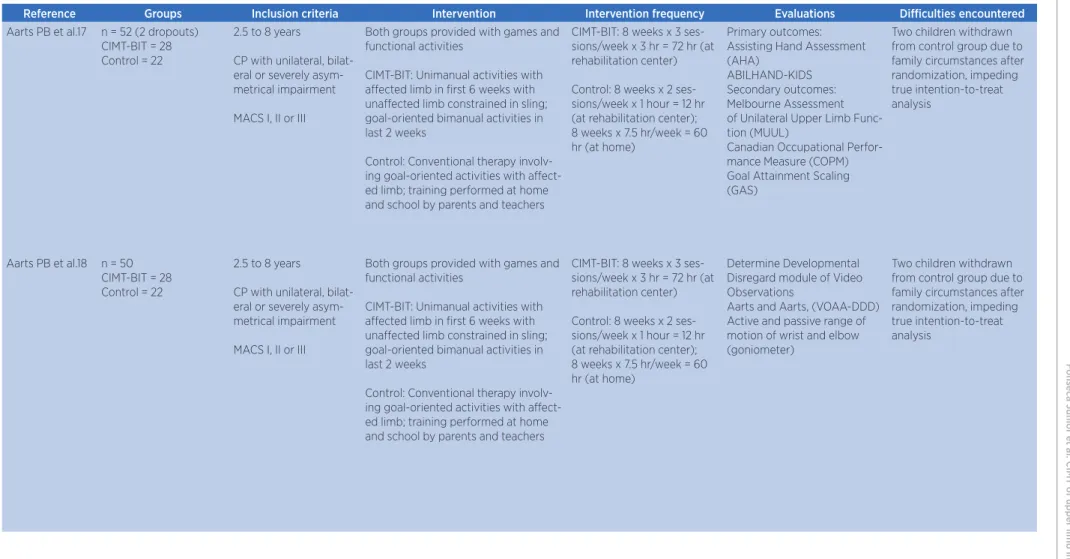
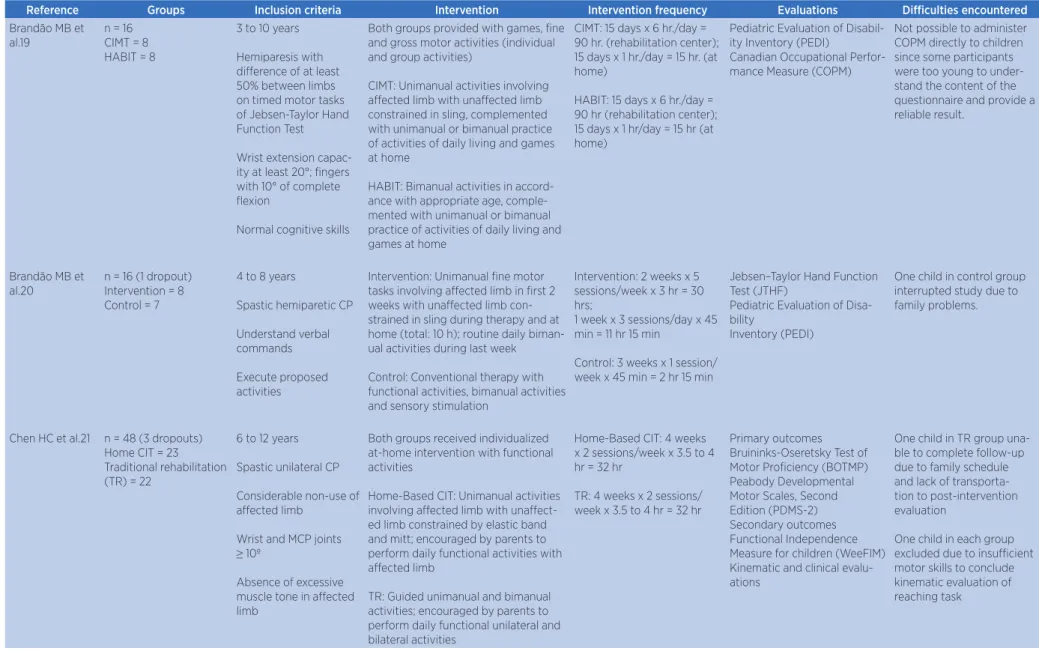
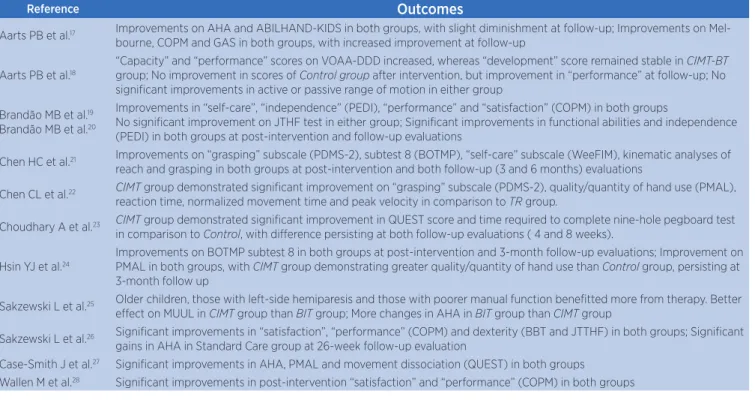
All articles that met the inclusion criteria and received a score of 6 or more points on the PEDro scale were included in the present systematic review. Table 2 ofers a summary of the studies and relevant characteristics. he “groups” column contains information on sample size. he inclusion criteria are listed to allow a comparison of patient characteristics and the results. Type and frequency of the intervention employed are essential for understanding how CIMT is performed in clinical practice. he “evaluation” column lists the measures employed in the diferent studies for the assessment of the indings reliability. Finally, the “diiculties encountered” column lists problems involved in managing CIMT to children, which is analyzed in depth in the study by Gordon et al.1. Table
3 lists the main outcomes of the clinical trials analyzed in the present systematic review.
RESULTS
Fisioter Pesqui. 2017;24(3):334-346
338
Figure 1 – Overview of selection process
Table 1 – Methodological quality score of each study (PEDro scale)
Reference
Item
Eligibilit
y
1- Randomiz
ed alloca
tion
2
- Alloca
tion c
onc
ealmen
t
3- Similar pr
ognosis
4- Blinding of participan
ts
5- Blinding of ther
apis
ts
6- Blinding of e
xaminer
s
7- Out
come measur
es
8- In
ten
tion t
o tr
ea
t
9- In
ter
-gr
oup c
omparisons
10- V
ariabilit
y and pr
ecision
Sc
or
e
1 Aarts PB. et al 17 1 1 0 1 0 0 1 1 0 1 1 6/10
2 Aarts PB. et al18 1 1 0 1 0 0 1 1 0 1 1 6/10
3 Brandão MB. et al.19 1 1 1 1 0 0 0 1 0 1 1 6/10
4 tBrandão MB. et al.20 1 1 1 1 0 0 1 1 1 1 1 8/10
5 Chen HC.et al.21 1 1 1 1 0 0 1 1 0 1 1 7/10
6 Chen CL.et al.22 1 1 0 1 0 0 1 1 0 1 1 6/10
7 Choudhary A. et al.23 1 1 1 1 0 0 1 1 1 1 1 8/10
8 Hsin YJ. et al.24 1 1 1 1 0 0 1 1 0 1 1 7/10
9 Sakzewski L et al.25 1 1 1 1 0 0 1 1 1 1 1 8/10
10 Sakzewski L et al.26 1 1 1 1 0 0 1 0 0 1 1 6/10
11 Case-Smith J. et al.27 1 1 0 1 0 0 1 1 0 1 1 6/10
F
onseca Junior e
t al. CIMT of upper limb in childr
en with CP
3
39
Table 2 – Characteristics of studies included in present systematic review
Reference Groups Inclusion criteria Intervention Intervention frequency Evaluations Diiculties encountered
Aarts PB et al.17 n = 52 (2 dropouts)
CIMT-BIT = 28 Control = 22
2.5 to 8 years
CP with unilateral, bilat-eral or severely asym-metrical impairment MACS I, II or III
Both groups provided with games and functional activities
CIMT-BIT: Unimanual activities with afected limb in irst 6 weeks with unafected limb constrained in sling; goal-oriented bimanual activities in last 2 weeks
Control: Conventional therapy involv-ing goal-oriented activities with afect-ed limb; training performafect-ed at home and school by parents and teachers
CIMT-BIT: 8 weeks x 3 ses-sions/week x 3 hr = 72 hr (at rehabilitation center) Control: 8 weeks x 2 ses-sions/week x 1 hour = 12 hr (at rehabilitation center); 8 weeks x 7.5 hr/week = 60 hr (at home)
Primary outcomes: Assisting Hand Assessment (AHA)
ABILHAND-KIDS Secondary outcomes: Melbourne Assessment of Unilateral Upper Limb Func-tion (MUUL)
Canadian Occupational Perfor-mance Measure (COPM) Goal Attainment Scaling (GAS)
Two children withdrawn from control group due to family circumstances after randomization, impeding true intention-to-treat analysis
Aarts PB et al.18 n = 50
CIMT-BIT = 28 Control = 22
2.5 to 8 years
CP with unilateral, bilat-eral or severely asym-metrical impairment MACS I, II or III
Both groups provided with games and functional activities
CIMT-BIT: Unimanual activities with afected limb in irst 6 weeks with unafected limb constrained in sling; goal-oriented bimanual activities in last 2 weeks
Control: Conventional therapy involv-ing goal-oriented activities with afect-ed limb; training performafect-ed at home and school by parents and teachers
CIMT-BIT: 8 weeks x 3 ses-sions/week x 3 hr = 72 hr (at rehabilitation center) Control: 8 weeks x 2 ses-sions/week x 1 hour = 12 hr (at rehabilitation center); 8 weeks x 7.5 hr/week = 60 hr (at home)
Determine Developmental Disregard module of Video Observations
Aarts and Aarts, (VOAA-DDD) Active and passive range of motion of wrist and elbow (goniometer)
Fisiot
er P
esqui. 20
17
;2
4(3):334-346
3
40
Reference Groups Inclusion criteria Intervention Intervention frequency Evaluations Diiculties encountered
Brandão MB et al.19
n = 16 CIMT = 8 HABIT = 8
3 to 10 years Hemiparesis with diference of at least 50% between limbs on timed motor tasks of Jebsen-Taylor Hand Function Test Wrist extension capac-ity at least 20°; ingers with 10° of complete lexion
Normal cognitive skills
Both groups provided with games, ine and gross motor activities (individual and group activities)
CIMT: Unimanual activities involving afected limb with unafected limb constrained in sling, complemented with unimanual or bimanual practice of activities of daily living and games at home
HABIT: Bimanual activities in accord-ance with appropriate age, comple-mented with unimanual or bimanual practice of activities of daily living and games at home
CIMT: 15 days x 6 hr./day = 90 hr. (rehabilitation center); 15 days x 1 hr./day = 15 hr. (at home)
HABIT: 15 days x 6 hr./day = 90 hr (rehabilitation center); 15 days x 1 hr/day = 15 hr (at home)
Pediatric Evaluation of Disabil-ity Inventory (PEDI)
Canadian Occupational Perfor-mance Measure (COPM)
Not possible to administer COPM directly to children since some participants were too young to under-stand the content of the questionnaire and provide a reliable result.
Brandão MB et al.20
n = 16 (1 dropout) Intervention = 8 Control = 7
4 to 8 years
Spastic hemiparetic CP Understand verbal commands Execute proposed activities
Intervention: Unimanual ine motor tasks involving afected limb in irst 2 weeks with unafected limb con-strained in sling during therapy and at home (total: 10 h); routine daily biman-ual activities during last week Control: Conventional therapy with functional activities, bimanual activities and sensory stimulation
Intervention: 2 weeks x 5 sessions/week x 3 hr = 30 hrs;
1 week x 3 sessions/day x 45 min = 11 hr 15 min
Control: 3 weeks x 1 session/ week x 45 min = 2 hr 15 min
Jebsen–Taylor Hand Function Test (JTHF)
Pediatric Evaluation of Disa-bility
Inventory (PEDI)
One child in control group interrupted study due to family problems.
Chen HC et al.21 n = 48 (3 dropouts)
Home CIT = 23
Traditional rehabilitation (TR) = 22
6 to 12 years Spastic unilateral CP Considerable non-use of afected limb
Wrist and MCP joints
≥ 10º
Absence of excessive muscle tone in afected limb
Both groups received individualized at-home intervention with functional activities
Home-Based CIT: Unimanual activities involving afected limb with unafect-ed limb constrainunafect-ed by elastic band and mitt; encouraged by parents to perform daily functional activities with afected limb
TR: Guided unimanual and bimanual activities; encouraged by parents to perform daily functional unilateral and bilateral activities
Home-Based CIT: 4 weeks x 2 sessions/week x 3.5 to 4 hr = 32 hr
TR: 4 weeks x 2 sessions/ week x 3.5 to 4 hr = 32 hr
Primary outcomes Bruininks-Oseretsky Test of Motor Proiciency (BOTMP) Peabody Developmental Motor Scales, Second Edition (PDMS-2) Secondary outcomes Functional Independence Measure for children (WeeFIM) Kinematic and clinical evalu-ations
One child in TR group una-ble to complete follow-up due to family schedule and lack of transporta-tion to post-interventransporta-tion evaluation
One child in each group excluded due to insuicient motor skills to conclude kinematic evaluation of reaching task
Table 2 – Continuation
F
onseca Junior e
t al. CIMT of upper limb in childr
en with CP
3
41
Reference Groups Inclusion criteria Intervention Intervention frequency Evaluations Diiculties encountered
Chen CL et al.22 n = 48 (1 dropout)
CIMT = 24
Traditional rehabilitation (TR) = 23
6 to 12 years Unilateral spastic CP Considerable non-use of afected limb (score on PMAL “how often” scale less than 2.5)
Wrist and MCP joints
≥ 10º
Absence of excessive muscle tone in afected
limb (≤ 2 on Ashworth
scale)
Both groups received individualized intervention with functional activities CIMT: Unimanual activities involving afected limb with unafected limb constrained by elastic band and mitt; encouraged by parents to perform daily functional activities with afected limb
TR: Guided unimanual and bimanual activities; encouraged by parents to perform daily functional unilateral and bilateral activities
CIMT: 4 weeks x 2 sessions/ week x 3.5 to 4 hr = 32 hr TR: 4 weeks x 2 sessions/ week x 3.5 to 4 hr = 32 hr
Peabody Developmental Motor Scales, Second Edition (PDMS-2)
Pediatric Motor Activity Log (PMAL)
Kinematic and clinical evalu-ations
One child in TR group una-ble to complete follow-up due to family schedule and lack of transporta-tion to post-interventransporta-tion evaluation
Choudhary A et al.23
n = 31 (1 dropout) CIMT = 15 Control = 15
3 to 8 years Hemiparetic CP with minimum diference between upper limbs of 10 points on QUEST Understand simple commands Sit without support See objects at distance of 1 m
CIMT: Unimanual reaching activities involving paretic limb with unafected limb wrapped in triangular bandage Control: Conventional therapy with stretching, strengthening, bimanual activities and practice of activities of daily living
CIMT: 10 days distributed over 4 weeks x 2 h/day = 20 hr (at rehabilitation center) Control: 4 weeks x 20 min/ day = 10 hr (at home)
Primary outcomes Quality of Upper Extremity Skills Test (QUEST) Secondary outcomes QUEST score Nine-hole pegboard
One patient in CIMT group received 5 supervised in-tervention sessions, but did not return for scheduled visits afterward.
Hsin YJ et al.24 n = 22
CIMT = 11 Control = 11
6 to 8 years Spastic unilateral CP Considerable non-use of afected limb (score on PMAL “how often” scale less than 2.5)
Wrist and MCP joints
≥ 10º
Absence of excessive muscle tone in afected
limb (≤ 2 on Ashworth
scale)
Both groups received individualized intervention with functional activities at home
CIMT: Unimanual activities involv-ing afected limb with unafected limb constrained by elastic bandage and mitt; encouraged by parents to perform daily functional activities with afected limb
Control: Guided unimanual and biman-ual activities; encouraged by parents to perform daily unimanual and biman-ual functional activities
CIMT: 4 weeks x 2 sessions/ week x 3.5 to 4 hr = 32 hr Control: 4 weeks x 2 ses-sions/week x 3.5 to 4 hr = 32 hr
Primary outcome Subtest 8 – Bruininks-Os-eretsky Test of Motor Proi-ciency (BOTMP)
Secondary outcomes Pediatric Motor Activity Log (PMAL)
Cerebral Palsy-Speciic Quality of Life (CPQOL)
No diiculties described
Table 2 – Continuation
Fisiot
er P
esqui. 20
17
;2
4(3):334-346
3
42
Reference Groups Inclusion criteria Intervention Intervention frequency Evaluations Diiculties encountered
Sakzewski L et al.25
n = 64 (3 dropouts) CIMT = 31
BIT = 30
5 to 16 years
Congenital hemipareiss Understand commands Muscle tone of afected limb grade 1 to 3 on Ashworth scale
Both groups provided with ine and gross motor activities, functional reach activities and balance activities in setting with circus theme
CIMT: Unafected limb constrained by mitt during unilateral activities BIT: Guided bimanual activities
6 hr/day x 10 days = 60 hr (daily camping)
Primary outcomes Melbourne Assessment of Unilateral Upper Limb Func-tion (MUUL)
Assisting Hand Assessment (AHA)
Canadian Occupational Perfor-mance Measure (COPM)
Three children did not com-plete intervention program.
Sakzewski L et al.26
n= 53 (9 dropouts) Hybrid-CIMT = 25 Standard Care = 19
5 to 16 years Unilateral CP
Understand commands Muscle tone of afected limb grade 1 to 3 on Ashworth scale
Both groups provided with ine and gross motor activities, functional reach activities and balance activities in setting with circus theme Hybrid-CIMT: Unafected limb con-strained by mitt during unilateral activ-ities; bimanual activities performed in second week
Standard Care: Bimanual activities; at-home training with parents
Hybrid-CIMT: 6 hr/day x 10 days = 60 hr (daily camping) Standard Care: 1.5 hr/day x 6 days = 9 hr
(daily camping)
12 weeks x 6 sessions/week x 30 min = 36 hr (at home)
Primary outcomes MUUL
AHA
Secondary outcomes COPM
JTTHF
Box and Block Test Children’s Hand-use Experi-ence Questionnaire (CHEQ)
Six children withdrew from Standard Care group and 3 withdrew from Hybrid-CI-MT
One child had seizure due to fever during intervention program.
Case-Smith J et al.27
n = 18 3-hr = 9 6-hr = 9
3 to 6 years Unilateral CP
Both groups submitted to intensive intervention in natural environment – functional activities, activities of daily living, reaching and sensory perception First 18 days – Unilateral activities involving afected limb with unafected limb constrained by cast
Last 3 days – bimanual activities
3-hr: 4 weeks x 21 days x 3 hr = 63 hr
6-hr: 4 weeks x 21 days x 6 hr = 126 hr
(performed in three diferent clinical settings)
Assisting Hand Assessment (AHA)
Quality of Upper Extremity Skills Test (QUEST) Pediatric Motor Activity Log (PMAL)
One child in 3-hr group and two in 6-hr group did not undergo six-month follow-up evaluation due to scheduling diiculties.
Wallen M et al.28 n = 50 CIMT = 25
Intensive occupational therapy (IOT) = 25
1.5 to 8 years
Spastic hemiparetic CP 10º wrist and inger extension of afected limb
Functional passive range of motion of afected limb Cooperation
Both groups provided with functional and play activities
CIMT: Unilateral activities involving afected limb with unafected limb constrained by mitt
IOT: Bimanual activities complemented with at-home program supervised by parents
8 weeks x 7 sessions/week x 2 hr = 112 hr
Primary outcomes
Canadian Occupational Perfor-mance Measure (COPM) Secondary outcomes Goal Attainment Scaling(GAS) Assisting Hand Assessment (AHA)
Pediatric Motor Activity Log (PMAL)
Modiied Tardieu Scale (MTS) Ashworth
No diiculties described
Fonseca Junior et al. CIMT of upper limb in children with CP
343
Table 3 – Outcomes of studies
Reference Outcomes
Aarts PB et al.17 Improvements on AHA and ABILHAND-KIDS in both groups, with slight diminishment at follow-up; Improvements on
Mel-bourne, COPM and GAS in both groups, with increased improvement at follow-up
Aarts PB et al.18
“Capacity” and “performance” scores on VOAA-DDD increased, whereas “development” score remained stable in CIMT-BT
group; No improvement in scores of Control group after intervention, but improvement in “performance” at follow-up; No
signiicant improvements in active or passive range of motion in either group
Brandão MB et al.19
Brandão MB et al.20
Improvements in “self-care”, “independence” (PEDI), “performance” and “satisfaction” (COPM) in both groups
No signiicant improvement on JTHF test in either group; Signiicant improvements in functional abilities and independence (PEDI) in both groups at post-intervention and follow-up evaluations
Chen HC et al.21 Improvements on “grasping” subscale (PDMS-2), subtest 8 (BOTMP), “self-care” subscale (WeeFIM), kinematic analyses of
reach and grasping in both groups at post-intervention and both follow-up (3 and 6 months) evaluations
Chen CL et al.22 CIMT group demonstrated signiicant improvement on “grasping” subscale (PDMS-2), quality/quantity of hand use (PMAL),
reaction time, normalized movement time and peak velocity in comparison to TR group.
Choudhary A et al.23 CIMT group demonstrated signiicant improvement in QUEST score and time required to complete nine-hole pegboard test
in comparison to Control, with diference persisting at both follow-up evaluations ( 4 and 8 weeks).
Hsin YJ et al.24
Improvements on BOTMP subtest 8 in both groups at post-intervention and 3-month follow-up evaluations; Improvement on
PMAL in both groups, with CIMT group demonstrating greater quality/quantity of hand use than Control group, persisting at
3-month follow up
Sakzewski L et al.25 Older children, those with left-side hemiparesis and those with poorer manual function beneitted more from therapy. Better
efect on MUUL in CIMT group than BIT group; More changes in AHA in BIT group than CIMT group
Sakzewski L et al.26 Signiicant improvements in “satisfaction”, “performance” (COPM) and dexterity (BBT and JTTHF) in both groups; Signiicant
gains in AHA in Standard Care group at 26-week follow-up evaluation
Case-Smith J et al.27 Signiicant improvements in AHA, PMAL and movement dissociation (QUEST) in both groups
Wallen M et al.28 Signiicant improvements in post-intervention “satisfaction” and “performance” (COPM) in both groups
DISCUSSION
Classic CIMT was originally developed for adults with neurological disorders and consequent motor impairment, and involves the constraint of the unafected upper limb with a sling, mitt or other type of device for 90% of the day for 14 consecutive days. he patient engages in six hours of intensive training of the afected upper limb for 10 of the 14 days using a set of activities involving repetitive actions and formation therapy. Morris et al.29 highlight the importance of
constraining the unafected limb for 90% of the time during the intervention for the reorganization of the motor cortex and the long-term increase in the use of the afected limb. A substantial number of studies published in recent years demonstrate that CIMT leads to considerable neuroplastic cortical reorganization and to improved function of the upper limb in both the short and long terms. In a pioneering study, Liepert et al.30 employed transcranial magnetic stimulation
to demonstrate an increase in the area of cortical representation of the afected limb following CIMT as well as improved limb use, as demonstrated by the Motor Activity Log.
In all studies analyzed in the present systematic review, games and functional activities were used during CIMT, but methodological quality, sample size, treatment modality, training intensity and
evaluation tools difered among the studies. CIMT was not employed in its classic form and was modiied with respect to the constraint method, duration of constraint (days or weeks), type and duration of therapy, intervention setting (home, school or clinic) and intervention provider (therapist, parent or teacher). he irst signiicant variant was the method employed to constrain the unafected limb, for which a range of techniques was used, such as a mitt21,22,24-26,28, sling17-20,
cast27 and splint23. Secondly, the treatment programs
varied the intensity, ranging from 4 weeks of intervention distributed in 10 days, 2 hours a day, totaling 20 hours of intervention23 for 4 weeks, distributed in 21 days, 6
hours per session, totaling 126 hours of intervention27.
he fact that the frequency, intensity and duration varied among the trials analyzed in the present review limits the development of guidelines regarding these aspects in interventions involving CIMT for children with CP.
In two clinical trials conducted by Aarts et al.17,18,
the treatment group submitted to CIMT received more sessions per week and more hours per session than the control group, but the individuals in the control group complemented their training at home to match the total number of hours to which the treatment group was submitted. Choudhary et al.23 conducted interventions
Fisioter Pesqui. 2017;24(3):334-346
344
received 20 minutes a day at home. he clinical trials of Sakzewski L et al.25 also diverged in intensity in both
groups (treatment and control).
he use of containment at home after treatment sessions was not used in any clinical trial. In some studies, children were encouraged to use the afected limb in functional and avd’s activities at home under parental supervision, with no need for restraint of the afected
limb21,22,24 or were submitted to complementary therapy
with unimanual and bimanual exercises through games at home19. Chen et al.21 employed home-based CIMT,
which consisted of the same principles as modiied CIMT, but the therapist conducted the training in the child’s home. A hybrid CIMT was used by Sakzewski et al.26, which was composed of the combination of
modiied CIMT and bimanual training involving high intensity duration with the aim of improving unimanual and bimanual capacity.
All authors of the selected studies speciied the children’s age and degree of impairment at the time of treatment, which were chosen based on the expected beneits of treatment. For the functional classiication of individuals eligible for inclusion in the study, the Manual Abilities Classiication System (MACS) was used in two studies17,18, which was developed
to categorize, respectively, the mobility and manual function of children with CP31,32. Other studies
included in this review used the results of the Quality of Upper Extremity Skills Test (QUEST), Pediatric Motor Activity Log (PMAL) and Jebsen-Taylor Hand Function Test ( JTHF) as part of the inclusion criteria19,22-24. It is recognized that the PMAL evaluation
scale is an evaluation tool of little reliability and insuicient validity33. Minimum functional capacities
of the afected limb were also used in the majority of studies, which required minimum wrist extension and inger lexion of 10º. he classiication of muscle tone at the time of treatment was determined in some studies, using grades 1 and 2 of the modiied Ashworth Scale as part of the inclusion criteria. Cognitive capacity, cooperation and comprehension of the commands were employed as inclusion criteria in the majority of studies, which are essential to conducting studies of this nature and obtaining the expected beneits. According to Moura34, adequate treatment planning
is fundamental and requires ample knowledge of all upper limb disorders. A clinical evaluation combined with quantitative upper limb measures can provide necessary information for the detection of clinically
signiicant changes in upper limb function, following an intervention.
All studies selected presented valid and reliable results using one or more types of primary and secondary evaluations. The PMAL, QUEST, Canadian Occupational Performance Measure (COPM) and Assisting Hand Assessment (AHA) were the most used outcome measures. In two clinical trials, Aarts et al.17,18 used the COPM, AHA,
ABILHAND-KIDS, Melbourne Assessment of Unilateral Upper Limb Function (MUUL) and Goal Attainment Scaling (GAS) as well as the Determine Developmental Disregard module of the Video Observations Aarts and Aarts module (VOAA-DDD), which was created by the authors themselves. The Bruininks-Oseretsky Test of Motor Proficiency (BOTMP) was used in two studies21,24, the Peabody
Developmental Motor Scales – Second Edition (PDMS-2) was used in two studies21,22 and the
Pediatric Evaluation of Disability Inventory (PEDI) was used by Brandão et al.19.
Other outcome measures were employed in the remaining studies. he Functional Independence Measure for Children (WeeFIM), together with a kinematic evaluation, was used in the study by Chen et al.21 for the evaluation of performance on activities
of daily living and functional independence. Hsin et al.24 employed the Cerebral Palsy-Speciic Quality of
Life (CPQOL) assessment tool as a secondary outcome measure35. Along with other measures, Sakzewski
et al.26 used the Box and Block Test and Children’s
Hand-Use Experience Questionnaire (CHEQ) as secondary outcome measures. Along with previously described measures, Wallen et al.28 used the Modiied
Tardieu Scale (MTS) and Modiied Ashworth Scale as secondary outcome measures for the evaluation of spasticity of the elbow lexors as well as the wrist pronators and extenders.
All studies included in the present systematic review reported signiicant improvements in some outcome measure, demonstrating the positive efects of the proposed treatment during both the post-intervention and follow-up evaluations. Despite the small sample sizes, all studies ofered satisfactory consistency regarding the outcome measures.
Fonseca Junior et al. CIMT of upper limb in children with CP
345 or there is a process of irritability during a therapy.
In 9 of the 12 clinical trials17-20,22,23,25-27, diiculties
and dropouts occurred due to family problems, scheduling problems, changes of address and a lack of transportation. In the study by Sakzewski et al.26, nine
of the participants dropped out of the study groups and a seizure occurred in one child during treatment; however, the authors did not describe the dropouts in detail. In the study by Chen et al.21, dropouts
occurred due to family problems and two children were excluded from the study during treatment due to a lack of suicient motor skills to perform the kinematic evaluation of the reaching task proposed as an outcome measure. Brandão et al.19 found that it
was impossible to administer the COPM directly to the children due to their young age and diiculty of understanding the questionnaire content, which was therefore answered by parents/caregivers.
Based on the studies selected for the present review, CIMT requires modiications for children with CP and the children’s response to a given intervention needs to be evaluated using a biopsychosocial approach, which can directly or indirectly exert an inluence on the results. Information regarding the types of intervention, modiications and dose-response relationship as well as the efects on structural and functional changes in children with CP is fundamental to the development of guidelines for the reliable, reproducible practice of CIMT.
CONCLUSION
he present systematic review of the literature indings demonstrate that, despite the lack of a common methodology among studies regarding the use of constraint-induced movement therapy for children with cerebral palsy, this form of intervention has been adapted with considerable lexibility, providing promising, positive results of the therapeutic intervention of the paretic upper limb.
his systematic review is not intended to synthesize and evaluate the results obtained with the use of the CIMT in clinical trials, but only to demonstrate its use and/or possible modiications/adaptations in clinical practice. Because of this limitation in our study, a summary of outcome measures is required, as well as synthesis of data on the studies reviewed in a future version.
DISCLOSURE
he authors declare no conlicts of interest in relation to this study. he authors alone are responsible for the content and writing of the paper. No commercial party having a direct inancial interest in the results of the research supporting this article has or will confer a beneit upon the authors or upon any organization with which the authors are associated. his systematic review was conducted in compliance with the norms of the Preferred Reporting Items for Systematic Reviews and Meta-Analyses (PRISMA).
REFERENCES
1. Gordon AM, Charles J, Wolf SL. Methods of constraint-induced movement therapy for children with hemiplegic cerebral palsy: development of a child-friendly intervention for improving upper-extremity function. Arch Phys Med Rehabil. 2005;86(4):837-44. doi: 10.1016/j.apmr.2004.10.008 2. Andersen JC, Majnemer A, O’Grady K, Gordon AM. Intensive
upper extremity training for children with hemiplegia: from science to practice. Semin Pediatr Neurol. 2013;20(2):100-5. doi: 10.1016/j.spen.2013.06.001
3. Balleoti LR, Gritti CC, Silva BC. Efeitos de um protocolo modiicado da terapia por contensão induzida em criança com paralisia cerebral hemiparética. Rev Ter Ocup Univ São Paulo. 2014;25(3):264-71. http://dx.doi.org/10.11606/ issn.2238-6149.v25i3p264-271
4. Sakzewski L, Ziviani J, Boyd RN. Eicacy of upper limb therapies for unilateral cerebral palsy: a meta-analysis. Pediatrics. 2014;133(1):175-204. doi: 10.1542/ peds.2013-0675
5. Silva LA, Tamashiro V, Assis RD. Terapia por contenção induzida: revisão de ensaios clínicos. Fisioter Mov. 2010;23(1):153-59. doi: 10.1590/S0103-51502010000100015 6. Diniz L, Abranches MHS. Neuroplasticidade na terapia
de restrição e indução do movimento em pacientes com acidente vascular encefálico. Med Reabil. 2003;22(3):53-5. 7. Liepert J, Bauder H, Miltner WHR, Taub E, Weiller C.
Treament-induced cortical reorganization after stroke in humans. Stroke. 2000;31(6):1210-6. doi: 10.1161/01.STR.31.6.1210
8. Bleyenheuft Y, Arnould C, Brandão MB, Bleyenheunft C, Gordon AM. Hand and arm bimanual intensive therapy including lower extremity (HABIT-ILE) in children with unilateral spastic cerebral palsy: a randomized trial. Neurorehabil Neural Repair. 2015;29(7):645-57. doi: 10.1177/1545968314562109
9. Taub E, Miller NE, Novack TA, Cook EW, Fleming WC, Neponucemo CS, et al. Technique to improve chronic motor deicit after stroke. Arch Phys Med Rehabil. 1993;74(4):347-54. 10. Taub E, Uswatte G, Pidikiti R. Constraint-induced movement
Fisioter Pesqui. 2017;24(3):334-346
346
11. Eliasson AC, Krumlinde-Sundholm L, Gordon AM, Feys H, Klingels K, Aarts, PBM, et al. Guidelines for future research in constraint-induced movement therapy for children with unilateral cerebral palsy: an expert consensus. Dev Med Child Neurol. 2014;56(2):125-37. doi: 10.1111/dmcn.12273
12. Taub E. The behavior-analytic origins of constraint-induced movement therapy: an example of behavioral neurorehabilitation. Behav Anal. 2012;35(2):155-78.
13. DeLuca SC, Echols K, Law CR, Ramey SL. Intensive pediatric constraint-induced therapy for children with cerebral palsy: randomized, controlled, crossover trial. J Child Neurol. 2006;21(11):931-8. doi 10.2310/7010.2006.00201
14. Dong VA, Tung IH, Siu HW, Fong KN. Studies comparing the eicacy of constraint-induced movement therapy and bimanual training in children with unilateral cerebral palsy: a systematic review. Dev Neurorehabil. 2013;16(2):133-43. doi: 10.3109/17518423.2012.702136
15. Chen YP, Pope S, Tyler D, Warren GL. Efectiveness of constraint-induced movement therapy on upper-extremity function in children with cerebral palsy: a systematic review and meta-analysis of randomized controlled trials. Clin Rehabil. 2014;28(10):939-53. doi: 10.1177/0269215514544982
16. Shiwa SR, Costa LOP, Moser ADL, Aguiar IC, Oliveira LVF. PEDro: the physiopherapy evidence database. Fisioter Mov. 2011;24(3):523-33. doi: 10.1590/S0103-51502011000300017 17. Aarts PB, Jongerious PH, Geerdink YA, van Limbeek J, Geurts
AC. Efectiveness of modiied constraint-induced movement therapy in children with unilateral spastic cerebral palsy: a randomized controlled trial. Neurorehabil Neural Repair. 2010;24(6):509-18. doi: 10.1177/1545968309359767
18. Aarts PB, Jongerious PH, Geerdink YA, van Limbeek J, Geurts AC. Modiied constraint-induced movement therapy combined with bimanual training (mCIMT–BiT) in children with unilateral spastic cerebral palsy: how are improvements in arm-hand use established? Res Dev Disabil. 2011;32(1):271-9. doi: 10.1016/j.ridd.2010.10.008
19. Brandão MB; Gordon AM; Mancini MC. Functional impact of constraint therapy and bimanual training in children with cerebral palsy: a randomized controlled trial. Am J Occup Ther. 2012;66(6):672-81. doi:10.5014/ajot.2012.004622 20. Brandão MB, Mancini MC, Vaz DV, Fonseca ST. Adapted
version of constraint-induced movement therapy promotes functioning in children with cerebral palsy: a randomized controlled trial. Clin Rehabil. 2010;24(7):639-47. doi: 10.1177/0269215510367974
21. Chen HC, Chen CL, Kang LJ, Wu CY, Chen FC, Hong WH. Improvement of upper extremity motor control and function after home-based constraint induced therapy in children with unilateral cerebral palsy: immediate and long-term efects. Arch Phys Med Rehabil. 2014;95(8):1423-32. doi: 10.1016/j. apmr.2014.03.025
22. Chen CL, Kang LJ, Hong WH, Chen FC, Chen HC, Wu CY. Efect of therapist-based constraint-induced therapy at home on motor control, motor performance and daily function in children with cerebral palsy: a randomized controlled study. Clin Rehabil. 2013;27(3):236-45. doi: 10.1177/0269215512455652
23. Choudhary A, Gulati S, Kabra, M, Singh UP, Sankhyan N, Pandey RM, et al. Eicacy of modiied constraint induce movement therapy in improving upper limb function in children with hemiplegic cerebral palsy: a randomized controlled trial. Brain Dev. 2013;35(9):870-6. doi: 10.1016/j.braindev.2012.11.001 24. Hsin YJ, Chen FC, Lin KC, Kang LJ, Chen CL, Chen CY. Eicacy
of constraint-induced therapy on functional performance and health-related quality of life for children with cerebral palsy: a randomized controlled trial. J Child Neurol. 2012; 27(8):992-9. doi: 10.1177/0883073811431011
25. Sakzewski L, Ziviani J, Boyd RN. Best responders after intensive upper-limb training for children with unilateral cerebral palsy. Arch Phys Med Rehabil. 2011;92(4):578-84. doi: 10.1016/j.apmr.2010.12.003
26. Sakzewski L, Miller L, Ziviani J, Abbott D, Rose S, Macdonell RA, et al. Randomized comparison trial of density and context of upper limb intensive group versus individualized occupational therapy for children with unilateral cerebral palsy. Dev Med Child Neurol. 2015;57(6):539-47. doi: 10.1111/ dmcn.12702
27. Case-Smith J, DeLuca SC, Stevenson R, Ramey SL. Multicenter randomized controlled trial of pediatric constraint-induced movement therapy: 6-month follow-up. Am J Occup Ther. 2012;66(1):15-23. doi:10.5014/ajot.2012.002386
28. Wallen M, Ziviani J, Naylor N, Evans R, Novak I, Herbert RD. Modiied constraint-induced therapy for children with hemiplegic cerebral palsy: a randomized trial. Dev Med Child Neurol. 2011;53(12):1091-9. doi: 10.1111/j.1469-8749.2011.04086.x 29. Morris DM, Taub E, Mark VW. Constraint-induced movement
therapy: characterizing the intervention protocol. Eura Medicophys. 2006;42(3):257-68.
30. Liepert J, Bauder H, Miltner WHR, Taub E, Weiller C. Treatment-induced cortical reorganization after stroke in humans. Stroke. 2000;31(6):1210-6. doi: 10.1161/01.STR.31.6.1210
31. Eliasson AC, Krumlinde-Sundholm L, Shaw K, Wang C. Efects of constraint-induced movement therapy in young children with hemiplegic cerebral palsy: an adapted model. Dev Med Child Neurol. 2005;47(4):266-75.
32. Eliasson AC, Krumlinde-Sundholm L, Rösblad B, Beckung E, Arner M, Ohrvall AM, et al. The Manual Ability Classiication System (MACS) for children with cerebral palsy: scale development and evidence of validity and reliability. Dev Med Child Neurol. 2006;48(7):549-54. doi: 10.1017/ S0012162206001162
33. Wallen, M, Ziviani, J. Caution regarding the pediatric motor activity log to measure upper limb intervention outcomes for children with unilateral cerebral palsy. Dev Med Child Neurol. 2013;55(6):497-8. doi: 10.1111/dmcn.12057
34. Moura RCF, Almeida CS, Dumont AJ, Lazzari RD, Lopes JB, Duarte NAC, et al. Kinematic upper limb evaluation of children and adolescents with cerebral palsy: a systematic review of the literature. J Phys Ther Sci. 2016;28(2):695-700. doi:10.1589/jpts.28.695