Effect of Biomolecules from Human Renal Matrix of Calcium
Oxalate Monohydrate (CaOx) Stones on In Vitro Calcium
Phosphate Crystallization
Priyadarshini Pathak, Shrawan K. Singh, Chanderdeep Tandon
Biotechnology & Bioinformatics (PP, CT), Jaypee University of Information Technology, Waknaghat, and Department of Urology (SKS), Post Graduate Institute of Medical Education and Research, Chandigarh, India
ABSTRACT
Purpose: Investigate the activity of high and low molecular weight biomolecules present in the matrix of human calcium oxalate (CaOx) stones not only on the initial mineral phase formation of calcium and phosphate (CaP) but also on its growth and demineralization of the preformed mineral phase.
Materials and Methods: Surgically removed renal stones were analyzed by Fourier Transform Infra Red (FTIR) spec-Fourier Transform Infra Red (FTIR) spec- (FTIR) spec- spec-troscopy and only CaOx stones were extracted with 0.05M EGTA, 1 mM PMSF and 1% β-mercaptoethanol. Renal CaOx and only CaOx stones were extracted with 0.05M EGTA, 1 mM PMSF and 1% β-mercaptoethanol. Renal CaOx stone extract was separated into > 10 kDa and < 10 kDa fractions by dialysis. Activity of both the fractions along with whole extract was studied on the three mineral phases of CaP assay system.
Results: It was interesting to observe that both high and low molecular weight biomolecules extracted from human renal matrix of calcium oxalate (CaOx) stones exhibited different roles in the three mineral phases of CaP. Whole extract exhib-ited inhibitory activity in all the three assay systems; however, mixed (stimulatory and inhibitory) activity was exhibexhib-ited by the > 10 kDa and < 10 kDa fractions. SDS-PAGE analysis showed bands of 66 kDa, 80 kDa, 42 kDa in whole EGTA extract lane and > 10 kDa fraction lane.
Conclusion: Both high and low molecular weight biomolecules extracted from human renal matrix of calcium oxalate (CaOx) stones have a significant influence on calcium and phosphate (CaP) crystallization.
Key words: calcium phosphate; calcium oxalate; EGTA; brushite; organic matrix protein
Int Braz J Urol. 2010; 36: 621-8
INTRODUCTION
Often calcium oxalate stones are mixed with various percentages of apatite or brushite, and some studies have shown that apatite is the principal com-ponent of Randall’s plaque and the primary nidus at which calcium oxalate stones grow (1,2). Pure apatite and brushite stones are composed of similar chemical components, calcium and phosphate, but the crystal-line structure is different. The theoretical ratio of calcium and phosphate in brushite [CaH(PO4)·2H2O] is 1.0, and in apatite [Ca10(PO4)6(OH)2] is 1.7, though
doi: 10.1590/S1677-55382010000500013
crystallization (5) are also active in the correspond-ing stages of calcium phosphate crystallization. The heterogeneous nucleation theory also underlines the importance of calcium phosphate crystals in calcium oxalate urolithiasis. All this evidence suggests that there is a close relationship between calcium phos-phate and calcium oxalate. Any alteration in calcium phosphate binding protein may lead to the increased deposition of calcium oxalate, by acting as a nidus or calcium oxalate binding protein may influence calcium phosphate crystallization. The aim of the present work was to study the activity of biomolecules present in the organic matrix of calcium oxalate on calcium phosphate crystallization.
MATERIALS AND METHODS
Human renal stones were obtained from the Urology Department of Postgraduate Institute of Med-ical Education and Research (PGIMER), Chandigarh, India. Calcium oxalate stones were confirmed after Fourier Transform Infra Red (FTIR) spectroscopy (FTIR) spectroscopy spectroscopy analysis. All stones were of non-infectious nature. Chemicals were of analytical grade and were used without further purification. Reagents were made with deionized, distilled water.
Extraction of Stones
Surgically removed human renal stones (60 gms) were pooled and extracted for the study. 0.15 M NaCl solution was used for washing the kidney stones to remove the adhered blood and tissue. They were then dried and pulverized with a mortar and pestle. The powder thus obtained was extracted with 0.05M EGTA, 1 mM PMSF and 1% β-mercaptoethanol. The extraction was carried out for 4 days at 4ºC with constant stirring. The suspension was centrifuged for 30 minutes at 10,000g and at 4ºC. The supernatant of EGTA extract was filtered through Amicon ultra centrifugal filter device with a molecular weight cut off 10,000 Daltons at 4ºC and concentrated to a known volume. Whole EGTA extract, greater than and less than 10,000 Dalton fractions were stored at -20ºC for further studies (6).
Protein Assay & SDS-PAGE
The protein concentration of each fraction was measured by the Bradford method (7). For SDS-PAGE each fraction was lyophilized and reconstituted with sample buffer containing β-mercaptoethanol. Samples were heated to 95ºC for 5 min. and were submitted to electrophoresis using 1 mm thick, 12% separating and 4.4% stacking gels with a Mini-Pro-tean III apparatus (Bio-Rad Laboratories). Broad range molecular weight markers (catalog # 161-0317, Bio-Rad) were used as standards. Protein bands were stained with silver using ProteoSilver™ Plus Silver Stain Kit (PROTSIL2, Sigma-Aldrich Corp. Banga-lore, India.).
Homogeneous Assay System of Initial Mineral Phase of Calcium Phosphate
To determine the activity of calcium phos-phate (CaP) precipitation, homogenous mineraliza-tion system was used to study the extent of in vitro mineral phase formation in the absence of any matrix (8). The 5 mL homogenous system consisted of 5 mM CaCl2 and 5 mM KH2PO4, Tris buffer (0.1M Tris and 210 mM NaCl [pH 7.4])and distilled water. After incubating this system at 370C, precipitates obtained were centrifuged and the pellets were resuspended in 0.1N HCl (9). The calcium (Ca2+) and phosphate ions (HPO42-) concentration in the precipitate represented the extent of precipitation (crystallization) of these ions and the biomolecule(s) will either minimize or maximize the extent of their precipitation. The Ca2+ and HPO42- ions were estimated by the methods of Trinder (10) and Gomori (11) respectively. Percent-age inhibition or stimulation of mineral phase in the presence of kidney stone extract (whole extract, > 10 kDa & < 10 kDa fraction) was calculated as: %age Inhibition = [(C-T)/C] X 100, where T is the concen-tration of Ca2+ or HPO
4
2- ion of the precipitate formed in the assay system with the kidney stone extract and C is the concentration of Ca2+ or HPO
4
Homogeneous Assay System of Growth and Demineralization of Calcium Phosphate Mineral Phase
The growth and demineralization of preformed mineral phase consisting of calcium phosphate required initial precipitates of these minerals as obtained by the initiation of calcium phosphate mineral phase. To study the growth of the preformed mineral phase, the precipi-tates formed by the above method were resuspended in the same assay system having calcium and phosphate along with the three fractions of kidney stone extract. This assay system was incubated at 370C for 30 min-utes. Then Ca2+ and HPO
4
2- ions were estimated and the concentration of these ions represented the growth of precipitation of these ions over the previously formed mineral phase.
For demineralization, the preformed mineral phase was resuspended in the assay system with all the three fractions of kidney stone extract but without further addition of calcium and phosphate ions. This assay system was incubated at 370C for 30 minutes. Ca2+ and HPO
4
2- ions were estimated in supernatant to determine the demineralization of mineral phase by all the three fractions of kidney stone extract.
In case of growth of pre-formed mineral phase, concentration of Ca2+ and HPO
4
2- ions was deducted from the final concentration of Ca2+ and HPO42- ions. The percentage inhibition or stimula-tion caused by different fracstimula-tions of renal extract was calculated with respect to control system, which had distilled water instead of kidney stone extract. In case of demineralization, the percentage inhibition of Ca2+ and HPO
4
2- ions demineralized, was calculated in supernatant.
RESULTS
Initial Mineral Phase
The 98.97% of phosphate ion inhibition was exhibited by the whole renal stone extract, 85.9% by > 10 kDa and 92.09% by < 10 kDa fraction on in vitro homogenous assay system of calcium phosphate (Figure-1A). However, whole extract showed maxi-mum 81.64% of calcium ion inhibition. Interestingly
both type of activity stimulatory (maximum 25.2%) as well as inhibitory activity (maximum 25.01%) was shown by > 10 kDa fraction. < 10 kDa fraction showed 96.23% of maximum inhibition (Figure-1B).
Growth of Preformed Mineral Phase
In cases where growth of preformed mineral phase percentage inhibition of phosphate ions in-creased with the increase of whole extract volume, > 10 kDa fraction stimulated the growth of phosphate ions on preformed mineral phase whereas < 10 kDa showed both types of activity (Figure-2A).
Inhibition of calcium ions was shown by whole extract and < 10 kDa fraction on the growth of preformed mineral phase. Stimulation was seen by various volumes of > 10 kDa fraction (Figure-2B).
Demineralization of Preformed Mineral Phase
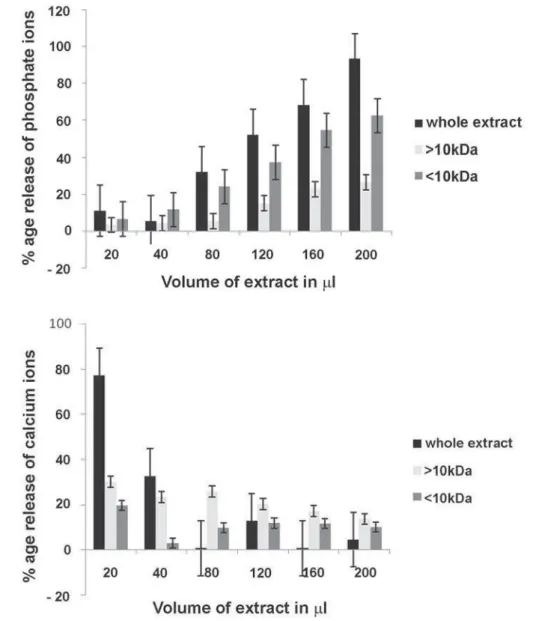
Release of phosphate ions increased with the increase of volume of different fractions. Maximum amount of phosphate was released with whole extract (Figure-3A). Percentage release of calcium ions were decreased with the increase of different extract volumes. Low volume of whole extract resulted in maximum release of calcium ions (Figure-3B).
Protein Estimation & SDS-PAGE
Protein content of crude (239.5μg/mL) and > 10 kDa (154.8μg/mL) fraction was high. < 10 kDa fraction had less (72.6μg/mL) amount of protein.
SDS-PAGE analysis revealed a large number of bands mainly (66 kDa, 80 kDa, 42 kDa) in whole extract and in > 10 kDa fraction (Figure-4). Faint bands of low molecular weight appeared in < 10 kDa lane (not shown in the image).
COMMENTS
most common cause of urinary tract disease (13). Among all types of kidney stones the frequency of calcium stone is 70-80%, struvite stone 5-10%, uric acid stone 5-10%, and cystine stone 1% (14). Calcium oxalate is the primary component of 70-80% of cal-cium stones (15-17) with calcal-cium phosphate being the predominant component in the rest of calcium stones. Calcium phosphate kidney stones include apatite
(carbapatite or hydroxyapatite (HAP)), brushite (Bru) and octacalcium phosphate (OCP) with the occurrence rate of apatite, 4-10%; Bru, 2-6%; and octacalcium phosphate, less than 1% (14). A recent study has reported that the occurrence of calcium phosphate containing stones has increased over time (18). Cal-cium phosphate occurs in stones in several different forms: amorphous calcium phosphate (ACP), HAP,
Figure 1 – Effect of various volumes of renal stone extract(whole extract, > 10kDa, < 10kDa) on initial mineral phase. Percentage inhibition/stimulation of phosphate ions (A) and calcium ions (B) by different renal stone extracts.
Bru, whitlockite, and carbonate apatite (CarbAp). The first product that precipitates is an ACP, which subsequently is converted to the crystal phases OCP and HAP or occasionally Bru. Hydroxyapatite is the thermodynamically most stable calcium phosphate crystal phase and it is also the major crystal phase in mixed calcium oxalate/calcium phosphate stones. Under certain conditions brushite (Bru; calcium hy-drogen phosphate) is formed (19-21).
In this study we determined whether the renal calculi organic matrix biomolecules of calcium oxalate had any functional role in calcium phosphate crystallization. Whole EGTA extract exhibited in-hibitory activity in initial and growth mineral phase. Stimulatory and inhibitory activity was shown by > 10 kDa fraction in initial mineral phase. Stimulatory activity was retained in growth mineral phase by this fraction. < 10 kDa had inhibitory activity in initial
Figure 2 – Percentage inhibition or stimulation of phosphate ions (A) and calcium ions (B) by different volumes of whole extract, > 10kDa and < 10kDa fractions of renal stone extract on the growth of preformed mineral phase.
mineral phase. Both types of activity was shown by < 10 kDa fraction in growth mineral phase.
High percentage of phosphate ion was re-leased with high volume of all the three fractions. However, the opposite trend was observed with calcium ion demineralization. It was found that high percentage of calcium ion was released with low volume of all the three fractions.
Romberg et al. have reported that macro-molecular modifiers of calcium oxalate
crystalliza-tion (4) are also active in the corresponding steps of calcium phosphate crystallization. There is, however, evidence that Mg, citrate, and pyrophosphate are the most important inhibitors of calcium phosphate crystal growth.
There are reports explaining the activity of uric acid binding protein (22) and calcium phosphate binding protein (23) on calcium oxalate crystalliza-tion. The predominant proteins found in organic matrices of CaOx crystals induced in the urine of
Figure 3 –Effect of various volumes of renal stone extract (whole extract, > 10kDa, < 10kDa) on demineralization of preformed mineral phase. Percentage of phosphate ions (A) and calcium ions (B) demineralized by different fractions of renal stone extract.
healthy controls were prothrombin-related proteins followed by albumin and osteopontin. In matrices of CaP crystals, the principal proteins were Tamm-Horsfall protein followed by albumin, prothrom-bin-related proteins and osteopontin (24). In our study, besides other bands, SDS-PAGE analysis also showed bands of MW ~ 66 kDa, 80 kDa and 42 kDa in whole EGTA extract lane and > 10 kDa fraction lane. Interestingly, their molecular weights are quite close to that of albumin, Tamm-horsfall protein and osteopontin/uropontin respectively. In our laboratory, very recently an anionic protein (MW ~ 42 kDa) with potent inhibitory activity against CaOx crystal growth was purified. It was identified by MALDI-TOF-MS followed by database search on MASCOT server as human phosphate cytidylyl-transferase 1, ß. Molecular weight of this novel CaOx crystal growth inhibitor from human renal stone matrix is also the same as that of human phosphate cytidylyltransferase 1, choline, β (25). Osteopontin (OPN) and Tamm-Horsfall protein (THP) are two major urinary macromolecules that exhibit various activities that can influence calcium crystallization in vitro (26,27). OPN is a ubiquitously expressed phosphoglycoprotein that regulates bone biominer-alization and ectopic calcification (28,29).
Therefore, our study suggest that both high and low molecular weight biomolecules extracted
from human renal matrix of calcium oxalate (CaOx) stones have a significant influence on calcium and phosphate (CaP) crystallization.
ACKNOWLEDGEMENTS
Jaypee University of Information Technology provided financial support to this research and the Department of Urology, Post Graduate Institute of Medical Education and Research, Chandigarh, India, provided the kidney stones.
CONFLICT OF INTEREST
None declared.
REFERENCES
1. Evan AP, Lingeman JE, Coe FL, Parks JH, Bledsoe SB, Shao Y, et al.: Randall’s plaque of patients with nephrolithiasis begins in basement membranes of thin loops of Henle. J Clin Invest. 2003; 111: 607-16. 2. Matlaga BR, Williams JC Jr, Kim SC, Kuo RL, Evan
AP, Bledsoe SB, et al.: Endoscopic evidence of calcu-lus attachment to Randall’s plaque. J Urol. 2006; 175: 1720-4; discussion 1724.
3. Pramanik R, Asplin JR, Jackson ME, Williams JC Jr: Protein content of human apatite and brushite kidney stones: significant correlation with morphologic mea-sures. Urol Res. 2008; 36: 251-8.
4. Bushinsky DA: Nephrolithiasis: site of the initial solid phase. J Clin Invest. 2003; 111: 602-5.
5. Romberg RW, Werness PG, Riggs BL, Mann KG: Inhibition of hydroxyapatite crystal growth by bone-specific and other calcium-binding proteins. Biochem-istry. 1986; 25: 1176-80.
6. Aggarwal S, Tandon CD, Forouzandeh M, Singla SK, Kiran R, Jethi RK: Role of biomolecules from human renal stone matrix on COM crystal growth. Mol Cell Biochem. 2000; 210: 109-19.
7. Bradford MM: A rapid and sensitive method for the quantitation of microgram quantities of protein utilizing the principle of protein-dye binding. Anal Biochem. 1976; 72: 248-54.
8. Kabra SG, Kabra V, Banerji P, Jain LK, Bhargava A, Chaturvedi RP: In vitro calculogenesis: methods to Figure 4 –SDS-PAGE showing bands in whole EGTA extract and
develop concretions of desired chemical composition. Indian J Exp Biol. 1978; 16: 212-7.
9. Bijarnia RK, Kaur T, Singla SK, Tandon C: A novel calcium oxalate crystal growth inhibitory protein from the seeds of Dolichos biflorus (L.). Protein J. 2009; 28: 161-8.
10. Trinder P: Colorimetric microdetermination of calcium in serum. Analyst. 1960; 85: 889-94.
11. Gomori HD: A modification of colorimetric phospho-rus determination for use with photoelectric colorim-eter. J Lab Clin Med. 1941; 27: 955-960.
12. Miyaoka R, Monga M: Use of traditional Chinese medicine in the management of urinary stone disease. Int Braz J Urol. 2009; 35: 396-405.
13. Amaro CR, Goldberg J, Amaro JL, Padovani CR: Metabolic assessment in patients with urinary lithiasis. Int Braz J Urol. 2005; 31: 29-33.
14. Morton AR, Wooltorton E: Nephrology in practice: a new series. CMAJ. 2002; 166: 195.
15. Herring LC: Observations on the analysis of ten thou-sand urinary calculi. J Urol. 1962; 88: 545-62. 16. Mandel NS, Mandel GS: Urinary tract stone disease in
the United States veteran population. II. Geographical analysis of variations in composition. J Urol. 1989; 142: 1516-21.
17. Tefekli A, Esen T, Ziylan O, Erol B, Armagan A, Ander H, et al.: Metabolic risk factors in pediatric and adult calcium oxalate urinary stone formers: is there any difference? Urol Int. 2003; 70: 273-7.
18. Mandel N, Mandel I, Fryjoff K, Rejniak T, Mandel G: Conversion of calcium oxalate to calcium phosphate with recurrent stone episodes. J Urol. 2003; 169: 2026-9.
19. Leusmann DB, Niggemann H, Roth S, von Ahlen H: Recurrence rates and severity of urinary calculi. Scand J Urol Nephrol. 1995; 29: 279-83.
20. Györy AZ, Ashby R: Calcium salt urolithiasis. Review of theory for diagnosis and management. Clin Nephrol. 1999; 51: 197-208.
21. Hesse A, Heimbach D: Causes of phosphate stone formation and the importance of metaphylaxis by urinary acidification: a review. World J Urol. 1999; 17: 308-15.
22. Kalaiselvi P, Udayapriya KL, Selvam R: Uric acid-binding proteins in calcium oxalate stone formers and their effect on calcium oxalate crystallization. BJU Int. 1999; 83: 919-23.
23. Nishio S, Hatanaka M, Takeda H, Aoki K, Iseda T, Iwata H, et al.: Calcium phosphate crystal-associated proteins: alpha-2-HS-glycoprotein, prothrombin frag-ment 1 and osteopontin. Int J Urol. 2001; 8: S58-62.
24. Atmani F, Khan SR: Quantification of proteins ex-tracted from calcium oxalate and calcium phosphate crystals induced in vitro in the urine of healthy controls and stone-forming patients. Urol Int. 2002; 68: 54-9. 25. Priyadarshini, Singh SK, Tandon C: Mass spectromet-ric identification of human phosphate cytidylyltrans-ferase 1 as a novel calcium oxalate crystal growth inhibitor purified from human renal stone matrix. Clin Chim Acta. 2009; 408: 34-8.
26. Devuyst O, Dahan K, Pirson Y: Tamm-Horsfall pro-tein or uromodulin: new ideas about an old molecule. Nephrol Dial Transplant. 2005; 20: 1290-4.
27. Kumar V, Lieske JC: Protein regulation of intrarenal crystallization. Curr Opin Nephrol Hypertens. 2006; 15: 374-80.
28. Giachelli CM, Steitz S: Osteopontin: a versatile regu-lator of inflammation and biomineralization. Matrix Biol. 2000; 19: 615-22.
29. Mo L, Liaw L, Evan AP, Sommer AJ, Lieske JC, Wu XR: Renal calcinosis and stone formation in mice lacking osteopontin, Tamm-Horsfall protein, or both. Am J Physiol Renal Physiol. 2007; 293: F1935-43.
Accepted after revision: December 20, 2009
Correspondence address:
Dr. C. Tandon
Biotechnology and Bioinformatics
Jaypee University of Information Technology Waknaghat, Solan, 173215, India
Tel: + 91 981 622-6719