*Correspondence: S. S. Roman. Universidade Regional Integrada do Alto Uruguai e das Missões, URI - Campus de Erechim. Av. Sete de Setembro, n.1621 - 99700-000 - Erechim - RS, Brasil. E-mail: [email protected]
A
rti
Pharmaceutical Sciences vol. 47, n. 3, jul./sep., 2011
Tissue injuries of wistar rats treated with hydroalcoholic extract of
Sonchus oleraceus
L.
Franciele Carla Prichoa
1, Silvane Souza Roman
2,*, Vanusa Manfredini
2¹Department of Biological Sciences, Faculty of Biological Sciences, Regional Integrated University of High Uruguay and Missions, URI-Campus Erechim, Rio Grande do Sul, ²Department of Health Sciences, Faculty of Biological Sciences and
Pharmacy, Regional Integrated University of High Uruguay and Missions, URI-Campus Erechim, Rio Grande do Sul
The use of plant species is emerging as an important alternative in the treatment of injuries. Therefore, the extract of Sonchus oleraceus 10% was employed in the repair of skin lesions. A total of 36 male Wistar rats were subjected to a punch injury and divided into three groups: a negative control, receiving no treatment, a positive control, treated with Dersani, and the experimental group treated with the extract. The injury was assessed macroscopically and microscopically. Morphometric data was collected at the 3rd, 5th and 7th postoperative day, and the experimental group showed greater changes in shrinkage of the lesion compared to control groups. On the 3rd postoperative day, the injury in the experimental group showed less necrotic tissue, lower slough and more granulation tissue in relation to the positive control group. On the 7th and 10th postoperative day, the injury in the experimental group showed lower slough compared to the positive control group. Microscopic analysis of lesions on the 5th postoperative day revealed increased ibroplasia in the experimental group compared to control groups, while on the 14th postoperative day less neovascularization was evident in the experimental group and increased formation of hair follicles in the negative control group. The extract of S. oleraceus provided tissue repair in accordance with normal physiological patterns thus conirming empirical evidence for its use.
Uniterms:Sonchus oleraceus/pharmacognosy. Skin lesions/treatment/experimental study. Wound healing/experimental study. Medicinal plants.
O emprego de espécies vegetais vem surgindo como alternativa no tratamento de lesões. Dessa forma, foi utilizado o extrato hidroalcoólico de Sonchus oleraceus a 10% na reparação de lesões cutâneas. Trinta e seis ratos machos Wistar, foram submetidos a uma lesão com “punch” e distribuídos em três grupos: controle negativo, não recebeu tratamento; controle positivo, tratado com Dersani; e o experimental, tratado com extrato. A lesão foi avaliada macroscopicamente e microscopicamente. Os dados morfométricos mostraram que no 3º, 5º e 7º dia pós-operação (DPO), o grupo experimental apresentou maior evolução na retração da lesão em relação aos grupos controles. No 3° DPO a lesão do grupo experimental apresentou menor tecido necrótico, menor esfacelo e maior tecido de granulação em relação ao grupo controle positivo. No 7° e 10º DPO, a lesão do grupo experimental apresentou menor esfacelo em relação ao grupo controle positivo. A análise microscópica das lesões revelou no 5º DPO maior ibroplasia no grupo experimental em relação aos grupos controles; no 14º DPO ocorreu menor neovascularização no grupo experimental e maior formação de folículos pilosos no grupo controle negativo. O extrato hidroalcoólico de S. oleraceus propiciou reparo tecidual obedecendo a padrões isiológicos normais e conirmando os dados empíricos de sua utilização.
INTRODUCTION
In recent years, a return to medical treatment, consi-dered by many health professionals as folk or nonscientiic medicine, has intensified, along with the gradual rein-troduction of many plant species, including weeds as an
alternative or complementary therapy (Garros et al., 2006).
The use of these plant species is an emerging alternative to some ineffective synthetic products that is linked to socioeconomic factors and a search by the population for treatments which are less aggressive to the body and
pro-duce fewer side effects (Coelho, 1998). Sonchus oleraceus
L. belongs to the Asteraceae family and is a grass-weed affecting several crops in Brazil. Originally from North Africa, Asia Minor and Europe and naturalized in Brazil, it is spreading to all regions with balmy weather, where it grows from September to March. It is an annual plant that is herbal, milky and popularly known by the name of milkweed, wild chicory, smooth, jealousy or locksmith (Jorge, Ferro 1987; Vieira, Barreto, 2006). The leaves of
S. oleraceus are eaten as salad in some regions. The whole plant is used in folk medicine in several regions of the country for stomach disorders, liver disease, a rheumatoid against wounds, sores, rashes, eczema, varicose ulcers and applied in the form of compresses or infusions. It has anti-inlammatory and diuretic properties, as well as a healing action when used externally (Lorenzi, Matos, 2008).
The plant’s chemical composition includes essential oils, steroids, resins, carbohydrates, phytosterine, alkaloi-ds, tannins, coumarins, lavonoids and saponins (Lorenzi,
Matos, 2008; Miyase, Fukushima, 1987; Guarrera et al.,
2008). Therapeutic studies with the plant species S.
ole-raceus are still scarce, although recent studies report its contraceptive action, and anxiolytic, anti-inlammatory
and antioxidant activity (Vilela et al., 2010; Nehir El,
Karakaya, 2004; Schaffer et al., 2005). Sonchus oleraceus
L. Milkweed is a weed that has been shown empirically to treat wounds and ulcers. Thus, the purpose of this study was to evaluate the effect of the extract of milkweed in the process of healing of skin in rats.
METHODS
The experiment was carried out at the Laboratories of Vegetable Biotechnology, Animal Experimentation, Microtécnica and Histology of the Regional Integrated University of High Uruguay and Missions - URI - Cam-pus Erechim/RS. All the ethical principles in animal experimentation advocated by the Brazilian Society of Laboratory Animal Science (SBCAL) were adopted. The research project was submitted to and approved by the
Re-search Ethics Committee (CEP) of the Regional Integrated University of Alto Uruguai and Mission, URI-Campus Erechim, under Protocol No. 32/TCA/09.
Collection and preparation of extract of S. oleraceus
Leaves, lowers and stems of milkweed (S. oleraceus)
were collected in January 2009 at a private estate in Upper Uruguay, Rio Grande do Sul, Brazil (herbarium specimens of the species were deposited at the Herbarium Father Bal-dwin Rambo, Regional Integrated University of High Uru-guay and Missions - Campus Erechim, under No. 11 506). The plant material was dried in an oven with forced air low at a temperature of 35 ± 1 °C to stabilize the active principles and achieve constant weight. The dried material was then pulverized in a blade grinder to obtain ine particles which were not sieved. Extraction was by cold maceration with vehicle extractor of 70% ethanol. A total of 50 grams of dried and ground plant material was added to 1000 mL of 70% ethanol solution for 24 hours for extraction, with
macerationperformed after 48 and 72 hours. The solution
was kept closed and protected from light. The liquid from iltration was evaporated in an oven with forced air low at a temperature of 35 ± 1 ºC to a constant weight for a period exceeding 24 hours. Residue from evaporation was considered the crude extract, which was then eluted with distilled water to obtain the concentration treatment of 10%. The yield of extract was calculated using the equation TEA (%) = (Mf / Mi) x 100 where, TEA refers to the total extract amount (%), Mi the initial mass of the sample (grams), and
Mf the inal mass of extract (g) according to Pansera et al.
(2003). A yield of 11.6 grams was obtained corresponding to 23.22% (w / v) of crude extract.
Experimental animals
A total of 36 male Wistar rats aged 60-90 days, supplied by the vivarium of the URI - Campus Erechim were used. During the study period, the animals were kept individually in polyethylene boxes under controlled temperature (22 ± 2 °C), humidity (50 ± 5%) and lighting,
with access to water and food “adlibitum” and a 12-hour
light/dark cycle.
Experimental model and treatment of injuries
thiopental 2.5% at doses of 40 mg/kg according to
Carre-garo et al. (2005). After immobilization the animals were
placed in the prone position to perform shaving and anti-sepsis of the dorsal region and posterior injury induction. A small fragment of skin (0.8 cm diameter) was removed on the dorsal cranial area extending to the dorsal muscle fas-cia using a dermal metal punch. The lesion was measured and then considered day 0 (zero) postoperatively (POD).
The animals were randomly divided into three groups where each group was subdivided according to
the analysis period on the 5th and 14th postoperative days
(POD). This gave a total of 18 animals for the 5th
posto-perative day (POD) and 18 for the 14th postoperative day
(POD). The treatment for all groups was given after the induction of injury and was in the form of an open curative applied twice a day (following the same schedule) in an amount suficient to fully cover the lesion (0.1 mL).
The negative control group (C-) received no tre-atment, but control animals were handled equally. The positive control group (C+) was treated with application
of Dersani®*, a curative medicine obtained commercially.
This consists of an oily lotion based on essential fatty aci-ds, with vitamins A and E, which revitalizes and maintains the skin’s moisture balance, improving its elasticity. The medicine contains caprylic acid, capric acid, lauric acid, soy lecithin, vitamin A and E and sunlower oil (linoleic acid) that helps prevent the formation of scabs and contri-butes to the restoration of skin integrity. The experimental
group was treated with the extract of milkweed (S.
olera-ceus) at a concentration of 10% (100 mg/mL).
Macroscopic analysis
At the 0, 3rd, 5th, 7th, 10th and 14th postoperative day
(respectively), animals of all groups were weighed and lesions analyzed for size of their ields and macroscopic as-pects (quantity of exudate and tissue type). All tests carried out before applying any topical agent, and for these tests as well as for all other painful procedures and/or stress, the animals were subjected to inhalation of anesthesia with diethyl ether 98%. Morphometric analysis was performed using calipers, where the transverse and longitudinal area of the lesion was measured. From these elements the area of the ellipse was calculated using the formula:
Area = π × a ÷ 2 × b ÷ 2, where π = 3.1416, a corresponds
to cross-sectional area and b corresponds to the area of
longitudinal lesion (Callegari-Jacques, 2008 ).
For morphological analysis, a hand-held magnifying glass with a two-times magniication was used, and the
parameters evaluated included the amount of exudate, and type of injury, classiied according to the scores: absent (0), little (1), moderate (2) and intense (3). The appearance
of the wound was deined as per Santos et al. (2005) into:
Necrotic Tissue, yellow or white; Slough, tissue stained black, brown or chestnut; Granulation Tissue, pink or red, moist and grainy; Epithelial Tissue, pink or bright tissue and Wound Closed, completely covered with epithelium. The data were evaluated according to the scores 0 (closed wound), 1 (epithelial tissue), 2 (granulation tissue), 3 (slough) and 4 (necrotic tissue).
Microscopic analysis
Histological analysis was performed with six ani-mals in each group. The aniani-mals were killed sequentially
on the 5th postoperative day (POD) or 14th postoperative
day (POD). The fragment of skin surrounding the lesion was collected for later histological processing in parafin and routine analysis by light microscopy. Histology slides with 4 mm-thick sections were stained with hematoxylin-eosin (HE) for general histological observation and with Mallory Trichrome (TM) for the study of collagen ibers,
in accordance with the directions of Carvalho et al. (1991)
and Santos et al. (2002). In the epidermis, the formation
of layers, degree of reepithelialization such as loose and dense dermis was evaluated while vasodilation, neovas-cularization, leakage of erythrocytes, vascular congestion, ibroplasia, the presence of sebaceous glands, sweat glands and hair follicles was also analyzed. These parameters were quantiied by scores deined as: 0: absent (0%), 1: minimal (0% to 25%), 2: moderate (25% to 50%) and 3: severe (50% to 75%) and then tabulated for statistical analysis.
Statistical analysis
The statistical data related to the animals’ body weight and morphometry were assessed using ANOVA followed by factor of Duncan. For the analysis of qualitative assessment of morphology (amount of exudate, wound type and total scores) and histological examination, the non-parametric Kruskal-Wallis and Mann-Whitney test were employed. The signiicance level was set at less than 5% (p <0.05) using Statistica software for Windows 5.1 (1997).
RESULTS
All animals recovered well from anesthesia and no deaths occurred during the experimental process. The
daily clinical evaluations showed adequate recovery, with all groups maintaining general condition, presence of physical activity and willingness to forage. During the observation period, no signiicant differences in body wei-ght between groups and days after surgery were recorded, revealing that even the animals submitted to inhalation anesthesia and surgery during the analysis showed no sig-niicant changes in body weight or toxic action mediated by the application of topical agents.
Macroscopic evaluation
Morphometric
The morphometric results of the area of lesions in control and experimental animals are shown in Table I. It was observed that the lesion area decreased gradually with time in all groups. This reduction was found in a linear fashion over the POD.
On the 3rd postoperative day the negative control
group and the experimental group had onset of tissue re-pair, with signiicant reduction of injury when compared
to the positive control group. On the 5th postoperative
day, the lesion area remained with signiicant reduction in negative controls and experimental animals versus the
control group. On the 7th postoperative day, a signiicant
reduction in lesion area (cm2) was observed among
expe-rimental rats compared to the control group. The lesion area of the negative control group showed no signiicant difference in relation to areas of injury compared to the
positive control and experimental groups. On the 10th
postoperative day, reduction in lesion area in animals of the experimental group was higher. However, no signii-cant difference was seen compared to control groups. On
the 14th postoperative day, areas of the lesions showed
no signiicant differences between the experimental and
control groups because the lesions of experimental rats had self-repaired (Table I).
Morphology
On the 3rd postoperative day, lesions of the animals
showed signiicant differences in necrotic tissue, slou-gh and granulation. The experimental group showed a reduction of necrotic tissue and slough and increased granulation compared to the control group. In contrast, the negative control group showed signiicant reduction only in the granulation tissue when compared to the ex-perimental group.
On the 5th postoperative day, signiicant differences
in the slough and granulation tissue in the lesions of the groups was evident. The experimental group showed signiicant difference with less slough and increased gra-nulation tissue in relation to the positive control group. Comparing the experimental group with the negative control group, a signiicant decrease was observed only for slough. No signiicant differences were observed in lesions in epithelial tissue necrosis.
On the 7th postoperative day, a signiicant increase
in the slough in the injury of the animals was evident in the positive control group compared to the experimental group. The control groups also showed greater intensity and thickening of crust formation. For the necrotic tissue, granulation and epithelial no signiicant differences were identiied between the lesions of experimental and control
groups. On the 10th postoperative day, the lesions of animals
in the positive control group showed signiicant increase in slough when compared to the experimental group. For the granulation and epithelial tissues, no signiicant differences were found between the experimental and control groups.
On the 14th postoperative day, there were no
signi-icant differences in tissue and epithelial sloughing of the
TABLE I - Morphometric analysis of tissue repair of injuries (cm2) among positive control, negative control and experimental groups
at 0, 3rd, 5th, 7th, 10th and 14th postoperative days (POD)
Postoperative Days (POD)
Groups
Value p Positive
Dersani® Negative ExperimentalExtract 10%
0 0.501 ± 0.116 0.543 ± 0.071 0.500 ± 0.109 0.5079
3rd 0.612 ± 0.160 0.458 ± 0.082 0.496 ± .126 0.0037 ªb
5th 0.527 ± 0.142 0.369 ± 0.095 0.346 ±0.073 0.0007 ªb
7th 0.423 ± 0.104 0.359 ± 0.097 0.234 ± 0.115 0.0219 b
10th 0.136 ± 0.040 0.127 ± 0.069 0.088 ± 0.009 0.6052
14th 0.006 ± 0.016 0.013 ± 0.018 - 0.2941
Values expressed as mean ± standard deviation, a signiicant difference between positive control and negative control groups, b
experimental and control groups. However, all animals in the experimental group had complete reepithelization of the lesion compared to control groups.
Microscopic evaluation
Epidermis
Judging from the histological parameters of healing
of the epidermis on the 5th and 14th postoperative day, no
signiicant differences were evident. The lesions in the animals from all groups showed complete formation of
layers by the 5th and 14th postoperative days. The
expe-rimental group showed greater intensity of reepitheliali-zation, without signiicant difference compared with the control groups.
Dermal
• Loose connective tissue
On the 5th postoperative day, no signiicant
diffe-rences for the parameters of loose connective tissue were evident in experimental and control groups. The control group showed negative scores with greater intensity for ibroplasia, whereas the experimental group showed a lo-wer intensity scores for vasodilation, with neither reaching signiicant differences.
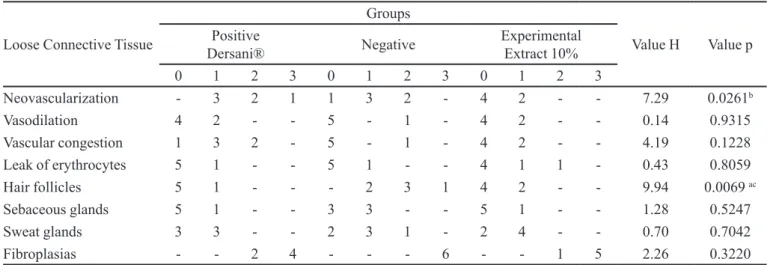
On the 14th postoperative day, the positive control
group showed a signiicant increase in neovasculariza-tion compared to the experimental group. In contrast, the negative control group, showed a signiicant increase in hair follicles compared to the positive control and
experi-mental groups. No changes between groups for the other parameters was shown (Table II).
• Dense connective tissue
On the 5th postoperative day, a signiicant increase in
ibroplasia was observed in the experimental group com-pared to control groups, indicating intense tissue repair. The negative control group showed a lower intensity of vasodilatation with no signiicant difference in relation to positive control and experimental groups. The other parameters showed no signiicant differences between groups (Table III).
On the 14th postoperative day, no significant
di-fferences were identiied for the parameters analyzed in dense connective tissue between the experimental and control groups.
DISCUSSION
Conventional wisdom drawn from the culture of people is considered the starting point for scientiic kno-wledge. Based on such knowledge, it is assumed more than 70% of drugs derived from plants were developed. Although there are counterpoints between scientiic kno-wledge and popular knokno-wledge in relation to the demands of building an accepted scientiic knowledge of medicinal plants, the steady integration of this knowledge contributes greatly to the acquisition of new knowledge, helping rese-archers in pursuit of cure for several diseases (Bittencourt
et al., 2002).
TABLE II - Number of animals according to intensity of loose dermal tissue repair (0 = absent, 1 = minimal, 2 = moderate, 3 = intense) in groups on 14th postoperative day (POD)
Loose Connective Tissue
Groups
Value H Value p
Positive
Dersani® Negative Experimental Extract 10%
0 1 2 3 0 1 2 3 0 1 2 3
Neovascularization - 3 2 1 1 3 2 - 4 2 - - 7.29 0.0261b
Vasodilation 4 2 - - 5 - 1 - 4 2 - - 0.14 0.9315
Vascular congestion 1 3 2 - 5 - 1 - 4 2 - - 4.19 0.1228
Leak of erythrocytes 5 1 - - 5 1 - - 4 1 1 - 0.43 0.8059
Hair follicles 5 1 - - - 2 3 1 4 2 - - 9.94 0.0069 ac
Sebaceous glands 5 1 - - 3 3 - - 5 1 - - 1.28 0.5247
Sweat glands 3 3 - - 2 3 1 - 2 4 - - 0.70 0.7042
Fibroplasias - - 2 4 - - - 6 - - 1 5 2.26 0.3220
a signiicant difference between positive control and negative control groups,b signiicant difference between positive control and
experimental groups, csigniicant difference between negative control and experimental groups, for p <0.05 by Kruskal-Wallis
Analyzing the results of morphometric and mor-phological evolution was observed in tissue repair in
animals treated with the extract of S. oleraceus. The more
pronounced tissue repair in the experimental group may have been due to less formation of crusts on the wound and the lower amount of exudate, particularly attributed to la-vonoids in the extract conferring these anti-inlammatory,
antioxidants and antibacterial properties (Schaffer et al.,
2005; Yin et al., 2007; Vilela et al., 2010). According to
Eurídes et al. (1998), lower crust formation explains the
performance of the product, facilitating reepithelialization since the presence of liquid in injury can affect the process of bacterial growth. The crust also impairs collagen
depo-sition and epithelialization of the lesions (Stadelmann et
al., 1988) and also prevents the products applied topically
from coming into close contact with the injured area.
At the 3rd and 5th postoperative days, the area of
injury of experimental rats showed signiicant differences in the lesion area versus the positive control group, as well as showing lesions with less exudates, reduced formation of necrotic tissue and slough and increased formation of granulation tissue compared to the positive control group. This factor was related to improvements in the process of shrinkage of lesions and may be linked to the activity of the
extract of S. oleraceus 10%. This effectiveness in wound
healing can be attributed to the lavonoids in extract of S.
oleraceus, corroborating their use as anti-inlammatory, antibacterial, antipyretic and antioxidant agents (Nehir
El, Karakaya, 2004; Schaffer et al., 2005; Yin et al., 2007;
Vilela et al., 2010) essential in the healing of wounds.
Ho-wever, the acceleration of the healing process displayed
on the 3rd and 5th postoperative day, although beneicial
through avoiding infection, can result in inal healing of
low quality (Campos et al., 2000).
The occurrence of the granulation tissue and
reduc-tion of exudate in the experimental group at the 3rd and 5th
postoperative days, indicate an improvement in retraction of the lesions as a result of shifting centripetal and contrac-tile activity of myoibroblasts in granulation tissue from the margins to the center of the lesion. After the initial reduction of the area, there is the resetting of the basement
membrane, optimizing reepithelialization (Mott et al.,
2003). This process of wound contraction is totally inde-pendent of the epithelialization process, occurring below the new epithelium formed and gradually disappearing, to the extent that the margins of the wound move to the center until joining (Swain, 1980). In the phase of ibroplasia that occurs after 48 hours of injury, the ibroblasts multiply and produce collagen. There is also intense endothelial proliferation at this stage, resulting in the formation of
granulation tissue (Sanchez-Neto et al., 1993).
From the 7th postoperative day, the lesion area in the
experimental group was found to be well-differentiated compared with the control groups, especially versus the positive control group. The morphological analysis also showed lower formation of slough for the experimental group compared to the positive control group, indicating again a breakthrough in the repair process by the extract.
From the 10th postoperative day, lesions in the
experimen-tal group had already self-repaired compared to control groups. The fact that there was no signiicant difference
in lesion area among groups at both the 10th and the 14th
TABLE III - Number of animals according to intensity of dense dermal tissue repair (0 = absent, 1 = minimal, 2 = moderate, 3 = intense) in groups on 5th postoperative day (POD)
Dense Connective Tissue
Groups
Value H Value p
Positive
Dersani® Negative ExperimentalExtract 10%
0 1 2 3 0 1 2 3 0 1 2 3
Neovascularization - 2 4 - - 2 4 - - 2 4 - - 1
Vasodilation - 2 3 1 - 1 5 - 1 3 2 - 1.04 0.5931
Vascular congestion - 1 3 2 - 1 4 1 1 3 2 - 0.27 0.8727
Leak. of erythrocytes 1 4 1 - 2 2 2 - 1 4 1 - 3.70 0.1565
Hair follicles 6 - - - 5 1 - - 6 - - - 0.31 0.8539
Sebaceous glands 5 1 - - 6 - - - 6 - - - 0.31 0.8539
Sweat glands 5 1 - - 6 - - - 5 1 - - 0.31 0.8538
Fibroplasias - 2 4 - - 2 3 1 - - - 6 11.09 0.0039bc
postoperative days was due to morphological repair of lesions in the experimental rats.
In the epidermis, based on the microscopic ratings of
lesions on the 5th and 14th postoperative days showing no
signiicant differences, better reepithelialization of expe-rimental and positive control groups was seen compared to the negative control group where the greater intensity of reepithelialization in these groups indicated eficient healing. In contrast, for layering, all groups independent of treatment, showed gradual and complete layering over
the postoperative days. On the 14th postoperative day, the
loose connective tissue lesions in experimental rats sho-wed less neovascularization compared with the control groups, indicating that lesions in the experimental group had been in the process of remodeling. According to
Solór-zano et al. (2001), the process of remodeling of the wound
involves the balance between synthesis and degradation of collagen, reducing the vascularization and iniltration of inlammatory cells until the lesion reaches maturity. Thus, a tissue injury is completely repaired when it presents formation of its skin appendages, increased ibroplasia and decreased neovascularization (Kierzenbaum, 2004). According to Stashak (1994), neovascularization promotes healing by increasing the supply of nutrients and cells in the affected area, reducing the retraction time of the lesion. In contrast, the oxygen tension decreased in the lesion site due to insuficient blood supply causes the inhibition of migration of ibroblasts and collagen synthesis resulting in risks and complications in wound healing (Gogia, 2003).
On the 14th postoperative day, it was also possible
to verify in loose connective tissue lesions of the animals in the negative control group, a significant increase in the number of hair follicles versus the positive control and experimental groups, evidencing that the negative control group showed adequate compensation for the in-jured tissue. The negative control group also showed no signiicant difference and greater formation of glands. An injury is considered fully repaired when presenting skin appendages, as these are requirements of the skin so that it can fully perform its function (Kierszenbaum, 2004).
In the analysis of dense connective tissue, on the 5th
postoperative day, the experimental group showed a high degree of ibroplasia with thicker collagen iber compared to control groups. The formation of collagen is crucial when it comes to tissue repair, however, if production is exaggerated in pathological situations featuring an exces-sive inlammatory phase, the limited production of colla-gen results in a scar with susceptibility to dehiscence with formation of broad, inelastic, slim and fragile scar tissue (Weinzweig, 2001). Collagens are major extracellular ma-trix proteins comprising approximately 25% of total body
protein mass with a fundamental role in tissue architecture, resistance of the tissues and in a wide variety of cell-cell and cell-matrix interactions (Baynes, Dominickzac, 2000).
According to Tiago (1997), the evolution and matu-ration of the scar occurs by the deposition of collagen at the wound site. Moreover, to bring this about, maturation is required for neovascularization of tissue oxygenation
(Greca et al., 2000), as anoxia leads to the synthesis
of unstable collagen and formation of fibers with less mechanical strength. Microscopic analysis of lesions in the experimental group showed intense fibroplasia on
the 5th postoperative day. However, the large increase in
ibroplasia did not occur simultaneously with increased neovascularization, which implies an inadequate process of tissue repair. Adzick (1999) suggested that the forma-tion of new vessels simultaneously with the ibroplasia is essential for healing since the growth of new blood vessels have to follow the progress of ibroblasts into the wound to provide their metabolic needs. If failures occur in angiogenesis, migration of ibroblasts and the healing of the lesion are impaired.
The results of this study, considering the various pa-rameters, showed gradual and continuous evolution of the phases of tissue repair in animals treated with the extract of
S. oleraceus and the Dersani commercial product (positive control). It was found that the extract acted more promi-singly in the repair of injuries since, provided adequate conditions for the restoration of the lesions, it accelerated external repair, followed by gradual repair procedure with the formation of thick collagen ibers. In contrast, the Der-sani provided slower external repair concomitantly with internal repair and gradual formation of thinner collagen
ibers. The healing effect of hydroalcoholic S. oleraceus
may be strongly attributed to the strong presence of tannins and lavonoids, since the participation of these compoun-ds have proven action in the healing process, as well as possessing anti-inlammatory, analgesic, wound healing, antimicrobial and antioxidant properties (Cowan, 1999;
Carvalho et al., 2003).
CONCLUSIONS
The similarity of the extract of S. oleraceus at 10%
in terms of healing, with the commercial product Dersa-ni, which has a proven effect, conirms the importance of studies related to the effects of medicinal plants. The progression of lesions is critical in the process of repair by secondary intention. Thus, we suggest carrying out
further studies to examine the therapeutic effect of S.
detrimental to the organism, because there is a strong re-lationship between the concentration of an extract and its
activity coeficient in the vehicle (Lachman et al., 2001).
Thus, the use of S. oleraceus for skin lesions in humans
remains an open ield of study and its therapeutic actions are still being explored in our laboratories.
REFERENCES
ADZICK, N.S. Cicatrização de ferida: características biológicas e clínicas. In: SABISTON, J.R.; DAVID, C.; LYERLY, H.K. (Eds.) Tratado de cirurgia: as bases biológicas da prática cirúrgica moderna. 15.ed. Rio de Janeiro: Guanabara Koogan, 1999. v.1.
BAYNES, J.; DOMINICKZAC, M. Bioquímica médica. 2.ed. São Paulo: Artes Médicas, 2000. 566 p.
BITTENCOURT, S.C.; CAPONI, S.; FALKENBERG, M.B. O uso das plantas medicinais sob prescrição médica: pontos de diálogo e controvérsia com o uso popular. Rev. Bras.
Farmacog., v.12, n.1, p.89-91, 2002.
CALLEGARI-JAQUES, S.M. Bioestatística: princípios e aplicações.Porto Alegre: Artmed, 2008. 255 p.
CAMPOS, M. C. P. S.; COELHO, M. C. O. C.; SILVA, L. B. G.; MONTEIRO, V. L. C.; LIMA, E. T.; ACETO, M. L. Tratamento de feridas infectadas utilizando Calendula oficinalis. Rev. Homeop. Bras., v.6, n.1, p.22-28, 2000.
CARREGARO, A. B.; CASTRO, M. B.; MARTINS, F. S. Estudo da ação inflamatória aguda do tiopental intraperitoneal em ratos. Arq. Bras. Med. Vet. Zootec., v.57, n.2, p.191-195, 2005.
CARVALHO, P.S.P.; TAGLIAVINI, D.G.; TAGLIAVINI, R.L. Cicatrização cutânea após aplicação tópica de creme de calêndula e da associação de confrei, própolis e mel em feridas infectadas: estudo clínico e histológico em ratos. Rev. Cienc. Biomed.., v.12, n.1, p.33-38, 1991.
CARVALHO, M.C.; BARCA, F.N.; AGNEZ-LIMA, L.F.; MEDEIROS, S.R. Evaluation of mutagenic activity in an extract of Peper tree pepper tree stem bark (Schinus terebinthifolius Raddi). Environ. Mol. Mutagen., v.42, n.1, p.185-191, 2003.
COELHO, M.C.O.C.; REZENDE, C.M.F.; TENÓRIO, A.P.M. Contração de feridas após cobertura com substitutos temporários de pele. Cienc. Rural,v.29, n.2, p.297-303, 1998.
COWAN, M.M. Plant products as antimicrobial agents. Clin. Microbiol. Rev., v.12, n.4, p.564-582, 1999.
EURÍDES, D.; MAZZANTI, A.; GONÇALVES, G.F.; BELLETI, M.E.; SILVA, L.A.F.; FIORAVANTE, M.C.S.; CHAVES, N.S.T.; BOMBONATO, P.P.; CAMPOS, V.A.; OGATA, A.S. Aspectos morfológicos,morfométricos e histológicos da reparação tecidual de feridas cutâneas de camundongos tratadas com óleo de copaíba (Copaifera langsdorii). Vet. Notícias, v.4, n.1, p.77-82, 1998.
GARROS, I.C.; CAMPOS, A.C.L.; TÂMBARA, E.M.; TENÓRIO, S.B.; TORRES, O.J.M.; AGULHAM, M.A.; ARAÚJO, A.C.F.; SAINS-ISOLAN, P.M.B; OLIVEIRA, E.M.; ARRUDA, E.C.M. Extrato de Passilora edulis na cicatrização de feridas cutâneas abertas em ratos: estudo morfológico e histológico. Acta Cir. Bras., v.21, supl.3, p.55-65, 2006. [periódico na internet]. Available at: <http:// www.scielo.br/acb>. Accessed on: 28 may 2010.
GOGIA, P.P. Feridas, tratamento e cicatrização.1.ed. Rio de Janeiro: Livraria e Editora: Revinter, 2003. 192 p.
GRECA, F.H.; BIONDO-SIMÕES, M.L.P.; COLLAÇO, L.M.; MARTINS, V.D.M.; TOLAZZI, A.R.D.; GASPARETTO, E.L.; SANTOS, E.A.A. A ação dos ácidos graxos de cadeia curta na cicatrização de anastomoses colônicas: estudo experimental em ratos. Acta Cir. Bras., v.15, n.3, p.12-16, 2000.
GUARRERA, P.M.; LUCCHESE, F.; MEDORI, S. Ethnophytotherapeutical research in the high Molise region (Central-Southern Italy). J. Ethnobiol. Ethnomed., v.4, n.1, p.7, 2008.
JORGE, L.I.F.; FERRO, V.O. Identificação de Sonchus oleraceus L.(serralha): principais características estruturais e químicas. Rev. Bras. Farmacogn., v.2,3,4, p.67-77, 1987.
KIERSZENBAUM, A.L. Histologia e biologia celular: uma introdução a patologia. 1.ed. Rio de Janeiro: Editora Elsevier, 2004. 680 p.
LACHMAN, L.; LIEBERMAN, H.A.; KANING, J.L. Teoria e prática na indústria farmacêutica. 5. ed. Lisboa: Fundação Calouste Gulbenkian, 2001. p.907-953.
MIYASE, T.; FUKUSHIMA, S. Studies on sesquiterpene glycosides from Sonchus oleraceus. Chem. Pharm. Bull., v.35, n.7, p.2869-2874, 1987.
MOTT, K.J.; CLARK, D.P.; STELLJES, L.S. Regional variation in wound contraction of mohs surgery defects allowed to heal by second intention. J. Dermatol. Surg., v.29, n.7, p.712-722, 2003.
NEHIR EL, S.; KARAKAYA, S. Radical scavenging and iron-chelating activities of some greens used as traditional dishes in Mediterranean diet. Int. J. Food Sci. Nutr., v.55, n.1, p.67-74, 2004.
PANSERA, M.R.; SANTOS, A.C.A.; PAESE, K.; WASUM, R.; ROSSATO, M.; ROTA, L.D.; PAULETTI, G.F.; SERAFINI, L.A. Análise de taninos totais em plantas aromáticas e medicinais cultivadas no nordeste do Rio Grande do Sul. Rev. Bras. Farmacogn., v.13, n.1, p.17-22, 2003.
SANCHEZ-NETO, R.; BARONE, B.; TEVES, D.C.; SIMÕES, M.J.; NOVO, N.F.; JULIANO, Y. Aspectos morfológicos e morfométricos da reparação tecidual de feridas cutâneas de ratos com e sem tratamento com solução de papaína a 2%. Acta Cir. Bras.,v.8, n.1, p.8-23, 1993.
SANTOS, L.O.M.; SIMÕES, M.L.P.B.; MACHADO, A.P.B.; MATIOSKI FILHO, G.R.; ENDO, P.C.; GRUEN, G.R.; CIPRIANI, V.R.; MESQUITA, L.D. Efeito da somatotropina sobre a cicatrização de feridas cutâneas em ratos. Acta Cir. Bras., v.17, n.4, p.220-224, 2002.
SANTOS, V. L. C. G; AZEVEDO, M. A. J.; SILVA, T. S.; CARVALHO, V. M. J.; CARVALHO, V. F. Adaptação transcultural do Pressure Ulcer Scale for Healing (push), para a língua portuguesa. Rev. Latino-Am. Enferm., v.13, n.3, p.305-313, 2005.
SCHAFFER, S.; SCHMITT-SCHILLIG, S.; MÜLLER, W.E.; ECKERT, G.P. Antioxidant properties of Mediterranean food plant extracts: geographical differences. J. Physiol.
Pharmacol., v.56, n.1, p.115-124, 2005.
SOLÓRZANO, O.T.; REYNA, H.H.; VELÁZQUEZ, J.L.L.; AGUILAR, J.P.; VALENCIA, M.G. Evaluación de la actividad reepitelizante del Triticum vulgare en La cervicitis crônica erosiva. Rev. Fac. Med. UNAM, v.44, n.1, p.8-11, 2001.
STADELMANN, W.K.; DIGENIS, A.G.; TOBIN, G.R. Physiology and healing dynamics of chronic cutaneous wounds. Am. J. Surg., v.176, n.2, suppl.1, p.26-38,1998.
STASHAK, T.S. Principles of wound healing. In: STASHAK, T.S. (Ed.). Equine wound management.London: Editora Lea & Febiger, 1994. 144 p.
SWAIN, S. F. Surgery of traumatized skin: management and reconstruction in the dog and cat. London: Editora Saunders, 1980. 585 p.
TIAGO, F.Feridas: etiologia e tratamento. 4. ed. Ribeirão Preto: Fundação de Apoio a Pesquisa e Assistência do Hospital das Clínicas da Universidade de São Paulo, 1997. 155 p.
VIEIRA, B.S.; BARRETO, R.W. First record of Bremia lactucae infecting Sonchus oleraceus and Sonchus asper in Brazil and its infectivity to lettuce. J. Phytopathol., v.154, n.2, p.84-87, 2006.
VILELA, F.C.; BITENCOURT, A.D.; CABRAL, L.D.M.; FRANQUI, L.S.; SONCINI, R.; GIUSTI-PAIVA, A. Anti-inlammatory and antipyretic effects of Sonchus oleraceus L.in rats. J. Ethnopharmacol., v.127, n.3, p.737-741, 2010.
YIN, J.; KWON, G-J.; WANG, M-H. The antioxidant and cytotoxic activities of Sonchus oleraceus L. extracts. Nutr. Res. Pract., v.1, n.3, p.189-194, 2007.
WEINZWEIG, J. Segredos em cirurgia plástica. 1.ed. Porto Alegre: Editora Artmed, 2001. 822 p.
Received for publication on 9th August 2010