Effects of structural factors on upwelling fouling community, Southeast
Brazil
To assess the successional pattern of fouling
organisms three hypotheses were tested: 1) a
thermocline is caused by seasonal upwelling events,
and therefore, depth inluences the successional
trajectory of the fouling community; 2) a reduction
in the intensity of natural light of the substrate
inluences the fouling composition and the
successional trajectory; 3) ish predation inluences
the community composition and its successional
trajectory. During one year, up-facing and
down-facing PVC panels on open, partially caged or fully
caged, and placed at depths of 1.5 and 3.5 meters were
monthly sampled by digital photograph to determine
the community composition and by contact point
to estimate the percent coverage of organisms. The
upwelling impact provided diferent water masses,
and light intensity was also a determining factor of
the overall successional trajectory of the fouling
community. After the installation of full and partial
cages, diferences were identiied in the respective
successional trajectories. The results of this study
suggest that each physical factor or biological
process can change the successional trajectory of
the community, and the successional model (e.g.,
convergent, divergent, parallel, or cyclic) depends
on the magnitudes of the determinants that act on
the community at each stage of its trajectory.
A
bstrAct
Bruno Pereira Masi
1, Ilana Zalmon
2*, Ricardo Coutinho
31 Universidade do Estado do Rio de Janeiro.
2 Universidade Estadual do Norte Fluminense Darcy Ribeiro.
(Av. Alberto Lamego 2000, 28013-602, Campos dos Goytacazes, RJ, Brazil.) 3 Instituto de Estudos do Mar Almirante Paulo Moreira.
(Divisão de Biotecnologia Marinha, Rua Kioto 253, 28930-000, Arraial do Cabo, RJ, Brasil.)
*Corresponding author: [email protected]
Descriptors:
Biofouling, Successional processes,
Multi-experimental design, Predation.
Para avaliar o padrão sucessional de organismos
incrustantes, três hipóteses foram testadas: 1) uma
termoclina é causada por eventos de ressurgência e,
portanto, a profundidade inluencia na trajetória su
-cessional da comunidade incrustante; 2) a redução
na intensidade de luz natural no substrato inluencia
a composição da comunidade e a trajetória
sucessio-nal; 3) a predação por peixes inluencia a composi
-ção da comunidade e sua trajetória sucessional.
Du-rante um ano, faces inferiores e superiores de painéis
de PVC em gaiolas abertas, parcial e totalmente
fe-chadas em profundidades de 1,5 e 3,5 metros foram
amostradas mensalmente por fotograia digital para
determinar a composição da comunidade por
ponto--contato e estimar a porcentagem de cobertura dos
organismos. Diferentes massas de água resultantes
da ressurgência e diferentes intensidades de luz
fo-ram fatores determinantes na trajetória sucessional
da comunidade. Após a instalação de gaiolas parcial
e totalmente fechadas, foram identiicadas diferen
-ças nas respectivas trajetórias. O resultado deste
es-tudo sugere que cada fator físico ou processo
bioló-gico pode alterar a trajetória de desenvolvimento de
uma comunidade, e o modelo sucessional (ex.
con-vergente, dicon-vergente, paralelo ou cíclico) depende da
magnitude dos fatores determinantes que atuam em
cada etapa de sua trajetória.
r
esumo
Descritores:
Bioincrustação, Processos sucessionais,
Desenho multi-experimental, Predação.
INTRODUCTION
Ecological succession is the changing pattern in the composition and abundance of organisms at a given spatial scale over time (CONNELL; SLATYER, 1977; TILMAN, 1990). This concept is fundamental to the principles of community ecology and has been studied based on sequential in situ observations over speciic units of time using experimental manipulations and/or conceptual models (reviewed by PRACH; WALKER, 2011). The predominant mechanisms involved in the ecological succession of benthic communities are: facilitation, inhibition and tolerance (CONNEL; SLATYER, 1977), multiple stable points (SUTHERLAND; KARLSON, 1977), random colonisation (LAWTON, 1987), and competition between individuals (HUSTON; SMITH, 1987).
The benthic rocky shore community can be viewed
as a mosaic of patches at diferent successional stages (MENGE et al., 2005). The irst substantial application
of the idea of multiple stable states in marine community ecology was proposed by SUTHERLAND (1974), i.e.,
diferences in life history driven by repeated disturbances
that continuously cause permanent changes. The temporary climax described by SUTHERLAND and KARLSON (1977) and SUTHERLAND (1984) occurs because of the life histories of its components, the availability of resources, or the presence of numerous potentially dominant species.
Several studies have identiied environmental
factors and biological processes that can explain
diferent fouling community patterns, such as the role of
environmental stress (SOUSA, 2001), depth (STARK, 2008), sedimentation and light intensity (IRVING; CONNELL, 2002), shade (GLASBY, 1999), and predation (CONNELL; ANDERSON, 1999).
Successional patterns in communities related to consolidated substrates vary with water depth (BRAM et
al., 2005). According to these authors, depth afects the
intensity of recruitment and the distribution and coverage
of late successional species, but does not inluence the early
development sequence of the community (<4 months).
These depth efects on the composition and structure of benthic communities were observed on artiicial substrates
in the Baltic Sea by QVARFORDT et al. (2006) and in Ryder Bay, on the Antarctic Peninsula, by STARK (2008). The light propagation decreases with depth in marine environments, which is a determining factor of the structure
and function of phytobenthic communities (reviewed by RIER et al., 2006). Additionally, observations indicate that marine invertebrates are dominant in shaded surfaces (GLASBY, 1999), as the larval stages of many marine invertebrates display photonegative behaviour (PAWLIK, 1992).
Seasonality in coastal benthic ecosystems causes
environmental luctuations in parameters such as
temperature and nutrient enrichment (COMA et al., 2000). According to HINRICHSEN (2009), the physical oceanographic variables of greatest importance for species biology and behaviour are the sea surface temperature,
the mixing of waters of diferent depths, the presence
and depth of the thermocline, the strength of upwelling, surface ocean currents, and sea ice. The Cabo Frio region, located on the southeast coast of Brazil, is subjected to the seasonal upwelling of cold water from the south, with lower water temperatures (<18 °C) occurring during spring and summer, and higher water temperatures during fall and winter, the period with low frequency of upwelling events. During the austral spring-summer, the upwelling
events are prevalent and cause stratiication of the water
column and the intrusion of cold, nutrient-rich waters even in shallower ones. During the austral autumn-winter, there is a homogenization of the water column. Lower temperatures, as low as 13 °C, and higher nitrate and
phosphate concentrations, approximately 10 and 0.8
μg-at.l−1, respectively, characterize the upwelling conditions (GUIMARAENS et al., 2005). According to MASI et al. (2015), the intensity and frequency of seasonal upwelling
events might afect the environmental variability due to particular oceanographic characteristics and may inluence
the level of stress that the fouling community experiences, with divergent successional trajectories.
Among biotic factors, the relative importance
of predation at diferent successional stages of the
community depends on the magnitude of the recruitment rate and strength of the predator-prey interaction (VIEIRA et al., 2012), which may be strongly related to the predator species in benthic communities of consolidated
natural (CONNELL; ANDERSON, 1999) and artiicial
(HACKRADT et al., 2011) substrates.
Manipulative experiments can identify diferent
A multi-experimental approach related to simultaneous experiments with identical access to the environmental
characteristics allows for the examination of the inluence
of each factor or biological process on various ecological assemblages over time. Additionally, experiments conducted in upwelling ecosystems also help to further elucidate the connections among pelagic and benthic processes (reviewed by LÓPES; COUTINHO, 2008; MAZZUCO et al., 2015).
The aim of the present study was to investigate the structuring factors of fouling communities in a tropical upwelling ecosystem by monitoring their successional trajectories on experimental panels, and simultaneously
investigating the efects of depth, orientation of the substrate, and ish predation. Three hypotheses have
been tested: H1. A thermocline is created in association with seasonal upwelling events, and consequently, depth
inluences the successional trajectory of the fouling
community; H2. The orientation of the substrate, which
dictate the intensity of natural light, inluences the
composition of the fouling community and, consequently, the successional trajectory; H3. Fish predation inluences the composition of the benthic community and, therefore, the successional trajectory of the fouling community.
MATERIAL AND METHODS
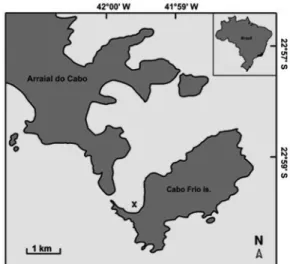
The study was conducted at Cabo Frio Island (23°00’04.46’’ S, 42°00’20.19’’ W), southeastern Brazil (Figure 1), in a small sandy cove surrounded by rocky shores, where upwelling events are frequent and intense. VALENTIN et al. (1987) have demonstrated the
signiicant inluence of the local winds on the luctuation
in the thermocline. Discrete upwelling events may occur throughout the year but are more intense and frequent during the spring-summer months (GUIMARAENS et al., 2005). Sedimentation rates for open waters in the Cabo
Frio upwelling zone range from 0.26 mm.year–1 to 0.66
mm.year–1 (MAHIQUES et al., 2005), and there is no
continental inluence on shallow waters that could alter
this condition.
Experimental design
Five multi-experiment units were aixed to
the substrate and each individually supported three experimental PVC panels (20 × 15 cm), arranged
horizontally, at two diferent depths, approximately 1.5
and 3.5 m (Figure 2). The local depth is around 5 m and
Figure 1. Location of the study area (×) on the Cabo Frio Island, Rio de Janeiro, southeastern Brazil.
Figure 2. Schematic of the multi-experimental biofouling structure. The treatments are depicted with their respective levels. Depth: 1.5 and 3.5 m; Orientation: up-facing and down-facing; Predation: open panel, partially caged panel and fully caged panel.
tidal variation is approximately 1.5 m. Each structure was composed of a PVC tube (5 m high and 20 cm diameter) supported on a cement block weighing approximately 350 kg. The multi-experiment units were placed at a distance of 10 m from each other, parallel to the beach line.
The multi-experiment design addressed
three effects:
a. Efect of depth was assessed at two levels (1.5 and 3.5
m) with panels inserted horizontally in the experimental
structure ixed to the substrate. The presence of distinct
water masses distributed vertically along the water column and temporally across periods of upwelling was assessed
are covered by each functional group are estimated. Thus, the relative abundance of the biota is calculated.
The taxonomic nomenclature followed the ‘ITIS -
Integrated Taxonomic Information System’ (ITIS, 2009).
Discrete functional or taxonomic groups were deined
based on DE MESSANO et al. (2009). Encrusting
coralline algae (Corallinales, Rhodophyta) were identiied
as an exclusive functional group.
The ish community was sampled qualitatively by
the stationary visual observation method adapted from BROTTO et al. (2007), in which the diver records the
presence of ish for 5 minutes at a distance of 3 metres.
Fish were grouped into trophic categories based on the main diets of adults following FERREIRA et al. (2004).
The interaction behaviour was classiied as ‘feeding’ when a ish was preying on panel organisms, as ‘shelter’ when a ish remained stationary above or next to the panels, and as ‘no interaction’ when a ish was only observed swimming
close to the experimental structure.
Data analysis
The structure of the thermal dome was assessed by
the diferences in temperature measured simultaneously
between 1.5 and 3.5 m. Values equal to 0 indicate homogeneity of the water column, whilst negative and positive values indicate vertical heterogeneity of the water column. Negative values show thermal dome inversion with higher temperature at 3.5 m. The temperature was determined by the number of upwelling events measured
in each study month. The diferences in the average light
intensity values on both depth and orientation treatments were analysed by Student’s t-tests.
The biofouling community structure was compared considering two sampling depths (1.5 and 3.5 m), the panel orientation (down-facing and up-facing) and the predation
inluence (open panel, fully and partially caged panel)
through a matrix of the species percent cover (arcsine-square-root transformed data) of the representative species and through a non-metric multidimensional scaling (nMDS) ordination using the Bray–Curtis similarity index (CLARKE; WARWICK, 2001). The comparative analysis of the community considering each treatment included an analysis of similarity (ANOSIM) to test for
signiicant diferences. The species’ contributions to the
similarities among assemblages were calculated using
the identiication of fouling associations (CLARKE;
WARWICK, 2001). The multivariate analyses were performed using the PRIMER v.6 statistical software. recorded the temperature every hour simultaneously at the
two experimental depths throughout the panel immersion period, from July 2009 to July 2010.
b. Efect of light was tested by analysing two panel
orientations: 1) up-facing and 2) down-facing. The light intensity was measured near the surface of the panels (down-facing X up-facing), with N=28 down-facing
panels and N=28 up-facing panels). The coeicient of
light extinction was calculated by in situ measurements with a Li-cor data logger (LI-1000) coupled to a LI-193SA Underwater Spherical Quantum Sensor. Since there was
no signiicant diference on light intensity of the same face on diferent depths, and due to the higher hydrodynamics at the shallower depth, the light efect was tested on 3.5
m panels.
c. Efect of ish predation was tested at the 3.5-m depth,
also due to higher hydrodynamics at the shallower depth, and included three levels: 1) open panel, freely
accessed by ish, 2) fully caged panel, to exclude ish,
and 3) partially caged panel to control for the exclusion
artefact. The efectiveness of the cages was examined by
comparing the open and partially caged panels. The panels were immersed for six months without any treatment, and subsequently, the cages were inserted to examine
the efects of ish predation on the already established
community. Full and partial cages were constructed of plastic 1-cm2 mesh screens to prevent access by all ish,
except small juveniles and families such as Blenniidae and Gobiidae, which are not usually predators of sessile epibiota according to Connell (2001). Physical cleaning of the cages was performed every 10 days by removing organisms attached to the mesh screen.
Experimental panels were immersed on 17 July 2009 and four subsequent fouling community samplings were performed: 19 October 2009 (month 3), 17 January 2010 (month 6), 15 April 2010 (month 9), and 27 July 2010 (month 12). Divers performed non-destructive sampling by collecting in situ photographs, which prevented possible interferences generated by the manipulation of the panels and provided a permanent photographic record of the data. Photographic sampling was conducted using a 12-megapixel digital camera (model DC1200 SeaLife) in
the macro mode, designed for short ixed distances.
RESULTS
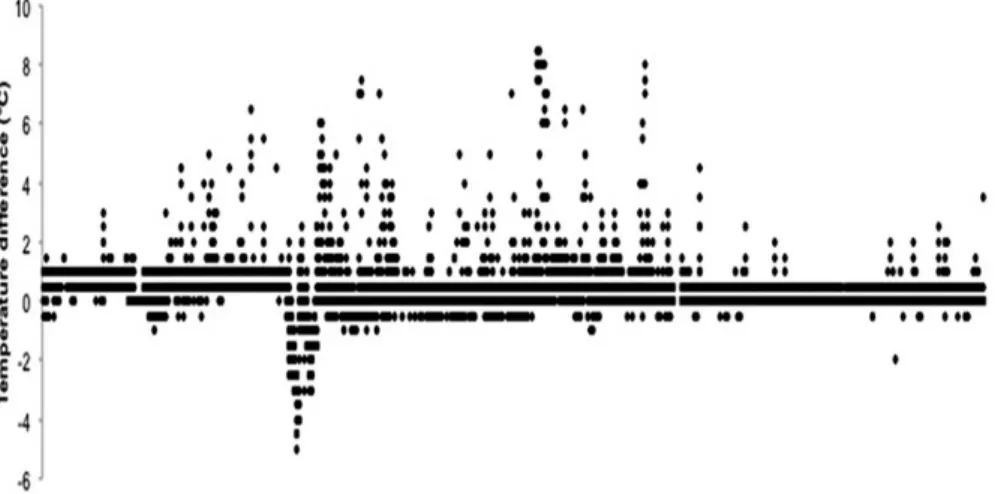
During the immersion panels, 4,505 temperature records were collected at each depth. The minimum and maximum temperatures were higher at the shallower depth (1.5 m: 15 and 33 °C; 3.5 m: 13.5 and 31.5 °C).
The greatest diferences in temperature between depths
occurred from September 2009 to March 2010, which corresponds to the austral spring-summer period (Figure
3). This stratiication in the water column indicates the
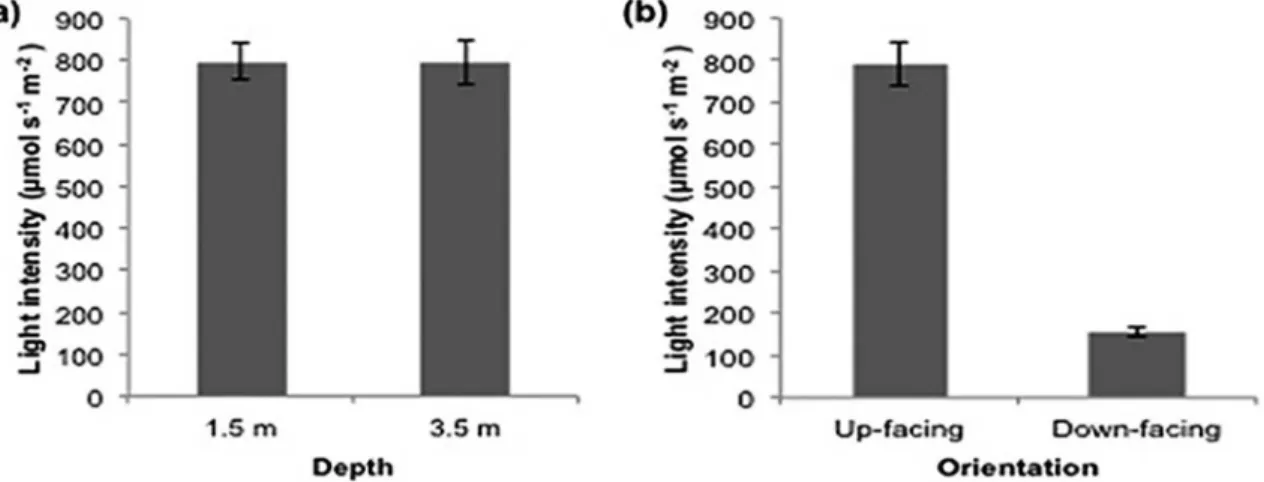
high frequency of upwelling events during this period. The average light intensity on the up-facing surface of the panels was 792.9±52.5 µmol s-1 m-2 at 1.5 m, and
797.2±43.3 µmol s-1 m-2 at 3.5 m, with no signiicant
diference (p=0.82) (Figure 4a). At 3.5 m, a signiicantly (p=0.00) lower light intensity was observed for the down-facing surfaces (156.5±11.2 µmol s-1 m-2) compared to the
up-facing surfaces (792.9±52.5 µmol s-1 m-2) (Figure 4b).
Considering all the treatments (depth, light and predation), the fouling community included seven taxonomic groups of invertebrates and six functional groups of algae. Filamentous macroalgae (Ectocarpaceae), sponges (Amorphinopsis sp., Dysidea etherea, Oceanapia
nodosa and Mycale microsigmatosa), hydroids (Pennaria
sp. and Obelia dichotoma), and barnacles (Megabalanus
coccopoma, Amphibalanus amphitrite and Balanus
trigonus) occurred in all the treatments. Diatoms (Nitzschia
and Navicula) and articulated calcareous macroalgae
(Jania sp.) were not recorded on the down-facing
surface of the panels. Corticated macrophyte (Codium
spongiosum) was observed on the down-facing surface
and in the fully caged panels. Mussel (Perna perna) and
gastropods (Anachis and Stramonita haemastoma) were
observed on the partially and fully caged panels. Fouling bryozoans (Savignyella lafonti and Schizoporella errata) were absent at 1.5 m, and colonial ascidians (Symplegma spp and Didemnum spp) were observed at 1.5 m and in the fully caged panels (Table 1).
Discrimination between bioilm 1 and 2 was performed based on observations of diferent colours and their occurrence at diferent stages in the successional trajectory: bioilm 1 was present irst after the substrate was immersed and bioilm 2 during the successional trajectory.
Effect of depth
The fouling community difered signiicantly between
the 1.5 and 3.5 m depths at the month 3 (ANOSIM: r=0.81, p=1.8%) and month 6 (ANOSIM: r=0.462, p=3.6%). At month
9 (ANOSIM, r=0.21, p=16.1%) and month 12 (ANOSIM,
r=0.174, p=21.4%), the depth efect was not signiicant. At 9 and 12 months, the sampling units were more dispersed in the n-MDS ordination, showing that the successional trajectories
do not converge at the diferent depths (Figure 5).
The dissimilarity between the associations at the 1.5- and 3.5-m depths increased along the successional trajectory (SIMPER: month 3=22.7%, month 6=35.3%, month 9=50.5%, month 12=58.6%), and seven taxonomic
Figure 3. Temperature diference between the depths of 1.5 and 3.5 m, indicating the heterogeneity of the water column on Cabo Frio Island during
Figure 4. Mean values and standard deviations of light intensity (µmol s-1 m-2) on the up-facing surface of the experimental panels in Cabo Frio
Island at the 1.5- and 3.5-m depths (A) and on the up- and down-facing surfaces of the 3.5-m panels.
Table 1. Taxonomic (invertebrates) and functional (algae) groups recorded on the experimental panels at Cabo Frio Island from July 2009 to July 2010. Functional groups are indicated in the text by the code recorded in the second column.
Group Code 1.5 m 3.5 m Up-facing Down-facing Open panel Full cage panel Partial cage panel
Bioilm 1 BI + + + - + + +
Bioilm 2 MI + + + - + + +
Articulate calcareous Algae
CA + + + - + + +
Crostose algae CR + + + + + +
-Filamentous algae FI + + + + + + +
Corticated macrophytes MC - - - + - +
-Sponge ES + + + + + + +
Hydrozoa HI + + + + + + +
Bivalve BI - - - + +
Gastropoda GA - - - + +
Cirripedia CI + + + + + + +
Encrusting bryozoan BI - + + + + + +
Colonial ascidian AC + - - - - +
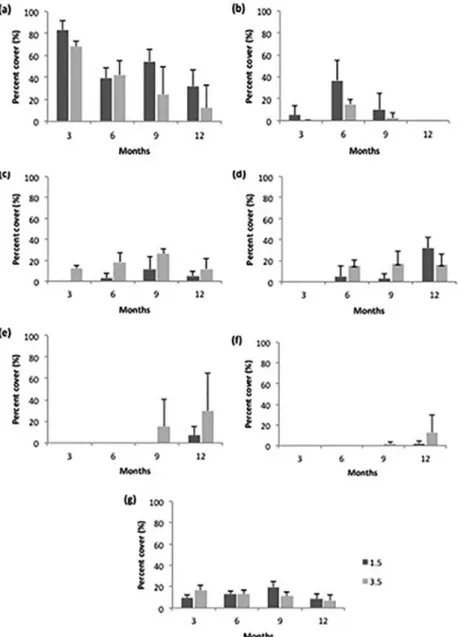
-groups contributed the most to these diferences (Figure 6): ilamentous algae at month 3 (Figure 6a); ilamentous algae, bioilm 2, barnacles and hydroids at month 6 (Figs 6a, b, c, d); ilamentous algae, barnacles, and hydroids at
month 9 (Figure 6a, c, d); hydroids, articulate calcareous algae and sponges at month 12 (Figure 6d, e, f). The amount of bare space increased until month 9 (Fig 6g).
Effect of light
The efect of the substrate orientation on the fouling community was signiicant, with diferences between the
up-facing and down-facing of the experimental panels on both successional trajectory: month 3 (ANOSIM:
r=0.898, p=0.8%), month 6 (ANOSIM: r=0.99, p=0.8%),
month 9 (ANOSIM: r=0.62, p=1.6%), and month 12
(ANOSIM: r=0.714, p=0.8%). The diferences among
Figure 5. Non-metric multidimensional scaling of the fouling community at each sampling period (3, 6, 9, and 12 months) and depth (1.5 and 3.5 m).
Figure 6. Mean values and standard deviations of the percent cover of the fouling organisms that contributed most to the dissimilarity between
the 1.5- and 3.5-m depths at 3, 6, 9 and 12 months (a. Filamentous algae, b. Bioilm 2, c. Cirripedia, d. Hydrozoa, e. Articulate calcareous algae, f.
Sponge, g. Bare space).
The dissimilarity between the communities of the up- and down-facing surfaces of the panels increased along the successional trajectory (SIMPER: month 3=22:16%, month 6=54.4%, month 9=59.4%, month 12=72.2%); nine taxonomic groups contributed the most to these
diferences (Figure 8): ilamentous algae at month 3 (Figure 8a); ilamentous algae, hydroids, barnacles, and bioilm 2 at month 6 (Figure 8a, b, c, d); hydroids,
Figure 7. Non-metric multidimensional scaling of the fouling community at each sampling period (3, 6, 9, and 12 months) and panel orientation (up-facing and down-facing).
more abundant on the up-facing surface at almost all stages, although with a decreasing trend (Figure 8i).
Effect of predation
The fouling community difered signiicantly on
the open and fully caged panels at month 9 (ANOSIM:
r=0.231, p=2.7%; Dissimilarity=58.7%) and month 12
(ANOSIM, r=0.339, p=2.2%; Dissimilarity=59.6%). The
efectiveness of the exclusion artefact, when comparing
the open panel and partially caged treatments, resulted in
signiicant diferences at 9 (ANOSIM: r=0.356, p=1.6%; Dissimilarity=52.5%) and 12 months (ANOSIM: r=0.448,
p=2.4%; Dissimilarity=66.6%). The taxonomic groups that
contributed to these diferences the most were hydroids
(33.3%), articulate calcareous algae (26.2%), and sponges (28.8%).
In the period preceding the exclusion treatment (3 and
6 months), the panels were dominated by ilamentous algae and bioilm 2 (Figure 9a, b). At 9 months, the open panels were characterised by ilamentous algae and barnacles
(Figure 9a, c), and the panels with partially and fully caged panels were dominated by hydroids (Figure 9d). At 12 months, the open panels were predominated by cirripedia and articulate calcareous algae (Figure 9c, e), the fully caged panels by hydrozoa and sponges (Figs 9d, f), and the partially caged panels by articulate calcareous algae and sponges (Figure 9e, f). The proportion of bare space did
not difer between the exclusion treatments and displayed a
decreasing trend (Figure 9g).
The qualitative sampling of the ish community
surrounding the multi-experimental biofouling structure
recorded 12 species including ive trophic categories (Table
2): omnivores (n=5), invertivores (n=3), carnivores (n=2),
herbivores (n=2) and piscivores (n=1). Interactions of ish
with the fouling community for food (n=5 species) and shelter (n=3 species) were observed for the carnivorous,
invertivorous and omnivorous ish. The herbivorous and piscivorous ish were not recorded interacting with the
experimental panels (Table 2).
DISCUSSION
The environmental stress can be considered a
disturbance that redeines the successional processes of communities at diferent stages, creating the mosaic pattern
that characterise several marine ecosystems (SOUZA, 2001). The characteristics of each patch may vary due to intrinsic and extrinsic factors, including species interactions, dispersal, physical disturbance and environmental stress (MENGE et al., 2005). The patch isolation represented by the experimental panels increased their independence,
enabling the formation of diferent assemblages. On a
quarterly scale, the sampling units exhibited an increasing dissimilarity over 12 months, probably due to the spatial heterogeneity in the fouling composition that resulted from the panel isolation in the various multi-experimental structures, generating independent samples.
A multi-experimental approach, such as that employed in the study, maximises the amount of general information concerning the main structuring factors of the community,
allowing for the assessment of the inluence of a single
factor and the ones to be considered in future multi-experimental designs (ROBERTS et al., 2011; CONNELL, 2001). For ecological succession, three components should be considered, according to PRACH and WALKER, 2011:
the model, stages, and trajectory. Hereafter, the efects
of the factors that structure the fouling community were analysed by addressing these components.
Considering the efect of depth along the successional trajectory, signiicant diferences were observed in the
Figure 8. Mean values and standard deviations of the percent cover of the fouling organisms that contributed most to the dissimilarity between the
up- and down-facing surfaces of the 3.5-m deep panels at 3, 6, 9, and 12 months (a. Filamentous algae, b. Hydrozoa, c. Cirripedia, d. Bioilm 2, e.
Encrusting bryozoan, f. Crustose calcareous algae, g. Articulate calcareous algae, h. Sponge, i. Bare space).
MENGE (2000), oceanographic changes with ecologically
signiicant consequences, such as variations in the supply
of food, may occur in seasonal upwelling regimes.
Temperature is a key factor of biological patterns
and processes that inluence the vital biochemical and
physiological rates, including the survival, growth and reproduction of organisms, and consequently determines “when” and “where” species can survive (DRINKWATER et al., 2010; KORDAS et al., 2011). The fouling community on Cabo Frio Island is composed of macroalgae and
sessile ilter feeders, whose internal temperatures vary considerably with luctuations in the ambient temperature (13.5 to 33 °C) and are therefore strongly inluenced by
the physical characteristics of their local environment (COMA et al., 2000). SKINNER et al. (2007) have reported that, for a barnacle species Tetraclita stalactifera, higher
temperatures may have a greater inluence on growth
than food availability in cold-water masses, such as the upwelling waters in the study area.
The supply of nutrients to plankton and benthic micro
and macroalgae, and consequently iltering organisms, has
a strong inluence on bottom-up control of trophic systems
(WIETERS et al., 2009) and therefore on the structure and dynamics of marine benthic communities (MENGE, 2000). In the region of Cabo Frio, GUIMARAENS et al. (2005) have suggested that the increased concentrations of nutrients during upwelling events can sustain greater algal
biomass; this idea was conirmed by the predominance of ilamentous algae at months 3, 6 and 9 and articulated
calcareous macroalgae at month 12, mainly at 3.5 m, up to threefold more upwelling events than at 1.5 m.
Figure 9. Mean values and standard deviations of the percent cover of the fouling organisms that contributed most to the dissimilarities among the open, partially caged and fully caged panels at the 3.5-m depth before (month 3 and month 6) and after (month 9 and month 12) the introduction of
sampling artefacts (a. Filamentous algae, b. Bioilm 2, c. cirripedia, d. Hydrozoa, e. Articulate calcareous algae, f. Sponge, g. Bare space).
Table 2. Fish present in the vicinity of the multi-experiment biofouling structure, including species, family, trophic group, and type of interaction.
Species Family Trophic Group Interaction
Holocentrus adscensionis Holocentridae Carnivore 1 Feeding
Pseudupeneus maculatus Mullidae Invertivore 1 Feeding
Stephanolepis hispidus Monacanthidae Omnivore 1 Feeding
Caranx sp. Carangidae Piscivore 2 No interaction
Haemulon aurolineatum Haemulidae Invertivore 1 Shelter
Halichoeres poeyi Labridae Invertivore 2 No interaction
Diplectrum formosum Serranidae Carnivore 3 No interaction
Kyphosus sectatrix Kyphosidae Herbivore 1 No interaction
Abudefduf saxatilis Pomacentridae Omnivore 1 Feeding
Diplodus argenteus Sparidae Omnivore 1 Feeding
Acanthurus bahianus Acanthuridae Herbivore 1 No interaction
Parablennius pilicornis Blenniidae Omnivore 3 Shelter
Coryphopterus sp. Gobiidae Omnivore 1 Shelter
model can be applied to the Cabo Frio region, and this weather condition is important in determining the patterns
of cirripedia larval supply and recruitment, relected in
both spatial and temporal variability (MAZZUCO et al., 2015).
The homogeneity of the water column during non-upwelling periods subjects the benthic assemblages at the two depths to similar environmental conditions, as
relected by the greater similarity between the communities at 9 and 12 months. The irst hypothesis that the presence of the thermocline is inluenced by seasonal upwelling events, and therefore, depth inluences the successional
trajectory of the fouling community was corroborated;
the successional stages difered between 1.5 and 3.5 m
during the austral spring-summer, when upwelling events
are prevalent and cause stratiication of the water column
and the intrusion of cold, nutrient-rich waters. During the austral autumn-winter, there is a homogenisation of the water column, and the oceanographic conditions are more similar at both depths. In summary, the possibility of a convergence or divergence in the successional trajectory related to the seasonality of the local environmental conditions was observed in association with periods with or without upwelling.
The efect of light intensity (sevenfold greater on
the up-facing side of the panels) on the successional
trajectory of the fouling community was relected in the
dominance of sessile invertebrates in the more shaded
environments at 3.5 m deep, with signiicant diferences
and increasing dissimilarity along the successional stages for both substrate orientations, with the dominance of photophyla species on the up-facing panels and scyaphyla ones on the down-facing panels. Two organisms played a key role in the observed pattern: articulated calcareous
macroalgae (Jania sp.) were present only on the
up-facing surface, whilst the fouling bryozoan Schizoporella
errata occurred exclusively on the down-facing surface.
Jania sp. requires light, which is more intense on the
up-facing surface of the panel. The increasing coverage of the fouling bryozoan corroborates reports in the literature that Schizoporella adults strongly inhibit the recruitment
and growth of other species at diferent periods in time
(SUTHERLAND, 1978). The dominance of sessile invertebrates in the shaded areas is often explained by observations of larval behaviour in the laboratory, with many species, mainly bryozoans and ascidians, exhibiting photonegative behaviours at the end of their pelagic larval stage (reviewed by IRVING; CONNELL, 2002).
According to IRVING and CONNELL (2002), the abundance of sessile invertebrate on bottom-facing surfaces and the lower coverage of algae is a good indicator of low light intensity. However, this may not always be the main cause of such patterns; the build-up of sediments can be detrimental to the survival of various organisms, preventing or reducing larval settlement and favouring organisms that have already become established. The
possible inluence of sediment could be disregarded in our
study, due to the relatively shallow depth, no continental
inluence on shallow waters that could alter this condition
and active circulation, all of which acted to prevent the accumulation of sediment on the experimental panels.
The second hypothesis that a reduction in the intensity of natural light, related to the orientation of the substrate,
inluences the composition of the fouling community, and
consequently the successional trajectory, was accepted.
The down-facing panel surface experienced a signiicant reduction in light intensity, inluencing the composition
of the fouling community and its trajectory. According to PRACH and WALKER (2011) successional trajectories can be convergent, divergent, parallel, circular, or form complex networks of successional pathways. Comparing the up- and down-facing surfaces of the panels at Cabo Frio Island, the trajectories of the fouling community
are classiied as parallel because they difer from the
beginning to the end of the panel immersion experiment.
Considering the efect of predation on the successional
trajectory of the fouling community on Cabo Frio Island, the results suggest that the high predation intensity and
their efects on the benthic composition are related to the
predator trophic habit. Considering the trophic groups (omnivores, herbivores, invertivores and carnivores),
fouling predation by ish was observed around the
experimental structures. The species Stephanolepis
hispidus, which is omnivorous and abundant at Cabo Frio
Island (FERREIRA et al., 2004), was the most frequently species interacting directly with the experimental panels before the addition of cages. Bite marks were observed,
indicating disturbance through predation of ilamentous
macroalgae at 3.5 m. The typically tropical species
Diplodus argenteus is common in Cabo Frio (FERREIRA
recolonization by ilamentous algae, thus initiating a
continuous successional process. Other papers regarding
the efect of predator on fouling communities on Brazil
include VIEIRA et al. (2016) and ORICCHIO et al. (2016).
Small ish of the families Blenniidae and Gobiidae living
in association with the substrate (GIBRAN; MOURA, 2012) were recorded inside the cages. The cages were
designed to prevent access to ish, except small juveniles
and Blenniidae and Gobiidae, which do not generally prey on sessile biota according to CONNELL (2001). The fouling assemblages in the open and partially caged panels
difered signiicantly, indicating the potential inluence of the sampling artefact on predation. One possible efect
is shading, as the coverage of several species of algae is reduced under such conditions (GLASBY, 1999; IRVING;
CONNELL, 2002). The lowest coverage of ilamentous
and articulated calcareous algae in the panels with partial
cages compared to open panels corroborates the indings
reported in the literature. The cage cleaning protocol was performed at an interval of 10 days, indicating the need for
shorter intervals to minimise the inluence of light. Despite the inluence of shading through the sampling
artefact, a comparison of the fouling assemblages in
the open and fully caged panels revealed signiicant diferences at 9 and 12 months. The greater abundance of ilamentous algae followed by barnacles on the open
panels resulted from predation by Stephanolepis hispidus on the macroalgae, providing space for these opportunistic algae to recolonize and dominate, and consequently, the association remained on an early successional stage. Filamentous algal forms are more nutritious and digestible (FERREIRA et al., 1998). Recently, CECCARELLI et
al. (2011) found that herbivorous ish (farmers) in the
Great Barrier Reef in Australia had a drastic impact on succession, essentially precluding the development of the algal community, which was dominated by palatable
ilamentous algae.
Regarding the efect of predation, it is worth noting
that up to the sixth month, before the inclusion of sampling
artefacts, the panels did not difer signiicantly. After the installation of the full and partial cages, diferences in
the respective successional trajectories were observed.
However, the detection of the artefact efect prevents us from accepting the alternative hypothesis that ish predation afects the fouling community.
It is possible to conclude that changes in hydrological characteristics associated with depth in a seasonal upwelling environment allowed for the formation of
multiple stable states in the system (sensu SUTHERLAND, 1974; SUTHERLAND; KARLSON, 1977). In addition to the upwelling, which provided distinct water masses,
light efect was a determining factor in the successional
trajectory of the fouling community at a scale of 12 months.
The results of this study suggest that each physical factor can alter the trajectory of succession and, consequently, the composition of the community. The successional model acting on the fouling community will depend on the magnitude of the determinant factor (e.g. depth, light intensity), acting on the community at each stage. If the community tends to a particular successional trajectory, e.g. convergent, divergent, parallel or cyclic, it can change as the acting successional model varies over time. Therefore, the fate of a fouling community is not predetermined but is guided by intrinsic and extrinsic factors, which will act as determining factors of the changes in the successional model.
ACKNOWLEDGEMENTS
This work was funded by the Brazilian Agencies CNPq (Conselho Nacional de Desenvolvimento
Cientíico e Tecnológico) and FAPERJ (Fundação
de Amparo à Pesquisa do Estado do Rio de Janeiro - FAPERJ/PRONEX Proc No E-26/111.438/2010). We are grateful to the Biofouling Laboratory (IEAPM) team for
ield assistance.
REFERENCES
BRAM, J. B.; PAGE, H. M.; DUGAN, J. E. Spatial and temporal variability in early successional patterns of an invertebrate
as-semblage at an ofshore oil platform. J. Exp. Mar. Biol. Ecol.,
v. 317, p. 223-237, 2005.
BROTTO, D. S.; KROHLING, W.; ZALMON, I. R.
Comparati-ve evaluation of ish assemblages census on an artiicial reef.
Rev. Brasil. Zool., v. 24, n. 4, p. 1157-1162, 2007.
CECCARELLI, D. M.; JONES, G. P.; MCCOOK, L. J.
Interac-tions between herbivorous ish guilds and their inluence on
algal succession on a coastal coral reef. J. Exp. Mar. Biol. Ecol., v. 399, n. 1, p. 60-67, 2011.
CLARKE, K. R.; WARWICK, R. M. Change in marine commu-nities: an approach to statistical analysis and interpretation. 2nd ed. Plymouth: PRIMER-E, 2001. 172 p.
COMA, R.; RIBES, M.; GILI, J. M.; ZABALA, M. Seasonality in coastal benthic ecosystems. Trends Ecol. Evol., v. 15, n. 11, p. 448-453, 2000.
CONNELL, S. D. Predation ish do not always afect the early de -velopment of epibiotic assemblages. J. Exp. Mar. Biol. Ecol., v. 260, n. 1, p. 1-12, 2001.
CONNELL, S. D.; ANDERSON, M. J. Predation by ish on as
-semblages of intertidal epibiota: efects of predator size and
patch size. J. Exp. Mar. Biol. Ecol., v. 241, n. 1, p. 15-29, 1999.
DE MESSANO, L. V. R.; SATHLER, L.; REZNIK, L. Y.;
COU-TINHO, R. The efect of biofouling on localized corrosion of
the stainless steels N08904 and UNS S32760. Int. Biodeter. Biodegr., v. 63, n. 5, p. 607-614, 2009
DRINKWATER, K. F.; BEAUGRAND, G.; KAERIYAMA, M.; KIM, S.; OTTERSEN, G.; PERRY, R. I.; PÖRTNER, H. O.; POLOVINA, J. J.; TAKASUKA, A. On the processes linking climate to ecosystem changes. J. Mar. Sys., v. 79, n. 3-4, p. 374-388, 2010.
FERREIRA, C. E. L.; GONÇALVES, J. E. A.; COUTINHO, R.
Community structure of ishes and habitat complexity in a
tropical rocky shore. Environ. Biol. Fishes, v. 61, n. 4, p. 353-369, 2001.
FERREIRA, C. E. L.; FLOETER, S. R.; GASPARINI, J. L.; FERREIRA, B. P.; JOYEUX, J. C. Trophic structure patterns
of Brazilian reef ishes: a latitudinal comparison. J. Biogeogr.,
v. 31, n. 7, p. 1093-1106, 2004.
FERREIRA, D. E. L.; PERET, A. C.; COUTINHO, R. Seasonal
grazing rates and food processing by tropical ish. J. Fish
Biol., v. 53, n. sA, p. 222-235, 1998.
GIBRAN, F. Z.; MOURA, R. L. The structure of rocky reef ish
assemblages across a nearshore to coastal islands’ gradient in Southeastern Brazil. Neotrop. Ichthyol., v. 10, n. 2, p. 369-382, 2012.
GLASBY, T. M. Efects of shading on subtidal epibiotic assem -blages. J. Exp. Mar. Biol. Ecol., v. 234, n. 2, p. 275-290, 1999. GUIMARAENS, M. A.; PAIVA, A. M.; COUTINHO, R. Mode-ling Ulva spp. dynamics in a tropical upwelMode-ling region. Ecol. Modell., v. 188, n. 2-4, p. 448-460, 2005.
HACKRADT, C. W.; FÉLIX-HACKRADT, F. C.;
GARCÍA--CHARTON, J. A. Inluence of habitat structure on ish as
-semblage of an artiicial reef in southern Brazil. Mar. Envi -ron. Res., v. 72, n. 5, p. 235-247, 2011.
HINRICHSEN, H. H. Biological processes and links to the phy-sics. Deep Sea Res. Part II Top. Stud. Oceanogr., v. 56, n. 21-22, p. 1968-1983, 2009.
HUSTON, M. A. & SMITH, T. M. 1987:Plant succession: life history and competition. Am. Nat. 130: 168-198.
IRVING, A. D.; CONNELL, S. D. Sedimentation and light pene-tration interact to maintain heterogeneity of subtidal habitats: algal versus invertebrate dominated assemblages. Mar. Ecol. Progr. Ser., v. 245, p. 83-91, 2002
ITIS - Integrated Taxonomic Information System. 2009. Availa-ble at: < http://www.itis.gov>. Accessed: 1 Sep. 2016. KOHLER, K. E.; GILL, S. M. Coral Point Count with Excel
ex-tensions (CPCe): A Visual Basic program for the determina-tion of coral and substrate coverage using random point count methodology. Comput. Geosci., v. 32, n. 9, p. 1259-1269, 2006.
KORDAS, R. L.; HARLEY, C. D. G.; O’CONNOR, M. I.
Com-munity ecology in a warming world: The inluence of tempe
-rature on interspeciic interactions in marine systems. J. Exp.
Mar. Biol. Ecol., v. 400, n. 1-2, p. 218-226, 2011.
LAWTON, J. H. Are there assembly rules for successional com-munities? In: GRAY, A. J.; CRAWLEY, M. J.; EDWARDS, P. J. (Eds.). Colonization, succession and stability. Oxford:
Blackwell Scientiic Publications, 1987. p. 225-244.
LÓPEZ, M. S.; COUTINHO, R. Acoplamento Plâncton-Bentos: o papel do suprimento larval na estrutura das comunidades bentônicas de costões rochosos. Oecol. Brasili., v. 12, n. 4, p. 575-601, 2008.
MAHIQUES, M. M.; BICEGO, M. C.; SILVEIRA, I. C. A.; SOUSA, S. H. M.; LOURENÇO, R. A.; FUKUMOTO, M. M. Modern sedimentation in the Cabo Frio upwelling system, Southeastern Brazilian shelf. An. Acad. Brasil. Ciênc., v. 77, n. 3, p. 535-548, 2005.
MASI, B. P.; COUTINHO, R.; ZALMON, I. Successional trajec-tory of the fouling community on a tropical upwelling ecosys-tem in southeast Rio de Janeiro, Brazil. Braz. J. Oceanogr., v. 63, n. 2, p. 161-168, 2015.
MAZZUCO, A. C. A.; CHRISTOFOLETTI, R. A.; PINEDA J.; STARCZAK, V. R.; CIOTTI, A. M. Temporal variation in intertidal community recruitment and its relationships to physical forcings, chlorophylla concentration and sea surface temperature. Mar. Biol., v. 162, n. 9, p. 1705-1725, 2015. MENGE, B. A. Top-down and bottom-up community regulation
in marine rocky intertidal habitats. J. Exp. Mar. Biol. Ecol., v. 250, n. 1-2, p. 257-289, 2000.
MENGE, B. A.; ALLISON, G. W.; BLANCHETTE, C. A.; FAR-RELL, T. M.; OLSON, A. M.; TURNER, T. A.; VAN TA-MELEN, P. Stasis or kinesis? Hidden dynamics of a rocky intertidal macrophyte mosaic revealed by a spatially explicit approach. J. Exp. Mar. Biol. Ecol., v. 314, n. 1, p. 3-39, 2005. ORICCHIO, F. T.; FLORES, A. A. V.; DIAS, G. M. The impor-tance of predation and predator size on the development and structure of a subtropical fouling community. Hydrobiologia, v. 776, n. 1, p. 209-219, 2016.
PAWLIK, J. Induction of marine invertebrate larval settlement: evidence for chemical cues. In: PAUL, V. J. (Ed.). Ecological roles of Marine Natural Products. New York: Cornell Univer-sity Press, 1992. p. 189-236.
PRACH, K.; WALKER, L. R. Four opportunities for studies of ecological succession. Trends Ecol. Evol., v. 26, n. 3, p. 119-123, 2011.
QVARFORDT, S.; KAUTSKY, H.; MALM, T. Development of fouling communities on vertical structures in the Baltic Sea. Estuar. Coast. Shelf Sci., v. 67, n. 4, p. 618-628, 2006. RIER, S. T.; STEVENSON, R. J.; LALIBERTE, G. D.
Photo--acclimation response of benthic stream algae across experi-mentally manipulated light gradients: a comparison of growth rates and net primary productivity. J. Phycol., v. 42, n. 3, p. 560-567, 2006.
ROBERTS, L. W.; BUTCHER, P. A.; BROADHURST, M. K.; CULLIS, B. R. Using a multi-experimental approach to
as-sess the fate of angled-and-released yellowtail kingish ( Se-riola lalandi). ICES J. Mar. Sci., v. 68, n. 1, p. 67-75, 2011.
SAZIMA, I. Similarities in feeding behaviour between some
ma-rine and freshwater ishes in two tropical communities. J. Fish
Biol., v. 29, n. 1, p. 53-65, 1986.
SKINNER, L. F.; SIVIERO, F. N.; COUTINHO, R. Comparative growth of the intertidal barnacle Tetraclita stalactifera
SOUSA, W. P. Natural disturbance and the dynamics of marine benthic communities. In: BERTNESS, M. D.; GAINES, S. D.; HAY, M. E. (Eds.). Marine Community Ecology. Sunder-land: Sinauer Associates, 2001. p. 85-130.
STARK, J. S. Patterns of higher taxon colonisation and develop-ment in sessile marine benthic assemblages at Casey Station, Antarctica, and their use in environmental monitoring. Mar. Ecol. Progr. Ser., v. 365, p. 77-89, 2008.
SUTHERLAND, J. P. Multiple stable points in natural communi-ties. Am. Nat., v. 108, p. 859-873, 1974.
SUTHERLAND, J. P. Functional roles of Schizoporella and Stye-la in the fouling community at Beaufort, North Carolina. Eco-logy, v. 59, n. 2, p. 257-264, 1978.
SUTHERLAND, J. P. The structure and stability of marine ma-crofouling communities. In: COSTLOW, J. D.; TIPPER, R. C. (Eds.). Marine biodeterioration: an interdisciplinary study. Annapolis: United States Naval Institute, 1984. p. 202-206. SUTHERLAND, J. P.; KARLSON, R. H. Development and
sta-bility of the fouling community at Beaufort, North Carolina. Ecol. Monogr., v. 47, n. 4, p. 425-446, 1977.
TILMAN, D. Constraints and tradeofs: toward a predictive
theory of competition and succession. Oikos, v. 58, n. 1, p. 3-15, 1990.
VALENTIN, J. L.; ANDRE, D. L.; JACOB, S. A. Hydrobiology in the Cabo Frio (Brazil) upwelling: two-dimensional struc-ture and variability during a wind cycle. Cont. Shelf Res., v. 7, p. 77-88, 1987.
VIEIRA, E. A.; DUARTE, L. F. L.; DIAS, G. M. How the timing
of predation afects composition and diversity of species in a
marine sessile community? J. Exp. Mar. Biol. Ecol., v. 412, p. 126-133, 2012.
VIEIRA, E. A.; DIAS, G. M.; FLORES, A. A. V. Efects of pre -dation depend on successional stage and recruitment rate in shallow benthic assemblages of the Southwestern Atlantic. Mar. Biol., v. 163, p. 87, 2016.