From the Department of Gastroenterology, Hospital das Clínicas, Faculty of Medicine, University of São Paulo – São Paulo/SP, Brazil.
Received for publication on April 25, 2003. Mansonic schistosomiasis is a
para-sitic disease that affects more than 15 million individuals in Brazil. Hepatosplenic schistosomiasis (HS) is the most severe presentation of the disease, which is characterized by ex-tensive splenomegaly, periportal fibro-sis, portal hypertension, and upper di-gestive bleeding due to rupture of esophageal varices1.
Development of portal hypertension (PH), regardless of its etiology, is due to increased vascular resistance or in-creased portal venous flow or both2-5. In
cirrhosis and schistosomiasis, although increased vascular resistance appears to be the initial event, mesenteric
hyperflow is important in maintaining portal hypertension1,3-6. The
pathophysi-ology of PH also frequently displays a systemic hyperdynamic state7-10 due to
portal shunting of splanchnic vasoactive mediators11,13-16.
Nevertheless, findings regarding portal hemodynamics in hepatosplenic mansonic schistosomiasis remain con-troversial. Total hepatic blood flow
was reportedly preserved in previous studies17,18,19,20. It should be
empha-sized that none of those studies em-ployed direct measurements18,21-24.
An-other important characteristic of schistosomal portal hypertension is extensive splenomegaly with dilated spleen vessels, suggesting that the splanchnic hyperflow is largely due to splenic hyperflux22,23,25.
The purpose of this study was to assess portal hemodynamics with the thermodilution technique in patients with PH due to HS as well as to assess the contribution of splenic flow to the pathophysiology of the portal hyper-tension.
ORIGINAL ARTICLE
PORTAL HYPERFLOW IN PATIENTS WITH
HEPATOSPLENIC MANSONIC SCHISTOSOMIASIS
Roberto de Cleva, William Abrão Saad, Paulo Herman, Vincenzo Pugliese, Bruno Zilberstein, Antonio Atílio Laudanna and Joaquim José Gama-Rodrigues
CLEVA R de et al. - Portal hyperflow in patients with hepatosplenic mansonic schistosomiasis. Rev. Hosp. Clín. Fac. Med. S. Paulo 59(1):10-14, 2004.
PURPOSE: The purpose of this study was to assess portal hemodynamics in patients with portal hypertension due to
hepatosplenic schistosomiasis as well as to assess the contribution of splanchnic hyperflow to the pathophysiology of the portal hypertension.
METHODS: Sixteen patients with schistosomal portal hypertension and previous history of upper digestive bleeding
due to esophageal varices rupture underwent elective esophagogastric devascularization and splenectomy and were prospectively studied. All patients underwent intraoperative invasive hemodynamic portal monitoring with a 4F-thermodilution catheter. The intraoperative portal hemodynamic assessment was conducted after laparotomy (initial) and after esophagogastric devascularization (final).
RESULTS: The initial portal pressure was elevated (mean 28.5 ± 4.5 mm Hg), and a significant drop of 25% was
observed at the end of the surgery (21.9 ± 4.9 mm Hg). The initial portal flow was elevated (mean 1766.9 ± 686.6 mL/min). A significant fall (42%) occurred at the end of the surgical procedure (1025.62 ± 338.7 mL/min). Fourteen patients (87.5%) presented a portal flow of more than 1200 mL/min, and in 5 cases, values greater than 2000 mL/min were observed.
CONCLUSIONS: Esophagogastric devascularization and splenectomy promote a significant reduction of the elevated
portal pressure and flow in schistosomal portal hypertension. These data favor the hypothesis of portal hyperflow in the physiopathology of portal hypertension of schistosomiasis.
METHODS AND PATIENTS
From June 1992 to July 1996, 16 patients with schistosomal portal hy-pertension (PH) and a previous history of upper digestive bleeding due to rupture of esophageal varices under-went elective esophagogastric devas-cularization and splenectomy and were prospectively studied.
The patients were hospitalized with the Liver and Portal Hypertension Group of the Division of the Digestive Tract Surgery of our Hospital. The Eth-ics Committee of the Hospital ap-proved the study protocol, and all pa-tients signed an informed consent.
The study included only patients with PH resulting from Manson’s HS with esophageal varices and a history of upper digestive bleeding (hematemesis or melena) for more than 30 days. Patients included 8 males and 8 females, their ages ranging from 15 to 70 years (mean 39 ± 13). The diag-nosis was based on epidemiological data (living in endemic regions of schistosomiasis in Brazil), history (pre-vious contact with water contaminated by S. mansoni), physical examination
(hepatomegaly with prominence of the left lobe, extensive splenomegaly, and collateral abdominal circulation), and laboratory evaluation (normal hepato-cellular function). Upper digestive en-doscopy was performed for detection of esophagogastric varices. The diag-nosis was confirmed by identification of S. mansoni eggs on parasitological
stool examination. Only those patients whose disease was confirmed (Symmer’s fibrosis and granulomata with S. mansoni eggs) by histological
study of the intraoperative hepatic bi-opsy were included in this series. The exclusion criteria were thrombosis of the portal, splenic, or superior me-senteric veins assessed by ultrasonog-raphy or arteriogultrasonog-raphy; chronic viral hepatitis (B and C), with evidence of hepatocellular lesions confirmed by
intraoperative biopsy; any type of heart disease; chronic alcoholism; and patients in endoscopic sclerotherapy programs.
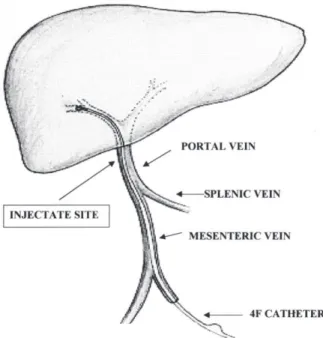
All patients underwent elective esophagogastric devascularization and splenectomy. The procedure consisted of ligature of the splenic artery close to the body of the pancreas followed by splenectomy and devascularization of the distal esophagus (5 to 7 cm) and of the upper two-thirds of the stomach (proximal to the incisura angularis). During surgery, portal pressure (PP) and flow (PF) were measured using a 4F thermodilution catheter (94-010H-4F, Baxter Corporation, EUA) inserted from a jejunal vein through the infe-rior mesenteric vein, locating the ther-mistor close to the tip of the catheter beyond the portal bifurcation and the injection hole in the middle of the por-tal vein (Fig.1), similar to the tech-nique employed for measurement of cardiac output with the pulmonary tery catheter. When the pulmonary ar-tery catheter is properly placed, the in-jection hole is located at the right atrium, and the thermistor is located at the right pulmonary artery.
The PP was electronically meas-ured using a Hewlett Packard model 1290 C pressure transducer, while PF was measured in triplicate using the thermodilution technique via the Hewlett Packard (model 783390A) Cardiac Output (CO) computer after the injection of 5 mL of 5% glucose at 0 to 4 oC. Portal pressure and PF
were assessed after laparotomy (initial) as well as after esophagogastric devas-cularization and splenectomy (final).
In this study, a PP between 5 and 10 mm Hg and a PF between 800 and 1200 mL/min were considered normal26.
Sta-tistical analysis was accomplished us-ing a paired t test, and p values <0.01
were considered statistically significant.
RESULTS
The individual results are reported on table 1.
The initial PP was elevated (mean 28.5 ± 4.5 mm Hg), and a significant drop of 25% was observed at the end of the surgery (21.9 ± 49 mm Hg). The initial PF was elevated (mean 1766.9 ± 686.6 mL/min). A significant fall
(42%) occurred at the end of the sur-gical procedure (1025.62 ± 338.7mL/ min). ). Fourteen patients (87.5%) pre-sented a PF greater than 1200 mL/min, and in 5 cases, values greater than 2000 mL/min were observed.
DISCUSSION
Portal hypertension is a syndrome characterized by increased vascular re-sistance and/or increased portal ve-nous flow5,26. Characteristically,
portosystemic collateral circulation and digestive hemorrhage through
esophageal varices occur independ-ently from hepatocellular function.
The study of portal hemodynamics is very important for the understand-ing of the pathophysiology of portal hypertension in hepatosplenic mansonic schistosomiasis and for the determination of the physiological ef-fects following surgical treatment. Since there is no consensus about the ideal surgical procedure for treatment of schistosomal portal hypertension, portal and systemic hemodynamic pro-files could help to determine the best surgical technique for these patients— either esophagogastric
devasculariza-tion and splenectomy or splenorenal distal shunt27-31.
There are no other studies that have assessed intraoperative PF by thermodi-lution in schistosomiasis. In our series, both the initial PF (1767 ± 692 mL/ min) and PP (28.5 ± 4.5 mm Hg) were elevated. These findings are in agree-ment with the theory that portal hyperflow plays a major role in the ori-gin and maintenance of schistosomal portal hypertension32-33.
Nine patients (56.25%) presented portal flow values greater than what is considered normal for total hepatic flow (1500 mL/min). These results are in disa-greement with previous findings of other authors who report portal hyperflow with preserved total hepatic blood flow22-25.
The 40% portal flow decrease at the end of the surgery (from 1767 to 1025 mL/min) suggests a greatly in-creased contribution of splenic flow to the total portal flow. Interestingly, our group had previously demonstrated that mansonic schistosomiasis presents a hyperdynamic systemic circulatory state that is also corrected by esophagogastric devascularization and splenectomy, demonstrating the impor-tance of the spleen and collateral cir-culation in these circulatory states34.
In conclusion, these data favor the hypothesis of portal hyperflow in the physiopathology of portal hyperten-sion of schistosomiasis.
Table 1 - Individual and mean results of portal pressure and portal flow before and after esophagogastric devascularization and splenectomy.
Case SEX PPi PPf FPi FPf
0 1 F 2 9 1 7 2640 810
0 2 F 2 4 1 2 1500 980
0 3 F 2 6 2 3 1310 1000
0 4 M 3 0 2 0 3210 920
0 5 M 2 6 2 0 2336 1050
0 6 F 2 9 1 7 2590 1250
0 7 F 2 8 2 3 1930 1610
0 8 M 2 9 2 5 1270 1500
0 9 M 2 8 2 2 690 580
1 0 F 3 0 1 9 2240 1310
1 1 M 3 0 2 2 1090 1130
1 2 M 4 3 3 8 1850 500
1 3 F 3 0 2 3 1140 720
1 4 M 2 2 1 7 1380 540
1 5 F 2 7 2 5 1860 1400
1 6 M 2 6 2 6 1240 1110
Mean + SD 28.6 + 4.50 21.8 + 5.7* 1767 + 686* 1026 + 339* p < 0.0001
Ppi: Initial portal pressure; PPf: Final portal pressure; Fpi: Initial portal flow; FPf: Final portal flow
RESUMO
CLEVA R de e col. - Hiperfluxo portal na forma hepatosplênica da esquistossomose mansônica. Rev. Hosp. Clín. Fac. Med. S. Paulo 59(1):10-14, 2004.
OBJETIVOS: o objetivo do pre-sente estudo é estudar a hemodinâmica portal em pacientes com hipertensão portal secundária a forma
hepatoes-plênica da esquistossomose e avaliar a contribuição do hiperfluxo esplênico na sua fisiopatologia
CASUÍSTICA E MÉTODOS: Fo-ram estudados prospectivamente 16 pa-cientes portadores de hipertensão por-tal secundária à forma hepatoesplênica da esquistossomose mansônica com in-dicação de tratamento cirúrgico. Todos foram submetidos a avaliação
hemo-dinâmica portal com cateter de termo-diluição 4F antes e após a realização de desvascularização esofago-gástrica com esplenectomia.
signi-ficante de 25% na pressão (21,65 + 5,55 mmHg ) e de 42% no fluxo (1011,18 + 332,73 ml/min) ao térmi-no da cirurgia. Quatorze pacientes (87.5%) apresentavam fluxo portal superior a 1200 ml/min e, em 5 casos, valores superiores a 2000 ml/min fo-ram observados.
CONCLUSÕES: A pressão e o flu-xo portais estão aumentados na hiper-tensão portal esquistossomótica. A desvascularização esofago-gástrica com esplenectomia reduz significati-vamente tanto a pressão quanto o flu-xo portais. Estes dados favorecem a hi-pótese do hiperfluxo esplâncnico
(esplênico e mesentérico) na fisiopa-tologia da hipertensão portal na es-quistossomose forma hepatoesplênica.
DESCRITORES: Hipertensão por-tal. Hemodinâmica. Sistema porta. Esquistossomose mansônica.
REFERENCES
1. Cleva R, Pugliese V, Zilberstein B, et al. Estado hiperdinâmico sistêmico na forma hepatoesplênica da esquistossomose mansônica. Rev. Hosp. Clin. Fac. Med. São Paulo 1998; 53: 6-1 0
2. Ferraz AAB, Bacelar TS, Silveira MC, et al. Surgical treatment of schistosomal portal hypertension. Int Surg 2001; 86:1-8. 3. Groszmann RJ, Genecin P. Portal Hypertension. In: Schiff l, Schiff
ER, eds. Diseases of the liver. Philadelphia, J.B. Lippincott, 1993. p.935-63.
4. Macmathuna PM, Westaby D, Willians R. Taking the tension out of the portal system. An approach to the management of portal hypertension in the 1990s. Scand. J. Gastroenterol 1990; 25:131-45, Supplement 135.
5. Rikkers LF - New concepts of pathophysiology and treatment of portal hypertension. Surgery 1990; 107:481-8.
6. Sherlock S. The portal venous system and portal hypertension. Diseases of the liver and biliary system. 8th.ed. London,
Blackwell, 1989. p.151-207.
7. Bosch J, Enriquez R, Groszmann RJ, Storer EH. Chronic bile duct ligation in the dog: hemodynamic characterization of a portal hypertensive model. Hepatology 1983; 3:1002-1007. 8. Colombato LA, Albillos A, Groszmann RJ. Temporal relationship
of peripheral vasodilatation, plasma volume expansion and the hyperdynamic circulatory state in portal-hypertensive rats. Hepatology 1992; 15: .323-328.
9. Fernandez-Seara J, Prieto J, Quiroga J, et al. Systemic and regional hemodynamics in patients with liver cirrhosis and ascites with and without functional renal failure. Gastroenterology 1989; 97: 1304-1312.
10. Fomon JJ, Warren WD. Hemodynamic studies in portal hypertension. Annu. Rev. Med. 1969; 20: 277-290. 11. Benoit JN, Womack WA, Hernandez L, Granger DN. “Forward”
and “backward” flow mechanisms of portal hypertension. Relative contributions in the rat model of portal vein stenosis. Gastroenterology 1985; 89: 1092-1096.
12. Um S, Nishida O, Tokubayashi M, et al. Hemodynamic changes after ligation of a major branch of the portal vein in rats: Comparison with rats with portal vein constriction. Hepatology 1994; 19: 202-209.
13. Vorobioff J, Bredfeldt JE, Groszmann RJ. Hyperdynamic circulation in portal-hypertensive rat model: a primary factor for maintenance of chronic portal hypertension. Am J Physiol 1983; 244: G52-57.
14. Benoit JN, Barrowman JA, Harper SL, Kvietys PR, Granger DN. Role of humoral factors in the intestinal hyperemia associated with chronic portal hypertension. Am. J. Physiol 1984; 247: G486-493.
15. Kravetz D, Arderiu M, Bosch J, et al. Hyperglucagonemia and hyperkinetic circulation after portocaval shunt in the rat. Am. J. Physiol. 1987; 252: G257-261.
16. Macdougall BD, Westaby D, Blendis LA. Portal hypertension -25 years of progress. Gut 1991; S18-S24. (Supplement 1). 17. Laudanna AA. Significado clínico e medição do fluxo hepático
pela depuração do ouro coloidal em normais e portadores de diferentes hepatopatias. Rev. Hosp. Clin. Fac. Med. São Paulo 1973; 28:74-9.
18. Laudanna AA, Chamonne DF, Lins GD, et al. Fluxo hepático na esquistossomose. Arq. Gastroenterol, 1972;.9:201-3. 19. Sarin SK, Mosca P, Sabba C, Groszmann RJ. Hyperdynamic
circulation in a chronic murine schistosomiasis model of portal hypertension. Hepatology 1991; 13: 581-4.
20. Mies S, Neto OB, Beer A, et al. Systemic and hepatic hemodynamics in hepatosplenic Manson´s schistosomiasis with and without propranolol. Dig Dis Sci 1997; 42:751-61.
21. Coelho JL. Fluxo Hepático Total na Esquistossomose Hepatoesplênica. São Paulo, 1984. (Mestrado- Instituto Brasileiro de Estudos e Pesquisas em Gastroenterologia). 22. Coutinho A. Hemodynamic studies of portal hypertension in
schistosomiasis. Am J Med 1968; 44: 547-57.
23. Mies S. Hemodinâmica sistêmica e hepática na esquistossomose mansônica. Ação do propranolol. São Paulo, 1992. (Livre-Docência - Faculdade de Medicina da Universidade de São Paulo).
25. Mies S, Larsson E, Mori T, Rosa P, Raia SO. Sistema porta e as artérias hepática, esplênica e mesentérica superior na esquistossomose hepatoesplênica. Estudo angiográfico. Rev Hosp Clin Fac Med S Paulo 1980; 35: 121-131.
26. Schrier RW, Caramelo C. Hemodynamics and hormonal alterations in hepatic cirrhosis In: Epstein M ed. The kidney in liver disease. 3thed Baltimore, Williams & Wilkins, 1988: 265-285.
27. Conn HO. A randomized comparison of three types of surgery in schistosomal portal hypertension: many fewer answers than questions. Hepatology 1994; 20: 526-8.
28. Paes Alves CA, Rebouças G. Esplenectomia na esquistossomose hepato-esplênica. Resultados tardios e imediatos. Hospital ( Rio de Janeiro )1964;66: 231-7.
29. Price JB, Voorhees AB, Britton RC. Operative hemodynamic studies in portal hypertension. Arch. Surg. 1967; 95: 843-52.
30. Raia S, Massarollo PB, Mellendez HV. Tratamento cirúgico da hipertensão portal na esquistossomose mansônica: estado atual da questão. Rev Med S Paulo1992; 71:108-13.
31. Warren WD, Restrepo JE, Respess JC, Muller WH. The importance of hemodynamic studies in management of portal hypertension. Ann. Surg. 1963;158: 387-404.
32. Pugliese V, Herman P, Machado MC, Pinotti HW. Esophagogastric devascularization, splenectomy and postoperative endoscopic sclerotherapy for the treatment of schistosomal portal hypertension. HPB Surg.1995;9:94. (Suppl 1).
33. Raia S, Mies S, Alfieri JR F. Portal hypertension in mansonic schistosomiasis. World J. Surg. 1991; 15:176-187.