Extended reverse abdominoplasty
Abdominoplastia reversa estendida
ABSTRACT
Extended reverse abdominoplasty is a procedure that widens reverse abdominoplasty and was first published in 1972. The original technique is selectively used for resection of the excessive skin located in the epigastrium, and involves a single continuous cicatricial line along the inframammary crease, which crosses the sternal region. In the original technique, excess skin in the hypogastrium is resected by using lower pubic transverse abdominoplasty. This second maneuver produces 2 transverse scars, without mobilizing the bellybutton. Extended reverse abdominoplasty aims at improving the aesthetics of the entire inner wall of the abdomen through ample dissection reaching the pubis, with mobilization of the pedicle of the bellybutton. This procedure was used in a young wo man who had saggy skin associated with adipose deposits and a vertical scar in the medial line of the epigastrium after bariatric surgery. Ample dissection of the abdominal cutaneous flap with mobilization and re-implantation of the bellybutton allowed aesthetic improvement of the entire anterior abdominal wall, with a single transverse scar along the inframammary crease and elimination of the scar from previous bariatric surgery. The surgery was combined with mastopexy and liposuction in the abdomen.
Keywords: Abdomen/surgery. Bariatric surgery. Weight loss. Obesity. Plastic surgery/me -thods.
RESUMO
A abdominoplastia reversa estendida é um procedimento que amplia a abdominoplastia re -versa, publicada pela primeira vez em 1972. A técnica original é seletiva para a ressecção dos excessos cutâneos localizados no epigástrio, que determina uma única linha cicatricial contínua ao longo do sulco inframamário, cruzando a região esternal. Ainda na técnica ori-ginal, os excessos cutâneos no hipogástrio são ressecados mediante abdominoplastia tipo transversal pubiana baixa. Essa segunda manobra determina duas cicatrizes transversais, sem mobilização do umbigo. A abdominoplastia reversa estendida tem o propósito de de-terminar melhoria estética de toda a parede anterior do abdome, mediante ampla dissecção, que atinge o púbis, com mobilização do pedículo do umbigo. O procedimento foi utiliza do em uma paciente jovem, pós-cirurgia bariátrica, apresentando lacidez associada a depósitos adiposos, com uma cicatriz vertical na linha média do epigástrio. A ampla dissecção do retalho cutâneo do abdome, com mobilização e reimplante do umbigo, determinou melhoria estética de toda a parede abdominal anterior, com uma única cicatriz transversal ao longo do sulco inframamário e eliminação da cicatriz da cirurgia bariátrica prévia. O ato operatório foi combinado com mastopexia e lipoaspiração do abdome.
Descritores: Abdome/cirurgia. Cirurgia bariátrica. Perda de peso. Obesidade. Cirurgia plás -tica/métodos.
Study carried out at the private clinic of the author, São Paulo, SP, Brazil.
Article submitted to SGP (Sistema de Gestão de Publicações/Manager Publications System) of RBCP (Revista Brasileira de Cirurgia Plástica/Brazilian Journal of Plastic Surgery).
Article received: November 14, 2011 Article accepted: January 24, 2012
1. Plastic surgeon, full member of the Sociedade Brasileira de Cirurgia Plástica (Brazilian Society of Plastic Surgery) - SBCP, São Paulo, SP, Brazil. 2. Plastic surgeon, full member of the SBCP, Campinas, SP, Brazil.
3. Student of Medicine, São Paulo, SP, Brasil.
INTRODUCTION
When extended reverse abdominoplasty was first publi-shed in 19721, under the title of abdominoplasty through
submammary incision, the aim of this technique was to improve the aesthetics of the abdominal segment above the horizontal line, at the level of the bellybutton, without trans-posing this structure. For cases in which the hypogastrium was enlarged, whether associated with saggy skin or not, the authors proposed a pubic transverse incision, similar to those performed in conventional abdominoplasties. This method produced 2 transverse scars at different levels. One lane of transversely positioned cutaneous tissue roughly 6–10 cm in size, which contained the bellybutton and its pedicle, was not dissected to preserve vascularization of the skin flaps.
In this article, we report the execution of reverse dissec-tion of the cutaneous lap down to the pubic area for inclusion of maneuvers practiced in lower pubic transverse abdomi -noplasty with simultaneous umbilicoplasty.
METHOD
Clinical Aspects
We report the case of a 22-year-old nulliparous Cauca-sian woman who underwent a bariatric surgery 2 years ago. After a loss of 52 kg from a previous surgery, her weight was 68 kg at the time of this surgery, which had been stabi-lized for 4 months. The patient had no history of tobacco or alcohol use.
Physical examination showed a 19 cm-long vertical scar in the medial line of the epigastrium, which was a conse-quence of a previous celiotomy, as well as a few stretch marks and lipodystrophy of the lanks and entire anterior abdominal wall, predominantly in the hypogastrium. The breasts showed ptosis, with sizes in proportion to the patient’s height and weight (Figure 1).
Surgical Technique
The surgery was performed using an endotracheal tu be under general anesthesia. The operative preparations in vol ved all routine measures, including thromboembolism pro -phylaxis without speciic medications.
The surgery started with mammoplasty, followed by li -posuction complemented with abdominoplasty. Mammary pexia without reduction of volume following the Pitanguy technique2 was performed with the patient’s trunk elevated
(by roughly 50°), until the bilateral assembly phase, and without exteriorizing the papillary-areolar complex (Figures 2 and 3). Isolated stitches were applied using black nonab -sorbable monoilament 2-0 thread for ixation of the posterior side of the breasts in the chest fascia.
A B
Figure 1 – A 22-year-old nulliparous patient who lost 52 kg after a previous bariatric surgery had a 19-cm scar in the middle
line of the epigastrium. She weighed 68 kg at the time of the surgery; this weight had stabilized for 4 months. Mammary ptosis was present with no hypertrophy and lipodystrophy with saggy skin
in the abdomen and lanks. In A, anterior view.
In B, semi-lateral view.
Figure 2 – Mammary markings for mastopexy using the Pitanguy technique, with the union of the inframammary incision
in the sternal midline.
Figure 3 – Appearance of the bilateral assembly of the breasts,
without deinitive reposition of the papillary-areolar complex, as well as dissection of the abdominal skin lap, liberation of the
Next, the patient was placed in a horizontal supine po -sition, and liposuction was performed after infiltrating all of the premarked regions of the abdomen, pubis, and flanks by using 0.9% saline solution containing epinephrine at 1: 500.000 UI, totaling 700 ml.
Liposuction was performed as follows: in the anterior wall of the abdomen, pubis, and lanks, 4-mm diameter tubes were used to suction 80% of the total aspirated volume, and the re maining 20% was complemented using 3-mm tubes in the sa me area. The total liposuctioned volume was 3.6 L of fat, which corresponded to 5.12% of the body weight of the patient.
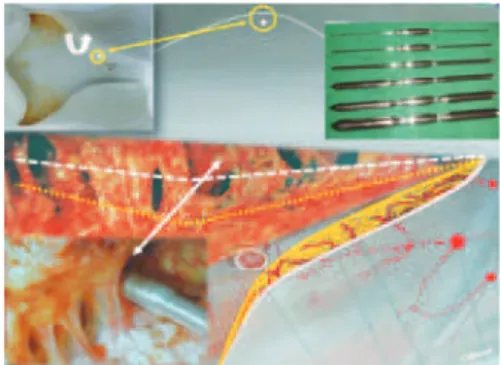
Extended reverse abdominoplasty comprised a bilateral incision in the inframammary crease until the anterior axil-lary line, with the union in the middle sternal line. This was followed by skin dissection in the plane of the aponeurotic muscle in all of the extension of the epigastrium, bilate ral ly limited by 2 convergent lines until the level of the belly -but ton, with the shape of an inverted triangle. Afterwards, in cision of the cutaneous lap was made throughout the com -plete pre vious medial vertical scar, forming 2 half-segments extending to its caudal end (Figure 4).
The bellybutton was dissected with a small ellipsoidal skin line, with a diameter of roughly 1 cm at its end. Infraum bilical dissection was performed down to the pubis, bi -laterally limited about 2 cm before the lateral border of the rectus abdominus muscles (Figures 3 and 4). Subsequently, bilateral libera tion throughout the entire length of the non-dis sected skin lap with progressive dilation by using Dilson Luz3 valves was performed (Figure 5).
No folding of the rectus abdominus was performed. The patient was then placed with her upper body elevated (by about 20°) and the skin laps were pulled cranially while the excess tissues were dissected, with bilateral repair stitches
being applied in the sternal and inframammary regions (Fi -gures 6 and 7). Surgical complementation was performed using umbilicoplasty and passage of adhesion stitches in the entire dissected abdominal area.
Figure 4 – In A and B, details of the abdominal skin lap are
shown, which was dissected until the pubic area, with a triangular shape and the base along the inframammary line. Successive and bilateral divulsions with dilators of Dilson Luz were applied
along the limits of the non-dissected skin lap. Dissection in the
hypogastrium was stopped 2 cm from the external border of the rectus abdominus. The white line indicates the dissection limits. The pedicle of the bellybutton had its ends free in an island of skin
of about 1 cm in diameter. FS = fascia of Scarpa. TS = selective tunneling. TP = progressive tunneling. PU = umbilical pedicle.
A B
Figure 6 – Cutaneous bi-parted and cranially pulled lap,
with the area of the bellybutton sutured and the excess tissues ready for dissection.
Figure 7 – Schematic representation of the suture line along the inframammary crease, crossing the sternal medial line.
The previous bellybutton oriice, which was sutured, and the
new positioning of the bellybutton in the skin are shown.
Figure 5 – Dilators of Dilson Luz with several calibers are shown, which were used for selective divulsion of the liposuctioned cutaneous cover from the lamellar to the areolar plane, with better preservation of the blood vessels, without preservation
The papillary-areolar complexes were repositioned and sutured with isolated stitches by using non-absorbable 5-0 thread. The inal suturing was performed using isolated stitches using nonabsorbable 30 and 40 thread in the sub -cutaneous and dermal planes and absorbable 4-0 thread (po lyglecapone-25) in the cuticular plane, along the sternal and inframammary lines. In the junction of the inverted T suture line, 1 stitch of a deep non-absorbable 2-0 thread was applied on both sides of the periosteum.
Drains and vacuums were inserted through the lipo -suc tion access paths. Porous adhesive tape was applied throughout the entire abdominal region and aspirated areas. In the operating room, the patient was dressed in an elastic truss for the breasts and upper body.
The drains were removed 24 h after the operation. The patient was hospitalized for the next 48 h, and the use of a corset-type girdle down to the middle upper part of the thighs was recommended for 30 days.
DISCUSSION
Ample dissection of the abdominal skin lap with mobi -lization and re-implantation of the bellybutton resulted in elimination of the scar from previous bariatric surgery and aesthetic improvement of the entire anterior abdominal wall, with a single transverse scar along the inframammary crease (Figures 8).
In contrast to conventional lipoabdominoplasty, in which the lipoplasty is performed in the areolar plane, in the ca se reported here, lipoplasty was carried out in the la meller
A B C D
E F G
Figure 8 – In A, semi-lateral preoperative view. In B, appearance in the 18th month after the operation, which included liposuction,
mastopexy, and extensive reverse abdominoplasty. In C, on the 7th postoperative day. In D, on the 18th postoperative month.
In E, anterior preoperative view. In F, on the 7th postoperative day.
In G, on the 18th postoperative month.
plane and gradually reduced to the areolar plane, obtaining the desired thickness without the care needed for pre ser-vation of the fascia of Scarpa (Figure 5). The use of 4-mm tubes for 80% of the total aspirated volume and 3-mm tu bes for the remaining 20% in the same areas was aimed at obtaining better uniformity in the thickness of the cuta-neous flap and finalizing the procedure.
The flap was amply mobilized and pulled towards the cranial side in the present case; the vertical scar from previous bariatric surgery was eliminated and the excessive skin was resected. Treatment of the aponeurotic muscle wall was not performed because the patient had not had any pregnancies. Umbilicoplasty was carried out routinely under direct vision.
Previous studies, including skin dissections of the ab -do minal wall4-6, microdissections in corpses7, and
non-in-vasive Doppler ultrasonographies8, have provided data on
the qualitative and quantitative fluxometry of the circula-tion in the pre- and postoperative periods. Two technical details were added to the association of abdominoplasties with liposuc tion in a single surgery: preservation of a closed vascular system9 and selective tunneling10.
Several factors of the procedure presented in the current report are favorable:
• in the lamellar layer, the perforant vessels have higher caliber because they are closer to their ori gin and, therefore, are at a low risk of being da maged;
• the adipose layer of the middle and lower segments of the abdomen is thicker and, consequently, the blood vessels are more extensive; that associated with nonpreservation of fascia of Scarpa and with the release of the non-dissected lap with dilators of Dilson Luz, offered greater mobilization of the lap (Figures 5 and 6);
• after liposuction of the lamellar layer, these vessels offer better circulatory guarantees, besides allowing better mobilizing conditions for the skin flap, ma king it more flexible, because it does not pre serve the Scarpa fascia to be divulsed with the me -tallic valves;
• the exobese show the internal characteristics si -milar to those of the obese, in that the caliber and length of the vessels do not return completely to pre-obesity conditions; therefore, these patients main tain intense circulatory low, contributing to the vitality of the cutaneous lap;
• limited liposuction in the areolar layer allows less manipulation in the peripheral circulatory net -work5, reducing the incidence of lesions in the skin
A B
Figure 9 – In A and B, a schematic appearance of the vascular complex of the abdominal skin lap. Region 1: perforant branches of the epigastric arteries (AEI-DIEP). Region 2: lower supericial epigastric artery (AESI); supericial iliac circumlex arteries (ACIS);
and external supericial pudendal artery (APSE). Region 3: deep iliac circumlex arteries (ACIP); the lumbar arteries (AsLs); remains of the subcostal arteries (AsSs); remains of the intercostal arteries (AsIs).
At the end of the dissection, a skin lap with an infero-la teral pedicle was obtained, maintained by most of the ves sels that comprised the three circulatory systems bila-terally, which were distributed in the lower segment of the abdominal wall and constituted of the following: (1) perfo-rant branches of the lower epigastric arteries, as the major cutaneous source, that emerge from the sheath of the rectus muscles; (2) perforant branches constituted for anastomo sis of lumbar arteries, deep iliac circumlex arteries, remnants of the intercostal arteries and remnants of the subcostal arteries that emerging from the external oblique fascia: (3) inferior supericial epigastric arteries; supericial iliac circumlex ar teries; external supericial pudendal arteries; originating from the femoral arteries (Figure 9).
No signs of edema were noted, besides the ones routi nely seen in conventional abdominoplasties. Adhesion points, applied within the systematization11, played 3 ro les: seroma
prevention, an anti-gravitational action, and a direction to the flap in the convergent ascension for the median region.
Extensive reverse abdominoplasty, whether combined with other compatible surgeries in a single operation or not, is a via ble and safe procedure. Despite ample dissection, the skin lap is founded on an extensive vascular complex, making it vital and well-vascularized. The aesthetic result relects on the entire anterior abdominal region. The procedure does not require the use of other techniques, like an anchor, or other procedures producing a second low transverse scar in the pubic area for aesthetic treatment of the hy pogastrium.
This procedure is particularly compatible with reduc-tion mammoplasty, mastopexy, and liposucreduc-tion in a single
operation, preferably without changing between the supine and prone positions.
REFERENCES
1. Rebello C, Franco T. Abdominoplastia por incisão submamária. Rev Bras Cir. 1972;62:249-52.
2. Pitanguy I. Mamoplastia: estudo de 245 casos consecutivos e apresen-tação de técnica pessoal. Rev Bras Cir. 1961;42:201-20.
3. Luz D. Técnica Dilson Luz. Tunelizações sucessivas: princípios, apli-cações e procedimentos complementares. São Paulo: DiLivro; 2010. 4. Boyd BJ, Taylor GI, Corlett R. The vascular territories of the superior
epigastric and deep inferior epigastric systems. Plast Reconstr Surg. 1984;73(1):1-16.
5. Taylor GI, Palmer JH. The vascular territories (angiossomes) of the body: experimental study and clinical applications. Brit J Plast Surg. 1987;40(2):113-41.
6. Munhoz AM, Ishida LH, Montag E, Sturtz G, Rodrigues L, Ferreira MC. Perfurator vessels anatomy and principal application in their inferior
epigastric perfurator (DIEP) lap. Kongs Verein Deutsch Plast Chirs.
2001;32(1):1-2.
7. El-Mraky HH, Milner RH. The vascular anatomy of the lower anterior abdominal wall: a microdissection study on the deep inferior epigas-tric vessels and the perforator branches. Plast Reconstr Surg. 2002; 109(2):539-43.
8. Fischer M, Bark A, Loureiro ALRS, Pianowski R, Graf R, Grillo MA,
et al. Estudo de doppler luxometria em retalho de abdominoplastia.
ACM arq catarin med. 2003;32(Supl 1):173-8.
9. Avelar JM. Uma nova técnica de abdominoplastia: sistema vascular fechado de retalho subdérmico dobrado sobre si, combinado com li-poaspiração. Rev Bras Cir. 1999;6:3-20.
10. Saldanha OR, Pinto EB, Matos WN Jr, Lucon RL, Magalhães F, Bello EM. Lipoabdominoplasty without undermining. Aesthet Surg J. 2001;21(6):518-26.
11. Baroudi R, Ferreira CA. Seroma: how to avoid it and how to treat it. Aesthet Plast Surg J. 1998;18(6):439-41.
Correspondence to: Cecin Daoud Yacoub