Casimir Effect for a Massive Scalar Field Under
Mixed Boundary Conditions
A.C. Aguiar Pinto, T.M. Britto, R. Bunchaft, F. Pascoal, and F.S.S. da Rosa
Universidade Federal do Rio de Janeiro, Instituto de F´ısica,
Caixa Postal 68528, CEP.: 21945-970, Rio de Janeiro-RJ, Brazil
Received on 25 April, 2003. Revised version received on 2 September, 2003.
We discuss the Casimir effect for a massive bosonic field with mixed (Dirichlet-Neumann) boundary conditions. We use theζ-function regularization prescription to obtain our physical results. Particularly, we analyse how the Casimir energy varies with the mass of the field and compare this mass dependence with those obtained for other boundary conditions. This is done graphically. Some other graphs involving a massive fermionic field are also included.
1
Introduction
Although the standard (electromagnetic) Casimir effect was proposed in 1948 by H.B.G Casimir[1], the Casimir effect in its general form1is a very active area of research nowadays (for a detailed discussion of the effect and its applications see [2, 3, 4] and references therein). This is due in part to its interdisciplinary character, once it is of some relevance not only in QED, but also in condensed matter physics, theories with compactified extra dimensions, gravitation and cosmol-ogy, mathematical physics and even in nanotechnolcosmol-ogy, on the construction of electromechanical devices.
Though the first experiment on Casimir effect has been performed by Sparnaay [5] in 1958 (with only a qualitative agreement), it was just recently that new measurements with slightly different setups were made with a high accuracy by many authors [6].
Although the Casimir effect disappears as the mass of the field goes to infinity, as expected (since in this limit there are no more quantum fluctuations), the precise way the Casimir energy varies as we change the mass is not obvious in some cases [4, 7].
Here we shall compute the influence of the mass in the Casimir energy of a bosonic field submitted to mixed bound-ary conditions (BC) and compare the obtained results with those for other BC already existent in the literature. Mixed BC are interesting mainly because they may provide repul-sive Casimir forces. In fact, T.H. Boyer [8] studied the Casimir force for electromagnetic field between two par-allel plates where one of them was a perfectly conductor plate and the other was an infinitely permeable one. This result can be mimicked by a massless scalar field submit-ted to mixed BC [9, 10]. Nowadays, the study of repulsive Casimir forces has attracted the attention of physicists, since
the existence of paramagnetic material with non-trivial per-meability may exist [11], though there is some controversy about it [12, 13]. Further, repulsive Casimir forces may be of some relevance in the construction of nanodevices where the attractive forces could lead to restrictions in these de-vices [4, 14]. Mixed BC have also been considered in the context of cavity QED [15-18].
This paper is organized as follows. In section 2, we cal-culate the Casimir energy for a massive bosonic field under mixed BC. In section 3, we compare the mass dependence of the Casimir energy of a bosonic field obtained in section 2 with those obtained with other BC, namely, Dirichlet, peri-odic and antiperiperi-odic BC. This is done graphically. We also compare (graphically) the mass dependence of the Casimir energy of a fermionic field under distinct BC. However, in this case, we use only three BC, namely, MIT2, periodic and antiperiodic BC, since there is no sense to impose Dirich-let or Neumann BC in the Dirac equation. We also make a comparison between the Casimir energy for a bosonic field under Dirichlet BC with a fermionic field under MIT BC. In section 4, we calculate the Casimir pressure for the massive scalar fields and plot some graphs. Last section is left for the final remarks and conclusions.
2
Casimir energy for a massive scalar
field with mixed boundary
condi-tion
Since massless scalar fields under Neumann or mixed BC may exhibt peculiar results regarding the signal of the Casimir force between the boundaries involved, it seems natural to investigate whether these results will persist for
1Every vacuum energy shift of any field (not necessarily the electromagnetic field) caused by the imposition of boundary conditions, dictated, for instance,
by the presence of material surfaces, or even due to the compactification of some dimensions, is also refered as Casimir effect.
2The fermionic Casimir energy was first computed by Johnson[19] in the context of the MIT-bag model for a massless Dirac field confined between
a massive scalar field. Let us then consider a massive scalar field in ad+ 1Euclidian spacetime subjected to a Dirichlet boundary condition atxd= 0and a Neumann BC atxd=a:
φ(τ, x1, x2, ..., xd= 0) = 0
∂φ ∂xd
(τ, x1, x2, ..., xd =a) = 0.
Using the ζ-function regularization prescription [20], the vacuum energy can be written as:
Ecas(a, m) =−
1 2TE
∂ ζA
∂s |s=0, (1)
where
ζA(s) =tr A−s=
Z
dd+1xhx|A−s|xi
(2)
withA=−∂2
E+m2. In Eq.(1),TEis the euclidean time and
it is implicit an analytic continuation for the whole complex plane. Such conditions lead us to the following eigenvalues: ⌋
{κ2+ (n+ 1/2)2(π/a)2|κ2=k12+...+kd2; n∈IN}. (3)
With these eigenvalues, we have:
ζA(s) =
TELd−1
(2π)d
∞ X
n=0
Z
dk1...dkd
(
κ2+
µ n+1
2
¶2π2
a2 +m 2
)−s
= TEL
d−1
2d−1πd/2Γ(d/2)
∞ X
n=0
Z ∞
0
dκ κ2(d−21)
(
κ2+
µ n+1
2
¶2 π2
a2 +m 2
)−s
, (4)
whereLd−1is the area of the hiperplane and we used thatH
dΩd= 2π
d/2
Γ(d/2).
Using the following integral representation of the Euler beta functionB(x, y) =Γ(Γ(xx)Γ(+yy))
Z ∞
0
dx (x2)α−21(x2+A2)β−1=1 2(A
2)α
2+β−1B(α/2,1−β−α/2) (5)
we get
ζA(s) = TEL d−1
2d−1πd/2
Γ(s−d/2) Γ(s)
X
n=odd
1 2
½ n2π2
4a2 +m 2
¾d2−s
. (6)
Introducing the Epstein function, defined as
EM2
1 (z, a) =
∞ X
n=1
1
(an2+M2)z , (7)
equation (6) can be cast into the form:
ζA(s) =
TELd−1Γ(s−d/2)
4d−sπ2s−d/2Γ(s)ad−2s
h
E1(2ma/π)2(s−d/2; 1)−4d/2
−sE(2ma/π)2
/4
1 (s−d/2; 1)
i
. (8)
The last expression is not well defined forℜ(s)>1/2, so one can say it is useless for our purposes, since we need it ats= 0. However, as it is well known in the literature [21], this function is suscetible to an analytic continuation into a meromorphic function in the whole complex plane, namely:
E1M2(z, a) =
1 2M2z +
³π
a
´1/2 1
2M2z−1Γ(z)×
×
"
Γ
µ z−1
2 ¶ + 4 ∞ X n=1
a(1−2z)/4
(πM n)(1/2)−zK(1/2)−z
µ2πM n a1/2
¶#
, (9)
whereKν(z)is the modified Bessel function of second type. We express then the generalized zeta function by the following
equation
ζA(s) = TEL d−1
232d− 3 2−sπ
d+1 2
md+12 −s
ad−21+s 1 Γ(z)
∞ X
n=1
ns−d
2− 1 2
·
Ks−(d+1
2 )(4mna)− 1 2s+1−d
2
Ks−(d+1
2 )(2mna)
¸
Computing thesderivative ats= 0and using Eq.(1), we obtain our main result:
Ecas(a, m) =−
Ld−1
23d2−1π
d+1 2
md+12
ad−21
∞ X
n=1
1
nd+12
h K−d+1
2 (4mna)−2
d−1 2 K
−d+1
2 (2mna)
i
. (11)
Ifd= 3, for instance, one can easily obtain the limits for the last expression whenma <<1orma >>1, respectively:
Ecas(a, m)≈
7 8
L2π2
1440 1
a3−
1 192
L2
a m
2 (ma <<1) (12)
and
Ecas(a, m)≈L
2
16
³m
πa ´3/2
e−2ma (ma >>1).
(13)
⌈
In eq.(13), we see that the Casimir energy for two paral-lel plates vanishes exponentially as the mass goes to infinity (for spherical geometries it vanishes as a negative power of the mass [4]). On the other hand, for a small mass, we have the well known result for the corresponding massless case (first term of r.h.s. stands for−78 times the standard result of the Casimir energy for a massless scalar field subjected to Dirichlet BC) [8, 10] plus a small (negative) correction in
m2.
3
The influence of the mass in the
Casimir effect: Graphical results
In this section we shall compare the result (11) obtained in the previous section with those already existent in the lit-erature obtained with other boundary conditions, namely, Dirichlet (D), periodic (P) and antiperiodic (A) ones. In order to make such a comparison, it is convenient to write down explicitly the respective expressions for the Casimir energies for these cases:
⌋
EcasD (a, m) = −
2Ld−1
(4π)(d+1)/2
m(d+1)/2
a(d−1)/2
∞ X
n=1
n−(d+1)/2K
−(d+1)/2(2mna); (14)
EcasP (a, m) = −
Ld−1
2(d−1)/2π(d+1)/2
m(d+1)/2
a(d−1)/2
∞ X
n=1
n−(d+1)/2K
−(d+1)/2(mna); (15)
EcasA (a, m) = −
Ld−1
2d−1π(d+1)/2
m(d+1)/2
a(d−1)/2
∞ X
n=1
n−(d+1)/2hK
−(d+1)/2(2mna)−
− 2(d−1)/2K
−(d+1)/2(mna)
i
. (16)
⌋
The first important thing to be noticed is the simple relation that arises between the Casimir energies under mixed BC and Dirichlet one:
EcasM (a, m) =EcasD (2a, m)− EcasD (a, m). (17)
For the zero mass limit indspatial dimensions the previous equation leads to
EcasM(a,0) = EcasD (2a,0)− EcasD (a,0)
=
µ1
2d −1

EcasD (a,0), (18)
where we used the fact that, form = 0, the Casimir ener-gies for such setups are proportional to1/ℓd, with ℓbeing
the distance between the planes. This gives the well known −7/8 factor for the particular case where d = 3 already mentioned.
Also, it is straightforward to verify that the antiperiodic-periodic comparison mimics this behaviour. In other words, we may also write
EcasA (a, m) =EcasP (2a, m)− EcasP (a, m). (19)
EcasM (a, m) = N
Z
dk1· · ·dkd
∞ X
n=0
r
(2n+ 1)2³π
2a ´2
+κ2+m2
= N
Z
dk1· · ·dkd
∞ X
n=odd
r
n2³π
2a ´2
+κ2+m2, (20)
whereN is a constant andκ= k1· · ·kd. Now, let us use the simple trick of adding and subtracting the sum over evenn
(n= 2n′
), that is
EM
cas(a, m) = N
Z
dk1· · ·dkd
∞ X
n=1
r
n2³π
2a ´2
+κ2+m2−
− N
Z
dk1· · ·dkd
∞ X
n′=1
r
(2n′)2³π
2a ´2
+κ2+m2
= EcasD (2a, m)− EcasD (a, m), (21)
⌈
where we identify the first term of the r.h.s. of (21) as the Casimir energy for a massive scalar field under Dirichlet BC with distance2abetween the planes and the second term as the same Casimir energy with distancea.
Considering now the normalized energy, which is de-fined as
˜
E(m, a) = Ecas(m, a)
Ecas(0, a)
(22) one can easily show that
˜
EA(2ma) = ˜EP(ma) (23)
˜
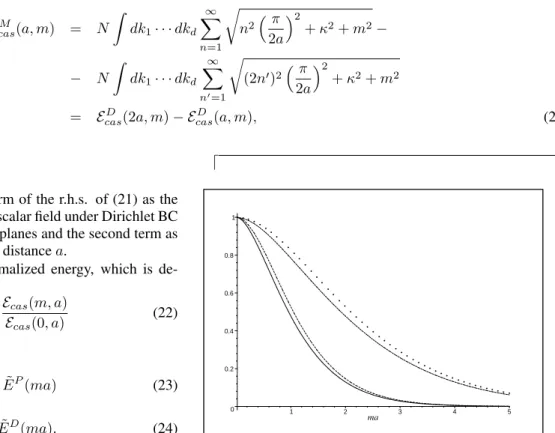
EM(2ma) = ˜ED(ma). (24) Note that the normalized energies depend on the mass and the distance only through the productma. Using Eqs.(11)-(16) and (22), we plot our first graph for the normalized en-ergies withd= 3(see Fig. 1). As already mentioned, note that in all graphs the energy vanishes as the mass goes to infinity.
For a massive fermionic field ind= 3, we may plot the following graph:
In the fermionic case, the Casimir energies for periodic and antiperiodic boundary conditions are equal to a quarter of the bosonic Casimir energy with the same BC ind= 3. The Casimir energy with MIT boundary condition for a massive fermionic field was first computed by Mamaev and Trunov [22] (see also Ref.[3]), but can be cast into the form [23]:
EcasM IT(a) =−
Ld−1α(d)µ(d−2)/2
2d+1πd/2Γ(d/2)ad
∞ X
k=1
(−1)k+1
kd/2+2
Γ
µd
2+k
¶ d
dλ h
λ−d/2W
−k,d−1 2 (4µkλ)
i¯ ¯
¯λ=1, (25)
0 0.2 0.4 0.6 0.8 1
1 2 3 4 5
ma
Figure 1. The vertical axis represents the normalized Casimir en-ergy for a massive field. In the graph, we have the following BC (from top to bottom): antiperiodic, periodic, mixed and Dirichlet respectively.
0 0.2 0.4 0.6 0.8 1
1 2 3 4 5
ma
Figure 2. Massive fermionic field with three BC (from top to bot-tom): antiperiodic, periodic and MIT.
whereµ:=ma,Wν,µ(z)is the Whittaker function [24] and
dif-ferent spin states and is given by2(d−1)/2, fordodd, and by
2(d−2)/2ifdis even.
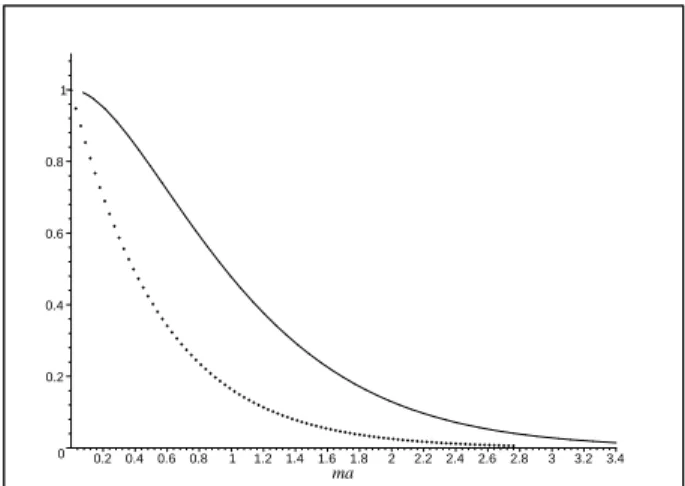
Once the Dirichlet and MIT boundary conditions are the most natural ones for the bosonic and fermionic fields re-spectively, we also compare graphically the Casimir energy for these two cases (see Fig. 3). It is worth emphasizing that the fermionic Casimir energy with MIT boundary condition goes to zero faster, as the mass of the field increases, than the Casimir energy for a massive bosonic field with Dirich-let boundary condition.
4
The Casimir pressure of massive
scalar fields
One interesting feature of the Casimir effect is that even-though it is a genuine quantum effect, it predicts macro-scopic effects, as an attractive force between two uncharged parallel perfectly conducting plates [1]. One can obtain the force per unit area (Casimir pressure) through the relation
F(m, a) =−∂E(m, a)
∂a , (26)
0 0.2 0.4 0.6 0.8 1
0.2 0.4 0.6 0.8 1 1.2 1.4 1.6 1.8 2 2.2 2.4 2.6 2.8 3 3.2 3.4 ma
Figure 3. From top to bottom we have the Casimir energies for a massive bosonic field subjected to Dirichlet BC and for a massive fermionic field submitted to MIT BC, respectively.
whereE(m, a) =Ecas(m, a)/Ld−1. Using Eq.(26), we are
able to extract the Casimir pressure for scalar fields when subjected to mixed boundary conditions, which is (for the cased= 3)
⌋
FM(m, a) = − m
2
16a2π2
"∞ X
n=1
3
n2K2(4man) +
∞ X
n=1
4ma
n K1(4man) #
+
+ m
2
8a2π2
"∞ X
n=1
3
n2K2(2man) +
∞ X
n=1
2ma
n K1(2man) #
.
(27) The explicit formulas for the other boundary conditions are
FD(m, a) =− m
2
8a2π2
"∞ X
n=1
3
n2K2(2man) +
∞ X
n=1
2ma
n K1(2man) #
, (28)
FP(m, a) =−
m2
2a2π2
"∞ X
n=1
3
n2K2(man) +
∞ X
n=1
ma
n K1(man) #
(29)
and
FA(m, a) =−
m2
4a2π2
"∞ X
n=1
3
n2K2(2man) +
∞ X
n=1
2ma
n K1(2man) #
+
+ m
2
2a2π2
"∞ X
n=1
3
n2K2(man) +
∞ X
n=1
ma
n K1(man) #
. (30)
⌋
0.1 0.15
0.2 0.25 0.3
1 2ma 3 4
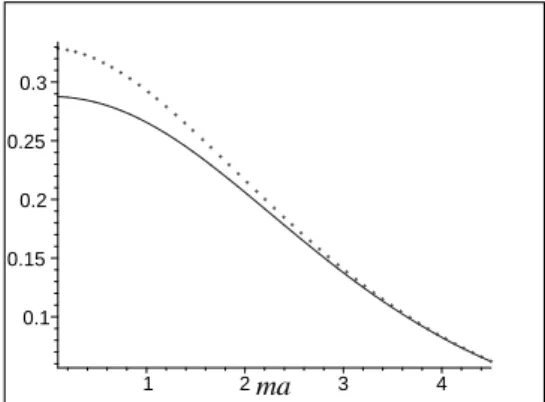
Figure 4. In this graphic: we plot the modules of pressures with antiperiodic BC (line) and periodic BC (point).
0 0.005
0.01 0.015 0.02
1 2ma 3 4
Figure 5. In this graphic we plot the modules of pressures with mixed BC (line) and Dirichlet BC (point).
which is not very different from the previous plot, compar-ing normalized energies. Uscompar-ing Eqs.(27)-(30), one can ob-tain analogous relations to (17) and (19) (see also Eq.(26))
FM(m, a) = 2FD(m,2a)− FD(m, a) (31)
and
FA(m, a) = 2FP(m,2a)− FP(m, a). (32)
5
Conclusions and final remarks
In this work we computed the Casimir energy and the Casimir pressure for a massive scalar field submitted to mixed boundary conditions. Our physical results were ob-tained with the aid of the generalizedζ-function regulariza-tion prescripregulariza-tion, but other methods could be used as well. The limits of small and large mass were taken and are in agreement with expected results. In fact, the zero mass limit coincides precisely with the results found in literature [8, 10] and the first correction in the mass has opposite sign com-pared with the zero mass case. This means that the first cor-rection weakens the Casimir energy.
For finite mass, we compared our result with those ob-tained from the literature for other boundary conditions and showed that the behaviour of the Casimir energy with mixed BC is analogous to the others (the Casimir energy is a mono-tonically decrescent function ofma).
As can be observed in Fig. 1, the relation between the Dirichlet BC and mixed BC is completely analogous to that between the periodic and antiperiodic BC. This can be easily understood from Eqs. (17) and (19).
We have also presented a graph involving a massive fermionic field under different BC which shows that the Casimir energy with MIT BC diminishes much more rapidly than the Casimir energy with periodic or antiperiodic BC. It is worth emphasizing that, when compared with the Casimir energy for a massive scalar field under Dirichlet BC, the fermionic Casimir energy with MIT BC also is much smaller for a given value ofma.
Though the influence of the mass in the Casimir energies for the cases discussed here were of considerable simplicity, this will not be the case for more involved situations, with other geometries and non trivial topologies, but that will be left for future works.
Acknowledgments
The authors would like to thank C. Farina for valu-able comments. T.M.B., F.P. and R.B. would like to thank CAPES for financial support. F.S.S.R. and A.C.A.P. ac-knowledge CNPq for financial support.
References
[1] H.B.G. Casimir, Proc. K. Ned. Akad. Wet.51, 793 (1948).
[2] G. Plunien, B. Muller, and W. Greiner, Phys. Rep.134, 89 (1986).
[3] V.M. Mostepanenko and N.N. Trunov, The Casimir Effect and Its Applications, (Clarendon Press, Oxford, 1997). [4] M. Bordag, U. Mohideen, and V.M. Mostepanenko, Phys.
Rep.353, 205 (2001).
[5] M.J. Sparnaay, Physica24, 751 (1958).
[6] S.K. Lamoreaux, Phys. Rev. Lett.79, 5 (1997);
U. Mohideen and A. Roy, Phys. Rev. Lett.81, 4549 (1998); A. Roy and U. Mohideen, Phys. Rev. Lett.82, 4380 (1999); A. Roy, C.-Y. Lin and U. Mohideen, Phys. Rev. D 60, 111101(R) (1999);
B.W. Harris, F. Chen, and U. Mohideen, Phys. Rev. A 62, 052109 (2000);
T. Ederth, Phys. Rev. A62, 062104 (2000);
H.B. Chan, V.A. Aksyuk, R.N. Kleiman, D.J. Bishop, and F. Capasso, Science291, 1941 (2001);
H.B. Chan, V.A. Aksyuk, R.N. Kleiman, D.J. Bishop, and F. Capasso, Phys. Rev. Lett.87, 211801 (2001);
G. Bressi, G. Carugno, R. Onofrio, and G. Ruoso, Phys. Rev. Lett.88, 041804 (2002).
[7] K. Kirsten,Spectral Functions in Mathematics and Physics, (Chapman & Hall, Dordrecht - Netherlands, 2001).
[8] T.H. Boyer, Phys. Rev A9, 2078 (1974).
[9] V. Hushwater, Am. J. Phys.65, 381 (1997).
[10] M.V. Cougo-Pinto, C. Farina, and A. Ten ´orio, Braz. J. Phys.
29, 371 (1999).
[11] O. Kenneth, I. Klich, and M. Revzen, Phys. Rev. D 65, 045005 (2002);
[12] D. Iannuzzi and F. Capasso, Phys. Rev. Lett. 91, 029101 (2003).
[13] O. Kenneth, I. Klich, A. Mann, and M. Revzen, Phys. Rev. Lett.91, 029101 (2003).
[14] E. Buks and M.L. Roukes, Phys. Rev. B63, 033402 (2001).
[15] M.V. Cougo-Pinto, C. Farina, F. Santos, and A. Tort, Phys. Lett. B446, 170 (1999).
[16] M.V. Cougo-Pinto, C. Farina, F. Santos, and A. Tort, J. Phys. A32, 4463 (1999).
[17] D.T. Alves, C. Farina, and A.C. Tort, Phys. Rev. A61, 034102 (2000).
[18] D.T. Alves, F.A. Barone, C. Farina, and A.C. Tort, Phys. Rev. A67, 022103 (2003).
[19] K. Johnson, Acta Phys. Polonica B6, 865 (1975).
[20] E. Elizalde, S. D. Odintsov, A. Romeo, A. A. Bitsenko, and S. Zerbini,Zeta Regularization Techniques with Applications, (World Scientific, Singapore, 1994).
[21] E. Elizalde and A. Romeo, J. Math. Phys.30, 1133 (1989); E. Elizalde and A. Romeo, J. Math. Phys.31, 771(E) (1990); K. Kirsten, J. Math. Phys.35, 459 (1994).
[22] S.G. Mamaev and N.N. Trunov, Sov. Phys.23, 551 (1980).
[23] E. Elizalde, F.C. Santos, and A.C. Tort, Int. J. Mod. Phys. A
18, 1761 (2003).