0103 - 5053 $6.00+0.00
Article
* e-mail: [email protected]
Terpenoids and Steroids from
Trichilia
Species
Mônica T. Pupoa, M. Angela T. Adornob, Paulo C. Vieira*b, João B. Fernandesb, M. Fátima das G. F. da Silvab and José R. Piranic
a
Faculdade de Ciências Farmacêuticas de Ribeirão Preto, Universidade de São Paulo, Av. Zeferino Vaz, s/n, 14040-903, Ribeirão Preto - SP, Brazil
b
Departamento de Química, Universidade Federal de São Carlos, CP 676, 13565-905, São Carlos - SP, Brazil c
Instituto de Biociências, Departamento de Botânica, Universidade de São Paulo, São Paulo - SP, Brazil
O trabalho descreve o isolamento de três novos sesquiterpenóides do extrato metanólico dos galhos de Trichilia claussenii: 14-hidroxielemol, 10(14)-en-9,11,15-triol e
germacra-3,10(14)-dien-9,11-diol-4-carbaldeído. Também foram isolados os sesquiterpenos β-eudesmol, criptomeridiol e o triterpeno 22,25-diidroxi-9β,19-ciclolanost-23-en-3-ona. Do extrato diclorometânico das folhas de T. lepidota foram isolados mistura de hidrocarbonetos (C29H60, C31H64 e C33H68), mistura dos sesquiterpenos epóxido de cariofileno e epóxido de humuleno, espatulenol e os esteróides 24-metileno-12β-hidroxicolesterol, 24-metil-12β -hidroxicolest-4-en-3-ona, 3-palmitato de 24-metil-12β-hidroxicolest-5-eno, mistura de 24-metilenocolesterol, campesterol, estigmasterol e β-sitosterol, além de α-tocoferol e fitol. O extrato metanólico forneceu a N -metil-4-hidroxiprolina. As estruturas das substâncias isoladas foram estabelecidas com base em dados espectroscópicos.
The methanol extract of stems of Trichilia claussenii yielded three new sesquiterpenoids: 14-hydroxyelemol, germacra-10(14)-en-9,11,15-triol and germacra-3,10(14)-dien-9,11-diol-4-carbaldehyde. Two known sesquiterpenoids β-eudesmol, cryptomeridiol and the triterpenoid 22,25-dihydroxy-9β,19-cyclolanost-23-en-3-one were also isolated. The dichloromethane extract from the leaves of T. lepidota afforded a mixture of hydrocarbons (C29H60, C31H64 and C33H68), a mixture of
the sesquiterpenes caryophyllene and humulene epoxides, spathulenol, and a series of sterols: 24-methylene-12β-hydroxycholesterol, 24-methyl-12β-hydroxycholest-4-en-3-one, 24-methylene-12β -hydroxycholest-5-ene-3-palmitate; a mixture of 24-methylenecholesterol, campesterol, stigmasterol and β-sitosterol; besides α-tocoferol and phytol. From the methanol extract it was isolated N
-methyl-4-hydroxyproline. The structures of the isolated compounds were determined on the basis of spectroscopic analysis.
Keywords:Trichilia claussenii, Trichilia lepidota, Meliaceae, sesquiterpenoids, cycloartane
triterpenoid, steroids
Introduction
The Meliaceae family has shown to be of much interest among phytochemists because either it contains plants which produce very complex chemical structures, or because of their biological activity, mainly against insects. As part of our interest in the chemistry of this family, we have already reported the isolation of γ-lactones from the fruits,1 androstane and pregnane steroids from the steams2
and cycloartane triterpenoids and a mixture of ω-phenyl alkanoic and alkenoic acids from the leaves3 of Trichilia
claussenii collected in Brazil. In continuation of our study
of Trichilia species, we now report the isolation of five
sesquiterpenoids and a cycloartane triterpenoid from the steams of T. claussenii and steroids from the leaves of T. lepidota Martius ssp schumanniana Harms, which has
never been investigated before.
Experimental
General experimental procedures
1H and 13C NMR spectra were recorded at 400.13 and
The spectra were run in CDCl3 with TMS as internal standard, pyridine-d5 and D2O. DCCC was performed in an
Eyela Droplet Counter Current Chromatograph D.C.C. -300. The GC-MS analyses were carried out with a Hewlett Packard System 5995 fitted with a dimethylpolysiloxane HP-1 (25 m x 0.20 mm i.d. x 0.30 film tickness) capillary column, with hydrogen as the carrier gas. The temperature was programmed initially at 120 oC for 2 min., then
increased with a rate of 8 oC min-1 to 280 oC and kept for
20 min. The injection volume was 1 µL in a split mode and temperature of the injector was 280 oC.
Isolation of the constituents from T. claussenii
Stems (2.4 kg) of T. claussenii were collected in Rio Claro, SP, Brazil, and a voucher is deposited in the Herbarium of Instituto de Biociências, Universidade Estadual Paulista, Rio Claro, SP, Brazil. The stems were dried, powdered and extracted with MeOH. The MeOH extract (45.7 g) was suspended in MeOH:H2O (1:3 v/v) and partitioned with CH2Cl2, EtOAc and n-BuOH. The CH2Cl2 fraction was concentrated and then partitioned with hexane and MeOH. The MeOH fraction (10.35 g) afforded 9 fractions after dry silica gel column using as eluent hexane:CH2Cl2:MeOH (10:10:1 v/v/v). Fr-6 (1.38 g) after flash chromatography (n-hexane:CH2Cl2:Me2CO 10:15:1
v/v/v) afforded 14 fractions. Fr-6-7 (73 mg) after flash
chromatography (n-hexane:EtOAc 9:1 v/v) afforded 10.1
mg of sesquiterpene 1. Fr-8 after flash chromatography (n
-hexane:CH2Cl2:MeOH 10:10:1 v/v/v, gradient elution) afforded 26 fractions. Column chromatography of Fr-8-11 (89 mg) on silanized (dimethylsilane, 63-200 µm) silica (Me2CO:H2O 1:1 v/v) afforded 7 fractions. Fr-8-11-4 after chromatography on silanized silica column (Me2CO:H2O 1:1 v/v) yielded 2 fractions. Fr-8-11-4-2 (19.5 mg) was acetylated (Ac2O-pyridine) and the mixture obtained was purified on flash chromatography (CH2Cl2:Me2CO 19:1 v/v) to yield 3a (2.5 mg). Fr-8-12 (318 mg) afforded 7
fractions after florisil column (CH2Cl2:Me2CO 19:1 v/v; 9:1 v/v). Column chromatography of Fr-8-12-3 (76 mg) on silanized silica (Me2CO:H2O 1:1 v/v, 2:1 v/v) yielded 9 new fractions. Fr-8-12-3-2 (14 mg) after chromatography on silica gel flash column (CHCl3:MeOH 19:1 v/v) afforded 5.5 mg of sesquiterpene 5. Flash chromatography of
Fr-8-12-3-3 (29 mg) (CHCl3:MeOH 19:1 v/v) yielded 14.2 mg of sesquiterpene 3. Fr-8-12-3-6 (8 mg) after flash
chromatography (n-hexane:Me2CO 3:1 v/v) yielded
compound 6 (2.9 mg). Column chromatography on
silanized silica of Fr-8-12-6 (Me2CO:H2O 1:1 v/v) afforded sesquiterpene 2 (6.0 mg). Fr-8-15 (215 mg) afforded, after
(Ac2O-pyridine) and the mixture obtained was purified on silica gel column (CH2Cl2:MeOH 19:1 v/v) to yield 4a
(4.7 mg), 4b (3.4 mg) and 4c (1.9 mg).
Isolation of the constituents from T. lepidota
Leaves of T. lepidota Martius ssp schumanniana Harms
were collected in Rio de Janeiro, Brazil. The CH2Cl2 extract (7.5 g) was chromatographed on silica gel (n-hexane, CH2Cl2, EtOAc and MeOH). The n-hexane fraction (769
mg) afforded a mixture of hydrocarbons. Chromatography of the dichloromethane fraction yielded three fractions.
Fr-1 (656 mg), after flash chromatography (n
-hexane:MeOH 49:1 v/v and n-hexane:Me2CO 99.4:0.6
v/v), was hydrolyzed with KOH (10%) in EtOH followed by chromatography on silica flash (n-hexane:Me2CO 99:1
v/v), to afford 4 mg of phytol. Fr-2 (770 mg), after flash chromatography and then prep-tlc (benzene:ethyl ether 99.6:0.4 v/v), afforded a mixture of sesquiterpenes: caryophyllene and humulene epoxides (7.3 mg) and α
-tocopherol (1.3 mg), spathulenol (35.6 mg) and 24-methylen-12β-hydroxycholest-4-en-3-palmitate (3.8 mg) (8). Compound 8 was hydrolyzed with KOH (10%) in EtOH
to yield 7 and a mixture of lauric, palmitic and stearic
acids, which was methylated with diazomethane. Fr-3 (396 mg) was chromatographed on silica gel (n-hexane:EtOAc
4:1 v/v) and then on florisil (n-hexane:EtOAc 4:1 v/v), to yield 6 mg of a mixture of 24-methylenecholesterol, campesterol, stigmasterol and β-sitosterol. Two fractions eluted with EtOAc were chromatographed on florisil using as eluent CH2Cl2 and n-hexane:EtOAc (9:1 v/v), to afford
7 (30 mg) and 9 (1.5 mg) that was further purified by
recycling-HPLC. The methanol extract was first submitted to a liquid-liquid partition, followed by DCCC of the MeOH fraction (4.4 g) using the mobile and stationary phases obtained from the organic and aqueous layers, respectively, of the mixture CHCl3:MeOH:H2O (13:7:4 v/ v/v), giving 40 fractions of 18 mL each. Column chromatography of fraction 37 on silica gel (CH2Cl2:Me2CO 97:3 v/v) yielded 7 (4.9 mg). Flash
chromatography of the n-BuOH fraction (500 mg)
(CHCl3:MeOH:H2O 10:10:1 v/v/v) afforded N
-methyl-4-hydroxyproline (19.2 mg).
Identification of the isolated compounds
14-Hydroxyelemol (3): Yellow oil. [α]D26 +4.40o (CHCl3,
c0.0126). IR νmax/cm-1 3401, 3079, 2967, 2938, 2869, 1639,
1447, 1377, 1033, 910, 757 (KBr). GC-MS: Rt 13.67 min.,
EIMS m/z (rel. int.): 220 [M – H2O] (1), 201 (3), 189 (24),
159 (8), 147 (23), 133 (23), 119 (25), 105 (35), 91 (47), 79
(49), 59 (100). 1H NMR (pyridine-d
5, 400 MHz) δ 6.10 (dd, J 17.6, 11.2 Hz, H-1), 5.36 (dd, J 17.6, 1.6 Hz, H-2a), 5.20
(dd, J 11.2, 1.6 Hz, H-2b), 4.95 (t, J 1.6 Hz, H-3a), 4.79 (d,
J 1.6 Hz, H-3b), 4.29 (d, J 10.8 Hz, H-14a), 4.03 (d, J 10.8,
H-14b), 2.57 (dt, J 13.2, 3.2, 3.2 Hz, H-9β), 2.21 (dd, J
12.4, 4.0 Hz, H-5), 1.78 (s, Me-15), 1.40 (s, Me-12), 1.39 (s, Me-13). 13C NMR: Table 1.
Germacra-10(14)-en-9,11,15-triol (4): Yellow oil.
[α]D26 –11.55o (MeOH, c0.00308). IR ν
max/cm-1 3396, 2928,
2852, 1655, 1461, 1025, 685 (KBr). 1H NMR (pyridine-d 5,
400 MHz) δ 5.66 (br. s, H-14a), 5.27 (br. s, H-14b), 4.59 (br. t, H-9), 3.77 (dd, J 10.4, 5.8 Hz, H-15a), 3.66 (dd, J 10.4,
6.6 Hz, H-15b), 2.44 (m, H-1), 2.36 (dt, J 15.2, 5.2, 5.2 Hz,
H-8a), 2.25 (H-4), 2.22 (H-7), 2.19 (H-2a), 1.97 (dt, J 15.2,
3.5, 3.5 Hz, H-8b), 1.93 (H-3a), 1.89 (H-2b), 1.73 (H-5a), 1.65 (H-5b), 1.57 (H-6a), 1.45 (H-3b), 1.40 (s, Me-13), 1.30 (s, Me-12), 1.30 (H-6b). 13C NMR: Table 1. HMBC: Table 2. Germacra-10(14)-en-9,15-diacetate-11-ol (4a): 1H NMR
(CDCl3, 400 MHz) δ 5.60 (dd, J 8.0, 4.0 Hz, H-9), 5.18 (br.
s, H-14a), 5.17 (br. s, H-14b), 3.87 (dd, J 10.8, 6.4 Hz,
H-15a), 3.81 (dd, J 10.8, 6.4 Hz, H-15b), 2.05 (s, OCOMe), 2.04 (s, OCOMe), 1.25 (s, Me-13), 1.18 (s, Me-12). 13C
NMR: Table 1.
Germacra-10(14)-en-15-acetate-9,11-diol (4b): 1H NMR
(CDCl3, 400 MHz) δ 5.26 (br. s, H-14a), 5.15 (br. s, H-14b), 4.31 (m, H-9), 3.87 (dd, J 10.8, 6.0 Hz, H-15a), 3.80 (dd, J
10.8, 6.4 Hz, H-15b), 2.05 (s, OCOMe), 1.26 (s, Me-13), 1.13 (s, Me-12). 13C NMR: Table 1.
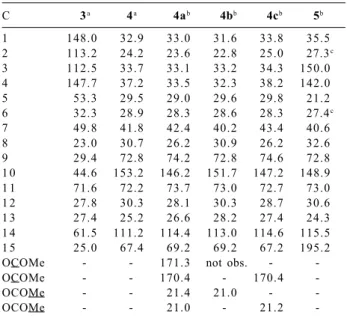
Germacra-10(14)-en-Table 1.13C NMR data for sesquiterpenes and their acetates (δ, 100
MHz)
C 3a 4a 4ab 4bb 4cb 5b
1 148.0 32.9 33.0 31.6 33.8 35.5
2 113.2 24.2 23.6 22.8 25.0 27.3c
3 112.5 33.7 33.1 33.2 34.3 150.0
4 147.7 37.2 33.5 32.3 38.2 142.0
5 53.3 29.5 29.0 29.6 29.8 21.2
6 32.3 28.9 28.3 28.6 28.3 27.4c
7 49.8 41.8 42.4 40.2 43.4 40.6
8 23.0 30.7 26.2 30.9 26.2 32.6
9 29.4 72.8 74.2 72.8 74.6 72.8
1 0 44.6 153.2 146.2 151.7 147.2 148.9
1 1 71.6 72.2 73.7 73.0 72.7 73.0
1 2 27.8 30.3 28.1 30.3 28.7 30.6
1 3 27.4 25.2 26.6 28.2 27.4 24.3
1 4 61.5 111.2 114.4 113.0 114.6 115.5 1 5 25.0 67.4 69.2 69.2 67.2 195.2
OCOMe - - 171.3 not obs. -
-OCOMe - - 170.4 - 170.4
-OCOMe - - 21.4 21.0 -
-OCOMe - - 21.0 - 21.2
-a Pyridine-d
9-acetate-11,15-diol (4c): 1H NMR (CDCl
3, 400 MHz) δ
6.05 (dd, J 9.6, 4.4 Hz, H-9), 5.42 (br. s, H-14a), 5.20 (br. s,
H-14b), 3.71 (br. s, H-15a), 3.70 (br. s, H-15b), 2.06 (s, OCOMe), 1.40 (s, H-13), 1.37 (s, H-12). 13C NMR: Table 1. Germacra-3,10(14)-dien-9,11-diol-4-carbaldehyde
(5): Amorphous solid. [α]D26 –9.97o (CHCl
3, c0.0065). IR
νmax/cm-1 3417, 2966, 2928, 1709, 1684, 1644, 1463, 1377,
756 (KBr). GC-MS: Rt 18.45 min., EIMS m/z (rel. int.): 234
[M – H2O] (3), 219 [M-CH2O] (6), 216 [M – 2xH2O] (4), 191 (9), 173 (17), 145 (59), 131 (34), 119 (37), 105 (65), 91 (100), 81 (46), 59 (99). 1H NMR (pyridine-d
5, 400 MHz,
δ): 9.38 (d, J 1.3 Hz, H-15), 6.47 (dd, J 11.7, 4.6 Hz, H-3),
5.12 (br. s, J 1.3 Hz, H-14a), 5.06 (br. s, H-14b), 4.26 (t, J 3.2
Hz, H-9), 2.80 (ddt, J 13.7, 12.0, 12.0, 4.8 Hz, H-2a), 2.58
(H-1a), 2.52 (H-1b), 2.47 (H-5a), 2.42 (H-5b), 2.36 (H-2b), 1.95 (ddd, J 16.3, 8.3, 3.2 Hz, H-8a), 1.79 8b), 1.68
(H-6a), 1.42 (H-7), 1.14 (s, 12), 1.11 (H-6b), 1.08 (s, Me-13). 13C NMR: Table 1. HMBC: Table 2.
22,25-Dihydroxy-9β,19-cyclolanost-23-en-3-one (6):
Amorphous solid. IR νmax/cm-1 3431, 2924, 2359, 1702,
756, 299 (KBr). 1H NMR (CDCl
3, 400 MHz) δ 5.85 (dd, J
15.6, 0.8 Hz, H-24), 5.71 (dd, J 15.6, 7.2 Hz, H-23), 4.22 (m, H-22), 2.71 (td, J 14.0, 14.0, 6.4 Hz, H-2β), 2.30 (ddd,
J 14.0, 4.4, 2.4 Hz, H-2α), 1.88 (m, H-1a), 1.53 (m, H-1b), 1.45 (m, H-20), 1.34 (s, 26 and 27), 1.10 (s, Me-30), 1.05 (s, Me-29), 1.03 (s, Me-18), 0.91 (d, J 6.8 Hz, Me-21), 0.86 (s, Me-28), 0.79 (d, J 4.4 Hz, H-19a), 0.58 (d, J 4.4
Hz, H-19b). 13C NMR (CDCl
3, 100 MHz) δ 216.7 (s, C-3),
140.4 (d, 24), 125.1 (d, 23), 74.4 (d, 22), 70.8 (s, 25), 50.2 (s, 4), 49.2 (d, 17), 48.4 (d, 5), 47.8 (d, 7), 45.6 (s, 13), 42.3 (d, 20), 37.5 (t, 2), 35.7 (t, 12), 33.4 (t, 1), 32.7 (t, 15), 30.1 (q, 26), 29.9 (q,
27), 29.7 (t, 19), 27.4 (t, 7), 26.6 (t, 16), 26.0 (s, 10), 25.9 (t, 11), 22.2 (q, 29), 21.5 (t, 6), 21.1 (s, 9), 20.8 (q, 30), 19.3 (q, 28), 18.2 (q, 18), 12.0 (q, C-21). Signal for C-14 was not observed. Multiplicities were obtained from DEPT.
24-methylene-12β-hydroxycholesterol (7): Amorphous
solid, mp 119-121°. [α]27
D -1.89° (Me2CO; c 0.72); 13C
NMR (CDCl3, 100 MHz) δ 157.1 (s), 140.9 (s), 121.9 (d), 106.3 (t), 79.7 (d), 71.9 (d), 57.5 (d), 54.9 (d), 49.7 (d), 47.9 (s), 42.3 (t), 37.4 (t), 36.8 (s), 34.0 (d), 33.7 (d), 33.6 (d), 32.7 (t), 31.8 (t), 31.5 (t), 30.9 (d), 24.7 (t), 24,0 (t), 22.2 (q), 22.1 (q), 21.8 (q), 19.5 (q), 8.1 (q). The multiplicities were
obtained from DEPT. 1H NMR (CDCl
3, 400 MHz) δ 5.30
(br. s, H-6), 4.67 (s, H-28a), 4.61 (s, H-28b), 3.50 (m, H-3), 3.39 (dd, J 4.4; 10.8 Hz, H-12).
24-methylene-12β-hydroxycholest-4-en-3-palmitate
(8): Amorphous solid; EIMS m/z (rel. int.): 413 (7), 412 (21), 396 (9), 229 (27), 212 (5), 147 (48), 137 (22), 125 (15), 124 (94), 107 (49), 91 (76); 1H NMR (CDCl
3, 400 MHz) δ 5.38
(br. s, H-6), 4.73 (s, H-28a), 4.69 (dd, H-12), 4.66 (s, H-28b), 4.64-4.58 (m, H-3); IR: νmax./cm-1 1726 (KBr).
24-methyl-12β-hydroxycholest-4-en-3-one (9): Ft-IR:
νmax/cm –1 3414, 1685 (film); EIMS m/z (rel. int.): 269 (45),
241 (6), 161 (30), 145 (36), 105 (54), 91 (68), 55 (100); 1H
NMR (CDCl3, 400 MHz) δ 5.74 (br. s, H-4), 3.46 (dd, J 4.4;
10.8 Hz, H-12).
Results and Discussion
The methanol extract of the stems of T. claussenii was
submitted to solvent partition followed by several column chromatographies. This procedure led to the isolation and characterization of five sesquiterpenoids: two known
eudesmane derivatives, β-eudesmol (1), and
cryptomeridiol (2), one new elemane derivative,
14-hydroxyelemol (3), two new germacrane derivatives,
germacra-10(14)-en-9,11,15-triol (4) and
germacra-3,10(14)-dien-9,11-diol-4-carbaldehyde (5), and one
cycloartane triterpenoid, 22,25-dihydroxy-9β
,19-cyclolanost-23-en-3-one (6). The structures of the
compounds were identified on the basis of their spectral data and comparison with compounds reported in the literature.
The data reported for β-eudesmol4 and cryptomeridiol5,6
confirmed the structures for 1 and 2. Other possible isomers
for 2 were ruled out through comparison with authentic
compounds reported in the literature.6,7
Compound 3 was established from 1H and 13C NMR
spectral data. The IR spectrum suggested the presence of hydroxyl groups (3401 cm-1). The 13C NMR spectrum
showed 15 carbon signals. The multiplicities of the carbons
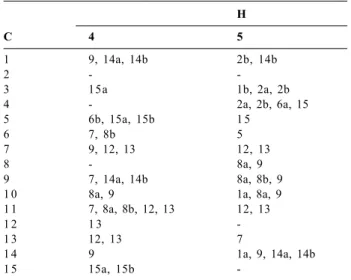
Table 2. HMBC correlations for 4 and 5
H
C 4 5
1 9, 14a, 14b 2b, 14b
2 -
-3 15a 1b, 2a, 2b
4 - 2a, 2b, 6a, 15
5 6b, 15a, 15b 1 5
6 7, 8b 5
7 9, 12, 13 12, 13
8 - 8a, 9
9 7, 14a, 14b 8a, 8b, 9
1 0 8a, 9 1a, 8a, 9
1 1 7, 8a, 8b, 12, 13 12, 13
1 2 1 3
-1 3 12, 13 7
1 4 9 1a, 9, 14a, 14b
-determined by PENDANT led to the attribution of 3 C, 3 CH, 6 CH2 and 3 CH3. The signals at δ 71.6 (s) and δ 61.5 (d) were attributed to carbinolic carbons, allowing us to propose the molecular formula C15H26O2 for compound 3.
In the MS the parent ion observed, m/z 220, does not represent the molecular ion which was expected to be m/z
238, due to the loss of one molecule of water. The
PENDANT spectrum showed four olefinic carbons at δ
148.0 (d), 147.7 (s),113.2 (t) and 112.5 (d). The remaining
unsaturations suggested that 3 was a monocyclic
sesquiterpenoid. The proton signals at δ 1.39 (s) and 1.40 (s) in the 1H NMR spectrum and at δ 27.4 (q), 27.8 (q) and
71.6 (s) in the PENDANT spectrum suggested the presence of a 1-hydroxy-1-methylethyl group, which was confirmed in the mass spectrum by the fragment m/z 59. In the 1H-1H
COSY experiment of 3, H-1 (δ 6.10, dd) was coupled to two H-2 (δ 5.20, dd and 5.36, dd). Both H-2 were coupled to each other. These olefinic signals suggested a vinyl group connected to a quaternary carbon. The olefinic protons H-3 (δ 4.95 and 4.79) were not coupled to other protons and the signals for C-3 (δ 112.5, t) and C-4 (δ
147.7, s) suggested an exomethylene group, where a methyl group H-15 (δ 1.78, s) is attached to C-4. These data together with consideration of isoprene rule led us to propose a sesquiterpene elemane derivative for 3. The 1H
NMR spectrum of 3 also showed an AX coupling system
(δ 4.29, 4.03, both d, J 10.8 Hz) and the 13C NMR showed
a carbinolic carbon at δ 61.5 (t), which led us to suggest that methyl group (C-14) was replaced by a hydroxymethylene group. Other carbon data are described in Table 1. The attribution of the carbon signals was based on related elemanes from the literature.8,9 Acetylation of 3
with acetic anhydride in pyridine provided the monoacetate of the primary alcohol (3a). The relative configurations of 3 were proposed on basis on the biogenesis of the elemane
derivatives.10
Compound 4 was also found to be a monocyclic
sesquiterpenoid. The IR spectrum suggested the presence of hydroxyl groups (3396 cm-1). The 13 C NMR showed 15
carbon signals. The multiplicities of the carbons determined by PENDANT led to the attribution of 2 C, 3 CH, 8 CH2 and 2 CH3, of which 3 were carbinolic carbons:
δ 72.8 (d, C-9), 72.2 (s, C-11) and 67.4 (t, C-15). The carbon signals at δ 153.2 (s, C-10) and 111.2 (t, C-14) suggested the presence of an exomethylene group. The molecular formula proposed for 4 was C15H28O3. The 1H NMR
spectrum showed the olefinic proton signals at δ 5.66 (br. s, H-14a) and 5.27 (br. s, H-14b). The 1H-1H COSY spectrum
showed that both carbinolic protons at δ 3.77 (dd, H-15a) and 3.66 (dd, H-15b) were coupled to each other and coupled to another proton at δ 2.25 (m, H-4). The HMBC
experiment showed the correlation of the carbinolic proton at δ 4.59 (br. t, H-9) with the olefinic carbons 10 and C-14, therefore H-9 should be carbinolic and allylic. The 1 H-1H COSY experiment showed that H-9 was coupled with
two protons at δ 2.36 (dt, H-8a) and 1.97 (dt, H-8b), which are both coupled to each other and coupled to another proton at δ 2.22 (m, H-7). The HMBC experiment showed that H-9 was also correlated with C-7 (δ 41.8) and C-1 (32.9). The presence of a 1-hydroxy-1-methylethyl group was also characterized by the correlation of the methyl proton signals at δ 1.30 (s, H-12) and 1.40 (s, H-13) with the quaternary carbinolic carbon at δ 72.2 (C-11) in the HMBC experiment and the fragment m/z 59 in the mass
spectrum. The possible bisabolane structure for compound
4 was ruled out by these correlations in addition to the
correlations of C-11 with H-7 and C-7 with methyl protons (H-12 and H-13), which confirmed a germacrane structure for the sesquiterpenoid 4. The chemical shifts for C-12
and C-13 are very close for compounds 1 (∆δ 0.1), 2 (∆δ
0.6) and 3 (∆δ 0.4), and more distinct for 4 (∆δ 5.1). This difference may be due to the hydrogen bond between the hydroxyl groups at C-9 and C-11, which might fix a preferential conformation. The chemical shifts observed for C-12 and C-13 for acetates 4a (∆δ 1.5), 4b (∆δ 2.1), and 4c (∆δ 1.3) suggested that the hydrogen bond is stronger when hydroxy group at C-9 is not esterified.
The IR spectrum of 5 suggested the presence of
hydroxyl (3417 cm-1) and α,β-unsaturated carbonyl
(1684 cm-1) groups. The 1H NMR spectrum showed two
methyl groups at δ 1.14 (s, H-12) and 1.08 (s, H-13), one carbinolic and allylic proton at δ 4.26 (t, H-9) and three olefinic protons at δ 6.47 (dd, H- 3), 5.12 (br. s, H-14), and 5.06 (br. s, H-14). A signal at δ 9.38 (d, H-15) suggested the presence of an aldehyde group. The 13C NMR spectrum of
5 showed 15 carbon signals. The multiplicities of the
carbons determined by DEPT led to the attribution of: 3 C, 4 CH, 6 CH2 and 2 CH3. Four olefinic carbons were observed at δ 150.0 (d, C-3), 142.0 (s, C-4), 148.9 (s, C-10), and 115.5 (t, C-14), indicating the presence of two double bonds, including one exomethylene group. The signal at
δ 195.2 (d, C-15) confirmed the presence of an aldehyde group. Two carbinolic carbons were observed at δ 72.8 (d, C-9) and 73.0 (s, C-11). The molecular formula proposed for 5 was C15H24O3. In the MS the parent ion observed,
m/z 234, does not represent the molecular ion which was expected to be m/z 252, due to the loss of one molecule of
water. Compound 5 was also found to be a germacrane
methine carbon (δ 150.0) suggested that this double bond should be conjugated with the aldehyde carbonyl group. The location of the double bond between C-4 and C-5 was ruled out mainly through analysis of the NMR data. The
1H-1H COSY experiment showed that the olefinic proton
(δ 6.47, H-3) was coupled to two allylic protons at δ 2.80 (H-2a) and 2.36 (H-2b). These allylic protons are also coupled to another two allylic protons at δ 2.58 (H-1a) and 2.52 (H-1b). These couplings are not possible for the double bond ∆4,5.
The complete assignment of the protons and carbons of the new sesquiterpenoids 4 and 5 was done on basis on
HMBC, HMQC and 1H-1H COSY data, Table 1 and 2. A
closely related germacrane-type sesquiterpenoid of 5,
6- hydroxy-5-methylene-8-isopropenylcyclodec-1-enecarbaldehyde, has been recently described and isolated from Leitneria floridana (Leitneriaceae).11
It is proposed that elemanes, germacranes and eudesmanes might share the same biogenetic pathway, which involves Cope rearrangement of germacranes to elemanes.10 The Cope rearrangement of germacranolides
to elemanolides has been investigated.12 Eudesmanolides
were also produced in this approach. The co-occurrence of elemanes, germacranes and eudesmanes in T. claussenii is
a good evidence that the biogenetic pathway of these sesquiterpenoids involves a single precursor.
The IR spectrum of 6 suggested the presence of
hydroxyl (3431 cm-1) and carbonyl (1702 cm-1) groups.
The 13C NMR spectrum showed 30 carbon signals. The
multiplicities of the carbons determined by DEPT 135o
led to the attribution of: 7 C, 7 CH, 9 CH2 and 7 CH3, which suggested that 6 was a triterpenoid. The 1H NMR
spectrum showed an AB coupling system at δ 0.79 and 0.58 (both d, J 4.4 Hz), characteristic for H-19 of the
cyclopropane ring of the cycloartane triterpenoids. In the
13C NMR spectrum, the signal at δ 216.7 (s) suggested the
presence of a ketonic carbonyl group at C-3. The signals of the α-carbonyl protons were observed at δ 2.30 (ddd, J
2.4, 4.4, 14.0 Hz, H-2α) and 2.71 (dt, J 6.4, 14.0, 14.0 Hz, H-2β). The olefinic proton signals of the side chain were observed at δ 5.85 (dd, H-24) and 5.71 (dd, H-23). The chemical shift of H-22 (δ 4.22) suggested that this proton should be carbinolic and allylic. The 1H-1H COSY
experiment showed that H-22 was coupled with two olefinic protons at δ 5.85 and 5.71, and with another proton at δ
1.45 (H-20). In the 1H-1H COSY experiment, the olefinic
protons were coupled to each other and to the carbinolic proton. The quaternary carbinolic carbon signal at δ 70.8 led us to propose one hydroxyl group at C-25. A similar compound has been reported as a diglucosylcycloartane showing the same side chain of 6.12 We have already
reported the isolation and identification of cycloartane triterpenoids from the leaves of T. claussenii.3
Chromatography of the dichloromethane extract from leaves of T. lepidota yielded a mixture of hydrocarbons as
the less polar compounds, besides sesquiterpenoids and several steroids. The mixture of hydrocarbons was analyzed through GC/MS, leading to the identification of three main components C29H60, C31H64 and C33H68.
The 1H NMR spectrum of the steroid 7,
24-methylene-12β-hydroxycholesterol, showed a pair of broad singlets
(δ 4.61 and 4.67), characteristics of a double bond in the side chain and signals of carbinolic protons (dd, δ 3.39 and m, δ 3.50); this was confirmed by its 13C NMR
spectrum (δ 79.7 and 71.9). These data allowed us to propose the structure of a steroid for this molecule, which contains two hydroxyl groups, one of those located at C-3. The location of the second hydroxyl was based on the
13C NMR spectrum, where a signal at δ 8.1 (Me) was
attributed to 18, requiring the hydroxyl attached to
C-12. Moreover, the hydroxyl should also occupy a β
position, being cis to Me-18. After acetylation, the 1H-1H
COSY experiment showed crosspeaks between a doublet (Me, δ 0.89) and a multiplet (δ 1.4), two methyl signals (d,
δ 1.03) with an allyl proton (δ 2.34). These observations led us to propose a 24-double bond; the double doublet at
δ 3.40 showed a shift to 4.70, with J 6.8 and 11.2 Hz, which
confirms the β-configuration of the 12-OH. This was corroborated by the presence of a γ-gauche effect between the hydroxyl group on C-12 and the methyl group (C-18,
δ 8.1). The steroid 8 showed to be very closely related to 7.
The main difference observed in the 1H NMR of 8, when
compared to 7, is the down field shift observed in the signal
of H-3 (m, δ 4.61) and an extra signal (br. s,δ 1.26) indicating
a linear long methylene chain. Compound 8 was
hydrolyzed under basic conditions yielding 7, besides a
mixture of fatty acids, which was methylated with diazomethane and analyzed by GC/MS. The methyl esters of palmitic, lauric and stearic acid where identified in the mixture in a ratio obtained by GC of 8:1:1. The steroid 9
was also very closely related to 7 and 8; the main difference
found in the 1H NMR spectrum was the replacement of the
hydroxyl at C-3 by an α,β-unsaturated carbonyl system,
like stigmast-4-en-3-one14. The IR spectrum confirmed the
presence of the carbonyl group (1680 cm-1). Therefore,
this compound was identified as 24-methyl-12β -hydroxy-cholest-4-en-3-one (9). The other steroids were identified
mainly by 1H NMR and GC/MS data, through comparison
with the literature15 as 24-methylenecholesterol,
campesterol, stigmasterol and β-sitosterol.
The aminoacid N-methyl-4-hydroxyproline was also
and the literature16 showed the identity of both compounds.
The sesquiterpenes spathulenol and a mixture of caryophyllene epoxide with humulene epoxide,17 were also
isolated from the same plant.
Acknowledgments
The authors are grateful to Fundação de Amparo à Pesquisa do Estado de São Paulo (FAPESP), Conselho Nacional de Desenvolvimento Científico e Tecnológico (CNPq), PRONEX and Financiadora de Estudos e Projetos (FINEP). One of us, M.A.T.A, acknowledges Coordenação de Aperfeiçoamento de Pessoal de Ensino Superior (CAPES) for the award of a scholarship.
References
1. Pupo, M. T.; Vieira, P. C.; Fernandes, J. B.; Silva, M. F. G. F.; Phytochemistry1998, 48, 307.
2. Pupo, M. T.; Vieira, P. C.; Fernandes, J. B.; Silva, M. F. G. F.; Rodrigues Fo., E.; Phytochemistry1997, 45, 1495.
3. Pupo, M. T.; Vieira, P. C.; Fernandes, J. B.; Silva, M. F. G. F.; Phytochemistry1996, 42, 795.
4. Jolad, S. D.; Timmermann, B. N.; Hoffmann, J. J.; Bates, R. B.; Camou, F. A.; Siahaan, T. J.; Phytochemistry 1988, 27, 2199.
5. Evans, F. E.; Miller, D. W.; Cairns, T.; Baddeley, G. V.; Wenkert, E.; Phytochemistry1982, 21, 937.
6. Nanayakkara, N. P. D.; Kinghorn, A. D.; Farnsworth, N. R.; J. Chem. Res.1986, 454.
7. Shun-Hua, W.; Hong-Jie, Z.; Zhong-Wen, L.; Han-Dong, S.; Phytochemistry1993, 34, 1176.
8. Mata, R.; Navarrete, A.; Alvarez, L.; Miranda, R. P.; Delgado, G.; Vivar, A. R.; Phytochemistry1987, 26, 191.
9. Askri, M.; Mighri, Z.; Bui, A. M.; Das, B. C.; Hylands, P. J.; J. Nat. Prod.1989, 52, 792.
10. Mann, J.; Davidson, R. S.; Hobbs, J. B.; Banthorpe, D. V.; Harborne, J. B.; Natural Products: their Chemistry and Bio-logical Significance; Longman: Essex, 1994, p. 323. 11. Xu, Z.; Chang, F.-R.; Wang, H.-K.; Kashiwada, Y.; McPhail,
A.; Bastow, K. F.; Tachibana, Y.; Cosentino, M.; Lee, K.-H.; J. Nat. Prod. 2000, 63, 1712.
12. Barrero, A. F.; Oltra, J. E.; Álvarez, M.; Tetrahedron Lett.
1998, 39, 1401.
13. Gromova, A. S.; Lutskii, V. L.; Zinchenko, S. V.; Ganenko, T. V.; Semenov, A. A.; Chem. Nat. Comp.1993, 29, 498. 14. Wu, T.-S.; Jong, T.-T.; Tien, H.-J.; Kuoh, C.-S.; Furukawa, H.;
Lee, K.-H.; Phytochemistry1987,26, 1623.
15. Gard, V. K.; Nes, W. R.; Phytochemistry1986,25, 2591. 16. Sciuto, S.; Chillemi, R.; Piattelli, M.; Impellizzeri, G.;
Phy-tochemistry1983,22, 2311.
17. Schneider, H. J.; Agrawal, P. K.; Magn. Reson. Chem.1986, 24, 718.
Received: July 13, 2001 Published on the web: May 13, 2002