Otorhinolaryngology Medical
Residency in Ceará in 2003:
openings and applicants’
profiles
Summary
João Aragão Ximenes Filho1, Marcelo GurgelCarlos da Silva2
1 PhD in Medicine - Medical School - USP. Guest Post-Graduation Professor of Surgery - UFC Medical School, MD.
2 PhD in Public Health. Full Professor of Public Health - State University of Ceará. Head of Teaching and Research - Cancer Hospital - Cancer Institute - Ceará. Study done at the Cancer Hospital - Cancer Institute Ceará.
Mailing Address: João Aragão Ximenes Filho - Rua Paula Ney 700 apto. 1202 Fortaleza CE 60140-200. Tel: (0xx85) 268-3641 - E-mail: [email protected]
Paper submitted to the ABORL-CCF SGP (Management Publications System) on May 24th, 2006 and accepted for publication on May 26, 2006. cod. 1966.
A
im: Analyze and compare the openings for medical residency in Otorhinolaryngology in Ceará in 2003 along with the profile of the applicants. Study design: cross-sectional. Methods: Data on medical residency programs in Ceará as of September 2003 were obtained electronically from the web page of the National Commission of Medical Residency (CNRM). The information regarding the applicants was retrieved directly from the institutions offering medical residency programs in Otorhinolaryngology in 2003 and complemented by searches in the databases of the Ceará State Regional Council of Medicine and the Federal Council of Medicine. Results: The total number of openings in Otorhinolaryngology authorized by CNRM is 12. Nine (75%) of the total and 4 (100%) of First Year Residence are currently filled. The hospital occupancy rate was 66.67% for HGF and 83.33% for HUWC. Competition per residency was 13.0 at both hospitals. The 48 applications received by the two hospitals were submitted by 37 doctors, 66.67% of whom were male. The largest number of candidates came from the medical schools of the Federal Universities of Ceará (62.50%), Paraíba (15.63%) and Alagoas (9.38%). Approximately 41% of the candidates had graduated in 2002. Conclusion: This study presents a profile of medical residency in Otorhinolaryngology.Keywords: otorhinolaryngology, selection process, medical residency.
ORIGINAL ARTICLE
INTRODUCTION
Medical Residency (MR) is but a “lato sensu”, post-graduation course, in which the physician has the opportunity to further enhance his/her knowledge and experience in a given medical specialty. It is fundamental because it completes the physician’s professional training, making him/her better for an increasingly demanding market place.
Even though medical education should be comple-ted in the graduate course, MR is a means for professional improvement. A large number of recently graduated physi-cians, either because of “tradition, need of improvement, or even due to deficiencies in his/her medical education aim at doing it as a means of learning, acquiring experience and specializing. With that they facilitate their acceptance
in the job market1.
The first MR programs in Brazil started during the 40’s at the Hospital dos Servidores do Rio de Janeiro and
the University Hospital of the University of São Paulo2,
following models created by Professors Halstedt and Osler from the Johns Hopkins University at the late XIX3 century.
In 1967, Brazilian resident physicians organized themselves and founded the National Association of Re-sident Physicians (ANMR), and held their first National Convention4. In that meeting they discussed issues per-taining to the residency programs, such as their strengths and the widespread exploitation of medical labor. They decided to fight for a federal regulation.
In 1977, The Brazilian Government, hearing the cry from the Universities and the ANMR, regulated MR in Brazil. Through Decree # 80.281 it implemented the National Committee of Medical Residency (CNRM), made up of ten members from the Ministry of Education and Culture - MEC. Through such decree, President Ernesto Geisel integrated all Brazilian MR Programs under the auspices of MEC.
Although it is burocratically under the auspices of the Ministry of Education (MEC), MR does not belong to the University; it is rather the responsibility of the institutions
and health care services that offer the program1,5.
In the State of Ceará, the first MR experience happe-ned in 1962, at the former University Hospital of the Federal University of Ceará, in the fields of General Practice and General Surgery. It was only in the second half of 1970 that the first state public programs cropped up in Ceará, with actions, in 1976, from the former National Institute of Social Security (INAMPS) in offering the opportunity in the fields of Surgery and Clinical Medicine at the Fortaleza General and the Messejana Hospitals.
The teaching of Otorhinolaryngology (ORL) started in 1951, at the fourth year of medical school in the Medical School of Ceará, inaugurated on May 12, 1948, and was
offered as a mandatory discipline. Notwithstanding, it was only in 1975 that MR in ORL kicked off at the University Hospital of the Federal University of Ceará, where it remai-ned in existence until 1980. After eight years of redesigning, the course was reopened in 1989, also the year in which
ORL MR started in the Fortaleza General Hospital6.
The School of Public Health of Ceará has fostered
studies about the SUS selective process under its auspices
7-12. Notwithstanding, the recently installed State Committee
of Medical Residency, as well as medical education institu-tions and class entities so far do not have a systematized and consolidated database which allows one to trace a profile of openings available for MR certified by CNRM in the State of Ceará, specially having seen the demand characteristics behind MR selection in Ceará..
The present study aims at assessing and comparing the offer of otorhinolaryngology medical residencies in Ceará, in 2003, and the profile of the applicants for the selection process of 2003.
MATERIALS AND METHODS
Data about MR programs in the state of Ceará were obtained from the Ministry of Education Internet Site (http://www.mec.gov.br/sesu/CNRM/consultaCNRM.asp), which holds the National Committee of Medical Residence (CNRM) homepage, and portrayed the situation of the programs in September of 2003. For each institution we collected information about administrative dependence (Federal, State, Municipal etc.), city of location and exis-ting program. For each program we assessed the offer and filling of MR spots per year of residency (R1, R2, and R3), the situation and expiration year of the MR program certification.
The data were plotted in a Microsoft Excel sprea-dsheet where they were sorted out and the variables of interest were established. The spreadsheet was also used to generate occupancy rates - measures by the percentage of spots filled by number of certified spots.
Complying with Resolution CNRM # 05/2002, the Medical Residency Programs were analyzed separately: the direct access ones and those that required some pre-requisites. The programs that had recently been discredited by CNRM and those under scrutiny for certification pur-poses in this committee were excluded from the analysis of results.
Board of Medicine of Ceará State and the Federal Board of Medicine. These data were also plotted in Microsoft Excel spreadsheets which were used to sort, select and classify the applicants enrolled for the selection process and calculate the occupancy rates of the programs and the rates by variables of interest.
RESULTS
In Ceará there are 14 institutions, all of them seated in Fortaleza, with Medical Residency Programs, of which only two have an ENT Residency Program implemented: Walter Cantídio University Hospital (HUWC) and Fortaleza General Hospital (HGF) (Table 1).
In total, there are 54 programs certified by CNRM, which offer 188 spots for R1, of which 137 correspond to direct access programs and 51 to specialized programs. The total number of ENT residency spots authorized by CNRM in the two working programs is 12, four for each year of residency. However, only 9 (75.00%) are filled, with the following numbers: 4 for R1, 4 for R2 and 1 for R3, portraying an occupancy rate of 100.00%, 100.00% and 25.00%, respectively; as to the filling of spots per hospital, we see that HGF uses 4 (66.67%) of the 6 spots assigned to them and HUWC uses 5 (83.33%) of its 6 assigned spots (Table 1).
Of the 373 applicants to Medical Residency at HUWC, 26 (6.97%) applied for Otorhinolaryngology, while of the 527 applicants to MR at HGF, 26 (4.93%) applied for ENT. The competition for each MR in ENT was of 13 applicants per spot for the programs, either together or separately (Table 2).
All the 52 applications to both selective processes for ENT Residency programs came from 32 physicians, since 20 of them had double applications for ENT; exclu-sive applications were seen from 6 applicants among the 26 who applied to the HUWV and from 6 of the 26 who applied to the SUS. Considering the different specialties of Medical Residency application in Fortaleza, six of the 32 applicants interested in Otorhinolaryngology also com-peted for spots in General Practice (2), at SUS, Radiology (2), at HUWC, General Surgery (1) and Anesthesiology (1), at the Dr. José Frota Institute.
Of the 52 applications, 32 (61.54%) were from males,
however when we excluded double applications in the programs, this figure goes up to 62.50%, in other words, 20 men among the 32 applicants; male participation was of 61.54% at HGF and at HUWC (Table 3).
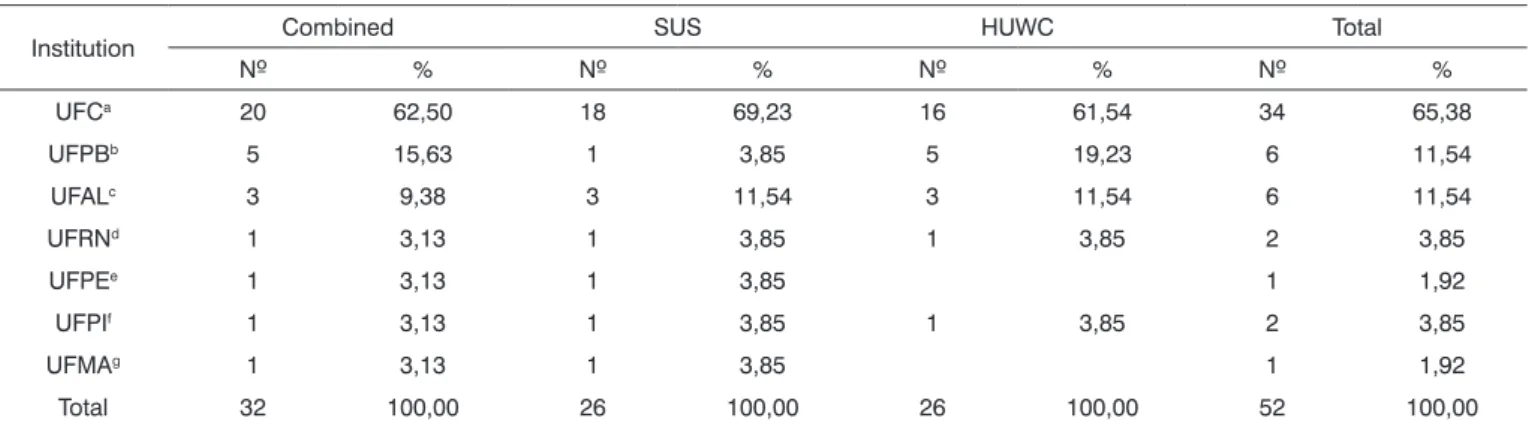
Of the 32 physicians interested in Otorhinolaryngo-logy MR, the University Institutions that most contributed with applicants were the Federal University of Ceará, with 20 (62.50%), the Federal University of Paraíba, with 5 (15.63%) and the Federal University of Alagoas, with 3 (9.38%) competitors, while other four institutions participa-ted with only one competitor each. According to the macro region of the applicant’s educational facility, all of them came from the Northeast, 20 (62.50%), from Ceará and 12 from other Northeastern States (37.50%) (Table 4).
By year of graduation, 13 (40.63%) had recently graduated in 2002, 9 (28.13%) had graduated in 2001 and 3 (9.38%) in 2000; from the 90’s, 7 showed up (21.88%); and there was one applicant that had graduated over 11 years before (Table 5).
DISCUSSION
The Federal Board of Medicine and the Brazilian Medical Association foster this interest for post-graduation “sensu lato” programs comprising Medical Residency pro-grams and specialization courses, aiming at serving the needs of the SUS - Brazilian Public Health Care System. The Certificate of Specialist is obtained after tests, board evaluations and proof of MR successful conclusion.
After Resolution CNRM 05/200213, partially con-firmed by resolution CFM 1.666/200314, MR programs in Otorhinolaryngology had its duration kept to 3 years and established the areas in which the ENT specialist may work as speech therapy and skull-facial surgery, the latter Table 2. Competition for ENT Medical Residency, according to pro-grams in Ceará - 2003
Institution Applicants Spots Competition
HGFa 26 2 13,00
HUWCb 26 2 13,00
Total 52 4 13,00
ª Fortaleza General Hospital; bWalter Cantídio University Hospital
Table 1. # of spots and occupancy rate of ENT Medical Residency Programs in Ceará - 2003
Institution Resident Spots % Occupancy
R1 R2 R3 Total R1 R2 R3 Total R1 R2 R3 Total
HGFa 2 2 0 4 2 2 2 6 100,00 100,00 0,00 66,67
HUWCb 2 2 1 5 2 2 2 6 100,00 100,00 50,00 83,33
Total 4 4 1 9 4 4 4 12 100,00 100,00 25,00 75,00
Table 4. Competition for ENT MR, according to the applicants’ educational institution in Ceará - 2003
Institution Combined SUS HUWC Total
Nº % Nº % Nº % Nº %
UFCa 20 62,50 18 69,23 16 61,54 34 65,38
UFPBb 5 15,63 1 3,85 5 19,23 6 11,54
UFALc 3 9,38 3 11,54 3 11,54 6 11,54
UFRNd 1 3,13 1 3,85 1 3,85 2 3,85
UFPEe 1 3,13 1 3,85 1 1,92
UFPIf 1 3,13 1 3,85 1 3,85 2 3,85
UFMAg 1 3,13 1 3,85 1 1,92
Total 32 100,00 26 100,00 26 100,00 52 100,00
a Federal University of Ceará; b Federal University of Paraíba; c Federal University of Alagoas; d Federal University of Rio Grande do Norte; e Federal University of Pernambuco; f Federal University of Piauí; g Federal University of Maranhão.
Table 5. Competition for ENT MR, according to the applicants’ year of graduation - Ceará - 2003
Year Combined HGF
a HUWCb Total
Nº % Nº % Nº % Nº %
1991 1 3,13 1 3,13 1 1,92
1996 2 6,25 1 2 7,69 3 5,77
1997 1 3,13 1 3,13 1 3,85 2 3,85
1998 1 3,13 1 3,13 1 3,85 2 3,85
1999 2 6,25 1 3,13 2 7,69 3 5,77
2000 3 9,38 3 9,38 1 3,85 4 7,69
2001 9 28,13 9 28,13 8 30,77 17 32,69
2002 13 40,63 9 28,13 11 42,31 20 38,46
Total 32 100,00 26 100,00 26 100,00 52 100,00
ª Fortaleza General Hospital; bWalter Cantídio University Hospital Table 3. Competition for ENT MR, according to gender, in Ceará - 2003
Combined HGFa HUWCb Total
Gender Nº % Nº % Nº % Nº %
Male 24 64,86 22 68,75 10 62,50 32 66,67
Female 13 35,14 10 31,25 6 37,50 16 33,33
Total 37 100,00 32 100,00 16 100,00 48 100,00
ªFortaleza General Hospital; bWalter Cantídio University Hospital
is shared with plastic surgery and head and neck surgery (http://www. mec.gov.br/sesu/CNRM).
In Ceará, only those applicants approved in 2003 had their spots guaranteed to receive a three year scho-larship. Prior to that, the third year of residency (R3) was optional, and this explains the occupation of only 25% of the spots for R3. Another piece of important piece of data is that it was also in 2003 that there was an increase in 33.3% in the number of spots available for ENT MR, due to an increase of one spot at HUWC. This increase the number of spots offered in Ceará went from three to four.
Of the results hereby reported, we see the ab-solute concentration of MR programs in the Capital of
the State of Ceará. Comparing this data with that from the 2002 census carried out by the Brazilian Society of
Otorhinolaryngology15, we may also see an intense
concen-tration of otorhinolaryngologists in the capitals of Brazilian States, especially in the North and the Northeast.
CONCLUSION
This paper tried to trace a profile of Medical Re-sidency in Otorhinolaryngology in the State of Ceará, focusing on supply and demand for spots in certified programs of ENT MR by the CNRM, analyzing different characteristics of these programs, such as location, spe-cialty and type of access.
REFERENCES
1. Machado MH. Os médicos no Brasil: um retrato da realidade. Rio de Janeiro: Fiocruz; 1997.
2. Sousa EG. A residência médica no Brasil. Rev Bras Educ Med 1985;9:112-4.
3. Furtado T. Residência médica e mestrado na área profissional da medicina. Rev Bras Educ Med 1995;9:5-6.
4. Leite EV. Residência médica, mestrado e doutorado. Rev Bras Educ Med 1983;7:101-4.
5. Feuerrwerker LCM. Mudanças na educação médica e residência médica. São Paulo: Hucitec/Rede Unida; 1998.
6. Pinheiro G. A história da otorrinolaringologia no Ceará. Fortaleza: Casa de José de Alencar/Programa Editorial; 1997.
7. Machado MH. Perfil dos médicos no Brasil: relatório final. Rio de Janeiro: NERHUS; 1996.
8. Silva JDM, Silva LFG, Silva MGC. Características educacionais dos candidatos ao processo seletivo da residência médica do sistema único de saúde do estado do Ceará para ingresso em 1997. Rev Ceará Med 2000;9(1):1-8.
9. Silva MGC, Silva JDM, Silva LFG. Avaliação dos critérios de seleção dos candidatos ao processo à residência médica do sistema único de saúde do estado do Ceará para ingresso em 1997. Rev Ceará Med 2000;9(3):1-9.
10. Silva JDM, Silva LFG, Silva MGC. Análise curricular e desempenho dos candidatos ao processo seletivo da residência médica do sistema único de saúde do estado do Ceará para ingresso em 1997. Rev Med Univ Fed Ceará 2001;41(1-2):61-77.
11. Silva JDM, Silva LFG, Silva MGC. Aspectos sócio-econômicos dos candidatos à residência médica do sistema único de saúde do estado do Ceará para ingresso em 1997. Rev Bras Educ Med 2002;24(3):13-20.
12. Mariano REM, Silva MGC. O processo seletivo para a residência mé-dica do sistema único de saúde no Estado do Ceará. In: Jorge MSB, Sampaio HAC, eds. Construção do conhecimento em saúde coletiva: políticas públicas e diversidades. Fortaleza: Ed. INESP/EdUECE, 2001. pp. 249-60.
13. Mariano REM, Silva MGC. O processo de avaliação na formação do profissional de saúde. In: Silva MGC, Jorge MSB, eds. Construção do saber em saúde coletiva: transição epidemiológica e diversidades. Fortaleza: Ed. INESP/EdUECE, 2002. pp. 348-58.
14. Brasil. Ministério da Educação. Comissão Nacional de Residência Médica (CNRM) Resolução CNRM 05/2002 Disponível em: http:// www.mec.gov.br/sesu/CNRM/ consultaCNRM.asp. Acessado em 15 de setembro 2003.
15. Sociedade Brasileira de Otorrinolaringologia. Censo 2002. São Paulo: Visão Gráfica; 2002.
specialists to the interior of Ceará.
As part of this process, considering the profile of medical students in these courses -most of them did not reside in the city where the schools are located, before being approved in the competitive university entrance exam, in order to guarantee the promise of keeping these professionals in these areas, it is of the utmost importance to offer MR programs where there are new courses being taught in the interior of Ceará. This happens because MR has a higher potential of keeping the physician where he/ she takes the program, since there is a greater possibility of professional acceptance after such training occurs. For these macro regions, as it has been suggested, the priority programs would be: General Practice, General Surgery, Obstetrics and Gynecology, Pediatrics, Anesthesiology, Otorhinolaryngology, Family and Community Practice.
The competition of 13.0 applicants per spot in MR among those applying for ENT, reveals a very uncomfor-table position, because it places Otorhinolaryngology among the most competitive programs when compared to anesthesiology, general practice, general surgery, or-thopedics, ophthalmology and radiology.
The figures portrayed here may very well reflect a very unfavorable situation, since the competition from those who graduate from UFC represent less than two-thirds, remaining around 37.50%, exactly the number of those who come from other medical schools. Since there is growing demand for MR spots in Ceará, from physicians graduated in other Brazilian States, the situation may cause an increase in competition, especially with the arrival of physicians who graduate from the new medical schools in Ceará, as of 2006.
For that, it is vital that the entities who sponsor or partner with the newly created medical schools setup proposals and qualify themselves to elaborate ENT MR Programs in the interior of the State. It is important to highlight that considering the time it takes to send pro-posals for the CNRM appraisal require great anticipation, it is urgent to join efforts aiming at correcting this unba-lance that, chronologically is not that far, before its effects become a reality.