Printed in Brazil - ©2005 Sociedade Brasileira de Química 0103 - 5053 $6.00+0.00
Article
* e-mail: [email protected]
A Simple Synthesis of Kaurenoic Esters and other Derivatives and Evaluation of
their Antifungal Activity
Paula Boecka, Marcus M. Sáa, Bruno S. de Souzaa, Rodrigo Cercená a, Andréa M. Escalanteb,
Susana A. Zachinob, Valdir Cechinel Filhoc and Rosendo A. Yunes*,a
a
Departamento de Química, Universidade Federal de Santa Catarina, 88040-900 Florianópolis - SC, Brazil
b
Facultad de Ciências Bioquímicas y Farmacêuticas, Universidad Nacional de Rosario, 2000 Rosario, Argentina
c
Núcleo de Investigações Químico-Farmacêuticas, Universidade do Vale do Itajaí, 88302-202 Itajaí - SC, Brazil
Este trabalho descreve a preparação de ésteres e amidas derivados do ácido caurenóico e a avaliação da atividade antifúngica frente a cepas padronizadas de fungos patogênicos. Ésteres alquílicos e benzílicos foram obtidos com bons rendimentos, sob condições brandas, a partir da esterificação do ácido caurenóico com haletos de alquila em KOH-acetona. Todos os compostos sintetizados foram submetidos aos testes de inibição contra leveduras, hifomicetos e dermatófitos, mas somente o ácido caurenóico e os derivados contendo um grupo carboxilato livre apresentaram atividade moderada frente a dermatófitos.
Representative esters derived from kaurenoic acid were prepared in order to evaluate their antifungal properties. Alkyl and substituted benzyl esters were obtained in good yield under mild conditions by esterification of kaurenoic acid with the corresponding alkyl halide in KOH-acetone. All synthesized compounds were tested for antifungal properties against pathogenic yeasts, hialohyphomycetes and dermatophytes. Kaurenoic acid and derivatives containing a free carboxyl group were moderately active against dermatophytes.
Keywords: kaurenoic acid, esters, Wedelia paludosa, antifungal activity
Introduction
Wedelia paludosa is a herbaceous medicinal plant employed in folk medicine for the treatment of several ailments, including dolorous processes.1 The hypoglycemic,2
antifungal3 and antinociceptive4 action of organic extracts
obtained from different parts of W. paludosa was recently described. This behavior was partially associated with the presence of ent-kaur-16-en-19-oic acid (1), a kaurane
diterpene5 containing a rigid tetracyclic skeleton known as
kaurenoic acid (Scheme 1). Kauranes are intermediates in the biosynthesis of a number of plant and fungal metabolites, including the gibberellins and other phytohormones involved in the regulation of growth and development of higher plants.6
Kaurenoic acid (1), along with several related kauranes,7
exhibits a wide variety of biological activities such as anti-microbial, anti-inflammatory, anti-fertility, cytotoxic, and trypanocidal.8-16 The relatively high natural abundance of
kaurenoic acid (1) and the inexistence of a general method
for the synthesis of alkyl kaurenoates by esterification of 1
provides further motivation to investigate its chemical modification17 in order to obtain derivatives and test their
pharmacological activity.18
This paper describes a general synthesis of kaurenoic esters and derivatives as well as their antifungal activity, evaluated against a panel of human opportunistic pathogenic fungi including yeasts, hialohyphomycetes and dermatophytes.
Results and Discussion
A search in literature revealed that preparation of alkyl kaurenoates by esterification of kaurenoic acid is limited to a few examples. Methyl kaurenoate 2 has been prepared
by diazotization of 1 in good yields by many research
groups,9,19-21 but the harmful reaction conditions and the
restrictions associated with the preparation of other diazoalkanes precluded its general use. On the other hand, synthesis of 3-hydroxypropyl kaurenoate 3 was achieved22
in carbon tetrachloride followed by addition of 1,3-propanediol to the unstable acyl chloride intermediate (Scheme 1). However, in our hands the utilization of environmentally prohibitive CCl4 as the chlorinating agent to promote esterification of kaurenoic acid 1 with methanol
was unsuccessful. The unavailability of general and simple methods to access alkyl kauranoates for biological screening motivated a more detailed study dealing with esterification of kaurenoic 1.
Attempts to prepare methyl kaurenoate 2 under classical
conditions such as sulfuric acid catalyzed esterification of 1
with methanol furnished the 16α-methoxy acid 4 instead of
the expected ester 2 (Scheme 2).23 Compound 4 obviously
arises from a typical Markovnikov addition of methanol to the tertiary carbocation (C-16) generated by protonation of terminal olefinic carbon (C-17). Observation of only one isolable stereoisomer indicated a high face differentiation by the nucleophile, which could be explained in terms of steric effects, the α-face (Re) being much less crowded than the β-face (Si). An initial effort to extend this reaction to other 16-alkoxy kaurenoic derivatives by treating kaurenoic acid
1 with higher alcohols such as ethanol, n-butanol or
ethyleneglycol under the same acidic conditions failed to give the expected addition products.
Another tentative approach to obtain alkyl kaurenoates from 1 involved a one-pot generation of kaurenoyl chloride
(from 1 and thionyl chloride) followed by addition of
methanol, resulting in esterification of the carboxylic group along with alcohol addition to the double bond to form 16α-methoxy ester 5 (Scheme 2). Structural characterization
of product 5 was achieved by 1H NMR singlets at δ 3.12 and
3.64 which were assigned, respectively, to methoxyl and methoxycarbonyl groups, by IR band at 1720 cm-1,
characteristic of ester carbonyl, and by comparison with previously reported spectral data (synthesized by esterification of 16-methoxy acid 4 with diazomethane).24
As expected, when pyridine was added to the above reaction conditions to prevent the acid-catalyzed methanol addition to the double bond, no detectable formation of adduct 5 was revealed in the NMR of the crude product
and methyl ester 2 could be obtained in moderate yield
(60-70%). However, the required excess of alcohol and utilization of unpleasant pyridine as an additive are obvious limitations that make this two-step process
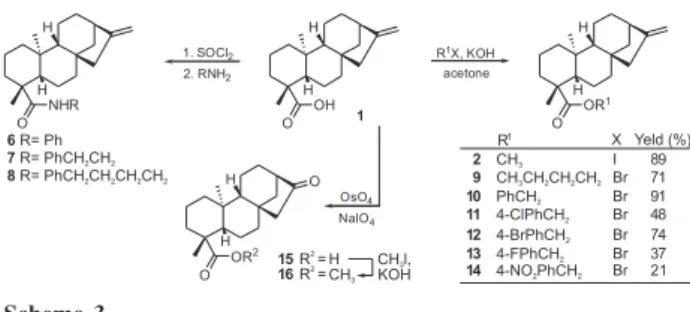
synthetically unattractive. Moreover, attempts to prepare amides by treating kaurenoyl chloride with an excess of aniline (to act as reagent and acid scavenger) leaded to the formation of the kaurenamide 6, albeit in low yield and
purity due to extensive formation of by-products (Scheme 3). Similarly, reactions of kaurenoyl chloride with aliphatic amines also gave rise to complex mixtures of products and attempts to isolate and completely characterize secondary alkyl amides 7 and 8 were unsuccessful.
A much more reliable strategy for esterification of kaurenoic acid 1 was carried out, based on the direct
alkylation of carboxylate ions. KOH in polar aprotic solvents has been used for the alkylation of carboxylic acids, amides and phenols with reactive alkyl halides under mild conditions, providing the corresponding esters, N -alkyl amides and aryl ethers in good yields.25 Accordingly,
alkylation of kaurenoic acid 1 with a combination of
methyl iodide and KOH in acetone resulted in a clean transformation to methyl kaurenoate 2, isolated in 89%
yield (not optimized). The potential generality of this reaction was attested by extending the conditions to alkyl bromides, leading to the respective kaurenoates 9-14 in
moderate to high yields (Scheme 3). Spectroscopic data are in well agreement with the proposed structures (Table 1). Replacement of benzyl bromide by benzyl chloride decreases the reaction rate and ester 10 was obtained in
lower yield. This SN2 process also shows a remarkable dependence on the solvent being used. Acetone was unique among those tested, usually affording the expected esters in a few hours. However, reaction of 1 with benzyl bromide
in KOH-DMF was slow, giving benzyl kaurenoate 10 in
low yield and purity. With THF or dichloromethane the corresponding ester was not observed even after days at room temperature, probably because of the poor solubility of KOH in these solvents.
This simple methodology for esterification was extended to 16-oxo-17-norkauranoic acid 15, which is an
intermediate for the synthesis of kauranes of biological importance.18 Oxidative cleavage19,20 of the olefin moiety
in 1 gave the keto acid 15 which was methylated with
CH3I in KOH-acetone to afford methyl norkauranoate 16
quantitatively (Scheme 3). Scheme 2.
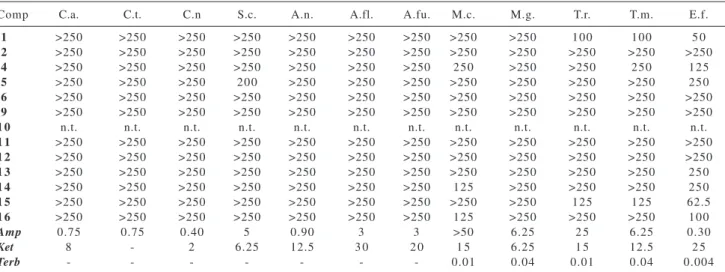
To carry out the antifungal evaluation, concentrations of kaurenoic acid and its derivatives up to 250 μg mL-1
were incorporated to growth media according to NCCLS guidelines.26 None of the compounds screened under the
microbroth dilution method presented significant activity against the yeasts Candida albicans, C. tropicalis,
Saccharomyces cerevisiae and Cryptococcus neoformans, the filamentous fungi Aspergillus niger, A. flavus and A. fumigatus or the dermatophytes Microsporum canis and
M. gypseum. In contrast, some selected compounds of the series showed moderate activity against the dermatophytes
Trichophyton rubrum, T. mentagrophytes and
Epidermophyton floccosum (Table 2).
Data in Table 2 revealed kaurenoic acid (1) as the most
active kaurane derivative, although 16-oxonorkauranoic
acid (15) displays comparable action against three
dermatophytes studied, being Epidermophyton floccosum
the most sensitive species. Since dermatophytes are a group of fungi which characteristically infect the keratinized areas of the body and cause dermatomycoses that are very difficult to eradicate, it is very interesting to note that kaurane derivatives showed selective activity against dermatophytes and not against any other type of fungi.
To evaluate the structure-activity relationships, the effects of three structural changes in the molecule of kaurenoic acid were considered: (a) conversion of the carboxylic acid group into esters (compounds 2, 5, 9-14, 16); (b) methanol addition
to the double bond (compounds 4, 5); (c) replacement of the
methylene 17 by a 16-oxo group (compounds 15, 16). It is
clear that when the carboxylic group is alkylated (change a) the derived esters do not show any activity up to 250 μg mL-1
(compare activity of 1 with that of compounds 2, 9, 11-14).
When a methoxyl is added to the double bond (1→4, change
b) a decrease in the spectrum of action and an enhancement of MIC values are observed. In addition, introduction of a methyl ester group as in adduct 5 also results in loss of activity.
Concerning the products from oxidative cleavage of the olefin moiety (change c) ketone 15 possess almost the same potency
as kaurenoic acid 1. The fact that methyl ester 16 displays a
lower activity than acid 15 again suggests that the 4-carboxylic
Table 1. 13C NMR (50 MHz; CDCl
3) chemical shift values (δ in ppm) for compounds 1, 2, 4, 5, 9-16
Carbon 1 2 4 5 9 1 0 1 1 1 2 1 3 1 4 1 5 1 6
1 40.7 40.7 41.3 40.6 40.1 41.3 40.2 41.3 41.3 41.2 40.5 41.3
2 19.0 19.0 19.7 19.0 19.7 19.8 19.8 19.8 19.8 19.8 18.9 19.7
3 37.8 38.0 37.8 37.1 37.9 33.7 32.6 33.7 33.7 38.7 37.2 37.9
4 43.7 43.8 43.9 43.2 41.3 44.4 41.3 44.4 44.4 44.4 42.4 43.1
5 57.0 57.0 57.6 56.9 57.5 57.8 57.8 57.8 57.7 57.7 56.6 57.4
6 21.8 21.9 22.7 22.0 21.4 22.5 22.6 22.6 22.5 22.6 20.6 21.4
7 41.2 41.2 42.7 42.0 40.9 41.9 40.3 41.9 41.9 41.8 40.9 41.7
8 44.2 44.2 45.4 44.6 44.5 44.8 44.8 44.8 44.8 44.8 43.6 44.4
9 55.1 55.0 55.2 54.5 56.3 55.6 55.6 55.6 55.6 55.6 53.8 54.6
1 0 39.6 39.4 38.4 38.0 38.6 38.7 38.7 38.7 38.7 40.1 39.6 40.2
1 1 18.4 18.4 19.1 18.4 19.6 19.0 19.0 19.0 19.0 19.0 18.6 19.4
1 2 33.1 33.1 29.6 29.6 32.6 30.3 30.3 30.4 30.3 33.7 29.4 30.1
1 3 43.8 43.8 44.3 43.7 41.7 44.5 41.9 44.6 44.5 44.6 47.6 48.4
1 4 39.6 39.6 40.3 39.4 39.9 40.1 40.1 40.2 40.2 40.2 37.5 38.6
1 5 48.9 48.9 49.8 49.1 48.8 49.5 49.6 49.6 49.5 49.5 54.8 55.6
1 6 155.9 155.8 84.7 83.9 155.8 156.4 156.5 156.5 156.5 156.3 222.6 223.2
1 7 102.9 102.9 18.9 18.2 102.8 103.6 103.6 103.7 103.6 103.7 -
-1 8 28.9 28.7 27.3 28.6 29.5 29.5 29.5 29.5 29.5 30.3 28.8 29.4
1 9 183.9 178.0 184.7 178.0 177.4 177.8 177.9 177.9 177.9 177.7 184.2 178.5
2 0 15.6 15.3 16.1 15.2 16.1 16.2 16.2 16.2 16.2 16.3 16.0 16.5
CH3O - - 56.6 55.9 - - -
-COOCH3 - 51.1 - 51.0 - - - 51.9
COOCH2 - - - - 63.9a 66.0 65.8 65.8 65.8 65.2
-ipso - - - 136.8 135.3 135.8 132.7 144.1 -
-orto - - - 128.8 129.3 132.3 130.9b 129.2 -
-meta - - - 129.0 130.3 130.6 116.0b 124.4 -
-para - - - 129.4 134.5 122.7 163.1b 147.9 -
-a Remaining carbons (CH
3CH2CH2): 14.3, 20.0 and 30.3 ppm; b Coupling constants for C-orto: 3JC-F = 10 Hz; -meta: 2JC-F = 25 Hz; -para: 1JC-F = 245 Hz.
group (and not the 16-oxo) should be a structural requirement for the antifungal activity in the kaurane series.
Conclusions
A simple method to prepare kaurenoic esters was developed based on alkylation of kaurenoic acids with alkyl halides in KOH-acetone. This mild protocol avoids the use of anhydrous conditions and potential contaminants such as high-boiling solvents and organic additives, leading to reproducible reaction conditions and easy work-up and purification steps. The solvent exerts a dramatic influence on the reaction rates and yields, acetone being the preferred by favoring cleaner reactions in shorter periods. According to the results obtained in microbroth dilution assays, only kaurenoic acid (1) and analogs
containing the acidic COOH group displayed a moderate activity against three dermatophytes, indicating that the presence of hydrophilic groups contributes to the observed antifungal activity.11 This synthetic method can be
potentially useful for esterification of other biologically important carboxylic acids, and studies dealing with their reactivity and other chemical properties are currently being investigated.
Experimental
General considerations
All chemicals were of reagent grade and were used as received. Melting points were determined using a
Microquímica MG-APF 301 apparatus and are uncorrected. Infrared spectra were acquired with a Perkin-Elmer FT-IR 1600 spectrometer using KBr for solids and film for liquid samples (range 4000-400 cm-1). 1H NMR (200 MHz) and 13C NMR (50 MHz, fully decoupled) spectra were recorded
with a Bruker AC-200F spectrometer. Samples were prepared in CDCl3 solution containing 1-2% tetramethylsilane (TMS) as internal standard. Chemical shifts are reported in parts per million (δ) relative to TMS. Coupling constants (J) are measured in Hertz (Hz); coupling patterns are designated as s (singlet); d (doublet); t (triplet); q (quartet); m (multiplet); brs (broad singlet). Elemental analyses were performed in a CHN Perkin Elmer 2400 by UFSC-Central Analítica, Departamento de Química, Florianópolis-SC, Brazil. The purity of the synthesized substances was monitored by thin-layer chromatography (TLC) using silica (Macherey-Nagel GmbH, Inc-USA) pre-coated in aluminum plates (Alugram® SIL G/UV254 layer 0.2 mm) with several
solvent systems of different polarity. Compounds were visualized with specific spray reagents anisaldehyde-sulfuric acid and iodine vapor, and were purified by column chromatography over silica gel (Aldrich, 100-200 mesh particle size) eluted with hexane-ethyl acetate gradient.
Extraction of plant material
Different parts of Wedelia paludosa DC. were collected in Florianópolis, State of Santa Catarina, Brazil, in November 2001, and identified by Dr. Ademir Reis (Department of Botany, UFSC, Florianópolis). A voucher specimen was deposited at the Barbosa Rodrigues Table 2. MIC values (mg mL-1) of kaurenoic acid and derivatives acting against human opportunistic pathogenic fungia
Comp C.a. C.t. C.n S.c. A.n. A.fl. A.fu. M.c. M.g. T.r. T.m. E.f.
1 >250 >250 >250 >250 >250 >250 >250 >250 >250 100 100 5 0 2 >250 >250 >250 >250 >250 >250 >250 >250 >250 >250 >250 >250 4 >250 >250 >250 >250 >250 >250 >250 250 >250 >250 250 125 5 >250 >250 >250 200 >250 >250 >250 >250 >250 >250 >250 250 6 >250 >250 >250 >250 >250 >250 >250 >250 >250 >250 >250 >250 9 >250 >250 >250 >250 >250 >250 >250 >250 >250 >250 >250 >250
1 0 n.t. n.t. n.t. n.t. n.t. n.t. n.t. n.t. n.t. n.t. n.t. n.t.
1 1 >250 >250 >250 >250 >250 >250 >250 >250 >250 >250 >250 >250 1 2 >250 >250 >250 >250 >250 >250 >250 >250 >250 >250 >250 >250 1 3 >250 >250 >250 >250 >250 >250 >250 >250 >250 >250 >250 250 1 4 >250 >250 >250 >250 >250 >250 >250 125 >250 >250 >250 250 1 5 >250 >250 >250 >250 >250 >250 >250 >250 >250 125 125 62.5 1 6 >250 >250 >250 >250 >250 >250 >250 125 >250 >250 >250 100
Amp 0.75 0.75 0.40 5 0.90 3 3 >50 6.25 2 5 6.25 0.30
Ket 8 - 2 6.25 12.5 3 0 2 0 1 5 6.25 1 5 12.5 2 5
Terb - - - 0.01 0.04 0.01 0.04 0.004
Herbarium, Itajaí-SC (VC Filho, 002). The different parts of the plant were cut into small pieces and macerated with acetone for six days. The extract was then concentrated under reduced pressure and submitted to chromatography column on silica gel eluted with a hexane-ethyl acetate gradient to give kaurenoic acid (1) as a white solid (ca. 0.2% yield); mp 179 -180 oC (lit.: 181-182 oC);27 IR (KBr)
νmax/cm-1: 3000-2800, 1692, 1650; 1H NMR: δ 0.70-2.40
(20H, m), 0.94 (3H, s, 20-CH3), 1.24 (3H, s, 18-CH3), 2.63 (1H, m, H-13), 4.73 (1H, s, H-17), 4.79 (1H, s, H-17).
16α-Methoxykauran-19-oic acid (4)
To MeOH (2 mL) and concentrated H2SO4 (2 drops) was added kaurenoic acid 1 (0.05 g; 0.165 mmol). The
reaction was stirred at 25 oC for 18 h, after which the mixture
was poured into water (20 mL) and extracted with ethyl acetate (3 X 20 mL). The combined organic layer was dried over MgSO4, filtered and concentrated in a rotary evaporator. The residue was purified by chromatography column to give 0.037 g of 4 as a white solid (66% yield);
mp 219-222 oC (lit.: 202-205 oC);23 IR (KBr) ν max/cm-1:
3180-2928, 2848, 1724; 1H NMR: δ 0.70-2.30 (21H, m),
0.95 (s, 3H, 20-CH3), 1.22 (s, 3H, 18-CH3), 1.27 (s, 3H, 17-CH3), 3.13 (s, 3H, OCH3). Anal. Calc. for C21H34O3: C, 75.41%; H, 10.25%. Found: C, 75.15%; H, 10.28%.
Methyl 16α-methoxykauran-19-oate (5)
A mixture of kaurenoic acid 1 (0.05 g; 0.165 mmol) and
thionyl chloride (0.70 mL; 9.6 mmol) was heated under reflux for 3 h. The excess of thionyl chloride was evaporated under reduced pressure and the residue was treated with anhydrous MeOH (3.0 mL) and then stirred under reflux for 3 h. After cooling, the mixture was concentrated in a rotary evaporator and the residue obtained was purified by chromatography column to give 0.040 g of 5 as a white solid (69% yield); mp
112-114 oC (lit.: 119.5 -120.5 oC);24 IR (KBr) ν
max/cm-1: 2932,
1720 ; 1H NMR: δ 0.70-2.40 (21H, m), 0.82 (s, 3H, 20-CH 3),
1.16 (s, 3H, 18-CH3), 1.25 (s, 3H, 17-CH3), 3.12 (s, 3H, OCH3), 3.64 (s, 3H, COOCH3). Anal. Calc. for C22H36O3: C, 75.82%; H, 10.41%. Found: C, 75.40%; H, 10.52%.
General procedure for preparation of alkyl kaurenoates
2, 9-14
Powdered KOH (0.032 g; 0.66 mmol) was added to anhydrous acetone (2.0 mL) and the mixture was stirred for 5 minutes at 25 oC. Kaurenoic acid 1 (0.05 g; 0.165
mmol) was then added to the reaction, followed by the alkyl halide (0.17 mmol). Stirring was continued for the
stated time at 25 oC, after which the reaction was poured
into water (20 mL) and extracted with ethyl acetate (3 x 20 mL). The combined organic extracts were washed with water (3 x 10 mL), dried over MgSO4, filtered and concentrated in a rotary evaporator. The residue was purified by chromatography column with a hexane-ethyl acetate gradient to give the following esters:
Methyl kaur-16-en-19-oate (2). 1 hour, white solid, 0.046
g (89% yield); mp 88-90 oC (lit.: 88-89 oC);19 IR (KBr)
νmax/cm-1: 3064, 1724, 1656; 1H NMR: δ 0.70-2.40 (20H,
m), 0.82 (s, 3H, 20-CH3), 1.16 (s, 3H, 18-CH3), 2.63 (m, 1H, H-13), 3.63 (s, 3H, COOCH3), 4.73 (s, 1H, H-17), 4.79 (s, 1H, H-17). Anal. Calc. for C21H32O2: C, 79.70%; H, 10.19%. Found: C, 79.86%; H, 10.11%.
Butyl kaur-16-en-19-oate (9). 1 hour, colourless oil, 0.042
g (71% yield); IR (film) νmax/cm-1: 2930, 1722, 1464; 1H
NMR: δ 0.70-2.40 (27H, m), 0.84 (s, 3H, 20-CH3), 1.16 (s, 3H, 18-CH3), 2.63 (m, 1H, H-13), 4.07-3.98 (m, 2H, OCH2), 4.73 (s, 1H, H-17), 4.79 (s, 1H, H-17). Anal. Calc. for C24H38O2: C, 80.39%; H, 10.68%. Found: C, 80.87%; H, 10.21%.
Benzyl kaur-16-en-19-oate (10). 2 hours, white solid, 0.059 g (91% yield); mp 44-46 oC; IR (KBr) ν
max/cm
-1: 3418,
2926, 1722, 1452; 1H NMR: δ 0.70-2.40 (20H, m), 0.78 (s,
3H, 20-CH3), 1.16 (s, 3H, 18-CH3), 2.62 (m, 1H, H-13), 4.72 (s, 1H, H-17), 4.78 (s, 1H, H-17), 5.03 (d, 1H, J 12.5 Hz, OCH2), 5.14 (d, 1H, J 12.5 Hz, OCH2), 7.36 (m, 5H, H-Ar). Anal. Calc. for C27H36O2: C, 82.61%; H, 9.24%. Found: C, 82.68%; H, 9.18%.
4-Chlorobenzyl kaur-16-en-19-oate (11). 24 hours, white
solid, 0.034 g (48% yield); mp 79-82 oC; IR (KBr)
νmax/cm-1: 3066, 1714, 1460; 1H NMR: δ 0.70-2.40 (20H,
m), 0.76 (s, 3H, 20-CH3), 1.18 (s, 3H, 18-CH3), 2.62 (m, 1H, H-13), 4.73 (s, 1H, H-17), 4.78 (s, 1H, H-17), 4.98 (d, 1H, J
12.5 Hz, OCH2), 5.11 (d, 1H, J 12.5 Hz, OCH2), 7.25-7.35 (m, 4H, H-Ar). Anal. Calc. for C27H35ClO2: C, 75.94%; H, 8.26%. Found: C, 76.20%; H, 8.28%.
4-Bromobenzyl kaur-16-en-19-oate (12). 20 hours, white solid, 0.057 g (74% yield); mp 84-86 oC; IR (KBr)
νmax/cm-1: 3064, 1714, 1480; 1H NMR: δ 0.70-2.40 (20H,
m), 0.75 (s, 3H, 20-CH3), 1.16 (s, 3H, 18-CH3), 2.61 (m, 1H, H-13), 4.72 (s, 1H, H-17), 4.77 (s, 1H, H-17), 4.95 (d, 1H, J
13.0 Hz, OCH2), 5.08 (d, 1H, J 13.0 Hz, OCH2), 7.22 (d, 2H,
4-Fluorobenzyl kaur-16-en-19-oate (13). 2 hours,
colourless oil, 0.025 g (37% yield); IR (film) νmax/cm-1:
2924, 1718, 1450; 1H NMR: δ 0.70-2.40 (20H, m), 0.74 (s,
3H, 20-CH3), 1.17 (s, 3H, 18-CH3), 2.62 (m, 1H, H-13), 4.72 (s, 1H, H-17), 4.78 (s, 1H, H-17), 4.99 (d, 1H, J 12.5 Hz, OCH2), 5.10 (d, 1H, J 12.5 Hz, OCH2), 7.04 (m, 2H, H-Ar), 7.34 (m, 2H, H-Ar). Anal. Calcd. for C27H35FO2: C, 78.99%; H, 8.59%. Found: C, 78.72%; H, 8.61%.
4-Nitrobenzyl kaur-16-en-19-oate (14). 24 hours, white solid, 0.015 g (21% yield); mp 115-117 oC; IR (KBr)
νmax/cm-1: 2924, 1718, 1462; 1H NMR: δ 0.70-2.40 (20H,
m), 0.78 (s, 3H, 20-CH3), 1.25 (s, 3H, 18-CH3), 2.63 (m, 1H, H-13), 4.73 (s, 1H, H-17), 4.79 (s, 1H, H-17), 5.10 (d, 1H, J
13.5 Hz, OCH2), 5.26 (d, 1H, J 13.5 Hz, OCH2), 7.54 (d, 2H,
J 8.5 Hz, H-Ar), 8.24 (d, 2H, J 8.5 Hz, H-Ar). Anal. Calcd. for C27H35O4N: C, 74.11%; H, 8.06%; N, 3.20%. Found: C, 74.38%; H, 7.73%; N, 3.02%.
16-oxo-17-norkauran-19-oic acid (15)
To a solution containing kaurenoic acid 1 (0.05 g; 0.165
mmol) in THF-H2O (1:1; 5.2 mL) was added NaIO4 (0.17 g; 0.82 mmol) and one crystal of OsO4. After stirring for 12 h at 25 oC, the reaction mixture was poured into water (20
mL), treated with saturated sodium bisulphite and sodium thiosulfate, and extracted with ethyl acetate (3 x 20 mL). The combined organic extracts were washed with water (5 x 10 mL), dried over MgSO4, filtered and concentrated in a rotary evaporator. The residue obtained was purified by chromatography column to give 0.042 g of 17 as a white
solid (85% yield); mp 234-236 oC (lit.: 229-232 oC);19 IR
(KBr) νmax/cm-1: 3530-2840, 1725; 1H NMR: δ 0.70-2.40
(19H, m), 1.01 (s, 3H, 20-CH3), 1.26 (s, 3H, 18-CH3), 1.95 (s, 2H, H-15). Anal. Calcd. for C19H28O3: C, 74.96%; H, 9.27%. Found: C, 74.66%; H, 9.25%.
Methyl 16-oxo-17-norkauran-19-oate (16)
Powdered KOH (0.032 g; 0.66 mmol) was added to anhydrous acetone (2.0 mL) and the mixture was stirred for 5 minutes at 25 oC. Compound 15 (0.051 g; 0.167
mmol) was then added to the reaction, followed by iodomethane (0.12 g; 0.8 mmol). After stirring for 24 hours at 25 oC, the reaction was poured into water (20 mL) and
extracted with ethyl acetate (3 x 20 mL). The combined organic extracts were washed with water (3 x 10 mL), dried over MgSO4, filtered and concentrated in a rotary evaporator. The residue was purified by chromatography column to give 0.053 g of 16 as a white solid (100% yield);
mp 108-110 oC (lit.: 127-128 oC);20 IR (KBr) ν max/cm
-1:
1741; 1H NMR: δ 0.70-2.40 (19H, m), 0.84 (s, 3H, 20-CH 3),
1.25 (s, 3H, 18-CH3), 1.95 (s, 2H, H-15), 3.66 (s, 3H, OCH3). Anal. Calcd. for C20H30O3: C, 75.43%; H, 9.50%. Found: C, 75.13%; H, 9.53%.
Microorganisms and media
For the antifungal evaluation, strains from the American Type Culture Collection (ATCC, Rockville, MD, USA) and the Centro de Referencia Micológica Facultad de Ciencias Bioquímicas y Farmacéuticas (CEREMIC), Suipacha 531-(2000)-Rosario, Argentina, were used:
Candida albicans ATCC 10231, Candida tropicalis C131,
Saccharomyces cerevisiae ATCC 9763, Cryptococcus neoformans ATCC 32264, Aspergillus flavus ATCC 9170,
Aspergillus fumigatus ATCC 26934, Aspergillus niger
ATCC 9029, Trichophyton mentagrophytes ATCC 9972,
Microsporum canis C 112, Trichophyton rubrum C 113,
Epidermophyton floccosum C 114 and Microsporum gypseum C 115. Strains were grown on Sabouraud-chloramphenicol agar slants for 48 h at 30 oC. The strains
were maintained on slopes of Sabouraud-dextrose agar (SDA, Oxoid) and subcultured every 15 days to prevent pleomorphic transformations. Spore suspensions were obtained according to reported procedures.28
Antifungal susceptibility testing
The Minimal Inhibitory Concentration (MIC) of each extract was determined by using broth microdilution techniques following the guidelines of the National Committee for Clinical Laboratory Standards (NCCLS).26
MIC values were determined in RPMI 1640 (Sigma, St Louis, Mo, USA) buffered to a pH 7.0 with MOPS. The starting inocula were 1x10³ to 5x10³ CFU mL-1. Microtiter
trays were incubated at 35 oC for yeasts and
hialohyphomycetes and at 28-30 oC for dermatophyte
strains in a moist, dark chamber, and MICs were recorded at 48 h for yeasts, and at a time according to the control fungus growth, for the rest of fungi. The susceptibilities of the standard drugs Ketoconazol, Terbinafine and Amphotericin B were defined as the lowest concentration of drug which resulted in total inhibition of fungal growth. For the assay, extract stock solutions were two-fold diluted with RPMI from 250-0.98 μg mL-1 (final volume = 100 μL)
Acknowledgements
The authors wish to thank Central de Análises (Departamento de Química, UFSC) for spectroscopic analysis. Financial support by CNPq is also acknowledged. PB is grateful to CNPq (Brazil) for a predoctoral fellowship. SAZ is grateful to Agencia de Promociones Científicas y Tecnológicas de la Argentina (ANPyCT) and OEA for financial support. This research is part of Project X.7-PIBEAFUN (Iberian-American Project on Search and Development of Antifungal Agents) of the Iberian-American Program for the Development of Science and Technology (CYTED), sub-program X.
References
1. Michalak, E.; Apontamentos Fitoterápicos da Irmã Eva Michalak, Epagri: Florianópolis, Brazil, 1997, pp. 60; Yunes, R. A.; Calixto, J. B.; Plantas Medicinais sob a Ótica da Química Medicinal Moderna, Argos: Chapecó, Brazil, 2001, pp. 59-66.
2. Bresciani; L. F. V.; Yunes, R. A.; Bürger, C.; de Oliveira, L. E.; Bóf, K. L.; Cechinel-Filho, V.; Z. Naturforsch. C 2004, 59, 229; Novaes, A. P.; Rossi, C.; Poffo, C.; Pretti Junior, E.; Oliveira, A. E.; Schlemper, V.; Niero, R.; Cechinel-Filho, V.; Bürger, C.; Therapie 2001, 56, 427.
3. Sartori, M. R. K.; Pretto, J. B.; Cruz, A. B.; Bresciani, L. F. V.; Yunes, R. A.; Sortino, M.; Zacchino, S. A.; Cechinel-Filho, V.; Pharmazie 2003, 58, 567.
4. Block, L. C.; Santos, A. R. S.; Souza, M. M.; Scheidt, C.; Yunes, R. A.; Santos, M. A.; Monache, F. D.; Cechinel-Filho, V.; J. Ethnopharmacol. 1998, 61, 85; Block, L. C.; Scheidt, C.; Quintão, N. L. M.; Santos, A. R. S.; Cechinel-Filho, V.; Pharmazie 1998, 53, 716.
5. Seaman, F.; Bohlmann, F.; Zdero, C.; Mabry, T. J.; Diterpenes of Flowering Plants - Compositae (Asteraceae), Springer Verlag: New York, 1990.
6. Helliwell, C. A.; Chandler, P. M.; Poole, A.; Dennis, E. S.; Peacock, W. J.; Proc. Natl. Acad. Sci. USA 2001, 98, 2065. 7. Ghisalberti, E. L.; Fitoterapia 1997, 68, 303.
8. Yang, Y.-L.; Chang, F.-R.; Hwang, T.-L.; Chang, W.-T.; Wu, Y.-C.; Planta Med. 2004, 70, 256; Kiem, P. V.; Cai, X. F.; Minh, C. V.; Lee, J. J.; Kim, Y. H.; Planta Med. 2004, 70, 282. Zamilpa, A.; Tortoriello, J.; Navarro, V.; Delgado, G.; Alvarez, L.; Planta Med. 2002, 68, 281. Wilkens, M.; Alarcón, C.; Urzúa, A.; Mendoza, L.; Planta Med. 2002, 68, 452.
9. Alves, T. M. A.; Chaves, P. P. G.; Santos, L. M. S. T.; Nagem, T. J.; Murta, S. M. F.; Ceravolo, I. P.; Romanha, A. J.; Zani, C. L.; Planta Med. 1995, 61, 85.
10. Slimestad, R.; Marston, A.; Mavi, S.; Hostettmann, K.; Planta Med. 1995, 61, 562.
11. Cotoras, M.; Folch, C.; Mendoza, L.; J. Agric. Food Chem. 2004, 52, 2821; Vieira, H. S.; Takahashi, J. A.; Boaventura, M. A. D.; J. Agric. Food Chem. 2002, 50, 3704.
12. Davino, S. C.; Giesbrecht, A. M.; Roque, N. F.; Braz. J. Med. Biol. Res. 1989, 22, 1127.
13. Pezzuto, J. M.; Compadre, C. M.; Swanson, S. M.; Nanayakkara, N. P. D.; Kinghorn, A. D.; Proc. Natl. Acad. Sci. USA 1985, 82, 2478.
14. Fraga, B. M.; González, P.; Guillermo, R.; Hanson, J. R.; Hernández, M. G.; Takahashi, J. A.; Phytochemistry 1994, 37, 717.
15. Cunha, K. M. A.; Paiva, L. A.; Santos, F. A.; Gramosa, N. V.; Silveira, E. R.; Rao, V. S.; Phytother. Res. 2003, 17, 320; Campos-Bedolla, P.; Campos, M. G.; Valencia-Sánchez, A.; Ponce-Monter, H.; Uribe, C.; Osuna, L.; Calderon, J.; Phytother. Res. 1997, 11, 11.
16. Anaya, J.; Grande, M. C.; Grande, M.; Patino, A.-I.; Torres, P.; Synlett 1999, 1429.
17. Ghisalberti, E. L.; Jefferies, P. R.; Sefton, M. A.; Sheppard, P. N.; Tetrahedron 1977, 33, 2451.
18. Vieira, H. S.; Takahashi, J. A.; Oliveira, A. B.; Chiari, E.; Boaventura, M. A. D.; J. Braz. Chem. Soc. 2002, 13, 151. 19. Henrick, C. A.; Jefferies, P. R.; Aust. J. Chem. 1964, 17, 915. 20. Mori, K.; Matsui, M.; Tetrahedron 1968, 24, 3095. 21. Yamasaki, K.; Kohda, H.; Kobayashi, T.; Kasai, R.; Tanaka,
O.; Tetrahedron Lett. 1976, 17, 1005.
22. Croft, K. D.; Ghisalberti, E. L.; Jefferies, P. R.; Knox, J. R.; Mahoney, T. J.; Sheppard, P. N.; Tetrahedron 1974, 30, 3663. 23. Das, A. K.; Mitra, S. R.; Adityachaudhury, N.; Patra, A.; Mitra, A. K.; Chatterjee, A.; Indian J. Chem., Sect. B 1979, 18B, 550. 24. Tanaka, O.; Mihashi, S.; Yanagisawa, I.; Nikaido, T.; Shibata,
S.; Tetrahedron 1972, 28, 4523.
25. Johnstone, R. A. W.; Rose, M. E.; Tetrahedron 1979, 35, 2169. 26. NCCLS, Committee for Clinical Laboratory Standards, Method M27-A2, 2nd ed., Wayne ed.; 2002, vol. 22 (15), p 1-29; ibid., Method M-38A, 2nd ed, Wayne ed.; 2002, vol. 22 (16), p 1-27. 27. Carvalho, G. J. A.; Carvalho, M. G.; Ferreira, D. T.; Faria, T. J.;
Braz-Filho, R.; Quím. Nova 2001, 24, 24.
28. Wright, L. R.; Scott, E. M.; Gorman, S. P.; J. Antimicrob. Chemother. 1983, 12, 317.