Printed in Brazil - ©2005 Sociedade Brasileira de Química 0103 - 5053 $6.00+0.00
Article
* e-mail: [email protected]
Abietane Diterpenes from
Hyptis platanifolia
Edigênia C. C. Araújoa, Mary Anne S. Limaa, Edson P. Nunesb and Edilberto R. Silveira*,a
a
Curso de Pós-Graduação em Química Orgânica, Departamento de Química Orgânica e Inorgânica and bDepartamento de Biologia, Centro de Ciências, Universidade Federal do Ceará,
CP 12200, 60971-270 Fortaleza-CE, Brazil
Das raízes de Hyptis platanifolia foram isolados três novos diterpenos abietanos 19-oxo-inuroyleanol, 11,14-di-hidroxi-12-metoxi-7-oxo-8,11,13-abietatrien-19,20β-olídeo and 19,20-epoxi-12-metoxi-11,14,19-tri-hidroxi-7-oxo-8,11,13-abietatrieno, em adição ao inuroyleanol e a coulterona. Investigação das partes aéreas forneceu a mistura de esteróides estigmasterol e β-sitosterol, e os triterpenos ácido betulínico e ácido ursólico. A caracterização estrutural dos compostos foi estabelecida com base em métodos espectroscópicos, principalmente RMN uni e bidimensional, e comparação com dados da literatura.
Three new abietane diterpenes 19-oxo-inuroyleanol, 11,14-dihydroxy-12-methoxy-7-oxo-8,11,13-abietatrien-19,20β-olide and 19,20-epoxy-12-methoxy-11,14,19-trihydroxy-7-oxo-8,11,13-abietatriene, in addition to inuroyleanol, and coulterone were isolated from roots of Hyptis platanifolia. Investigation of the aerial parts yielded a mixture of the steroids stigmasterol and β-sitosterol, and the triterpenes betulinic and ursolic acids. Structural characterization of all compounds was established on the basis of spectroscopic methods, particularly 1D and 2D NMR, and comparison with data from literature.
Keywords: Hyptis platanifolia, NMR, abietane diterpenes, betulinic and ursolic acids, steroids
Introduction
The genus Hyptis (Labiatae) is large (300 species) and widespread in the tropical America.1 Several species have been
reported to possess medicinal properties and are frequently reported in the treatment of gastrointestinal infections, as antifungal, antibacterial, anticonvulsant, to alleviate cramps and pain, as well as in the treatment of malaria.2-7 Despite
their reported use for medicinal purposes, a literature survey revealed that the phytochemical analysis of plants belonging to the Hyptis genus have been limited to a few species.
During the course of previous work on Brazilian Hyptis
species, we have reported the isolation and cytotoxic activity of abietane diterpenoids from roots of Hyptis martiusii.8 In continuation to the investigation of plants
from this genus, we present now the phytochemical study of Hyptis platanifolia Mart. ex Benth, a small shrub that grows in abundance in the Northeast of Brazil. From the roots extract three new abietane diterpenoids were isolated 1-3, in addition to the known diterpenes
inuroyleanol 4 and coulterone 5.9 From the aerial parts
the triterpenes betulinic 6 and ursolic acids 710 and a
mixture of the steroids stigmasterol 8 and β-sitosterol
9,11were characterized.
Results and Discussion
Compound 1 was isolated as an orange solid, mp 147-150 oC. The IR spectrum revealed bands for hydroxyl (3341
cm-1), and two carbonyl functions related to an aldehyde
(1727, 2721 cm -1) and a conjugated ketone (1619 cm -1).
The 1H NMR spectrum (Table 1) showed two deshielded
signals assignable to a hydrogen-bonded hydroxyl group at δ 13.30 and an aldehyde proton at δ 9.26, corroborating with the observations from the IR. The presence of an isopropyl group attached to the aromatic ring indicative of an abietane-type diterpenoid,12 was suggested by the
Hyptis platanifolia
respectively. Signals relative to an ABC system at δ 2.73 (dd, J 14.7 and 17.1 Hz, H-6eq), 2.14 (dd, J 2.5 and 17.1 Hz, H-6ax) and 2.40 (dd, J 2.5 and 14.7 Hz, H-5) were also observed and confirmed by analysis of the 1H-1H COSY
experiments. The magnitude of the coupling constant of 17.1 Hz observed to the methylene group at δ 2.73 (dd, J
17.1 and 14.7 Hz, H-6eq) and 2.14 (dd, J 17.1 and 2.5 Hz, H-6ax) was attributed to the geminal coupling of a methylene “α” to a ketone group, coupling just with a hydrogen at δ 2.40 (dd, J 14.7 and 2.5 Hz, H-5).9
Furthermore, geminal couplings between the methylene hydrogens at δ 3.38 (dt, J 2.3 and 10.9 Hz, H-1eq) and 1.51 (m, H-1ax); δ 1.83 (m, H-2eq) and 1.77 (m, H-2ax); and δ 1.53 (m, H-3eq) and 1.42 (m, H-3ax), besides vicinal couplings for the hydrogens at δ 1.83 and 1.77 (H-2eq and H-2ax) with both methylene at δ3.38 and 1.51 (H-1ax and H-1eq) and at
δ1.53 and 1.42 (H-3eq and H-3ax), revealed one subsystem constituted by six protons belonging to three adjacent methylene groups, which were placed between two quaternary sp3 carbon atoms.
Comparative analysis of BB and DEPT–13C NMR
spectra (Table 1) revealed 21 lines, in agreement with the C21H28O5 suggested molecular formula from the EIMS data (m/z [M•+] 360). From this analysis, one can easily deduce
the presence of two carbonyls (δ 205.0 and 204.5), one of
which of an aldehyde, five sp3 methyl carbons (one
methoxyl and four non functionalized methyls), four methylenes, two methine, and eight non-protonated carbons, six of which were unsaturated.
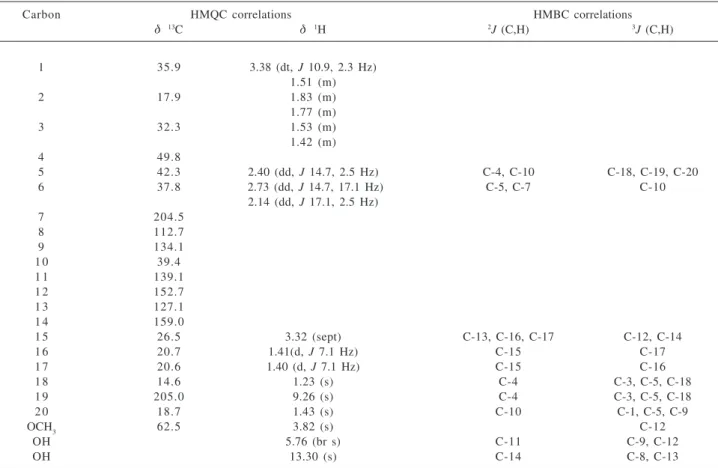
The substitution pattern of the fully substituted C aromatic ring was established from the HMBC analysis (Table 1). The suggestion of the location of one hydroxyl group at C-11 was determined by correlations of the OH hydrogen at δ 5.76 (br s) with the carbons at δ 152.7 (C-12, 3J), 139.1 (C-11, 2J) and 134.1(C-9, 3J). The
deshielded resonance of one hydrogen at δ 3.38 of the methylene group at C-1, allowed its assignment to the
Table 1.1H and 13C NMR data assignments for the compound 1 (CDCl
3, 500/125 MHz)
Carbon HMQC correlations HMBC correlations
δ 13C δ 1H 2J (C,H) 3J (C,H)
1 35.9 3.38 (dt, J 10.9, 2.3 Hz)
1.51 (m)
2 17.9 1.83 (m)
1.77 (m)
3 32.3 1.53 (m)
1.42 (m)
4 49.8
5 42.3 2.40 (dd, J 14.7, 2.5 Hz) C-4, C-10 C-18, C-19, C-20
6 37.8 2.73 (dd, J 14.7, 17.1 Hz) C-5, C-7 C-10
2.14 (dd, J 17.1, 2.5 Hz)
7 204.5
8 112.7
9 134.1
1 0 39.4
1 1 139.1
1 2 152.7
1 3 127.1
1 4 159.0
1 5 26.5 3.32 (sept) C-13, C-16, C-17 C-12, C-14
1 6 20.7 1.41(d, J 7.1 Hz) C-15 C-17
1 7 20.6 1.40 (d, J 7.1 Hz) C-15 C-16
1 8 14.6 1.23 (s) C-4 C-3, C-5, C-18
1 9 205.0 9.26 (s) C-4 C-3, C-5, C-18
2 0 18.7 1.43 (s) C-10 C-1, C-5, C-9
OCH3 62.5 3.82 (s) C-12
OH 5.76 (br s) C-11 C-9, C-12
OH 13.30 (s) C-14 C-8, C-13
et al J. Braz. Chem. Soc.
C-1β equatorial hydrogen as already observed for
abietane derivatives having a C-11 phenol group on ring C.13 Long-range correlations between the chelated
hydroxyl group at δ13.30 with the carbons at δ 159.0 (C-14, 2J), 127.1 (C-13,3) and 112.7 (C-8, 3J), and of the
methoxyl group at δ 3.82 with the carbon at δ 152.7
(C-12, 3J), determined the position of hydroxyl and
methoxyl groups at C-14 and C-12, respectively. Moreover, the correlation of the hydrogen of the formyl group at δ 9.26 (H-19) with the quaternary carbon at δ
49.8 (C-4, 2J), and the concomitant correlations of both
hydrogens at δ 2.40 (H-5, 3J) and 1.23 (CH 3-18,
3J) with
the carbonyl at δ 205.0 (C-19) established that the aldehyde group was, therefore, attached to C-4. (Figure 1). The equatorial orientation of the aldehyde group at C-4, was based on the chemical shift of the aldehyde hydrogen at the δ 9.26 in the 1H NMR, whereas an axial
substitution would take that hydrogen to an usual proton range, lower than δ 9.7, in agreement with a
previous report by Bohlmann et al.14 The above
information and comparison of the 13C NMR data found
to compound 1 with to those published for inuroyleanol
4 and 20-oxo-inuroyleanol 10, isolated from Salvia coulteri (Labiatae),9 allowed to establish its structure as
the new abietane diterpene 19-oxo-inuroyleanol. Compound 2 was obtained as an yellow solid with mp
248-250 oC. The molecular formula C
21H26O6 was
established by EIMS (m/z [M·+] 374). The IR spectrum
showed the presence of hydroxyls (3351 cm-1) and two
carbonyl groups relative to an ester (1735 cm-1) and a
conjugated ketone (1618 cm-1). Analysis in the 13C NMR
spectrum of 2 were similar to those observed for compound
1 (Table 2), except for the absence of the signals relative to the aldehyde and a methyl carbon and the presence of an extra oxygenated methylene at δ 72.8. The 1H NMR
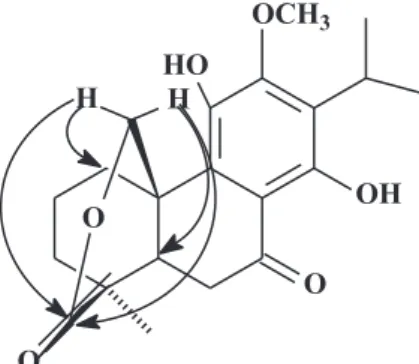
spectrum corroborated with these observations, through the absence of the singlets relative to both methyl and aldehyde hydrogens, besides the presence of additional signals for an AB system at δ 5.03 (d, J 12.5, H-20 pro-S) and 4.59 (dd, J
12.5, 2.0 Hz, H-20, pro-R). Significant long-range correlations in the HMBC spectrum were observed between the hydrogen of the AB system at δ 5.03 (H-20 pro-S) with the carbons at δ 175.6 (C-19, 3
J), 46.7 (C-5, 3
J) and 33.8 (C-10, 2J), while the other at δ 4.59 (H-20 pro-R) showed
correlations with the carbons at δ 175.6 (C-19, 3
J), 35.1 (C-1, 3J) and 33.8 (C-10, 2J) (Figure 2). The above spectral
informations suggested the presence of a δ-lactone moiety for compound 2, with the ring closure through the oxygen between C-19 and C-20. The relative stereochemistry was defined by the small value of the coupling constant (J 2.0 Hz) observed for the B part of the AB system at δ 4.59, that was ascribed to the long range coupling between the H-20
pro-S with the hydrogen H-1α, only possible in structures where the ethereal oxygen C-19 and C-20 is oriented towards C-2.15 These data suggested the final structure of compound
2 as the new abietane 11,14-dihydroxy-12-methoxy-7-oxo-8,11,13-abietatrien-19,20β-olide.
Hyptis platanifolia
Compound 3 was obtained as yellow crystals, mp 175.0-181.0 oC. The IR spectrum showed bands relative to
hydroxyls (3411 cm-1) and one conjugated carbonyl group
(1621 cm-1). The 1H NMR spectrum displayed duplicated
signals for the majority of the spin systems with a molar ratio 3:1, what indicated a close relationship with those observed for compound 2. A slight difference was found by the presence of extra singlets at δ 4.88 and 4.91 suggesting a diastereoisomeric mixture. The proposition that the δ -lactone moiety of compound 2 was reduced on 3 was suggested by comparison of their 13C NMR data, since the
carbonyl group of δ-lactone of the compound 2 (δ 175.6) was substituted by the hemiaketal methine carbons at δ
98.4 and 99.2 (C-19) on 3, and by the respective 3 J long-range conectivities in the HMBC spectrum between the H-19 hemiaketal hydrogens of both epimers at δ 4.91 and 4.88 with the C-5 carbons at δ 47.7 and 44.4, and C-20 carbons at δ 66.4 and 60.1, respectively. The stereochemistry at C-19 to the two isomers was proposed by the chemical shifts observed for the AB part of the ABX systems. The double doublets at δ 4.17 and 4.02 were ascribed to both H-20 pro -S signals. The more deshielded signal at δ 4.17, relative to the most abundant isomer, was related to the compound which contains the hydroxyl group at C-19 in a 1-3 diaxial relationship with the H-20 pro-S, as observed in the structure of the abietane diterpenoid 19-dihydro-deacetyl sesseine
11, also isolated as an diastereoisomeric mixture from Salvia candicans (Labiatae).15 Thus, compound 3 was determined
as the diastereoisomeric mixture of the new diterpene 19,20- epoxy-12-methoxy-11,14,19-trihydroxy-7-oxo-8,11,13-abietatriene.
Abietane diterpenes are widespread in the Labiatae family, and well represented in the genus Hyptis through the species H. martiusii,8
H. suaveolens16 and
H. dilatata.17
On the other hand, icetexane skeletons have been isolated
only in the Labiatae genus Salvia, Coleus and
Plectranthus.9,15,18 The co-occurrence of coulterone 5 and
inuroyleanol 4 in Hyptis martiusii, confirmed the suggestion that icetexane diterpenes has a rearranged abietane skeleton, where the C-20 Me group was included in the ring B by migration of the C9-C-10 bond into the C9-C20 position, as previously observed by Kelecom in Coleus barbatus.18
Experimental
General procedures
Melting point were obtained on a Mettler FP82HT and are uncorrected. IR spectra were recorded using a Perkin Elmer 1000 spectrophotometer. Optical rotations were measured on a Perkin Elmer 341 polarimeter. The mass
spectra were obtained on a Hewlett-Packard 5971 mass spectrometer by electron impact ionization (70 eV). 1H
and 13C NMR where recorded on a Bruker Avance
DRX-500; chemical shifts were given in δ (ppm) relative to TMS as an internal standard. All compounds were visualized on TLC using the vanillin-sulfuric acid reagent.
Plant material
Roots and aerial parts of Hyptis platanifolia Mart ex Benth were collected in september 2002, at the flowering stage, from plant populations growing wild in Crato County, Ceará State, Northeast of Brazil. A voucher specimen (no 31674) has been identified by Dr. Edson Paula
Nunes and deposited at the Herbário Prisco Bezerra (EAC), Departamento de Biologia, Universidade Federal do Ceará, Brazil.
Extraction and isolation
Roots (2470 g) and aerial parts (330 g) of H.
platanifolia were separately pulverized and extracted with hexane at room temperature. The solvent was removed under reduced pressure to give the correspondent extracts. Both residues obtained after hexane extraction were extracted with EtOH.
Chromatography on a Si gel column of the hexane extract from the roots (11.6 g) by elution with hexane,
CHCl3, EtOAc and MeOH yielded four fractions. The
hexane fraction yielded small crystals, which were collected by removal of the supernatant liquid and recrystallized from MeOH yielding inuroyleanol 4 (8.0 mg). Sucessive flash chromatography of the CHCl3 fraction using CH2Cl2:EtOAc as a binary mixture with increasing polarity, yielded compounds 2 (17.0 mg) and 3 (12.0 mg). The EtOH extract (19.0 g) was submitted to partition with hexane, CH2Cl2, EtOAc and MeOH to give four fractions. The CH2Cl2 fraction (4.6 g) was submitted to the flash chromatography using hexane:EtOAc(90:10) as the isocratic eluting mixture, to afford compound 1 (7.0 mg) and coulterone 5 (8.0 mg).
et al J. Braz. Chem. Soc.
hexane:EtOAc as a binary mixture with increasing polarity, yielded ursolic acid 7 (66.0 mg).
19-oxo-inuroyleanol,(1). Orange solid. [α]D20 : +112.0o
(CHCl3 ; c 0.09). IR (film) νmax /cm-1: 3341, 2936, 2721,
1727, 1619, 1493, 1410, 1330, 1243, 1182, 1100, 1060. EIMS m/z (rel. int.): 360 [M•+](100) , 345 (38), 327 (8), 261
(9), 249 (10), 235 (9), 115 (6), 91 (4), 55 (14), 43 (21), 41 (15). 1H and 13C NMR data: see Table 1.
1 1 , 1 4 d i h y d ro x y 1 2 m e t h o x y 7 o x o 8 , 1 1 , 1 3 -abietatrien-19,20-olide,(2). Yellow solid. [α]D20 +79.0o
(CHCl3; c 0.1). IR(film) νmax/cm-1:3351, 2947, 2867, 1735,
1618, 1459, 1417, 1247, 1213, 1131, 1036, 956. EIMS
m/z (rel. int.): 374 [M•+] (100), 359 (11), 346 (21), 331 (11),
316 (18), 301 (14), 261 (10), 245 (11), 115 (8), 69 (6), 44 (23), 41 (16). 1H and 13C NMR: see Table 2.
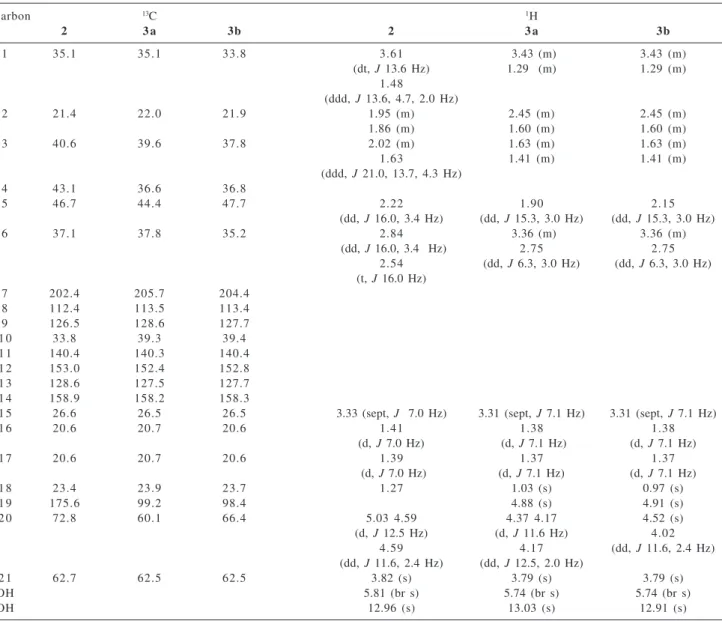
Table 2.13C and 1H NMR assignments for compounds 2, 3a and 3b (CDCl
3, 500/125 MHz)
Carbon 13C 1H
2 3 a 3b 2 3 a 3b
1 35.1 35.1 33.8 3.61 3.43 (m) 3.43 (m)
(dt, J 13.6 Hz) 1.29 (m) 1.29 (m) 1.48
(ddd, J 13.6, 4.7, 2.0 Hz)
2 21.4 22.0 21.9 1.95 (m) 2.45 (m) 2.45 (m)
1.86 (m) 1.60 (m) 1.60 (m)
3 40.6 39.6 37.8 2.02 (m) 1.63 (m) 1.63 (m)
1.63 1.41 (m) 1.41 (m)
(ddd, J 21.0, 13.7, 4.3 Hz)
4 43.1 36.6 36.8
5 46.7 44.4 47.7 2.22 1.90 2.15
(dd, J 16.0, 3.4 Hz) (dd, J 15.3, 3.0 Hz) (dd, J 15.3, 3.0 Hz)
6 37.1 37.8 35.2 2.84 3.36 (m) 3.36 (m)
(dd, J 16.0, 3.4 Hz) 2.75 2.75
2.54 (dd, J 6.3, 3.0 Hz) (dd, J 6.3, 3.0 Hz) (t, J 16.0 Hz)
7 202.4 205.7 204.4
8 112.4 113.5 113.4
9 126.5 128.6 127.7
1 0 33.8 39.3 39.4
1 1 140.4 140.3 140.4
1 2 153.0 152.4 152.8
1 3 128.6 127.5 127.7
1 4 158.9 158.2 158.3
1 5 26.6 26.5 26.5 3.33 (sept, J 7.0 Hz) 3.31 (sept, J 7.1 Hz) 3.31 (sept, J 7.1 Hz)
1 6 20.6 20.7 20.6 1.41 1.38 1.38
(d, J 7.0 Hz) (d, J 7.1 Hz) (d, J 7.1 Hz)
1 7 20.6 20.7 20.6 1.39 1.37 1.37
(d, J 7.0 Hz) (d, J 7.1 Hz) (d, J 7.1 Hz)
1 8 23.4 23.9 23.7 1.27 1.03 (s) 0.97 (s)
1 9 175.6 99.2 98.4 4.88 (s) 4.91 (s)
2 0 72.8 60.1 66.4 5.03 4.59 4.37 4.17 4.52 (s)
(d, J 12.5 Hz) (d, J 11.6 Hz) 4.02
4.59 4.17 (dd, J 11.6, 2.4 Hz)
(dd, J 11.6, 2.4 Hz) (dd, J 12.5, 2.0 Hz)
2 1 62.7 62.5 62.5 3.82 (s) 3.79 (s) 3.79 (s)
OH 5.81 (br s) 5.74 (br s) 5.74 (br s)
OH 12.96 (s) 13.03 (s) 12.91 (s)
Acknowledgements
The authors are grateful to CNPq/CAPES/PADCT/ PRONEX/FUNCAP/FINEP for the fellowships and financial support.
References
1. Harley, R. M.; Reynolds, T.; Advances in the Labiatae Science, The Royal Botanic Gardens: Kew-UK, 1992.
2. Kuhnt, M.; Rimpler, H.; Heinrich, M.; Phytochemistry1994,
36, 485.
3. Almtorp, G. T.; Hazell, A. C.; Torssel, K. B. G.; Phytochemistry
1991, 30, 2753.
4. Raja Rao, K. V.; Rao, L. J. M.; Rao, N. S. P.; Phytochemistry
Hyptis platanifolia
5. Asekun, O. T.; Ekundayo, O.; Adevini, B. A.; Fitoterapia
1999, 70, 440.
6. Akah, P. A.; Nwambi, A. I.; Fitoterapia 1993, 62, 42. 7. Pereda-Miranda, R.; Gascon-Figueroa, M.; J. Nat. Prod. 1988,
51, 996.
8. Costa-Lotufo, L. V.; Araújo, E. C. C.; Lima, M. A. S.; Moraes, M. E. A.; Pessoa, C.; Silveira, E. R.; Moraes, M. O.; Pharmazie
2003, 58, 78.
9. Frontana, B.; Cardenas, J.; Rodriguez-Hahn, L.;
Phytochemistry1994, 36, 739.
10. Ahmad, V. U.; Rhaman-A-U.; Handbook of Natural Products
Data – Pentacyclic Triterpenoids, Elsevier: Amsterddam, 1994,
vol. 2.
11 Aragão, P. C.; Toledo, J. B.; Morais, A. A.; Braz-Filho, R.;
Quim. Nova 1990, 13, 254.
12. Ulubenen. A.; Topcu, G.; Tan, N.;Phytochemistry 1992, 31, 3637.
13. Carreiras, M.C.; Rodriguez, B.; de la Torre, M.C.; Perales, A.; Torres, M.R.; Savona, G.; Piozzi, F.; Tetrahedron1990, 46, 847.
14. Bohlmann, F.; Suwita, A.; King, R. M.; Robinson, H.;
Phytochemistry1980, 19, 111.
15. Cardenas, J.; Lydia, R.; Phytochemistry1995, 38, 199. 16. Manchand, P. S.; White, J. D.; Fayos, J.; Clardy, J.; J. Org.
Chem. 1974, 39, 2306.
17. Urones, J. G.; Marcos, I. S.; Diez, D.; Cubilla, L. R.;
Phytochemistry1998, 48, 1035.
18. Kelecom, A.; Tetrahedron1983, 39, 3603.