J. Braz. Chem. Soc., Vol. 17, No. 7, 1436-1439, 2006.
Printed in Brazil - ©2006 Sociedade Brasileira de Química 0103 - 5053 $6.00+0.00
Short Report
*e-mail: [email protected]
X-ray Diffraction and IR Spectroscopic Characterization of AgLn
IIITiO
4
Oxides
Related to the K
2NiF
4Structural Type
Araceli E. Lavat a and Enrique J. Baran*,b
a
Departamento de Ingeniería Química, Facultad de Ingeniería, Universidad Nacional del Centro de la Provincia de Buenos Aires, 7400 Olavarría, Argentina
b
Centro de Química Inorgánica (CEQUINOR/CONICET, UNLP), Facultad de Ciencias Exactas, Universidad Nacional de La Plata, C. Correo 962, 1900 La Plata, Argentina
Uma série de óxidos ternários do tipo AgLnIIITiO
4 (com Ln = La, Nd, Sm, Eu, Gd, Dy, Y) foi
preparada e os seus parâmetros de cela unitária foram determinados por difratometria de raios
X. Esses compostos são relacionados com os do tipo estrutural K2NiF4, com os cátions AgI e
LnIII distribuídos de uma maneira ordenada no sub-retículo dos íons potássio. Os espectros de
absorção no infravermelho desses materiais foram registrados e são discutidos com base nas suas peculiaridades estruturais e por comparação com as de óxidos similares. Os produtos apresentam uma relação estrutural e espectroscópica forte com os materiais de partida NaLnIIITiO
4.
Ternary oxides of the type AgLnIIITiO
4 (with Ln = La, Nd, Sm, Eu, Gd, Dy, Y) have been
prepared and their unit cell parameters determined by X-ray powder diffractometry. They are related to the K2NiF4 structural type, with the AgI and LnIII cations distributed in an ordered way
on the K-sub lattice. The infrared spectra of these materials were recorded and discussed on the basis of their structural peculiarities and by comparison with those of related oxides. They
show a close relationship with the parent NaLnIIITiO
4 materials.
Keywords: mixed-oxides, K2NiF4 structure, X-ray diffraction, indexing, IR spectroscopy
Introduction
Materials belonging to the perovskite structural type and some closely related structures present a lot of technological applications derived from their interesting
physicochemical properties.1-4
We have recently investigated the spectroscopic
behavior of a series of A2BB’O6 perovskites5 and of some
mixed oxides of composition AA’BO4 belonging to the
related K2NiF4 structural type,6,7 which meet the
requirements for the deposition of superconducting films,
i.e. they present low dielectric constants, chemical
inertness, and their lattice parameters are close to that of the films to be deposited. In the last of these studies we have investigated the spectroscopic behavior of a series
of ternary oxides of the type NaLnIIITiO
4 and of two related
materials, containing LaIII or NdIII in which Na+ was
replaced by Ag+.
In order to extend this investigation we have now characterized a more complete series of this type of Ag-substituted oxides.
Experimental
Syntheses
Polycrystalline samples of the starting NaLnIIITiO
4
compounds were prepared by conventional solid state
reactions, following well known procedures.7-10 Intimate
stoichiometric mixtures of analytical grade TiO2 (anatase),
Na2CO3 and Ln2O3 were calcined in air, in platinum
1437 Lavat and Baran
Vol. 17, No. 7, 2006
The silver compounds (with Ln = La, Nd, Sm, Eu, Gd, Dy, Y) were obtained by an ion-exchange reaction from the parent Na-compound, according to the procedure
described by Toda et al.8 The parent compound was
allowed to react with molten AgNO3 at 250 °C for 12
hours. The products were firstly washed with abundant distilled water and finally with diluted ammonia to
eliminate Ag2O.
Indexing
X-ray powder diagrams were recorded using a continuous step scanning procedure (step size: 0.020° (in
2θ); time per step: 0.5 s), with a Philips PW 3710
diffractometer and monochromatic Cu-Kα radiation (λ =
1.54060 Å), using NaCl as an external calibration standard. The indexation of the diagrams and determination of the unit cell parameters were performed with a locally
modified version of the program PIRUM of Werner.11
Spectroscopic measurements
The infrared spectra were recorded with a Nicolet-Magna 550 FTIR instrument, using the KBr pellet technique. The results were also confirmed employing the
Nujol-mull technique.12
Results and Discussion
Unit cells of the compounds
The powder diffraction patterns of all the prepared materials could be indexed on the basis of a tetragonal unit
cell, confirming the K2NiF4 structural type (JCPDF, No.
24-1326). In all cases, the intensity distribution of the
diffraction lines closely resembles that observed for Sr2TiO4
(JCPDF, No.39-1471), the oxide prototype of the K2NiF4
structure.13 It has been proposed that the NaLnIIITiO
4
structures may be described as a superstructure of Sr2TiO4
(or K2NiF4) consisting of single layers of TiO6 octahedra
that are separated in alternate layers by Na+ and Ln3+ cations,
perpendicular to the c axis.14 This ordering implies a change
of the space group I4/mmm of K2NiF4 to P4/nmm.10 The
charge imbalance between sodium and the lanthanide ions both located at the interlayer is compensated by a displacement of the titanium(IV) ions from the position of
the regular octahedral center toward the Na+ ions.8-10
According to the totally similar powder diffractograms, it becomes evident that the silver ion-exchanged compounds retain the structural characteristics of the parent phases. These
compounds are probably metastable 8 and, therefore, the
ion-exchange reaction departing from NaLnTiO4 becomes a
unique synthetic route. The driving force for the reaction, in
mind of the similarity in charge density between Na+ and
Ag+ cations should be the stronger polarizing power of Ag+
due to its electronic configuration.
The determined unit cell parameters for the prepared
AgLnTiO4 phases are presented in Table 1. As it can be
seen from these data, a relatively abrupt change in the unit
cell constants occurs when going from AgNdTiO4 to
AgSmTiO4, whereas they are of the same order for the
remaining trivalent cations. A similar change has been
previously found by Toda et al.9 in the NaLnTiO4 series for
which, after Ln = Sm, a pseudo-orthorhombic cell with a≈
12.5 Å and b≈c≈ 5.3 Å was proposed. Notwithstanding,
for this series our own results,7 as well as those of Byeon
et al.,10 point to the existence of tetragonal unit cells with a
≈ 3.8 Å and c≈ 13.0 – 12.5 Å. Attempts to index the now
investigated AgLnTiO4 unit cells as orthorhombic or
pseudo-orthorhombic failed. Consequently, we assume that the silver-substituted materials retain the original tetragonal structure of the parent sodium compounds with an additional weak distortion of the unit cells, containing the smaller lanthanide cations. The origin of this distortion is not easy to explain but, apparently, it may be generated by a different
degree of distortion of the TiO6-octahedra, and/or with the
relative tilting of these building units in the different
materials.9 On the other hand, this distortion has no effect
on the overall cationic distribution as shown by Toda and
co-workers8,9 and also supported by our spectroscopic
measurements, analyzed in the following section.
Infrared spectra
The infrared spectra of perovskites or of AA’BO4
materials possessing the normal K2NiF4 structure usually
present only two strong IR bands. The higher energy band
can be assigned to B-O stretchings of the BO6 octahedra
whereas the second one, found at lower energies, may be related to the deformational modes of these same
octahedra.1,6,15
Table 1. Unit cell parameters of the investigated mixed oxides of the type AgLnIIITiO
4
Oxide a / (Å) c / (Å) V / (Å3)
1438 X-ray Diffraction and IR Spectroscopic Characterization J. Braz. Chem. Soc.
The IR spectra of the now investigated oxides are very
similar. As a typical example of them, that of AgDyTiO4
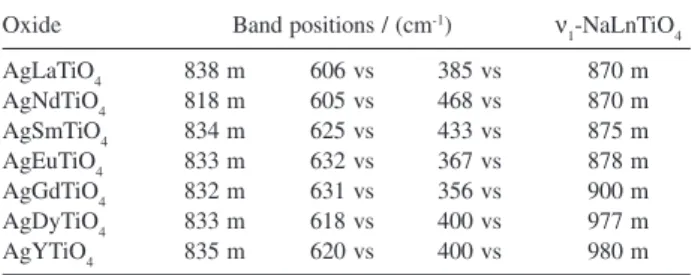
is presented in Figure 1. The measured band positions are shown in Table 2 and, as it can be seen, all the materials
present a typical three band spectra, i.e. one band more
than those found in the AA’BO4 oxides6 and in the same
way as found in the previously investigated NaLnTiO4
series.7 This new additional, medium intensity band, is
located at about 830 cm-1 in most of the silver compounds.
According to the structural characteristics commented
above, in the TiO6 sheets the Ti-O apical bonds towards the
Ag+ cations are shortened due to structural compression.
In agreement with this structural peculiarity, this highest energy band may be assigned in all materials to the stretching mode involving this shortened Ti-O apical bond
of the TiO6 polyhedra. The remaining vibrations, involving
the equatorial O-atoms of these polyhedra, are expected at somewhat lower frequencies. Therefore, the two remaining
strong bands can be assigned similarly as in the AA’BO4
materials,6 i.e., the strong middle energy band (630-600
cm-1) is ascribed to the equatorial Ti-O stretchings, whereas
the other strong band found at around 400 cm-1 should be
assigned to the deformational modes of the TiO6 octahedra.
Besides, one interesting trend is clearly noticeable when the position of the first band is compared in pairs of
equivalent sodium and silver compounds. As it is also seen in Table 2, this highest energy band shows a considerable shift to lower frequencies in the case of the silver oxides suggesting an important decrease of the
Ti-O bond order upon Na+ substitution by Ag+. This
weakening is surely induced by the higher polarizing
power of the Ag+ cations, which generates a certain degree
of Ag-O covalent interaction. This is a well-known behaviour that has often been observed in simple silver
salts and compounds.16-18 Nevertheless, a final general
comment upon the spectroscopic consequences of the performed ionic exchanges should be made: the comparison of the spectra of both series of materials clearly shows that the overall characteristics of the parent compound are retained in the exchanged samples, since the similarity of the spectra reveals that the same symmetry
rules for the vibrating TiO6 units are maintained. The
additional distortion apparently generated after the
Nd/Sm transition in the AgLnTiO4 materials has no
spectroscopic consequences, confirming the same cation ordering in the full series of investigated compounds.
In the case of the NaLnIIITiO
4 materials with LnIII =
Gd, Dy and Y, the highest energy band lies unexpectedly high (cf. Table 2). This was related to the stepwise
diminution of the c unit-cell parameter in this series, which
reinforces the strength of the shortened apical Ti-O bonds.7
This effect is probably absent in the present case, due to the generation of larger unit cells for the heavier lanthanides.
Conclusions
The unit cell parameters of a series of mixed oxides
of composition AgLnIIITiO
4, belonging to the K2NiF4
structural type, have been determined. The results confirm
a close structural relationship to the parent NaLnIIITiO
4
materials, from which they are obtained by ionic exchange
in molten AgNO3. Besides, the spectroscopic study of these
materials demonstrates a very close relationship between
spectra and structure. In the related AA’BO4 phases6 in
which the effect of A/A’ ordering is negligible, the spectra present two strong IR bands involving the main Ti-O
vibrations of the TiO6 octahedra (stretching and bending
vibrations of a regular TiO6 moiety with six similar Ti-O
bonds). The same behaviour was observed for the
prototype Sr2TiO4 oxide,7 which presents only two strong
IR bands at 576 and 362 cm-1. On the contrary, in the
present group of materials as well as in the previous
investigated NaLnIIITiO
4 oxides7 the shortening of one of
the Ti-O bonds of the TiO6 polyhedra, arising from A/A’
sub lattice ordering, allows a clear separation of the Ti-O
Table 2. IR spectroscopic data of the investigated mixed oxides of the type AgLnIIITiO
4 and comparison of its highest energy band with that in
the equivalent sodium compounds
Oxide Band positions / (cm-1) ν
1-NaLnTiO4
AgLaTiO4 838 m 606 vs 385 vs 870 m
AgNdTiO4 818 m 605 vs 468 vs 870 m
AgSmTiO4 834 m 625 vs 433 vs 875 m
AgEuTiO4 833 m 632 vs 367 vs 878 m
AgGdTiO4 832 m 631 vs 356 vs 900 m
AgDyTiO4 833 m 618 vs 400 vs 977 m
AgYTiO4 835 m 620 vs 400 vs 980 m
Band intensities: vs: very strong; m: medium.
1439 Lavat and Baran
Vol. 17, No. 7, 2006
apical and equatorial stretching motions, generating the observed characteristic three band IR spectra.
Acknowledgments
This work was supported by the Universidad Nacional de La Plata and the Consejo Nacional de Investigaciones Científicas y Técnicas de la República Argentina-CONICET. E.J.B. is a member of the Research Career from this organism.
References
1. Baran, E. J.; Catal. Today1990, 8, 133.
2. Tejuca, L. J.; Fierro, J. L. G.; Properties and Applications of Perovskite Type Oxides, Marcel Dekker: New York, 1993.
3. Rao, C. N. R.; Raveau, B.; Transition Metal Oxides, Verlag
Chemie: New York, 1995.
4. Peña, M. A.; Fierro, J. L. G.; Chem. Rev. 2001, 101, 1981.
5. Lavat, A. E.; Baran, E. J.; Vib. Spectrosc.2003, 32, 167.
6. Lavat, A. E.; Baran, E. J.; J. Alloys Compd. 2004, 368, 130.
7. Lavat, A. E.; Baran, E. J.; J. Alloys Compd. 2006, 419, 334.
8. Toda, K.; Kurita, S.; Sato, M.; Solid State Ionics1995, 81,
267.
9. Toda, K.; Kameo, Y.; Kurita, S.; Sato, M.; J. Alloys Compd.
1996, 234, 19.
10. Byeon, S. H.; Park, K.; Itoh, M.; J. Solid State Chem.1996,
121, 430.
11. Werner, P. E.; Ark. Kemi1969, 31, 51.
12. Drago, R.S.; Physical Methods in Inorganic Chemistry,
Reinhold Publish Corporat.: New York, 1965.
13. Muller, O.; Roy, R.; The Major Ternary Structural Families,
Springer: Berlin, 1974.
14. Blase, G.; J. Inorg. Nucl. Chem.1968, 30, 656.
15. Last, J. D.; Phys. Rev. 1957, 105, 1740.
16. Baran, E. J.; Aymonino, P. J.; Spectrochim. Acta1968, 24A,
288.
17. Baran, E. J.; Aymonino, P. J.; Müller, A.; Z. Naturforsch. , B: Chem. Sci.1969, 24, 271.
18. Müller, A.; Baran, E. J.; Carter, R. O.; Struct. Bonding1976,
26, 81.
Received: March 16, 2006