DOI: 10.1590/0004-282X20160184 ARTICLE
The mortality rate after hospital discharge in
patients with myelomeningocele decreased
after implementation of mandatory flour
fortification with folic acid
Redução da taxa de mortalidade após a alta hospitalar em pacientes com mielomeningocele
depois da implementação da fortificação obrigatória das farinhas com ácido fólico
Renato Manganelli Salomão1, Tatiana Protzenko Cervante2, José Francisco Manganelli Salomão2, Soniza
Vieira Alves Leon3
Myelomeningocele (MMC), or spina biida cystica, is the most common neural tube defect, developing between days 21 and 28 after fertilization1,2. he lack of a protective lining exposes the neural tissue to gradual destruction due to the deleterious efects of amniotic luid over the neural plate3.
he prevalence of MMC varies according to the geographic, racial, and ethnic characteristics of the population being
studied, and may difer greatly between diferent regions of the same continent or country4,5. In Brazil, the prevalence of Chiari II malformation (CMII) is estimated to range be
-tween 1.4 and 1.5 per 10,000 births6,7. he cause of MMC is multifactorial, but folic acid (FA) deiciency is the main risk factor. Chromosomal and genetic abnormalities, maternal hyperthermia during the early stages of pregnancy, use of
1Universidade Federal do Estado do Rio de Janeiro, Escola de Medicina e Cirurgia, Rio de Janeiro RJ, Brasil;
2Fundação Oswaldo Cruz (IFF/ Fiocruz), Departamento de Cirurgia Pediátrica, Setor de Neurocirurgia do Instituto Nacional da Saúde da Mulher, Criança e
Adolescente Fernandes Figueira, Rio de Janeiro RJ, Brasil;
3Universidade Federal do Estado do Rio de Janeiro, Departamento de Neurologia, Rio de Janeiro RJ, Brasil;
Correspondence: Renato Manganelli Salomão; UNIRIO / Escola de Medicina e Cirurgia; Rua Silva Ramos, 32; 22290-240 Rio de Janeiro RJ, Brasil;
E-mail: [email protected]
Conflict of interest: There is no conlict of interest to declare.
Received 17 December 2015; Received in inal form 19 April 2016; Accepted 28 September 2016.
ABSTRACT
Objective: To evaluate the mandatory folic acid fortiication of lour on mortality rates after the hospital discharge of children born with myelomeningocele, the most affected age group and the most frequent cause of death. Methods: A retrospective study of 383 children born with myelomeningocele from January 1990 to December 2013 in a high-fetal-risk reference hospital. Results: A total of 39 patients died (10.1%), of which 23 (6%) died after discharge. Most children who died were younger than 12 months of age. The most frequent cause of death was infection of the central nervous system, followed by urinary tract sepsis and infections of the respiratory system. Symptomatic Chiari II malformation was the most frequent comorbidity factor. Conclusion: Although there was no signiicant difference in infant mortality before and after folic acid fortiication, there was a signiicant reduction in deaths after hospital discharge in babies born after implementation of mandatory folic acid fortiication Keywords: meningomyelocele; mortality; folic acid.
RESUMO
Objetivo: Avaliar a fortiicação obrigatória de farinhas com ácido fólico nas taxas de mortalidade após a alta hospitalar de crianças nascidas com mielomeningocele, a faixa etária mais atingida e a causa mais freqüente de morte. Métodos: Estudo retrospectivo de 383 crianças nascidas com mielomeningocele de janeiro de 1990 a dezembro de 2013, em um hospital de referência de alto risco fetal. Resultados: Um total de 39 pacientes morreram (10,1%), dos quais 23 (6%) morreram após a alta. A maioria das crianças que morreram não alcançaram 12 meses de idade. A causa mais frequente de morte foi infecção do sistema nervoso central, seguido por sépsis, infecções do trato urinário e do sistema respiratório. A malformação de Chiari Tipo II foi a comorbidade mais freqüente. Conclusão: Apesar de não haver diferença signiicativa na frequência de mortalidade de recém-nascidos, antes e depois da fortiicação obrigatória com ácido fólico, houve uma redução signiicativa no número de mortes após a alta hospitalar em bebês nascidos após a implementação da fortiicação obrigatória das farinhas com ácido fólico.
antiepileptic drugs (e.g., valproic acid), diabetes mellitus, and obesity may also be involved8.
Around 14% of the children born with MMC die before the age of ive years, and the mortality rate of children with brain stem dysfunction may exceed 35%9. he most frequent causes of death in patients with MMC include CMII-related complications; urinary tract, pulmonary, and cerebrospinal luid infections; as well as ventricular shunt malfunction10. In Brazil, fortiication of wheat and maize lour and their derivatives with FA became mandatory after 2002.
In 2006, Bol et al.11 reported signiicantly improved irst-year survival after implementation of mandatory folic acid fortiication (FAF), compared with the survival rate of children with MMC born before fortiication. A signiicant decline in perinatal and infant mortality was also shown by Sayed et al.12 in 2008. In 2010, Blencowe et al.2 conduct -ed a systematic review of the literature and estimat-ed that FAF reduces the incidence of neural tube defect by 46% and expected neonatal deaths by 13%.
he aim of this study was to evaluate the impact of FAF on the mortality rate of patients with MMC who underwent surgery at a pediatric hospital in Rio de Janeiro, Brazil.
METHODS
We performed a retrospective study of a cohort of 383 children diagnosed with MMC who were surgically repaired from January 1990 to December 2013. here were 39 deaths, and our focus was on the children who died after hospital dis
-charge, which accounted for 23 out of the 39 (58.97%) deaths. his study was approved by the institution’s Committee of Ethics in Research.
he relationship of mortality to the following variables were evaluated: age, cause of death, risk factors, postopera
-tive complications, and gender. Data were analyzed using Epi Info, ver. 7.1.4.0 software (Centers for Disease Control and Prevention, Atlanta, USA). Results with p values < 0.05 were considered signiicant. he period of implementa
-tion of lour fortiica-tion was calculated according to the model used by Orioli et al.6, and consisted of the sum of the 18 months elapsed from the time of publication of the decree, the three-month period for the implementation of fortiied lours, and the nine months of gestation.
RESULTS
Demographics
Of the 21,310 live births between 1994 and 2013 at the Insitituo Fernandes Figueira, 10,894 (51.1%) were boys and 10,299 (48.3%) were girls (male/female ratio of 1.05:1). Gender-related information was not found for 0.5% (n = 117) of the children. Analysis of the 330 cases of MMC showed
that the proportion of female children with MMC was 56.6% (n = 187) and that of male children with MMC was 43.3% (n = 143, p = 0.0038).
he frequency of MMC before mandatory lour fortiica
-tion was 1.34% (n = 172), while the incidence after implemen
-tation of FAF was 1.81% (n = 158), which was a signiicant in
-crease in the incidence rate (p = 0.0055).
Surgical technique
For all 383 MMC cases, the initial treatment was correc
-tion of the MMC according to the usual 5-layer technique. Among the 23 patients who died after hospital discharge, ive patients also underwent simultaneous placement of a ven
-triculoperitoneal shunt.
Surgical complications
here were 28 surgical complications; the most common were infections of cerebrospinal luid and shunt hardware (78.5%, n = 22), as well as ventriculoperitoneal shunt mal
-function. he complications and incidence rates are shown
in Table 1.
Risk factors and causes of death
Neurogenic bladder, recurrent urinary tract infections, lower-limb paralysis; recurrent respiratory infections, chron
-ic constipation, chron-ic renal failure, hydronephrosis, apne-ic crises, and gastroesophageal relux disease were risk factors for mortality.
he most common causes of death were central nervous system (CNS) infections, occurring in eight of the 23 (34.7%) fatalities after hospital discharge. Respiratory infections and sepsis of urinary tract origin were the second most common cause of death, each being a major contributing factor in 21.7% (n = 5) of the 23 deaths. Respiratory tract infections were also an aggravating factor in eight cases. All the cases of urinary sepsis had kidney failure. Intracranial hypertension and CMII were major contributing factors in two of 23 (8.69%) patients. Chiari II malformation was also present and associated with death in four other cases. he cause of death of one patient was septic gastroenteritis complicated by kidney failure.
Table 1. Complications of surgical treatment.
Variable N %
Surgical procedure 6 21.4
Wound Infection 3 10.7
Intracranial hypertension* 3 10.7
Ventriculoperitoneal shunt (VPS) 22 78.5
CNS Infection 8 28.5
VPS Infection 7 25
VPS Malfunction** 6 21.4
VPS Shortening*** 1 3.5
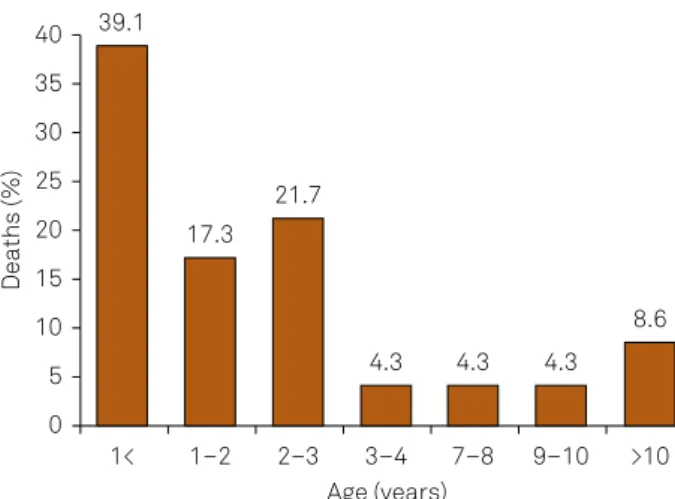
Nine of 23 (39.1%) children died in the irst year of life, ive between the ages of two and three years, and four between the ages of one and two years. Five children died between the ages of three and 11 years (Figure). he highest number of deaths after hospital discharge occurred in female children, 60.8% (n = 14), but this rate was not signiicant (p = 0.981).
At a given moment, ive live births presenting with signs and symptoms of CMII were identiied, and accounted for 21.7% of the 23 children analyzed.
Correlation of deaths with hospital discharge and FAF
Of the 383 operated children, the total number of deaths was 39 (10.1%). he deaths were classiied as occurring before hospital discharge (BHD) or after hospital discharge (AHD). he BHD group, composed of 16 of the 383 (4.1%) cases of MMC, included the children who died at younger than 30 days and those who, despite surviving the irst month of life, were not discharged. he AHD group included 23 of 383 (6.0%) chil
-dren who died after hospital discharge. he mean survival pe
-riod was 2.8 years, ranging from two months to 11 years. he mortality rates before and after fortiication of the BHD group and AHD and group were compared. Before forti
-ication there were 11 BHD deaths and 20 AHD deaths. After fortiication, ive BHD patients and three AHD patients died. he total number of deaths was 31 before and eight after man
-datory fortiication. he reduction in total number of deaths after mandatory fortiication was signiicant (p = 0.00919) and the reduction in the number of AHD deaths after forti
-ication was signiicant (p = 0.0088), but not the number of BHD deaths (p = 0.568). he results are shown in Table 2.
Of the 23 children who died AHD, the highest prevalence was observed in the lumbosacral region, followed by thoraco
-lumbar. he locations and frequencies are presented in Table 3.
DISCUSSION
here have been few studies related to late mortality in pa
-tients with MMC, particularly regarding etiology and age ranges.
he decrease in the incidence of MMC at our institution before and after mandatory FAF was not signiicant. here are several possible explanations for this inding: a) FAF of lour alone was not suicient for promoting a signiicant decrease in MMC rates, because the FA concentration in Brazilian lours is 1.5 mg/kg, which is lower than the FA con
-centration adopted by other Latin American countries, such as Argentina and Chile where the FA concentration is high
-er and wh-ere they have exp-erienced a signiicant decrease in neural tube defects and MMC6,7,13; b) the Brazilian public health system nowadays provides easier and faster access to prenatal diagnostic tools, thereby increasing the frequency of early MMC diagnosis and directing these cases to reference centers such as the Insitituo Fernandes Figueira; c) our in
-stitution is a tertiary reference center for a low-income pop
-ulation, which is much more frequently afected by neural tube defects; d) Brazil is a multiracial country with an eth
-nic proile diferent from other Latin-American countries7. Moreover, in some countries, the prevalence of MMC was not substantially reduced by FAF of lours, and in some countries the prevalence has even increased14. hese indings might be a result of heterogeneous supplementation policies and lack of lour fortiication. Also, educational and social interven
-tions regarding folic acid supplementation are needed14. In our series, of the 383 live births with MMC, 23 (6%) died after hospital discharge; most of the deaths occurred be
-fore ive years of age (n = 20), corresponding to 86.9% of the total number of AHD deaths. Analysis of deaths by age range showed that 39.1% (n = 9) of the children died during the irst year of life. Ten deaths occurred from the ages of one to four, as follows: four (17.3%) between one and two years, ive (21.7%) between two and three years, and one (4.3%) between three and four years. he remaining four deaths occurred at the ages of seven (n = 1), nine (n = 1), and 11 years (n = 2). he highest death rates occurred in the lowest age ranges.
A Brazilian study of 36 cases of MMC found a mortality rate of 16.6% (n = 6), with all the deaths occurring before two years of age15. Another study followed 84 patients after dis -charge, and most of the deaths (74%) occurred during the irst
Table 2. Deaths before and after mandatory lour fortiication.
Variable DBF n (%) DAF n (%) pc Fisher exact
Total 31 (13.7) 8 (5) 0.00919 0.00569
BHD 11 (4.8) 5 (3.1) 0.568 0.450
AHD 20 (8.8) 3 (1.8) 0.0088 0.0040
DBF: Deaths before fortiication; DAF: Deaths after fortiication.
Table 3. MMC frequency according the site of the defect.
Site n %
Lumbosacral 9 39.1
Thoracolumbar 8 34.8
Lumbar 5 21.7
Thoracic 1 4.3
Figure. Distribution of deaths by age group.
Deaths (%)
Age (years) 40 39.1
17.3 21.7
4.3 4.3 4.3
8.6 35
15 20 25 30
10 5 0
month of life16. Another case series reported that most deaths occurred between the neonatal period and preschool age9,17,18. Mortality rates in MMC do not stabilize as the patients be
-come older. An analysis of long-term studies showed that 240 (71.2%) of 337 reported deaths occurred in patients up to 16 years of age9,16,17,18. he main cause of death in patients old -er than 16 years was unrecognized ventriculop-eritoneal shunt dysfunction18,19. A cohort study that followed patients for more than 40 years found that there were 56% of patients who sur
-vived to around 20 years of age, but the mortality rate contin
-ued to increase with age, and the last evaluation showed that there were 33.3% of patients of the initially observed popula
-tion who were still alive9,20. hese results are very diferent from those presented by Talamonti et al., who reported only ive deaths among 202 patients followed over 25 years21.
he total number of deaths in our study was 39 (10.1%). During the period before FAF (January 1990 - December 2005), there were 225 cases of MMC, with a mortality rate of 13.7% (n = 31). Considering only the cases in which AHD deaths oc
-curred, the mortality rate was 8.8% (n = 20). After implementa
-tion of FAF, there were 158 cases of MMC, and the total death rate for this period was 5.0% (n = 8). here were ive neona
-tal deaths (3.1%) during the same period. hese data show a signiicant reduction in the total number of deaths during the years after FAF implementation. However, regarding neonatal mortality, that is, the live births not discharged from the hospi
-tal, the mortality rate was not signiicantly reduced after FAF. his result difers from the indings of others on the protective role of FAF against neonatal mortality2,11,12. here was a signii -cant decrease in AHD deaths 1.8% (n = 3) after implementa
-tion of mandatory FAF versus 8.8% (n = 20) before implemen
-tation. A series of 304 children with MMC, who were born in Ireland before FA supplementation, showed that only 33% of the children survived to their irst birthday, and just over 27% survived to the age of ive years22. However, after mandato -ry FAF, there was a signiicant increase in the survival rate of children with MMC, leading to the hypothesis that FA, in ad
-dition to preventing MMC, might also play an important role in reducing the severity of MMC among live births1, as well as
malformations in other organs or systems23 and the resulting neonatal mortality24.
he most common cause of death detected in our study was CNS infections, particularly those related to the cerebro
-spinal luid (34.7%), followed by urinary sepsis and respira
-tory infections (21.7%). Cerebrospinal luid infections were mostly caused by shunt infections and these are regarded as a highly signiicant predictor of mortality25. Children with shunts are at high risk of cerebrospinal luid infection, rang
-ing from 5.5% to 25% of cases26, and shunts are thought to be the cause of death in 33% to 50% of children with MMC15,16.
Urinary tract infections resulting from neurogenic blad
-der and vesicoureteral relux, in some cases, have led to uri
-nary sepsis, kidney failure, and ultimately death27.
Chiari II malformation was the third most common cause of death, acting either as a determining or contributory factor. he signs and symptoms of this malformation are protean and may be transient, making it diicult to estimate its real preva
-lence among neonates and infants. It is assumed that, at some time, 6% to 32% of individuals with MMC will have neurolog
-ical manifestations related to CMII28. he mortality is higher and may be the main cause of death among neonates with CMII, afecting more than 40% of MMC patients18,29,30.
Discontinuing the follow-up of patients with MMC has a dramatic impact on the number of deaths21,22. he most com -mon cause of discontinuation is the lack of multidisciplinary centers for spina biida treatment. Since most families have a low income and live on the outskirts of large cities, regular follow-ups are reduced or even neglected, since most patients have severe limitations in ambulation and need special require
-ments for transportation, which is not always available31. In conclusion, the mortality rate of patients with MMC after they were discharged from the hospital was 6%. Most children died before their irst birthday. he most common causes of death were CNS infections, respiratory infections, and urinary sepsis. Symptomatic CMII was the most com
-mon comorbidity factor. he mortality rate after hospital dis
-charge decreased after implementation of mandatory lour fortiication with folic acid.
References
1. Padmanabhan R. Etiology, pathogenesis and prevention of neural tube defects. Congenit Anom (Kyoto). 2006;46(2):55-67. doi:10.1111/j.1741-4520.2006.00104.x
2. Blencowe H, Cousens S, Modell B, Lawn J. Folic acid to reduce neonatal mortality from neural tube disorders. Int J Epidemiol. 2010;39 Suppl 1:i110-21. doi:10.1093/ije/dyq028
3. Adzick NS. Fetal myelomeningocele: natural history, pathophysiology, and in-utero intervention. Semin Fetal Neonatal Med.
2010;15(1):9-14. doi:10.1016/j.siny.2009.05.002
4. Busby A, Abramsky L, Dolk H, Armstrong B. Preventing neural tube defects in Europe: population based study. BMJ. 2005;330(7491):574-5 8. doi:10.1136/bmj.330.7491.574
5. De Marco P, Merello E, Calevo MG, Mascelli S, Pastorino D, Crocetti L, et al. Maternal periconceptional factors affect the risk of spina biida-affected pregnancies: an Italian case-control study. Childs Nerv Syst. 2011;27(7):1073-81. doi:10.1007/s00381-010-1372-y
6. Orioli IM, Lima do Nascimento R, López-Camelo JS, Castilla EE. Effects of folic acid fortiication on spina biida prevalence in Brazil. Birth Defects Res A Clin Mol Teratol. 2011;91(9):831-5. doi:10.1002/bdra.20830
8. Sandler AD. Children with spina biida: key clinical issues. Pediatr Clin North Am. 2010;57(4):879-92. doi:10.1016/j.pcl.2010.07.009
9. Oakeshott P, Hunt GM. Long-term outcome in open spina biida. Br J Gen Pract. 2003;53(493):632-6.
10. Woodhouse CRJ. Myelomeningocele: neglected aspects. Pediatr Nephrol. 2008;23(8):1223-31. doi:10.1007/s00467-007-0663-3
11. Bol KA, Collins JS, Kirby RS, National Birth Defects Prevention Network. Survival of infants with neural tube defects in the presence of folic acid fortiication. Pediatrics. 2006;117(3):803-13. doi:10.1542/peds.2005-1364
12. Sayed AR, Bourne D, Pattinson R, Nixon J, Henderson B. Decline in the prevalence of neural tube defects following folic acid fortiication and its cost-beneit in South Africa. Birth Defects Res A Clin Mol Teratol. 2008;82(4):211-6. doi:10.1002/bdra.20442
13. López-Camelo JS, Castilla EE, Orioli IM. Folic acid lour fortiication: impact on the frequencies of 52 congenital anomaly types in three South American countries. Am J Med Genet A. 2010;152A(10):2444-58. doi:10.1002/ajmg.a.33479
14. Botto LD, Lisi A, Robert-Gnansia E, Erickson JD, Vollset SE, Mastroiacovo P, et al. International retrospective cohort study of neural tube defects in relation to folic acid recommendations: are the recommendations working? BMJ. 2005;330(7491):571. doi:10.1136/bmj.38336.664352.82
15. Ulsenheimer MMM, Antoniuk SA, Santos LHCD, Ceccatto MP,
Silveira AE, Ruiz AP, et al. Myelomeningocele: a Brazilian University Hospital experience. Arq Neuropsiquiatr. 2004;62(4):963-8.. doi:10.1590/S0004-282X2004000600006
16. Faraji M, Ashrafzadeh F, Ariamanesh A, Faraji S. Surgical Outcome of Patients With Meningomyelocele Treated With a Team Approach. Neurosurg Q. 2006;16(2):85-8. doi:10.1097/00013414-200606000-00007
17. Althouse R, Wald N. Survival and handicap of infants with spina biida. Arch Dis Child. 1980;55(11):845-50. doi:10.1136/adc.55.11.845
18. Bowman RM, McLone DG, Grant JA, Tomita T, Ito JA. Spina biida outcome: a 25-year prospective. Pediatr Neurosurg. 2001;34(3):114-20. doi:10.1159/000056005
19. Piatt JH Jr. Treatment of myelomeningocele: a review of outcomes and continuing neurosurgical considerations among adults. J Neurosurg Pediatr. 2010;6(6):515-25. doi:10.3171/2010.9.PEDS10266
20. Oakeshott P, Reid F, Poulton A, Markus H, Whitaker RH, Hunt GM. Neurological level at birth predicts survival to the mid-40s and urological deaths in open spina biida: a complete prospective cohort study. Dev Med Child Neurol. 2015;57(7):634-8. doi:10.1111/dmcn.12698
21. Talamonti G, D’Aliberti G, Collice M. Myelomeningocele: long-term neurosurgical treatment and follow-up in 202 patients. J Neurosurg. 2007107(5 Suppl):368-86. doi:10.3171/PED-07/11/368
22. Sutton M, Daly LE, Kirke PN. Survival and disability in a cohort of neural tube defect births in Dublin, Ireland. Birth Defects Res A Clin Mol Teratol. 2008;82(10):701-9. doi:10.1002/bdra.20498
23. Botto LD, Mulinare J, Erickson JD. Occurrence of congenital heart defects in relation to maternal mulitivitamin use. Am J Epidemiol. 2000;151(9):878-84. doi:10.1093/oxfordjournals.aje.a010291
24. Barboza-Arguello ML, Benavides-Lara A, Umaña L, Vargas-Leitón B. [Infant mortality from birth defects in Costa Rica, 1981–2010]. Rev Panam Salud Publica. 2013;34(5):304-11. Spanish.
25. Tuli S, Tuli J, Drake J, Spears J. Predictors of death in pediatric patients requiring cerebrospinal luid shunts. J Neurosurg. 2004;100(5 Suppl Pediatrics):442-6. doi:10.3171/ped.2004.100.5.0442
26. Charney EB, Melchionni JB, Antonucci DL. Ventriculitis in newborns with myelomeningocele. Am J Dis Child. 1991;145(3):287-90. doi:10.1001/archpedi.1991.02160030055020
27. Veenboer PW, Bosch JL, Asbeck FW, Kort LM. Upper and lower urinary tract outcomes in adult myelomeningocele patients: a systematic review. PLoS One. 2012;7(10):e48399. doi:10.1371/journal.pone.0048399
28. McLone DG. Results of treatment of children born with a myelomeningocele. Clin Neurosurg. 1983;30:407-12.
29. Tubbs RS, Oakes WJ. Treatment and management of the Chiari II malformation: an evidence-based review of the literature. Childs Nerv Syst. 2004;20(6):375-81. doi:10.1007/s00381-004-0969-4
30. Salomão JF, Bellas AR, Leibinger RD, Barbosa AP, Brandão MA. [Symptomatic Chiari type II malformation]. Arq Neuropsiquiatr. 1998;56(1):98-106. Portuguese. doi:10.1590/S0004-282X1998000100016