271
Ruptured hepatic cavernous hemangioma: a case report
Radiol Bras. 2009 Jul/Ago;42(4):271–273
Case Report • Relato de Caso
Ruptured hepatic cavernous hemangioma: a case report
and literature review*
Hemangioma cavernoso hepático roto: relato de caso e revisão da literatura
Walter Teixeira de Paula Neto1, Ana Celia Baptista Koifman2, Carlos Alberto de Souza Martins3
Hepatic hemangioma is frequently asymptomatic, and bleeding is rare, even in cases of large lesions. The authors report the case of a 31-year-old female patient presenting with acute abdominal pain, whose imaging studies have demonstrated hematoma in the left hepatic lobe associated with hemoperitoneum. The patient was submitted to left hepatectomy, with a final histopathological diagnosis of cavernous hemangioma. Keywords: Hepatic hemangioma; Hemoperitoneum; Computed tomography; Acute abdomen.
O hemangioma hepático é frequentemente assintomático e, mesmo quando de grandes dimensões, não mostra tendência a sangramento. Os autores relatam o caso de uma paciente de 31 anos de idade com dor abdo-minal aguda, cujos exames de imagem evidenciaram hematoma no lobo hepático esquerdo, associado a hemoperitônio. A paciente foi submetida a hepatectomia esquerda, com o diagnóstico histopatológico de hemangioma cavernoso.
Unitermos: Hemangioma hepático; Hemoperitônio; Tomografia computadorizada; Abdome agudo.
Abstract
Resumo
* Study developed at Life Imagem – Hospital Evangélico, Rio de Janeiro, RJ, Brazil.
1. MD, Radiologist at Division of Radiology and Diagnostic Imaging – Hospital Uniclínicas, Chapecó, SC, Brazil.
2. Private Docent, MD, Radiologist at Hospital Municipal Souza Aguiar, Rio de Janeiro, RJ, Brazil.
3. President of Sociedade Brasileira de Radiologia – SBR, Director, Life Imagem, Rio de Janeiro, RJ, Brazil.
Mailing address: Dr. Walter Teixeira de Paula Neto. Complexo Unimed Chapecó. Rua Porto Alegre, 132D – Caixa Postal 514. Chapecó, SC, Brazil, 89802-130. E-mail: walterteixeira21@ yahoo.com.br
Received November 25, 2007. Accepted after revision Janu-ary 11, 2008.
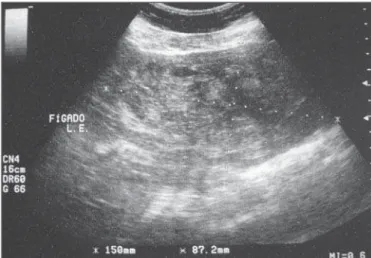
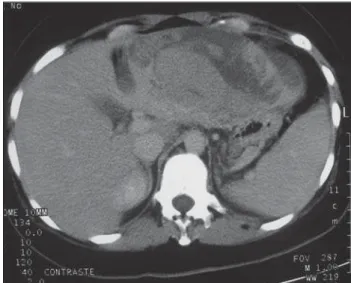
Abdominal ultrasonography (US) was performed, demonstrating increased vol-ume of the left hepatic lobe, with diffusely heterogeneous echotexture corresponding to intermingled, poorly defined, hypo and hyperechoic areas (Figure 1). Abdominal computed tomography (CT) evidenced hypo and hyperdense areas, at times reach-ing a density of 40 UH, without contrast enhancement, compromising almost the whole left hepatic lobe, compatible with acute hematoma (Figures 2 and 3). Paula Neto WT, Koifman ACB, Martins CAS. Ruptured hepatic cavernous hemangioma: a case report and literature review. Radiol Bras. 2009;42(4):271–273.
CASE REPORT
Female, 31-year-old patient presenting with acute abdomen. There was no history of subjacent abdominal disease. The pa-tient was using oral contraceptives. At physical examination the patient presented a tense abdomen, with pain at light and deep palpation in the epigastrium and right hypochondrium regions. Laboratory analy-sis showed a subtle decrease in hematocrit (34%) and hemoglobin (11 g/dl) levels.
0100-3984 © Colégio Brasileiro de Radiologia e Diagnóstico por Imagem INTRODUCTION
Spontaneous hepatic hemorrhage is an uncommon condition, and in the absence of trauma or anticoagulant therapy, it fre-quently occurs as a consequence of the subjacent hepatic disease(1).
The most common causes of nontrau-matic hepatic hemorrhages are hepatocel-lular carcinoma and hepatic adenoma(2).
There are few cases of spontaneous rupture of cavernous hemangioma(3) reported in the
literature.
Radiological findings reveal hemoperi-toneum and heterogeneous hepatic mass. Intraperitoneal clot may also be identified adjacent to the site of the bleeding(4).
272
Paula Neto WT et al.
Radiol Bras. 2009 Jul/Ago;42(4):271–273 The patient was submitted to
explor-atory laparotomy, which demonstrated a large reddish tumor taking up almost en-tirely the left hepatic lobe (Figure 4).
The histopathological diagnosis was ruptured cavernous hemangioma involved by hepatic tissue with recent hematomas.
DISCUSSION
Spontaneous hepatic hemorrhage is a very uncommon condition, and in the ab-sence of trauma or anticoagulant therapy, it frequently occurs as a consequence of a subjacent hepatic disease(1). The most
com-mon nontraumatic causes of spontaneous hepatic hemorrhage are hepatocellular car-cinoma and hepatic adenoma, and it also may occur in patients with focal nodular
hyperplasia, hemangioma, angiosarcoma and metastases(1–3).
Cavernous hemangioma is the most common benign hepatic tumor(4,5), with
greater prevalence in women. In general, they are single tumors, smaller than 5 cm, and cause no symptoms(6).
There are few cases of hemorrhage and spontaneous rupture of these lesions re-ported in literature(3). Giant hemangiomas
> 10 cm are the most likely ones to rupture, particularly when associated with trauma or during pregnancy(3,7).
At US these lesions present a nonspe-cific appearance, with large dimensions, heterogeneous echotexture and poorly de-fined limits(6). Magnetic resonance imaging
(MRI) is the most sensitive method for detection of acute abdominal bleeding(5).
However CT is more widely utilized for such purpose, due to shorter acquisition time, lower cost and wider availability as compared with MRI(2). At the first 48
hours, noncoagulated blood is observed with a high density (30–45 UH), due to the high proteic content. These values may change according to the hematocrit levels and bleeding progression time(3).
In patients with hepatic hemangioma, the imaging diagnosis of lesional hemor-rhage is suggested in the presence of a large lesion (> 10 cm), increased echogenicity at US, increased attenuation at CT or areas with hypersignal on T1-weighted se-quences at MRI(1) . These findings may be
associated with subcapsular hematoma or hemoperitoneum(4).
Figure 2. Unenhanced abdominal computed tomography, demonstrating the presence of hypo and hyperdense areas affecting the left hepatic lobe. Observe the presence of fluid in the anterior space (arrow).
Figure 3. Abdominal computed tomography after intravenous contrast agent injection, demonstrating unenhanced hypo and hyperdense areas affect-ing the left hepatic lobe compatible with acute hematoma.
Figure 4. Exploratory laparotomy shows capsular rupture in the left hepatic lobe and reddish tumor affecting the whole lobe.
Figure 2 Figure 3
273
Ruptured hepatic cavernous hemangioma: a case report
Radiol Bras. 2009 Jul/Ago;42(4):271–273 CONCLUSION
The diagnosis of nontraumatic hepatic hemorrhage should always be suspected in patients presenting sudden abdominal pain, particularly in patients using anticoagulant drugs or with preexisting hepatic lesions. Although rare, ruptured hepatic hemangio-mas are surgical emergencies with high mortality rates. CT is the appropriate method for hepatic evaluation due to rapid image acquisition and the possibility of dynamic studies(8).
REFERENCES
1. Casillas VJ, Amendola MA, Gascue A, et al. Im-aging of nontraumatic hemorrhagic hepatic le-sions. Radiographics. 2000;20:367–78.
2. Lubner M, Menias C, Rucker C, et al. Blood in the belly: CT findings of hemoperitoneum. Radiographics. 2007;27:109–25.
3. Hanbidge AE, Buckler PM, O’Malley ME, et al. Imaging evaluation for acute pain in the right upper quadrant. Radiographics. 2004;24:1117– 35.
4. Vilgrain V, Boulos L, Vullierme MP, et al. Imag-ing of atypical hemangiomas of the liver with pathologic correlation. Radiographics. 2000;20: 379–97.
5. D’Ippolito G, Appezzato LF, Ribeiro ACR, et al. Apresentações incomuns do hemangioma hepá-tico: ensaio iconográfico. Radiol Bras. 2006;39: 219–25.
6. Machado MM, Rosa ACF, Lemes MS, et al. He-mangiomas hepáticos: aspectos ultra-sonográfi-cos e clíniultra-sonográfi-cos. Radiol Bras. 2006;39:441–6. 7. Coumbaras M, Wendum D, Monnier-Cholley L,