w w w . s b f g n o s i a . o r g . b r / r e v i s t a
Original
Article
Antiproliferative
activity,
antioxidant
capacity
and
chemical
composition
of
extracts
from
the
leaves
and
stem
of
Chresta
sphaerocephala
Larissa
Saito
da
Costa
a,
Nathalia
Luiza
Andreazza
a,
Wallace
Ribeiro
Correa
a,b,
Ildenize
Barbosa
da
Silva
Cunha
a,
Ana
Lúcia
Tasca
Gois
Ruiz
c,
João
Ernesto
de
Carvalho
c,
Elisandra
Cristina
Schinor
d,
Diones
Aparecida
Dias
d,
Marcos
José
Salvador
a,∗aDepartamentodeBiologiaVegetal,ProgramadePós-graduac¸ãoemBiociênciaseTecnologiadeProdutosBioativoseProgramadePós-graduac¸ãoemBiologiaVegetal,Institutode
Biologia,UniversidadeEstadualdeCampinas,Campinas,SP,Brazil
bInstitutoFederaldeEducac¸ão,CiênciaeTecnologiadoSuldeMinasGerais,Inconfidentes,MG,Brazil
cDivisãodeFarmacologiaeToxicologia,CentroPluridisciplinardePesquisasQuímicas,BiológicaseAgrícolas,UniversidadedeCampinas,Campinas,SP,Brazil
dFaculdadedeCiênciasFarmacêuticasdeRibeirãoPreto,UniversidadedeSãoPaulo,RibeirãoPreto,SP,Brazil
a
r
t
i
c
l
e
i
n
f
o
Articlehistory:
Received4December2014
Accepted7April2015
Availableonline18June2015
Keywords:
Chrestasphaerocephala
Steroids Terpenoids Flavonoids
Antiproliferativeandantioxidantactivities
a
b
s
t
r
a
c
t
Inthisstudy,antiproliferativeandantioxidantactivitiesofcrudeextracts(hexane,ethylacetateand methanol)fromleavesandstemofChrestasphaerocephalaDC.,Asteraceae,wereinvestigated. Antipro-liferativeactivitywastestedinvitroagainsttenhumancancercellsandagainstVERO(nocancercell). AntioxidantactivitiesweredeterminedusingDPPHandORAC-FLassaysandthetotalphenoliccontent wasestimatedbyFolin–Ciocalteumethod.Hexaneandethylacetateextracts(leavesandstem)exhibited antiproliferativeactivityagainstcancercelllineswithtotalgrowthinhibition(TGI)between50.40and 250g/ml.ForVEROcell,TGIvalueswere>250g/mlforallextracts,excepttohexaneextractofthe stem(TGI80.92g/ml).Inaninitialevaluation,ethylacetateandmethanolextracts(leavesandstem) haveshownlevelsofphenoliccompoundsbetween6.94and30.96mgGAE/kginFolin–Ciocalteuassay, DPPHfree-radicalscavengingactivitywithSC50intherangeof75.22and400g/mlandantioxidant
capacitybetween290.08and1088molTE/gofextractinORAC-FLassay.HPLC-DADandESI-MS analy-sisallowedtheidentificationofflavonoidsinthemethanolextractfromtheleavesofC.sphaerocephala. ThreesteroidsandninetriterpenoidswereidentifiedinthebioactivehexaneextractsusingHRGC.
©2015SociedadeBrasileiradeFarmacognosia.PublishedbyElsevierEditoraLtda.Allrightsreserved.
Introduction
Naturalproductsaresmallmoleculesthatcanpresentbioactive
structurebyitselforbeemployedasprecursorsforthesynthesis
ofdifferentdrugs(Kumaretal.,2014).Therefore,theyaremajor
sourcefor drugdiscoveryor canhelp inthecomprehension of
biochemicalpathwayrelatedtopathologicalprocesses(Rishton,
2008).A great diversity of organisms canbe a sourceof
natu-ral productswithemphasisonterrestrial plants. Plantsarethe
basis oftraditional medicine aroundtheworld,in which many
drugsusedtodaywerediscovered.Ethnobotanyand
ethnophar-macognosystudiesassistintheidentificationofplantspecieswith
pharmacologicalpotential,aswellastoidentifysourcesofdifferent
compoundclasses(Gurib-Fakim,2006).
∗ Correspondingauthor.
E-mail:[email protected](M.J.Salvador).
Nonetheless, studies for the development of validated, safe
andeffectivenaturalproducts,coupledwithsustainableuse,are
increasinglyneeded(Farias,2004).Indevelopingcountries,about
twothirdsofthepopulationusesplantsasasourceofdrugs
with-outanyscientificbasis,apracticethatcanleadtoacuteorchronic
poisoning.InBrazil,itisalsoareality,furtheraggravateddueto
anabundanceofplantspeciesunknown,bothtaxonomicallyand
chemically.
Moreover,Brazildisplaysagreatbiodiversityandanintrinsic
chemicaldiversity,whichensuresapotentialforbioprospecting
fromitsnaturalresources.Therefore,studiestotracechemicaland
pharmacologicalprofileofthisbiologicalwealth,seenasa
promis-ingalternativefortheprimaryhealthcare,arerequired(Maciel
etal.,2002).
The Asteraceae family has many species with
ethnophar-macological and medicinal uses, being popularly used for its
anti-inflammatory,antiseptic and anti-tumor properties.
Phyto-chemical studiesofAsteraceaespecies reporttheoccurrenceof
http://dx.doi.org/10.1016/j.bjp.2015.04.005
Table1
AntiproliferativeactivityofChrestasphaerocephalaextracts.
Samples TGI(g/ml)a
U251 UACC-62 MCF-7 NCI-ADR/RES 786-0 NCI-H460 PC-03 OVCAR-3 HT-29 K562 VERO
Chrestasphaerocephala
Extractsofleaves
HEL 98.6 125.2 >250 210.2 72.3 210.8 135.9 58.3 198.9 152.1 >250
EEL >250 >250 >250 250.0 >250 >250 >250 172.3 >250 >250 >250
MEL >250 >250 >250 >250 >250 >250 >250 >250 >250 250.0 >250
Extractsofstem
HES 77.6 143.9 250.0 87.0 94.6 90.1 250.0 50.4 72.6 250.0 80.9
EES 90.8 >250 >250 >250 >250 >250 >250 199.3 >250 118.6 >250
MES >250 >250 >250 >250 >250 >250 >250 >250 >250 >250 >250
Doxorubicinb 6.3 1.2 >25 >25 25 >25 3.5 3.8 >25 1.0 6.9
aTGI–Totalgrowthinhibition–concentrationthatinhibitedcellgrowthby100%.Thecoefficientsofvariationobtainedintheseanalyseswerebelowto5%.
b Positivecontrol.
Celllines:U251(glioma);UACC-62(melanoma);MCF-7(breast);NCI-ADR/RES(ovarian-resistant);786-0(kidney);NCI-H460(lung);PC-03(prostate);OVCAR-3(ovarian);
HT-29(colon);K562(leukemia);VERO(normalepithelialrenalcellline,greenmonkey).
triterpenes, sesquiterpene lactones, lignans,flavonoids and
caf-feoylquinicacidderivatives(Schinoretal.,2006;Gobbo-Netoand
Lopes,2008;Salvadoretal.,2009),relatedtoantioxidant,analgesic
andantiprotozoalproperties.
ThegenusChresta,comprisestwelveendemicspeciesincentral
Brazil,andsomespeciesshowedantibacterialandantiprotozoal
activites(Schinor et al.,2006, 2007a,b; Robinson, 1999). These
speciesarerecognizedby thepopulationof northeasternBrazil
astraditional herbsusedtotreatgastricdiseasesand other
dis-orders,hencepresenting ethnopharmacological relevance(Silva
etal.,2012).
ChrestasphaerocephalaDC.,isanherbaceousspeciesfromthe
tribe Vernonieae, Asteraceae, known as “joão-bobo”. It strictly
occursintheregionofBraziliancerrado.FewspeciesoftheChresta
genushavebeenstudiedregardingitschemicalcompositionand
pharmacologicalpotential.C.exsuccaand C.scapigerapresented
significantpotentialregardingantimicrobialactivityagainst
bacte-ria,fungiandprotozoaandsteroids,terpenoidsandflavonoidswere
identifiedontheirbioactiveextracts(Schinoretal.,2006,2007a,b).
Theseresultsindicatethatspecies ofthis genuscanbesources
ofactivecompounds. Tothebestof ourknowledge, noreports
aboutcytotoxicandantioxidantpropertiesC.sphaerocephalahas
beendocumentedintheliterature.Thisfactpromptedusto
inves-tigatetheseactivitiesofcrudeextracts(hexane,ethylacetateand
methanol)fromtheleavesandstemofC.sphaerocephala,aswell
as,exploreinmoredetail itschemicalcompositionbydifferent
chromatographictechniques.
Materialsandmethods
Plantmaterial
ChrestasphaerocephalaDC.,Asteraceae,wascollectedinits
nat-uralhabitat,Furnas-MG,Brazil.Thebotanicalidentificationwas
carriedoutbyProf.Dr.JoãoSemir(DepartamentodeBiologia
vege-tal,InstitutodeBiologia,UniversidadedeCampinas)andavoucher
specimenhasbeendepositedin theherbariumofFaculdadede
Filosofia,CiênciaseLetras deRibeirãoPretodaUniversidadede
SãoPaulo(SPFR06875).
Plantextracts
Afterdrying theplantmaterial(leavesand stem)ina
circu-latingair ovenat 40◦C,it waspulverizedin grinderknivesand
subjectedtotheprocessofmacerationwithorganicsolvents,
hex-ane,ethylacetate(EtOAc)andmethanol,atapowder/solventratio
of1:20(w/v).Afterfiltration,solventswereremovedunderreduced
pressuretoobtainthecrudeextractsdenominatedasfollows:
hex-aneextractsfromtheleaves(HEL)andstem(HES),ethylacetate
extractsfromleaves(EEL)andstem(EES)andmethanolextracts
fromleaves(MEL)andstem(MES).Theseextractswereproperly
packedandstored.
Antiproliferativeassay
HumantumorcelllinesU251(glioma),UACC-62(melanoma),
MCF7 (breast),NCI-ADR/RES (ovarian expressing multipledrug
resistancephenotype),786-0(kidney),NCI-H460(lung,non-small
cells),PC-3(prostate),OVCAR-3(ovary),HT29(colon)andK-562
(leukemia)werekindlyprovidedbyNationalCancerInstituteat
FrederickMA-USA(NCI).Also,anormalcellline(VERO,renal,green
monkey)wasused.Stockculturesweregrowninmedium
contain-ing5mlRPMI1640(GIBCOBRL)supplementedwith5%fetalbovine
serum.Peniciline:streptomicinemixture(1000UI/ml:1000g/ml,
1ml/LRPMI 1640) wasadded toexperimentalcultures. Cells in
96-wellplates(100lcells/well)wereexposedtodifferent
sam-pleconcentrationsinDMSO/RPMI(0.25,2.5,25,and250g/ml)
and incubated at 37◦C, 5% of CO
2 in air for 48h. Final DMSO
concentrationdidnotaffectcellviability.Afterwards,cellswere
fixedwith50%trichloroaceticacidandcellproliferationwas
deter-minedbyspectrophotometricquantification(540nm)ofcellular
proteincontentusingsulforhodamineBassay.Doxorubicin
chlo-ridrate(0.1mg/mg;Europharma)wasusedasapositivecontrol.
Three measurements were obtained: at time zero (T0, at the
beginningofincubation)and48hpost-incubationfor
compound-free (C) and tested (T)cells. Cell proliferation wasdetermined
accordingtotheequation100×[(T−T0)/C−T0],forT0<T≤C,and
100×[(T−T0)/T0],forT≤T0andaconcentration–responsecurve
foreachcelllinewasplottedusingsoftwareOrigin8.0(OriginLab
Corporation).Fromtheconcentration–responsecurveforeachcell
line,TGI(concentrationthatproduces100%ofcellgrowth
inhibi-tionorcytostaticeffect)valuewasdeterminedthroughnon-linear
regressionanalysisusingthesoftwareOrigin8.0®(OriginLab
Cor-poration)(Monksetal.,1991;Shoemaker,2006).Theresultsare
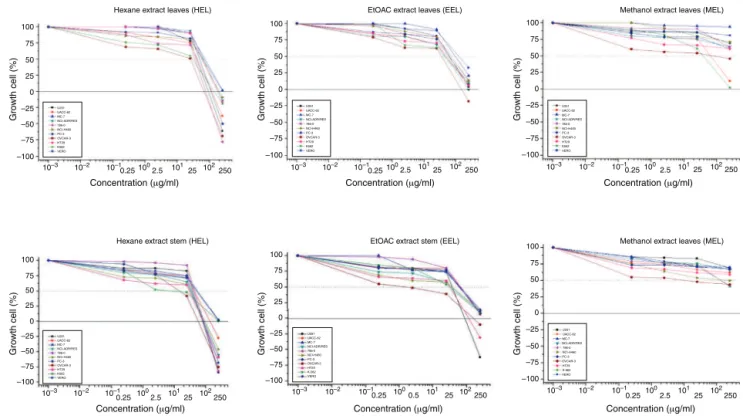
depictedinTable1andFig.1.
DPPHradicalreduction
TheradicalDPPH(2,2-diphenyl-1-picrylhydrazyl)isstable,pale
purple,andwhenreduced,turnsyellow.Inthisassay,itwas
evalu-atedstandardsandsamplesabilitytoreduceDPPHradical.Briefly,
1mgofeachextractwasdissolvedinmethanol(10ml),yielding
astocksolution.Severaldilutionswereprepared(20–200g/ml)
Hexane extract leaves (HEL) EtOAC extract leaves (EEL) Methanol extract leaves (MEL)
Methanol extract leaves (MEL) EtOAC extract stem (EEL)
Hexane extract stem (HEL)
Concentration (μg/ml) Concentration (μg/ml)
Concentration (μg/ml) Concentration (μg/ml) Concentration (μg/ml) Concentration (μg/ml)
Gro
wth cell (%)
Gro
wth cell (%)
Gro
wth cell (%)
Gro
wth cell (%)
Gro
wth cell (%)
100
75
50
25
–25
–50
–75
–100
10–2 100 101 102 10–3 10–1
0.25 2.5 25 250 10–3 10–2 10–10.251002.5 10125 102250 10–3 10–2 10–1 100 10125 102
0.25 2.5 250
0
100
75
50
25
–25
–50
–75
–100
100
75
50
25
–25 0
–50
–75
–100 0
100
75
50
25
–25
–50
–75
–100
100
75
50
25
–25
–50
–75
–100 0
10–2 10–3 10–3 10–2 10–1 100 101 102
0.25 2.5 25 250 101 102
100
10–3 10–2 10–1 100 101 102
0.25 0.5 25 250 10–1
0.25 2.5 25 250
0
Gro
wth cell (%)
100
75
50
25
–25
–50
–75
–100 0
Fig.1.AntiproliferativeactivityofChrestasphaerocephalaextracts.
(10mg/ml).After30min,theabsorbancewasmeasuredbya
spec-trophotometer (=517nm) and the percentage of anti-radical
activitywas calculated (Huang et al., 2005).Asa positive
con-trolit wasused quercetinand trolox and the dilutionsolution
(methanol)asnegativecontrol.Antioxidantactivityofeach
sam-plewasexpressedastheSC50value,whichistheconcentration
ing/mlofeachextractthatscavenged50%ofDPPHradical.All
experimentswereperformedintriplicate(Table2).
EvaluationofantioxidantcapacitybyORACassay
Antioxidant activity of extracts was measured applying
ORAC-FLassay,withfluoresceinas fluorescentprobeandAAPH
[2,2′-azobis (2-amidiopropane) dihydrochloride] as a source of
radical peroxyl. The experiments were performed in 96 wells
microtiterplatesasdescribedbyOuetal.(2001)andPrioretal.
(2003)withmodifications(Salvadoretal.,2006).Forthisreason,
extracts(50mg/ml)andfractions(5mg/ml)stocksolutionswere
prepared in phosphate buffer/DMSO (99:1) and diluted 100,
500, 1000,5000and 10,000times withphosphate buffer. Both
compounds and trolox (referencesubstance,
6-hydroxy-2,5,7,8-tetramethylchroman-2-carboxylicacid–vitamin Eanalog)were
analyzedatconcentrationsof6.25,12.5,25,50,100and200M,
usingthesamesolventsystem.Thereadingwasperformedusing
fluorescentfilter(excitation=485nmandemission=528nm)in
amicroplatereaderbymonitoringthereationkineticsevery2min
foraperiodof70min,at37◦C.Resultswereexpressedasmolof
troloxequivalent(TE)pergramofextractindrybasis(molTE/g)
andastroloxequivalentrelativetoisolatedcompounds(positive
controls).Quercetin,isoquercitrin,caffeicacidandchlorogenicacid
wereusedaspositivecontrolsandthedilutionsolutionasnegative
control.Allexperimentswereperformedintriplicate(Table2).
Table2
TotalphenolcontentandantioxidantcapacitybytheDPPHandORACassaysofChrestasphaerocephalaextracts.
Samples Phenolcontenta(mgofGAE/kg)b DPPHassay,SC
50a(g/ml)c ORACa(molTE/g)d
Hexaneextractleaves(HEL) <5.0 – –
EtOAcextractleaves(EEL) 30.9(0.07) >400 290.1(0.23)d
Methanolextractleaves(MEL) 14.6(0.05) 75.22(3.00) 1088(0.12)d
Hexaneextractstem(HES) <5.00 – –
EtOAcextractstem(EES) 6.94(0.06) >400 <200d
Methanolextractstem(MES) 17.24(0.04) 400(6.80) 471.2(0.17)d
Quercetin* – 12.40(2.00) 5.60(0.75)e
Isoquercitrin* – – 5.15(1.20)e
Caffeicacid* – – 2.98(1.90)e
Chlorogenicacid* – – 2.40(1.70)e
Trolox* – 9.60(1.80) –
*Experimentalpositivecontrols.
–Notevaluated.
aMean(%RSD,relativestandarddeviation)oftriplicateassays.
bTotalphenolicsdataexpressedasmilligramsofgallicacidequivalentspergram(mgofGAE/kg)ofextract.
c DPPHassaydataexpressedasSC
50(concentrationthatinhibited50%oftheDPPHradical)inmicrogramspermilliliters(g/ml).
d ORACdataexpressedasmicromolofTroloxequivalentspergram(molofTE/g)ofextract.
TLCautographicassayforDPPHradical-scavengingandEASI-MS analysisofantioxidantextracts
TLCautographicchromatography assay wasperformedwith
antioxidantmethanolextractfromleavesofC.sphaerocephalaand
TLCchromatographyyellowspotwithantioxidantactivitywere
analyzedby EASI-MS (easy ambientsonic-spray ionization) via
ambientdesorption/ionizationand (tandem)massspectrometry
detection (Haddad et al., 2008).Thus, 10lof extract solution
(1mg/ml) in methanol wasapplied into two TLC plates (silica
gel60GF254,Fluka,AG,Switzerland,n-butanol/aceticacid/water,
65:15:25,v/v).OneoftheTLCplatewassprayedwitha0.2%
2,2-diphenyl-1-picrylhydrazyl (DPPH, Sigma–Aldrich,St Louis, MO)
solutioninMeOHandleftatroomtemperatureandtheotherplate
(control,withoutDPPHspraying)wasanalyzedonlybyEASI-MS.
Plateswereobserved30minafterspraying.Activecompoundsare
observedasyellowspotsagainstapurplebackground.AsbothTLC
weredevelopedtogether,theyellowspotsinfirstTLC(sprayed
withDPPH)had servedasa guidetochooseareasintheother
TLCplatethatwouldbeanalyzedbyEASI-MSaccordingtoHaddad
etal.(2008)andMSorMS/MScharacterizationwereperformed.
Allexperimentswereperformedintriplicate.
Quantitativedeterminationoftotalsolublephenols
Extracts,dissolvedinmethanol,wereanalyzedfortheirtotal
solublephenoliccontentaccordingtoFolin–Ciocalteucolorimetric
method(Piccinellietal.,2004;Wuetal.,2004),usinggallicacid
asreference(FCRassay).Resultswereexpressedasmilligramsof
gallicacidequivalents(GAE)pergramofextract(mgofGAE/g).
Analyseswereperformedintriplicate(Table2).
Cleanupprocedure
TheexperimentswereperformedasdescribedbySchinoretal.
(2004).Analiquot(10mg)ofHEL and HESwasresuspended in
analyticalgradechloroform(3ml)andpercolatedthrougha
sep-kap column (Alltech, silica-gel 200mg, 3ml). The column was
elutedwithhexane(10ml)andchloroform(10ml).Fractionswere
collectedseparatelyandevaporatedtodrynessatroom
temper-ature.ChloroformphasewasanalyzedbyHRGCbelow.MELand
MESextracts(10mg)wereresuspendedinmethanol–water(7:3,
v/v,3ml)andpercolatedthroughasep-kap column(Alltech,
C-18,200mg,3ml).Thecolumnwaseluted withanalytical grade
methanol(10ml)andthisphasewasanalyzedbyHPLC–ESI-MS.
Gaschromatographicanalysis
Chloroform phase was analyzed by HRGC on a
Hewlett-Packard model 5890 Series II Gas Chromatograph with a split
injector (split ratio 1:60, v/v) at 260◦C and a flame
ioniza-tiondetectorat330◦C.Theinjectedvolumewas2l.Hydrogen
was employed as carrier gas at an average linear velocity of
44cm/s(HP-50)and42cm/s(HP-1).AnHP-50(cross-linked50%
phenyl-methylsilicone, 30m×0.25mm×0.25mm) and anHP-1
(cross-linked methyl-silicone, 30m×0.25mm×0.25mm)
capil-larycolumnswereemployed.ForHP-50thecolumntemperature
was280◦C(isotherm)andforHP-1,thecolumntemperature
pro-gramwas250◦Cheldfor12min,increasedat6◦C/minto280◦C,
andheldthistemperaturefor30min.Eachsamplewasanalyzedin
duplicate.DatawereprocessedonaHewlett-Packardmodel3395
injector.Thestandardsusedinthegaschromatographyarelisted
inTable3.
Table3
Chemicalcompositionofhexaneextracts(HELandHES)ofChrestasphaerocephala
(steroids,triterpenoidsandtriterpenoidacetates)analyzedbygaschromatography
(HP-50column).
Compounds Leaves Stem RRa
Campesterol − + 1.236
Stigmasterol + + 1.306
-Sitosterol − + 1.450
Stigmast-7en-3-ol + + 1.509
Spinasterol − − 1.676
Taraxerone − − 1.628
Epitaraxerol − − 1.656
Taraxerol − − 1.698
-Amyrin + + 1.760
␣-Amyrin + + 1.983
Lupeol + + 2.041
-Friedelanol − + 2.476
Friedelin − + 2.709
Pseudotaraxasterol − − 2.467
Taraxasterol − + 2.561
11-Oxours-12-ene − − 3.047
11-Oxolean-12-ene − − 3.386
Taraxerolacetate − − 1.866
-Amyrinacetate + + 1.923
␣-Amyrinacetate + + 2.145
Lupeolacetate + + 2.224
Bauerenylacetate − − 2.497
11␣-12␣-Oxidetaraxeryl − − 2.795
-Friedelanolacetate − − 2.857
␣-Amyrinononilacetate − − 3.637
-Amyrinononilacetate − − 4.107
−Compoundnotdetected.
+Compounddetected.
aRelativeretentiontimerelatedtotheinternalstandard(cholesterol)inminutes.
HPLC-DAD
Methanolextracts,MELandMES,wereinvestigatedbyHPLC
andtheanalysiswascarriedoutwithaWatersAlianceequipment,
usingaC-18Polaris-Variananalyticalcolumn(4.6mm×250mm).
Themobilephaseconsistedofalineargradientcombiningsolvent
A(methanol)andsolventB(water/formicacid,99:1,v/v)as
fol-lows:15%A(0min),15–90%A(30min),90%A(5min),90–15%A
(5min).Theanalyseswereperformedintriplicateataflowrate
of1.0ml/minwiththeUVdetectorsetat=280nmandan
injec-tionvolumeof10l.Subsequentsampleswereinjectedwithan
intervalof10minaftertheprevioussamplerun.
HPLC–ESI-MSanalysis
TheESI-MSspectrawereacquiredonaQ-trap(Applied
Biosys-tems) Mass Spectrometer with an ESI source operated in the
negativeionmode.Thesourceanddesolvationtemperatureswere
70◦Cand100◦C,respectively.Conevoltagewas30V.Theparent
ionandtheretentiontimewerecomparedwithpreviouslyisolated
flavonoids(Table4)ofourresearchgroup,asdescribedbySchinor
etal.(2006,2007a,b).
Statisticalanalysis
Dataarereportedasmean(%RSD,relativestandarddeviation)
andanalyzedbyANOVAtheTukeytest,p-value<0.05.
Resultsanddiscussion
TheantiproliferativeactivityoftheextractsofC.sphaerocephala
(leavesandstem)wasinvestigatedonaseriesofcancercelllinesby
sulforhodamineBassay.Theresultsshowedantiproliferativeeffect
againstallcelllinesonlyforhexaneextractswithtotalgrowth
Table4
FlavonoidsidentifiedbyHPLCandESI-MSonmethanolextracts(MELandMES)ofChrestasphaerocepahala.
Compounds Rt.(min)a [M−H]−(m/z)b Presentflavonoidsinmethanolextract
Leaves Stem
Apigenin 24.56 269 + −
Luteolin 22.72 285 + −
Genkwanin 29.20 283 + −
Crysoeriol 24.78 299 + −
Velutin 29.01 313 + +
Luteolin3′-O--d-glucopyranoside 19.38 447 + −
Luteolin7′-O--d-glucopyranoside 11.08 447 + −
Vicenin-2 12.63 593 + −
+Compounddetected.
−Compoundnotdetected.
aValuesofretentiontime.
bESI-MSanalysis.
For both HESand HEL extracts,thecell lineOVCAR-3 (ovarian
cancercellline) wasmore susceptiblywithTGIvalues equalto
50.4 and 58.3g/ml,respectively. HESalsoshowed weak
cyto-staticeffectagainstHT29(colon,TGI=72.6g/ml),U251(glioma,
TGI=77.6g/ml),NCI-ADR/RES(ovarianexpressingmultipledrug
resistance phenotype, TGI=87.0g/ml), NCI-H460 (lung,
non-smallcells,TGI=90.1g/ml)and786-0(renal,TGI=94.6g/ml).
This extract also inhibited cell growth of VERO cells (renal,
greenmonkey)at thesamelevel thataffectedcancercells (TGI
80.9g/ml).Ingeneral,bothmethanolandethylacetateextracts
wereinactiveagainstallcelllines.Theseresultsindicatethatthe
antiproliferativeactivityofC.sphaerocephalaareprobablydueto
nonpolarcompounds.
In FCRassay,both methanoland ethylacetateextracts,
pre-sented significant levels of phenolic compounds (Table 2).The
amountofgallicacidinMEL(14.6mg/kg)andMESweresimilar
(17.2mg/kg),whilethiscompoundcontentatEEL(30.9mgGAL/g)
werealmostfivetimeshigherthantheonefoundinEES(6.9mg
GAE/kg).OnlyMELshowedexpressiveDPPHscavengeabilitywith
SC50 valuesequal to75.2g/ml whereasfor EEL,EESandMES,
SC50werehigherthan400g/ml.Ontheotherhand,atORAC-FL
assay,theseextractsdemonstratedantioxidantcapacitybetween
Intensity (U
.A)
Intensity (U
.A)
Intensity (U
.A)
Intensity (U
.A)
Intensity (U
.A)
Intensity (U
.A)
Intensity (U
.A)
Intensity (U
.A)
Intensity (U
.A) Genkwanin, Rt = 29.20 min, [M-H] = 283 m/z
Velutin, Rt = 29.01 min, [M-H] = 313 m/z
Luteolin, Rt = 22.72 min, [M-H] = 285 m/z
Luteolin-7’-O-β-D-glucopyranoside, Rt = 11.08 min, [M-H] = 447 m/z Luteolin-3’-O-β-D-glucopyranoside,, Rt = 19.38 min, [M-H] = 447 m/z
Vicenin-2, Rt = 12.63 min, [M-H] = 593 m/z
Apigenin, Rt = 24.56 min, [M-H] = 269 m/z
Crysoeriol, Rt = 24.78 min, [M-H] = 299 m/z
290.1and1088.1molTE/gofextract,exceptforEES,whichdid
notreachmeasurableconcentrations accordingtoexperimental
procedure.Hexaneextracts(HELandHES)showednoantioxidant
activityinbothtests.Therefore,itispossibletoassertthatDPPH
radicalreductionandantioxidantcapacityofmethanolandethyl
acetateextractsareingoodcorrelationwiththetotalphenolic
con-tentmeasuredbyFolin–Ciocalteu,oncetheseclassesofcompounds
areknownaspotentantioxidants.
In chemical profile characterization of HES and HEL by GC
analysis, allowed the identification of three steroids
(stigmas-terol,-sitosterolandstigmast-7-en-3-ol)andninetriterpenoids
(␣-amyrin, -amyrin, lupeol, taraxasterol, friedelin, friedelanol,
␣-amyrin acetate, -amyrin acetate and lupeol acetate) as
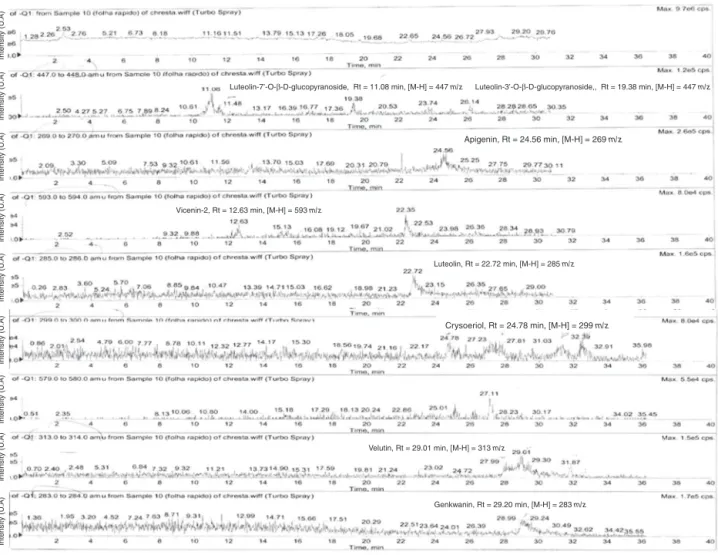
shown in Table 3. HPLC-DAD and ESI-MS analyses revealed
that both methanol extracts present flavonoids as major
con-stituents, such as luteolin-3-O--d-glucopyranoside,
luteolin-7-O--d-glucopyranoside, vicenin-2, luteolin, crysoeriol, velutin,
apigeninand genkwanin(Table4; Fig.2).TLC chromatography
analysisofMELextract(theonewithhigherantioxidantactivity),
followedbyEASI-MSanalysisoftheyellowspotreveledintheTLC
plateforantioxidantactivityshowedthesubstanceasbeing
api-genin.Inthiscase,notonly,theseextract(MEL)antioxidantactivity
isprobablyattributedtotheseflavonoidbutalso,thecombination
ofbothanalyticaltechniquesprovidedasimpleandadvantageous
techniquefortheseparationanddetectionofanactivecompound.
Moreover, the compounds stigmasterol and lupeol found
in hexane extracts have already been described as possessing
promisingantiproliferativeactivitiesandcouldberelatedtothe
resultsobserved inthis study(Yasukawaetal., 1991;Kasahara
et al., 1994; Saleem, 2009). On the other hand, luteolin and
apigenin, observed in methanol extracts, are reported as
out-standing antioxidant/free-radical scavenging substances (Burda
andOleszek,2001;Romanovaetal.,2001;Salaetal.,2003;Shohreh
etal.,2008).
Despite the promising results foundhere, further biological
studies should be performed, including in vivo investigations,
lookingtowardaclinicalemploymentofthesebioactivenatural
products.
Authorcontributions
LSCand NLAcarriedout allexperimentalproceduresof this
study,dataanalysisandinterpretationanddraftedthemanuscript.
WRCassistedinantioxidantassays.ALTGRandJECassistedinthe
antiproliferativebiologicalassays.IBSCcarriedoutESI-MSanalysis
andassistedinspectradatainterpretation.ECS,DADandMJS
con-ceivedthestudyandparticipatedinitsdesignandcoordination
andhelpedtodraftthemanuscript.Allauthorsreadandapproved
thefinalmanuscript.
Conflictsofinterest
Theauthorsdeclarenoconflictsofinterest.
Acknowledgements
TheauthorsaregratefultoDr.JoãoSemirfromDepartamento
deBiologiaVegetal/UNICAMPforplantidentification;toDr.Marcos
NogueiraEberlinfromLaboratórioThomsondeEspectrometriade
Massas,InstitutodeQuímica/UNICAMPformassspectra;andto
FAPESP,CAPES,CNPqandFAEPEX-UNICAMPforfinancialsupport.
References
Burda,S.,Oleszek,W.,2001.Antioxidantandantiradicalactivitiesofflavonoids.J.
Agric.FoodChem.49,2774–2779.
Farias,M.R.,2004.Avaliac¸ãodaqualidadedematerias-primasvegetais.In:Simões,
C.M.O.,Schenkel,E.P.,Gosmann,G.,Mello,J.C.P.,Mentz,L.A.,Petrovick,P.R.(Eds.), Farmacognosia:daplantaaomedicamento.,5thed.EditoradaUniversidade UFRGS/EditoradaUFSC,PortoAlegre/Florianópolis,pp.263–288.
Gobbo-Neto, L., Lopes, N.P., 2008. Online identification of chlorogenic acids,
sesquiterpenelactones,andflavonoidsintheBrazilianarnicaLychnophora eri-coidesMart(Asteraceae)leavesbyHPLC-DAD–MSandHPLC-DAD–MS/MSand avalidatedHPLC-DADmethodfortheirsimultaneousanalysis.J.Agric.Food Chem.56,1193–1204.
Gurib-Fakim,A.,2006.Medicinalplants:traditionsofyesterdayanddrugsof
tomor-row.Mol.Asp.Med.27,1–93.
Haddad,R.,Milagre,H.M.S.,Catharino,R.R.,Eberlin,M.N.,2008.Easyambient
sonic-sprayionizationmassspectrometrycombinedwiththin-layerchromatography. Anal.Chem.80,2744–2750.
Huang,D.,Ou,B.,Prior,R.L.,2005.Thechemistrybehindantioxidantcapacityassays.
J.Agric.FoodChem.53,1841–1856.
Kasahara,Y.,Kumaki,K.,Katagiri,S.,Yasukawa,K.,Yamanouchi,S.,Takido,M.,
Aki-hisa,T.,Tamuta,T.,1994.Carthamiflosextractanditscomponent,stigmasterol,
inhibittumourpromotioninmouseskintwo-stagecarcinogenesis.Phytother. Res.8,327–331.
Kumar,S.V.,Saravanan,D.,Kumar,B.,Jayakumar,A.,2014.Anupdateonprodrugs
fromnaturalproducts.AsianPac.J.Trop.Med.7,S54–S59.
Maciel,M.A.M.,Pinto,A.A.,Veiga,V.F.J.,2002.Plantasmedicinais:anecessidadede
estudosmultidisciplinares.Quim.Nova25,429–438.
Monks,A.,Scudiero,D.,Skehan,P.,Shoemaker,R.,Paull,K.,Vistica,D.,Hose,C.,
Langley,J.,Cronise,P.,Vaigro-Wolff,A.,Gray-Goodrich,M.,Campbell,H.,Mayo,
J.,Boyd,M.,1991.Feasibilityofahigh-fluxanticancerdrugscreenusingadiverse
panelofculturedhumantumorcelllines.J.Natl.CancerInst.83,757–766.
Ou,B.,Hampsch-Woodill,M.,Prior,R.L.,2001.Developmentandvalidationofan
improvedoxygenradicalabsorbancecapacityassayusingfluoresceinasthe fluorescentprobe.J.Agric.FoodChem.49,4619–4626.
Piccinelli,A.L.,DeSimone,F.,Passi,S.,Rastrelli,L.,2004.Phenolicconstituentsand
antioxidantactivityofWenditacalysinaleaves(burrito),afolkParaguayantea. J.Agric.FoodChem.52,5863–5868.
Prior,R.L.,Hoang,H.,Gu,L.,Wu,X.,Bacchiocca,M.,Howard,L.,Hampsch-Woodill,M.,
Huang,D.,Ou,B.,Jacob,R.,2003.Assaysforhydrophilicandlipophilic
antiox-idantcapacity(oxygenradicalabsorbancecapacity(ORAC-FL))ofplasmaand otherbiologicalandfoodsamples.J.Agric.FoodChem.51,3273–3279.
Rishton,G.M.,2008.Naturalproductsasarobustsourceofnewdrugsanddrug
leads:pastsuccessesandpresentdayissues.Am.J.Cardiol.101,S43–S49.
Robinson,H.,1999.In:SmithsonianInstitutionPress(Ed.),GenericandSubtribal
ClassificationofAmericanVernonieae.SmithsonianContributionstoBotany, Washington,DC,pp.9–12.
Romanova,D.,Vacakova,A.,Cipak,L.,Ovesna,Z.,Rauko,P.,2001.Studyofantioxidant
effectofapigenin,luteolinandquercetinbyDNAprotectivemethod.Neoplasma 48,104–107.
Sala,A.,Recio,M.C.,Schinella,G.R.,Ma ˜nez,S.,Giner,R.M.,Cerdá-Nicolas,M.,Rios,J.L.,
2003.Assessmentoftheanti-inflammatoryactivityandfreeradicalscavenger
activityoftiliroside.Eur.J.Pharmacol.461,153–161.
Saleem,M.,2009.Lupeol,anovelanti-inflammatoryandanti-cancerdietary
triter-pene.CancerLett.285,109–115.
Salvador,M.J.,Ferreira,E.O.,Mertens-Talcott,S.U.,Castro,W.V.,Butterweck,V.,
Derendorf,H.,Dias,D.A.,2006.IsolationandHPLCquantitativeanalysisof
antioxidantflavonoidsfromAlternantheratenellaColla.Z.Naturforsch.C61, 19–25.
Salvador,M.J.,Sartori,F.T.,Sacilotto,A.C.B.C.,Pral,E.M.,Alfieri,S.C.,Vichnewski,
W.,2009.BioactivityofflavonoidsisolatedfromLychnophoramarkgraviiagainst
Leishmaniaamazonensisamastigotes.Z.Naturforsch.C64,509.
Schinor,E.C.,Salvador,M.J.,Turatti,I.C.,Zucchi,O.L.A.D.,Dias,D.A.,2004.Comparison
ofclassicalandultrasound-assistedextractionsofsteroidsandtriterpenoids fromthreeChrestaspp.Ultrason.Sonochem.11,415–421.
Schinor,E.C.,Salvador,M.J.,Tomaz,J.C.,Pral,E.M.F.,Alfieri,S.C.,Albuquerque,S.,Dias,
D.A.,2006.Biologicalactivitiesandchemicalcompositionofcrudeextractsfrom
Chrestaexsucca.Braz.J.Pharm.Sci.42,83–90.
Schinor,E.C.,Salvador,M.J.,Pral,E.M.F.,Alfieri,S.C.,Albuquerque,S.,Dias,D.A.,2007a.
EffectofextractsandisolatedcompoundsfromChrestascapigeraonviabilityof LeishmaniaamazonensisandTrypanossomacruzi.Braz.J.Pharm.Sci.43,295–300.
Schinor,E.C.,Salvador,M.J.,Ito,I.Y.,Dias,D.A.,2007b.Evaluationoftheantimicrobial
activityofcrudeextractsandisolatedconstituentsfromChrestascapigera.Braz. J.Microbiol.38,145–149.
Shoemaker,R.H.,2006.TheNCI60humantumourcelllineanticancerdrugscreen.
Nat.Rev.Cancer6,813–823.
Shohreh,N.,Mehrdad,H.,MehdI,R.,Heidar,A.T.,2008.DNAadductswithantioxidant
flavonoids:morin,apigenin,andnaringin.DNACellBiol.27,433–442.
Silva,A.A.R.,Bezerra,M.M.,Chaves,H.V.,Pinto,V.P.T.,Franco,E.S.,Vieira,A.M.,
Araújo,E.B.,Cunha,L.R.,Leite,A.C.R.,Maia,M.B.S.,2012.Protectiveeffectof
Chrestamartiiextractonethanol-inducedgastropathydependsonalpha-2 adrenoceptorspathwaysbutnotonnitricoxide,prostaglandinsoropioids.J. Ethnopharmacol.142,206–212.
Wu,X.,Beecher,G.R.,Holden,J.M.,Haytowitz,D.B.,Gebhardt,S.E.,Prior,R.L.,2004.
LipophilicandhydrophilicantioxidantcapacitiesofcommonfoodsintheUnited States.J.Agric.FoodChem.52,4026–4037.
Yasukawa,K.,Takido,M.,Matsumoto,T.,Takeuchi,M.,Nakagawa,S.,1991.Sterol