A stress-displacement solution for a pressure tunnel with
im-permeable liner in elastic porous media
Abstract
Considering the effects of the changes of the pore water pressure around the opening, the construction sequence of the tunnel and the interaction between the liner and the surrounding geomaterial on the mechanical response of the tunnel and in conjunction with the analyses of the continuity and boundary conditions for the stress and displacement and hydraulic conditions, the elastic problem for a deep pressure tunnel with impermeable liner in a saturated elastic porous media that obeys Terzaghi’s effective stress principle is in-vestigated. The influences of the relative liner thickness and rigidity and the relative distance of the point under inves-tigation to the tunnel axis on the stress-displacement fields for various combinations of the mechanical and geometric parameters are evaluated and discussed.
Keywords
tunnel, liner, porous media, relative liner thickness and rigid-ity, Terzaghi’s effective stress principle.
M.B. Wanga,∗ and G. Wangb
a
School of Civil Engineering, Ludong Univer-sity, Yan’tai 264025 – P.R. China
b
State Key Laboratory of Mine Disaster Pre-vention and Control, Shandong University of Science and Technology, Qingdao 266590 – P.R.China
Received 10 Jun 2011; In revised form 04 Oct 2011
∗Author email: [email protected]
1 INTRODUCTION
With the development and upgrade of infrastructures, the demand for tunnel construction is increasing all over the world. Therefore, an extensive amount work has been done on the geomaterial-liner interaction of the tunnel based on elastic theory [7, 15].
and second it can change the stress field in the surrounding geomaterial around the tunnel decreasing effective stresses. Even though some of the effects of pore water pressure on tunnel support have been investigated [1, 3–6, 12–14, 16, 17], there are many aspects that require further scrutiny; in particular a criterion for tunnel support is needed where groundwater flow conditions are included.
One of the most important problems associated with tunneling is to determine the defor-mation produced by tunnel excavation. Even though this is a key aspect of tunneling, due to many complex factors affecting the solution, there are still a limited number of closed-form solutions than can be used to predict the deformation produced by tunnel excavation. Em-pirical or quasi-emEm-pirical methods are usually available. However, Chou and Bobet [8] note explicitly in their paper that empirical methods have significant shortcomings: (1) they have been developed or have been validated from a limited number of cases; (2) they should be applied only to tunnels that fall within the scope of the cases from which the method was developed; (3) only few soil and geometry parameters are taken into account; (4) they do not consider construction methods; and (5) they cannot give the complete solution of a tunnel with liner.
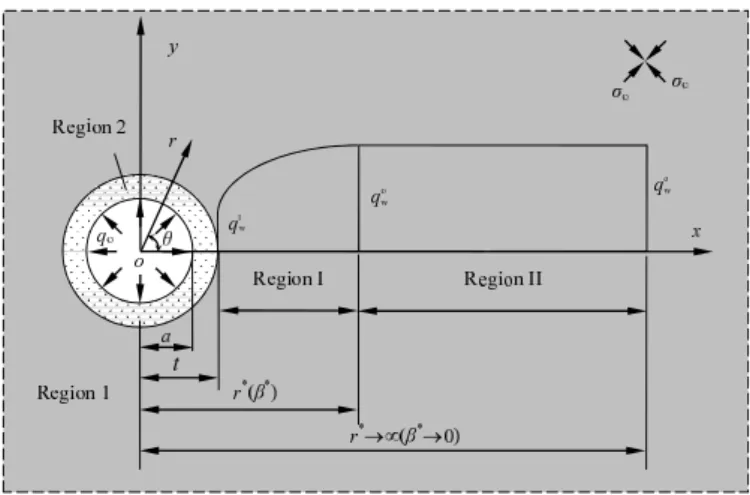
The present paper proposes an elastic stress-displacement solution for a deep pressure tunnel with impermeable liner excavated in a saturated elastic porous geomaterial that obeys Terzaghi’s effective stress principle [2, 18], as shown in Fig. 1. In all the analyses the following assumptions are made:(1) the geomaterial and the liner are always elastic; (2) the permeability of the geomaterial is homogeneous and isotropic; (3) the groundwater field is a steady-flow seepage field; (3) the cross-section of the tunnel is circular; (4) plane strain conditions are applicable at any cross-section of the tunnel; (5) the tunnel is deep enough so that the stress distribution before excavation is homogeneous. Even though some assumptions may be too restrictive, the method has the following advantages: (1) it is simple to use; (2) it can properly model the tunnel construction sequence; (3) it can be used for preliminary design, which facilitates a more advanced or detailed modeling of the tunnel.
2 PROBLEM STATEMENT
Consider an infinite elastic plane oxy (geomaterial made in elastic porous material, or Region
1) that is homogeneous, except for the presence of a deep circular lined tunnel subjected to uniform internal pressure−qo (with qo a positive number and tensile stresses are considered as
positive in the work), or Region 2 (see Fig. 1). The elastic constants of the geomaterial are denoted by G1(shear modulus) and γ1 (Poisson’s ratio), and the polar coordinates in theoxy
plane by r and θ. It is assumed that the tunnel-axis is aligned with the direction of the third out-of-planez-axis. The inner and outer radii of the liner are denoted byaandt, respectively,
Figure 1 Lined circular tunnel subjected to total stresses (including in situ stress and water pore pressure). which is defined as
Γ= G2
G1 (1)
In addition, as discussed in the main text, a dimensionless variableβ is defined in terms of the outer radius of the linert and the radial distance r to the tunnel axis, as follows
β= t
r (2)
Also, the solution is expressed in terms of the two Lame’s elastic parameters, λ and G
respectively, that are related to the Young’s modulus E and the Poisson’s ratio γ of the liner and the geomaterial as follows
G= E
2(1+γ) (3)
and
λ= Eγ
(1+γ)(1−2γ) (4)
Prior to excavation, the total stresses and the pore water pressure in the geomaterial are uniform and equal to −σo and −qow, respectively. The tunnel is then excavated and water is
drained from inside the tunnel, leading to the non-uniform pore water pressure distribution shown in Fig.1, whereqw=−qwt at the outer boundary of the liner andqw=−qowat and beyond
the radial distance r=r∗. The pore water pressure distribution is depicted by Regions I and
II in Fig.1, respectively. By using Terzaghi’s effective stress principle, the total stress can be decomposed into effective stresses and pore water pressure and the equation can be written in matrix notation as
where σ represents a component of total normal stress, σ′ the corresponding component of effective normal stress, and qw the pore water pressure.
3 THE CLOSED-FORM FULL FIELD ELASTIC SOLUTION
According to Eq.(2), the radial distance r can therefore be expressed as follows
r= t
β (6)
In view of the relationship (6), the first derivation of an arbitrary function with respect to the variabler, can be equally expresssed in terms of the derivative of the same function with respect to the variableβ, i.e.,
d( ) dr =−
β2 t
d( )
dβ (7)
similarly, the second derivative of an arbitrary function with respect to the variabler results
d2
( )
dr2 =
2β3 t2
d( ) dβ +
β4 t2
d2
( )
dβ2 (8)
Firstly, the solution for pore water pressure is discussed. The differential equation in a steady flow field can be expressed in terms of the pore water pressure qw and the radial distancer as follows [10]
d2 qw dr2 +
1
r dqw
dr =0 (9)
In view of the transformation (6), Eq.(9) can be equally expressed in terms of β as follows
d2qw
dβ2 +
1
β dqw
dβ =0 (10)
The general solution of Eq.(10) is obtained as follows
qw(β)=A1+A2lnβ (11)
where A1 and A2 are integration constants.
In reference to Fig.1, the values of the pore water pressure at the distances r=t(orβ=1)
and r=r∗ are as follows, respectively
qw=−qtw β=1 (12)
and
qw=−qwo β=β∗ (13)
A1=−qtw (14)
and
A2= q
t w−qow
lnβ∗ (15)
Consequently, the solutions for the pore water pressure in Regions I and II result in as follows, respectively
qw(I β)=−qwt + (qtw−qow) lnβ
lnβ∗ β
∗≤β ≤1 (16)
and
qIIw(β)=−qow 0≤β ≤β∗ (17)
Next, we discuss the derivation of the solution for displacements and stresses. Considering Eqs.(6) and (7), the differential equation of equilibrium for the axisymmetric problem can be expressed as
dσr
dβ −
σr−σθ
β =0 (18)
In addition, the radial strain ϵr and ϵθ can be equally expressed in terms of the radial displacementur and the variable β as follows, respectively
εr=−
β2 t
dur
dβ (19)
and
εθ =
β
aur (20)
According to Terzaghi’s effective stress principle, only the effective components of normal stresses induce mechanical deformation, therefore, the elastic stress-strain relationships, as defined by the theory of elasticity, may be revised as
ε1r= 1
E{(σr−qw) −γ[(σθ−qw) + (σz−qw)]} (21)
ε1θ= 1
E{(σθ−qw) −γ[(σr−qw) + (σz−qw)]} (22)
ε1z= 1
E{(σz−qw) −γ[(σθ−qw) + (σr−qw)]} (23)
where, ε1
r, ε
1
θ and ε
1
z denote the total strains including the components prior to excavation.
Similarly, prior to excavation, between the strains, defined byεor, εoθ and εoz, and the stresses by σro,σoθ and σzo, the following relationships yield
εor= 1 E{(σ
o r+q
o
εoθ= 1 E {(σ
o
θ +qw) −o γ[(σro+qow) + (σoz+qw)]}o (25)
εoz= 1 E {(σ
o
z +qw) −o γ[(σθo+qow) + (σor+qw)]}o (26)
Hence, the incremental strainsεr,εθ and εz may be obtained as follows
εr=ε
1
r−εor
= 1
E{(σr−qw) − (σ
o
r+qw) −o γ[(σθ−qw) − (σθo+qow) + (σz−qw) − (σoz+qw)]}o
(27)
εθ=ε
1
θ−ε o θ
= 1
E{(σθ−qw) − (σ
o
θ+qow) −γ[(σr−qw) − (σro+qow) + (σz−qw) − (σoz+qw)]}o
(28)
εz=ε
1
z−εoz
= 1
E{(σz−qw) − (σ
o
z+qow) −γ[(σθ−qw) − (σoθ+qw) + (o σr−qw) − (σor+qw)]}o
(29)
In terms of Eqs.(27)-(29), for the special case of plane strain, i.e., εz = 0, the following
expressions results in
(σr−qw) + (σo−qw)o =(λ+2G)εr+λεθ (30)
(σθ−qw) + (σo−qow)=(λ+2G)εθ+λεr (31)
(σz−qw) + (σo−qw)o =λ(εr+εθ) (32)
wherein, σr−qw,σθ−qw and σz−qw represent the effective components of radial, tangential
and axial stresses, respectively, while σo−qwo represent the initial effective in situ stress.
By substituting Eqs.(30) and (31) together with Eqs.(19) and (20) into Eq.(18), the follow-ing differential equation representfollow-ing the equilibrium condition in terms of the displacements is obtained
β2d 2
ur1 dβ2 +β
dur1
dβ −ur1− t λ1+2G1
dqw
dβ =0 (33)
where, the second subscripts 1 is related to the components in the surrounding geomaterial. For region I, noting Eq.(16), the solution of Eq.(33) gives the following expression for the radial displacement
uIr1(β)= AI
1
β +A
I
2β+ t(q
o w−qw)t
2(λ1+2G1)
lnβ
βlnβ∗ (34)
σIr1(β)=−σo+ (qwo −qtw) +
2(λ1+G1)
t A I 1− 2G1 t β 2 AI2−
qow−qtw
2 lnβ∗ (1+
2G1
λ1+2G1lnβ) (35)
and
σθI1(β)=−σo+ (qwo −qtw) +
2(λ1+G1)
t A
I
1+ 2G1
t β
2 AI2
−qow−q t w
2 lnβ∗ ( λ1
λ1+2G1+ 2G1
λ1+2G1lnβ)
(36)
As for region II, noting Eq.(17), the following expressions for the displacement and stresses result in
uIIr1(β)= AII
1
β +A
II
2 β (37)
σrII1(β)=−σo+ (qwo −q t
w) +2(λ1+G1)
t A II 1 − 2G1 t β 2
AII2 (38)
σBθ1(β)=−σo+ (qow−qtw) +
2(λ1+G1)
t A II 1 + 2G1 t β 2
AII2 (39)
where, the superscript II is related to the components in the region II of the surrounding geomaterial.
In reference to Fig.1, the boundary or continuity conditions at the distancesr=t(orβ =1), r→∞(orβ→0) andr=r∗ (or β=β∗) are summarized as
σrI1=− (qs+qtw) β=1 (40)
σIIr1=−σo β =0 (41)
σrI1=σIIr1 β=β∗ (42)
uIr1=u
II
r1 β =β∗ (43)
where,qsdenotes the normal pressure along the interface between the liner and the surrounding
geomaterial for the case that the liner is impermeable. Eqs.(40) through (43) – withσrI1,σIIr1, uIr1 and uIIr1 defined by Eqs.(35), (38), (34) and (37), respectively – conform a system of four
algebraic equations to solve four unknowns, the variables AI1,AI2,AII1 and AII2 , as follows
AI1=
t
2(λ1+2G1)(q
t
w−qw) (o 1−
1
2 lnβ∗) (44)
AI2= t
2G1(qs+q
t
w−σo) +
t
2(λ1+2G1)(q
t w−q
o
w) ( 1
2 lnβ∗ −1) (45)
AII1 =0 (46)
AII2 = t
2G1(qs+q
t
w−σo) +
t
2(λ1+2G1)(q
t
w−qow) [
1
2 lnβ∗ −1−
1
In summary, substituting Eqs.(44) and (45) into Eqs.(34)-(36) and Eqs.(46) and (47) into Eqs.(37)-(39), respectively, the final expressions for the displacements and stresses for regions I and II are obtained as follows
uIr1(β)= t
2G1(qs+q
t
w−σo)β−
t
4(λ1+2G1)
qwt −qow
βlnβ∗ [2 lnβ+ (1−β 2
) (1−2 lnβ∗)] (48)
σIr1(β)=−σo− (qs+qwt −σo)β
2
+4(λ12G1+2G1)qwt −qwo
lnβ∗ [2 lnβ+ (1−β 2
) (1−2 lnβ∗)] (49)
σθI1(β)=−σo+ (qs+qtw−σo)β
2
+ 2G1
4(λ1+2G1)
qwt −qwo
lnβ∗ [2 lnβ−2+ (1+β 2
) (1−2 lnβ∗)] (50)
uIIr1(β)= t
2G1(qs+q
t
w−σo)β−
t
4(λ1+2G1)
qtw−qwo
(β∗)2lnβ∗β[1− (β
∗)2
+2(β∗)2lnβ∗] (51)
σrII1(β)=−σo− (qs+qtw−σo)β
2
+4(λ12G1+2G1) qwt −qwo
(β∗)2lnβ∗β
2
[1− (β∗)2+2(β∗)2lnβ∗] (52)
σθII1(β)=−σo+ (qs+qtw−σo)β
2
−4(λ12G1+2G1) qwt −qwo
(β∗)2lnβ∗β
2
[1− (β∗)2+2(β∗)2lnβ∗] (53)
The above expressions for radial and tangential stresses correspond to total stresses. Ac-cording to Terzaghi’s effective stress principle (Eq.(5)), the effective radial and tangential stresses for regions I and II, are computed as follows
σr(′ β)=σr(β) −qw(β) (54)
σ′θ(β)=σθ(β) −qw(β) (55)
By making qt
w=qwo =0 in Eqs.(48)-(53), the classical Lam´e’s solution can be recovered. In
this case, the total and effective stresses are the same and the solution for radial displacement, radial stress and tangential stress, result to be, respectively
ur1(β)= t
2G1(qs−σo)β (56)
σr1(β)=−σo− (qs−σo)β
2
(57)
σθ1(β)=−σo+ (qs−σo)β 2
(58)
For another special case that the pore water pressure distribution in the surrounding ge-omaterial is uniform, by considering qt
w = qwo in Eqs.(48)-(53), the following expressions for
displacement and stresses are obtained
ur1(β)= t
2G1(qs+q
o
σr1(β)=−σo− (qs+qwo −σo)β 2
(60)
σθ1(β)=−σo+ (qs+qwo −σo)β 2
(61)
For this case there is no distinction between regions I and II, in terms of Eqs.(16) and (17), the solution for the pore water pressure is
qw(β)=qw(I β)=qwII(β)=−qwo (62)
Figure 2 Model for tunnel construction.
Finally, the solution for the support pressure qs is discussed below. It is assumed that the radii of the opening immediately after excavation, after the elastic deformation finishes and before the liner is installed, are t′′′, t′′ and t′, respectively. The construction sequence of the tunnel is modeled with regard to Fig.2. Then, we define
η= t
′ −t′′
t′ (63)
as the relative radius misfit between the surrounding geomaterial and the liner. This misfit is assumed of the order of the admissible strains in linear elasticity.
Based on Kirsch’s solution [11] and Eq.(48), t′′ is expressed as follows
t′′ =t
′′′
[1− σo
2G1] (64)
The case of η =0 means that the liner is installed after the elastic deformation finishes,
and η =ηmax means that the region of r ≤t′′′ in the surrounding geomaterial is replaced by
the liner. Thus,ηmax can be written in the following form
ηmax= t
′′′ −t′′ t′′′ =
σo
2G1 (65)
Substituting (65) into (64) yields the following relation
Next, the elastic deformation rate of the surrounding geomaterial is defined by
δ= t
′′′ −t′
t′′′−t′′ ×100% (67)
Taking advantage of Eq.(66), δ can be rewritten
δ= 1 ηmax(1−
t′
t′′′) ×100% (68)
Inserting Eqs.(65), (66) and (68) into Eq.(63) gives
η= (1−δ)ηmax
1−δηmax (69)
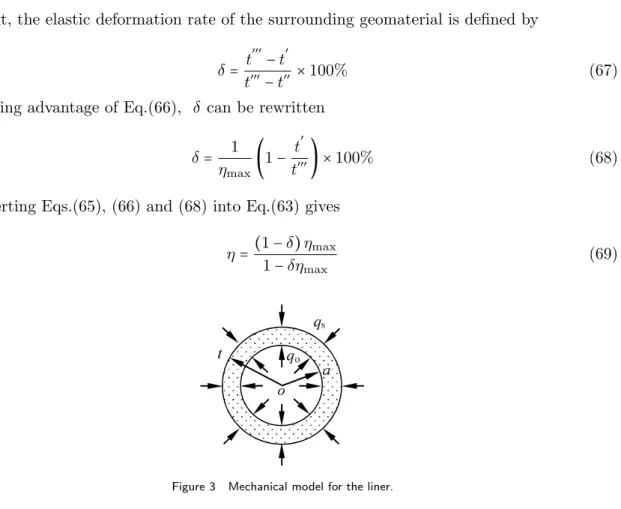
Figure 3 Mechanical model for the liner.
In terms of the Lam´e’s solution and Eq.(6), the stresses and displacement in the liner may be equally written as follows (see Fig.3)
σr′2(β)=σr2(β)=− β2−1
t2
a2 −1 qo−
1−a2 t2β
2
1−at22
qs (70)
σθ′2(β)=σθ2(β)= β2+
1
t2
a2−1 qo−
1+at22β 2
1−a2
t2
qs (71)
ur2(β)=
1 2G2
β t
⎡⎢ ⎢⎢ ⎢⎣
(1−2γ2)aβ22+a 2
1−at22
qo−
(1−2γ2)βt22 +a 2
1−at22
qs ⎤⎥ ⎥⎥
⎥⎦ (72)
Furthermore, it is noted that the liner will be installed when the tunnel partially deforms. Hence, the following relationship results in
uIr1(1)∣σ
o=0
=ur2(1) +ηt (73)
qs=
2(1−γ2)a2
qo+ (2ηG2−Γqtw) (t2
−a2
)
(1−2γ2+Γ)t2+ (
1−Γ)a2 (74)
In terms of Eq.(48), the displacement along the interface between the liner and the sur-rounding geomaterial may also be written in a explicit form as follows
uIr1(1) =
ηtΓ(t2−a2)
(1−2γ2+Γ)t2+(1−Γ)a2+
t
2G1
(1−2γ2)a2+a2 (1−2γ2+Γ)t2+(1−Γ)a2qo
+ t
2G1
(1−2γ2)t2+a2
(1−2γ2+Γ)t2+(1−Γ)a2q
t
w−2Gt1σo
(75)
where and hereafter, uI
r1(1) denotes the support displacement corresponding to the case that
the liner is impermeable.
In terms of Eqs.(74) and (75), it may be found that the pore water pressure distribution in the surrounding geomaterial has significant influences on the support pressureqsand
displace-ment uIr1(1). The support pressure qs and displacementuIr1(1) may decrease with increasing
the pore water pressure qtw along the outer boundary of the liner and the reverse trend may occur if to decrease the pore water pressure qwt. As for the internal water pressureqo, it may
be found that the support pressure qs increases with increasing the internal water pressure
qo. However, the support displacement uI
r1(1) decreases with increasing the internal water
pressureqo.
4 NUMERICAL RESULTS AND DISCUSSIONS
In this Section, in order to illustrate the appllication of the obtained solution, we take γ1 = γ2=0.3,δ=0,G1/σo=103,qwo =0.5σo,qtw=0.025σo,qo=0.05σo andr∗=5a2/t.
The variations of the normalized support pressure (qs/σo) and displacement (G1uIr1(1)/(σoa))
with relative liner rigidity for various relative liner thicknesses are depicted in Figs.4 and 5. It is seen that in general the varying trend of the support pressure with respect to relative liner rigidity for various liner thicknesses is similar to that of the support displacement. Namely, both of the support pressure and displacement monotonically increase with increasing liner rigidity and thickness. From Figs.4 and 5, it is further seen that in the range of 1≤Γ≤200,
the influences of the liner rigidity and thickness on the support pressure and displacement are significant. However, in the range of 200<Γ≤800, the variations of the support pressure and
displacement with various values of Γ or t/a become insignificant. Finally, when 800<Γ, the
variations of the support pressure and displacement are almost independent of the values of Γ and t/a.
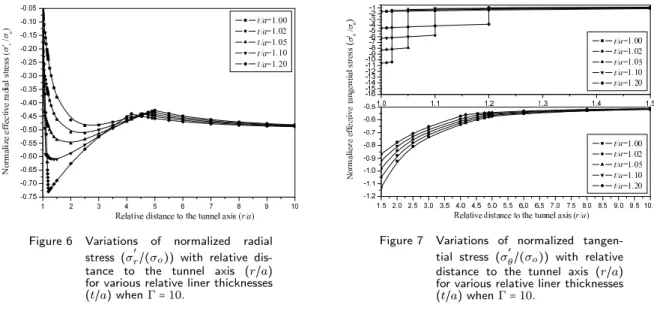
In Figs.6 and 7, we illustrate the variations of the normalized effective stresses in the liner and the surrounding geomaterial with relative liner thickness (t/a) and distance to the tunnel axis (r/a) when Γ= 10 [9, 15]. It is found from Fig.6 that at first the effective radial stress
Figure 4 Variations of the normalized support pressure (qs/σo) with the relative
liner rigidity (Γ) for various relative liner thicknesses (t/a).
Figure 5 Variations of the normalized support displacement (G1uIr1(1)/(σoa))
with the relative liner rigidity (Γ) for various relative liner thicknesses (t/a).
values of σr′ increases and the corresponding position of the points holding a maximum value in the surrounding geomaterial gradually approaches to the outer boundary of the liner. When the distance to the tunnel is further increased, σr′ may also gain a minimum value when those points under investigation in the surrounding geomaterial reach the position ofr∗ (or β∗).
Figure 6 Variations of normalized radial stress (σ′r/(σo)) with relative
dis-tance to the tunnel axis (r/a) for various relative liner thicknesses (t/a) whenΓ=10.
Figure 7 Variations of normalized tangen-tial stress (σ′θ/(σo)) with relative
distance to the tunnel axis (r/a) for various relative liner thicknesses (t/a) whenΓ=10.
The variations of the normalized tangential stress σθ/′ σo versus the relative distance to
the tunnel axis with different relative liner thicknesses when Γ = 10 are shown in Fig.7. In
is much higher than that in the surrounding geomaterial. And the jump values decrease with increasing relative liner thickness. As for the tangential stress in the surrounding geomaterial, it is found that σ′θ/σo also decreases with increasingr/aand t/a. In addition, compared with
the variation of the radial stress at r=r∗, it may be observed that the tangential stress does
not exist extremum property atr=r∗.
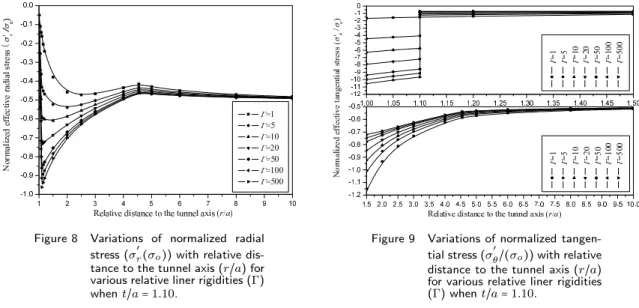
By comparing Figs.8 and 9 with Figs.6 and 7, an interesting phenomenon is observed that the variations of the normalized effective stresses with relative liner rigidity are similar to those with relative liner thickness. Moreover, it may be found from Figs. 6 and 8 that around the position of r∗ the fluctuation range of the minimum value of σr′ with relative liner rigidity compared with relative liner thickness is large, and that for a certain liner rigidity the distance to the tunnel axis of those points holding a minimum value ofσr′ decreases with increasing the liner thickness. However, for a certain liner thickness the position of those points holding a minimum value of σr′ is almost fixed.
Figure 8 Variations of normalized radial stress (σ′r(σo)) with relative
dis-tance to the tunnel axis (r/a) for various relative liner rigidities (Γ) whent/a=1.10.
Figure 9 Variations of normalized tangen-tial stress (σ′θ/(σo)) with relative
distance to the tunnel axis (r/a) for various relative liner rigidities (Γ) whent/a=1.10.
It is also seen from Figs.6-9 that in a range about 1≤r/a≤r∗/athe influences of the liner
thickness and rigidity and the distance to the tunnel axis on the stress fields are significant and when r∗/a <r/a≤8 the influences become trivial. As for r/a >8, the variations of the
stress fields are almost independent of the values of r/a,t/aand Γ.
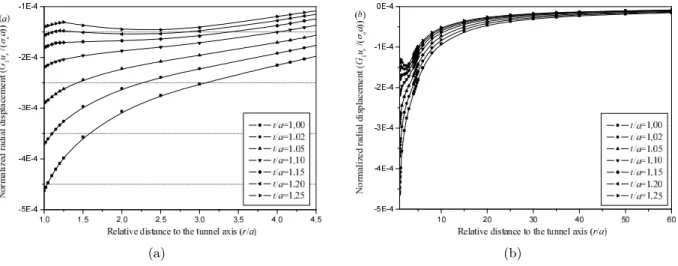
The variations of the normalized radial displacement with relative liner thickness and dis-tance to the tunnel axis when Γ = 10 are depicted in Fig.10. It is seen that in general the
normalized radial displacement decreases monotonically with increasing relative liner thickness and distance to the tunnel axis. However, when the relative liner thickness is larger than a cer-tain value, i.e.,t/a≥1.2 and those points under investigation are in a range about 1<r/a≤1.5
or 2 <r/a ≤3.5, a maximum or minimum value of the radial displacement will occur when
(a) (b)
Figure 10 Variations of normalized radial displacement (G1ur/(σoa)) with relative distance to the tunnel axis
(r/a) for various relative liner thicknesses (t/a) whenΓ=10.
Figure 11 Variations of normalized radial displacement (G1ur/(σoa)) with relative distance to the tunnel axis
(r/a) for various relative liner rigidities (Γ) whent/a=1.10.
Fig.11 illustrates the variations of the normalized radial displacement with relative liner rigidity and distance to the tunnel axis when t/a=1.10. It may be found that, when Γ<20, yr decreases monotonically with increasing r/a and t/a. However, if the relative liner rigidity
Γ ≥ 20 as shown in Fig.11, the varying trend of ur is non-monotonic and ur may obtain a
negative maximum value when the distance to the tunnel axis reaches a certain value for a specific liner rigidity. It also be noted that, when Γ≥50, the radial displacement occurring at
the inner boundary of the liner trends to 0.
Furthermore, it may be found from Figs.10 and 11 that in a range about 1 ≤ r/a ≤ 5
the influences of the liner thickness and rigidity and the distance to the tunnel axis on the radial displacement are significant and when 20<r/a the influences become insignificant. As
for r/a>50, Figs.10 and 11 indicate that the variations of the displacement field are almost
In Section 1 in the paper, the pressure tunnel is assumed that it is deep enough. However, Figs.6-9 indicate that, when those points under investigation are in the range of r/a>8, the
influence of tunnel excavation upon them is almost trivial. Thus, a conclusion may be drawn that, when the ratio between the embedded depth of a pressure tunnel and the outer radius of the liner is larger than 8, the results about the stress field in the paper are applicable for the stress analysis of the present tunnel. In addition, by comparing Figs.6-9 with Figs.10 and 11, it may be found that the influence of the tunnel excavation upon the displacement field is significantly larger than upon the stress field and only when the ratio between the embedded depth of a tunnel under investigation and the outer radius of the liner is larger than 50 the results about the displacement field in the paper are applicable for the displacement analysis of the tunnel.
5 CONCLUSIONS
In the present paper, an elastic stress-displacement solution for a deep pressure tunnel with impermeable liner in a saturated elastic porous geomaterial that obeys Terzaghi’s effective stress principle is derived. The proposed solution considers the effects of the changes of the pore water pressure around the opening, the construction sequence of the tunnel and the interaction between the liner and the surrounding geomaterial on the mechanical response of the tunnel. Finally, the influences of the relative liner thickness and rigidity and the relative distance of the point under investigation to the tunnel axis on the stress-displacement fields for various combinations of the mechanical and geometric parameters are demonstrated numerically.
AcknowledgementsThe authors would like to deeply appreciate the financial support by the Project of Shandong Province Higher Educational Science and Technology Program (Grant No. J11LE03), the Natural Science Foundation of China (Grant No. 51009086), the Project supported by the Doctoral Foundation of Ludong University (Grant No. LY2011013), the Research Award Fund for Outstanding Middle-aged and Young Scientist of Shandong Province China (Grant No.BS2010HZ015) and the Program for Changjiang Scholars and Innovative Research Team in University (Grant No. IRT0843).
References
[1] F. Ahamad and R.Z. Mohammad. A theoretical solution for analysis of tunnels below groundwater considering the hydraulic-mechanical coupling. Tunnelling and Underground Space Technology, 24:634–646, 2009.
[2] M.A. Biot. General theory of three dimensional consolidation. Journal of Applied Physics, 12:155–164, 1941.
[3] A. Bobet. Analytical solutions for shallow tunnels in saturated ground. Journal of Engineering Mechanics, 127(12):1258–1266, 2001.
[4] A. Bobet. Effect of pore water pressure on tunnel support during static and seismic loading. Tunnelling and Underground Space Technology, 18:377–393, 2003.
[5] A. Bobet. Lined circular tunnels in elastic transversely anisotropic rock at depth. Rock Mechanics and Rock Engi-neering, 44:149–167, 2011.
[7] B.H.G. Brady and E.T. Brown. Rock mechanics for underground mining. Allen & Unwin, 1985.
[8] W.I. Chou and A. Bobet. Predictions of ground deformations in shallow tunnels in clay.Tunnelling and Underground Space Technology, 17:3–19, 2002.
[9] H.H. Einstein and C.W. Schwartz. Simplified analysis for tunnel supports. Journal of Geotechnical Engineering Division, GT4:499–518, 1979.
[10] J.C. Jaeger, N.G.W. Cook, and R. Zimmerman. Fundamentals of rock mechanics. Blackwell Publishing, Oxford, 2007.
[11] G. Kirsch. Die theorie der elastizitat und die bedurfnisse der festigkeitslehre. Zeitschrift des Vereines Deutscher In.genieure, 42:797–807, 1898.
[12] S.W. Lee, J.W. Jung, S.W. Nam, and I.M. Lee. The influence of seepage forces on ground reaction curve of circular opening. Tunnelling and Underground Space Technology, 22:28–38, 2006.
[13] S.W. Nam and A. Bobet. Liner stresses in deep tunnels below the water table. Tunnelling Underground Space Technology, 21:626–635, 2006.
[14] F. Pellet, F. Descoeudres, and P. Egger. The effect of water seepage forces on the face stability of an experimental microtunnel. Canadian Geotechnical Journal, 30:363–369, 1993.
[15] H.G. Poulos and E.H. Davis. Elastic solutions for soil and rock mechanics. Wiley, New York, 1974.
[16] Y.J. Shin, B.M. Kim, J.H. Shin, and I.M. Lee. The ground reaction curve of underwater tunnels considering seepage forces. Tunnelling and Underground Space Technology, 25:315–324, 2010.
[17] Y.J. Shin, K.I. Song, I.M. Lee, and G.C. Cho. Interaction between tunnel supports and ground convergence – consideration of seepage forces. International Journal of Rock Mechanics & Mining Sciences, 48:394–405, 2011.