ISSN 1517-7076 artigo 11743, pp.767-779, 2016
Autor Responsável: Renata Nunes Oliveira Data de envio: 04/11/2015 Data de aceite: 06/04/2016
10.1590/S1517-707620160003.0072
FTIR analysis and quantification of phenols
and flavonoids of five commercially
available plants extracts used
in wound healing
Análise por FTIR e quantificação de fenóis
e flavonóides de cinco produtos naturais
disponíveis comercialmente utilizados
no tratamento de feridas
Renata Nunes Oliveira1, Maurício Cordeiro Mancini1, Fernando Cabral Salles de Oliveira2, Thayse Marques Passos3, Brid Quilty3, Rossana Mara da Silva Moreira Thiré4, Garrett Brian McGuinness5
1
Chemical Engineering Department, Federal Rural University of Rio de Janeiro, Br. 465, km 7, Z.C.: 23897000, Sero-pédica/RJ, Brazil.
e-mail: [email protected] 2
School of Pharmacy, Royal College of Surgeons in Ireland, Dublin 2, Dublin, Ireland 3
School of Biotechnology, Dublin City University, Glasnevin, Dublin, Dublin 9, Ireland 4
Materials and Metallurgical Engineering Department, Federal University of Rio de Janeiro, COPPE/UFRJ, Cid. Univer-sitária – Technology Center - Bl. I, S. I-245, Ilha do Fundão, RJ/RJ, Z.C.: 21941-972, POBox: 68505 Brazil.
5
Centre for Medical Engineering Research, Dublin City University, Glasnevin, Dublin, Dublin 9, Ireland. e-mail: [email protected]; [email protected], [email protected], [email protected], [email protected]; [email protected]
ABSTRACT
Natural products are used in wound healing in order to prevent infection. Propolis is a well known antimicro-bial with phenolic compounds and flavonoid content which vary according to the propolis origin. Besides propolis (from both Brazilian and UK sources), pomegranate, dragon’s blood and sage are possible antim i-crobials to be used in biomaterials. The goal of this work was to analyze the amount of phenols and flavonoid compounds in these natural products, their antioxidant activities and the bonds present by FTIR. The FTIR analysis revealed the presence of active compounds in all drug samples. The phenols quantification showed that Brazilian propolis was rich in phenols compared to the other drugs, followed by pomegranate and UK propolis. UK propolis was the most rich in flavonoids, which is expected on account of its origin. Pomegran-ate, UK propolis and Dragon’s blood presented the highest antioxidant activity. All samples presented antio x-idant activity > 82%.
Keywords: propolis, pomegranate, sage, dragon’s blood.
RESUMO
Produtos naturais são classicamente usados em tratamento de feridas, para prevenção de infecção. A Própolis é um agente antimicrobiano natural bem estabelecido, o qual contém compostos fenólicos e flavonoides, cu-jos teores variam conforme a sua origem. A Própolis de origem britânica e a de origem brasileira, a romã, o sangue de dragão e a sálvia são agentes antimicrobianos utilizados em biomateriais. O objetivo deste trabalho foi a análise do teor de fenóis e flavonoides, da atividade antioxidante das mesmas e das ligações químicas presentes nesses compostos, usando FTIR. A análise de FTIR revelou a presença desses compostos ativos em todos os produtos analisados. A própolis brasileira é rica em fenóis comparada aos outros fitoterápicos, se-guido de romã e própolis britânica. A própolis britânica é rica em flavonoides devido à sua origem. Romã, própolis britânica e sangue de dragão apresentaram as maiores atividades antioxidantes. Todas as amostras apresentaram atividade antioxidante superior a 82%.
768
1. INTRODUCTION
Natural products have been used in the treatment of several diseases for centuries [1]. Wounds are among the diseases that have been treated with several natural products. The products applied to wound healing would have anti-inflammatory, antimicrobial, antifungal and antiviral activities [2].
According to Kumar and collaborators (pg. 104, l. 41-44 [1]), healing “involves platelet aggregation and blood clotting, formation of fibrin, an inflammatory response to injury, alteration in the ground sub-stances, angiogenesis and re-epithelialization”. To heal, the wound / the burn needs to be free of infection. In order to prevent infection in burns for example, synthetic drugs have been developed to kill bacteria and fun-gus, among the most used ones there are antibiotics, chlorhexidine and silver [3]. Among the natural products to treat burn wounds there are honey, propolis, Aloe vera, Calendula officinalis, etc [4]. In addition, the in-flammation process leads to the accumulation of reactive oxygen species at the wound site, which attack pro-teins leading to tissue injury. In order to prevent it, there are natural products which have antioxidant activity [5].
Natural products have been used in the treatment of several diseases for centuries, among them, wound healing [1]. To heal, the wound or burn needs to be free of infection. To achieve this, synthetic anti-microbials and natural products can be used, e.g. honey, propolis, Calendula officinalis, etc [4]. These prod-ucts should be antimicrobial and anti-inflammatory compounds. They should also present antioxidant activi-ty, since the inflammation process leads to the accumulation of reactive oxygen species at the wound site, which attack proteins and damage the cells [5].
Crotton lechleri(Dragon’s blood) is a red resin used in folk medicine to treat wounds. There are n u-merous components in its composition, but its active compounds would be terpenoids, flavonoids and phe-nols [6]. Phenolic compounds and flavonoids can be considered as antioxidant substances by acting as reduc-ing agents and by free-radical scavengreduc-ing, since they donate hydrogen to free-radicals [7].
Propolis, Propolis mellifera, a bee based product, is used to protect the hive from microbes and from other insects [8] [9]. Propolis has antibacterial, anti-fungal, anti-viral and anti-inflammatory activities [10] [11]. Propolis composition varies with its origin / local flora, but phenolic compounds and flavonoids are usually part of its composition [12]. Flavonoids, besides phenolic substances, e.g. caffeic acid phenethyl ester - CAPE, and cinnamic acids derivatives, would be the ones responsible for the antioxidant, anti-inflammatory, anticancer and antiviral activities of propolis [13].
Pomegranate, Punica granatum, a plant species, also has the required properties to be used in wounds [14], as well as sage, Salvia officinalis, which present various bioactive compounds to be applied on wounds [15]. Regarding pomegranate, the fruit has several medicinal properties and different parts of the fruit (peel, juice etc) can be used. Its main active compounds would be phenolic compounds [16]. Salvia species have also been used in wound treatment in folk medicine. Salvia species have anti-inflammatory, antifungal and antiseptic properties [17].
The goal of this work is to analyze the compounds effective bonds, the amount of active compounds and the anti-oxidant activity of five natural products used in wound healing, Brazilian and UK propolis ex-tracts, pomegranate tincture, dragon’s blood and sage tincture.
2. MATERIALS AND METHODS
The natural antimicrobials used were: Green Propolis Extract (Uniflora, Brazilian propolis, minimum of dry extract of 11%); Propolis (BeeHealth, United Kingdom, 50%); Pomegranate tincture (Atomo, 50%), Sage Tincture (Fushi Wellbeing, 25%) and Dragon’s blood (Amazon Therapeutics Laboratories, 100%).
The Fourier-Transform Infrared Spectroscopy (FTIR) analysis of the drugs was performed on a drop of each drug. The FTIR analysis was done on the liquid extracts. The equipment used was Perkin Elmer Spectrum GX, 16 scans per samples in the region of (4000-650) cm-1.
To evaluate the amount of flavonoids present in the drugs extracts, 0.5 mL of the diluted drugs (1mg/mL) was mixed with 0.5 mL of 2% AlCl3 (Sigma-Aldrich) ethanolic solution in the dark (triplicates). To plot a standard curve, 0.5 mL of different solutions of quercetin – “Q” (Sigma-Aldrich, range of 0 µg – 125.00 µg) in ethanol was mixed with 0.5 mL of 2% AlCl3 ethanolic solution in the dark. After incubation for 45 min, the solutions were analyzed in the UV-Vis spectrophotometer (VWR, UV-3100PC Spectropho-tometer), wavelength of 415 nm [18].
spec-769 trometer at wavelength of 765 nm. An aliquot of 0.1 mL of each solution (Gallic acid or drugs’ dilutions), was mixed with 0.5 mL of solution Folin-Ciocalteu (Sigma-Aldrich) for 5 min in the dark. These solutions were then mixed with 0.4 mL of solution 2% Na2CO3 (Sigma-Aldrich) in the dark and incubated for 2h be-fore analysis [18].
The 1,1-Diphenyl-2-Picryl-Hydrazyl (DPPH) scavenging activity, equation 1, was measured by mix-ing 0.5 mL of the drugs’ dilutions (A1) with 0.5 mL of the 100 µM DPPH alcoholic solution in the dark. The reference sample (A0) was 1.0 mL of the 100 µM DPPH solution. After incubating for 15 min, they were analyzed in the UV-Vis spectrometer (VWR, UV-3100PC Spectrophotometer), wavelength of 517 nm [18].
Eq. 1
In the set of triplicates for each drug, it was found that one sample presented experimental error. These sam-ples were not considered for the statistical analysis. Based on duplicates, the coefficient of variation was cal-culated and the t-student tests were proceeded, level of confidence 95%.
3. RESULTS
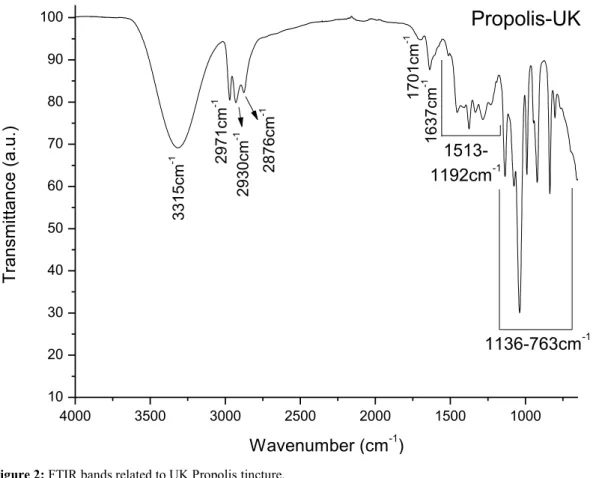
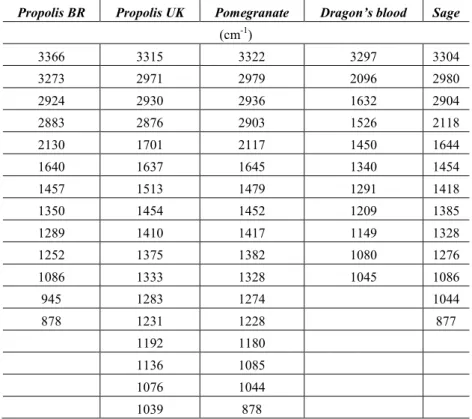
The FTIR spectra related to each studied sample are displayed in: Figure 1, spectrum related to Brazilian Propolis extract; Figure 2, spectrum related to UK propolis tincture; Figure 3, spectrum related to Pomegran-ate tinctureν Figure 4, spectrum relPomegran-ated to dragon’s bloodν and Figure 5, spectrum relPomegran-ated to sage extract. The bands identified in each sample are displayed in Table 1.
4000 3500 3000 2500 2000 1500 1000
10 20 30 40 50 60 70 80 90 100
1
0
8
6
cm
-1
2130cm
-11
6
4
0
cm
-1
2
8
8
3
cm
-1
2
9
2
4
cm
-1
9
4
5
cm
-1
3
2
7
3
cm
-1
Tra
ns
m
itta
nc
e
(a
.u
.)
Wavenumber (cm
-1)
Propolis-BR
3
3
6
6
cm
-1
1457-1252cm
-18
7
8
cm
-1
770
4000 3500 3000 2500 2000 1500 1000
10 20 30 40 50 60 70 80 90 100 3 3 1 5 cm
-1 29
7 1 cm -1 1 6 3 7 cm -1 1 7 0 1 cm -1 2 9 3 0 cm -1 2 8 7 6 cm -1
Tra
ns
m
itta
nc
e
(a
.u
.)
Wavenumber (cm
-1)
Propolis-UK
1513-1192cm
-11136-763cm
-1Figure 2: FTIR bands related to UK Propolis tincture.
4000 3500 3000 2500 2000 1500 1000
10 20 30 40 50 60 70 80 90 100
1
0
4
4
cm
-12
9
0
3
cm
-11
6
4
5
cm
-12
9
7
9
cm
-12
9
3
6
cm
-11
0
8
5
cm
-18
7
8
cm
-11479-1180cm
-12117cm
-1Tra
ns
m
itta
nc
e
(a
.u
.)
Wavenumber (cm
-1)
Pomegranate
3
3
2
2
cm
-1771
4000 3500 3000 2500 2000 1500 1000
10 20 30 40 50 60 70 80 90 100
2
0
9
6
cm
-11
6
3
2
cm
-11
0
4
5
cm
-1T
ra
n
smi
tt
a
n
ce
(a
.u
.)
Wavenumber (cm
-1)
Dragon's
blood
3
2
9
7
cm
-11526-1080cm
-1Figure 4: FTIR bands related to Dragon’s blood.
4000 3500 3000 2500 2000 1500 1000
10 20 30 40 50 60 70 80 90 100
8
7
7
cm
-11
6
4
4
cm
-11
0
8
6
cm
-11
0
4
4
cm
-12118cm
-12
9
0
4
cm
-12
9
8
0
cm
-1Tra
ns
m
itta
nc
e
(a
.u
.)
Wavenumber (cm
-1)
Sage
3
3
0
4
cm
-11454-1276cm
-1772
Table 1: Identified bands in FTIR spectra of all studied samples.
Propolis BR Propolis UK Pomegranate Dragon’s blood Sage
(cm-1)
3366 3315 3322 3297 3304
3273 2971 2979 2096 2980
2924 2930 2936 1632 2904
2883 2876 2903 1526 2118
2130 1701 2117 1450 1644
1640 1637 1645 1340 1454
1457 1513 1479 1291 1418
1350 1454 1452 1209 1385
1289 1410 1417 1149 1328
1252 1375 1382 1080 1276
1086 1333 1328 1045 1086
945 1283 1274 1044
878 1231 1228 877
1192 1180
1136 1085
1076 1044
1039 878
The amount of phenols and of flavonoids in each herbal was analyzed at the concentration of 1 mg/ml of the dry extract and the results are shown in Table 2. The antioxidant activity of each herbal at the concen-tration of 1mg/ml was also analyzed, Table 2.
It can be observed (Figure 6) that, related to the amount of phenols, Brazilian propolis and pomegran-ate, as well as UK propolis and pomegranpomegran-ate, present approximately the same amount of phenols, and are the richest ones. No significant variance was observed. Dragon’s blood present low amount of phenols compared to the previous herbals and sage has the lowest amount of phenols among the herbals studied (p < 0.05). With respect to flavonoids, UK propolis is the richest one. The amount of flavonoids in the other herbals was lower than that of UK propolis, where the amount of flavonoids diminished progressively according to: Brazilian propolis, pomegranate, sage and dragon’s blood, respectively. All the samples’ flavonoids amounts are si g-nificantly different (p < 0.05). The DPPH scavenging activity of UK propolis, Pomegranate and Dragon’s blood are identical (p > 0.05), followed by Brazilian propolis and sage with the lowest amounts, respectively.
Table 2: Amount of active compounds in each drug. Ph = phenolic compounds, Fl = flavonoids and D.B. = dragon’s
blood.
Drug Propolis-BR Propolis-UK Pomegranate D.B. Sage
Ph (mg/g) 209.72±16.55a 161.65±12.93b 167.25±28.77a,b 85.88±6.67c 57.18±0.56d
Fl (mg/g) 28.60±0.20e 35.80±1.76f 14.93±1.00g 3.03±0.04h 7.76±0.18i
773 Drago
n's Bl ood
Pome
grana te
Propo lis-BR
Propo
lis-UK Sage
0 50 100 150 200 250
Phenols Flavonoids
(
mg
/g
o
f
d
ry
ex
tr
ac
t)
Drago n's Bl
ood
Pome
grana te
Propo lis-BR
Propo
lis-UK Sage
0 10 80 85 90 95 100
DPPH
D
P
P
H
(
%)
Figure 6: Phenolic compounds and flavonoids amounts of the products and anti-oxidant (DPPH) activity of the products.
4. DISCUSSION
Since the samples extracts were alcoholic extracts, ethanol bands could be in all FTIR spectra. Characteristic ethanol bands would be at ~3687 cm-1, related to stretching vibration of O-H groups; at 2977 and 2924 cm-1, due to stretching vibration of C-H (the bands at 2994, 2977, 2924, 2904 and 2890 cm-1 would be due to stretching vibrations of CH2 and CH3 groups). The bands at 1391 cm-1 and at 1242 cm-1 would be related to C-H bending vibration and to O-H bending vibration respectively. The band at 1067 cm-1 would be due to C-O stretching vibration and the band at 877 cm-1 would be related to C-C stretching vibration [19].
Propolis (Brazilian propolis, wax free) presented the bands showed in Figure 1. It can be observed bands at 3366 cm-1 and at 3273 cm-1, related to hydroxyl groups [20]. Bands approximately in the same range of wavelength in different propolis samples were also identified, e.g. a band at 3487 cm-1, related to stretch-ing ( ) vibration of hydroxyl groups [21] and a band at 3433 cm-1, related to OH wagging (OH of phenolic compounds) [22]. Bands at 2924 cm-1 and at 2883 cm-1 could be attributed to ethanol [19]. The band at 2130 cm-1 could not be identified. A band was found at 1640 cm-1. This band could be due to stretching vi-bration of C=C groups [21], due to aromatic ring deformations [23], due to flavonoids and amino acids: stretching vibration of C=O and of C=C, asymmetric bending vibration of N–H [24], due to C=O stretching vibration of caffeic acid and its derivatives [22] and due to stretching vibration of C=O of lipids and flavo-noids [20]. The band at 1457 cm-1 could be related to CH3, CH2, flavonoids and aromatic rings, where the
vibrations would be the bending (δ) vibration of C–H and the stretching vibration of aromatics [24] [25]. There were also found non-identified bands at 1350 cm-1 and 1289 cm-1. The band at 1252 cm-1 would be due to vibration of C–O group of polyols, such as hydroxyflavonoids [25]. A band at 1086 cm-1 would be related to secondary alcohols [20] and/or to C-O- stretching ester group [22]. There was a non-identified band at 945 cm-1 and a band at 878 cm-1, probably related to aromatic ring vibration [22] or to ethanol [19].
car-774 boxyl groups [21], stretching of C = O of flavonoids and lipids [23] [24]. A band at 1513 cm-1, related to ar-omatic ring deformations [23] and to flavonoids and aromatic rings (stretching of aromatic C=C). A band at 1410 cm-1, C=C ring stretching (which occurs in pairs at 1638 cm-1 and at 1409 cm-1) [22]. Bands at 1375 cm -1
and at 1333 cm-1 were non-identified. A band at 1192 cm-1 was non-identified, although bands at 1160s were considered to occur due to lipids and alcohol groups (stretching of C–O and bending of C–OH) [23] [24]. A band at 1136 cm-1 related to tertiary alcohols [20]. A band at 1039 cm-1, probably related to primary and secondary alcohols [20] and to C-O- stretching ester group [22]. The bands at 990 cm-1, 922 cm-1, 837 cm-1 and 803 cm-1 were not identified.
Pomegranate sample, Figure 3, revealed bands at: 3322 cm-1, probably related to NH and bonded -OH groups of carboxylic acids [26]; the band at 2979 cm-1 could be due to ethanol [19]; the band at 2936 cm -1
could be related to C-H stretching vibration of methyl and methoxy groups [27] [28] and to stretching vibra-tion of -CH3 or -CH2 groups in carboxylic acid [26]. The band a 2903 cm-1 would be due to ethanol [19] and the band at 2117 cm-1 was not identified. The band at 1645 cm-1 could be related to C=C stretching vibration of aromatic rings [29] [23] [21] and to the vibration of N-H of amines, C=O of amides and carboxylic groups [26], in addition, based on propolis analysis, this band could be related to flavonoids and amino acids, (C=O), (C=C), δas(N–H) [24]. There was a non-identified band at 1479 cm-1 and there was a band at 1452 cm-1, probably due to the presence of aromatic -C=C- bond [29] and / or to N-H bending vibration [26]. Band at 1417 cm-1 was not identified and the band at 1382 cm-1 would be related to ethanol [19]. The band at 1328 cm-1 could be related to C–O stretching of acid groups [27] or to bending vibrations of -CH3 or -CH2 groups in carboxylic acid [26]. The bands at 1274 cm-1 and at 1228 cm-1 were not identified, although a band at 1255 cm-1 was related to C–O acid stretching [28] and a band at 1242 cm-1 is related to ethanol [19]. The band at 1180 cm-1 could be related to C–O stretching and –OH deformation of primary alcohols, the band at 1085 cm-1, to C–O stretching and –OH deformation of secondary alcohols and at 1044 cm-1, to C–O stretch-ing and –OH deformation of tertiary alcohols [28], the last one could also be attributed to C-N stretching vi-bration [26]. The band at 878 cm-1 could be due to aromatic ring vibration [22] or to ethanol [19].
Analysing Dragon’s Blood, Figure 4, there were bands at 3297 cm-1, possibly due to OH groups vibra-tions [20]; at 2096 cm-1 is a non-identified band; at 1632 cm-1, it could be related to stretching vibration of aromatic C=Cν a “shoulder” at 1526 cm-1 was not identified; at 1450 cm-1 could be due to stretching vibration of aromatic C=C; at 1340 cm-1 could be related to rocking vibration of aromatic CH; at 1291 cm-1 was not identified; at 1209 cm-1 would be due to the stretching vibration of (O–CH3); the band at 1149 cm-1 was not identified; the band at 1080 cm-1 could possibly be related to the stretching vibration of (C–O–C) [30]. The band at 1045 cm-1 was not identified.
Sage sample’s analysis, Figure 5, revealed bands that could be related to lipids [31]: at 3304 cm-1, also possibly related to OH groups vibrations [20]; at 2980 cm-1 and at 2904 cm-1, also possibly related to ethanol [19], nonetheless, this last band could also be due to asymmetric stretching CH2 vibration of lipids [15]. The band at 2118 cm-1 was not identified. The band at 1644 cm-1 could be related to amide I [31], to carboxylic acid [32] or to stretching C=O vibration of proteins [15]. The bands at 1454 cm-1 and at 1418 cm-1 were not identified. The band at 1385 cm-1 could be related to bending symmetric CH3(CO) vibration of 1,8-Cineole [33]. There were bands related to amide III [31]: at 1328 cm-1, probably also due to bending of CH2 vibration, and at 1276 cm-1. The bands at 1086, 1044 and 877 cm-1 could be due to carbohydrates [31]. Among these bands, the first two could be related to polysaccharides [15]. The band at 1086 cm-1 could also be due to symmetric stretching of (C–O–C) of 1,8-Cineole [33]; the band at 1044 cm-1 could also be related to OH groups vibration [32]; and the band at 877 cm-1 could also be due to the stretching vibration of CH2 of 1,8-Cineole [33] or to ethanol [19].
775 (~9000 mg/g) [39] and from Latin America Dragon’s Blood Latex (~300mg /g) [40]. Sage presented the low-est amounts of phenols among all herbals studied (~57 mg/g), approximately half of the amount of phenols found in sage extracts from Macedonia [41]. Variation on the amount of phenols is expected, since the quan-tity of active compounds varies with the plant’s origin.
Flavonoids are also an important group of active compounds and their action is by the inhibition of DNA, RNA and proteins synthesis of bacteria and by altering its membrane permeabilization [42]. Regarding flavonoids amounts, propolis from UK presented the highest amounts (p < 0.05), followed by propolis-BR, pomegranate, sage, all with approximately the same amount of flavonoids, and dragon’s blood, presenting the lowest amount of flavonoids among all. The herbal with the highest amount of flavonoids among the prod-ucts studied is Propolis from UK, 35mg Q / g of propolis dry extract. The amount of flavonoids in UK propo-lis is in the range of flavonoids found in samples from Poland [43]. Brazilian propolis presents fewer amounts of flavonoids than the UK one, which could be confirmed by the FTIR. In UK propolis spectrum, several bands related to flavonoids could be found while in Brazilian Propolis were found some bands related to phenols, e.g. caffeic acid band. Classically, propolis from tempered zone is rich in flavonoids and aromatic acids while propolis from tropical zone is rich in phenolic compounds [44]. Nonetheless, the propolis sam-ples fulfil ANVISA’s requirement to be considered as effective extracts, both presented amounts of flav o-noids higher than 0.25% w/w [37]. Related to pomegranate extract, it was found (14.93±1.00) mg Q / g of dry extract. This value is below the Yemeni pomegranate extract’s flavonoids amount [45] and it is in be-tween the amount of flavonoids found in Tunisian’s pomegranate seed extract, (6.79 ± 0.57) mg/g of dry ex-tract, and its leave’s extract, (26.08 ± 1.24) mg/g of dry extract [38]. Regarding sage, the amount of flavo-noids can be considered low or, at least, it is below the values found in sage from Macedonia [41]. Dragon’s blood present the lowest amount of flavonoids among all products studied. Its amount of flavonoids (3.03±0.04) mg Q / g of dry extract is considerably below the amount of flavonoids in Dragon’s blood from China, (43.59 ± 2.45) mg/ g of dry extract [39].
The DPPH scavenging activity is correlated to the antioxidant activity of the herbals. Free radicals are reactive oxygen species (ROS), produced by human cells in wounds when there is an inflammatory process. ROS excess can cause oxidative stress, which can cause damage to cells or even cells death. Antioxidant sub-stances can quench ROS and avoid cell damage / death [46]. DPPH works as a free radical and the herbals hability to scavenge the DPPH radicals shows the herbals’ antioxidant activities. The DPPH activity of UK propolis, Pomegranate and Dragon’s blood are identical (p > 0.05). It can be noticed that UK propolis antiox-idant activity (~92%) is higher than that of Polish propolis (~60%), both from tempered zone [47]. The anti-oxidant activity of pomegranate extract is close to the antianti-oxidant activity of high concentration pomegranate extracts [45] [48]. Dragon’s blood anti-oxidant activity (concentration of 1mg/ml), ~94%, can be compared to the antioxidant activity of 0,3mg/ml Dragon’s blood resin extracts, ~(80-90)% [7]. Brazilian propolis has, in comparison, low antioxidant activity (~88%), nonetheless, in the range of other Brazilian propolis’ DPPH scavenging activities [49]. Sage (1mg/ml) has the lowest DPPH scavenging activity, ~82%, activity compa-rable to the DPPH scavenging activity of 50 g/ml sage ethanolic extracts, ~81% [50]. Apparently, the anti-oxidant activity of all herbals in the concentration of 1mg/ml can be considered high.
The antioxidant activity can be traditionally correlated with the amount of phenolic compounds in plants. Phenolic compounds and flavonoids can be considered secondary metabolites. Phenolic compounds would be the ones directly correlated with the antioxidant activity, but flavonoids could also be responsible for this effect. Their mechanism of action is related to their ability to donate hydrogen and scavenging free-radicals. The ability to scavenge the free radicals allows these compounds to interact with reactive oxygen species (ROS) which can lead to oxidative stress and damage to tissues. Phenolic compounds and flavonoids, by reacting with ROS, avoid oxidative stress that could delay wound healing. They thereby stimulate the wound healing. In addition, other metabolites in plants besides phenols and flavonoids could contribute to the antioxidant activity and wound healing. The results found in the present work could be related to phenols, flavonoids and other metabolites [51] [52].
776
5. CONCLUSIONS
Five natural products were analysed in this study. All five products were found to contain Phenols and flavo-noids and to present antioxidant activities. Of the products studied, Brazilian propolis and pomegranate were found to be rich in phenolic compounds, although the phenol content in the UK propolis was also high. As would be expected in products from temperate zones UK propolis was found to be rich in flavonoids, as con-firmed by FTIR analysis. All products presented high antioxidant activities in the concentrations studied, with the antioxidant activities of Dragon’s blood, UK propolis and pomegranate being the highest. Phenolic compounds are ostensibly responsible for pomegranate’s antioxidant activity while flavonoids would pre-sumably contribute significantly to the antioxidant activity of UK propolis. In dragon’s blood other non -quantified metabolites (besides phenols and flavonoids) are most likely responsible for the anti-oxidant activ-ity.
6. ACKNOWLEDGEMENTS
The authors thank CNPq, FAPERJ and CAPES for the financial support.
7. BIBLIOGRAPHY
[1] KUMAR, B., VIJAYAKUMAR, M., GOVINDARAJAN R., et al. “Ethnopharmacological approaches to wound healing - Exploring medicinal plants of India”, Journal of Ethnopharmacology, v. 114, n. 2, pp. 103–113, Nov. 2007.
[2] KLASEN, H. “Historical review of the use of silver in the treatment of burns. I. Early uses”, Burns, v. 26, n.2, pp. 117-130, Mar. 2000.
[3] ULKUR, E., ONCUL, O., KARAGOZ, H., et al. “Comparison of silver-coated dressing (ActicoatTM), chlorhexidine acetate 0.5% (BactigrassR), and fusidic acid 2% (FucidinR) for topical antibacterial effect in methicillin-resistant Staphylococci-contaminated, full-skin thickness rat burn wounds”, Burns, v. 31, n. 7, pp. 874–877, Nov. 2005.
[4] VUJANOVIC S., VUJANOVIC, J. “Bioresources in the pharmacotherapy and healing of burns: A mini-review”, Burns, v. 39, n. 6, pp. 1031-1038, Sep. 2013.
[5] GASPAR, A., CRACIUNESCU, O., TRIF, M., et al.“Antioxidant and anti-inflammatory properties of active compounds from Arnica Montana L.”, Romanian Biotechnological Letter, v. 19, n. 3,pp. 9353-9365, Jan. 2014.
[6] OLIVEIRA, I., LIMA, J., SILVA R., et al.“Triagem da atividade antibacteriana in vitro do látex e
extratos de Croton urucuranaBaillon”, Brazilian Journal of Pharmacognosy, v. 18, n. 4, pp. 587-593, Oct. 2008.
[7] GUPTA D., GUPTA, R. “Bioprotective properties of Dragon’s blood resinμ In vitro evaluation of antioxidant activity and antimicrobial activity”, BMC Complementary and Alternative Medicine, v. 17, n. 11, pp. 1-9, Feb. 2011.
[8] ADEWUMI A., OGUNJINMI, A. “The healing potential of honey and propolis lotion on septic wounds”, Asian Pacific Journal of Tropical Biomedicine, v. 1, n. 1, pp. S55-S57, Sep. 2011. [9] SEHN, E., HERNANDES, L., FRANCO, S., GONÇALVES C., BAESSO, M. “Dynamics of
reepithelialisation and penetration rate of a bee propolis formulation during cutaneous wounds healing”,
Analytica Chimica Acta, v. 635, n.1, pp. 115–120, Jan. 2009.
[10] PEREIRA, A., ANDRADE, S., SWERTS, M., et al. “First in vivo evaluation of the mutagenic effect of Brazilian green propolis by comet assay and micronucleus test”, Food and Chemical Toxicology, v. 46, n. 7, p. 2580–2584, Apr. 2008.
[11] BORGES, J., TAGLIAMENTO, M., SILVA, A., et al. “Development and characterization of orally -disintegrating films for propolis delivery”, Food Science and Technology, v. 33, suppl. 1, pp. 28-33, Feb. 2013.
777 [13] MIRZOEVA, O., GRISHANIN, R. CALDER, P. “Antimicrobial action of propolis and some of its
componentsμ the effects on growth, membrane potential and motility of bacteria”, Microbiological Research, v. 152, n. 3, pp. 239-246, Sep. 1997.
[14] AMJAD, L. SHAFIGHI, M. “Evaluation of Antioxidant activity, phenolic and flavonoid content in
Punica granatum var. Isfahan Malas flowers”, International Journal of Agriculture and Crop Sciences,
v. 5, n. 10, pp. 1133-1139, 2013.
[15] CAPEK, P., HRIBALOVA, V., ŠVANDOVÁ, E., et al. “Characterization of immunomodulatory polysaccharides from Salvia officinalis L.”, International Journal of Biological Macromolecules, vol. 33, n. 1-3, pp. 113–119, Nov. 2003.
[16] BACCARIN, T., MITJANS, M., RAMOS, D., et al. “Photoprotection by Punica granatum seed oil nanoemulsion entrapping polyphenol-rich ethyl acetate fraction against UVB-induced DNA damage in human keratinocyte (HaCaT) cell line”, Journal of Photochemistry & Photobiology, B: Biology, v. 153, pp. 127–136, Sep. 2015.
[17] SÜNTAR, I., AKKOL, E., KELES, H., et al. “A novel wound healing ointmentμ A formulation of Hypericum perforatum oil and sage and oregano essential oils based on traditional Turkish knowledge”,
Journal of Ethnopharmacology, v. 134, n. 1, pp. 89–96, Mar. 2011.
[18] PLYLER, E.K. “Infrared spectra of methanol, ethanol, and n-propanol”, Journal of Research of the National Bureau of Standards, v. 48, n.4, pp. 281-286, Apr. 1952.
[19] GUTIERREZ-GONÇALVES, M. E. J., MARCUCCI, M. C. “Atividades Antimicrobiana e Antioxidante da Própolis do Estado do Ceará”, Revista Fitos, v.4, n.1, PP. 81-86, Mar. 2009.
[20] JUNIOR, V., ARRUDA, I., BEMME, L., et al., “Caracterização térmica e espectroscópica de
microcápsulas de quitosana incorporada de própolis”,Revista Eletrônica da Univar, v. 2, n. 10, pp. 161 – 165, 2013.
[21] BARUD, H., JÚNIOR, A., SASKA, S., MESTIERI, L., et al., “Antimicrobial Brazilian propolis (EPP-AF) containing biocellulose membranes as promising biomaterial for skin wound healing”, Evidence-Based Complementary and Alternative Medicine, v. 2013, pp. 1-10, May 2013.
[22] SHARAF, S., HIGAZY, A., HEBEISH, A. “Propolis induced antibacterial activity and other technical properties of cotton textiles”,International Journal of Biological Macromolecules, v. 59, pp. 408–416, Aug. 2013.
[23] FRANCA, J., DE LUCA, M., RIBEIRO, T., et al., “Propolis - based chitosan varnish: drug delivery, controlled release and antimicrobial activity against oral pathogen bacteria”,BMC Complementary and Alternative Medicine, v. 14:478, pp. 1-11, 2014.
[24] MOT, A., SILAGHI-DUMITRESCU, R., SÂRBU, C. “Rapid and effective evaluation of the antioxidant capacity of propolis extracts using DPPH bleaching kinetic profiles, FT-IR and UV–vis spectroscopic data”,Journal of Food Composition and Analysis, v. 24, n. 4-5, pp. 516–522, Jun. 2011.
[25] SILVA, A., SILVA, J., DE SOUZA, N., et al., “Membranes from latex with propolis for biomedical applications”,Materials Letters, v. 116, n. 1, pp. 235–238, Feb. 2014.
[26] AY, Ç., ÖZCAN, A., ERDOGAN, Y., ÖZCAN, A. “Characterization of Punica granatum L. peels and quantitatively determination of its biosorption behavior towards lead(II) ions and Acid Blue 40”,
Colloids and Surfaces B: Biointerfaces, v. 100, pp. 197– 204, May 2012.
[27] VENKATESWARLU, S., KUMAR, B., PRATHIMA, B., et al.“A novel green synthesis of Fe3O4 magnetic nanorods using Punica granatum rind extract and its application for removal of Pb(II) from aqueous environment”,Arabian Journal of Chemistry, pp. 1-9, Oct. 2014.
[28] VARDIN, H., TAY, A., OZEN, B., MAUER, L. “Authentication of pomegranate juice concentrate using FTIR spectroscopy and chemometrics”,Food Chemistry, v. 108, n. 2, pp. 742–748, May 2008. [29] EDISON, T., SETHURAMAN, M. “Biogenic robust synthesis of silver nanoparticles using Punica
778 [30] KOPERSKA, M., ŁOJEWSKI, T., ŁOJEWSKA, J. “Vibrational spectroscopy to study degradation of
natural dyes. Assessment of oxygen-free cassette for safe exposition of artefacts”,Analytical and Bioanalytical Chemistry, v. 399, n. 9, pp. 3271–3283, Mar. 2011.
[31] SKOTTI, E., KOUNTOURI, S., BOUCHAGIER, P., et al., “FTIR spectroscopic evaluation of changes in the cellular biochemical composition of the phytopathogenic fungus Alternaria alternata induced by extracts of some Greek medicinal and aromatic plants”,Spectrochimica Acta Part A: Molecular and Biomolecular Spectroscopy, v. 127, pp. 463–472, Jun. 2014.
[32] RODRÍGUEZ-TORRES, A., VALLADARES-CISNEROS, M., GONZALEZ-RODRÍGUEZ, J. “Use of
Salvia officinalis as green corrosion inhibitor for carbon steel in acidic media”, International Journal of Electrochemical Science, v. 10, pp. 4053 - 4067, 2015.
[33] SCHULZ, H., OZKAN, G,. BARANSKA, M, et al., “Characterisation of essential oil plants from Turkey by IR and Raman spectroscopy”,Vibrational Spectroscopy, v. 39, n. 2, pp. 249–256, Oct. 2005. [34] TIWARI, V., ROY, R., TIWARI, M. “Antimicrobial active herbal compounds against Acinetobacter
baumannii and other pathogens”,Front. Microbiol., vol. 6, pp. 1-11, Jun. 2015.
[35] SILVA, J., SOUZA, M., MATTA, S., et al., “Correlation analysis between phenolic levels of Brazilian propolis extracts and their antimicrobial and antioxidant activities”,Food Chemistry, v. 99, n. 3, pp. 431–435, 2006.
[36] CABRAL, I., OLDONI, T., ALENCAR, S., et al., “The correlation between the phenolic composition and biological activities of two varieties of Brazilian propolis (G6 and G12)”,Brazilian Journal of Pharmaceutical Sciences, v. 48, n. 3, pp. 557-564, Jul. 2012.
[37] BRAZIL, “Diário Oficial da União”, Governo Federal do Brasil, Brasília, n. 16, 26 Jan. 2001.
[38] ELFALLEH, W., HANNACHI, H., TLILI, N., et al., “Total phenolic contents and antioxidant activities of pomegranate peel, seed, leaf and flower”,Journal of Medicinal Plants Research, v. 6, pp. 4724-4730, Aug. 2012.
[39] LUO, Y., WANG, H., XU, X., et al., “Antioxidant phenolic compounds of Dracaena cambodiana”, Molecules, v. 15, n. 12, pp. 8904-8914, Jun. 2010.
[40] DE MARINO, S., GALA, F., ZOLLO, F., et al., “Identification of minor secondary metabolites from the latex of Croton lechleri (Muell-Arg) and evaluation of their Antioxidant Activity”,Molecules, v. 13, pp. 1219-1229, 2008.
[41] ALIMPIĆ, A., OALDJE, M., MATEVSKI, V., et al., “Antioxidant activity and total phenolic and flavonoid contents of Salvia amplexicaulis Lam. extracts”,Archives of Biological Sciences, v. 66, n. 1, pp. 307-316, 2014.
[42] DZOYEM, J., HAMAMOTO, H., NGAMENI, B., et al., “Antimicrobial action mechanism of flavonoids from Dorstenia Species”,Drug Discoveries & Therapeutics, vol. 7, n. 2, pp. 66-72, Apr. 2013.
[43] SOCHA, R., GAŁKOWSKA, D., BUGAJ, M.,et al., “Phenolic composition and antioxidant activity of propolis from various regions of Poland”,Natural Product Research, v. 29, n. 5, pp. 1-9, Sep. 2014. [44] RIGHI, A., NEGRI, G., SALATINO, A. “Comparative chemistry of propolis from eight Brazilian
localities”,Evidence-Based Complementary and Alternative Medicine, v. 2013, pp. 1-15, Mar. 2013. [45] SHIBAN, M., AL-OTAIBI, M., AL-ZOREKY, N. “Antioxidant Activity of pomegranate (Punica
granatum L.) fruit peels”, Food and Nutrition Sciences, v. 3, n. 7, pp. 991-996, Jul. 2012.
[46] POLJSAK, B., ŠUPUT, D., MILISAV, I. “Achieving the balance between ROS and antioxidants: when to use the synthetic antioxidants”,Oxidative Medicine and Cellular Longevity, v. 2013, pp. 1-12, 2013. [47] TYSZKA-CZOCHARA, M., PAŚKO, P., RECZYŃSKI, W., et al., “Zinc and propolis reduces
cytotoxicity and proliferation in skin fibroblast cell Culture: total polyphenol content and antioxidant capacity of propolis”,Biological Trace Element Research, v. 160, n. 1, pp. 123-131, Jun. 2014. [48] JARDINI, F., PINTO, J., MENDONÇA, R., et al., “Avaliação da atividade antioxidante do extrato
779
Alimentos, v. 27, pp. 80-83, Aug. 2007.
[49] ALVES, E., KUBOTA, E. “Conteúdo de fenólicos, flavonoides totais e atividade antioxidante de amostras de própolis comerciais”,Revista de Ciências Farmacêuticas Básica e Aplicada, v. 34, n. 1, pp. 37-41, 2013.
[50] RASMY, N., HASSAN, A., FODA, M., EL-MOGHAZY, M. “Assessment of the antioxidant activity of sage (Salvia officinalis L.) extracts on the shelf life of mayonnaise”,World Journal of Dairy & Food Sciences, v. 7, n. 1, pp. 28-40, 2012.
[51] SILVA, J., SOUZA, M., MATTA, S., et al., “Correlation analysis between phenolic levels of Brazilian propolis extracts and their antimicrobial and antioxidant activities”,Food Chemistry, v. 99, n. 3, p. 431– 435, 2006.