ISSN 0104-6632 Printed in Brazil
www.abeq.org.br/bjche
Vol. 25, No. 01, pp. 201 - 206, January - March, 2008
Brazilian Journal
of Chemical
Engineering
STUDY ON PREPARATION OF A NOVEL SILICA
ADSORBENT AND ITS SELECTIVE SEPARATION
APPLIED TO GENISTEIN
Yuqing Zhang
*, Yahui Zhang and Hongliu Zhang
School of Chemical Engineering and Technology, Tianjin University, Phone: (022) 2789-0470/Fax: (022) 2740-3389, Tianjin 300072, China.
E-mail: [email protected]
(Received: February 4, 2007 ; Accepted : November 6, 2007)
Abstract - In order to selectively separate genistein from its crude solution, a novel silica adsorbent was prepared using genistein as the template molecule, γ-aminopropylthriethoxysilane as the functional monomer and tetraethyl orthosilicate as the cross-linker. It was analyzed by the BET, FTIR, TEM characteristics, the static adsorption experiment, and selective adsorption experiment. The results show that the silica adsorbent has high specific area, special selectivity and high adsorption capacity for genistein. It can recognize and bind genistein in aqueous solution, and lots of nanopores distribute on its surface uniformly. It is concluded that both the shape and size of the recognition sites matching the template molecule result in the performance of this adsorbent to bind genistein and that there are strong ionic and hydrogen bond attractions between the phenolic hydroxyl and the –NH2.
Keywords: Silica adsorbent; Selective separation, Genistein.
INTRODUCTION
Genistein has a special cancer and anti-oxidation properties among all kinds of soybean isoflavones, so it is broadly used in healthy food and its supplements. Common methods to extract it from crude solution include organic solvent extraction, macroporous resin adsorption, super critical fluid extraction, and microwave treatment. These processes have lots of drawbacks such as long extraction times, large quantities of solvents, high investment or complex operations. Especially, these methods can only separate isoflavones, but not the isolate component. Recently the molecular imprinting technique (MIT) has brought a great advantage to selective separation, while composite materials with nanometer and molecular level size show unique chemical and physical properties which
solution, so the cost will decrease and the efficiency will be enhanced, besides, our research team has provided a foundation for its accomplishment.
EXPERIMENTAL
Materials
The genistein was purchased from North China Pharmaceutical Group Corporation. The Rutin was gotten from Xi An HAUQI Co. Ltd. The tetraethyl ortho-silicate (TEOS) was gained from No.1 Reagent Chemical Factory, Tianjin, and was distilled and stored under nitrogen.
The adsorbents were characterized with the transmission electron microscope (TEM, Tecnai.G2.F20. FEI Corporation. Holland), fourier transform infrared spectrometer (FTIR, MAGNA. IR560. Nicolet Corporation. America), the specific area analyzer (BET, NOVA-2000. Quantachrome Corporation. American).
Adsorbent Preparation
0.1g genistein and 10ml γ
-aminopropylthriethoxysilane were placed into a 150ml flask to prepare the precursor under slight agitation, then 20ml TEOS and 30ml H2O were
added to the mixture. After hydrolysis reaction and polymerization, a silica solid mixture appeared. Following filtration, the filter cake was dried at 105
oC. Finally the materials were extracted in
acetone/water solution for 6h, and the novel silica adsorbent was obtained. For comparison, a blank adsorbent was prepared (without template molecule) under the same conditions. In this context, they were called silica adsorbent and blank adsorbent respectively.
The Adsorption Experiment in Static State
1g silica adsorbent was placed into 50ml genistein solution under different temperatures. Its concentration was 0.5mg/ml genistein in 30% ethanol aqueous solution. In this experiment, the concentration of genistein was analyzed by high performance liquid chromatography (HPLC) at the
fixed interval. The amount adsorbed can be calculated by formula (1). The same test was carried on blank adsorbent.
(Co Ce) V Qe=
m
− × (1)
Qe: the amount adsorbed, mg/g; Co: the initial concentration ,mg/ml;
Ce: the equilibrium concentration, mg/ml; V: the solution volume, ml;
m: the quantity of adsorbent, g
Adsorption Dynamics of Genistein on the Silica Adsorbent
The adsorption experiment was repeated at different concentrations from 0.1~0.8mg/ml at 70 oC, and the same liquid volume of 50ml. The adsorption capacity was calculated by formula (1). The adsorption behaviors can be described with the Langmuir adsorption equation (Formula (2)).
e e
max
e max
C C
1/ bQ
Q =Q + (2)
e
C : the equilibrium concentration, mg/ml;
e
Q : the equilibrium adsorption capacity, mg/g;
max
Q : the max adsorption capacity, mg/g;
b : the Langmuir adsorption equilibrium constant, g/ml.
The Selectivity of the Adsorbent
Rutin is another natural material. Its structure is similar to genistein as can be seen from Fig.1. It was placed into the same solvent of the former experiment. The volume and concentration were 50ml and 0.5mg/ml respectively. The adsorption experiment was repeated and the temperature kept at 70 oC, and the capacity was calculated with formula (1).
The Characterization of the Silica Adsorbent
Study on Preparation of a Novel Silica Adsorbent and its Selective Separation Applied to Genistein 203
0 1 2 3 4 5 6
0 2 4 6 8 10 12
Q
e a
m
o
u
n
t a
d
so
rb
ed
/
(m
g
/g
)
time/h
90°C
70°C
50°C
O
OH
OH
O OH
rutinose HO
O O HO
HO
HO
Figure 1: Molecular frame of rutin Figure 2: Molecular frame of genistein
RESULTS AND DISCUSSIONS
Amount of Genistein Adsorbed
Temperature is an important factor for genistein adsorption (Fig.3). 1g silica adsorbent is placed into 50ml of 0.5mg/ml. genistein solution. The experiment was fulfilled at different temperatures. When the temperature rises, the amount adsorbed increases. At 70 °C the amount adsorbed reached 10.8mg/g, which is higher than that at 50 oC and 90 oC, and the time to saturation was only 3h. This is due to the fact that the velocity of adsorption and desorption are very slow at low temperatures, so equilibrium is not reached and the adsorption is limited. When temperature rises, the adsorption is enhanced. But desorption process is also expanded, so very high temperatures will prejudice adsorption.
It can be concluded that this adsorbent can recognize and bind genistein in aqueous solution and 70 oC is the most favorable temperature.
The Adsorption Isotherms
In order to investigate the adsorption performance of the silica adsorbent, 1g silica adsorbent was placed into 50ml genistein solution and the experiment fulfilled at 70 oC, then the adsorption isotherm (Fig.4) was drawn with an initial concentration of genistein solution changing from 0.1 to 0.8mg/ml. Among this range, the data were regressed by Langmuir adsorption equation. Ultimately, the Langmuir equation is
e
e C
=0.00664+0.07251
Q C , R=0.99961. The new e
formed line is shown in Fig.5. The slope and intercept are equal to Qmaxand 1/b Qmaxrespectively, and
b and Qmaxwere calculated to be 10.92 and 13.79mg/ml. This means that the adsorption is consisted with the Langmuir adsorption theory. The reason is that the template molecules on the surface can be removed in the extraction process and one recognition site only binds one template molecule, so the adsorption must be a monolayer adsorption and must always happen on the adsorbent surface.
0.0 0.2 0.4 0.6 0.8 0
2 4 6 8 10 12
Q
t
h
e a
m
o
u
n
t a
d
so
rb
ed
/
(m
g
/g
)
Co the initial concentration of genistein solution/(mg/ml)
0.05 0.10 0.15 0.20 0.25 0.30
0.005 0.010 0.015 0.020 0.025 0.030
Ce
/Q
e (
g
/m
l)
Ce the equilibrium concentration/(mg/ml)
Figure 4: Curve of adsorption equilibrium under 70 °C
Figure 5:. Adsorption isotherm according the Langmuir equation
The Selectivity to Genistein
There is a big difference of adsorption capacity between the silica adsorbent and its blank counterpart when 1g silica adsorbent and 1g the blank adsorbent are put into 50ml genistein solution
Study on Preparation of a Novel Silica Adsorbent and its Selective Separation Applied to Genistein 205
adsorption capacity of silica adsorbent is more than four times greater than that of the blank adsorbent. So the silica adsorbent has a stronger affinity for the template.
The selective experiment was done at 70 oC. 1g silica adsorbent was placed into 50ml solution containing 0.5mg/ml genistein and 0.5mg/ml rutin. The experiment indicates that the silica adsorbent has a higher selective effect as can be seen in Table 2.
The equilibrium adsorption capacity for rutin was only 1.1mg/g, while the capacity for genistein reached to 9.3mg/g at the same conditions. As for the blank adsorbent, the final adsorption capacity for rutin and genistein were nearly equal, which were 1.03mg/g and 1.19mg/g respectively, so the blank adsorbent has no selectivity to genistein. The adsorption capacities of both adsorbents were a little inferior in the selective experiment when compared to the adsorption experiment, because there is a competition with rutin, which can take up some adsorption sites, so the capacity decreases.
The Characteristics of FTIR and TEM
Comparing the two lines in Fig.6, the peak of hydroxyl at 3400.3cm-1 obviously weakens. This proves that there is a strong ionic and hydrogen bond attractions between the phenolic hydroxyl and the – NH2 of the functional groups. There is a new wide
adsorption band at 1035.6cm-1, which means that the Si-O-Si bond is formed.
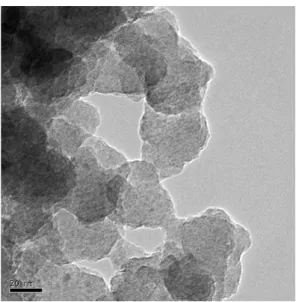
The transmission electron microscope (TEM) is used to visualize the surface of the silica adsorbent, and the pores can be easily seen in Fig.7 as white dots in the picture.
Their diameter is about 30nm, and it remarkably expands the specific surface and the porosity of the adsorbent, contributing to the adsorption capacity of the adsorbent. The recognition sites exist in these pores, whose shape and size match the template molecule, so the molecular recognition occurs between the recognition sites and the template molecule by ionic and hydrogen bond attractions.
Table 1: Specific area and adsorption capacity of the silica adsorbent and the blank adsorbent
Material Specific area (m2/g) Adsorption
capacity(mg/g)
Silica adsorbent 201 10.8
Blank adsorbent 125 2.5
Table 2: Result of the selective experiment
Component The initial concentration
(mg/ml) The adsorption capacity(mg/g)
Genistein 0.5 9.3
Rutin 0.5 1.1
4000 3500 3000 2500 2000 1500 1000 500
0 10 20 30 40
10
35.
6
34
00
.3
b
a
tr
ans
m
it
ta
nc
e(%)
wavenumber/cm-1
Figure 7: TEM image of the silica adsorbent
CONCLUSIONS
The silica adsorbent can be prepared in aqueous solution and the recognition and affinity processes can also be accomplished in water solution, so it is a great improvement to traditional molecular imprinting technique. This novel adsorbent has a special selectivity to genistein which can reach more than 4 times that of the blank counterpart, and lots of nanopores distribute on the surface of the silica adsorbent, which can help to enhance the adsorption capacity. The adsorption is consistent with Langmuir adsorption theory. So it is promising for selective separation of genistein.
ACKNOWLEDGMENT
Supported by the Basic Research of Tianjin Municipal Science and Technology Commission (№.07JCYBJC00700), the Science and Technology Innovation Venture Foundation of PetroChina Company Limited (№.2006-25), the National Postdoctoral Science Foundation of China under Grant (№. 413395-0306) and the National Advanced Materials Committee of China under Grant (№. 863-715-004-220).
REFERENCES
Maurício A. R., Jǘlio M. A. and Delcio S., Supercritical fluid extraction of isoflavones from soybean flour. Food Chemistry, 78, No.1, 111 (2002).
Xu Z. H., Li L., Wu F., W., et al. The application of the modified PVDF ultrafiltration membranes in further purification of Ginkgo biloba extraction. Journal of Membrane Science, 255, No. 2. 125 (2005).
Mathias U., Membrane separation using molecularly imprinted polymers, Journal of chromatography B, 804, No, 1,113 (2004).
Tatinan A. S., Sergey A. P., Elena V.P., et al. In situ formation of porous molecular imprinted polymer membrane, Macromolecules, 36, No. 19, 7352 (2003).
Xu L., Feng Y. Q., Da S. L. et al. Application of ordered mesoporous materials in separation science , Chinese Analytical Chemistry, 32, No. 3, 374 (2004).
Tomoki O., and Yoshiki V., Synthesis of photosensitive organic-inorganic polymer hybrids by utilizing caged photoactivatable alkoxysilane, Macromolecules, 37, No. 16, 5916 (2004).
Xie J.C., Luo H. P., Zhu L. L., et al. Extracting active compounds from herbs using molecular imprinting technology, Acta Phys- Chim sin, 17, No. 7, 582 (2001).
Alexander K., Mark E. D., Molecular imprinting of bulk, microporous silica, Nature, 418, No. 25, 285, (2000).
Zhang Y. Q., Zhao X.M., and Wang R.S., New Composite Sorbent’s Preparation and Its Selective Separation of Estrone, Chemical Engineering, 31, No. 5, 21 (2003).