Studying the structural features of peptide
dendrimers using a combined
computational and experimental approach
Luís Carlos Santos Filipe
supervised by Dr. António M. BAPTISTA
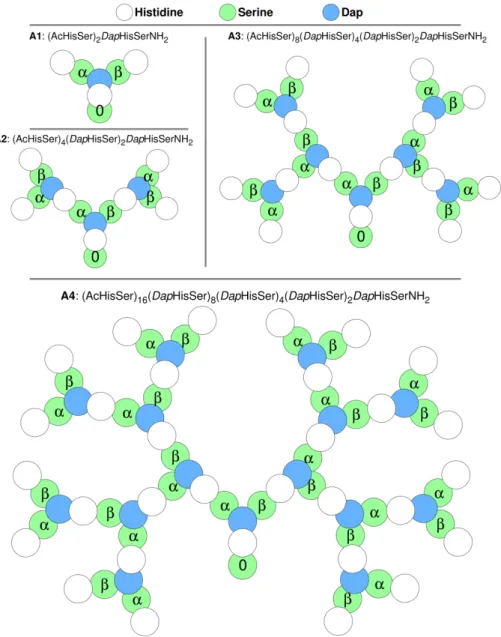
Dr. Tamis DARBRE Dr. Miguel MACHUQUEIRO
Acknowledgments
I would like to start this thesis by acknowledging the contributions made to it by Miguel Machuqueiro, Tamis Darbre and António Bap-tista. Their teachings, guidance and support over the years were critical to the sound conclusion of the work presented here and to my growth as a "scientist". It is because of them that I could not, in conscience, write this dissertation entirely in the first-person singular and felt compelled to write it in the first-person plural.
A very special word of thanks is ought to António, for welcoming me into is lab and for all his reviewing efforts over the last months.
In the course of this project I have, fortunately, come to know a num-ber of persons who directly or indirectly contribute to it. Probably, they are unaware of how their companionship and every day good humour helped me to stay motivated and maintain some degree of mental san-ity. To properly thank them, I am going to break the usual protocol of an acknowledgements section and include some pictures where we are together (that, and because they truly are a lot to mention by name).
I must, however, single out two friends: João Damas and Pedro Ma-galhães. Without their IT skills and the willingness to use them, this work would have taken twice as long to do.
I also want to acknowledge the two academic institutions that have hosted me: the Instituto de Tecnologia Química e Biológica and the Uni-versity of Bern. The persons in the academic and scientific staffs of both institutions really ensured the adequate environment to carry out my research. I also acknowledge Fundação para a Ciência e Tecnologia for financial support through grant SFRH/BD/76085/2011.
None of this would have been possible without the support,
ii ACKNOWLEDGMENTS
The 1stPortuguese Biomolecular Modelling meeting, Tavira, 2011
The Reymond group, Bern, 2013
tives and love of my parents and my brother.
Abstract
Dendrimers are a family of highly branched synthetic compounds that share a common layout where wedges emerge radially from a core by means of a regular branching pattern. Topologically, dendrimers are characterized by three distinct regions: core, branches, and periphery, with the latter being typically composed of functionalized end-groups.
Peptide dendrimers are dendrimers composed of amino acids. These peptidic tree-like molecules have attracted considerable interest due to their inherent multivalency and the possibility of constructing molecules with a variable number and type of amino acids within the dendrimer branches and core. This topologic versatility, along with the possibility of grafting different functional groups to the dendrimers end-groups, has sparked the development of several applications ranging from cat-alytic peptide dendrimers and metalloprotein models to antimicrobial and drug delivery agents.
Although the synthesis of these systems is becoming increasingly straightforward, two main issues remain mostly unaddressed and hin-der their widespread application: (1) little is known about these mole-cules structure in solution and the influence played by each of its con-stituents on the overall fold, and (2) the selection of which amino acids to use for specific functions is ruled by chemical reasoning and trial and error screening of large combinatorial libraries.
There are at least two kinds of preferential structural behaviors ex-hibited by these molecules, which acquire either compact or noncom-pact shapes. However, the key structural determinants of such behav-iors remained, until now, unstudied.
In the first part of this work, we have conducted a comprehensive
iv ABSTRACT
investigation of the structural determinants of peptide dendrimers by employing long molecular dynamics simulations to characterize an ex-tended set of third generation dendrimers. In particular, we investi-gated the structural role played by branching and the replacement of neutral residues by negatively charged ones. Our results support the idea that a joint effect of electrostatics and hydrogen bonds is the defin-ing factor for these molecules structural behavior in solution.
In the second part of this work, we have combined experimental and computational techniques to study the structure of positively charged peptide dendrimers. Third-generation dendrimers containing combi-nations of positive/neutral amino acid residues in the different den-drimer generations were synthesized and their compactness evaluated using diffusion NMR. Molecular dynamics simulations were performed to obtain a comprehensive description of the molecular–level phenom-ena substantiating the structural differences observed. Comparison of the results presented with the first part of the work reveals a striking charge-dependent tendency in these systems, where the simple num-ber and placement of charged amino acids in the sequence allows an extensive control over the exhibited structural features.
pH effects and electrostatic interactions are known to be crucial play-ers to explain the conformational and functional behaviors observed in these systems. In the third part of this work, we present the results of constant-pH molecular dynamics simulations performed at several pH values for four peptide dendrimers of different generations (from one to four) composed of the same type of aminoacids: histidines, serines and diaminopropionic acid. These dendrimers are known to catalyze the hydrolysis of pyrene sulfonate esters. Constant-pH MD simulations in the presence of substrate molecules at the optimum pH for catalysis are also reported.
intra-ABSTRACT v
molecular interactions, which, in turn, modulate the shape and struc-ture at the different pH values. The atypical and highly pH-dependent protonation profiles of some histidine residues are also investigated.
The interactions between dendrimers and substrates restrict the con-formational space available to the dendrimers and enforces conforma-tional homogeneity. This structuring effect is a consequence of the den-drimer–substrate interactions which occur through stabilizing hydro-gen bonds and ion pairs between the substrates sulfonate groups and the dendrimers residues.
Resumo
Os dendrímeros são uma família de compostos sintéticos altamente ra-mificados, caracterizados por um padrão regular de crescimento a partir de um núcleo comum. Topologicamente os dendrímeros são caracteri-zados por três regiões distintas: um núcleo, as diferentes ramificações e uma periferia normalmente composta por grupos terminais funcionali-zados.
Os dendrímeros peptídicos são dendrímeros constituídos por ami-noácidos. Estas moléculas peptídicas e ramificadas têm atraído uma considerável atenção devido à sua multivalência e à possibilidade de sintetizar moléculas com inúmeros e variados aminoácidos nas diferen-tes ramificações. Tal versatilidade topológica, juntamente com a possi-bilidade de enxertar diferentes grupos funcionais nos terminais de um dendrímero, tem suscitado interesse nestas moléculas e conduziu já a diversas aplicações. Os dendrímeros peptídicos desempenham nessas aplicações papéis muito variados, desde modelos catalíticos e miméti-cos de metalo-proteínas, até agentes antimicrobianos ou transportado-res de fármacos.
Apesar dos consideráveis avanços na síntese destes sistemas, dois tópicos importantes permanecem inexplorados, dificultando a aplica-ção e aceitaaplica-ção generalizada destes sistemas. Em primeiro lugar, existe pouca informação acerca da estrutura destas moléculas em solução e do papel desempenhado por cada um dos seus constituintes na aquisição dessa mesma estrutura. Em segundo lugar, a selecção dos aminoácidos a utilizar para obter comportamentos funcionais específicos é baseada essencialmente na experiência adquirida, na intuição química dos in-teressados e, quando possível, em processos de screening de livrarias
viii RESUMO
combinatórias contendo várias sequências peptídicas.
Em termos estruturais, são conhecidos dois tipos de comportamento preferenciais nestas moléculas, que podem adoptar formas compactas ou abertas. Contudo, os determinantes conformacionais preponderan-tes na adopção de um comportamento em detrimento de outro perma-neciam, até agora, por estudar.
Na primeira parte deste trabalho realizámos uma investigação abran-gente dos determinantes conformacionais dos dendrímeros peptídicos. Para tal, realizámos longas simulações de dinâmica molecular por forma a caracterizar um extenso conjunto de dendrímeros de terceira geração. Investigámos especificamente o papel desempenhado pelos resíduos de bifurcação (variando o comprimento da sua cadeia lateral) e pela quan-tidade e distribuição de carga negativa (substituindo glutaminas por ácidos glutâmicos). Os resultados obtidos suportam a ideia de que as interacções electrostáticas e as pontes de hidrogénio são factores deter-minantes no comportamento destas moléculas em solução.
Na segunda parte deste projecto combinámos técnicas experimen-tais e computacionais para estudar a estrutura de dendrímeros peptícos carregados positivamente. Dendrímeros de terceira geração com di-ferentes combinações de aminoácidos positivos/neutros nas didi-ferentes gerações foram sintetizados e a sua compactação foi avaliada através de RMN de difusão. Posteriormente, foram realizadas simulações de dinâmica molecular para obter uma descrição dos detalhes moleculares que ocasionam as diferenças observadas. Juntamente com os resultados obtidos na primeira parte do trabalho, estes resultados mostram que a simples variação do número e posicionamento de resíduos carregados permite controlar características estruturais.
diaminopropió-RESUMO ix
nico.
Os resultados destas simulações demostraram que, no que respeita a variações estruturais, os dendrímeros de primeira e segunda geração são praticamente insensíveis a alterações de pH. Nos dendrímeros de terceira e quarta geração o pH desempenha um papel estruturante e observam-se comportamentos diferentes ao passar de pH ácidico para neutro. Os efeitos resultantes do acoplamento entre protonações e con-formações influenciam diversas interacções intramoleculares, que por sua vez condicionam a estrutura destes dendrímeros a diferentes valo-res de pH. Os perfis de protonação atípicos e altamente dependentes do pH de alguns resíduos de histidina foram também investigados.
Dados experimentais demonstram que estes dendrímeros catalisam a hidrólise de ésteres de pireno sulfonados. Como tal, foram também realizadas simulações de dinâmica molecular a pH-constante dos den-drímeros na presença dos respectivos substratos.
As interacções entre dendrímeros e substratos restringem o espaço conformacional acessível aos dendrímeros e impõem uma acentuada homogeneidade conformacional. Este efeito estruturante é uma con-sequência das interacções entre os dendrímeros e os substratos, interac-ções essas que ocorrem essencialmente através de pares iónicos e pontes de hidrogénio entre os grupos sulfonato dos substratos e os resíduos dos dendrímeros.
Contents
Acknowledgments i
Abstract iii
Resumo vii
List of Figures xvii
List of Tables xx
List of Abbreviations xxi
1 Introduction 1
1.1 Dendrimers . . . 2
1.2 Peptide Dendrimers . . . 7
1.3 Structural studies of dendrimers . . . 14
1.4 Scope and structure . . . 19
2 Theory and Methods 23 2.1 Molecular Mechanics . . . 25
2.1.1 Force Fields . . . 25
2.1.2 Bonded Interactions . . . 28
2.1.3 Non-bonded Interactions . . . 28
2.2 Sampling Methods . . . 30
2.2.1 Molecular Dynamics (MD) simulations . . . 31
2.2.2 Monte Carlo (MC) simulations . . . 33
2.3 Statistical mechanics . . . 34
xii CONTENTS
2.4 Modeling titration states . . . 38
2.4.1 Continuum Electrostatics . . . 40
2.4.2 The Poisson-Boltzmann equation . . . 42
2.4.3 Protein titration . . . 44
2.5 Constant-pH MD . . . 47
3 Conformational Determinants of Peptide Dendrimers 51 3.1 Summary . . . 52
3.2 Introduction . . . 52
3.3 Computational Methods . . . 57
3.3.1 Simulation Details . . . 57
3.3.2 Energy landscapes . . . 58
3.4 Results and Discussion . . . 61
3.4.1 Relevance of Branching Residues . . . 61
3.4.2 Relevance of Charged Residues . . . 63
3.5 Concluding Remarks . . . 72
3.6 Acknowledgments . . . 73
4 Properties of Positively Charged Peptide Dendrimers 75 4.1 Summary . . . 76
4.2 Introduction . . . 76
4.3 Materials and Methods . . . 78
4.3.1 Dendrimer Synthesis . . . 78
4.3.2 Diffusion NMR . . . 79
4.3.3 MD simulations . . . 80
4.3.4 Asphericity . . . 81
4.3.5 Geometrical criteria for hydrogen bonds . . . 82
4.4 Results and Discussion . . . 82
4.5 Conclusions . . . 88
4.6 Acknowledgments . . . 89
5 Structuring peptide dendrimers through pH modulation and substrate binding 91 5.1 Summary . . . 92
CONTENTS xiii
5.3 Methods . . . 98 5.3.1 CpHMD simulations at different pH values . . . . 98 5.3.2 CpHMD simulations with substrates . . . 101 5.3.3 Analyses . . . 102 5.4 Results and Discussion . . . 104 5.4.1 Peptide dendrimers at different pH values . . . . 104 5.4.2 A3 and A4 simulations with substrates . . . 113 5.5 Conclusions . . . 119 5.6 Acknowledgments . . . 120
6 Key results and conclusions 121
A Potential Energy Functions 127
B Supporting information for Chapter 3 131
C Supporting information for Chapter 4 145
D Supporting information for Chapter 5 153
List of Figures
1.1 Macromolecular architectures . . . 2
1.2 Illustration of a dendrimer . . . 3
1.3 Polylysine dendrimer . . . 6
1.4 PAMAM dendrimer . . . 6
1.5 Fréchet–type dendrimer . . . 7
1.6 Peptide dendrimer SPPS synthesis . . . 12
1.7 3thgeneration peptide dendrimer . . . . 13
1.8 Dense–shell vs. dense–core models . . . 16
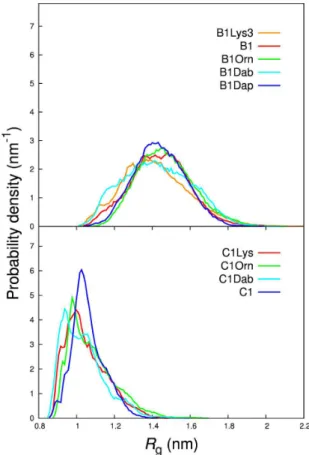
1.9 Rgand energy landscapes of B1 and C1 . . . 18
2.1 Continuum electrostatic model . . . 41
2.2 Thermodynamic cycle . . . 45
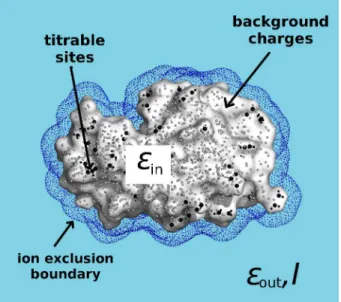
2.3 Stochastic titration CpHMD algorithm . . . 49
3.1 Topology of the peptide dendrimers investigated . . . 56
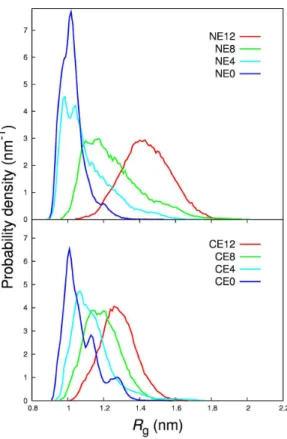
3.2 Rghistograms of B1- and C1-series . . . 62
3.3 Rghistograms of the NE- and CE-series . . . 65
3.4 Total charge vs. hRgiof the NE- and CE-series . . . 65
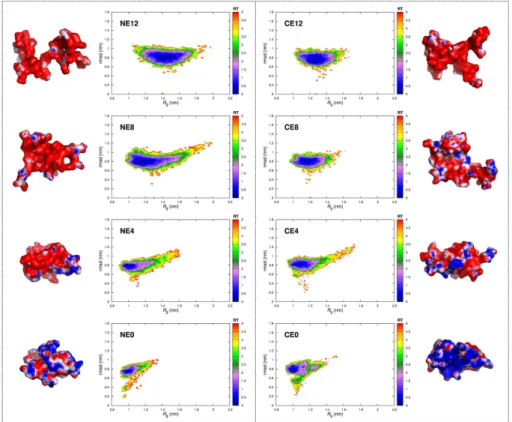
3.5 Energy landscapes of the NE- and CE-series . . . 67
3.6 HB matrices of the NE-series by generation . . . 69
4.1 Dendrimers topology and sequence . . . 77
4.2 Dendrimers experimentalRh . . . 83
4.3 Dendrimers energy landscapes from MD simulations . . 85
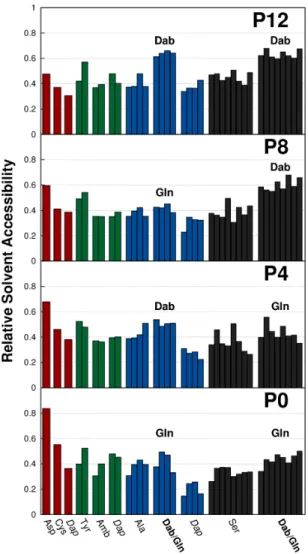
4.4 Residues relative solvent accessibilities . . . 87
4.5 Average number of HBs . . . 88
xvi LIST OF FIGURES
5.1 Sequence of the dendrimers studied . . . 96
5.2 8-butyryloxypyrene-1,3,6-trisulfonate (substrate BPTS) . 97 5.3 Average properties of dendrimers at different pHs . . . . 105
5.4 Energy landscapes of A4 at different pHs . . . 107
5.5 Averageπ-π, X-H···πand hydrogen bonds . . . 109
5.6 Histidine residues pKavalues . . . 112
5.7 Individual protonation behaviors . . . 113
5.8 Residues protonations in the presence and absence of sub-strates . . . 116
5.9 Energy landscapes in the presence of substrates . . . 117
5.10 Topological representation of dendrimer–substrate inter-actions . . . 118
B.1 Energy landscapes of B1- and C1-series . . . 137
B.2 Rghistograms for the BE-series . . . 139
B.3 Total charge vs.hRgi . . . 139
B.4 Energy landscapes for BE-series . . . 140
B.5 RF vs. PME test . . . 141
B.6 hRgivs.hHBsi . . . 142
B.7 HB matrices of BE- and CE-series . . . 143
C.1 Partial atomic charges for Dap . . . 151
C.2 Partial atomic charges for Amb . . . 151
D.1 Replicate sampling convergence, A1 . . . 154
D.2 Replicate sampling convergence, A2 . . . 155
D.3 Replicate sampling convergence, A3 . . . 156
D.4 Replicate sampling convergence, A4 . . . 157
D.5 Atom types for BPTS . . . 158
D.6 Rg, total charge and contact area time series, A3–BPTS . . 165
D.7 Rg, total charge and contact area time series, A4–BPTS . . 166
D.8 Dendrimer–substrate replicate sampling convergence . . 167
D.9 X-H···πtest . . . 167
D.10 Experimental titration curves of A1 and A2 . . . 168
D.11 MS spectra of A1 . . . 169
LIST OF FIGURES xvii
D.13Rghistograms of A1, A2, A3 and A4 at different pHs . . 171
D.14hSASAiof the dendrimers at different pH values . . . 172
D.15 Energy landscape of A1 at different pH values . . . 173
D.16 Energy landscape of A2 at different pH values . . . 174
D.17 Energy landscape of A3 at different pH values . . . 175
D.18π-πstacking by type and histidine charged states . . . 176
D.19 HB by donors and acceptors of the dendrimers main-chain or side-chain . . . 177
D.20 A1: proton occupancy and imidazole SASA curves . . . . 178
D.21 A2: proton occupancy and imidazole SASA curves . . . . 179
D.22 A3: proton occupancy and imidazole SASA curves . . . . 181
D.23 A4: proton occupancy and imidazole SASA curves . . . . 185
D.24 Distribution of dendrimer–substrate contact areas . . . . 186
D.25 Number of substrate molecules interacting with the den-drimer when testing contact area cutoffs . . . 186
D.26 Examples of dendrimer-substrate complexes . . . 187
List of Tables
1.1 Applications of peptide dendrimers . . . 14
2.1 Thermodynamical ensembles . . . 35
3.1 Sequences of the dendrimers studied . . . 54 3.2 hRgiof B1- and C1-series . . . 63
3.3 hRgiand experimentalRhof the NE- and CE-series . . . . 66
3.4 Different HB contributions in the NE-series . . . 71
4.1 Peptide dendrimer sequences and synthesis . . . 78 4.2 Properties of the peptide dendrimers . . . 83
5.1 Properties in the presence and absence of substrates . . . 114 5.2 HBs between the dendrimer and substrates . . . 119
B.1 GROMOS96 53A6 FF Fragment Parameters . . . 132 B.2 pKavalues for residues of the NE-series . . . 135
B.3 BE-series sequences . . . 138 B.4 Different HB contributions in the CE-series . . . 144 B.5 Different HB contributions in the BE-series . . . 144
C.1 RSA normalization factors . . . 152
D.1 Atomic partial charges of BPTS . . . 159 D.2 Bond types of BPTS . . . 160 D.3 Angle types of BPTS . . . 161 D.4 Dihedrals of BPTS . . . 162 D.5 Pairs in BPTS . . . 163
xx LIST OF TABLES
List of Abbreviations
Amino acids
Alanine Ala A
Arginine Arg R
Asparagine Asn N
Aspartate Asp D
Cysteine Cys C
Glutamate Glu E
Glutamine Gln Q
Glycine Gly G
Histidine His H
Isoleucine Ile I
Leucine Leu L
Lysine Lys K
Methionine Met M
Ornithine Orn
Phenylalanine Phe F
Proline Pro P
Serine Ser S
Threonine Thr T
Tryptophan Trp W
Tyrosine Tyr Y
Valine Val V
2,3-diaminopropanoic acid Dap 2,4-diaminobutanoic acid Dab 4-aminomethyl(benzoic) acid Amb
xxii LIST OF ABBREVIATIONS
Other abbreviations and constants
CE continuum electrostatics COM center of mass
CpHMD constant-pH molecular dynamics FF force field
GRF generalized reaction field MC Monte Carlo
MD molecular dynamics MM molecular mechanics NMR nuclear magnetic resonance PB Poisson–Boltzmann
PAMAM poly(amidoamine) dendrimers PPI poly(propylene imine) dendrimers PME particle mesh ewald
PPL poly-L-lysine dendrimers
LIST OF ABBREVIATIONS xxiii
Latin and Greek symbols
D diffusion coefficient h Planck constant I ionic strength kB Boltzmann constant
K kinetic energy mi mass of particlei
N number of particles in a system
pKeff,i effective pKa of a titrable site i, i.e., the pH-dependent
pKa-like quantity expressing its protonation equilibrium
pKhalf,i pH value at which a titrable siteiis half-protonated
pKint,i intrinsic pKaof a titrable sitei, i.e., its pKawhen all other
sites are neutral
pKmod,i pKa of the model compound corresponding to a titrable
sitei
H Hamiltonian function pi momentum of particlei
P pressure
ri coordinates of particlei
R ideal gas constant Rg gyration radius
Rh hydrodynamic radius
t time
T absolute temperature U potential energy
V volume
W electrostatic energy
δ asphericity
ε(r) general dielectric constant
µ chemical potential
ξ(r) counter-ion charge density
ρ(r) general charge density
Chapter 1
Introduction
Contents
1.1 Dendrimers . . . . 2 1.2 Peptide Dendrimers . . . . 7 1.3 Structural studies of dendrimers . . . 14 1.4 Scope and structure . . . 19
2 CHAPTER 1. INTRODUCTION
1.1 Dendrimers: concepts, definitions and examples
Nowadays, traditional synthetic polymers are usually classified into four major groups according to their architecture (Figure 1.1). Den-drimers are an important subclass of the fourth major polymer archi-tecture category: dendritic polymers [1–5].
Figure 1.1:Schematic representation of the four major classes of macro-molecular architecture. Adapted from [2].
An exact definition for dendrimer has been the subject of some de-bate and as such the term has evolved to a broader definition. It is now generally accepted that dendrimers are monodisperse macromolecular tree-like synthetic structures with a well-defined topology, composition, size and molecular weight [1, 6–10]. Indeed, this is what sets them apart from the other subclasses of dendritic polymers. The structural (syn-thetic) control over the topology of dendrimers is in sharp contrast to the statistical nature of the other subclasses of dendritic polymers, namely random hyperbranched [11] and dendrigraft polymers [12], where due to the synthesis methodologies and the nature of the branching groups used, the length of the branching chains is somewhat arbitrary, and hence, architectural asymmetries exist [1, 3, 13].
Dendrimers feature a unique core-shell molecular structure consist-ing of three basic architectural components: a core, the inner shells (gen-erations) consisting of repetitive branches, and the periphery which is composed by the terminal groups (also known as the surface or outer shell) [1, 14]. Figure 1.2 illustrates these three regions using an idealized dendrimer.
struc-1.1. DENDRIMERS 3
Figure 1.2:Schematic representation of a dendrimer composed by three dendrons. Adapted from [1].
ture branches in regular layers (shells) with each branching originat-ing a new consecutive generation, composed by additional spacoriginat-ing and branching units. The multiplicity of both the core and the branching units determine the precise number of end groups, whereas mass am-plification as a function of generation is also determined by the nature of the spacing units. Finally, the periphery may consist of either passive or reactive terminal groups. The branched structures linked in the form of segments to the core are known as dendrons [1–3, 7, 15].
The nature of these three architectural components determines the physicochemical properties found in different dendrimers, namely the size, shape, solubility, viscosity, reactivity, and conformational rigidi-ty/flexibility [16–18]. Unique functional property patterns that depend on a dendrimer generation and are driven by its architecture are often found in these systems; such patterns are known as dendritic effects [19]. Within limits, appropriatea priori design of a dendrimer allows certain properties to be modulated or possibly tailored to requirement [6, 20, 21].
func-4 CHAPTER 1. INTRODUCTION
tional macromolecules. A myriad of possibilities is available by incorpo-rating different building blocks, whose functional groups can partici-pate in chemical/physical processes [1, 22].
When referring tofunctional dendrimers it is common to distinguish between dendrimers incorporating specific chemically active functional groups (e.g. catalytically active, metal-coordinating or photoactive groups), and dendrimers whose functionalities serve mainly the pur-pose of controlling the characteristic chemical/physical molecular fea-tures (e.g. solubility, conformational flexibility) [16, 22, 23]. Since both fulfill a function, and has previously done by others [1, 23], the word "functional" is used here in its broader sense. It is important to empha-size that functional groups accounting for different functionalities can coexist in a single dendrimer, and that examples of placement of func-tional groups in any of the three architectural components aforemen-tioned are available [6, 9, 23, 24].
Over the years, driven by the success of technological and medical applications employing dendrimers, the field has become a pervasive topic where elegant "tactics" developed by talented organic chemists have resulted in the construction of a broad range of dendrimers, from low generation ones to supramolecular assemblies [6, 24]. For example, recently Vötgle et al. have categorized dendrimers into twenty-nine dis-tinct groups based on functional groups and chirality [1].
Having introduced the basic concepts, in the remainder of this sec-tion some historical background is presented. It merely intends to pro-vide a quick overview on the evolution of the field, identifying key dis-coveries, and also, perhaps of greater importance to the reader, provide practical examples of different dendrimers, illustrating the versatility and synthetic potential of this architecture. An exhaustive enumeration of the types of dendrimers, their applications, and the available syn-thetic approaches is out of scope, but can be found in some excellent books [1, 2, 6, 14] and review articles [7, 10, 16, 17, 23, 25].
characteris-1.1. DENDRIMERS 5
tics of such molecules, preceded their experimental "finding".
Indeed, in the early 1940s P. J. Flory (Nobel Prize in Chemistry, 1974) introduced the infinite (polymer) network theory, where he showed sta-tistically that branched polymeric products are likely to appear in the polymerization processes [26–29]. His seminal work already included studies on tri- and tetrafunctional branching units [27, 28]. However, at the time, the experimental techniques (e.g. modern mass spectrome-try tools) allowing the unequivocal characterization of such compounds did not exist. W. Stockmayer subsequently corroborated and extended Flory’s work by developing a general formalism to estimate the most probable distributions of molecular sizes for certain types of branched-chain polymers [30]. It was only in the late 1970s that Vögtle et al. first reported the synthesis of several low molecular weightcascade molecules [31], using a repetitive growth synthesis relying on branching units. For the first time, generational molecules were prepared and characterized at each stage of the process; the result was a new core-shell macro-moleculer architecture, now recognized as dendrimers.
Those initial studies were proceeded by several reports illustrating the usage of repetitive chemistry to prepare dendritic materials, includ-ing the noteworthy studies of Denkewalter et al. [32] describinclud-ing the syn-thesis of polylysine–based dendrimers, i.e. the first peptide dendrimers (Figure 1.3). At the time, the asymmetric branching pattern and the presence of multiple chiral centers made those dendrimers unique.
6 CHAPTER 1. INTRODUCTION
Figure 1.3:Second generation polylysine dendrimer [32].
It was also Tomalia who coined the term dendrimer1. It is derived from the Greek wordsdendron(tree) andmeros(part of), underlying the tree-like nature of these molecules.
Figure 1.4: Second generation poly(amidoamine) dendrimer, PAMAM [33].
1.2. PEPTIDE DENDRIMERS 7
In the beginning of the 90s Fréchet and Hawker were responsible for a major development in the field: the introduction of theconvergent growthapproach for the preparation of dendrimers, i.e, built from the outside inwards [34]. They synthesized a series of poly(aryl ether) den-drimers which are also known as Fréchet-type denden-drimers (Figure 1.5). Instead of expanding a core moleculeoutwardsin a divergent fashion, the convergent growth starts at what will become the periphery of the molecule proceeding inwards, to afford multiple building blocks (den-drons) that are subsequently coupled to a core [2].
Figure 1.5:Third-generation poly(aryl ether) dendrimer, also known as Fréchet dendrimer [34].
1.2 Peptide Dendrimers: concepts, innovations and
applications
con-8 CHAPTER 1. INTRODUCTION
venience of the existing peptide–coupling techniques [35] and the com-mercial availability of many proteinogenic and unnatural amino acids. Since those early studies, dendrimers containing amino acids have proven to display unique useful features justifying a wider interest.
Peptide dendrimers can generally be defined as dendrimers contain-ing peptide bonds in their structure [10, 36, 37]. This broad definition includes dendrimers with an amino acid core, branching units, surface functional groups or any combination of the three, and is further broad-ened by taking into account all types of amino acids (naturally occurring and unnatural amino acids). Therefore, it is useful to classify peptide dendrimers into three different types based on the role played by the amino acids.
The first type includes dendrimers with a traditional (organic) den-drimer framework where amino acids compose only a specific architec-tural region (core, branches or surface). Examples include poly(hydro-xyl)-surfaced PAMAM dendrimers where unnaturalβ-amino acids have
been used as branching units [5], and poly(propylene imine) (PPI) den-drimers grafted with amino acids [38].
The second type encompasses dendrimers with amino acids com-posing the main framework (core and branches) while the periphery is grafted with other functional groups. Examples include peptide drimers functionalized with polyethylene glycol (PEG) [39] and den-drimers grafted with carbohydrate moieties (known as glycopeptide dendrimers) [6].
1.2. PEPTIDE DENDRIMERS 9
the focus of the present thesis.
Amino acid-based dendrimers capitalize on the unique properties of the amino acid building blocks including chirality, hydrophilicity/hydro-phobicity, biorecognition, and optical properties [6, 10, 37, 41]. Further-more, the combination of a tree-like topology with the basic components of natural proteins results in molecules displaying protein-like proper-ties and that are expected to adopt protein-like structure.
The possibility of taking advantage of peptide dendrimers intrin-sic multivalency to graft other molecules, alongside with the ability of inducing specific microenvironments by combining different amino acids into their topology, makes peptide dendrimers extremely versatile molecules. For example, the distinctive internal composition created by the amino acid building blocks offers stereoselective sites for noncova-lent host–guest interactions [10, 37, 42].
Also, in a sense, peptide dendrimers can be regarded as branched molecules incorporating peptidic segments. Peptides are ubiquitous in nature, playing an important role as antimicrobials, antivirals, anal-gesics, among many others [37]. Although in essence, peptides are built from amino acid monomers joined "simply" through peptide bonds (amide bonds), the diversity of functional groups that can be included through the side-chains of the different amino acids and the interplay between those groups leads to molecules exhibiting very different physi-co/chemical properties. The solubility and conformational flexibility of a peptide molecule is deeply correlated to the interactions that the side-chains of the residues can establish (e.g. hydrogen bonds, stacking in-teractions, or, when cysteine residues are present, disulfide bonds) and the nature of the functional groups present (e.g. hydrophobic or polar residues). The potential usefulness of a peptide and its efficiency also depend on its sequence. For example, peptides that have roughly the same number of amino acids can, depending on their sequence, pene-trate or disrupt membranes [43].
10 CHAPTER 1. INTRODUCTION
architecture of dendrimers. It is this duality, and the heterogenerational features it can encompass, that often allows low molecular weight pep-tide dendrimers (G2 or G3) to outperform the efficiency of other, more homogeneous, and higher generation dendrimers. This has recently been exemplified for DNA transfection [44] and bacterial biofilm inhi-bition [45].
Compared to their linear polymeric counterparts and to other (or-ganic) dendrimers, the advantages of peptide dendrimers lie in the fol-lowing features:
i. a protein-like structure that can act as a receptor by adapting to the shape of natural ligands [37];
ii. positive dendritic effects accounting for a cooperative amplifica-tion of funcamplifica-tion [46, 47];
iii. solubility in aqueous media without formation of aggregates [42];
iv. increased resistance to proteolysis, caused by their high degree of branching [37, 48];
v. biocompatibility, which can minimize their cytotoxicity [10, 37].
In 2005 Crespo et al. published an excellent review article surveying advances in the peptide dendrimer field; they finished the article by stating a crucial long-term goal:
The production of vast combinatorial libraries of dendrimers, based on the 20 genetically coded amino acids as well as hundreds of non-coded amino acids, with variations in branching units or build-ing blocks at each generation can be imagined. Such combinato-rial libraries should promote the discovery of lead structures and products with novel properties. Moreover, analysis of the libraries should facilitate exploration into new areas of application (...)
Crespo et al.Chem. Rev., 2005, 105, 1663-1681.
1.2. PEPTIDE DENDRIMERS 11
new approach to peptide dendrimers as artificial proteins [6, 42]. This approach involved essentially two main innovations.
(1) First the optimization of solid-phase peptide synthesis (SPPS) protocols to synthesize dendrimers with variable types, and amounts, of amino acids as spacer and branching residues. A divergent synthe-sis process under the standard conditions of SPPS [35, 49], with Fmoc-protected amino acid building blocks (Fmoc-SPPS), provided peptides with a dendritic topology when diamino acids were introduced in the sequences [6, 42]. A schematic description of the synthetic protocol is presented in Figure 1.6.
The side chains of the amino acids distributed throughout the bran-ches can be used to provided specific functional groups (e.g. for cataly-sis) or be chosen for fine-tuning the physico/chemical properties of the dendrimers [41, 42].
With this protocol dendrimers with one to three amino acids be-tween branches can be prepared with up to 37 amino acids (G1 to G3, MW~5×10³ Da), Figure 1.7. This divergent synthesis was later
com-bined with a convergent assembly approach that takes advantage of chloroacetyl to cysteine (ClAc) ligations to make larger peptide den-drimers (G4 to G6, MW~30×103Da) [50].
12 CHAPTER 1. INTRODUCTION
Figure 1.6: Solid Phase Peptide Synthesis (SPPS) of Peptide Den-drimers. The SPPS of peptide dendrimers using Fmoc-protected amino acids is exemplified using a dendrimer with sequence: (AcAla)4(LysSer)2LysSer-NH2. The dendrimer core is composed by
1.2. PEPTIDE DENDRIMERS 13
Figure 1.7: Third-generation peptide dendrimer with sequence: (AcHisSer)8(DapHisSer)4(DapHisSer)2DapHisSer-NH2 [46, 47]. The
14 CHAPTER 1. INTRODUCTION
Table 1.1:Known applications of peptide and glycopeptide dendrimers.
Application References
Ester hydrolysis catalysts [46, 47, 50, 53, 57–60]
Aldol reactions catalysts [50, 54, 61]
Labeling and drug delivery to cancer cells [62, 63] Models of metalloproteins: cobalamin ligands [55, 64] Models of metalloproteins: FE(II) ligands [65, 66]
Pseudomonas aeruginosabiofilm inhibitors [67–71]
Membrane disrupting antimicrobial dendrimers [72–74]
Cell penetrating peptides [44, 75, 76]
To date, the Reymond group has synthesized over 400 different pep-tide and glycopeppep-tide dendrimers [42, 56]. Table 1.1 provides a sum-mary of the most relevant dendrimers discovered and their applica-tions.
Both the synthesis and applications of peptide dendrimers have re-cently been thoroughly reviewed elsewhere [6, 37, 41, 42, 52].
1.3 Structural studies of functional dendrimers
For experimentalists the topic of dendrimer molecular-level structure is a somewhat frustrating issue. On one hand there is wide curiosity in understanding the solution behavior of these molecules, and their in-teractions with other relevant molecules, on the other hand such desire stumbles on technical difficulties that most likely result from the intrin-sicfunctionalproperties of dendrimers.
1.3. STRUCTURAL STUDIES OF DENDRIMERS 15
a series of first generation polyphenylene dendrimers (which are essen-tially dendritic repetitions of aromatic rings), and the work of Michaud et al. [80] published in 2016, describing the structure of a second gen-eration glycopeptide dendrimer co-crystallized with a lectin from Pseu-domonas aeruginosa. The simplicity of those dendrimers, and the confor-mational rigidity observed, attest the difficulties found in this kind of studies.
Over recent years some success has been achieved with small-angle neutron scattering (SANS) [78], small-angle X-ray scattering (SAXS) [81] and PSGE diffusion NMR techniques [50, 55, 64, 74]. Nonetheless, those techniques provide only very rough pictures of the systems without any atomic-level detail.
Hence, it comes as little surprise that computational techniques such as molecular mechanics/molecular dynamics (MM/MD) have become a pervasive tool to explore the behavior of dendrimers, providing a sound basis for the molecular reasoning of the observed phenomena. Given the importance of such computational techniques to the present thesis, a more thorough discussion is presented in the next chapter.
To what pertains the application of computational methods to study dendrimers in general, suffices to say that almost every method as been (adequately) applied by different groups and even with different, and sometimes conflicting, findings. In analogy with the focus of experi-mental research, also the majority of computational studies have (and still do) focus mainly on PAMAM dendrimers.
The conformational features of PAMAM dendrimers in solution have been extensively studied using atomistic and coarse-grained models with different computational methods; including Brownian dynamics (BD) [82], Molecular Dynamics simulations [83], Monte Carlo simula-tions [84], and enhanced sampling techniques such as metadynamics simulations [85].
16 CHAPTER 1. INTRODUCTION
Figure 1.8: Segment density distribution of a hypothetical dendrimer according to the "dense-shell" (left) and "dense-core" (right) models. Adapted from [81].
and Hervet [86], which suggested that segments in successive genera-tions are confined in spherical shells located at increasing distances from the dendrimer center of mass. This concept is known as the "dense-shell model" (Figure 1.8).
However, the currently accepted view on this issue is the "dense-core model". It was first proposed by Lescanec and Muthukumar [87] and latter confirmed by several SANS and SAXS studies with PAMAM dendrimers [1, 78, 81]. In the "dense-core model" maximum density is postulated to occur at the core of the dendrimer, with a decrease in segment density proportional to the distance from the core. The de-crease in segment density towards the periphery is caused by partial back-folding of end groups into the interior of the dendrimer (Figure 1.8) [1].
Over recent years the focus of computational studies has shifted from monomer distribution models to solution effects (such as pH [88] and counter-ions [89]) and interactions with other molecules (e.g. host– guest [90], lipid membranes [91] and DNA [92]). Some excellent re-views surveying all the computational methods and findings resulting from their application to PAMAM and PPI dendrimers are available [77, 78, 90, 93].
PA-1.3. STRUCTURAL STUDIES OF DENDRIMERS 17
MAM dendrimers, the same can not be said for peptide dendrimers. Indeed, the conformational preferences of such systems have remained mostly unaddressed; despite the multiple applications for such systems, the conformational variability that is to be expected due to the amino acid side-chains, and the humongous combinations of amino acid se-quences accessible.
At the time we started the work presented in this thesis, only a few reports on the topic were available and all off them using MD simula-tions.
Dendrimers of the first type (organic framework grafted with amino acids, see the previous section) were studied by Cavallo et al. [94], who performed simulations of PPI dendrimers surface modified with phenylalanine. Their results suggested the self-inclusion of the periph-eral amino acids into the dendritic inner shell.
Dendrimers of the second type, namely generations one to six of dendrimers with a poly(lysine) scaffold functionalized with other mole-cules were studied by Roberts et al. [95, 96], who observed a transition from a small molecule (flexible) behavior to a more polymer-like (dense-core) behavior with increasing generation.
Regarding peptide dendrimers composed solely by amino acids (third type) only three articles were available: two of those articles were published in 2009, namely one by Moiani et al. [97] addressing the speci-ficities of the interaction between a second-generation dendrimer and a human immunoglobin; and a second one by Reymond and cowork-ers [98] showing that third-generation peptide dendrimcowork-ers acquire a molten-globule like structure in solution. In both cases the simulation times used were short (10 ns and 20×4 ns respectively) and doubts
re-garding the equilibration of those systems remain. For the interested reader, a brief discussion specifically on equilibration issues in compu-tational studies of dendrimers is available in reference [14], as well as a more general review [99] of such issues.
den-18 CHAPTER 1. INTRODUCTION
Figure 1.9: Radius of gyration histograms (left) and free en-ergy profiles (middle and right) of two third-generation pep-tide dendrimers typifying the different conformational behavior ob-served by Filipe et al [100]. Dendrimer C1 (gray, middle): (AcSerGly)8(DapGluTyr)4(DapHisThr)2DapArgAla-NH2. Dendrimer B1
(red, right): (AcGluSer)8(DapGluAla)4(LysAmbTyr)2DapCysAsp-NH2.
Dap = L-2,3-diaminopropionic acid. Amb = 4-aminomethyl(benzoic) acid.
drimers, including some known to bind aquocobalamine. Our study, specifically addressed the differences in the conformational preferences of peptide dendrimers with variable amino acid sequences.
The results underlined a high conformational flexibility, and two markedly distinct behaviors were found in dendrimers with the same topology but with different amino acid sequences, Figure 1.9. By re-sorting to energy landscapes and other analysis we showed that one of the dendrimers displayed mostly compact conformations clustered into distinct basins (C1, rough landscape), while the remaining dendrimers displayed mainly noncompact conformations with no significant clus-tering (B1, downhill landscape). These different structural preferences helped to explain why B1 is a stronger and faster aquocobalamin binder than C1.
Understanding the functional differences between peptide dendri-mers that account for such entirely different conformational behaviors, is one of the main objectives of the present work. Over the next chapters of this thesis we report our endeavors and findings.
an-1.4. SCOPE AND STRUCTURE 19
timicrobial peptide dendrimers with bacterial membranes [73].
1.4 Scope and Structure of this Work
Peptide dendrimers are the subject of this work. In the previous sections the basic concepts regarding these dendrimers were introduced. The reader can now have an overall idea of the state-of-art of the field and the challenges it faces.
As pointed out in the previous sections, peptide dendrimers appli-cations have been extensively studied using experimental means. How-ever, the underlying structural features of these systems have been, for practical reasons, somewhat neglected. This knowledge-gap limits the maturity of the field, and the broad acceptance of these systems.
Let us consider a simple first-generation peptide dendrimer with two spacer residues in each branch, i.e. a sequence of the form (AB)2bCD,
wherebis a branching residue and A, B, C and D are amino acid residues which may or may not be identical.
If we restrict A, B, C, and D to be one of the 20 proteinogenic (nat-ural) amino acids, and we also consider thatbcan be a single diamino acid, it becomes apparent that, even for such a simple system, there are 204 possible combinations of amino acids that could be used to
con-struct such a peptide dendrimer. And we have not even considered the fact that B can actually correspond to two different amino acids, if an orthogonal deprotection scheme is used in the synthesis (e.g. Fmoc/Al-loc chemistry). One can already start to imagine the myriad of dis-tinct physical/chemical and structural features that are likely to result from the combination of different functional groups (e.g. side-chains of amino acids) in higher generation dendrimers. And, if one looks at the literature (which is summarized in the previous sections) it is noticeable that the most interesting and "applicable" peptide dendrimers are not this simple and are at least second-generations ones.
combina-20 CHAPTER 1. INTRODUCTION
torial libraries of amino acids, such as the ones described before, not all sequences can be attempted, and even such an approach would greatly benefit from knowing in advance some preferential dendrimer charac-teristics resulting from amino acids that are to be placed in specific po-sitions.
Understanding in detail these systems, their interactions with other molecules, their behavior under different environmental conditions, the relation between the functional groups present in the amino acid se-quence and the observed conformational features, are key milestones in the path leading to the development of truly knowledge-based pep-tide dendrimers; with all the benefits from such an approach, namely in terms of prospective applications.
Obtaining a solid fundamental knowledge of the key structural as-pects of peptide dendrimers is the central goal of the work presented here.
We have taken advantage of the already available experimental in-formation and have used molecular modeling methods to obtain the lacking atomic-level glimpse into these fascinating molecules world. In practice, we have performed a comprehensive set of computational studies using several dendritic systems and different methodologies. The results retrieved from our studies allow a new and deeper com-prehension of these systems.
The basic concepts behind the computational methods employed are reviewed in the next chapter.
In the third chapter we describe our investigations on the conforma-tional determinants of peptide dendrimer structure acquisition. Molec-ular dynamics simulations were used to study the influence of using different branching diamino acids, and also the effect of the placement of variable amounts of negatively charged residues in dendrimers with the same topology. This work entailed the development of several com-putational tools required to perform simulations of dendrimers. This work also originated a publication inMacromolecules[102].
molec-1.4. SCOPE AND STRUCTURE 21
ular dynamics simulations were used to investigate these systems, but the actual synthesis and experimental characterization of the dendrimers was also performed. An upgrade of the computational tools previously created was also needed to handle different (all-atom) force fields. This work confirmed a true structural dependence of peptide dendrimers on electrostatic effects, and has originated a manuscript that as been sub-mitted for publication.
The pH-dependent conformational behavior of peptide dendrimers, and the interactions of catalytic dendrimers with substrate molecules are described in the fifth chapter of this thesis. Those topics were inves-tigated using constant-pH molecular dynamics simulations. It should be emphasized that this is the first report on the usage of such methods to study any dendritic system, allowing us to reach a level of description of the systems that is absent in any of the other computational studies addressing pH-effects in dendrimers. This work involved adapting the in-house constant-pH MD software to allow for the simulation of den-dritic systems. Furthermore, this work originated a manuscript that has recently been submitted for publication.
Chapter 2
Theory and Methods
Contents
2.1 Molecular Mechanics . . . 25 2.1.1 Force Fields . . . 25 2.1.2 Bonded Interactions . . . 28 2.1.3 Non-bonded Interactions . . . 28 2.2 Sampling Methods . . . 30 2.2.1 Molecular Dynamics (MD) simulations . . . . 31 2.2.2 Monte Carlo (MC) simulations . . . 33 2.3 Statistical mechanics . . . 34 2.4 Modeling titration states . . . 38 2.4.1 Continuum Electrostatics . . . 40 2.4.2 The Poisson-Boltzmann equation . . . 42 2.4.3 Protein titration . . . 44 2.5 Constant-pH MD . . . 47
24 CHAPTER 2. THEORY AND METHODS
Atoms are quantum entities and hence their behavior and interac-tions can in principle be adequately detailed in the framework of the quantum mechanics theory introduced at the beginning of the 20th cen-tury. However, due to the intrinsic complexity of atomic systems, along-side with several conceptual and practical problems, such an approach is virtually impossible for the great majority of relevant systems. Such difficulties are even more obvious when one considers biomolecular systems.
The complexity of molecular systems, which are essentially many-particle systems with multiple degrees of freedom, excludes the usage of analytical theoretical methods to characterize the static and dynamic features of such systems. As a consequence, numerical/computational simulations have been developed [103].
In a simplified view, one can consider that an adequate description of a molecular system through modeling and simulation involves essen-tially two aspects: first the construction of a physical model of the real system, which commonly includes several assumptions and approxi-mations (i.e. a molecular model); second, a statistically meaningful way to determine the configurations accessible to the system (i.e. a sampling method).
Computer simulations of molecular systems have become of interest in the fields of chemistry, biology and biophysics, since they provide: (1) the means to rationalize and interpret experimental results from a microscopic point of view, (2) quantitative estimates of several proper-ties of the systems and (3) the ability to study features of the systems under conditions that are beyond the reach of experimental techniques [104, 105].
2.1. MOLECULAR MECHANICS 25
2.1 Molecular Mechanics
The most common molecular models used in computer simulations are inspired either by quantum or classical mechanics. The distinction be-tween different models lies in the level of detail used to represent the system, i.e. the degrees of freedom taken into account.
Molecular Mechanics (MM) theoretical models, also known asforce field methods, follow from classical mechanics and consist in the usage of elegant "classical" functions to calculate the potential energy of a molec-ular system [104, 105, 109].
Such models implicitly consider two main assumptions. First, that the Born–Oppenheimer approximation is invariably assumed to oper-ate, separating the electronic and nuclear motions. The electrons are regarded as presenting an endlessly smaller mass than the nuclei, and consequently they will rapidly adjust to any change in nuclear posi-tion. The second assumption is that the behavior of molecular systems, which are intrinsically of a quantum nature and whose motion is only fully described by the time–dependent Schrödinger’s equation, can be accurately captured by the laws of classical mechanics.
In summary, in MM models, a molecular system is represented by a set of point masses where movement depends solely on the instanta-neous coordinates of those point masses. Classical mechanics concepts, such as potential energies, partial charges or forces apply.
2.1.1 Force Fields
The total energy of a system can be represented by its Hamiltonian,H.
If H takes a classical mechanical form, than it can be decomposed in
terms of potential energy contributions,U(that depend on the particles coordinates), and kinetic energy contributions,K(dependent on the par-ticles momenta), as
26 CHAPTER 2. THEORY AND METHODS
For a closed system, the kinetic energy of a N-particle system, is given by [107, 108],
K= N
∑
i=1|pi|2
2mi
, (2.2)
where the masses and momentum of each particle are mi andpi (i =
1, 2, ...,N), respectively. As can be seen, dealing with the kinetic en-ergy of the system is relatively straightforward. Defining the position– dependent potential energy is somewhat more complex.
In MM models, the mathematical form of U, the potential energy function, generally consists of several potential energy terms describing molecular connectivities and interactions. A textbook example of a po-tential energy function for a system ofNatoms with position vectorsri
(i=1, 2, ...,N) is [104]:
U(r1,r2, ...,rN) =
∑
bonds1
2Kb[b−b0]2
+
∑
angles
1
2Kθ[θ−θ0]2
+
∑
dihedrals
Kϕ[1+cos(mϕ−δ)]
+
∑
impropers
1
2Kξ[ξ−ξ0]2
+
∑
pairs(i,j) "
C12(i,j)
r12ij −
C6(i,j)
r6ij
#
+
∑
pairs(i,j)
1 4πε0
qiqj
εrrij .
(2.3)
The potential can be separated into bonded and non-bonded terms (see below). In this functional form, covalent interactions are taken as summations over 1-2, 1-3 and 1-4 bonded terms, while non-bonded in-teractions are pairwise additive, modeled by sums over Lennard-Jones and Coulombic potentials.
The designation force field (FF), usually refers to both the potential energy function and the corresponding parameters used (Kb, b0, Kθ,
2.1. MOLECULAR MECHANICS 27
quantitative way, employing a set of equations, estimates of constant parameter values and free parameters. Consequently, force fields are empirical [105, 109, 110].
To a large extent, even the form of the potential energy function is empirical, since it depends on considerations of what terms are and are not required to effectively model the underlying quantum mechanical phenomena using a simple multi-term classical depiction. The form of Equation 2.3 represents a compromise between simplicity and accuracy. Given the empirical nature of potential energy functions, FFs with addi-tional terms, or that account for coupling between different types of in-teractions are common. For example, some FFs contain mixed terms as Kb0[b−b0][θ−θ0], which directly couple bond-length and bond-angle
vibrations [104, 110]. The actual potential energy functions used in Chapters 3 to 5 of this thesis are presented in Appendix A (page 127).
Force fields are also very distinct in the way empirical parameters are determined. In some force fields, such as AMBER [111, 112] or OPLS [113], the parameters are fitted to high-levelab-initioquantum calcula-tions of small molecules. A different philosophy is followed in force fields such as GROMOS [114–116], where parameters are obtained from fittings to experimental data (e.g. crystal structures, X-ray data of small molecules, free energy of solvation, among others).
Another aspect that further differentiates the existing force fields is the representations of the particles that compose the system. Some ex-plicitly depicted all the atoms in the system (known as all-atom force fields), however, coarse–graining of some atoms or even of entire mo-nomers (e.g. amino acids) is common practice since it allows for signif-icant computational savings. For example, in force fields of the GRO-MOS family, non-polar hydrogens (aliphatic and aromatic) are typically subsumed into the atoms they are covalently bonded; the parameters of those atoms are modified accordingly. These force fields are called united–atom.
28 CHAPTER 2. THEORY AND METHODS
2.1.2 Bonded Interactions
The first four terms of Equation 2.3 describe bonded interactions. Bonded terms represent the displacements of bond lengths (stretching), angles (bending) and rotations about covalent bonds (torsional angles) [104, 110].
The first term in the equation, bonds, is a harmonic potential ac-counting for the covalent bond stretching along bondb. The associated force constant (Kb) and minimum–energy bond length (b0) depend on
the particular type of bond.
The second term in the equation, angles, is also a harmonic poten-tial but for three-body interactions and represents the bending of bond angles. A force constant (Kθ) and a bending–angle reference value (θ0)
must also be defined.
The third and fourth terms in Equation 2.3 both describe torsional angle interactions (four-body). The third term,dihedrals, is a sinusoidal potential for flexible dihedral anglesϕ, which can make 360° turns and have multiple dihedral minima. The periodicity of the torsions is de-scribed by the parameterm(multiplicity) whereasδstands for the phase offset.
The fourth term,impropers, is a harmonic term applied toξdihedral angles in order to disallow transitions. Such terms are normally applied to dihedral angles of atoms in aromatic rings in order to maintain the planarity of the ring, or to chiral groups in order to maintain the chiral-ity [104, 109].
2.1.3 Non-bonded Interactions
The last two terms of Equation 2.3 describe non-bonded interactions. Both terms are sums over all pairs of atoms in the system, and therefore, these interactions can be intra- or inter-molecular.
2.1. MOLECULAR MECHANICS 29
At short distances the vdW interaction energies are very high, account-ing for the repulsion between the particles. As the distance between the particles increases it is the attractive part of the function that becomes preponderant, but the magnitude of the interaction decreases. There-fore, vdW interactions are considered as short-ranged and it is common to reduce the calculation of the interaction term to pairs of atoms that are within acutoff distance [103, 106, 109].
vdW interactions are a generic way of accounting for specific non-bonded forces, which include the forces between permanent dipoles, permanent and corresponding induced dipoles and also London dis-persion forces (between two instantaneously induced dipoles).
Electrostatic interactions occur between groups that bear formal charges, or that contain substantial partial charges. In the last term of Equation 2.3, Coulomb’s law is used to account for electrostatic interac-tions. Such interactions occur between non-bonded atomsiand jwith chargesqi andqj at a distance rij. ε0is the relative permittivity of
vac-uum andεrthe relative permittivity of the medium1.
Electrostatic interactions are particularly relevant in simulations of biomolecular systems since the interaction energy associated to them does not show a rapid decay withrij(proportional to 1/rij) as in the case
of vdW interaction. Therefore, electrostatic interactions are considered to be long-ranged and there is a conceptual need to account for their effect beyond the system boundaries.
Computationally the calculation of these long-ranged electrostatic interaction is extremely cumbersome, and stratagems allowing for sig-nificant computational savings have been developed. Typically electro-static interactions are evaluated using either continuum or Lattice-sum methods.
In continuum methods, as for instance the reaction-field approach, the real charge distribution beyond a cutoff distance is treated using a mean-field approximation represented by a dielectric constant εRF,
1Depending on the force field and the conditions it aims at describing (gas- or
30 CHAPTER 2. THEORY AND METHODS
and an average ionic distributionIRF. Electrostatic interactions between
atom pairs within the cutoff are treated explicitly [104, 109, 117].
In Lattice-sum methods, such as the Ewald summation, and all its fast Fourier transform variants (e.g. P3M and PME), the system is
rep-resented as a neutral central unit cell that is infinitely repeated in all di-mensions,2and the electrostatic interactions between all pairs of atoms
(including periodic images) are summed. The neutrality condition and the breaking of the calculations into real and reciprocal space makes the energy summation convergent [118, 119].
2.2 Sampling Methods
Under physiological conditions molecules are not isolated, they inter-act with other molecules such as solvent ones. Such interinter-actions lead to conformational fluctuations (e.g., entropic effects that result from colli-sions at non-zero temperatures) and hence, the thermodynamic behav-ior of molecules can only be described if we take into account this dy-namics. This means that a system is not characterized by the energy of a single conformation, but by its free energy [120, 121].
The entire behavior of a dynamical system can be conceptualized in terms of a multidimensional space defined by all the values of position (r) and momenta (p) that are accessible to it.3 For a system composed
of N atoms, this space, which is known as phase space(represented as Γ(rN,pN)) will be defined by 6Nvalues; three coordinates per atom and
three components of the momentum. Under equilibrium conditions, the regions of this space will be populated with different probabilities in accordance with a Boltzmann distribution (i.e. the probability density function governing the populations of the phase space) [106, 108, 122].
The systems that are currently tractable with computational
simu-2This treatment of the system boundaries is known as periodic boundary
condi-tions (PBC) and is not an exclusive feature of Lattice-sum methods, but rather a general way to deal with the boundaries of systems that are periodic or contain explicit solvent molecules. PBC can also be used in simulations with the continuum methods men-tioned in the text.
2.2. SAMPLING METHODS 31
lation methods have a very large number of atoms (104-106 or more)4,
implying that the underlying phase space can be huge. It is thus, nor-mally impossible to describe the entire phase space of a system. Alter-natively, simulations of molecular systems focus on the generation of a statistically representative set of configurations at well defined bulk thermodynamic properties (e.g temperature, pressure, etc.), a so-called ensemble.
Herein, we shall describe two methods that provide a correct Boltzmann–weighted sampling of ensembles: Molecular Dynamics (MD) and Monte Carlo (MC) simulations.
2.2.1 Molecular Dynamics (MD) simulations
One way to generate an ensemble of configurations it to try to mimic the true temporal evolution of the system by solving Newton’s equations of motion over time. This is known as the Molecular Dynamics (MD) method [105, 106].
Newton’s law of motion (or second law) elaborates the relation be-tween a particle’s mass (m), acceleration (a) and an applied force as: F= ma. Since acceleration is the second derivative of a position vector - r - with respect to time (and the first derivative of velocity)5 we can
rewrite Newton’s law for a system of N-particles as:
Fi
mi = ∂
2r
i
∂t2 (2.4)
withi = 1, 2, ...,N. The force,Fi, acting on each particle of the system
is determined by the gradient of the potential energy,U(see Equation 2.3), relative to the position of that particle, as:
Fi = −∂U
(r1,r2, ...,rN)
∂ri
(2.5)
where U is a scalar quantity, that depends on the positions of all the
4A number that is still very small when compared with Avogadro’s number, that is,
macroscopic sizes.
5We could equivalently write this with respect to velocity as: Fi mi =
∂vi
32 CHAPTER 2. THEORY AND METHODS
particles in the system and the force field [105, 107]. Once the forces (vectorial quantity) acting on all the particles are calculated through Eq 2.5 we can use Eq. 2.4 to obtain the particles new positions and ve-locities. However, this can only be achieved using numerical methods (many-body problem) that discretise time and solve the equations via a finite difference method. Those algorithms are called MDintegratorsand textbook examples include the Verlet and Leap-frog schemes [104, 105].
Normally, the equations are integrated over short time steps, ∆t (1 to 2 fs for all-atom simulations). At each step, the forces on the atoms are computed and combined with the current positions and velocities to generate a new set of positions and velocities a short time ahead. The force acting on each particle is assumed to be constant during the time step of each iteration [108]. This is easily understood by looking at the equations used in the Leap-frog algorithm [123]; the velocities of a particle (vi) at timet+∆t/2 are defined by:
vi
t+∆t
2
=vi
t− ∆t
2
+∆t
mi
Fi(t), (2.6)
and the positions at instantt+∆tby
ri(t+∆t) =ri(t) +∆tvi
t+ ∆t
2
. (2.7)
Usually MD simulations are run for tens to hundreds of nanoseconds.6
The required duration of a simulation can only be decided by evaluating the convergence of the properties one wishes to study (which is very system-dependent).
The final result of an MD simulation is a trajectory (configurations as a function of time) of the molecular system, which can be "viewed" as a sequence of points in phase space that are connected in time. Average as well as time-average information can thus, be obtained [105, 106, 108, 121].
2.2. SAMPLING METHODS 33
2.2.2 Monte Carlo (MC) simulations
When one is not interested in the temporal properties of a system, Monte Carlo (MC) simulations can be used to sample the different states of a system in a stochastic manner [106, 124]. In MC simulations, the configurations sampled are not time-correlated as in MD. Each new con-figuration depends only on the preceding concon-figuration.
The usual approach is to use a MC algorithm together with a Metro-polis acceptance/rejection criterion (MetroMetro-polis MC) [125]. Starting from a configuration of the systemrS, a new configurationrS+1 = rS+∆r
is generated by random displacement of one (or more) particles (∆r). Then, the change in potential energy betweenrS andrS+1 is evaluated
(∆U).
According to the Metropolis criterion, the probability of acceptance, pis:
pS→S+1=min
1, exp
−∆U
kBT
. (2.8)
The new configuration is always accepted if it has lower potential en-ergy than the previous one (∆U ≤ 0). However, ifrS+1 has higher
en-ergy than the previous state (∆U>0), a random number,rand, between 0 and 1 is generated. If the value ofrand< pS→S+1the move is also ac-cepted. This procedure has the effect of allowing the proper sampling of high energy states.
Upon acceptance, the configuration becomes part of the productive ensemble and is used as starting point for the subsequent random dis-placement (rS+2 = rS+1+∆r). If on the other hand the criteria are not
met, rS+1 is rejected,rS is counted again and a new random
displace-ment starting again from the initial configuration (rS) is attempted.
There is no momentum component in usual Monte Carlo simula-tion and such simulasimula-tions sample from a 3N-dimensional phase space corresponding to the positions of the atoms. This also implies that ki-netic features of the systems can not be studied using this method (see Equation 2.2).
![Figure 1.2: Schematic representation of a dendrimer composed by three dendrons. Adapted from [1].](https://thumb-eu.123doks.com/thumbv2/123dok_br/15769840.641160/31.748.188.618.130.421/figure-schematic-representation-dendrimer-composed-dendrons-adapted.webp)
![Figure 1.4: Second generation poly(amidoamine) dendrimer, PAMAM [33].](https://thumb-eu.123doks.com/thumbv2/123dok_br/15769840.641160/34.748.153.529.562.889/figure-second-generation-poly-amidoamine-dendrimer-pamam.webp)
![Figure 2.3: Schematic representation of the stochastic titration contant- contant-pH MD algorithm [126, 128].](https://thumb-eu.123doks.com/thumbv2/123dok_br/15769840.641160/77.748.214.590.122.436/figure-schematic-representation-stochastic-titration-contant-contant-algorithm.webp)