AIDS in Mexico: Trends and Projections
Josh
LUISVALDESPINOG.,~ Jo& ANTONIO~ZAZOLA
L.,l
~BLANCA
RICOG.~The f&t case of AIDS in Mexico was reported in 1981. Through mid-1988, 1,502 cases had been reported, the incidence of cases having doubled every 7.7 months. Of the cases in adults, 87.6% were sexually transmitted, transfusion with contami- nated blood or blood products accounted for lO.S?h, and intravenous drug abuse for 0.3%. In the 56 pediatric AIDS cases reported, transmission through contaminated blood accounted for 67.9%, sexual contact for 5.4%, and perinatal transmission for 19.6%. The disease appears to be spreading from the large cities to peripheral and rural areas, and to be spreading faster among heterosexuals than among homosexual and bisexual males. Projections based on continued exponential doubling at the 1983-1986 rate suggest the cumulative AIDS case total could exceed 75,000 by the end of 1991. More conservative estimates based on an observed lengthening of the doubling time predict as many as 260,000 cases by the end of 1994.
B
roadly speaking, AIDS epidemiol- ogy around the world can be re- garded as involving four transmission patterns found in distinct geographic re- gions, as follows:l In some parts of Africa and the Ca-
ribbean, transmission began before the 1970s. High levels of HIV infec- tion have been found, the agent be- ing transmitted predominantly through heterosexual contact, peri- natal contact, and blood transfusions (1).
l In the United States and Western Eu-
rope, transmission typically began toward the end of the 1970s and has produced high levels of HIV infec- tion among homosexual and bisexual males and intravenous drug abusers. HIV transmission through blood
*General Directorate of Epidemiology, Secretariat of Health, Mexico City, Mexico. Mailing address: Aniceto Ortega 1321, 5” piso, 03100 Mexico, D.F., Mexico.
2National Committee for AIDS Prevention, Mexico City, Mexico.
20 PAHO Bdetin 23(1-2), 2989
transfusions has been limited. In general, persistent but low levels of heterosexual transmission have oc- curred, and perinatal transmission has been occurring in hyperendemic areas (2).
l In Latin America outside the Carib-
bean, transmission began in the early 1980s and has produced mod- erate prevalences of infection among groups engaging in high-risk prac- tices, chiefly homosexual and espe- cially bisexual males. Blood transfu- sions have played an important role in HIV transmission, one that has not been completely eliminated; but the proportions of cases occurring as a result of intravenous drug abuse and perinatal contact have been low (3,4).
l In Asia and Oceania, transmission of
Analysis of these different epidemio- logic patterns suggests that HIV trans- mission first involves homosexuals with many partners; but then, as the epidemic progresses, the agent comes to spread mainly between heterosexuals with fewer partners. Perinatal transmission re- flects HIV transmission to women, both sexually and through blood transfusions. The experiences of some countries to date have indicated that transmission via blood transfusion can be controlled by energetic measures designed to detect HIV infections in blood donors (5).
AIDS EPIDEMIOLOGY IN MEXICO
As of June 1988 a cumulative total of 1,502 AIDS cases had been reported in Mexico, the number having grown expo- nentially and having doubled, on the av- erage, once every 7.7 months. The dy- namics of past HIV transmission in Mexico is reflected in the sex ratio of AIDS patients (11 males to one female) as well as their age distribution.
Among adult males, 92.7% of those af- flicted acquired the infection through sex- ual contact. Of this 92.7%, most (58.6%) was accounted for by people identified as homosexuals, a smaller share (26.3%) by ones identified as bisexuals, and the re- maining 7.8% by ones identified as het- erosexuals. Also, 5.7% of the adult males with AIDS were infected via contami- nated blood or blood products, with 4.3% being transfusion recipients, 1.1% hemo- philiacs, and 0.3% having been infected through intravenous drug abuse. Re- garding the relatively small number of adult females with AIDS, some two- thirds appear to have acquired their infections through blood transfusions and the remainder through heterosexual contact.
Overall, the most frequent mode of HIV transmission in the adults with AIDS was sexual contact, which ac-
counted for 87.6% of the reported cases, while transfusion with contaminated blood or blood products accounted for 10.8% and intravenous drug abuse for 0.3%. In addition, 56 pediatric AIDS cases were reported, of which transmis- sion through contaminated blood ac- counted for 67.9%, sexual contact for 5.4%, and perinatal transmission for 19.6% (6). The modes of transmission of the remaining 1.3% of adult cases and 7.1% of pediatric cases are unknown.
CURRENT TRENDS AND
PROJECTIONS
Trends in the numbers of AIDS cases in Mexico indicate that the disease is spreading from the large cities to the sub- urbs and countryside. Also, the inci- dence of AIDS is rising faster among women and children than among young men, even though the latter still account for the largest number of cases. It ap- pears that the disease is spreading faster among heterosexual males than among homosexual and bisexual males.
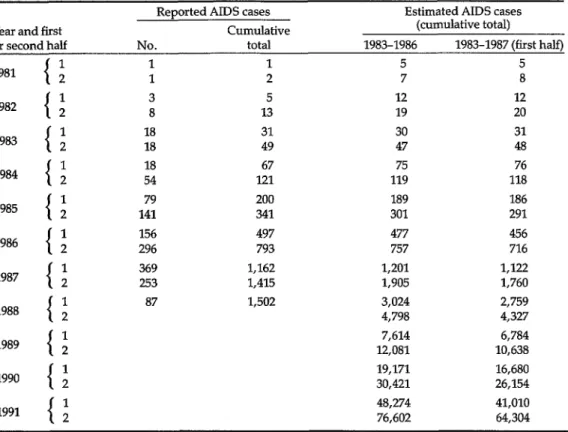
If one directly applies the curves de- rived from 1983-1986 and 1983-1987 (first half) AIDS case data, the resulting pro- jections indicate that the cumulative number of AIDS cases occurring in Mex- ico by the end of 1991 could range from 64,304 to 76,602. As Table 1 shows, the higher projection was derived from the 1983-1986 data, while the lower projec- tion was obtained by including data from the first half of 1987. Later data have not been used in the projections because not all cases beginning in the second half of 1987 and the first half of 1988 have been diagnosed.
It should also be noted that exponential growth curves do not accurately describe the AIDS case growth rates observed in all countries. In the United States, for ex- ample, no exponential growth of AIDS cases has been seen since 1983. Hence, a
Table 1. Reported AIDS cases in Mexico by time of onset, 1981-June 1988, and exponential projections of case numbers based on 1983-1986 and 1983-June 1987 data.
Reported AIDS cases Estimated AIDS cases Year and first Cumulative (cumulative total)
or second half No. total 1983-1986 1983-1987 (first half)
1981
1982
1983
1984
1985
1986
1987
1988
1989
1990
1991 {
1 2
1
2 1 -t 2 1{ 2 1
{ 1 2 1 2 1
{ 2 1
i 2 1
1 1 2 1 2 1
{ 2 1
18 18 18 54 79 141 156 296 369 253 87
1 2 5 13 31 49 67 121 200 341 497 793 1,162 1,415 1,502
5 7 12 19 30 47 75 119 189 301 477 757 1,201 1,905 3,024 4,798 7,614 12,081 19,171 30,421 48,274 76,602
5 8 12 20 31 48 76 118 186 291 456 716 1,122 1,760 2,759 4,327 6,784 10,638 16,680 26,154 41,010 64,304
number of possible adjusted curves have been proposed, among them a damp- ened exponential curve. (A principal problem involved in applying this latter curve is accurately determining in ad- vance the point where the exponential growth starts decelerating.) Another al- ternative is to project various estimates based on changes in the incidence growth rate and doubling interval.
In this regard it appears relevant that growth in the incidence of AIDS cases in Mexico City appears less rapid than it was, and that the doubling intervals ob- served there are longer than those found in other jurisdictions. It thus appears that the phase of rapid growth in Mexico City may be giving way to slower exponential growth.
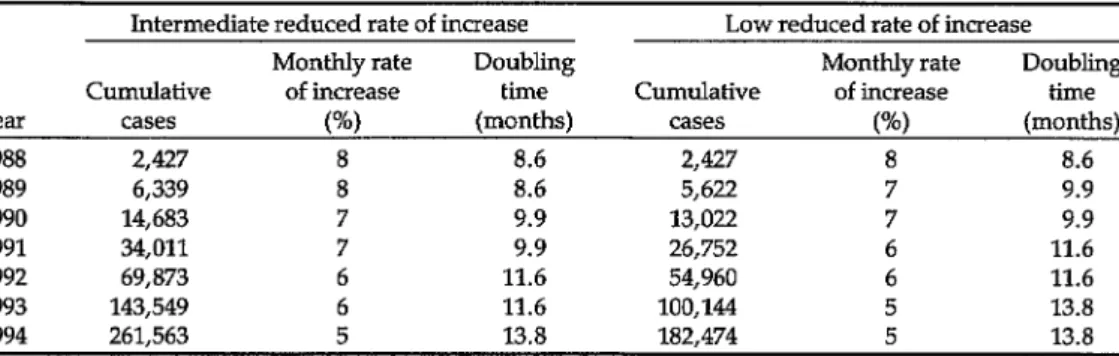
Nationwide, by estimating the number of cases associated with different dou- bling rates, we can project various possi- ble behavior patterns for the epidemic. Table 2 indicates two such possible patterns.
CONCLUSIONS
Overall, the number of AIDS cases in Mexico to date has continued to grow at an exponential rate, despite the deceler- ating growth rate observed in Mexico City. Projections of anticipated AIDS cases based on observed growth rates lead to anticipation of continued expo- nential growth. However, projections of this growth must be reduced in order to incorporate the observations for Mexico
Table 2. Estimates of the cumulative AIDS cases that would be expected in Mexico during 1988-1994, by year of origin, if the incidence rate’s doubling time were prolonged as shown.
Intermediate reduced rate of increase Low reduced rate of increase Monthly rate Doubling Monthly rate Doubling Cumulative of increase time Cumulative of increase time Year cases (%l (months1 cases (%l (months)
1988 2,427 8 8.6 2,427 a 8.6
1989 6,339 8 8.6 5,622 7 9.9
1990 14,683 7 9.9 13,022 7 9.9
1991 34,011 7 9.9 26,752 6 11.6
1992 69,873 6 11.6 54,960 6 11.6
1993 143,549 6 11.6 100,144 5 13.8
1994 261,563 5 13.8 182,474 5 13.8
City, where about 20% of the population and one-third of the AIDS cases in the country are concentrated.
AIDS case projections must also con- sider relevant transmission patterns and sociodemographic factors. For example, HIV is expected to spread most exten- sively in marginal urban and rural set- tings, most commonly afflicting people with low socioeconomic status. Increased transmission of the disease among women and children presages a wider age distribution of AIDS cases, even though most cases are still expected to occur among young men.
In this same vein, although the upward trend in HIV transmission among homo- sexual males is expected to persist, the proportion of AIDS cases among exclu- sively homosexual males is expected to decline because of increased HIV trans- mission among bisexuals and heterosex- uals. It also seems probable that AIDS cases associated with receipt of blood and blood products will decline over the next four years or so as a result of HIV detec- tion in blood donors.
REFERENCES
1.
2.
3.
4.
5.
6.
Quinn, T. C., J. M. Mann, J. W. Curran, and l? Piot. AIDS in Africa: An epidemio- logic paradigm. Science 234:955-963,1986. Curran, J. W., H. W. Jaffe, A. M. Hardy, W. M. Morgan, R. M. Selik, andT. J. Dondero. Epidemiology of HIV infection and AIDS in the United States. Science 239:610-616, 1988.
St. John, R. K., and F. Zacarfas. Status of AIDS in the Americas. Paper presented at the III International Conference on Ac- quired Immunodeficiency Syndrome held in Washington, D.C., l-5 June 1987. Valdespino, J. L., J. Sepulveda, J. A. Iza- zola, et al. Patrones y predicciones epide- mioldgicas de1 SIDA en Mexico. Salud Pliblica Mex 30(4):567-592, 1988.
Rot, P., F. A. Plummer, F. S. Mhalu, J. L. Chin, and J. M. Mann. AIDS: An intema- tional perspective. Science 239:573-579, 1988.
Direction General de Epidemiologfa. Si- tuaci6n de1 SIDA en MCxico hasta el pri- mero de junio de 1988. Bol Mens SIDA (Mtkico) 2 (6):322-330,1988.