Original Article
Pathological manifestations and immune responses of serotypes Ia and III
Streptococcus agalactiae
infections in Nile tilapia (
Oreochromis niloticus
)
Atchariya Suwannasang
1, 2, Machalin Dangwetngam
1, Akkarawit Issaro
1, Wutiporn Phromkunthong
1,
and Naraid Suanyuk
1*
1 Kidchakan Supamattaya Aquatic Animal Health Research Center,
Department of Aquatic Science, Faculty of Natural Resources, Prince of Songkla University, Hat Yai, Songkhla, 90112 Thailand.
2 Aquaculture Program, Faculty of Agricultural Technology,
Phuket Rajabhat University, Mueang, Phuket, 83000 Thailand.
Received: 25 April 2014; Accepted: 25 June 2014
Abstract
Streptococcus agalactiae (Group B Streptococcus, GBS) infections cause serious worldwide damage to fish farming. Here, we evaluated the pathological manifestations and immune responses of Nile tilapia (Oreochromis niloticus) infected with GBS serotype Ia (GBS-Ia) and GBS serotypes III (GBS-III). Experimental infection of fish with GBS by intraperitoneal injection indicated the severity of GBS-Ia infection as shown by the LD50 of GBS-Ia and GBS-III, being 1.58106 CFU/fish
and 2.10108 CFU/fish, respectively. The onset of disease and clinical observation revealed notable differences between the
GBS-Ia and GBS-III infections. Histological findings showed severe changes of the liver, pancreas, kidney and brain of fish infected with GBS. In addition, significantly different haemato-immunological parameters were observed between GBS-Ia and GBS-III infected fish. Differences in the pathological manifestations and immune responses of GBS-Ia and GBS-III infections in tilapia are of practical use for fish pathologists who monitor tilapia mortality resulting from GBS infections.
Keywords: Streptococcus agalactiae, tilapia, pathology, immune responses
1. Introduction
Streptococcosis is an emerging disease causing mass mortality in a variety of fish species. Recent reports demon-strate that streptococcal infections are occurring in Asia, where streptococci have been isolated from sea bream (Sparus auratus), wild mullet (Liza klunzingeri) and silver pomfret (Pampus argenteus)in Kuwait (Evans et al., 2002; Duremdez et al., 2004), and from tilapia (Oreochromis spp.), Asian sea bass (Lates calcarifer) and golden pompano
(Trachinotus blochii) in Thailand and Malaysia (Suanyuk et al., 2008, 2010; Zamri-Saad et al., 2010; Amal et al., 2012). Traditional classification of streptococci is usually based on the serogrouping of the carbohydrate antigens of the cell wall and haemolytic activity. Only Lancefield serogroup B corresponds to a single streptococcal species, Streptococcus agalactiae (Group B Streptococcus, GBS) (Evans et al., 2002). GBS is an important pathogen affecting humans and animals, including aquatic species. (Rasheed et al., 1985; Martinez et al., 2000; Evans et al., 2002; Duremdez et al., 2004; Straková and Motlová, 2004; Ip et al., 2006). The main clinical signs of GBS infection in fish include erratic swimming, loss of appetite, lethargy, unilateral or bilateral exophthalmia, corneal opacity and visceral cavity distension (Salvador et al., 2005;
* Corresponding author.
Email address: [email protected]
Suanyuk et al., 2008). Based on the composition of the capsular polysaccharide, GBS can be sub-divided into ten serotypes (Ia, Ib and II to IX ) (Imperi et al., 2010). Among GBS isolates from infected tilapia, GBS-Ia, Ib and III are the most common serotypes (Evans et al., 2008; Suanyuk et al., 2008; Rodkhum et al., 2011). Two distinguishable GBS are known to infect tilapia cultured in Thailand. One of these belongs to serotype Ia and contains genes encoding proteins C (bca)and C (bac), three insertions sequences (IS1381, IS861 and ISSag2) and the group II intron GBSi1. The other belongs to serotype III, contains bca, three insertion sequences (IS1381, ISSag1, ISSag2) and a tetracycline resistance gene (tetM) (Suanyuk et al., 2008). Despite progress in diagnosis and genotyping of GBS isolated from infected fish, the pathological basis of the disease caused by different serotype of GBS has not been addressed. The aims of the present study were to define the pathological manifestation and immune responses of Nile tilapia (Oreochromis niloticus) infected with GBS-Ia and GBS-III.
2. Materials and Methods
2.1 Fish
Healthy Nile tilapia (Oreochromis niloticus) with an average weight of 5 g were obtained from a commercial hatchery in Phatthalung province, southern Thailand. The fish were cultured to experimental size in three-tonne fiber glass tanks with aeration. During the cultivation and acclimatiza-tion period, they were fed daily to satiaacclimatiza-tion with commercial feed and a sub-sample was cultured and determined to be free of pathogenic bacteria.
2.2 Bacteria
Bacterial strains used in this study were obtained from previous study (Suanyuk et al., 2008). The GBS-Ia isolate (genotype Ia-bca-bac-IS1381-IS861-GBSi1-ISSag2) was isolated from diseased tilapia in Nakhon Si Thammarat province and GBS-III isolate (genotype III-4-bca-IS1381 -ISSag1-ISSag2-tetM-intTn) was isolated from infected tilapia cultured in Songkhla province. A pure culture of the strain was kept at -70°C; to prepare for infecting fish, a sterile tryptic soy agar (TSA) was inoculated with a loop of the frozen culture and incubated at 30°C for 24-48 h. This plate was kept at 4°C and subculturing onto new plates was performed every week to keep the culture alive. Prior to use, the bacteria were inoculated intraperitoneally (i.p.) in Nile tilapia, and aseptically re-isolated from the brain of a mori-bund fish to select for virulence. The bacterial colonies were confirmed to be GBS by standard biochemical methods as well as polymerase chain reaction (Suanyuk et al., 2008). The Lancefield group antigen and serotype of GBS isolates were confirmed by means of a Slidex Strepto Plus (bioMérieux, France) and by group B streptococci typing antisera (Denka Seiken Co. Ltd., Japan), respectively.
2.3 Experimental infectivity trials
Two hundred and seventy Nile tilapia with an average weight of 14.02±3.16 g were used in this study. The fish were kept in a separate 100 L fiber glass tank at 30.5±0.5°C and acclimated for a period of one week before infection. Over-night culture of either GBS-Ia or GBS-IIIin TSB was pelleted by centrifugation at 10,000 g for 10 min at 4°C. The cells were washed twice with phosphate buffer saline (PBS, pH 7.4) and adjusted to the final concentration of approximately 102, 104, 106 and 108 CFU/ml. Viable bacterial count were
determined using drop plating serial dilution technique on TSA. Experimental fish were anaesthetized with 40 mg/l clove oil (Coyle et al., 2004) and were given an i.p. injection with 0.1 ml of each bacterial suspension. The experiment was conducted in triplicates using 10 fish per replication and dose level. A control group was similarly inoculated with sterile PBS. Daily mortality and clinical signs were recorded for 4 weeks and relative virulence of the GBS-Ia and GBS-III were assayed by determining the fifty percent lethal dose (LD50) using the probit analysis program developed by
Luangthuvapranit (1988). Fresh tissue samples of all dead fish were collected and bacterial cells were isolated and identified to fulfill Koch’s postulates. Mortality was consi-dered only if the GBS was reisolated from the infected organs and biochemically confirmed.
2.4 Histopathology
Infected tissues obtained from experimental infectivity trials were fixed in 10% buffered formalin and processed using standard histological techniques (Humason, 1979). Histological sections were cut at 3-5 µm and stained with haematoxylin and eosin (H&E). Stained sections were examined under a light microscope. Control samples were examined in parallel, representing the same tissue type but from the control group of fish.
2.5 Haemato-immunological parameters
One hundred and eighty Nile tilapia with an average weight of 27.16±7.46 g were used in this study. Before infec-tion the fish were acclimatized for 1 week in a 100 l fiber glass tank with dechlorinated water and aeration system, at 30.5± 0.5°C. The fish were fed twice daily with a commercial feed. The experiments were conducted in triplicates with 20 fish per replication. Each group was i.p. injected with 0.1 ml of GBS-Ia or GBS-III (approximately 107 CFU/fish). A control
cyanamet-haemoglobin according to Blaxhall and Daisley (1973). Haematocrit (Ht) was measured using the method of Larsen and Snieszko (1961). Total plasma protein was determined colorimetrically by the method of Lowry et al. (1951), see Supamattaya et al. (2000).
Plasma lysozyme activity was measured based on a turbidimetric assay with a microplate reader, according to Demers and Bayne (1997). Plasma (25 l/well) was added to 175 ml of Micrococcus lysodeikticus (Sigma) suspension and the plate was read at a wavelength of 450 nm. Hen egg white lysozyme was used as an external standard. The reduction rate in the absorbance of the samples was converted to lysozyme concentration (g/ml) using a standard curve.
The respiratory burst activity of the leucocytes was determined using the reduction of nitroblue tetrazolium to formozan as a measure of superoxide anion (O2-) production.
The absorbance at 630 nm was measured spectrophoto-metrically in triplicate with a microplate reader (Model PowerWaveX, Biotek) using DMSO/KOH alone as a blank (Stasiak and Baumann, 1996).
Head kidney leucocytes were isolated under sterile conditions according to Chung and Secombes (1988). Leucocyte phagocytic activity and phagocytic index were measured following the method of Thuvander et al. (1987).
2.6 Statistical analysis
Blood and non-specific immune response data were analyzed by ANOVA followed by means comparisons using Duncan’s multiple-range test. A significant difference satisfies p<0.05.
3. Results
3.1 Experimental infectivity trials
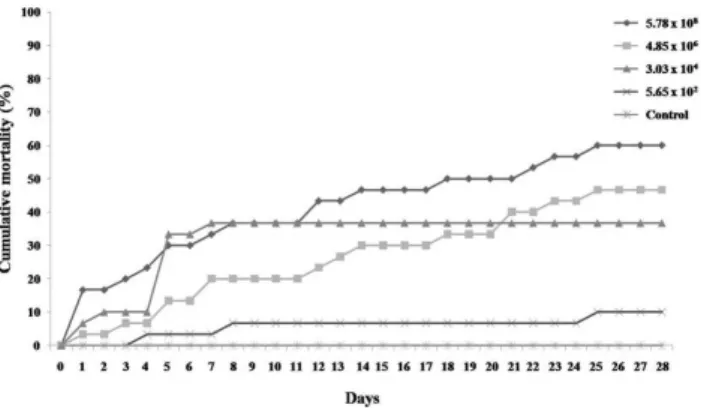
Inoculation and reisolation of GBS-Ia and GBS-III from dead fish established the organisms as pathogenic for the fish and confirmed Koch’s postulates. The fish injected with GBS-Ia exhibited both early- and late-onset disease and mortality occurred continuously throughout the induction of disease experiment. Infected fish exhibited 10-60% mortality (Figure 1), with a 28 day-LD50 of 1.58106 CFU/fish. Fish
injected with GBS-III exhibited only early-onset disease, with high mortality only during the first week after infection. Infected fish showed 16–50% mortality, with a 28 day-LD50
of 2.10108 CFU/fish (Figure 2).
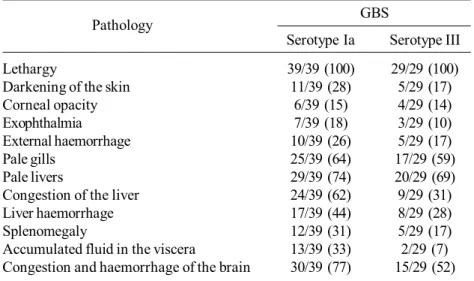
Sixty eight moribund fish obtained from both GBS-Ia and GBS-III infection were observed clinically. Of these, 39 originated from GBS-Ia infection and 29 from GBS-III infec-tion. No abnormal behavior was observed in the control fish injected with PBS. Clinical observation indicated that fish infected with GBS began to show clinical signs within 10 h post infection. Clinical manifestations due to experimental infection included lethargy, darkening of the skin, abnormal swimming, and some fish dying without showing any prior
clinical signs. After 2 dpi, infected fish showed listless circling at the water surface, redness of lip, and external haemorrhage. Corneal opacity and exophthalmia (uni- and bi-lateral exophthalmia) were observed during 3 and 5 dpi. Gross pathology study indicated that GBS-Ia produces higher virulence than GBS-III. Moreover, GBS-Ia infected fish presented 18% exophthalmia, 44-62% congestion and haemorrhage of the liver and 77% congestion and haemorrhage of the brain, whereas the fish infected with GBS-III showed 10%, 28-31% and 52% of exophthalmia, congestion and haemorrhage of the liver and congestion and haemorrhage of the brain, respectively. Other disease signs of fish infected with GBS are shown in Table 1.
3.2 Histopathology
Histopathological changes in Nile tilapia infected by GBS were found in several organs including liver, pancreas, kidney and brain. In GBS-Ia infected fish, the liver was flooded with red blood cells along with hepatocytic vacuolization and necrosis (Figure 3). The pancreas revealed degeneration of acinar cells and loss of zymogen granules (Figure 4). Brain from infected fish showed meningitis asso-ciated with lymphocytic infiltration (Figure 5). There was shrinkage of the glomerulus associated with necrosis and
Figure 1. Mean percent cumulative mortality of Nile tilapia challenged with different concentrations of GBS- Ia.
degeneration of renal tubule in the kidney (Figure 6). Similar observations were found in GBS-III infected fish (Figures 3-6).
3.3 Haemato-immunological parameters
3.3.1 Blood parameters
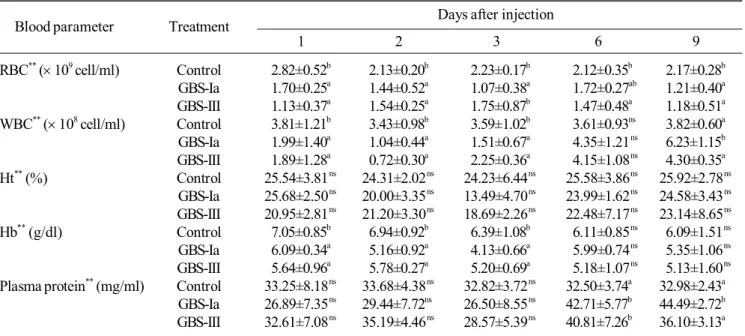
Infected fish produced lower blood parameter values
Table 1. Gross pathology of Nile tilapia infected with GBS-Ia and GBS-III. Values show number of fish exhibiting symptom per number of fish sampled (%).
GBS Pathology
Serotype Ia Serotype III Lethargy 39/39 (100) 29/29 (100) Darkening of the skin 11/39 (28) 5/29 (17) Corneal opacity 6/39 (15) 4/29 (14) Exophthalmia 7/39 (18) 3/29 (10) External haemorrhage 10/39 (26) 5/29 (17) Pale gills 25/39 (64) 17/29 (59) Pale livers 29/39 (74) 20/29 (69) Congestion of the liver 24/39 (62) 9/29 (31) Liver haemorrhage 17/39 (44) 8/29 (28) Splenomegaly 12/39 (31) 5/29 (17) Accumulated fluid in the viscera 13/39 (33) 2/29 (7) Congestion and haemorrhage of the brain 30/39 (77) 15/29 (52)
Figure 3. Liver tissues of Nile tilapia infected with (a) GBS-Ia and (b) GBS-III showing haemorrhage (R), hepatocytic necrosis (N) and high degree of vacuolization (V) (H&E).
Figure 4. Pancreatic tissues (P) of Nile tilapia infected with (a) GBS-Ia and (b) GBS-III showing degeneration of acinar cells and loss of zymogen granules (H&E).
Figure 5. Brain tissues of Nile tilapia infected with (a) GBS-Ia and (b) GBS-III showing meningitis (M) and lymphocytic infiltration (L) (H&E).
Figure 6. Kidney tissues of Nile tilapia infected with (a) GBS-Ia and (b) GBS-III showing shrinkage of glomerulus (G) in the Bowman’s capsule and lymphocytic infiltration (L) (H&E).
value was observed between the infected and the control group (Table 2).
3.3.2 Lysozyme, respiratory burst and phagocytic activities
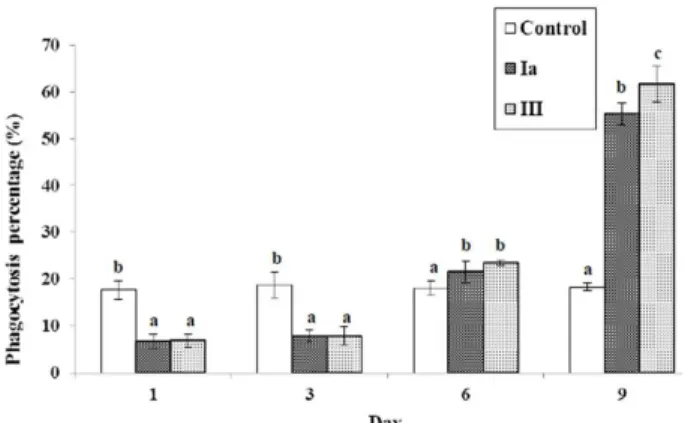
Infected fish exhibited lower immune responses than the uninfected fish. The lysozyme activity was decreased at 2 and 3 dpi, returning to normal value at 6 dpi, and increased at 9 dpi (Figure 7). On the other hand, the respiratory burst activity was increased at 3 and 6 dpi and returned to normal by 9 dpi (Figure 8). The phagocytic activity and phagocytic
Table 2. Mean red blood cell count (RBC), white blood cell count (WBC), haematocrit (Ht), haemoglobin (Hb) and plasma protein at 1, 2, 3, 6 and 9 days post infection of Nile tilapia with GBS-Ia and GBS-III*.
Days after injection Blood parameter Treatment
1 2 3 6 9
RBC** ( 109 cell/ml) Control 2.82±0.52b 2.13±0.20b 2.23±0.17b 2.12±0.35b 2.17±0.28b
GBS-Ia 1.70±0.25a 1.44±0.52a 1.07±0.38a 1.72±0.27ab 1.21±0.40a
GBS-III 1.13±0.37a 1.54±0.25a 1.75±0.87b 1.47±0.48a 1.18±0.51a
WBC** ( 108 cell/ml) Control 3.81±1.21b 3.43±0.98b 3.59±1.02b 3.61±0.93ns 3.82±0.60a
GBS-Ia 1.99±1.40a 1.04±0.44a 1.51±0.67a 4.35±1.21 ns 6.23±1.15b
GBS-III 1.89±1.28a 0.72±0.30a 2.25±0.36a 4.15±1.08 ns 4.30±0.35a
Ht** (%) Control 25.54±3.81 ns 24.31±2.02 ns 24.23±6.44 ns 25.58±3.86 ns 25.92±2.78 ns
GBS-Ia 25.68±2.50 ns 20.00±3.35 ns 13.49±4.70 ns 23.99±1.62 ns 24.58±3.43 ns
GBS-III 20.95±2.81 ns 21.20±3.30 ns 18.69±2.26 ns 22.48±7.17 ns 23.14±8.65 ns
Hb** (g/dl) Control 7.05±0.85b 6.94±0.92b 6.39±1.08b 6.11±0.85 ns 6.09±1.51 ns
GBS-Ia 6.09±0.34a 5.16±0.92a 4.13±0.66a 5.99±0.74 ns 5.35±1.06 ns
GBS-III 5.64±0.96a 5.78±0.27a 5.20±0.69a 5.18±1.07 ns 5.13±1.60 ns
Plasma protein** (mg/ml) Control 33.25±8.18 ns 33.68±4.38 ns 32.82±3.72 ns 32.50±3.74a 32.98±2.43a
GBS-Ia 26.89±7.35 ns 29.44±7.72ns 26.50±8.55 ns 42.71±5.77b 44.49±2.72b
GBS-III 32.61±7.08 ns 35.19±4.46 ns 28.57±5.39 ns 40.81±7.26b 36.10±3.13a
*Values in the same column with different superscript differ significantly (p<0.05). Data expressed as Mean ± s.d. (N=6). **Initial fish (uninfected): RBC 2.46109 ± 0.62109 cell/ml, WBC 3.01108 ± 0.62108 cell/ml, Ht 25.03 ± 6.01%, Hb 6.65 ± 1.22
g/dl and plasma protein 32.70 ± 6.58 mg/ml
Figure 7. Plasma lysozyme activity of Nile tilapia at 1, 2, 3, 6 and 9 days post infection with GBS by i.p. injection. Each bar represents mean ± s.d. Different letters stand for statistically significant differences at p<0.05.
Figure 8. Respiratory burst activity of Nile tilapia at 1, 3, 6 and 9 days post infection with GBS by i.p. injection. Each bar represents mean ± s.d. Different letters stand for statisti-cally significant differences at p<0.05.
4. Discussion
GBS infections have a great negative impact on tilapia cultivation worldwide. Among GBS isolates from infected tilapia, GBS-Ia, Ib and III are the most common serotypes (Evans et al., 2008; Suanyuk et al., 2008; Rodkhum et al., 2011). In this study, the taxonomic status of Ia and GBS-III isolates, determined by using the methods described in Bergey’s Manual of Systematic Bacteriology, indicated that these isolates are biochemically and physiologically similar (data not shown). Experimental infection of tilapia demon-strated that GBSis pathogenic to fish. Clinical signs of fish infected with GBS were similar to those reported earlier in tilapia cultured in Thailand, Brazil and Malaysia (Suanyuk
et al., 2008; Mian et al., 2009; Zamri-Saad et al., 2010; Abuseliana et al., 2011). However, while the clinical and histopathological findings revealing that the GBS-Ia and GBS-III infections of tilapia have common features, the onset of disease and clinical observation enabled us to differentiate between the serotypes based on symptoms. The hyperacute and acute disease following GBS-Ia infection, and mortality along with the differences in the LD50, support the clinical
and hemato-immunological data, demonstrating the severity of GBS-Ia infection. Among the human GBS isolates from the US, serotype Ia, III, and V are the most common isolates associated with early-onset disease (Lin et al., 1998). Studies on GBS virulence factors such as the IS1548 which has been reported as causative of neonatal meningitis and endocarditis (Granlund et al., 2001; Safadi et al., 2010) and other GBS virulent related genes are needed to evaluate the patho-genesis of these GBS isolates.
GBS induced invasive systemic infection and led to haemato-immunological changes. Haematology values of infected Nile tilapia were different from those of the control group. Similar results have been reported by McNulty et al. (2003) for tilapia infected with S. iniae and Harikrishnan
et al. (2003) for common carp injected with Aeromonas hydrophila. This result suggests that RBC and WBC counts can be used as indicators of bacterial infection. In this study, significantly elevated WBC was noted in the GBS-Ia infected group on 9-days post infection. The WBCs are normally lower in healthy fish and increase after infection with the pathogen (Jamalzaden et al., 2009)
The innate immune system is also of primary importance in combating infections in fish, including lysozyme and phagocytic cells (Magnadóttir, 2006). Lysozyme is one of the defensive factors against invasion by microorganisms. It cleaves the -(14) linkages between
N-acetylmuramic acid and N-acetylglucosamine in the cell walls of Gram-positive bacteria, thus preventing them from invading (Salton and Ghuysen, 1959; Yano, 1996). Increased lysozyme activity in the GBS infected group in the present study indicates that lysozyme is an important humoral component of the non-specific immune system.
Phagocytic cells play an important role in anti-bacterial defenses by production of toxic oxygen forms during a process called respiratory burst (Neumann et al., 2001). Significantly increased phagocytic activity, phagocytic index and respiratory burst of infected tilapia, from the present investigation, indicates bacterial pathogen killing activity by phagocytes and hence a better immunity (Kumar
et al., 2011).
In summary, the data generated in the present study are of practical use for fish pathologists who determine tilapia mortality resulting from GBS infections. Despite the fact that a type-specific capsular polysaccharide – that prevents the activation of the complement system and inhibits opsono-phagocytosis (Rubens et al., 1987; Chaffin et al., 2000) – is an indispensable GBS virulence determinant, further investi-gation of GBS virulence factor may provide additional useful insights into GBS induced pathogenesis. In addition, the application of effective vaccines against streptococcosis in fish, with different serotypes of GBS,could be investigated.
Acknowledgements
This work was supported by the Higher Education Research Promotion and National Research University Project
Figure 9. Phagocytic activity (%) of Nile tilapia at 1, 3, 6 and 9 days post infection with GBS by i.p. injection. Each bar represents mean ± s.d. Different letters stand for statisti-cally significant differences at p<0.05.
of Thailand, Office of the Higher Education Commission. The authors thank Seppo J. Karrila and Alan F. Geater for editing the manuscript.
References
Abuseliana, A., Daud, H., Aziz, S.A., Bejo, S.K. and Alsaid, M. 2011. Pathogenicity of Streptococcus agalactiae
isolated from a fish farm in Selangor to juvenile red tilapia (Oreochromis sp.). Journal of Animal and Veterinary Advances. 10, 914-919.
Amal, M.N.A., Zamri-Saad, M., Iftikhar, A.R., Siti-Zahrah, A., Aziel, S. and Fahmi, S. 2012. An outbreak of
Streptococcus agalactiae infection in cage-cultured golden pompano, Trachinotus blochii (Lacépède), in Malaysia. Journal of Fish Diseases. 35, 849-852. Blaxhall, P.C. and Daisley, K.W. 1973. Routine hematological
methods for use with fish blood. Journal of Fish Bio-logy. 5, 771-781.
Chaffin, D.O., Beres, S.B., Yim, H.H. and Rubens, C.E. 2000. The serotype of type Ia and III group B streptococci is determined by the polymerase gene within the polycistronic capsule operon. Journal of Bacteriology. 182, 4466-4477.
Chung, S. and Secombes, C.J. 1988. Analysis of events occurring within teleost macrophages during the respiratory burst. Comparative Biochemistry and Physiology Part B Biochemistry and Molecular Bio-logy. 88, 539-544.
Coyle, S.D., Durborow, R.M. and Tidwell, J.H. 2004. Anesthetics in Aquaculture. Publication No. 3900. Southern Regional Aquaculture Center.
Demers, N.E. and Bayne, C.J. 1997. The immediate effects of stress on hormones and plasma lysozyme in rainbow trout. Development Comparative Immunology. 21, 363-373.
Duremdez, R., Al-Marzouk, A., Qasem, J.A., Al-Harbi, A. and Gharabally, H. 2004. Isolation of Streptococcus agalactiae from cultured silver pomfret, Pampus argenteus (Euphrasen), in Kuwait. Journal of Fish Diseases. 27, 307-310.
Evans, J.J., Bohnsack, J.F., Klesius, P.H., Whiting, A.A., Garcia, J.C., Shoemaker, C.A. and Takahashi, S. 2008. Phylogenetic relationships among Streptococcus agalactiae isolated from piscine, dolphin, bovine and human sources: a dolphin and piscine lineage associated with a fish epidemic in Kuwait is also associated with human neonatal infections in Japan. Journal of Medical Microbiology. 57, 1369-1376. Evans, J.J., Klesius, P.H., Gilbert, P.M., Shoemaker, C.A.,
Al Sarawi, M.A., Landsberg, J., Duremdez, R., Al Markouk, A. and Al Kenzi, S. 2002. Characterization of –haemolytic group B Streptococcus agalactiae in cultured sea bream, Sparus auratus, and wild mullet,
Liza klunzingeri (Day), in Kuwait. Journal of Fish Diseases. 25, 505-513.
Granlund, M., Michel, F. and Norgren, M. 2001. Mutually exclusive distribution of IS1548 and GBSi1, an active group II intron identified in human isolates of group B streptococci. Journal of Bacteriology. 183, 2560-2569.
Harikrishnan, R., Rani, N.M. and Balasundaram, C. 2003. Hematological and biochemical parameters in common carp, Cyprinus carpio, following herbal treatment for
Aeromonas hydrophila infection. Aquaculture. 221, 41-50.
Humason, G.L. 1979. Animal Tissue Techniques. W.H. Free-man and Company, San Francisco.
Imperi, M., Pataracchia, M., Alfarone, G., Baldassarri, L., Orefici, G. and Creti, R. 2010. A multiplex PCR assay for the direct identification of the capsular type (Ia to IX) of Streptococcus agalactiae. Journal of Micro-biological Methods. 80, 212-214.
Ip, M., Cheuk, E.S.C., Tsui, M.H.Y., Kong, F., Leung, T.N. and Gillbert, G.L. 2006. Identification of a Streptococcus agalactiae serotype III subtype 4 clone in associa-tion with adult invasive disease in Hong Kong. Journal of Clinical Microbiology. 44, 4252-4254. Jamalzaden, H.R., Keyvan, A., Ghomi, M.R. and Gherardi, F.
2009. Comparison of blood indices in healthy and fungal infected Caspian salmon (Salmo trutta caspius). African Journal of Biotechnology. 8, 319-322.
Kumar, N., Antony Jesu Prabhu, P., Pal, A.K., Remya, S., Aklakur, Md., Rana, R.S., Gupta, S., Raman, R.P. and Jadhao, S.B. 2011. Anti-oxidative and immunohemato-logical status of Tilapia (Oreochromis mossambicus) during acute toxicity test of endosulfan. Pesticide Biochemistry and Physiology. 99, 45-52.
Larsen, H.M. and Snieszko, S.F. 1961. Modification of the microhaematocrit technique with trout blood. Transactions of the American Fisheries Society. 90, 139-142.
Lin, F.Y., Clemens, J.D., Azimi, P.H., Regan, J.A., Weisman, L.E., Philips, J.B., Rhoads, G.G., Clark, P., Brenner, R.A. and Ferrieri, P. 1998. Capsular polysaccharide types of group B streptococcal isolates from neonates with early-onset systemic infection. The Journal of Infec-tious Diseases. 177, 790-792.
Lowry, O.H., Rosebrough, N.J., Farr, A.L. and Randall, R.J. 1951. Protein measurement with the Folin phenol reagent. Journal Biological Chemistry. 193, 265-275. Luangthuvapranit, C. 1988. Methodology for using a
micro-computer to evaluate toxicity in fish. Journal of Science and Technology. 3, 25-38.
Magnadóttir, B. 2006. Innate immunity of fish (overview). Fish and Shellfish Immunology. 20, 137-151.
Martinez, G., Harel, J., Higgins, R., Lacouture, S., Daignault, D. and Gottschalk, M. 2000. Characterization of
71-78.
McNulty, S.T., Klesius, P.H., Shoemaker, C.A. and Evans, J.J. 2003. Hematological changes in Nile tilapia ( Oreo-chromis niloticus)infected with Streptococcus iniae
by nare inoculation. Journal of the World Aquaculture Society. 34, 418-422.
Mian, G.F., Godoy, D.T., Leal, C.A.G., Yuhara, T.Y., Costa, G.M. and Figueiredo, H.C.P. 2009. Aspects of the natural history and virulence of S. agalactiae infection in Nile tilapia. Veterinary Microbiology. 136, 180-183. Neumann, N.F., Stafford, J.L., Barreda, D., Ainsworth, A.J. and
Belosevic, M. 2001. Antimicrobial mechanisms of fish phagocytes and their role in host defense. Develop-mental and Comparative Immunology. 25, 807-825. Rasheed, V., Limsuwan, C. and Plumb, J.A. 1985.
Histopatho-logy of bullminnows, Fundulus grandis Baird and Girard, infected with a non-haemolytic group B
Streptococcus sp. Journal of Fish Diseases. 8, 65-74. Rodkhum, C., Kayansamruaj, P. and Pirarat, N. 2011. Effect of
water temperature on susceptibility to Streptococcus agalactiae serotype Ia infection in Nile tilapia (Oreochromis niloticus). Thai Journal of Veterinary Medicine. 41, 309-314.
Rubens, C.E., Wessels, M.R., Heggen, L.M. and Kasper, D.L. 1987. Transposon mutagenesis of type III group B
Streptococcus: Correlation of capsule expression with virulence. Proceedings of the National Academy of Sciences of the United States of America. 84, 7208-7212.
Safadi, R.A., Amor, S., Hery-Arnaud, G., Spellerberg, B., Lanotte, P., Mereghetti, L., Gannier, F., Quentin, R. and Rosenau, A. 2010. Enhanced expression of lmb gene encoding laminin binding protein in Streptococcus agalactiae strains harboring IS1548 intergenic region. PLoS One. 5, e10794.
Salton, M.R.J. and Ghuysen, J.M. 1959. The structure of di- and tetra-saccharides released from cell walls by lysozyme and Streptomyces F1 enzyme and the
(14) N-acetylhexosaminidase activity of these enzymes. Biochimica et Biophysica Acta. 36, 552-554. Salvador, R., Müller, E.E., Freitas, J.C., Leonhardt, J.H.,
Pretto-Giordano, L.G. and Dias, J.A. 2005. Isolation and characterization of Streptococcus spp. group B in Nile tilapia (Oreochromis niloticus) reared in hapas nets and earth nurseries in the northern region of Parana State, Brazil. Ciência Rural. 35, 1374-1378.
Stasiak, A.S. and Baumann, C.P. 1996. Neutrophil activity as a potential bioindicator for contaminant analysis. Fish and Shellfish Immunology. 6, 537-539.
Straková, L. and Motlová, J. 2004. Active surveillance of early onset disease due to group B streptococci in newborns. Indian Journal of Medical Research. 119 (Suppl.), 205-207.
Suanyuk, N., Kong, F., Ko, D., Gilbert, G.L. and Supamattaya, K. 2008. Occurrence of rare genotypes of Strepto-coccus agalactiae in cultured red tilapia Oreochromis
sp. and Nile tilapia O. niloticus in Thailand – Relation-ship to human isolates? Aquaculture. 284, 35-40. Suanyuk, N., Sukkasame, N., Tanmark, N., Yoshida, T., Itami,
T., Thune, R.L., Tantikitti, C. and Supamattaya, K. 2010. Streptococcusiniae infection in cultured Asian sea bass (Lates calcarifer) and red tilapia ( Oreo-chromis sp.) in southern Thailand. Songklanakarin Journal of Science and Technology. 32, 341-348. Supamattaya, K. 1995 Laboratory Manual for fish Disease
and Parasites. Department of Aquatic Science, Faculty of Natural Resources, Prince of Songkla University. Supamattaya, K., Ruangsri, J., Kiriratnikom, S. and
Song-srichan, N. 2000. The immune system in black tiger shrimp, Penaeus monodon, Fabricius: IV. Normal immuno - physiological values in black tiger shrimp,
Penaeus monodon, Fabricius. Songklanakarin Journal of Science and Technology. 22(suppl.), 597-603. Thuvander, A., Norrgren, L. and Fossum, C. 1987 Phagocytic
cells in blood from rainbow trout (Salmo gairdneri
Richardson) characterized by flow cytometry and electronmicroscopy. Journal of Fish Biology. 31, 197-208.
Yano, T. 1996. The nonspecific immune system: humoral defense. In: The Fish Immune System: Organism, Pathogen, and Environment, Iwama, G., Nakanishi, T. (Eds.), Academic Press, San Diego, pp. 105-157. Zamri-Saad, M., Amal, M.N.A. and Siti-Zahrah, A. 2010.
Pathological changes in red tilapias (Oreochromis