INDEXED
'A I 03C20 PR E RM 001 UlSF 480BOBEERIEITH, MANUEL AHBI/PC ___
"V
WASH NGTN C UF PaHO
IQ
LIMEA36*
'
II.
6
1
'A A £ A
3
' A A11omqr AH MISSN 0256-1859 Vol. 8, No. 3-4, 1987
Epidemiological Assessment of Tuberculosis.
Trends in Some Countries of the Americas
Introduction
The continuity of the tuberculosis transmission chain that keeps the disease endemic in the popula-tion depends on multiple factors. Prominent among them are the prevalence of sources of infection, mainly, cases of bacillary pulmonary tuberculosis; the number of persons infected by each case; and the probability of infected individuals contracting the disease as a result of infection.
The number of infected persons per case depends on the site and type of tuberculosis and the behavior of the patient. The number of exposed persons and the degree of exposure, which in turn depend on population density and type of housing, also influ-ence the number of infected persons. The probabil-ity of contracting the disease depends mainly on the infecting dose and on the immune status of the host, and therefore, on age, sex, nutrition and concomi-tant diseases. In relation to the latter it is well known, for example, that diabetes and the use of corticoste-roids increase the risk of acquiring the disease. Sim-ilarly, infection with human immunodeficiency virus (HIV) significantly increases the risk of contracting tuberculosis (usually about 10%), among infected persons. Infection with HIV interferes with the cellu-lar immune mechanism responsible for destroying mycobacteria. In developed countries such as the United States of America, the age group infected
with tuberculosis and infected with HIV do not over-lap much; in developing countries, however, both infections have greater prevalence in young adults, which could bring about an increase in tuberculosis if HIV infection spreads. In Brazil, 17% of the AIDS cases are discovered through tuberculosis.
In developed countries, improvement of socio-economic conditions contributed to a gradual reduction of approximately 5% annually of endemic disease; and when control measures such as diagno-sis, treatment, vaccination and chemoprophylaxis were added, this reduction reached 14% annually in countries with better health programs(l). The decrease in mortality from tuberculosis in the coun-tries of nothern Europe and the United States of America began at the end of last century, long before chemotherapy. In less developed countries, how-ever, the effect of socioeconomic development is much smaller and a decrease in endemic disease does not occur without an effective control program. This control program must have enough coverage and quality to be able to break the transmission chain. Although the latter goal is more difficult to attain, the impact of such a program may be greater in a developing country. In developed countries the dis-ease occurs among the aged population, as a conse-quence of old infections, and cannot be prevented by the principal control activities.
IN THIS ISSUE...
* Epidemiological Assessment of Tuberculosis Trends in Some Countries of the Americas * Epidemiological Activities in the Countries
* Acquired Immunodeficiency Syndrome * AIDS Surveillance in the Americas
* Progress in Epidemiology
* Regional Course on Gerontology, Geriatrics, and Administration of Services for the Elderly
* Diseases Subject to International Health Regulations * Calendar of Meetings
* To our Readers
1
Epidemiological Indicators
In general, evaluation of the status of tuberculosis is based on a combination of estimates of three indicators, i.e., risk of infection, incidence, and mortality, along with knowledge of socioeconomic and sanitary conditions in the country and the quality and coverage of program activities. The most frequently used indicators are discussed below.
Risk of infection, or the probability of an individ-ual being infected in a year. Obtaining this indicator requires prevalence studies of infection, with tuber-culin tests in representative samples of the child population, repeated at several years intervals. This is the most useful indicator; however, vaccination with BCG, infections with nontuberculous myco-bacteria and the mobility of the population make its obtention difficult.
Case incidence, especially of smear positive pul-monary tuberculosis in young adults. This indicator is useful only when the case detection program achieves good coverage, its intensity is maintained relatively constant, and there is good reporting and quality of registration .
Mortality. This indicator is greatly affected by the program for case finding and treatment, and usually decreases more rapidly than transmission. In the absence of control measures its trend is similar to that of the risk of infection and incidence. It is useful as an indicator in countries with high mortality where mortality reduction is a priority objective.
Current Situation and Trends in Incidence and Mortality
In 1983 an analysis of the information available on annual reported incidence of new cases and mortal-ity from tuberculosis in countries of the Americas with more than 100,000 population was performed at the PAHO/WHO Regional Office. The work was done with the cooperation of the WHO Collaborat-ing Center for Tuberculosis Epidemiology in Santa Fe, Argentina. The resulting document was distrib-uted to countries with the request that they provide the Collaborating Center, on a regular basis, with annually updated information on reported cases by age, site and bacteriology; and on mortality by age. With those data a second document(2) was pre-pared, on which this paper is based.
In general, for the population of the developed countries in the Region-Canada and the United States of America-annual reductions of nearly 6% in the risk of becoming ill from tuberculosis are estimated. These countries lack an "active" control program with national coverage, but have ample
resources for highly effective diagnosis and treat-ment in addition to the historical trend resulting from their socioeconomic development. In recent years reported incidence in the United States has stabilized at 10% above expected figures. The two most important factors affecting this trend are the immigration of persons with a greater prevalence of infection and risk of becoming ill-from countries of Southeast Asia and Latin America-and the rapid spread of infection with HIV.
In countries of Latin America the trend varies according to the level of development, quality of the health care system, and coverage and quality of control measures. The average reduction is esti-mated at 6% annually. There is a latent period of several years between improvement or deterioration of program activities and its reflection in the indica-tors. Hence a program with improved organization will initially produce an increase in reported cases-especially smear positive-followed by a reduction in mortality and a stabilization of reporting, then a reduction in incidence, greater among young people. It should be reiterated that the epidemiological indi-cators cannot be interpreted independently of oper-ational factors of the programs, especially with respect to data obtained from the notification registries.
Trend differences in Latin America can be illus-trated by the tuberculosis situation in some coun-tries (Figure 1). Cuba, for example, has a good health care delivery system and a well-organized tuberculosis control program; coverage of practi-cally 100% of children with BCG; case finding among patients with respiratory symptoms who consult the general health services, through sputum smear and culture; and treatment with high compliance. The result has been an annual reduction of incidence of 9.6% since 1978, and juvenile tuberculous meningitis has not been observed for 10 years. The incidence level reached is similar to that in Canada and the United States, although the average age of cases is lower.
On the other hand, Costa Rica, with a much slower reduction-approximately 6% annually in incidence before 1975 and around 9% annually in mortality-has also reached very low levels. This is partly explained by an effective, ongoing program, although of limited coverage in some areas due to lack of integration of symptomatic case finding into the social security health services system. From 1977 to 1983 sharp increases in reporting and a continued decline in mortality were observed; this can be interpreted as an increase in diagnoses-in large measure through immigration due to political instability in Central America-followed by good treatment of the cases detected. A reactivation of the
Figure 1. Reported incidence of tuberculosis (per 100,000
popu-lation) in Brazil, Canada, Chile, Costa Rica, Cuba and the United States of America, 1974-1986.
100 90
80
70
60
50
40
30
20
10
5
1975
I
1980 1985
probably a good reflection of the national trend (Figure 2). The annual risk of infection is estimated at approximately 0.9%, ranging from 0.2% in the south to 2% in the north of the country.
In Chile the intensity of case finding efforts has increased yearly. This may be observed through the annual number of sputum smears performed in the country for diagnosis of tuberculosis. Treatment has also improved, currently utilizing an abbreviated scheme of seven months includingjust one month of daily treatment with completely supervised adminis-tration. As a result of the real reduction in incidence and greater case-finding efforts, the reported inci-dence decreased gradually by 5.6% annually from 1976 to 1985, while the yield, as measured by the proportion of positive sputum smears, decreased rapidly. Mortality decreased by 9.9% annually between 1981 and 1985.
Figure 2. Tuberculosis mortality (per 100,000 population) in Argentina, Brazil, Chile, Ecuador, Peru and Uruguay, 1974-1985.
30
Years
20
program, currently in progress, should give rise to a new peak in the detection of cases.
In Brazil the existent program, which had less than 600 health services units and approximately 23,000 specialized beds, was gradually merged into the general health services of the States in the 1970s. Currently approximately 4,000 health services units are incorporated into an integrated program, with less than 3,000 specialized beds, almost all in general or chest hospitals. At the same time, notification increased from 47,000 cases in 1974 to 88,000 in 1984 and stabilized at an estimated 80% of the real inci-dence that can be detected with the technology available in the country. Information at the national level represents an average of the trends and levels of the problem, as well as of the coverage and quality of information, in the individual States. An average minimum reduction in real incidence of 6% annually can be assumed; mortality in state capitals, on the * other hand, is declining by 11% annually, which is
o
o
o
o-0.
cR
m
10
9
8
7 6 5
4
3
2
1
1975
Brazil
Chile
Costa Rica
United States
' Canada Cuba , I I I I I I I I I I I I I
Peru
Uruguay
I I I 1 1 1 1 1 I I
1980 1985
Years
3
a
m a o
a
o
It is more difficult to interpret data from countries where the program and the information systems are inefficient. In Mexico, for example, it is estimated that less than half the cases are reported; 10 years ago the number of reported cases was almost the same as the number of deaths registered by the vital statistics system. The increase in reported cases is not due to extension of the program but to the incorporation of the cases treated by the Social Security health care system into the reports of the services of the Ministry of Health. The 7% annual reduction in reported cases from 1974 to 1978, when there were no changes in the program, may be real; however, this would not be true for real incidence rates which are probably much higher.
In countries with high incidence such as Haiti, Bolivia, Paraguay and Peru, the problems of cover-age of the health infrastructure coincide with the scarcity of resources for tuberculosis control activi-ties. This is the case especially with respect to the provision of drugs, and supervision of services with integrated actions necessary to maintain case find-ing and assure compliance with treatment. As a result the reported incidence, although high, is much lower than the real incidence. In addition, interrup-tion of treatment for lack of drugs or abandonment by patients produces a large number of drug-resistant cases which survive a long time and con-tribute to maintenance of the transmission chain. Changes in incidence in these countries are basically due to variations in case finding intensity and com-pleteness of registration. This is observed especially in Haiti.
In spite of the limitations described, mortality seems to be decreasing continuously in most coun-tries, reflecting gradual improvements in treatment and, in general, in the quality of the tuberculosis program and the health care systems in the Region (Figure 2).
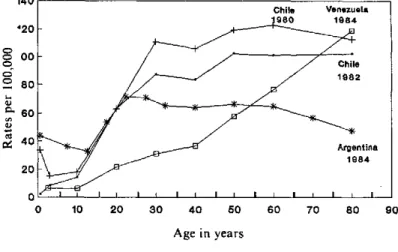
The age distribution of tuberculosis incidence rates illustrates another aspect of the problem (Fig-ure 3). Although the magnitude of the rate depends greatly on diagnostic coverage, it shows the risk accumulated in countries by age cohorts. In devel-oped countries incidence increases in proportion to age, as a result of risk accumulated over a lifetime, and exposure to greater risks in prior decades. In developing countries the risk of infection is high and the "pool" of uninfected is rapidly exhausted, which explains the peak incidence of disease among young adults. In Venezuela the curve by age is similar to that of a developed country, whereas in Argentina there is still a peak among the young. In Venezuela the older age groups were exposed to greater risks than in Argentina, but that situation has been
re-Figure 3. Reported incidence of tuberculosis (per 100,000 popu-lation) by age-groups in Argentina (1984), Chile (1980 and 1982) and Venezuela (1984).
o
o o
o
L
a>
m
iz
0 10 20 30 40 50 60 70 80 90
Age in years
versed in the last 40 years. In Chile the curve by age is changing; the risk is high but has rapidly diminished
in recent years.
Conclusions
Appropriate analysis of the data on incidence and mortality, accompanied whenever possible by information on the risk of tuberculosis infection or the prevalence of infection among children, allows measurement of the long-term result of tuberculosis control measures as well as the effect of nonspecific factors, including socioeconomic development and development of the health care system. For most of Latin America, levels of annual reductions close to those of developed countries of the Region have been achieved through organized control programs. The average reduction is estimated at 6% annually at the very least, which would reduce real rates by half in 11 years and the absolute number of cases in 18 years. These estimates refer to real incidence, since observed incidence depends on operational factors and will probably increase as coverage of the pro-gram improves and new diagnostic methods become available. A real increase in many countries is also possible, if HIV infection spreads rapidly.
Given that data interpretation should lead to pro-gram improvement and should be made in relation to programs, PAHO/WHO has assigned priority for next year to developing a system of evaluation of
program operations through periodic information from countries, similar to that already existing for epidemiological information. The basis for this sys-tem will be discussed, in November 1987, by a work-ing group which will propose basic indicators on coverage and quality of interventions-BCG vac-cines, case finding and treatment-and criteria to assess strategies, resources and intermediate activi-ties for national and international use.
References
(I) Styblo, K. Epidemiology of Tuberculosis. VEB Gustav Fischer Verlag Jena, 1984.
(2) Pan American Health Organization. Tuberculosis: Inci-dencia y Mortalidad. PNSP/87-1 I1, Washington, D.C., 1987.
(Source: Tuberculosis, Maternal and Child Health Program, PAHO.)
Epidemiological Activities in the Countries
Workshop on Improvement of National Informa-tion Systems and Development of Epidemiology
The Latin American and Caribbean Association for Education in Public Health (ALAESP) and the Association of Schools of Public Health (ASPH) of the United States of America, under the sponsorship
of the Pan American Health Organization (PAHO),
are holding a series of meetings, during 1987, at different Latin American schools of public health to explore new forms of cooperation among the schools of both associations aimed at institutional develop-ment, strengthening of educational capabilities, and development of research capabilities.
The meetings are based on the following key top-ics: Analysis of public policies in the health and development context; health information and epidemiology; health economics and financing; human resources for health; technological process in health; and health services systems.
The workshop on Improvement of National Information Systems and Development of Epide-miology was held in Caracas, Venezuela, from 25 to 29 May 1987. The following institutions partici-pated: ALAESP; ASPH; the Schools of Public Health of the University of North Carolina, Colum-bia University, the University of Southern Florida, and the Central University of Venezuela; the Minis-try of Health and Social Welfare of Venezuela, and PAHO. The Schools of Rio de Janeiro and of Medellín were invited to the meeting but were unable to attend.
Current problems in epidemiology practice and training in the Region of the Americas were
dis-cussed, and each of the participating schools pres-ented a status report on their courses and problems. It was noted that efforts to achieve the strengthen-ing of epidemiology in countries of the Region have already begun. Special mention was made of the comprehensive development project for epidemiol-ogy in Venezuela and the projects in the schools of public health of Medellín, México, and Rio de Janeiro; PAHO's activities for information dissemi-nation by means of the Epidemiological Bulletin and the project for dissemination of selected bibli-ography (underway) were underlined, as well as its support and encouragement for meetings on the subject in the Region.
The group was of the opinion that basic epidemi-ology activities should include the analysis of health situation; epidemiological surveillance; evaluation of the impact of programs, services and techniques; and epidemiological research. The need to strength-en the schools of public health in epidemiology, was recognized as an important way to support devel-opment of human resources in this area.
To achieve a strengthening of epidemiology in schools of public health, the group recommended consideration of projects for institutional strength-ening; development of academic and research ca-pabilities; and establishment of an interschool network.
With regard to institutional strengthening the fol-lowing proposals were made: Development of information systems including a system that would permit identification of the various types of resour-ces available in the area of epidemiology; develop-ment of mechanisms and strategies for exchange of
5