INTRODUCTION
The rat is arguably the most commonly used animal model for training and research in plastic surgery.1–11 Its abdominal wall is frequently employed in tissue perfusion
and transference studies.12–18 Oddly, anatomical and histo-logical studies concerning the blood supply to the integu-ment over the ventrolateral aspect of the abdomen of the rat (IOVAAR) are scant and are based on small series of animals.19 Hence, many fundamental questions remain to be clarified, namely the degree of homology between it and that of humans.19 The aim of this work was to charac-terize in detail the macro and microvascular blood supply to the IOVAAR.
METHODS
This study focused on the blood supply to the IOVAAR, defined by the region ventral to the dorsal axillary lines. Two hundred five Wistar male rats weighing 250–350 g were used.
Disclosure: Supported by a grant from “The Programme for Advanced Medical Education” (Dr. Casal), sponsored by “Fundação Calouste Gulbenkian, Fundação Champali-maud, Ministério da Saúde and Fundação para a Ciência e Tecnologia, Portugal.” The Article Processing Charge was paid for by the authors.
Blood Supply to the Integument of the Abdomen of the
Rat: A Surgical Perspective
From the *Plastic and Reconstructive Surgery Department and Burn Unit, Centro Hospitalar de Lisboa Central, Lisbon, Portugal; †Anatomy Department, Nova Medical School, Lisbon, Portugal; ‡UCIBIO, Departamento de Ciências da Vida, Faculdade de Ciências e Tecnologia, Universidade NOVA de Lisboa, Caparica, Portugal; §Glycoimmunology Group, CEDOC, NOVA Medical School, Universidade NOVA de Lisboa, Lisbon, Portugal; ¶Molecular Microbiology and Biotechnology Group, iMed—Research Institute for Medicines, Faculdade de Farmácia Universidade Lisboa, Lisbon, Portugal; ∥CDG & Allies—Professionals and Patient Associations International Network (CDG & Allies—PPAIN), Caparica, Portugal; **LIBPhys, Physics Department, Faculdade de Ciências e Tecnologias, Universidade NOVA de Lisboa, Lisbon, Portugal; and ††Pathology Department, Centro Hospitalar de Lisboa Central, Lisbon, Portugal. Received for publication November 7, 2017; accepted July 7,2017.
Diogo Casal, MD*†‡§ Diogo Pais, MD, PhD† Inês Iria, MSci§¶ Paula A. Videira, PhD‡§∥
Eduarda Mota-Silva, MSci** Sara Alves, MSci†† Luís Mascarenhas-Lemos, MD†† Cláudia Pen, MSci†† Valentina Vassilenko, PhD** João Goyri-O’Neill, MD, PhD†
Background: Many fundamental questions regarding the blood supply to the integ-ument of the rat remain to be clarified, namely the degree of homology between rat and humans. The aim of this work was to characterize in detail the macro and microvascular blood supply to the integument covering the ventrolateral aspect of the abdominal wall of the rat.
Methods: Two hundred five Wistar male rats weighing 250–350 g were used. They were submitted to gross anatomical dissection after intravascular colored latex injection (n = 30); conversion in modified Spalteholz cleared specimens (n=10); intravascular injec-tion of a Perspex soluinjec-tion, and then corroded, in order to produce vascular corrosion casts of the vessels in the region (n = 5); histological studies (n = 20); scanning electron microscopy of vascular corrosion casts (n = 10); surgical dissection of the superficial caudal epigastric vessels (n = 100); and to thermographic evaluation (n = 30).
Results: The ventrolateral abdominal wall presented a dominant superficial vascular system, which was composed mainly of branches from the superficial caudal epigastric artery and vein in the caudal half. The cranial half still received significant arterial contributions from the lateral thoracic artery in all cases and from large perforators coming from the intercostal arteries and from the deep cranial epigastric artery. Conclusions: These data show that rats and humans present a great deal of ho-mology regarding the blood supply to the ventrolateral aspect of the abdominal integument. However, there are also significant differences that must be taken into consideration when performing and interpreting experimental procedures in rats. (Plast Reconstr Surg Glob Open 2017;5:e1454; doi: 10.1097/GOX.0000000000001454; Published online 11 September 2017.)
Supplemental digital content is available for this article. Clickable URL citations appear in the text. Copyright © 2017 The Authors. Published by Wolters Kluwer
Health, Inc. on behalf of The American Society of Plastic Surgeons. This is an open-access article distributed under the terms of the Cre-ative Commons Attribution-Non Commercial-No DerivCre-atives License 4.0 (CCBY-NC-ND), where it is permissible to download and share the work provided it is properly cited. The work cannot be changed in any way or used commercially without permission from the journal.
DOI: 10.1097/GOX.0000000000001454
All the animals were housed under standard environ-mental conditions and given nothing by mouth 6 hours before surgical procedures.
All in vivo studies were performed in strict accordance with the recommendations in the Guide for Proper Con-duct of Animal Experiments and Related Activities in Aca-demic Research and Technology, 2006.
The protocol was approved by the Institutional Animal Care and Use Committee and Ethical Committee at the authors’ institution (08/2012/CEFCM).
Gross Anatomical Dissection
In 30 rats, a 22G catheter was introduced in the left ventricle and another in the right ventricle. A volume of 180–200 ml/kg of a red colored latex solution (Robialac) was introduced in the left ventricle and a volume of 300– 350 ml/kg of a blue colored latex solution (Robialac) was introduced in the right ventricle, until good peripheral contrast perfusion was noted. Subsequently, the rats were submitted to abdominal wall dissection to characterize the origin of the supplying vessels. This technique allows to highlight the vessels as they are normally observed during surgical procedures.20
In 10 rats subjected to a similar procedure, the IOVAAR was converted into modified Spalteholz cleared specimens.21 This technique creates transparent 3-dimen-sional specimens, while preserving vascular and perivascu-lar structure.22
Five rats were submitted to a left ventricular injection of a Perspex solution, and then corroded, to produce vas-cular corrosion casts of the vessels in the IOVAAR. Vascu-lar corrosion casts produce a faithful replica of vascuVascu-lar beds, allowing detailed 3-dimensional morphological analysis of even small vessels.23
All identified perforator vessels were plotted on a Car-tesian grid centered on the pubic symphysis.
Microscopic Anatomical Study—Optical Microscopy
Ten rats were submitted to surgical collection of the IOVAAR, which was fixed in 10% paraformaldehyde and prepared for histological examination, using hema-toxylin-eosin and Masson’s trichrome stains, as well as immunohistochemistry for CD31 for staining the endo-thelium24–26 and for neurofilaments for staining nerves.27 Rats were submitted to axial sections in the caudal, mid-dle, and cranial aspect of both sides of the abdomen. Ten additional rats were subjected to the preparation just de-scribed and their largest integumentary veins were sec-tioned longitudinally for evaluation of venous valves.
Microscopic Anatomical Study—Scanning Electron Microscopy of Vascular Corrosion Casts
Ten rats were submitted to intravascular injection of a resin cast (Mercox) and latter corroded.28 The vascu-lar casts were processed and examined using 2 scanning electron microscopes (acceleration voltage of 2–30 kV): a JEOL JSM-5410, for histomorphometric analysis, and a JEOL JSM-7001F, for obtaining high-quality images. Vas-cular casts were interpreted according to Aharinejad and Lametschwandtner.28
Surgical Anatomy of the Superficial Caudal Epigastric Vessels
In 100 rats used for surgical training and experi-ments, the origin of the superficial caudal epigastric vessels (SCEVs) was registered on the left side of the ab-domen.
The specimens were photographed using adequate mi-croscopes. Vessels’ dimensions were determined using the ImageJ software.
Thermographic Evaluation
In 30 rats, thermographic assessment of the IOVAAR was performed with a FLIR E6 camera placed 25 cm above the abdomen. Evaluations were done after the rats were anesthetized intraperitoneally with a mixture of ketamine and diazepam and placed on their backs for 10 minutes. The day before the evaluation, animals were lightly anesthetized and the hair of the abdomi-nal area removed using a depilatory cream. Evaluations were performed at a constant room temperature (22ºC) and humidity (50%).29
Statistical Analysis
Qualitative variables were expressed as percentages. Quantitative variables were expressed as means ± SD. The SPSS 21.0 software was used for statistical analysis. The Kolmogorov-Smirnov test was used to assess nor-mality. Analysis of variance and Student’s t test were used to compare averages in normally distributed data. Kruskal-Wallis and Mann-Whitney tests were used to compare means in nonnormally distributed data. Pro-portions were analyzed with the chi-square test or Fish-er’s exact test.
A cluster analysis was performed using a 2-step cluster-ing procedure based on the Schwarz Bayesian criteria to determine the overall distribution of all significant cuta-neous perforators.
A 2-tailed P < 0.05 was considered to be statistically sig-nificant.
RESULTS
Gross Anatomy
Casal et al.
•
Blood Supply to the Abdominal Wall of the Rat
of cases on the right side and 93.3% of cases on the left side). Most of the lateral and cranial aspects of the IOVAAR drained into the tributaries of the large LT vein (thoracoepigastric vein). In all cases, the lateral branch of the SIEV and the branches that originated the LT vein were anastomosed in the lateral aspect of the midportion of the abdomen (Figs. 3, 4).
The IOVAAR received relatively minor contributions from the comparatively diminutive deep inferior epi-gastric system, from the terminal branches of the last 6 intercostal vessels and lumbar/iliolumbar vessels, from the thoracodorsal vessels, from the deep and superficial circumflex iliac vessels, and from the external pudendal vessels.
The Angiosomes of the IOVAAR
The angiosomes of the IOVAAR are represented in Figure 2. The SCEVs presented numerous variations (see figure, Supplementary Digital Content 2, which demonstrates schematic representation of the variations in the origin, termination, and distribution of the SIEA and vein, respectively, and the external pudendal artery (EPA) and vein on the left side of the rat, http://links.lww. com/PRSGO/A504). The frequency of each variation is shown at the top right hand corner of each drawing. The
total number of rats analyzed was 185 (http://links.lww. com/PRSGO/A504). In most cases (71.7%), the SIEA and the EPA originated from a common trunk called pudendoepigastric arterial trunk. In only 28.3% of cases did the SIEA and the superficial EPA arise as isolated vessels. The SIEA and the EPA were each accompanied by a comitant vein that had a parallel course, draining either into the pudendoepigastric venous trunk or into the femoral vein.
After its origin, the SIEA moved obliquely in the di-rection of the axilla. In all cases, this artery divided into 2 branches, being followed in its trajectory toward the axilla by its lateral branch. The lateral branch of the SIEA was larger than its medial counterpart in nearly all cases (94.5% of cases on the right side and 95.6% on the left side). The lateral branch anastomosed with the terminal branches of the LT artery and with the domi-nant perforators originating from the intercostal ves-sels. The medial branch of the SIEA anastomosed with the superficial cranial epigastric artery and/or with per-forators of the deep cranial epigastric artery (Figs. 2–4; Supplementary Digital Content 1, http://links.lww.com/ PRSGO/A503).
The large LT vein could be found in a line drawn from the rat’s hip to the ipsilateral axilla (Figs. 3, 4;
Fig. 2. macrovascular blood supply to the ventrolateral aspect of the rat’s abdominal wall. a, Schematic representation of the angiosomes of the ventrolateral aspect of the rat. the angiosomes of the abdomen studied in the present study are represented are numbered in arabic numerals and represented in different colors. the adjacent angiosomes are numbered in roman numerals and highlighted in different levels of gray. these angiosomes have been represented according to taylor et al.32,33 and Kochi et al.40 B, photograph of the integument covering
Casal et al.
•
Blood Supply to the Abdominal Wall of the Rat
mentary Digital Content 1, http://links.lww.com/PRSGO/ A503). This vein originated at the level of the costal mar-gin from the convergence of 3 veins that drained the me-dial, central, and lateral portion of the cranial aspect of the IOVAAR.
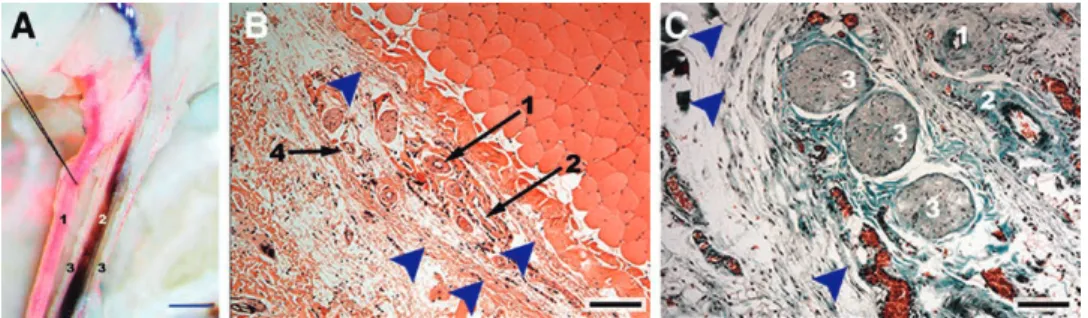
The SIEA and the SIEV were accompanied by a size-able branch of the saphenous nerve—the caudal epigas-tric nerve (Fig. 5). At its origin, the diameter of this nerve was 0.33 ± 0.17 mm. It divided into 2, 3, or 4 branches in the proximal third of the SIEA in 60.6%, 13.1%, and 26.2% of cases, respectively. These branches traveled with the SIEA from its origin and in turn provided multiple twigs throughout the territory of the SCEVs and also to the medial aspect of the thigh.
Musculocutaneous Perforators
Multiple sizeable perforator vessels were seen pierc-ing the muscles and muscular fascia and supplypierc-ing the IOVAAR (Figs. 2–4, 6; Supplementary Digital Content 1, http://links.lww.com/PRSGO/A503). These perforators were most commonly seen arising from the rectus ab-dominis fascia in the central aspect of the abdomen (Fig. 7). In this region, the superficial vascular system was less dense (Fig. 2). The largest central abdominal perforators derived mainly from the deep epigastric vessels and par-ticularly from the cranial deep epigastric vessels. On each side, there were on average 6.52 ± 3.64 perforators on the right side and 6.56 ± 3.67 perforators on the left side, rang-ing between 2 and 15.
Fig. 3. macrovascular blood supply to the ventrolateral aspect of the rat’s abdominal wall. a, pho-tograph under transillumination of the integument covering the left side of the abdomen showing its largest vessels. B, photograph of the left groin region showing the origin of the SCEVs from the femoral vessels; C, photograph of the deep surface of the left rectus abdominis muscle, showing the deep caudal epigastric vessels supplying this muscle; Ca, caudal; Cr, cranial; le, left; la, lateral; m, medial. 1, lt artery; 2, anastomoses between the superficial caudal epigastric arteries and the lt arteries; 3, lateral branch of the SiEa; 4, medial branch of the SiEa; 5, SiEa; 6, femoral vessels and nerve; 7, Deep Epa; 8, superficial Epa; 9, medial branch of the deep caudal epigastric artery; 10, lateral branch of the deep caudal epigastric artery; 11, deep caudal epigastric vessels; 12, cranial deep epigastric artery perforator; 13, xyphoid process; 14, perforators from the medial branch of the deep caudal and cranial epigastric arteries; 15, intercostal perforators; 16, lumbar perforators. Calibration bar = 10 mm.
Overall, 79.1% of perforators originated in the deep epigastric system, whereas 28.1% originated in the seg-mental vessels that supplied the abdominal wall (last 6 intercostal, lumbar/iliolumbar, and the deep circumflex iliac vessels). This difference was statistically significant (P < 0.05). Perforators were more common in the cranial half of the abdomen, that is to say in the region were the axial vessels were inexistent or of a smaller caliber [P < 0.05; Fig. 7; see figure, Supplementary Digital Content 3, which demonstrates a dot plot graph drawn over a schematic drawing of the ventrolateral surface of the rat showing the location of the abdominal perforator arteries in the an-terior and lateral aspect of the abdominal wall and their origin from the paramedian arteries (cranial and caudal deep epigastric arteries) and from the segmental vessels (intercostal, lumbar/iliolumbar arteries), http://links.lww. com/PRSGO/A505]. A 2-step cluster analysis based on the Schwarz Bayesian criteria allowed the identification of 7 musculocutaneous perforator clusters on each side of the abdomen (Fig. 7).
Table 1 summarizes the main histomorphometric fea-tures of the largest vessels supplying the IOVAAR. No sta-tistically significant differences were found between the right and left sides of the body.
Noteworthy is the large direct cutaneous vessels described above were present in areas where the in-tegument was laxer, whereas the musculocutaneous per-forators were placed more densely in the region where the IOVAAR was more adherent to the underlying muscle fascia. Moreover, the perforator vessels were longer in the lateral aspect of the abdomen compared with those that were more centrally placed in the region of the rectus abdominis muscles. Interestingly, on each side of the ab-domen, there was a triangular region, lateral to the lateral branch of the SCEVs, where large vessels were absent (see figure, Supplementary Digital Content 4, which demon-strates a schematic diagram illustrating the safe zones (blue) for subcutaneous and intraperitoneal injections in the ventrolateral abdomen of the rat due to the rela-tive scarcity of large vessels in these areas, http://links.lww. com/PRSGO/A506).
Microscopic Anatomy
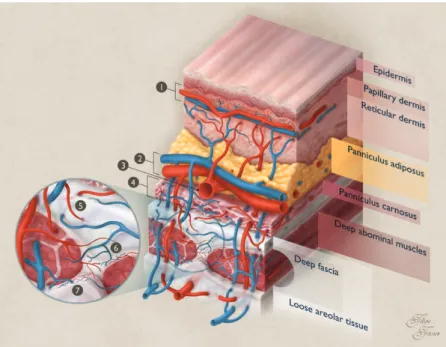
The IOVAAR was composed of multiple layers, includ-ing a sheath of loose connective tissue associated with white adipose tissue and smooth muscle known as pan-niculus carnosus (Fig. 6; see figure, Supplementary Digi-tal Content 5, which displays a general view of the blood supply to the different layers of the ventrolateral aspect of the abdominal wall of the Wistar rat, http://links.lww.com/ PRSGO/A507). Soon after their origin, the large nominat-ed vessels with an axial pattern were found in the pannic-ulus adiposus, immediately superficial to the pannicpannic-ulus carnosus layer. These vessels gave ascending branches to all layers of the IOVAAR, including the panniculus carno-sus. The musculocutaneous perforator vessels originated arterioles and received venules to and from the muscular subfascial, fascial, and epifascial plexuses. Additionally, in their ascending trajectory toward the skin, they gave branches to all the layers of the IOVAAR. Overall, integu-mentary vessels formed fine interconnecting meshworks of predominantly horizontal arrangement, establishing the following vascular plexuses: prefascial plexus, pan-niculus carnosus plexus, panpan-niculus adiposus plexus, sub-dermal plexus, reticular sub-dermal plexus, and subpappilary dermal plexus (Figs. 3–7; Supplementary Digital Content 1, 5, 6; see figure, Supplementary Digital Content 6, which shows details of the blood supply to the different layers of the ventrolateral aspect of the abdominal wall of the Wis-tar rat, http://links.lww.com/PRSGO/A508).
At the subdermal and the subpapillary vascular plex-uses, scattered and rare arteriovenous anastomoses were found. Precapillary sphincters were frequent findings at the subdermal and reticular dermis plexuses. Multiple venous valves were found in all layers of the integument, from the reticular dermis plexus until the major nomi-nated veins. However, the first-order subdermal veins presented large segments devoid of valves. Venous valves were almost always bicuspid, although a few tricuspid valves were observed. All the nominated veins and their tributaries presented venous valves, with the exception of the SIEV itself, which presented no valves in all speci-mens studied (see figure, Supplementary Digital Content
Casal et al.
•
Blood Supply to the Abdominal Wall of the Rat
7, which demonstrates a venous drainage of the integu-ment of the ventrolateral abdomen of the rat, http://links. lww.com/PRSGO/A509; see figure, Supplementary Digital Content 8, which demonstrates details of the microvascu-lar blood supply to the integument covering the ventro-lateral aspect of the abdomen of the rat, http://links.lww. com/PRSGO/A510).
Each of the branches of the caudal epigastric nerve presented a monofascicular pattern (Fig. 5). The average number of nerve fibers in the proximal portion of this nerve was 1093.00 ± 88.32 on the right side and 1051.50 ± 107.39 on the left side, being overall 1072.20 ± 97.80. The differ-ence between sides was not statistically significant.
Thermographic Results
Figure 2 illustrates the typical infra-red thermographic images of the IOVAAR obtained directly and post cool-ing of the rat’s surface. In all cases, direct thermography showed a region of higher temperature corresponding to the territory of the SCEVs and the LT vessels. Post cool-ing thermography, used to highlight perforator vessels, showed a region of higher temperatures in the central and cranial aspect of the abdomen.
DISCUSSION
The IOVAAR has been used regularly for training and research purposes since at least 1967 when the rat
epigastric flap was described.30 Surprisingly, few stud-ies have addressed the macroscopic vascular anatomy of this region.4,7,31–37 Furthermore, the literature on the mi-crovascular blood supply to the rat’s integument is even scarcer, being restricted to the paw and tail regions.28,38 As far as the authors could determine, the present series, comprising 205 rats, is the largest on the macroscopic and
microscopic anatomy of the vascular blood supply to the IOVAAR.
Numerous doubts persist regarding the extent of similarity between the blood supply to this region in hu-mans and rats. Some authors state that the blood supply is relatively similar,31 whereas others argue that it is sub-stantially different.32 Table 2 summarizes the main differ-ences found in the present study. Overall, although there are some strong analogies between rats and the humans, namely a common vascular framework (Figs. 1, 6), there are also some noteworthy differences.
The most striking difference refers to the preponder-ance of the direct cutaneous vessels in the rat, compared with the dominance of the musculocutaneous vessels in humans. Taylor32,33 attributed this difference to the fact that in loose-skinned animals, like the rat, the integument is more mobile relative to the underlying muscles due to the presence of a loose areolar tissue layer between the muscular fascia and the panniculus carnosus (Fig. 6). The corollary of this is a greater dependence on direct cutaneous vessels in loose-skinned animals compared with humans.32,33 Interestingly, in the present study, the greater number of perforators was in fact found close to the mid-line, an in particular in the cranial half of the abdomen, precisely where the integument of the rat was more adher-ent to the underlying muscle fascia (Fig. 7). In this region, the superficial vascular system was less dense (Fig. 1).
Another important difference found in this work rela-tive to humans is that central abdominal perforators in the rat were derived mostly from the deep cranial epigastric artery and not from the deep inferior epigastric vessels as in the former species.34 These findings are supported by the 2 other articles that systematically evaluated the num-ber and location of musculocutaneous perforators of the rat’s abdomen.34,37 Hence, perforator flaps in the IOVAAR seem to be substantially different from those in humans, in terms of vascular homology.
An additional difference relative to humans is the im-portance of the vessels in the panniculus carnosus of the rat for integumentary perfusion. This had already been hinted by the greater survival of flaps that included this layer, comparatively to flaps that excluded it.39 In fact, we observed that, soon after their origin, the major subcuta-neous vessels coursed in the panniculus adiposus
immedi-Fig. 7. Dot plot graph drawn over a schematic drawing of the ven-trolateral surface of the rat showing the location of the abdominal perforator arteries in the anterior and lateral aspect of the abdomi-nal wall. a two-step cluster aabdomi-nalysis based on the Schwarz Bayesian criteria allowed the identification of 7 perforator clusters on each side of the abdomen.
Table 1. Histomorphometric Evaluation of the Major Arteries and Veins Supplying the Ventrolateral Region of the Integument of the Abdomen of the Rat
Vessel Length* (cm) Caliber† (mm) Wall Thickness‡ (μm)
SIEA 1.45 ± 0.22 0.32 ± 0.13 479.07 ± 27.37
SCEV 1.61 ± 0.19 0.65 ± 0.24 183.05 ± 15.63
First divisions of the SIEA 0.72 ± 0.16 0.13 ± 0.08 288.19 ± 31.72 First divisions of the SCEV 0.92 ± 0.18 0.18 ± 0.05 128.24 ± 43.53 Second divisions of the SIEA 0.60 ± 0.12 0.08 ± 0.03 202.38 ± 87.34 Second divisions of the SCEV 0.85 ± 0.20 0.16 ± 0.09 102.63 ± 65.71 Thoracoepigastric vein 4.13 ± 1.59 0.47 ± 0.17 41.67 ± 15.67 First divisions of the thoracoepigastric vein 1.63 ± 0.47 0.17 ± 0.04 0.11 ± 0.09 Second divisions of the thoracoepigastric vein 0.96 ± 0.54 0.14 ± 0.05 0.09 ± 0.08
Values are expressed as average values ± SD.
*Length determination was based on Spalteholz cleared specimens (n = 10).
†Caliber determination was based on Spalteholz cleared specimens (n = 10), on transverse histological sections stained with CD 31 (n = 10) and on the scanning electron microscopy observation of the vascular corrosion casts (n = 10).
Casal et al.
•
Blood Supply to the Abdominal Wall of the Rat
ately superficial to panniculus carnosus. In addition, the panniculus carnosus was provided with a vascular plexus of its own that was connected with the deep vascular system through anastomoses with branches of the musculocutane-ous perforators (Fig. 6; see Supplementary Digital Content 5, http://links.lww.com/PRSGO/A507, and Supplementary Digital Content 6, http://links.lww.com/PRSGO/A508).
Interestingly, the SCEVs in the rat presented nu-merous anatomical variations (Supplementary
Digi-tal Content 2, http://links.lww.com/PRSGO/A504). This had already been demonstrated in mice and hu-mans.40–42
Our data showed that in nearly all cases, the lateral branch of the SIEA was dominant relative to its medial counterpart. This is in accordance with the observations of Petry and Wertham4 who suggested that part of the sur-vival variance of the rat epigastric flap could be explained by the inconsistent incorporation of this branch.
Table 2. Main Differences between the Usual Blood Supply to the Integument of the Ventrolateral Aspect of the Abdomen of Humans33,57 and Rats
Anatomical Structure(s) Humans Rat
Dominant arteries Musculocutaneous (in particular the deep inferior epigastric artery)
Direct cutaneous (in particular the SIEA/superficial inferior epigastric artery)
Dominant veins Superficial and deep veins (in particular the deep inferior epigastric veins and the superficial inferior epigastric vein)
Superficial veins (in particular the LT vein/thoracoe-pigastric vein and the SCEV/superficial inferior epigastric vein)
SIEV Frequently absent or hypoplasic Always present and with a sizeable caliber Perforator vessels Major role in the normal perfusion; more numerous;
more abundant laterally and below the umbilicus
Less important role in integumentary perfusion; less numerous; mostly located in an area cranially to the umbilicus
Venous valves Uniformly present in the superficial and deep venous systems
More abundant in the deep venous system and in the cranial aspect of the superficial venous system Panniculus carnosus Absent Well-developed and associated with a vascular plexus Nerves accompanying
major vessels
Intercostal nerves 7–12 accompanying the homonymous vessels
Intercostal nerves 7–12 accompanying the homony-mous vessels; caudal epigastric nerve/inferior epigastric nerve is a sizeable and constant nerve that is part of the superficial caudal epigastric neurovas-cular bundle
To the best of the authors’ knowledge, the fascial enve-lope surrounding the superficial caudal epigastric neuro-vascular bundle and determining a specific compartment had not been described before. Notwithstanding, it is well known that when dissecting the superficial caudal epigastric pedicle, one has to tease away or to cut a delicate tissue sleeve that surrounds these structures. The superficial caudal epi-gastric fascia resembles the saphenous fascia that surrounds the saphenous veins in the lower limbs.43 Acknowledging this fascial envelope may facilitate dissection of flaps in this region, particularly by novices in microsurgery.
An interesting information provided by this study was the identification of a triangular zone on each side of the IOVAAR where large vessels were absent ( Supplementa-ry Digital Content 4, http://links.lww.com/PRSGO/A506). These zones are probably safer for performing abdominal injections. As far as the authors could determine, these safe zones had not been described before.
Our thermographic analysis suggested that the most important perforators physiologically were located in the central and cranial aspect of the abdomen (Fig. 2). This information concurred with the anatomical dissection studies performed in the present studies and with those described by other authors.34,35 Moreover, our thermo-graphic examination also favored the notion that in nor-mal conditions the superficial vessels were more important for supplying blood to the integument in the caudal and lateral aspects of the IOVAAR, whereas the perforator vessels were more important in the central and cranial aspects. Additionally, these data lend support to the use of thermography as a good technique for evaluating the most important perforator vessels in rats, as it had already been shown in humans by other authors.29
The presence of valves in the veins of the IOVAAR has been a matter of debate.19 Our data show that multiple venous valves are found in all layers of the integument, from the reticular dermis plexus until the major nominat-ed veins (Supplementary Digital Content 5, http://links. lww.com/PRSGO/A507, Supplementary Digital Content 6,
http://links.lww.com/PRSGO/A508, Supplementary Digital Content 7, http://links.lww.com/PRSGO/A509, Supplemen-tary Digital Content 8, http://links.lww.com/PRSGO/A510). However, the subdermal first-order venules presented large segments devoid of valves, which probably facilitate oscillating or bidirectional blood flow.44 All the nominated veins and their tributaries presented venous valves, with the exception of the SIEV (Fig. 1B). Valdatta et al.19 also failed to observe valves inside this vein. Scanning electron microscopy of vascular corrosion casts of human tissues revealed valves in superficial veins as small as 20 µm in di-ameter in different regions of the integument, and in par-ticular in the lower limb, the anterior and posterior walls of the trunk.45 The major difference between humans and rats regarding venous valves in these regions is, thus, the relative paucity of venous valves in the caudal aspect of the dominant venous system of rats, namely in the SIEV. This difference should be born in mind, for example, when us-ing rats in experimental studies of tissue perfusion, name-ly in unconventional perfusion flaps and in particular in arterialized venous flaps.46,47
Human microcirculatory studies have shown that the skin subpapillary plexus presents an abundance of vertically arranged capillary loops, coinciding with the dermal papillae. These loops are more pronounced and numerous in body regions were the skin is thicker and subject to intense forces, namely in weight-bearing regions or the palm of the hands.48 However, in our study and contrarily to what has been described in the skin in the footpad of the rat,48,49 vertical capillary loops in the subpapillary plexus were relatively scarce. Capil-laries were more frequently disposed in a horizontal manner in this region. These findings may be due to the fact that this region of the skin of the rat is thinner, has fewer dermal papillae, and it is not usually submit-ted to intense vertical forces (see Supplementary Digi-tal Content 5, http://links.lww.com/PRSGO/A507, and Supplementary Digital Content 6, http://links.lww.com/ PRSGO/A508).
In concordance with other microcirculatory studies performed in the skin covering the abdomen of humans, the authors found that there were few arteriovenous anastomoses in the IOVAAR.48,50 This suggests that this region probably does not play a primordial role in ther-moregulation.50
This study also lends support to the use of the epi-gastric flap as sensate flap, as proposed by Hirigoyen et al.51 (Fig. 5). This construction has a similar anatomical rationale to that of using the 12th intercostal nerve in the human species to tailor a neurosensible fasciocuta-neous SIEA flap.51 However, a major difference between rats and humans is that in the former the SIEA and the caudal epigastric nerve are proportionally larger and are always present. Additionally, it should be noted that there is no exact human equivalent to the caudal epigas-tric nerve.51
One of the main limitations of the present work is that the histomorphometric data presented probably underestimate vessels’ size, because optical microscopy images, as well as scanning electron microscopy images are known to be associated with vessels’ shrinking during processing, resulting in underestimation of vessels’ size of up to 30%.28,52
Finally, we believe that the anatomical study herein de-scribed helps to better plan, execute, and interpret the evolution of the multiple flaps performed in the IOVAAR for teaching, training, and research purposes (Fig. 8; see pdf, Supplementary Digital Content 9, which displays photographs illustrating the surgical anatomy of a few common flaps made on the ventrolateral aspect of the ab-domen of the rat based on nominated vessels, http://links. lww.com/PRSGO/A511).2,7,30,31,35,53–56
CONCLUSIONS
Casal et al.
•
Blood Supply to the Abdominal Wall of the Rat
Diogo Casal, MD Anatomy Department NOVA Medical School Universidade NOVA de Lisboa Campo dos Mártires da Pátria, 130 1169-056, Lisbon Portugal E-mail: [email protected]
ACKNOWLEDGMENTS
The authors are very grateful to Mr. Filipe Franco and Mr. Nuno Folque for producing the drawings contained in this article.
The authors are very thankful to Professor Maria Angélica Almeida and Dr. José Videira e Castro for their advice in all steps of the research project. The authors also acknowledge the role of Mr. José Ferreira Silva and that of Dr. Mário Ferraz Oliveira in the supervision of the histological specimens.
REFERENCES
1. Miles DA, Crosby NL, Clapson JB. The role of the venous system in the abdominal flap of the rat. Plast Reconstr Surg. 1997;99:2030–2033. 2. Okşar HS, Coşkunfirat OK, Ozgentaş HE. Perforator-based
flap in rats: a new experimental model. Plast Reconstr Surg. 2001;108:125–131.
3. Ozgentaş HE, Shenaq S, Spira M. Development of a TRAM flap
model in the rat and study of vascular dominance. Plast Reconstr Surg. 1994;94:1012–7; 1025.
4. Petry JJ, Wortham KA. The anatomy of the epigastric flap in the experimental rat. Plast Reconstr Surg. 1984;74:410–413.
5. Roberts AP, Cohen JI, Cook TA. The rat ventral island flap: a comparison of the effects of reduction in arterial inflow and ve-nous outflow. Plast Reconstr Surg. 1996;97:610–615.
6. Sano K, Hallock GG, Rice DC. The relative importance of the deep and superficial vascular systems for delay of the transverse rectus abdominis musculocutaneous flap as demonstrated in a rat model. Plast Reconstr Surg. 2002;109:1052–7; discussion 1058. 7. Strauch B, Murray DE. Transfer of composite graft with
immedi-ate suture anastomosis of its vascular pedicle measuring less than 1 mm. in external diameter using microsurgical techniques. Plast Reconstr Surg. 1967;40:325–329.
8. Kayano S, Hallock GG, Rice DC, et al. Instructional models for dissection techniques of perforator flaps. In: Blondeel P, Morris SF, Hallock GG, Neligan PC eds. Perforator Flaps: Anatomy, Technique and Clinical Applications. 2nd ed. Rome: Quality medi-cal publishing, Inc.; 2013;1:97–107.
9. Shurey S, Akelina Y, Legagneux J, et al. The rat model in mi-crosurgery education: classical exercises and new horizons. Arch Plast Surg. 2014;41:201–208.
10. Lee S. Historical events on development of experimental micro-surgical organ transplantation. Yonsei Med J. 2004;45:1115–1120. 11. Siemionow MZ. Microsurgery models. In: Siemionow MZ, ed. Plastic
and Reconstructive Surgery: Experimental Models and Research Designs. 1st ed. London, United Kingdom: Springer - Verlag; 2015:3–67. 12. Fukui A. Microvascular anastomoses in the rat. In: Tamai S,
Usui M, Yoshizu T, eds. Experimental and Clinical Reconstructive Microsurgery. 1st ed. Tokyo: Springer-Verlag; 2004:35–43. 13. Hirase Y. Skin and muscle flaps in the rat. In: Tamai S, Usui M,
Yoshizu T, eds. Experimental and Clinical Reconstructive Microsurgery. 1st ed. Tokyo: Springer-Verlag; 2004:111–114.
14. Morain WD. Historical perspectives. In: Mathes SJ, ed. Plastic Surgery. 2nd ed. Philadelphia, Pa.: Saunders; 2006;1:27–34. 15. Santoni-Rugiu P, Sykes PJ. Skin flaps. In: Santoni-Rugiu P, Sykes
PJ, eds. A History of Plastic Surgery. 1st ed. Leipzig, Germany: Springer; 2007:79–119.
16. Tamai S. The history of microsurgery. In: Tamai S, Usui M, Yoshizu T, eds. Experimental and Clinical Reconstructive Microsurgery. 1st ed. Tokyo, Japan: Springer-Verlag; 2003:3–24.
17. Michaels J, 5th, Levine JP, Hazen A, et al. Biologic brachyther-apy: ex vivo transduction of microvascular beds for efficient, targeted gene therapy. Plast Reconstr Surg. 2006;118:54–65; dis-cussion 66.
18. Lao WW, Wang YL, Ramirez AE, et al. A new rat model for ortho-topic abdominal wall allotransplantation. Plast Reconstr Surg Glob Open. 2014;2:e136.
19. Valdatta L, Congiu T, Thione A, et al. Do superficial epigastric veins of rats have valves? Br J Plast Surg. 2001;54:151–153. 20. Fukui A. Technique of microangiography. In: Tamai S, Usui M,
Yoshizu T, eds. Experimental and Clinical Reconstructive Microsurgery. 1st ed. Tokyo: Springer-Verlag; 2004:55–56.
21. Sempuku T. Technique for making a Spalteholz cleared speci-men. In: Tamai S, Usui M, Yoshizu T, eds. Experimental and Clinical Reconstructive Microsurgery. 1st ed. Tokyo: Springer-Verlag; 2004:59–60.
22. Steinke H, Wolff W. A modified Spalteholz technique with pres-ervation of the histology. Ann Anat. 2001;183:91–95.
23. Sempuku T. Technique for making a vascular corrosion cast. In: Tamai S, Usui M, Yoshizu T eds. Experimental and Clinical Reconstructive Microsurgery. 1st ed. Tokyo: Springer-Verlag; 2004:57–58.
24. Fischer AH, Jacobson KA, Rose J, et al. Hematoxylin and eosin staining of tissue and cell sections. CSH Protoc. 2008;2008:pdb. prot4986.
25. Foot NC. The Masson trichrome staining methods in routine laboratory use. Stain Technol. 1933;8:101–110.
26. Pusztaszeri MP, Seelentag W, Bosman FT. Immunohistochemical expression of endothelial markers CD31, CD34, von Willebrand factor, and Fli-1 in normal human tissues. J Histochem Cytochem. 2006;54:385–395.
27. Raimondo S, Fornaro M, Di Scipio F, et al. Chapter 5: methods and protocols in peripheral nerve regeneration experimental research: part II-morphological techniques. Int Rev Neurobiol. 2009;87:81–103.
28. Aharinejad SH, Lametschwandtner A. Identification and in-terpretation of cast vessel structures. In: Aharinejad SH, Lametschwandtner A, eds. Microvascular Corrosion Casting in Scanning Electron Microscopy: Techniques and Applications. 1st ed. New York, N.Y.: Springer-Verlag; 1992:103–115.
29. Sheena Y, Jennison T, Hardwicke JT, et al. Detection of perfora-tors using thermal imaging. Plast Reconstr Surg. 2013;132:1603– 1610.
30. Gurunluoglu R, Siemionow MZ. The microsurgical groin skin flap in the rat model. In: Siemionow MZ, ed. Plastic and Reconstructive Surgery: Experimental Models and Research Designs. 1st ed. London, United Kingdom: Spronger; 2015:53–62.
31. Dunn RM, Mancoll J. Flap models in the rat: a review and reap-praisal. Plast Reconstr Surg. 1992;90:319–328.
32. Taylor GI, Minabe T. The angiosomes of the mammals and other vertebrates. Plast Reconstr Surg. 1992;89:181–215.
33. Taylor GI, Pan WR. The angiosome concept. In: Dodwell P, ed. The Angiosome Concept and Tissue Transfer. 1st ed. Saint Louis, Missouri: Quality Medical Publishing, Inc.; 2014;1:354–395. 34. Hallock GG, Rice DC. Physiologic superiority of the anatomic
dominant pedicle of the TRAM flap in a rat model. Plast Reconstr Surg. 1995;96:111–118.
35. Hallock GG, Rice DC. Cranial epigastric perforator flap: a rat model of a true perforator flap. Ann Plast Surg. 2003;50:393– 397.
36. Ozkan O, Coşkunfirat OK, Ozgentaş HE, et al. New
37. Ozkan O, Koshima I, Gonda K. A supermicrosurgical flap model in the rat: a free true abdominal perforator flap with a short ped-icle. Plast Reconstr Surg. 2006;117:479–485.
38. Aharinejad SH, Lametschwandtner A. The peripheral sense or-gans. The integument. In: Aharinejad SH, Lametschwandtner A, eds. Microvascular Corrosion Casting in Scanning Electron Microscopy: Techniques and Applications. 1st ed. New York, N.Y.: Springer-Verlag; 1992:354–360.
39. Pearl RM, Johnson D. The vascular supply to the skin: an ana-tomical and physiological reappraisal—Part II. Ann Plast Surg. 1983;11:196–205.
40. Kochi T, Imai Y, Takeda A, et al. Characterization of the arterial anatomy of the murine hindlimb: functional role in the design and understanding of ischemia models. PLoS One. 2013;8:e84047. 41. Gagnon A, Blondeell P. Deep and superficial inferior epigastric
artery perforator flaps. Cirugía Plástica Ibero-Latinoamericana. 2006;32:7–13.
42. Fathi M, Hatamipour E, Fathi HR, et al. The anatomy of superfi-cial inferior epigastric artery flap. Acta Cir Bras. 2008;23:429–434. 43. Abu-Hijleh MF, Roshier AL, Al-Shboul Q, et al. The membranous
layer of superficial fascia: evidence for its widespread distribu-tion in the body. Surg Radiol Anat. 2006;28:606–619.
44. Blondeel PN, Morris NJ, Hallock GG, et al. Vascular territories of the integument. In: Blondeel PN, Morris NJ, Hallock GG, Neligan PC, eds. Perforator Flaps: Anatomy, Technique and Clinical Implications. 2nd ed. St. Louis, MO: Quality Medical Publishing, Inc.; 2013;1:26–52.
45. Caggiati A, Phillips M, Lametschwandtner A, et al. Valves in small veins and venules. Eur J Vasc Endovasc Surg. 2006;32:447–452. 46. Casal D, Cunha T, Pais D, et al. Systematic review and
meta-anal-ysis of unconventional perfusion flaps in clinical practice. Plast Reconstr Surg. 2016;138:459–479.
47. Koyama T, Sugihara-Seki M, Sasajima T, et al. Venular valves and retrograde perfusion. In: Swartz HM, Harrison DK, Bruley DF,
eds. Oxygen Transport to Tissue XXXVI. New York, N.Y.: Springer; 2014;1:317–323.
48. Aharinejad SH, Lametschwandtner A. Microangioarchitecture of selected organ systems: the integument. In: Aharinejad SH, Lametschwandtner A, eds. Microvascular Corrosion Casting in Scanning Electron Microscopy: Techniques and Applications. 1st ed. New York, N.Y.: Springer-Verlag; 1992:354–360.
49. Imayama S. Scanning and transmission electron microscope study on the terminal blood vessels of the rat skin. J Invest Dermatol. 1981;76:151–157.
50. Walløe L. Arterio-venous anastomoses in the human skin and their role in temperature control. Temperature (Austin). 2016;3:92–103.
51. Hirigoyen MB, Rhee JS, Weisz DJ, et al. Reappraisal of the infe-rior epigastric flap: a new neurovascular flap model in the rat. Plast Reconstr Surg. 1996;98:700–705.
52. Millington PF, Wilkinson R. The skin in depth: dermal vascu-lature. In: Harrison RJ, McMinn RM, eds. Biologic Structure and Function of the Skin: Skin. 1st ed. London: Cambridge University Press; 1983;1:69–72.
53. Syed SA, Tasaki Y, Fujii T, et al. A new experimental model: the vascular pedicle cutaneous flap over the dorsal aspect (flank and hip) of the rat. Br J Plast Surg. 1992;45:23–25.
54. Ozkan O, Akyürek M, Safak T, et al. A new flap model in rats: ili-ac osteomusculocutaneous flap. Ann Plast Surg. 2001;47:161–167. 55. Nasır S. New modification of the oldest flap in rats to increase
antigenicity of transplanted skin: the extended groin flap model. Plas Reconstr Surg. 2015;1:227–236.
56. Dunn RM, Huff W, Mancoll J. The rat rectus abdominis myocu-taneous flap: a true myocumyocu-taneous flap model. Ann Plast Surg. 1993;31:352–357.