Cop
yright
© ABE&M t
odos os dir
eit
os r
eser
vados
.
Speciic use of CSII during enteral
nocturnal nutrition in a child with
type 1 diabetes, Hashimoto’s
thyroiditis, and Down syndrome
Uso especíico de ISCI durante a nutrição enteral noturna em criança com diabetes tipo 1, tireoidite de Hashimoto e síndrome de Down
Barbara Piccini1, Sonia Toni1, Lorenzo Lenzi1, Federica Barni1, Monica Guasti1, Fina Belli2, Maurizio de Martino3
SUMMARY
The management of insulin therapy in diabetic patients who have comorbidities that involve nutritional aspects, is a major challenge for diabetes care teams. In diabetic patients with com-promised nutritional status, artiicial nutrition, both enteral or parenteral, may help in the treat-ment of chronic and acute diseases, leading to better and faster recover of the health status but, if not adequately associated with insulin therapy, it may negatively affect blood glucose levels and lead to poorer metabolic control. In particular, evidence-based recommendations for the treatment of diabetic patients during enteral nutrition therapy are not currently available and, therefore, medical practices are often based on case reports, rather than outcomes of research. We report our experience with a diabetic patient receiving nocturnal enteral feeding due to co-morbidities and malnutrition, who was followed up at our centre and precociously treated with continuous subcutaneous insulin infusion after the onset of type 1 diabetes. There is great need for adequately powered randomized controlled trials to provide scientiic evidence for the insu-lin treatment of diabetic patients undergoing enteral feeding. Arq Bras Endocrinol Metab. 2013;57(5):388-92
SUMÁRIO
O manejo da terapia com insulina em pacientes diabéticos que têm comorbidades que envol-vam aspectos nutricionais é um grande desaio para os especialistas em diabetes. Em pacien-tes diabéticos com estado nutricional comprometido, a nutrição artiicial, tanto enteral quanto parenteral, pode ajudar no tratamento de doenças crônicas e agudas, levando à recuperação melhor e mais rápida do estado de saúde. Entretanto, se não adequadamente associada à tera-pia com insulina, a nutrição artiicial pode afetar negativamente os níveis de glucose e levar a um pior controle glicêmico. Particularmente, não há recomendações baseadas em evidências para o tratamento de pacientes diabéticos durante a terapia nutricional enteral e, portanto, as práticas médicas são geralmente baseadas em relatos de caso, em vez de desfechos de estu-dos. Relatamos nossa experiência com uma paciente diabética que recebeu nutrição enteral noturna em função de comorbidades e desnutrição, acompanhada no nosso centro e tratada precocemente com infusão subcutânea contínua de insulina depois do estabelecimento do dia-betes tipo 1. Existe grande necessidade de estudos randomizados controlados para se obter evidências cientíicas sobre o tratamento insulínico de pacientes diabéticos que sejam subme-tidos à nutrição enteral. Arq Bras Endocrinol Metab. 2013;57(5):388-92
1 Pediatric Diabetology Unit, Meyer Children's Hospital, University of Florence, Italy 2 Pediatric Dietology Unit, Meyer Children's Hospital, University of Florence, Italy 3 Pediatric Unit, Meyer Children's Hospital, University of Florence, Italy
Correspondence to:
Sonia Toni
Pediatric Diabetology Unit, Meyer Children's Hospital, Viale Pieraccini, 24 50139 – Florence, Italy [email protected]
Received on Dec/7/2012 Accepted on Jan/21/2013
INTRODUCTION
M
anaging diabetic patients with comorbidities presents additional dificulties, especiallyCop
yright
© ABE&M t
odos os dir
eit
os r
eser
vados
.
control is the goal for all diabetic subjects, but in this kind of patient, this aim must be absolutely reached because additional calorie loss is not acceptable and hyperglycemia worsens clinical conditions. Replacement therapy must mimic exactly the endogenous insulin proile of non-diabetic people, and this cannot always be carried out by FMDI (lexible multiple daily injections) (1). Categories of patients commonly considered eligible for continuous subcutaneous insulin infusion (CSII) are the following: patients with elevated glycated hemoglobin (HbA1c) in MDI; with marked same-day or between-same-day glucose level luctuations; with variability in insulin requirements (dawn phenomenon or particular lifestyles, such as athletes); with needle phobia; with recurrent hypoglycaemia; with very low insulin requirement (2-4). Increased diabetes care team experience, ability in pump programming and in adequate patient education, availability of insulin rapid analogues, and the modern, high precision and easy-to-use insulin pumps make CSII a possible irst choice therapy in patients without classical eligibility criteria, but with particular clinical conditions, such as malnutrition or other severe illness (5-7). Enteral nutrition, unlike parenteral feeding, enables natural supply of nutrients, stimulates the immunological system, reduces overgrowth of intestinal microlora, and has a positive effect on intestinal peristalsis. Attention must be paid in diabetic patients in the selection of macronutrient intake that optimizes blood glucose and lipid control, and prevents over or underfeeding (8,9). We report our experience in CSII management in a patient undergoing permanent nocturnal enteral feeding (NEF) due to comorbidities.
CASE REPORT
An 8-year-old female with Down syndrome and surgi-cally-corrected congenital heart disease, who underwent NEF since she was 1 year old due to swallowing pro-blems, and affected by Hashimoto’s thyroiditis since the age of 2, was diagnosed with immune-mediated type 1 diabetes (T1D) in April, 2010.
Insulin replacement with MDI therapy (NPH insulin and lyspro) failed to reach adequate glycemic control: sustained hyperglycemia occurred during nocturnal enteral nutrition, despite the increased number of injections, and hypoglycemia appeared during the day because of the small amount of food eaten, and the dificulty in administering fractionated insulin doses.
The daily life of the child and her family was negatively affected because the parents had to stay awake during the night to administer insulin at least three times a night, whereas during the day the occurrence of hypoglycemia required frequent glucose administration, which the child refused strongly. During the day, the frequency of self-monitoring blood glucose (SMBG) was 6 times, including pre- and post-meal measurements, while during the night the frequency of SMBG was increased to a 2-hour interval, and rapid-acting insulin analog (RAA) was administered if glycemic levels exceeded 200 mg/dL. Moreover, every insulin injection caused the patient suffering and considerable stress because of needle phobia. After a week, MDI therapy was replaced by CSII (PARADIGM VEO, Medtronic, USA) to obtain better glycemic control, reach speciic glycemic targets, and allow discharge from the hospital. We chose Paradigm Veo insulin pump to perform continuous glucose monitoring (CGM), but two attempts failed, because the patient strongly refused the devices.
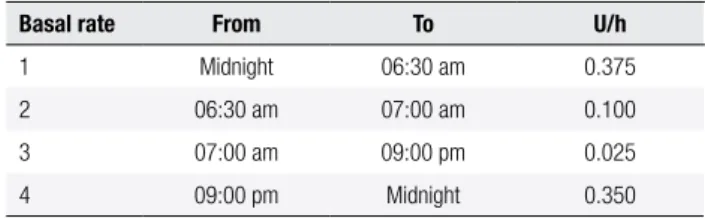
At the beginning of CSII, considering an insulin requirement of 0.27 U/kg/day with MDI, a total basal rate of 3.9 units/day was programmed and administered as reported in table 1. Enteral nutrition (500 mL of Nutrini Energy Multiibre and 300 mL of water) started at 9:30 pm, and continued to 6:30 am. CHO intake was about 10 g per hour. Due to the slow food intake, we administered at breakfast, lunch and dinner square wave boluses of 0.3 unit lasting 1 hour, while at snack time we administered 0.1 unit only if glycemia was over 150 mg/dL.
Table 1. Basal rate at the start of CSII in an 8-year-old female with Down syndrome
Basal rate From To U/h
1 Midnight 06:30 am 0.375 2 06:30 am 07:00 am 0.100 3 07:00 am 09:00 pm 0.025 4 09:00 pm Midnight 0.350
The theoretical insulin sensitivity factor (ISF) by the “1800 rule” was 370 mg/dL per unit, but the real ISF estimated by SMBG was 600 mg/dL per unit.
The theoretical insulin/carbohydrate ratio (ICR) by the “500 rule” was 103 g of CHO per unit, but the real ICR, assessed by SMBG and daily food diary, was 200 g of CHO per unit, and decreased dramatically during NEF (about 27 g of CHO per unit).
Cop
yright
© ABE&M t
odos os dir
eit
os r
eser
vados
.
both in diurnal and during enteral nocturnal nutrition blood glucose levels, as demonstrated by the decreased average glycemia from 290 mg/dL (± 200 mg/dL) to 150 mg/dL (± 40 mg/dL).
Eight months after the onset of diabetes, when the honeymoon period ended, insulin requirement increased to a maximum of 11.8 units/day. The nocturnal insulin requirement was still elevated, even though CHO intake by NEF decreased. Clinical and metabolic parameters recorded during the irst year of follow-up are shown in table 2.
The parents learnt to use the bolus wizard, adminis-tering a small amount of insulin (about 20% of the to-tal dose) when the patient began the meal (pre-bolus), followed by the remaining dose at the end of the meal based on CHO counting.
Current ISF is 200 mg/dL per unit, and ICR is 30 g CHO per unit (according to the theoretical ICR) and decreases during NEF by up to 7.6 g of CHO per unit. Neither ketoacidosis episodes nor severe hypogly-cemia (deined as any hypoglycaemic event with neu-rologic involvement) were experienced during CSII therapy. Despite frequent acute illness, nutritional sta-tus improved (increased weight and BMI) with better compliance with oral feeding.
DISCUSSION
Diabetes mellitus is deined as a group of metabolic
di-seases characterized by hyperglycemia which, when un-treated, can lead to long-term complications, including micro- and macrovascular complications. The Diabetes Control and Complications Trial (DCCT) demonstra-ted that intensive diabetes control during childhood reduces such complications signiicantly (10). Insulin therapy is the mainstay of treatment in children and adolescents with T1D, and is a key component in the treatment of type 2 diabetes (T2D). The prevalence and incidence of T2D in the young has increased dra-matically in last decades, owing to several factors such as obesity, lifestyle, and diet problems. T2D in children
Table 2. Clinical and metabolic parameters during the follow-up period in an 8-year-old female with Down syndrome during nocturnal enteral feeding (NEF)
HbA1c %
Weight
kg BMI-SDS
I/W ratio U/kg
Basal rate U/24 h
Basal/Bolus %
NEF CHO gr/h
CSII onset 7.2 18 -4.71 0.27 3.9 80/20 10.3 2 months after starting CSII 6.5 20.4 -3.40 0.16 2.3 70/30 10.3 5 months after starting CSII 5.9 20 -0.68 0.16 2.3 70/30 10.3 12 months after starting CSII 7.7 21 -0.20 0.83 11.8 67/33 8.2
is most commonly managed with lifestyle modiication and metformin and/or insulin, the only medications currently approved for use in children (11,12).
A major aim of current insulin replacement therapy is to simulate, as closely as possible, the normal pattern of insulin secretion. This goal may be best achieved by intensiied insulin treatment with basal-bolus therapy using MDI or CSII pump therapy (13). CSII is inten-sive insulin therapy that attempts to mimic physiologic insulin release by administration of 24-hour adjustable basal rates and lexible mealtime bolus doses. Many studies have been performed to compare CSII with MDI in terms of its eficacy and safety, with conlicting results. Metabolic control was demonstrated to be simi-lar in some studies. On the other hand, other studies found better glycemic control with CSII (14). Reznik and cols. (15) found that CSII was effective, particu-larly in patients with baseline HbA1c of above 8%, and beneits may persist in a 6-year follow-up. However, long-term follow-up studies regarding diabetes control in children with CSII are scarce.
absorp-Cop
yright
© ABE&M t
odos os dir
eit
os r
eser
vados
.
tion of carbohydrates in order to achieve better glycemic control with lower insulin requirements (16).
Few studies have focused on the optimal manage-ment of hyperglycemia during enteral nutrition therapy. Clinical reviews and small uncontrolled studies recom-mend a variety of subcutaneous regimens, including the administration of regular insulin (every 4-6 h), NPH in-sulin (every 8-12 h), inin-sulin glargine once or twice a day, or the administration of 70/30 biphasic insulin 2 or 3 times daily. During critical care, continuous intravenous insulin infusion has been shown to be effective in achiev-ing glycemic control (17,18). Even though T2D is usu-ally considered less prone to diabetic ketoacidosis (DKA) than T1D, when a precipitating cause does exist, such as acute illness or disease with severe or acute hyperglyce-mia or need for nutritional support, patients with T2D should receive the same insulin treatment as T1D, even-tually associated with oral antidiabetic drugs (OAD).
Korytkowski and cols. compared, in the irst rando-mized controlled clinical trial on the subject, different subcutaneous insulin regimens, basal-bolus with glar-gine versus sliding scale regular insulin (SSRI), in
non--critically ill adult inpatients with T2D receiving enteral nutrition therapy. Fifty patients with or without pre-vious history of diabetes and with two or more blood glucose levels > 130 mg/dL were randomized to re-ceive SSRI (n = 25) or glargine insulin once daily (n = 25). NPH insulin was added in the SSRI group for persistent hyperglycemia (more than two blood glu-cose level measurements > 180 mg/dL). In addition, supplemental SSRI was administered every 4-6 h for any blood glucose level > 130 mg/dL in both groups. Glycemic target in both groups was glucose levels be-tween 100 and 180 mg/dL. Mean daily blood gluco-se, as well as daily peak value, were similar in the SSRI and glargine groups, without any signiicant difference both in glycemic control and in the frequency of hypo-glycemia. The authors concluded that more prospecti-ve randomized studies were needed in order to inprospecti-vesti- investi-gate strategies for better glycemic control and identify speciic glycemic targets in diabetic inpatients receiving nutrition support (19). Park and cols. performed a re-trospective analysis on 70 patients with diabetes mellitus
who required nutritional support and established that, during parenteral nutrition, an increase of insulin daily dose up to 225% from previous dose is required. The change from preadmission diabetes therapy depended on the severity of the underlying illness and on the type of feeding (greater with parenteral nutrition), but not
on preadmission therapy, age of patient, or type of en-teral nutrition (cyclic versus continuous) (20).
One of the most controversial issues is the distribu-tion of the total calorie requirements and, particularly, the carbohydrate/lipid ratio in diabetic patients who might require nutritional support. The American Dia-betes Association (ADA) sets out that these patients may receive either a standard formula (50% carbohydrates) or a formula low in carbohydrates (33-40%). In con-trast, the European Association for the Study of Dia-betes recommends that fat content in the diet should not exceed 35%, and that carbohydrate intake should be within 45-60% of the daily calorie needs. There are speciic enteral formulas for diabetics containing fewer carbohydrates (35-40%) and more fats (40-50%), with predominance of monounsaturated fatty acids (MUFA) (> 60% of the total fat content) (16). Currently, there are insuficient data available to address the eficacy of nutritional support, including diabetes-speciic formu-las, according to diabetes type (type 1 or type 2), espe-cially in pediatric patients.
Besides the widely known beneits of insulin pump therapy in T1D in relation to HbA1c decrease, reduced total daily insulin dose, reduced risk of hypoglycemia, and lower blood glucose variability, we want to under-score the role of the pump in the category of patients who require stricter glycemic control. CSII enables the elimination of multiple daily injections (to correct hy-perglycemia and manage extra meals) and the stress re-lated to each additional insulin administration, and is an eficacious choice to more easily reach the desired glyce-mic levels in malnourished patients who need nutritional support, leading to better acceptance of a new therapy in children already suffering from other severe comor-bidities. If the achievement and maintenance of good metabolic control is the therapeutic goal in all diabetic patients, it is essential in those with poor nutritional sta-tus to prevent worsening of clinical conditions (21).
Cop
yright
© ABE&M t
odos os dir
eit
os r
eser
vados
.
end of the meal. This approach enables solving problems encountered in planning the quantity of food eaten dur-ing a meal, and to give insulin in a more physiological pattern, which is much more important in patients with a poor nutritional status. Furthermore we wish under-score that the nocturnal insulin basal rate, despite the homogeneous distribution of nocturnal enteral rate, is related to age-dependent insulin requirements (3,4). Our patient shows dawn-reverse phenomenon typical of prepuberty, with higher basal rate required in the irst part of the night (when falling asleep) (Table 1). We point out that it is necessary to translate theoretical rules into clinical practice in particular regarding ICR and ISF, since ICR is completely different of assumed CHO during each meal compared with CHO introduced by enteral formulas. Furthermore, the lack of speciic guide-lines and the small number of patients with T1D who need NEF, makes a trial-and-error approach necessary for the diabetes care team. Further research is needed to determine the role of enteral nutritional support in malnourished patients with diabetes and to establish the optimal composition of nutritional feeds to gain meta-bolic control, improve immune function, and achieve a satisfactory nutritional status. Randomized controlled clinical trials are needed to draw up guidelines about the use of CSII in patients who are undergoing either noc-turnal or continuous enteral nutrition.
In conclusion, we recommend CSII use during ente-ral nocturnal nutrition because it is more lexible and the therapeutic objective may be more easily reached, if a dia-betes care team with experience in pump management is involved. Moreover, CSII is more appropriate as a treat-ment to satisfy elevated insulin requiretreat-ments due to NEF and an appropriate basal rate, instead of SSII or boluses, is the best option to control hyperglycemia caused by nocturnal enteral nutrition, enabling age-related insulin requirements during the night to be taken into account.
Disclosure: no potential conlict of interest relevant to this article was reported.
REFERENCES
1. The effect of intensive treatment of diabetes on the development and progression of long-term complications in insulin-dependent diabetes mellitus. The diabetes control and complications trial re-search group. N Engl J Med. 1993;329:977-86.
2. Valla V. Therapeutics of diabetes mellitus: focus on insulin ana-logues and insulin pumps. Exp Diabetes Res. 2010;2010:doi:10.1 1.55/2010/178372.
3. Pinelli L, Rabbone I, Salardi S, Toni S, Scaramuzza A, Bonfanti R, et al. Insulin pump therapy in children and adolescents with type 1 diabetes: the Italian viewpoint. Acta Biomed. 2008;79:57-64.
4. Danne T, Battelino T, Jarosz-Chobot P, Kordonouri O, Pánkowska E, Ludvigsson J, et al. Establishing glycaemic control with conti-nuous subcutaneous insulin infusion in children and adolescents with type 1 diabetes: experience of the PedPump Study in 17 countries. Diabetologia. 2008;51:1594-601.
5. Phillip M, Battelino T, Rodriguez H, Danne T, Kaufman F; for the Consensus forum participants. Use of insulin pump therapy in the pediatric age-group. Diabetes Care. 2007;30:1653-62. 6. Clement S, Braithwaite SS, Magee MF, Ahmann A, Smith EP,
Schafer RG; American Diabetes Association Diabetes in Hospitals Writing Committee. Management of diabetes and hyperglycemia in hospitals. Diabetes Care. 2004;27:553-91.
7. Cheung NW, Napier B, Zaccaria C, Fletcher JP. Hyperglycemia is associated with adverse outcomes in patients receiving total par-enteral nutrition. Diabetes Care. 2005;28:2367-71.
8. Bergman M, Ravikumar S, Auerhahn C, DelSavio N, Savino J, Fe-lig P. Insulin pump therapy improves blood glucose control dur-ing hyperalimentation. Arch Intern Med. 1984;144:2013-5. 9. Elia M, Ceriello A, Laube H, Sinclair AJ, Engfer M, Stratton RJ.
Enteral nutritional support and use of diabetes-speciic formulas for patients with diabetes: a systematic review. Diabetes Care. 2005;28:2267-79.
10. Effect of intensive diabetes treatment on the development and progression of long-term complications in adolescents with in-sulin-dependent diabetes mellitus: Diabetes Control and Compli-cations Trial. Diabetes Control and CompliCompli-cations Trial Research Group. J Pediatr. 1994;125:177-88.
11. Golden SH, Sapir T. Methods for insulin delivery and glucose monitoring in diabetes: summary of comparative effectiveness review. J Manag Care Pharm. 2012;18:1-17.
12. Guidoni CM, Borges AP, Freitas Od, Pereira LR. Prescription pat-terns for diabetes mellitus and therapeutic implications: a popula-tion-based analysis. Arq Bras Endocrinol Metabol. 2012;56:120-7. 13. Tamborlane WV, Sikes KA. Insulin therapy in children and
adoles-cents. Endocrinol Metab Clin North Am. 2012;41:145-60. 14. Nabhan ZM, Kreher NC, Greene DM, Eugster EA,
Kronenber-ger W, DiMeglio LA. A randomized prospective study of insulin pump vs. insulin injection therapy in very young children with type 1 dia betes: 12-month glycemic, BMI, and neurocognitive outcomes. Pediatr Diabetes. 2009;10:202-8.
15. Reznik Y, Morera J, Rod A, Cofin C, Rousseau E, Lireux B, et al. Eficacy of continuous subcutaneous insulin infusion in type 2 diabetes mellitus: a survey on a cohort of 102 patients with pro-longed follow-up. Diabetes Technol Ther. 2010;12:931-6.
16. Vaquerizo Alonso C, Grau Carmona T, Juan Díaz M. Guidelines for specialized nutritional and metabolic support in the critically-ill patient: update. Consensus SEMICYUC-SENPE: hyperglycemia and diabetes mellitus. Nutr Hosp. 2011;26(suppl. 2):46-9. 17. Umpierrez GE. Basal versus sliding-scale regular insulin in
hos-pitalized patients with hyperglycemia during enteral nutrition therapy. Diabetes Care. 2009;32:751-3.
18. Hsia E, Seggelke SA, Gibbs J, Rasouli N, Draznin B. Comparison of 70/30 biphasic insulin with glargine/lispro regimen in non-crit-ically ill diabetic patients on continuous enteral nutrition therapy. Nutr Clin Pract. 2011;26:714-7.
19. Korytkowski MT, Salata RJ, Koerbel GL, Selzer F, Karslioglu E, Idriss AM, et al. Insulin therapy and glycemic control in hospi-talized patients with diabetes during enteral nutrition therapy: a randomized controlled clinical trial. Diabetes Care. 2009;32:594-6. 20. Park RH, Hansell DT, Davidson LE. Management of diabetic
pa-tients requiring nutritional support. Nutrition. 1992;8:316-20. 21. Reali MF, Festini F, Neri AS, Taccetti G, Repetto T, Chiarelli F, et al.