Suely Arruda VidalI Isabella Chagas SamicoI Paulo Germano de FriasII,III Zulmira Maria de Araújo HartzIV
I Grupo de Pesquisa de Gestão e Avaliação em Saúde. Instituto de Medicina Integral Prof. Fernando Figueira. Recife, PE, Brasil II Secretaria de Saúde do Recife. Recife, PE,
Brasil
III Programa de Pós-Graduação em Saúde da Criança e do Adolescente. Centro de Ciências da Saúde. Universidade Federal de Pernambuco. Recife, PE, Brasil
IV Instituto de Higiene e Medicina Tropical. Universidade Nova de Lisboa. Lisboa, Portugal
Correspondence: Suely Arruda Vidal
Instituto de Medicina Integral Prof. Fernando Figueira
Rua dos Coelhos, 300 – Boa Vista 50070-550 Recife, PE, Brasil E-mail: [email protected] Received: 2/18/2010 Approved: 10/18/2010
Article available from: www.scielo.br/rsp
An exploratory study of the
costs and consequences of
prenatal care in the Family
Health Program
ABSTRACT
OBJECTIVE: To assess costs and consequences of prenatal care on perinatal morbidity and mortality.
METHODS: Evaluation study using two types of analysis: implementation
and effi ciency analysis, carried out at 11 Family Health Units in the Recife,
Northeastern Brazil, in 2006. The costs were calculated by means of the activity-based costing technique and the cost-effectiveness ratio was calculated for each consequence. Data sources were information systems of the Ministry of Health and worksheets of costs provided by the Health Department of Recife and Instituto de Medicina Integral Prof. Fernando Figueira. Healthcare units with implemented or partially implemented prenatal care were compared in terms of their cost-effectiveness and perinatal results.
RESULTS: In 64% of the units, prenatal care was implemented with a mean total cost of R$ 39,226.88 and variation of R$ 3,841,87 to R$ 8,765.02 per healthcare unit. In the units with partially implemented prenatal care (36%), the mean total cost was R$ 30,092.61 (R$ 4,272.12 to R$ 11,774.68). The mean cost per pregnant woman was R$ 196.13 with implemented prenatal care and R$ 150.46 with partially implemented prenatal care. A higher proportion of low birth weight, congenital syphilis, perinatal and fetal deaths was found in the partially implemented group.
CONCLUSIONS: Prenatal care is cost-effective for several studied consequences. The adverse effects measured by the health indicators were lower in the units with implemented prenatal care. The mean cost in the partially implemented group was higher, which suggests a possible waste of resources, as the teams’ productivity is insuffi cient for the installed capacity.
DESCRIPTORS: Cost-Effectiveness Evaluation. Prenatal Care. Family Health Program. Evaluation Studies as Topic.
INTRODUCTION
Health economics evaluates the relationship between the costs and effects of
different interventions to determine the most effi cient, the one that offers the
best yield and allocation of resources.4
This type of evaluation in the health area was criticized in the 1970s-1980s,
being considered an artifi ce for rationing of expenditures. However, according
to Hartz & Pouvourville,14 the costs rationalization process has other
their effects. It is necessary that public resources effi ciency is promoted, due to the principle of justice, and this does not exclude the possibility of reducing investments in interventions to which there is still no proof of effectiveness.
There are four techniques or types of health economics analysis, with similar procedures for cost calculation, but with different measures concerning consequences. In the cost-benefit analysis, costs and effects are measured in monetary units; in cost-utility analysis, the result is measured in utility units, like the
quality-adjusted life year (QALY); in cost-effectiveness
analysis, the single outcome is expressed in natural units (avoided cases); and in cost-minimization analysis, the cost of two interventions with similar results and different costs is compared.8
There is a variant of cost-effectiveness analysis that is called costs and consequences,4 proposed by the Centers
for Disease Control (CDC), in which the visualization
of the intervention by the managers is more effi cient
and practical. The utilization of the results in planning aims to meet the needs of the population, considering its values and preferences.5 Coast7 considers it the best
alternative for decision-making and its main advantage is that it provides a scenario of options, including employed resources and effects that are prevented by the intervention, and it also allows to add quantitative and qualitative information.
Prenatal care is a programmatic action that has been consolidated in Brazil since 1984. Assistance to low-risk pregnancy is provided by family health teams based on the technical manual of Programa Nacional de Humanização do Pré-Natal e Nascimento (PHPN – National Program for Prenatal and Birth
Humanization),a which is part of the National Policy
for Women’s Health.b
Prenatal care was chosen to be studied due to the national challenge of reducing perinatal morbidity and mortality, which are still high in Brazil, and because maternal and child actions are cost-effective, as it has been shown in international studies.1,9
The present study aimed to evaluate the costs and conse-quences of prenatal care regarding perinatal morbidity and mortality.
METHODS
Evaluation research with two types of analysis:8
imple-mentation (type two) and effi ciency analysis.
The study was carried out in the city of Recife, State of Pernambuco, Northeastern Brazil, with 17 equipes de saúde da família (ESF – family health teams), allocated in 11 Unidades de Saúde da Família (USF – Family Health Units) of three sanitary districts. These USF inte-grate the Community Extension Program of Instituto de Medicina Integral Prof. Fernando Figueira – PEC/IMIP, and are administered in partnership with the Municipal Health Department. They provide health assistance for
approximately 60,000 inhabitants.c
To evaluate the degree of implementation, Donabedian’s systemic approach was adopted. This approach deals
with three components: structure, process and result,15
the last one as a proxy of effectiveness. Based on this approach, we initially performed a normative analysis taking as good practices standard the norms of the tech-nical manual of PHPN.a This type of evaluation compares
the empirical reality with the established norms and attributes the degree of adherence to the norms.11
A questionnaire was administered to the ESF in May and June 2007 with closed questions about material resources, inputs, personnel and training (structure) and about prenatal care practices (process). This normative stage was consolidated through the answers of the ESF. Weight fi ve was attributed to the questions referring to structure and ten to the ones referring to the working process, totaling 100 points. The percentage of correct answers of each ESF was calculated. The ESF were
classifi ed as implemented prenatal care (76% to 100%
compliance with the standards established in the tech-nical manual); partially implemented prenatal care (between 51% and 75.9%); incipient (between 26% and
50.9%); or without implementation (≤ 25%).
The degree of implementation of prenatal care was related to perinatal results measured by health indica-tors. The explanatory power of this analysis was in the coherence of the relations between the effects that were found and the degree of adequacy of the program’s structure and functioning.10
The indicators related to child health were: neonatal, fetal and perinatal deaths of the triennium 2004-2006
and tracer conditions, such as:13 neonatal tetanus,
congenital syphilis, low birth weight (below 2,500 g); live births with no prenatal assistance and with less than four prenatal consultations in the year of 2006. This information was provided by the Information Systems: on Live Births (SINASC), Mortality (SIM), Mandatory Reporting of Health Conditions (SINAN), supplied by the Health Department of Recife; and by Sistema de Informação Hospitalar (SIH – Hospital Information
a Ministério da Saúde. Secretaria de Atenção à Saúde. Departamento de Ações Programáticas Estratégicas. Área Técnica de Saúde da Mulher. Pré-natal e puerpério: atenção qualifi cada e humanizada: manual técnico. 3.ed.rev. Brasília, DF; 2006. (Série A. Normas e Manuais Técnicos. Série Direitos Sexuais e Direitos Reprodutivos, 5).
System) provided by the State Health Department. All
the events were identifi ed by the mother’s name and
her full address.
The effi ciency analysis employed the costs and
conse-quences4 alternative of the cost-effectiveness type
through the measure of outcomes in natural units.8 We
adopted the technique Basic Assessment Scheme for Intervention Costs and Consequences Methodology (BASICC), recommended by CDC, which incorpo-rates the principles of evidence-based medicine for public health programs in the evaluation of prevention
programs9 and enables to evaluate adverse effects that
are caused or prevented by the intervention.4
Costs were calculated according to the activity-based
costing(ABC) technique in the perspective of the public
sector, which was chosen due to the greater connection between costs and activities. It uses only the direct costs (fi xed and variable) involved in the activity, calculated by means of specifi c drivers.2
The assistance drivers that were analyzed were prenatal consultations and number of pregnant women. In addi-tion to assistance provided by a doctor and/or nurse, we included tests request, weight and blood pressure measurement through the nursing technique, educa-tional activities and home visits performed by health agents. To calculate the fraction of other direct costs concerning prenatal care related to rent payment, water supply, electricity, telephone, maintenance, cleaning and conservation, and the hiring of employees, the driver “prenatal assistance shifts” of each ESF was selected. Neither the cost of units implementation, nor the cost of personnel training and the depreciation rate were considered, because we were dealing with a short period, equivalent to a gestation.
The worksheets of costs with monetary values spent per
USF were obtained at the Health Department of Recifed
and at Instituto de Medicina Integral Prof. Fernando Figueira,e referring to the last quarter of 2006 and fi rst
quarter of 2007.
Assistance-related information was extracted from the reports from Sistema de Informação da Atenção Básica (Primary Care Information System), which provides data disaggregated by ESF: “Historical Series of Health Information (SSA2)” and “Historical Series of Production (PMA2)”, year 2006, issued by the Health Department of Recife.
The consequences (effects) used in the efficiency analysis were the same indicators and tracer condi-tions selected in the implementation analysis, except for “absence of prenatal care and number of live births with less than four prenatal consultations”.
For the analysis of costs and consequences, the USF were grouped according to the degree of implementation, and the same procedure was employed with costs and indica-tors, aggregating them per group. The cost-effectiveness ratio was calculated dividing the difference of costs by the difference of each consequence between the groups with the best and worst degree of implementation.
RESULTS
Table 1 presents the degree (%) of implementation of structure and process and the indicators of effects, except
for the numbers of deaths in absolute fi gures. The USF
were classifi ed in two groups: with implemented prenatal care, called GI (in Portuguese, Grupo Implantado), with seven USF (64% of the total), and the four remaining
ones (36%) were classifi ed as “partially implemented
group” (GPI – Grupo Parcialmente Implantado).
The number of live births registered at SINASC in the catchment area was 440 in the GI group and 344 in the GPI. Approximately 5% of the mothers of the live-born babies did not have prenatal care. The majority of them belonged to the GPI.
Eight cases of congenital syphilis were reported to SINAN, and one case was recovered from SIH, the majority in GPI areas. There was no register of neonatal tetanus cases in the period (Table 1).
The monthly mean costs with professionals in the ESF, proportional to the prenatal assistances, varied from R$ 381.45 (Sanitary District I) to R$ 1,287.72 (District IV, data not presented on a table).
In the cost composition (Table 2), the values directly related to pregnant woman assistance had greater participation (R$ 63,433.47; 92.1%). The mean frac-tion attributed to prenatal care related to costs with rent payment, water supply, electricity, telephone, equipment maintenance, cleaning and conservation, and hiring of employees was R$ 5,482.85 in the analyzed period.
The total mean cost of prenatal care in the perspective of Sistema Único de Saúde (SUS – National Health System) was R$ 39,226.88 in GI, with variation of R$ 3,841.87 to R$ 8,765.02, and in GPI, R$ 30,092.61 (R$ 4,272.12 to R$ 11,774.68) (Table 2). To SUS, the mean cost of prenatal care per pregnant woman of GI was R$196.13 and in GPI, R$150.46 (data not presented on a table).
The neonatal and perinatal mortality coeffi cients, the
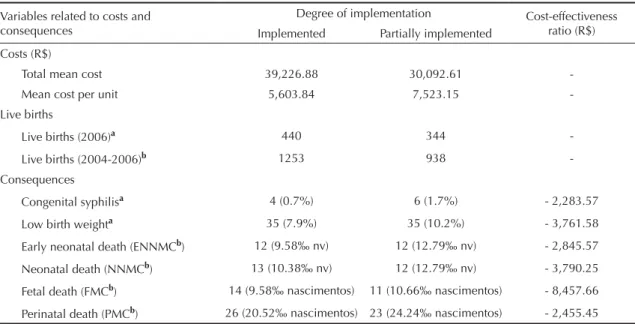
proportion of low birth weight and the incidence of congenital syphilis were higher in the GPI USF, which also presented higher mean costs. The prenatal care per USF cost, on average, R$ 5,603.84 in the GI group and R$ 7,523.15 in the GPI group (Table 3).
d Secretaria de Saúde do Recife. Relatório do CC/DAS, issued on 10 May 2007.
To prevent low birth weight, an investment of R$ 3,761.58, on average, is necessary in the USF of the GPI group; and to reduce congenital syphilis, R$ 2,283.57 (Table 3). For perinatal mortality, the cost-effectiveness ratio showed that four events might be avoided with an investment of R$ 2,455.45 in the GPI.
DISCUSSION
The results show that prenatal care is cost-effective for several studied consequences. The adverse effects measured by the health indicators were lower in the group of units with implemented prenatal care. The mean cost in the partially implemented group was higher, which suggests waste of resources, as the teams’ productivity is insuffi cient for the installed capacity.
The choice of the costs and consequences approach using the BASICC methodology of CDC was based on the easiness of application to decision-making and on the criticism of the cost-effectiveness and cost-utility analyses. In the fi rst case, the manager needs to analyze and appraise many effects instead of only one, and in
the second, there is diffi culty in fully understanding
the measure “cost per earned QALY”. Besides, the understanding of the economic theory that supports the comparison of costs and effects is not easy for those
who are not economists.7
The implementation analysis was carried out before the effi ciency one because, fi rstly, effectiveness needed to be proved in the economic evaluations so that a relationship could be established between costs and
Table 1. Implementation analysis per Sanitary Districts, family health units and teams, according to the dimensions of structure, process and results. Recife, Northeastern Brazil, 2006.
Levels Dimensions
Live births (2006)
Structure / Process Results / USF
SD USF ESF
Degree of implementation
per team (%)
Degree of implementation
per USF (%) NB without
PN (%)a
< 4 PN consultations
(%)
Congenital syphilis
(%)
Neonatal deathb
(no.)
Fetal deathb
(no.) Low birth weight
(%)
I
1 1.1c 95 95 2.3 11.5 2.3 4 3 6.9 87
1.2 95
2 2.1 58.5 64 3.6 20.5 6.0 3 5 13.3 83
2.2 69.5
3 3.1c 84 84 4.2 15.5 0 1 1 4.2 71
3.2 84
II
4 4.1 80.5 87 3.5 12.9 0 2 3 8.2 85
4.2 94
5 5c 93 93 0 7.5 0 2 0 12.5 40
6 6c 90.5 91 0 4.5 2.3 2 2 15.9 44
IV
7 7c 89.5 90 0 1.6 1.6 0 3 4.9 61
8 8.1 70 71 3.8 10.7 0.8 2 3 15.9 131
8.2 71.5
9 9 72.5 73 3.4 12.1 0 6 0 15.5 58
10 10c 82.5 83 0 13.5 0 2 2 7.7 52
11 11.1 73 75 4.2 12.5 0 1 3 8.3 72
11.2 74
Total of USF with implemented prenatal care (7) 1.8 10.2 0.9 13 14 7.9 440
Total of USF with partially implemented prenatal
care (4) 3.8 13.7 1.7 12 11 10.2 344
TOTAL PEC 2.7 11.7 1.3 25 25 8.9 784
Sources: Information Systems about Live Births, Mortality and Mandatory Reporting of Health Conditions SD: Sanitary District
USF: Unidade de Saúde da Família (Family Health Unit) NB: Newborn
PN: Prenatal care
PEC: Programa de Extensão Comunitária (Community Extension Program)
effects.6 Likewise, the intervention must be
undoubt-edly implemented, because, with no knowledge of the degree of implementation, the evaluation may be
innocuous or lead to an erroneous interpretation of its effectiveness, which was called by Contandriopoulos et al8 type two mistake.
Table 2. Drivers and direct mean costs related to the action of prenatal care per family health unit in 2006/2007. Recife, Northeastern Brazil, 2010.
SD USF
Driver –Pregnant woman mean
(n)a
Prenatal consultation
(n)a
Mean cost of assistance (R$)a
Driver- Shifts/ monthb
Other direct
mean costs (R$)b Total of costs per USF (R$)
I 1c 47 58 8,266.56 (94.3%) 4.5 498.46 (5.7%) 8,765.02 (100%)
2 37 47 6,640.95 (95.5%) 4.5 302.14 (4.5%) 6,943.09 (100%)
3c 30 33 5,594.77 (91.3%) 4.5 531.93 (8.7%) 6,126.70 (100%)
II 4c 37 52 6,802.29 (89.7%) 11.25 778.64 (10.3%) 7,580.93 (100%)
5c 18 26 3,135.32 (81.1%) 9 732.14 (18.9%) 3,867.46 (100%)
6c 20 25 3,527.74 (91.8%) 4.5 314.13 (8.2%) 3,841.87 (100%)
IV 7c 26 31 4,480.03 (94.3%) 4.5 272.59 (5.7%) 4,752.62 (100%)
8 56 59 10,537.23 (89.5%) 11.25 1,237.45 (10.5%) 11,774.68 (100%)
9 23 29 3,974.38 (93.0%) 4.5 297.74 (7.0%) 4,272.12 (100%)
10 22 31 3,809.78 (88.8%) 4.5 482.49 (11.2%) 4,292.27 (100%)
11 36 45 6,664.42 (93.8%) 4.5 438.30 (6.2%) 7,102.72 (100%)
Total PEC 352 436 63,433.47 (92.1%) - 5,482.85 (7.9%) 6,9319.48 (100%)
SD: Sanitary district
USF: Unidade de Saúde da Família (Family Health Unit)
a Pregnant woman mean and prenatal consultation mean are drivers of the cost of assistance.
b Prenatal shifts are drivers of the other costs (water supply, electricity, telephone, rent, equipment maintenance, cleaning
and conservation, and hiring of personnel) to which fractions corresponding to prenatal care were calculated.
c USF with implemented prenatal care.
Table 3. Costs and consequences according to the degree of implementation of prenatal care and the cost-effectiveness ratio of each consequence in the set of family health units of the Community Extension Program of IMIP in 2006. Recife, Northeastern Brazil, 2010.
Variables related to costs and consequences
Degree of implementation Cost-effectiveness
ratio (R$)
Implemented Partially implemented
Costs (R$)
Total mean cost 39,226.88 30,092.61
-Mean cost per unit 5,603.84 7,523.15
-Live births
Live births (2006)a 440 344
-Live births (2004-2006)b 1253 938
-Consequences
Congenital syphilisa 4 (0.7%) 6 (1.7%) - 2,283.57
Low birth weighta 35 (7.9%) 35 (10.2%) - 3,761.58
Early neonatal death (ENNMCb) 12 (9.58‰ nv) 12 (12.79‰ nv) - 2,845.57
Neonatal death (NNMCb) 13 (10.38‰ nv) 12 (12.79‰ nv) - 3,790.25
Fetal death (FMCb) 14 (9.58‰ nascimentos) 11 (10.66‰ nascimentos) - 8,457.66
Perinatal death (PMCb) 26 (20.52‰ nascimentos) 23 (24.24‰ nascimentos) - 2,455.45
ENNMC: Early Neonatal Mortality Coeffi cient (< 7 days) NNMC: Neonatal Mortality Coeffi cient (< 28 days) FMC: Fetal Mortality Coeffi cient
PMC: Perinatal Mortality Coeffi cient l b: live births
The use of the ABC technique allows greater connection between costs and activities, calculated by means of specifi c drivers. Thus, it identifi es items that consume
more fi nancial resources; in the present study, teams
and actions. This becomes particularly important in the
public sector, considering Complementary Law 101,f
which regulates norms related to control of costs and
evaluation of results of programs fi nanced by public
budget resources. But the use of this technique is possible only in places with a structured cost calculation system, like the studied municipality.
There are few studies in the area of health economics in Brazil. Its results are not much used, and even in the international level, it is rarely employed to subsidize planning21 and decision-making. Coast7 justifi es this
assertion through the insuffi cient knowledge about
the methods, and it is possible to add the incipient degree of institutionalization of the evaluative culture of public policies in the Brazilian reality. We have not identifi ed, up to the present moment, in the electronic databases that we searched (SciELO, Lilacs, PubMed), a Brazilian economic study that compared the same intervention with different degrees of implementation, like the present study.
The implementation of basic child healthcare actions in Pernambuco was analyzed in previous studies, such as the one by Bezerra et al.3 Also, studies were conducted
on the effectiveness of the family health strategy over infant mortality16 and over the effi ciency of the family
health model in relation to the traditional one. In this last study, some indicators were better, like offer of services, measured by the number of assistances or of
access/utilization, judged by vaccinal coverage.g
To Darmstadt et al,9 interventions to improve maternal
health include the effectiveness of anti-tetanus vacci-nation, of detection and treatment of syphilis and asymptomatic bacteriuria during the prenatal period. According to the World Health Organization, almost ¾ of the maternal deaths that occur in poor countries can be avoided, 26% with prenatal care and 48% with the amplifi cation of access to high-quality obstetric care.
These aspects consumed 30% and 26% of the fi nancial
resources of the Safe Maternity Program, respectively.15
Adam et al1 evaluated the cost-effectiveness of prenatal
activities in the poor countries of the Sub-Saharan Africa and of the Southeast of Asia. They identifi ed that the most cost-effective in primary care are: anti-tetanus vaccination; screening for and treatment of asymp-tomatic bacteriuria and syphilis; screening for pre-eclampsia, by means of blood pressure measurement,
detection of proteinuria, and existence of reference service for treatment. However, to avoid approximately 50% of neonatal and maternal deaths, it would be necessary that, apart from these activities, others related to childbirth, puerperium and to immediate neonatal assistance had 95% of population coverage. It should be noted that all these activities are incorporated into prenatal care in Brazil and are included in the technical
manual of the Ministry of Health.a
Prenatal coverage in Recife for four or more
consulta-tions reached 88.3%.c In the catchment areas of the
researched USF, even in the worst scenario (GPI), the prenatal coverage was similar to Recife’s mean. This suggests that the ESF need to follow the assistance norms with the involvement of the whole team, perform active searches for absent pregnant women and follow them up with home visits.
Another indication of fl aws in prenatal care is the occur-rence of congenital syphilis, more frequent in the GPI group, a result that is coherent with the implementation degree. This result signals the need of greater efforts on the part of the ESF in the follow-up of pregnant women suffering from this sexually transmitted infec-tion to ensure the complete treatment provided by the SUS for the couple. This treatment has low cost and good cost-effectiveness relationship per avoided case.
In 2006, 8.2% of the live births in Brazil were low weight newborns, including preterm babies and
newborns who were small for the gestational age.c This
occurrence is associated with absent and/or inadequate prenatal assistance,18,19 and was more frequent (10.2%)
in the areas with GPI, above the national mean.c To
reduce the proportion of low weight in this group and in the country’s mean, it would be necessary to invest more in the ESF, according to the cost-effectiveness ratio.
Low birth weight children are more vulnerable to diseases and death; in addition, hospitalization cost varies inversely with birth weight.12, 20 In 2001, a study
carried out in the United States compared the mean cost of the hospitalization of preterm/low birth weight children with normal weight newborns, which
corre-sponded to US$15,800 and US$600, respectively.20
Another research conducted in Greece in 2004 verifi ed
that the mean cost for the government with newborns weighing between 1001 and 1500g in intensive neonatal
care public units was US$10,438.12
It is not our intention to debate the need of these units, but rather, what could be done at lower costs to avoid the excessive demand of these services. Apart from
the higher fi nancial cost, there are intangible costs,
f Brasil. Presidência da República. Lei Complementar 101, de 4 de maio de 2000. Capítulo II, Seção II Lei de diretrizes orçamentárias, Art. 4 [Internet]. [Cited July 2010]. Available from: http://www.planalto.gov.br/ccivil_03/Leis/LCP/Lcp101.htm
g Castro JD. A utilização do sistema de custeio por absorção para avaliar os custos da atenção básica de saúde: reformulações e
as low weight babies present higher risk of avoidable neonatal death, according to the classifi cation of Malta et al,17 related to failures in prenatal assistance and to
the handling of childbirth and of the neonatal period.19
The failure in the prenatal assistance also infl uenced
the perinatal and neonatal mortality rates, which were higher in the GPI group. The similar rates between groups can be explained by the small difference in score
for the classifi cation of the implementation degree of
prenatal care in the units, which, in general, had a good score, except for one.
It was not possible to establish prenatal effects on women’s health with the selected indicators, because there was no maternal death in the areas under analysis in the triennium 2004-2006. On the other hand, there were problems in the identifi cation of hospitalizations due to pregnancy complications in the SIH, such as
arterial hypertension (fi rst cause of maternal death),
gestational diabetes and urinary tract infection. There is the possibility of an important under-record, since three hospitalizations due to severe pre-eclampsia (USF 8, 9 and 10) were located, and also one childbirth with eclampsia (USF 1) due to failure in fi lling in the pregnant woman’s address.
The lack of availability of these women’s health indica-tors and deriving costs is perhaps the greatest limitation of this work, probably, with underestimation bias of the
magnitude of the effectiveness differentials between GI and GPI. Uncertainties about the information systems’ reliability may have increased the prenatal costs in those units that registered less, which is another limi-tation of the study.
It is possible that there are potential selection and infor-mation biases, based on the form of identifi cation of the effects, through the addresses of the coverage areas of the USF provided by the health agents which, involun-tarily, may have been suppressed or may be incomplete.
The constructed model can be applied to the universe of family health teams of Recife or be adapted to other actions and contexts, according to the stages recom-mended in the BASICC model.
As for generalization, the results cannot be extrapolated to other places, due to the different characteristics of the communities, of the productivity of the teams’ profes-sionals, as well as of the organization of the healthcare system and input prices, including salaries.
Also relevant are the factors related to the cost unit associated with a resource and with the effectiveness measure, and all these characteristics have a temporal relationship. However, to the municipality of Recife, the results can represent a good estimate to the public sector, concerning the programmatic action conducted by the ESF, and be useful to guide decisions.
1. Adam T, Lim SS, Mehta S, Bhutta ZA, Fogstad H, Mathai M, et al. Cost effectiveness analysis of strategies for maternal and neonatal health in developing countries. BMJ. 2005;331(7525):1107. DOI:10.1136/ bmj.331.7525.1107
2. Beulke R, Bertó DJ. Gestão de custos e resultado na saúde: hospitais, clínicas, laboratórios e congêneres. 3. ed. rev. atual. ampl. São Paulo: Saraiva; 2005.
3. Bezerra LCA, Frias PG, Vidal SA, Macedo VC, Vanderlei LC. Aleitamento materno: avaliação da implantação do programa em unidades básicas de saúde do Recife, Pernambuco (2002). Cienc Saude Coletiva. 2007;12(5):1309 -17. DOI:10.1590/S1413-81232007000500029
4. Brousselle A, Lachaine J, Contandriopoulos AP. L’évaluation économique: In: Brousselle A, Champagne F, Contandriopoulos A-P, Hartz Z. Concepts et méthodes d’évaluation des interventions. Montréal: Les Presses de l´Université de Montréal; 2009. p.187-224.
5. Centers for Disease Control and Prevention - CDC. Assessing the effectiveness of disease and injury prevention programs: costs and consequences. MMWR Recomm Rep. 1995;44(RR-10):1-10.
6. Clyne G, Edwards R. Understanding economic evaluations: a guide for health and human services. Can J Program Evaluation. 2002;17(3 Special Issue):1-23.
7. Coast J. Is economic evaluation in touch with society´s health values? BMJ. 2004;329(7476):1233-6. DOI:10.1136/bmj.329.7476.1233
8. Contandriopoulos A-P, Champagne F, Denis J-L, Hartz ZMA, Pineault R. A avaliação na área da saúde: conceitos e métodos. In: Hartz ZMA, organizador. Avaliação em saúde: dos modelos conceituais à prática na análise da implantação de programas. Rio de Janeiro: Fiocruz; 1997. p.29-47.
9. Darmstadt GI, Bhutta ZA, Cousens S, Adam T, Walker N, Bernis L. Evidence-based, cost-effective interventions: how many newborn babies can we save? Lancet. 2005;365(9463):977-88. DOI:10.1016/S0140-6736(05)71088-6
10. Denis J-L, Champagne F. Análise de implantação de programas. In: Hartz ZMA, organizador. Avaliação em saúde: dos modelos conceituais à prática na análise da implantação de programas. Rio de Janeiro: Fiocruz; 1997. p.49-88.
11. Donabedian A. The quality of care. How can it be assessed? JAMA. 1988;260(12):1743-8.
12. Geitona M, Hatzikou M, Hatzistamatiou Z, Anastasiadou A, Theodoratou TD. The economic burden of treating neonates in Intensive Care Units in Greece. Cost Eff Resour Alloc. 2007;5:9. DOI:10.1186/1478-7547-5-9.
13. Hartz ZMA, Champagne F, Contandriopoulos A-P, Leal MC. Avaliação do programa materno-infantil: análise de implantação em sistemas locais de saúde no Nordeste do Brasil. In: Hartz ZMA, organizador. Avaliação em saúde: dos modelos conceituais à prática na análise de implantação de programas. Rio de Janeiro: Fiocruz, 1997. p.89-131.
14. Hartz ZMA, Pouvourville G. Avaliação dos programas de saúde: a efi ciência em questão. Cienc Saude Coletiva. 1998;3(1):68-82.
15. Jowett M. Safe motherhood interventions in low-income countries: an economic justifi cation and evidence of cost effectiveness. Health Policy. 2000;53(3):201-28.
16. Macinko J, Guanais FC, Souza MFM. An evaluation of impact of the Family Health Program on infant mortality in Brazil, 1990-2002. J Epidemiol Community Health. 2006;60(1):13-9. DOI:10.1136/jech.2005.038323
17. Malta DC, Duarte EC, Almeida MF, Dias MAS, Morais Neto OL, Moura L, et al. Lista de causas de mortes
evitáveis por intervenções do Sistema Único de Saúde do Brasil. Epidemiol Serv Saude. 2007;16(4):233-44. 18. Minuci EG, Almeida MF. Diferenciais intra-urbanos de
peso ao nascer no município de São Paulo. Rev Saude Publica. 2009;43(2):256-66. DOI: 10.1590/S0034-89102009005000011
19. Ribeiro AM, Guimarães MJ, Lima MC, Sarinho SW, Coutinho SB. Fatores de risco para mortalidade neonatal em crianças com baixo peso ao nascer. Rev Saude Publica. 2009;43(2):246-255. DOI:10.1590/ S0034-89102009005000004
20. Russell RB, Green NS, Steiner CA, Meikle S, Howse JL, Poschman K, et al. Cost of hospitalization for preterm and low birth weigth infants in the United States. Pediatrics. 2007;120(1);e1-9. DOI: 10.1542/ peds.2006-2386
21. Sancho LG, Vargens JMC. Avaliação econômica em saúde na esfera de atenção local à saúde. Cienc Saude Coletiva. 2009;14 (Supl 1):1513-21. DOI:10.1590/ S1413-81232009000800025