ARTIGO
MEANINGS ATTRIBUTED TO THE THEME “CLIMATE CHANGE” IN NATURAL SCIENCE’S TEXTBOOKS FOR THE LAST YEARS OF PRIMARY EDUCATION, APPROVED BY 2014 PNLD
ABSTRACT: This research aimed to identify and analyze the meanings attributed to the theme Climate Change by Primary School Science’s textbooks, indicated by PNLD 2014. Nineteen of the twenty collections approved by the program were analyzed in accordance with Content Analysis procedures. Data systematization enabled us to build ive categories. In general, we can state that the collections present considerations about Climate Change. Some of these are based on current information taken from scientiic texts. However, it is interesting to note that the analyzed books do not address this subject from controversy and/or complexities. Addressing the theme’s controversies and complexities could be a signiicant didactic innovation for these materials.
Keywords: Climate change. Controversy. Textbooks.
SIGNIFICADOS ATRIBUíDOS AO TEMA “MUDANçAS CLIMáTICAS” EM LIVROS DIDáTICOS DE CIêNCIAS NATURAIS DO ENSINO FUNDAMENTAL II APROVADOS PELO PNLD DE 2014
RESUMO: Esta investigação teve como objetivo identiicar e analisar
os signiicados atribuídos ao tema Mudanças Climáticas presentes nos livros didáticos de Ciências do ensino fundamental II, indicados pelo PNLD 2014. Analisamos dezenove das vinte coleções aprovadas pelo programa de acordo com os procedimentos da Análise de Conteúdo. A sistematização dos dados nos possibilitou a construção de cinco categorias. De modo geral, podemos indicar que as coleções apresentam considerações sobre as Mudanças Climáticas. Parte destas estão baseadas em informações atuais retiradas de textos de divulgação cientíica. Todavia, é interessante indicar que os livros analisados não abordam esse tema a partir de controvérsias e/ou complexidades. A abordagem das controvérsias e complexidades do tema poderia vir a ser uma inovação didática signiicativa para esses materiais.
Palavras-chave: Mudanças climáticas. Controvérsias. Livros didáticos.
Ms. Nijima Novello Rumenos* Prof. Dr. Luciano Fernandes Silva** Profa. Dra. Rosa Maria Feiteiro Cavalari***
*Mestre em Educação pela Universidade Estadual Paulista “Júlio de Mesquita Filho” (UNESP/Rio Claro). Doutoranda em Educação para a Ciência pela Universidade Estadual Paulista “Júlio de Mesquita Filho” (UNESP/Bauru). Integrante do Grupo de Pesquisa em Educação Ambiental (GPEA/Fapesp), da pós-graduação em Educação para a Ciência da UNESP de Bauru. Bauru, SP - Brasil. E-mail: <[email protected]>
**Doutor em Educação pela Universidade Estadual Paulista “Júlio de Mesquita Filho” (UNESP/Araraquara). Professor, Pesquisador e Coordenador do Programa de Mestrado em Educação em Ciências da Universidade Federal de Itajubá (UNIFEI). Professor e Pesquisador do Programa de Pós Graduação em Educação da Universidade Estadual Paulista “Júlio de Mesquita Filho” (UNESP/Rio Claro). Participante do grupo de pesquisa A Temática Ambiental e o Processo Educativo da UNESP de Rio Claro.
Itajubá, MG - Brasil. E-mail: <[email protected]>.
SIGNIFICADOS ATRIBUIDOS AL TEMA “CAMBIOS CLIMáTICOS” EN LIBROS DIDáCTICOS DE LAS CIENCIAS NATURALES EN LOS úLTIMOS AñOS DE LA PRIMARIA, APROBADOS POR EL PNLD DEL 2014
RESUMEN: Esta investigación tuvo el objetivo de identiicar y analizar
los signiicados atribuidos al tema Cambios Climáticos presentes en los libros didácticos de las Ciencias en los últimos años de la Primaria, indicados por el PNLD del 2014. Analizamos diecinueve de las veinte colecciones aprobadas por el programa segundo los procedimientos del Análisis de Contenido. La sistematización de los datos nos ha permitido construir cinco categorías. En general, podemos indicar que las colecciones presentan consideraciones sobre los Cambios Climáticos. Parte de estas están basadas en informaciones actuales retiradas de textos de divulgación cientíica. Todavía, es interesante indicar que los libros analizados no abordan ese tema a partir de controversias y/o complejidades. El abordaje de las controversias y complejidades del tema podrían ser una innovación didáctica signiicativa para eses materiales.
1 INTRODUCTION
The environmental disasters that have occurred over the last decades point to the fact that we are living an unprecedented environmental crisis in human history. Some of these environmental disasters are related to extreme weather phenomena, such as increased incidence of torrential rains and / or hurricanes
and hot lashes. For many scholars, these extreme weather phenomena are related
to current terrestrial Climate Changes.
It is important to highlight that the current Climate Changes cannot
be understood without taking into account the way society historically relates to nature. Over the past three centuries humankind has intensified its power
to change the environment. In this context, we are currently living a situation - previously not even imagined - that we have conditions to signiicantly modify the
gaseous composition of the planet’s atmosphere. This is due, among other factors, the history of massive use of fossil fuels such as those derived from petroleum
and natural coal. (IPCC, 2014).
In other words, we experience a period of human history marked by the intense industrialization of a signiicant part of the world and by great changes in nature brought about by human intervention. It is necessary to point that several
organized groups of society, among these scientists and intellectuals, defend the
idea that these modiications that humans have been provoking in nature may be directly or indirectly related to the causes of current Climate Changes (IPCC, 2014). However, from a scientiic point of view, one must be cautious about
the categorical statements about the true weight of these changes on the causes of Climate Change. Part of these uncertainties is due to the fact that climatic
phenomena are marked by nonlinearity, instability and irreversibility (PRIGOGINE, 1996; WATANABE-CARAMELLO, 2012; REIS; SILVA; FIGUEIREDO, 2015).
It is important to mention that discussions and reflections regarding
Climate Change have encouraged several educators to elaborate works on this theme in basic education. There are several possibilities for approaching Climate Change issues in educational proposals, but we believe that some of them, in particular, can be carried out by treating the issue from the controversies and complexities inherent in it.
We point out that the use of controversial themes in the ield of Education
in Sciences has been widely explored in works written by Brazilian and foreign authors. Some of these papers are presented in the form of doctoral theses that
were defended in Brazil, England and Portugal (LEVINSON, 2008; REIS, 2004; SILVA, 2007).
Reis (2004), for example, understands that there is great educational potential
in the exploration of controversial themes in science classes. These themes, for the author, are those on which people or organized social groups diverge and assume different positions. This occurs, among many aspects, due to the fact that these issues involve value judgments that make it impossible to solve them through the exclusive
resource of evidence analysis or experience. In this context, we can understand that
exclusively to facts, empirical data or experiences because it involves both facts and
issues of the dimension of values (Axiological ield).
Ribeiro and Kawamura (2014), in turn, claim that several controversies involving socio-environmental issues stem from the different hypotheses elaborated
on the causes, as well as on the possible effects and different possibilities of mitigating or even reversing the consequences of some environmental problems. Among these
topics are those related to Climate Changes. In this context, these controversies,
[...] are constituted less of causal relations or conceptual constructs, and more by the view of science itself that, in order to deal with complex systems, it is necessary to review the reductionist models, or the simpliication paradigm, and to understand the meaning of results, measures and predictions of the models used (RIBEIRO and KAWAMURA, 2014, p. 164).
Therefore, the authors point out that the perspective of elaborating educational works from the consideration of the complexities inherent to the Climate Change theme can contribute so that teachers have the opportunity to question, in the classroom, some epistemological conceptions about science and production of
scientiic knowledge, especially those that are ruled by determinism and linearity. In addition, as Reis, Silva and Figueiredo (2015) emphasize, there is also the possibility of
enriching the educational context from the consideration that economic, political and
social decisions related to Climate Change characterize a complex and conlictive game of interests, which allows the identiication of political and economic controversies
directly associated with any decision making on the topic.
From these considerations we assume that the theme of Climate Change
can be worked on basic education following its complexities, especially those involving the terrestrial climate dynamics, the interaction between human being and nature, the political conceptions of the rulers which are or are not adequate to the mitigation measures, the economic gains that lie behind negotiations on
reducing emissions of fossil fuels (WATANABE-CARAMELLO, 2012).
In agreement with Reis, Silva and Figueiredo (2015) and Watanabe-Caramello (2012), we understand, also, that the educational work with the theme
of Climate Change, especially from the approach of some complexities involving the theme, can make possible to the teacher of basic education the elaboration of
a context for the treatment of speciic contents of the area of science and aspects of the nature of science. In addition, the approach to the subject can enable the
science teacher to carry out an educational work that problematizes the relationship
between the human being and nature. In this context, it is also possible to construct
educational works that problematize the values that support the societies’ lifestyle.
In this case, the educational treatment of controversies and complexities
inherent to environmental problems opens up possibilities so that teachers who teach Natural Sciences in basic education can problematize values, such as those centered on the logic of consumerism and individualism, in which private interests prevails in detriment of collective interests, especially through the practice of competition activity between individuals and / or groups (SANTOS,
CARVALHO and LEVINSON, 2014).
speciically in the elementary school level, environmental issues are, according to Carvalho (2010), frequently worked in subjects focused on the area of Natural Sciences. In this sense, it is possible to indicate that these subjects certainly
approach different aspects of the Climate Change theme.
Considering the fundamental role of the educational process for the recognition and confrontation of the environmental crisis, it seems important to us to question whether controversies and complexities are addressed by the disciplines directly focused on the Nature Sciences when dealing with the topic of Climate Change.
A possibility of carrying out an investigative work of this nature can be constructed from the perspective of having as object of studies the textbooks of Sciences used in middle school.
The cut of this study in the textbooks is justiied due to the fact that the use of
these materials in basic education is widely recognized, being one of the main resources in the support of the teaching work, besides presenting an important role in the
construction of a democratic environment (FRACALANZA; MEGID NETO, 2006).
The present work aims to identify and analyze the meanings attributed to the Climate Change theme in middle school Science textbooks, indicated by the
National Textbook Program (PNLD) of 2014.
We also highlight that other investigative works have turned to issues
involving the environmental theme in textbooks, more speciically the Climate
Change theme. Part of these researches was aimed at high school and for the
speciic subjects of Biological Sciences, Physics, Chemistry and Geography, but
none of them for the subject of Natural Sciences in middle school. Among these
investigations we highlight the work of Lobato et al. (2009), Barreto (2009), Santos and Barros (2010), Delaqua and Bassoli (2013) and Lucena and Moura (2014). However, these papers did not have as a concern the discussion of the
controversies and complexities inherent to the Climate Change theme.
Regarding the PNLD, it is interesting to note that this is currently one of the oldest programs aimed at the distribution of textbooks to students of the Brazilian public school system, having been started in 1929 under another
denomination. Currently the PNLD is established by the National Fund of the Development of Education (FNDE).
2 RESEARCH PROCEDURES
This research is of qualitative nature, of the documentary type. According
to Godoy (1995) qualitative research is one that offers better opportunities to
understand phenomena involving human beings and their social relations. According to the author, this type of research can be conducted in different
ways, document analysis being one of the possibilities. In this sense, documentary
research requires “[...] the examination of materials of diverse nature, which have not yet received an analytical treatment, or that can be reexamined, seeking new
and / or complementary interpretations” (GODOY, p. 21, 1995).
It is considered as a document any written record that can be used as a source of information. [...] In the case of education, textbooks, school records, course programs, lesson plans, student work are widely used.
For the composition of the documentary corpus of this investigation we
contacted the education department of Piracicaba-SP, public schools of the same
region and the publishers of these collections. We requested the collections of
textbooks present in the Science textbook guide for the inal years of middle school in 2014 approved by the MEC (BRAZIL, 2013) for the triennium 2014/2015/2016.
Each collection contains a student’s book, sixth to ninth grade, that is, four books in each collection, totaling eighty books. Nineteen didactic collections were analyzed, only one of which was not analyzed because it was not found in public schools and
in the education department of the Piracicaba region. In addition, this collection was not made available by the publisher for research purposes. We also did not ind
this collection in specialized textbooks selling stores.
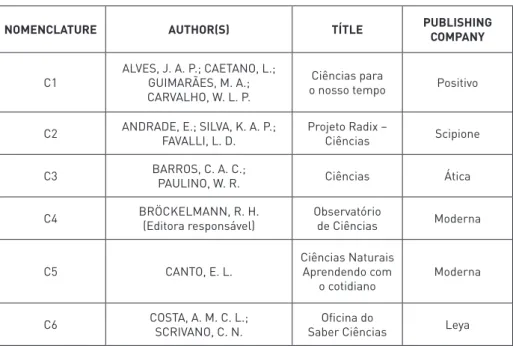
Information regarding Science textbooks approved by PNLD 2014 for middle school, submitted to the analysis. In order to construct and analyze the data of this investigation we used the procedures of Content Analysis (BARDIN, 2004). Among the different techniques of Content Analysis, we used the one recognized by thematic or categorical analysis. Utilizing thematic analysis consists of identifying the nuclei of meaning that make up the message (content). For this,
we sought to identify the units of record that were directly related to the subject of the investigation. The presence or frequency of occurrence of sense nuclei in the text may have some meaning for the purpose of the work performed.
Table 1 – Information regarding in the middle school Science textbooks approved by PNLD 2014, submitted to the analysis.
NOMENCLATURE AUTHOR(S) TÍTLE PUBLISHING
COMPANY
C1
ALVES, J. A. P.; CAETANO, L.; GUIMARÃES, M. A.; CARVALHO, W. L. P.
Ciências para
o nosso tempo Positivo
C2 ANDRADE, E.; SILVA, K. A. P.; FAVALLI, L. D. Projeto Radix – Ciências Scipione
C3 BARROS, C. A. C.;
PAULINO, W. R. Ciências Ática
C4 BRÖCKELMANN, R. H. (Editora responsável) Observatório de Ciências Moderna
C5 CANTO, E. L. Ciências Naturais Aprendendo com
o cotidiano Moderna
C7 GEWANDSZNAJDER, F. Projeto Teláris – Ciências Ática
C8 GODOY, L. P.; OGO, M. Y.. Vontade de Saber Ciências FTD
C9 GOWDAK, D. O;
MARTINS, E. L.
Ciências Novo Pensar – Edição
Renovada
FTD
C10 KANTOR et al. Ciências, Natureza
& Cotidiano FTD
C11 SANTOS, T. H. F.MOISES. H. N.; Ciências da Natureza
IBEP – Instituto Brasileiro de Edições Pedagógicas
C12 MORETTI, R. Ciências nos dias de hoje Leya
C13 MOZENA, E. R.; SANTANA, O. A. Ciências Naturais Saraiva livreiros editores
C14 NERY, A. L. P. et al. Para viver juntos – Ciências Edições SM
C15 PEREIRA, A. M.; SANTANA, M.; WALDHELM, M.
Perspectiva –
Ciências Editora do Brasil
C16 SCHECHTMANN E. et al. das CiênciasCompanhia Saraiva Livreiros Editores
C17 SHIMABUKURO, V.
(Editora responsável)
Projeto Araribá –
Ciências Editora Moderna
C18 STERN, I. Ciências no século XXI Saraiva Livreiros Editores
C19 YAMAMOTO, A. C. A.; CARNEVALLE, M. R.; RODRIGUES, R. M. A.
Jornadas.cie –
Ciências Saraiva Livreiros Editores
Source: created by the authors.
The theme is deined by Bardin (2004, 131) as “[...] a statement about a subject ... a phrase or compound phrase, usually a condensed summary or phrase, by inluence of which can be affected a vast set of singular formations “. The identiication of
themes occurs at the coding stage of the message. Then, in the categorization phase, the themes are divided into categories according to their common characteristics.
The categorization generates classes that bring together a group of elements of the record unit. The classes are compiled from the correspondence between the meaning, the common sense logic and the theoretical orientation of the researcher. Therefore, the criteria for categorization may be semantic;
syntactic; lexical or expressive. Still, Bardin (2004) indicates the possibility of a
In this investigation we work with the construction of categories a
posteriori. After the constitution of the documentary corpus, we performed a
thorough reading of the material. This irst reading enabled us to get in touch with the material, so we built our irst impressions on how the Climate Change issue is presented and discussed in textbooks. From a second reading, taking into account
the objectives of the research, we chose the registry units relevant to our research work. The next step was to organize the registration units into groups by thematic similarity. The groups enabled us to construct categories a posteriori.
3 MEANINGS OF THE CLIMATE CHANGE THEME IN THE TEXTBOOKS OF NATURAL SCIENCES
According to the National Curricular Parameters (PCN) of Natural Sciences for the third and fourth cycles of middle (BRAZIL, 1998), the thematic axes articulate different concepts in their respective school years, which are deined as follows: 6th grade - “Terra e Universe”; 7th grade - “Life and Environment”; 8th grade - “Human Being and Health” and 9th grade - “Technology and Society”. In
addition to these, the “Environment” theme may appear across all content. Taking into account these thematic axes we can indicate that in the
analyzed textbooks:
• Issues related to the Climate Change theme are more frequent in
textbooks for the 6th grade (C1, C2, C3, C4, C6, C7, C8, C9, C10, C11, C12, C13, C14, C15, C16, C17, C18 e C19), which propose to work with the “Earth and Universe “ theme;
• Books of the 7th grade (C1, C2, C6, C7, C8, C9, C11, C14, C16, C17 e C19); propose the work with the theme “Life and Environment”.
The Climate Change theme is infrequent in these textbooks and their
presence is usually limited to some speciic text or in small comments
delimited and highlighted in the material by a box;
• Books of the 8th grade (C5, C9 e C13), are the ones that least address
the theme of Climate Change, since, in general, they discuss issues
related to the “Human Being and Health” theme;
• Books of the 9th grade (C3, C4, C5, C7, C8, C9, C11, C12, C14, C15, C16, C17, C18 e C19), are presented in a frequent form (falling behind
in frequency only of the 6th grade textbooks) issues related to the
topic of Climate Change. Recalling that these books focus on the thematic axis “Technology and Society”.
Taking into account this context we present below other results of our
investigation. Part of these results is described from the following categories: Considerations on the Greenhouse Effect Phenomenon; Considerations on the Global Warming Phenomenon, Causes of Climate Change, Consequences of Climate Change and Mitigation Measures Related to Climate Change.
3.1 Considerations on the Greenhouse Effect Phenomenon
being a natural phenomenon inherent to Earth’s own climate dynamics.
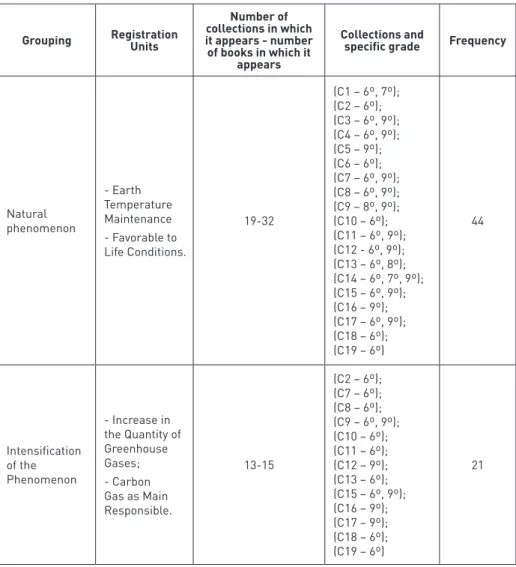
In Table 2 we present in a systematic way how the Greenhouse Effect is presented in the textbooks of the Natural Sciences of in middle school. In this table we have the following groupings: Natural Phenomenon, Intensiication of
the Phenomenon and Analogies related to the Phenomenon.
The mention of the fact that the Greenhouse Effect is a natural phenomenon is present in thirty-two of the total analyzed textbooks and appears forty-four times throughout the analysis of the works. As can be seen in Table 2, the Earth Temperature Maintenance and Favorable to Life Conditions record
units enabled us to construct the group called Natural Phenomenon.
It is signiicant the number of collections and frequencies in which the Greenhouse Effect is presented as a natural phenomenon.
Table 2 – Considerations on the Greenhouse Effect phenomenon present in the middle school Science textbooks approved by the 2014 PNLD.
Grouping Registration Units
Number of collections in which it appears - number of books in which it
appears
Collections and
specific grade Frequency
Natural phenomenon
- Earth Temperature Maintenance - Favorable to Life Conditions.
19-32
(C1 – 6º, 7º); (C2 – 6º); (C3 – 6º, 9º); (C4 – 6º, 9º); (C5 – 9º); (C6 – 6º); (C7 – 6º, 9º); (C8 – 6º, 9º); (C9 – 8º, 9º); (C10 – 6º); (C11 – 6º, 9º); (C12 - 6º, 9º); (C13 – 6º, 8º); (C14 – 6º, 7º, 9º); (C15 – 6º, 9º); (C16 – 9º); (C17 – 6º, 9º); (C18 – 6º); (C19 – 6º)
44
Intensification of the Phenomenon
- Increase in the Quantity of Greenhouse Gases; - Carbon Gas as Main Responsible.
13-15
(C2 – 6º); (C7 – 6º); (C8 – 6º); (C9 – 6º, 9º); (C10 – 6º); (C11 – 6º); (C12 – 9º); (C13 – 6º); (C15 – 6º, 9º); (C16 – 9º); (C17 – 9º); (C18 – 6º); (C19 – 6º)
Analogies to explain the Greenhouse Effec.
- Glass greenhouses - Cars with closed windows
14-19
(C1 – 6º); (C3 – 6º); (C4 – 6º, 9º); (C5 – 9º); (C6 – 6º); (C7 – 6º, 9º); (C9 – 6º); (C11 – 6º, 9º); (C12 – 6º); (C13 – 6º); (C14 – 6º, 9º); (C15 – 6º); (C16 – 6º, 9º); (C19 – 6º)
22
Source: Elaborated by the authors.
The data also indicate that a significant part of the discussion on the
Greenhouse Effect proposed by the books addresses scientiic concepts such as:
temperature, radiation, heat and energy. These concepts, in a certain way, are directly
related to the systematized knowledge of the ield of Physics. There are also direct references to the modiication of the composition of the gases that make up the atmosphere, this matter being related to the discussions elaborated by the ield of Chemistry. Systematized knowledge by Biological Sciences can be identiied in
discussions that deal with terms such as life, survival, species and living beings. Another highlight in the analysis of this topic in textbooks is directly related
to the weight attributed to human actions to explain the causes of the intensiication of the Greenhouse Effect. In this sense, in Table 2 we present the group called Intensiication of the Phenomenon. In it we can observe the units of record of Increase in the Quantity of Greenhouse Gases and Carbon Gas as Main Responsible.
The collection C15 refers to the Greenhouse Effect as:
[...] natural and beneicial for maintaining the temperature of the Earth and,
consequently, favoring the survival of living beings. However since the emergence of the irst industries in the 21st century, the amount of carbon dioxide released
into the atmosphere has increased(C15,2012, 6ºgrade, p. 161, highlighted by us).
In this case, the authors of the C15 collection afirm that the Greenhouse Effect is a natural phenomenon that is being modiied by the human being due
to the great emissions of greenhouse gases, being that an important part of these emissions is due to the activities of the burning of fossil fuels.
Our analyzes also indicate that the phenomenon of the Greenhouse
Effect at various times is presented through analogies with other phenomena.
We veriied that the analogies to explain the Greenhouse Effect were found in nineteen of the total of analyzed books and appear twenty-two times throughout
the works, as presented in Table 2.
It should be noted that we could observe conceptual misunderstandings
in these analogies presented in these textbooks. Comparisons between the
Greenhouse Effect phenomenon with glass greenhouses and cars with closed
main criticism is that the composition of the atmosphere and the interaction of radiation with matter are not adequately presented from this analogy. The interaction of electromagnetic radiation with gases in the atmosphere has not
parallel with a glass obstacle that encloses hot air. In this sense, it would be
important that the authors of these books, even when using these analogies, differentiate the phenomenon that occurs in the glass greenhouses or in cars with
closed glass with the phenomenon of the Greenhouse Effect.
3.2 Considerations on the Global Warming Phenomenon
The increase in the amount of greenhouse gases in the atmosphere, due to natural and anthropogenic causes, is one of the factors that cause the
intensification of the Greenhouse Effect phenomenon, causing atmospheric
warming or increasing the Earth’s average temperature, a phenomenon called
Global Warming. It is important to stress that for many people the idea of Global Warming is much better known than that of Global Climate Change.
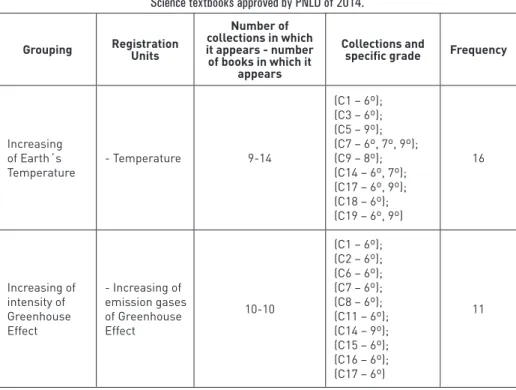
The systematization of the information obtained in the books allowed us
to construct Table 3.
Table 3 – Considerations on the phenomenon Global Warming present in the middle school Science textbooks approved by PNLD of 2014.
Grouping Registration Units
Number of collections in which it appears - number of books in which it
appears
Collections and
specific grade Frequency
Increasing of Earth´s Temperature
- Temperature 9-14
(C1 – 6º); (C3 – 6º); (C5 – 9º); (C7 – 6º, 7º, 9º); (C9 – 8º); (C14 – 6º, 7º); (C17 – 6º, 9º); (C18 – 6º); (C19 – 6º, 9º)
16
Increasing of intensity of Greenhouse Effect
- Increasing of emission gases of Greenhouse Effect
10-10
(C1 – 6º); (C2 – 6º); (C6 – 6º); (C7 – 6º); (C8 – 6º); (C11 – 6º); (C14 – 9º); (C15 – 6º); (C16 – 6º); (C17 – 6º)
11
Source: created by the authors.
afirms that Global Warming is directly related to the increase in average of Earth’s temperature, not citing any relation with the phenomenon of the Greenhouse Effect; the other afirms that the origin and cause of this phenomenon are directly related to the intensiication of the emission of carbon dioxide in the atmosphere
by means of human actions.
These statements in the books enabled us to elaborate two groups when
we refer to the considerations on the phenomenon of Global Warming: Increase of Earth’s Temperature and Increase of the Intensity of the Greenhouse Effect.
We also observed that the frequency of appearance of the irst group (sixteen times) is greater than that of the second group (eleven times). In addition, the nuclei of meanings relative to the irst group are present in fourteen books
while the second, in ten books of the analyzed total.
It is observed that concepts related to physics, such as heat and
thermodynamic temperature, are present in the books. Also striking is the
development of ideas related to the ield of Biology, such as ecological imbalances. In the sequence we present another important category in this investigation,
which is directly related to the considerations found in the textbooks on the causes of Climate Change.
3.3 Causes of Climate Change
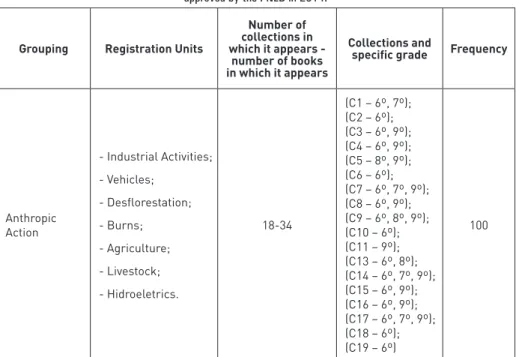
In table 4 the groups and record units that address the causes of Climate
Change are highlighted.
Table 4 – Causes associated with Climate Change in the middle school Science textbooks approved by the PNLD in 2014.
Grouping Registration Units
Number of collections in which it appears -
number of books in which it appears
Collections and
specific grade Frequency
Anthropic Action
- Industrial Activities; - Vehicles;
- Desflorestation; - Burns; - Agriculture; - Livestock; - Hidroeletrics.
18-34
(C1 – 6º, 7º); (C2 – 6º); (C3 – 6º, 9º); (C4 – 6º, 9º); (C5 – 8º, 9º); (C6 – 6º); (C7 – 6º, 7º, 9º); (C8 – 6º, 9º); (C9 – 6º, 8º, 9º); (C10 – 6º); (C11 – 9º); (C13 – 6º, 8º); (C14 – 6º, 7º, 9º); (C15 – 6º, 9º); (C16 – 6º, 9º); (C17 – 6º, 7º, 9º); (C18 – 6º); (C19 – 6º)
Natural and/or Anthropogenic Actions
- Excretion of Animals;
- Breathing of Living; - Beings, Materials in Decomposition; - Volcanic Eruptions; - Burns;
- Natural Gas Deposits; - Water Reserves; - Tectonic Plates; - Solar Cycles - Orbital Variations; - Earth’s Core Heating; - Cycles of Milankovitch
9-13
(C1 – 6º, 7º); (C4 – 9º); (C7 – 9º); (C8 – 6º); (C9 – 6º, 8º, 9º); (C10 – 6º); (C13 – 6º, 8º); (C16 – 6º); (C19 – 6º)
18
Source: created by the authors.
In thirty-four analyzed books and with a frequency of one hundred, the
prevailing view is that Climate Change is caused exclusively by anthropic action.
The C7 collection, for example, states:
[...] with 90% certainty, that the human being is responsible for global warming (C7, 2012, 9th grade, p. 262, highlighted by us).
We note that all the analyzed books on the subject of Global Warming
present the idea that the increase of greenhouse gases in the atmosphere is the main cause of Climate Change observed today. This is an aspect widely publicized in the
media and also by research reports from groups of scientists such as the IPCC (2014). There are textbooks, for example in the C15 collection, which present
arguments indicating that the increase of carbon dioxide in the atmosphere is the
main cause of current Climate Change. In collections C6 and C14, for example,
other gases responsible for the causes of climate change are indicated, such as methane and nitrogen oxides.
The authors of one of the didactic analyzed collections, C14, were
based on a text by Moraes (2011), published in the newspaper O Eco, to present
considerations about the role of greenhouse gases to explain the causes of Climate
Change. In this context the water vapor was rightly considered an important greenhouse gas. However, the idea that the weight of anthropogenic emissions of
carbon dioxide is the most important factor in explaining the causes of current Climate Change prevailed in this text.
Change. However, it is necessary to indicate that other factors of natural and / or
anthropogenic origin also help to explain the causes of the current Climate Change
(REIS, SILVA e FIGUEIREDO, 2015; WATANABE-CARAMELLO, 2012). In this context, it would be important that the textbooks, in the near future,
could present considerations about the fact that the causes of Climate Change are
not necessarily based on consensuses, which includes the scientiic environment. It would be important to present some considerations about how some
hypotheses are constructed on the Earth’s future scenarios from Earth’s climate
models. It may be considered an improvement if the textbooks present some scientiic controversies on the subject, as for example those that involve the concept of Global Average Temperature (ESSEX, McKTRICK e ANDERSEN, 2006).
The second group called Natural and / or Anthropogenic Action can be observed in thirteen of the total of analyzed books, and the subject is presented eighteen times, meaning, in relatively smaller proportions when compared to the
irst group.
It is interesting to observe (see Table 4) that thirteen of the analyzed books present considerations that afirm that the causes of Climate Change are also associated with natural phenomena. In this case, the frequent terms are: Excretion of Animals, Breathing of Living Beings, Materials in Decomposition, Volcanic Eruptions, Burns, Natural Gas Deposits, Water Reserves, Tectonic Plates, Solar Cycles, Orbital Variations, Earth’s Core Heating and Cycles of Milankovitch. The excerpt below exempliies these considerations:
A quantitative reconstruction of history allows us to advance the understanding of the causes and the mechanisms responsible for the climatic evolution, some of them of very signiicant periodic origin. Thus, in the last 500 thousand years, there were three variations of climate with periods of 25 thousand years (10%), 42 thousand years (25%) and 10 thousand years (50%). All these periods are associated with the position of the Earth in space and orbit in the Solar System. As a consequence, one could say that these variations are the causes of ice ages, an idea defended for years by the Russian astronomer Milannkovitch and only now, with paleoclimatology, veriied in a safe way (MOURÃO, 1988, apud C1, 2011, 6th grade, p. 169).
An interesting data observed by this research is the fact that the collection
C3 presents considerations on uncertainties related to the models of climatic phenomena, as in the following excerpt:
Calculations of greenhouse gas emissions from deforestation of forests, such as the Amazon Rainforest, represent a remarkable challenge for scientists. Despite efforts to improve these calculations, the estimates still show a signiicant degree of uncertainty (FEIGL et al., 2009 apud C3, 2012, 6th grade, p. 230).
In agreement with the perspective that we defend for the educational approach of the theme of Climate Change (REIS, SILVA and FIGUEIREDO, 2015), we consider relevant that the C3 collection presents references to the
emissions of greenhouse gases. In addition to the C3 collection, the authors of the collections C5, C9 and C10 also seek to present the topic discussing some
uncertainties and controversies regarding the causes of Climate Change. The
following excerpt exempliies this position:
[...]A group of scientists studying atmospheric conditions over time argued that the rapid rise in the planet’s average temperature is caused by the exaggerated increase in greenhouse gas emissions generated by human activities, notably the use of fossil fuels, deforestation and burns. Another group of scientists inds this view very alarmist and advocates reducing the emission of greenhouse gases produced by humans as a way to reduce environmental problems in the metropolis. But they are categorical in saying that the average temperature rise of the planet has been going on for quite some time, long before humans began to use fossil fuels intensively and burn large areas of the planet. For these scientists, global warming did not begin in the last century, but much earlier, and is part of a natural cycle of global warming and cooling.
Only time will tell which side is right. The debate is open and we must pay attention to the actions that provide the best conditions for survival on the planet, as well as to continue studying the conditions of the past and the current changes of the climate around the globe (C10, 2012, 6th grade, p. 160-161).
In this text we can see that the scientiic controversies regarding the causes
of the changes in climate are attributed to the different positions of scientists on the phenomenon, that is, they are generated in the internal scope of Science. This excerpt can be understood as an indication that some textbooks address certain
aspects of scientiic controversies involving the topic of Climate Change. In the
C9 collection are presented some information extracted from a site of researchers
of the University of São Paulo (USP) that report unpredictable aspects of the
climatic variations, although they point out that Climate Change is basically caused
by human activity, as we can observe in the excerpt below:
These very complex and unpredictable natural phenomena may be the explanation for the climate change that the Earth has suffered, but it is also possible and more likely that these changes are being brought about by the increase of the greenhouse effect, basically due to human activity (Extracted from the website: <http://educar.sc.usp.br/licenciatura/2003/ ee/Aquecimento1.html> por C9, 2012, 8th grade, p. 303).
It is noteworthy that complex and unpredictable phenomena form the
basis for explaining Climate Change. We consider that this is an interesting point of the discussion on the theme proposed by this collection.
But in the C5 collection it is presented the existence of controversies on the effects of Climate Change:
in the next few decades (C5, 2012, 9th grade, p. 99).
In agreement with our references (LEVINSON, 2008; REIS, 2004; SILVA, 2007) we understand that this collection (C5) presents important considerations
on the theme of Climate Change.
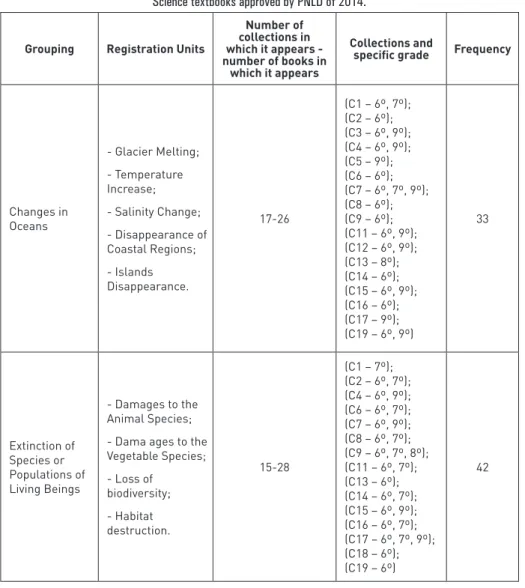
3.4 Consequences of Climate Change
In the Table 5 we summarized the systematized information in this research
on the consequences associated with Climate Change presented by the collections.
Table 5 – Consequences associated to the Climate Change present in the middle school Science textbooks approved by PNLD of 2014.
Grouping Registration Units
Number of collections in which it appears - number of books in
which it appears
Collections and
specific grade Frequency
Changes in Oceans
- Glacier Melting; - Temperature Increase; - Salinity Change; - Disappearance of Coastal Regions; - Islands Disappearance.
17-26
(C1 – 6º, 7º); (C2 – 6º); (C3 – 6º, 9º); (C4 – 6º, 9º); (C5 – 9º); (C6 – 6º); (C7 – 6º, 7º, 9º); (C8 – 6º); (C9 – 6º); (C11 – 6º, 9º); (C12 – 6º, 9º); (C13 – 8º); (C14 – 6º); (C15 – 6º, 9º); (C16 – 6º); (C17 – 9º); (C19 – 6º, 9º)
33
Extinction of Species or Populations of Living Beings
- Damages to the Animal Species; - Dama ages to the Vegetable Species; - Loss of biodiversity; - Habitat destruction.
15-28
(C1 – 7º); (C2 – 6º, 7º); (C4 – 6º, 9º); (C6 – 6º, 7º); (C7 – 6º, 9º); (C8 – 6º, 7º); (C9 – 6º, 7º, 8º); (C11 – 6º, 7º); (C13 – 6º); (C14 – 6º, 7º); (C15 – 6º, 9º); (C16 – 6º, 7º); (C17 – 6º, 7º, 9º); (C18 – 6º); (C19 – 6º)
Changes in the Earth’s Climate Dynamics
- Changes in Rain Regime;
- Changes in Wind Currents;
- Changes in Earth Temperature.
15-20
(C1 – 6º); (C2 – 6º); (C3 – 6º, 9º); (C4 – 6º); (C6 – 6º); (C7 – 6º, 9º); (C8 – 6º); (C9 – 6º, 8º, 9º ); (C10 – 6º); (C11 – 6º); (C13 – 6º, 8º); (C14 – 9º); (C15 – 6º); (C17 – 9º); (C19 – 6º)
30
Increased occurrence of extreme natural phenomena
- Storms; - Cyclones; - Tornados; - Hurricanes; - Floods.
7-7
(C1 – 6º); (C4 – 6º); (C6 – 6º); (C9 – 8º); (C11 – 9º); (C15 – 9º); (C16 – 6º)
8
Source: Created by the authors In twenty-six analyzed books, the authors, when they seek to portray
the consequences of Climate Change, do so by relating them to visible effects
in the oceans. In this case, the frequency in which it appears is thirty-three times throughout these analyzes. The record units that gave rise to this group are: Glacier Melting, Temperature Increase, Salinity Change, Disappearance of Coastal Regions and Islands Disappearance.
It is important to point out that the authors of the analyzed books refer to the melting of the glaciers as a direct result of Global Warming.
The authors of the collections C9, C14 and C19, afirm that the melting
of the glaciers has great potential of provoking changes in the salinity of the
water, an aspect that interferes in a signiicant way in the dynamics of the marine
currents. We consider this to be relevant information presented in these books,
especially since they are based on consolidated scientiic research (IPCC, 2014).
We understand that it would be interesting that the books could indicate that, besides these, there are risks that were not even imagined with the melting of
the glaciers (WATANABE-CARAMELLO, 2012).
We also emphasize that the analyzed books report other consequences of climate change, such as those that turn to the group Extinction of Species
or Populations of Living Beings. We have veriied that in twenty eight different parts of the analyzed textbooks there are afirmations of this nature (see Table 5). In these we’ve identify units of record that indicate different consequences of
the current Climatic Changes emphasizing, above all, the Damages to the Animal Species like, for example, corals, polar bears, amphibians and Damages to the
Vegetable Species, besides the Loss of Biodiversity and Destruction of Habitat. The authors of the analyzed books (see Table 5) indicate that Climate
The collection C17 presents the discussion on the Damage to Vegetable
Species using as reference an article published in 2010 in the journal Science, authored
by Zhao and Running. This article, according to the analyzed collection, presents data from a survey that indicates that plants - in general - have grown less. This assertion,
according still to the analyzed collection, is in contrast to the usual assertion that increasing global temperature should increase plant growth and productivity.
It is important to indicate, in this case, that the authors of the C17 textbook used information from a prestigious scientiic journal in the academic world to discuss the topic. In fact, we see that this is a trend in the analyzed textbooks, that is,
textbooks often present data and information from articles and electronic websites
of scientiic associations to deal with aspects of the topic of Climate Change. In the C7 collection, for example, data from research carried out by the National Institute of Space Research (INPE) are presented, which indicate an increase
in terrestrial temperature, an aspect that, according to the analysis of this institute, has the potential to provoke the Savanization of Amazon and the Loss of Biodiversity.
The analyzes that we conducted indicate that the books also present themes related to the Changes in the Earth’s Climate Dynamics. The recording units developed
for the formation of this group are the following: Changes in Rain Regime, Changes
in Wind Currents and Changes in Earth Temperature. This group was constructed from record units that are frequent in twenty of the total of analyzed books, with an absolute frequency of thirty times throughout the analysis of the works.
We highlight an excerpt from the C16 collection, which indicates that research data are generating controversy among scientists. This excerpt also mentions that the referred research was published in the prestigious journal Nature. The following extract:
[...]For the irst time, concrete data associate global warming with the extinction of several species of amphibians. Researchers have found a strong correlation between rising air temperature and ocean surface temperatures and the proliferation of a predator accused of exterminating two-thirds of the toad species of the genus Atelopus that occur in Central and South America. Today [Nov. 2011], the results are already generating controversy among experts worldwide (C16, 2012, 7th grade, p. 239, highlighted by us).
Again we consider relevant the mention of the controversies, but there is a deepening in relation to the meanings, aspect that could be better worked on in
this material in the future. In the C15 collection, in turn, this theme is afirmative that it passable doubt. In this sense, it is indicated that there is no consensus in the scientiic community about the causes and consequences of Climate Change. The following excerpt exempliies this position:
Scientists around the world monitor the consequences of the worsening of global warming and make calculations (although there are differences and controversies between them) that point to the increase in the average temperature of the planet (C15, 2012, 6th grade, p. 162, highlighted by us).
interesting. However, as we have already indicated, we believe that there could be,
in the near future, a deepening of this discussion, pointing to considerations about the complexity of climatic phenomena.
4. MITIGATION MEASURES RELATED TO CLIMATE CHANGE
The textbooks present considerations for mitigation measures that aim to combat the causes and effects of Climate Change. Some of the mitigation
measures presented relate to the following groups:
• Actions of a technological nature - Creation or improvement of
technologies that will be able to reduce, retain or reverse emissions of greenhouse gases due to anthropogenic actions;
• Use of renewable energy sources - The idea is to replace the use of non-renewable energy sources with renewable energy sources; • Actions of individual nature - investing in changing people’s habits,
such as the use of personal vehicles;
• Carbon Sequestration – The idea is to reduce the existence of excess carbon in the atmosphere, mainly by planting trees;
• Actions of a political nature - Elaboration of decrees, initiatives,
political protocols, among others, that can aid in the reduction, retention or reversion of the global Climate Change framework.
Given this context, the present category was constructed from the ive groups
presented. Next, in Table 6, the information found in textbooks is systematized.
The group of Actions of Technological Nature appears in ive of the total of analyzed books. In this grouping there are considerations that point to mitigation measures related to the use of so-called clean technologies. These
technologies could reduce the increase of greenhouse gases in the atmosphere.
The following logging units gave rise to this group: Eficient Equipment, Climate Management, Geoengineering and Monitoring.
Table 6 – Mitigation measures related to the consequences of Climate Change present in the middle school Science textbooks approved by the PNLD of 2014.
Grouping Registration Units
Number of collections in which it appears - number of books in which it
appears
Collections and
specific grade Frequency
Actions of Technological Nature
- Efficient Equipment; - Climate Management; - Geoengineering; - Monitoring.
4-5
(C3 – 9º); (C7 – 6º, 9º); (C9 – 6º); (C19 – 7º)
Usage of Renewable Energy Sources
- Wind Energy; - Tidal Energy; - Geothermal Energy - Biofuels; - Solar energy.
9-11
(C1 – 9º); (C6 – 6º); (C7 – 6º, 9º); (C12 – 6º); (C14 –6º, 9º); (C15 – 9º); (C16 – 9º); (C17 – 7º); (C18 – 9º)
13
Actions of Individual Nature
- Reduce, reuse, recycle; - Conscious consumption; - New patterns of behavior.
7-7
(C1 – 6º); (C3 – 9º); (C5 – 9º); (C7 – 9º); (C9 –9º); (C15 –9º); (C17 –9º) 8 Carbon Sequestration of
the atmosphere - Carbon credits 7-8
(C1 – 7º); (C6 – 6º); (C7 – 6º); (C14 – 7º, 9º); (C16 – 9º); (C17 – 9º); (C19 – 7º)
9
Actions of a
Political Nature - International Agreements 14-17
(C1 – 6º); (C2 – 6º); (C4 – 6º); (C6 – 6º); (C7 – 6º, 9º); (C8 – 6º, 9º); (C10 – 6º); (C11 – 6º, 9º); (C12 – 6º); (C13 – 8º); (C14 – 6º); (C15 – 6º); (C16 – 6º); (C17 – 7º)
24
Source: Created by the authors
In the C19 collection, the authors point to the role of new technologies in
mitigating the effects of climate change. They present a perspective in which technology
can solve environmental problems, as we can observe in the following excerpt:
The authors of another collection analyzed, C9, cited an excerpt from
Fapesp Agency (2008), which indicates the need to improve the measurement technologies, i.e. Climate and Gas Monitoring, as we can see in:
Among the most immediate needs that the researchers point out are the development of better climate observation and drought forecasting systems and the continued monitoring of methane levels in the atmosphere (FAPESP AGENCY, 2008 apud C9, 2012, 6th grade,
p. 102, highlighted by us).
The second grouping Usage of Renewable Energy Sources appears in
eleven of the total of analyzed books. The record units that make up this grouping
are: Wind Energy, Solar Energy, Tidal Energy, Geothermal Energy and Biofuels. There are a number of books analyzed (C1, C6, C7, C14, C15, C16 and C17)
that indicate the need for the country to increase the use of renewable energy sources.
However, there are no considerations on controversies concerning this matter. In
this sense, the idea prevails that in fact there are clean technologies and that they will be responsible for a great reversion in the current scenario of environmental
degradation in which the world inds itself. In this way, they end up simplifying a theme that could be better explored from social and scientiic controversies.
The third group called Actions of Individual Nature is identified in seven books. In this grouping are the nuclei of meaning that point to changes in
individual behavior to reduce emissions of greenhouse gases.
Reducing consumption, recycling, reducing the number of cars running on the streets or using less polluting means of transportation, replacing plastic bags with returnable ones, among other attitudes, are presented by the authors as a
mitigation measure of Climate Change. In this perspective, the authors of the C9
collection, for example, reinforce the need to modify the habits of individuals as a possibility to change the framework of the environmental degradation installed.
This view can be observed as follows:
The responsibility is, therefore, of each one of us. [...]. As societies result from the behavior of the individuals composing them, new standards of ethical and social behavior will be established. Political representatives and governments will then be chosen according to these new standards. So it will be possible to imagine a response for the future of the planet: living conditions will be better if we want it to (LD9, 2012, 9th grade, p. 312, highlighted by us).
Another grouping formed concerns the Carbon Sequestration of the atmosphere. This grouping appears in eight of the total of analyzed books. The main feature of the groups is the idea of removing carbon dioxide through photosynthetic organisms, which capture carbon and deplete oxygen to the atmosphere. An example of this is the planting of trees or the reduction of current
deforestation. The so-called Carbon Credits are the registration unit used for the
formation of the present group, as it is the main topic discussed when subjects related to carbon sequestration are presented in these materials.
irreversibility of climatic phenomena and also the dificulty in quantifying this type of emission (REIS, SILVA e FIGUEIREDO, 2015).
The C1 collection, however, claims that there are criticisms about carbon credits purchased by companies, as they continue to pollute. The following excerpt
exempliies this position:
[...]There are some criticisms of carbon credits. This is because some researchers say that their use would allow large countries to continue polluting, since they could buy the credits to compensate for their polluting activity.
What is your opinion about carbon credits? (C1, 2011, 7th grade, p. 116, highlighted by us).
The last group formed refers to the Actions of a Political Nature. It is
present in seventeen of the total of analyzed books. The registry unit that formed
this group was called International Agreements.
Authors of collections C4, C7, C8, C11 and C14 present international
agreements to discuss mitigation measures, which are considered to be one of the
main measures to reduce greenhouse gas emissions. In agreement with Santos, Carvalho and Levinson (2014), we consider relevant the existence of discussions
of this nature in classes of Sciences that deal with the environmental theme, since
it presents the politics as something fundamental for the modiication of the
process of environmental crisis that we experience in the world today.
In collections C8 and C15 are presented political and economic criticism
regarding the international agreements that deal with the reduction of greenhouse gas emissions. The main criticism is that some countries are unable to adhere to international greenhouse gas emission reduction agreements, mainly because this may mean a strong limitation of the economic growth of these countries.
It is important to point out that this is a complex and conlicting game of interests, which allows the identiication of political and economic controversies directly associated with to decision-making on the subject (WATANABE-CARAMELLO, 2012). However, our analyzes indicate that there isn’t in these
materials considerations about unpredictable and incalculable aspects related to these mitigation measures.
FINAL CONSIDERATIONS
The Climate Change theme is present in the middle school Science textbooks approved by the PNLD in 2014. Considerations on this theme are more frequent in the textbooks of the 6th grade, which are proposed to work with the Earth and Universe theme. The theme appears punctually in the books of 7th grade, these having focus on Life and Environment. It is observed also that the 8th grade textbooks are those in which it is less frequent to approach the subject, since in general, they work on subjects related to Human Being and Health. In addition to the textbooks of 6th grade, the ones that present more considerations on the subject are the ones of 9th grade, which present subjects related to Technology and Society.
the textbooks enabled us to elaborate ive analytical categories: Considerations on the Greenhouse Effect Phenomenon; Considerations on the Global Warming
Phenomenon, Causes of Climate Change, Consequences of Climate Change and
Mitigation Measures related to Climate Change. From these categories we make
several considerations about these textbooks.
Among the results, we also emphasize that textbooks present, in a general way, a conceptually consistent discussion on the Climate Change topic for the
proposed educational level. In this sense, it is worth noting that many textbooks rely on information obtained from articles in scientiic journals or from texts that can be found on online websites of scientiic societies. In addition, concepts of
Physics, Chemistry and Biology are explicitly presented to support the proposed discussions. We can infer that this conceptual advance present in the analyzed textbooks may be due to the requirements related to the evaluation of textbooks
by the FNDE, once this has been done frequently in the last few years.
However, the data collected in this research allow us to afirm that there is
scarce in the analyzed materials the approach of the theme from the complexities that are inherent to the climatic phenomena. These materials present some consideration of complexities and controversies inherent to the theme only when they address the Causes of Climate Change and the Consequences of Climate Change.
We understand that in future, these materials could consider - in the approach to the Climate Change theme - aspects that point to the overcoming of a linear and simplifying view of climatic phenomena. In this context, we consider
it necessary that these materials question the approaches exclusively focused on a
deterministic view of Science. In other words, these materials could, in the near
future, problematize the theoretical perspectives that reduce the complexity of environmental issues to a discussion focused exclusively on simple and universal laws that are not able to advance us in understanding the risks inherent in how we
relate to nature (SILVA, 2007; WATANABE-CARAMELLO, 2012).
Finally, the lack of discussions that point to the complexity of climatic phenomena leads us to a consideration of textbooks: the Climate Change theme is
treated with emphasis on its conceptual aspects and still with little attention to the process of knowledge construction and considerations which involve articulations between Science, Technology, Society and Environment.
From the results of this research, we consider it opportune to elaborate other investigative works that turn speciically to the analysis of the articulation
between the specific content of sciences present in these materials and the
theme of Climatic Changes. It also seems interesting to investigate the concrete
educational opportunities that the contents of sciences present in these materials offer for the treatment of some complexities inherent to climatic phenomena.
SUPPORT
REFERENCES
ALVES-MAZZOTTI, A. J.; GEWANDSZNAJDER, F. O método nas ciências naturais e sociais: pesquisa quantitativa e qualitativa. 2. ed. São Paulo: Pioneira, 1998. 203 p.
BARDIN, L. Análise de conteúdo. 3. ed. Lisboa: Edições 70, 2004.
BARRETO, M. M. Análise de livros didáticos de geograia do ensino fundamental considerando diferentes hipóteses sobre o aquecimento global e as mudanças climáticas. 2009. 161 f. Dissertação (Mestrado em Geograia)- Departamento de Geograia, Universidade de Brasília, Brasília, DF, 2009.
BRASIL. Guia PNLD 2014 Anos inais Ciências. Brasília, DF: Ministério da Educação, 2013. 40 p. BRASIL. Parâmetros Curriculares Nacionais: terceiro e quarto ciclos do ensino fundamental: ciências naturais. Brasília, DF: SEF/MEC, 1998. 139 p.
CARVALHO, L. M. Educação ambiental. In: OLIVEIRA, D.A.; DUARTE, A.M.C.; VIEIRA, L.M.F. DICIONÁRIO: trabalho, proissão e condição docente. Belo Horizonte: UFMG/Faculdade de Educação, 2010. Disponível em: < http://www.gestrado.org/pdf/241.pdf>. Acesso em: 11 fev. 2015. DELAQUA, F. A.; BASSOLI, F. Ciência acrítica: o aquecimento global nos livros didáticos de biologia. In: Congresso Internacional sobre Investigatión em Didáctica de las Ciencias, 10., 2013, Girona. Anais... Girona: Barcelona, 2013. Disponível em: <http://www.congresoenseciencias.com/ ES/>. Acesso em: 3 dez. 2015.
ESSEX, C.; MCKITRICK, R.; ANDRESEN, B. Does a global temperature exist? Journal of Non-Equilibriun Thermodinamics, v. 32, n. 1, p. 1-28, 2006.
FRACALANZA, H.; MEGID NETO, J. O livro didático de Ciências no Brasil. Campinas: Editora Komedi, 2006. 224p.
GODOY, A. S. Pesquisa qualitativa: tipos fundamentais. Revista de Administração de Empresas, São Paulo, v. 35, n. 3, p. 20-29, 1995.
LEVINSON, R. Towards a pedagogical framework for the teaching of controversial socio-scientiic issues to secondary school students in the age range 14-19. 2008, 242f. Tese (Doutorado em Educação) - Instituto de Educação, Universidade de Londres, Londres, Inglaterra. LOBATO, A. C. et al. Dirigindo o olhar para o efeito estufa nos livros didáticos de ensino médio: é
simples entender esse fenômeno? Ensaio Pesquisa em Educação em Ciências, Minas Gerais, v. 11, n. 1, p. 7-22, 2009. Disponível em: <http://www.portal.fae. ufmg.br/seer/index.php/ensaio/article/ view/161/231>. Acesso em: 15 out. 2014.
LUCENA, L. B.; MOURA, M. O. O discurso das mudanças climáticas globais abordadas nos livros didáticos de geograia. In: II EREPEG – ENCONTRO REGIONAL DE PRÁTICAS DE ENSINO DE GEOGRAFIA. Teresina – PI, 2014. Anais do II Encontro Regional de práticas de ensino de Geograia. Teresina – PI, 2014.
PAINEL INTERGOVERNAMENTAL SOBRE MUDANÇAS DO CLIMA (IPCC). Climate Change 2014: Synthesis Report. Contribution of Working Groups I, II and III to the Fifth Assessment Report of the Intergovernmental Panel on Climate Change [Core Writing Team, R.K. Pachauri and L.A. Meyer (eds.)]. IPCC, Geneva, Switzerland, 151 p. Disponível em: < http://ar5-syr. ipcc.ch/>. Acesso em: 20 jan. 2017.
PRIGOGINE, I. O im das certezas: tempo, caos e as leis da natureza. Trad.: Roberto Leal Ferreira. São Paulo: Editora UNESP, 1996.
REIS, D. A.; SILVA, L. F.; FIGUEIREDO, N. As complexidades inerentes ao tema mudanças climáticas: desaios e perspectivas para o Ensino de Física. Ensaio Pesquisa em Educação em Ciências, Belo Horizonte, v. 17, n. 3, set./dez. 2015.
REIS, P. R. Controvérsias sócio-cientíicas: discutir ou não discutir? Percursos de aprendizagem na disciplina ciências da terra e da vida. 2004. 457f. Tese (Doutorado em Educação) -Universidade de Lisboa, Lisboa, 2004.
RIBEIRO, R. A; KAWAMURA, M. R. D. Educação ambiental e temas controversos. Revista Brasileira de Pesquisa em Educação em Ciências, Belo Horizonte, v. 14, n. 2, p. 159-169, 2014. Disponível em: <http://revistas.if.usp.br/rbpec/article/view/898>. Acesso em: 3 dez. 2015. SANTOS, W. L. P.; CARVALHO, L. M.; LEVINSON, R. A Dimensão Política da Educação Ambiental em Investigações de Revistas Brasileiras de Ensino de Ciências. Revista Brasileira de Pesquisa em Educação em Ciências, v. 14, n. 2, 2014, p. 199-213.
SILVA, L. F. A Temática Ambiental, o Processo Educativo e os Temas Controversos: implicações teóricas e práticas para o ensino de Física. 2007. 211 f. Tese (Doutorado em Educação) – Universidade do Estado de São Paulo, Araraquara, 2007.
WATANABE-CARAMELLO, G. Aspectos da complexidade: contribuições da física para a compreensão do tema ambiental. 2012. 250f. Tese (Doutorado em Ensino de Ciências)-Instituto de Física e Faculdade de Educação, Universidade de São Paulo, São Paulo, 2012.
Submetido em 18/10/2016
Aprovado em 24/04/2017
Contato:
Nijima Novello Rumenos