CLINICAL SCIENCE
A close association of body cell mass loss with
disease activity and disability in Chinese patients
with rheumatoid arthritis
Yi-Ming Chen,I,II,III Hsin-Hua Chen,I,III,IVChia-Wei Hsieh,I,IVTsu-Yi Hsieh,I,IV,VJoung-Liang Lan,I,II,III,IV,V Der-Yuan ChenI,II,III,IV,V*
IDivision of Allergy, Immunology and Rheumatology, Department of Internal Medicine, Taichung-Kang Road, Taichung City, Taiwan.IICenter for
Geriatrics and Gerontology, Taichung Veterans General Hospital, Taiwan.IIIFaculty of Medicine, National Yang-Ming University, Taiwan.IVSchool of
Medicine, Chung-Shan Medical University, Taiwan.VInstitute of Biomedical Science, National Chung-Hsing University, Taiwan.
OBJECTIVES:To investigate the association of body cell mass loss with disease activity and disability in rheumatoid arthritis patients.
INTRODUCTION:Rheumatoid cachexia, defined as the loss of body cell mass, is important but under-recognized and contributes to morbidity and mortality in patients with rheumatoid arthritis.
METHODS:One hundred forty-nine rheumatoid arthritis patients and 53 healthy, non-rheumatoid arthritis control subjects underwent anthropometric measurements of body mass index and waist and hip circumferences. Bioelectrical impedance analysis was used to determine the subjects’ body compositions, including fat mass, skeletal lean mass, and body cell mass. The disease activity of rheumatoid arthritis was assessed using C-reactive protein serum, the erythrocyte sedimentation rate and the 28-joint disease activity score, while disability was evaluated using a health assessment questionnaire.
RESULTS:Rheumatoid arthritis patients had lower waist-to-hip ratio (0.86¡0.07 vs. 0.95¡0.06;p,0.001) and lower skeletal lean mass indexes (14.44¡1.52 vs. 15.18¡1.35; p= 0.002) than those in the healthy control group.
Compared with rheumatoid arthritis patients with higher body cell masses, those with body cell masses lower than median had higher erythrocyte sedimentation rates (40.10¡27.33 vs. 25.09¡14.85;p,0.001), higher disease activity scores (5.36¡3.79 vs. 4.23¡1.21;p= 0.022) and greater disability as measured by health assessment questionnaire
scores (1.26¡0.79 vs. 0.87¡0.79;p= 0.004).
CONCLUSIONS: The loss of body cell mass is associated with higher disease activity and greater disability in rheumatoid arthritis patients. Body composition determined by bioelectrical impedance analysis can provide valuable information for a rheumatologist to more rapidly recognize rheumatoid cachexia in rheumatoid arthritis patients.
KEYWORDS: Body cell mass; Rheumatoid arthritis; Bioelectrical impedance analysis; Disease activity; Disability.
Chen YM, Chen HH, Hsieh CW, Hsieh TY, Lan JL, Chen DY. A close association of body cell mass loss with disease activity and disability in Chinese patients with rheumatoid arthritis. Clinics. 2011;66(7):1217-1222.
Received for publication onMarch 5, 2011;First review completed onApril 12, 2011;Accepted for publication onApril 12, 2011
E-mail: [email protected] Tel.: 886-4-23592525 ext 3335 *contact author
INTRODUCTION
Rheumatoid cachexia affects two-thirds of rheumatoid arthritis (RA) patients and is defined as the loss of body cell mass (BCM), which is the fat-free component of cells within muscle, visceral organs and the immune system, and an often compensatory increase in fat mass (FM; i.e., cachectic
obesity).1BCM is considered to be the most important factor
in determining energy expenditure, protein needs, and the metabolic response to stress.2The consequences of chronic inflammation and increased production of cytokines, including tumor necrosis factor (TNF)-a and interleukin (IL)-1b, are responsible for higher resting energy turnovers and altered body compositions in RA patients.3 Sir James
Paget described wasting of skeletal muscle mass in patients with inflammatory arthritis that was not due to disuse atrophy.4 The loss of BCM in various diseases, including RA, congestive heart failure, acquired immunodeficiency syndrome (AIDS), starvation, critical illness, and aging has been associated with poor clinical outcomes.5Rheumatoid Copyrightß2011CLINICS– This is an Open Access article distributed under
cachexia is associated with an increased erythrocyte sedimentation rate (ESR), C-reactive protein (CRP), func-tional dependence, and an increased chance of morbidity and premature mortality.6Although the prevalence rate of
rheumatoid cachexia is high, it remains under-recognized, partly because an abnormal body composition phenotype in RA patients occurs most often in patients with normal body mass indexes (BMIs).1,3,7-9 Therefore, a body composition measurement beyond anthropometric parameters is essen-tial to identifying RA patients with rheumatoid cachexia.
A wide range of imaging techniques have been used to analyze the body compositions of RA patients, and dual X-ray absorptometry (DXA) has been reported to be the most useful tool for measuring soft tissue mass and bone mineral density.3,6,10-12However, DXA is not universally available,
requires a scheduled appointment and is sensitive to the patient’s hydration status.13-15A rapid and simple tool for identifying rheumatoid cachexia in outpatient settings is therefore necessary.
The abilities of different body tissues to conduct electrical currents have been known for more than a century.16 Bioelectrical impedance analysis (BIA) has the ability to distinguish fat tissue from fat-free tissue and water. Due to its relatively low cost, easy operation and high portability, BIA is probably the most commonly utilized method of evaluating body composition.16
The present study was designed to compare the body compositions, as measured by BIA, of RA patients with those of healthy control subjects. The impact of RA disease activity and disability on body composition was also explored.
MATERIALS AND METHODS
Participants
This study included 149 patients who visited the rheumatol-ogy clinic of Taichung Veterans General Hospital and were diagnosed with RA according to the 1987 revised criteria of the American College of Rheumatology (ACR).17 Patients with terminal cancer, end-stage liver, or renal disease were excluded. Fifty-three age- and gender-matched volunteers without rheu-matic diseases were enrolled as healthy control subjects.
Anthropometric Measurements
All measurements were performed after a 12-hour over-night fast. Participants were weighed while wearing light clothes but no shoes. Patient heights were determined to the nearest 0.1 cm using a fixed-wall-scale measuring device. The weight of each subject was determined to an accuracy of 0.1 kg using an electronic scale that was calibrated before each measurement session. The BMI was calculated as weight (kg) per height (m2). The waist circumference (WC) was measured to the nearest centimeter at the level of the umbilicus after expiration while the participant was standing still, breathing quietly, distributing weight equally onto both feet with arms hanging loosely at the sides and the head facing straight ahead. The hip circumference (HC) was measured to the nearest centimeter at the level of the maximal protrusion of the gluteal muscles over the underwear. The waist-to-hip ratio (WHR) was computed as WC divided by HC.
Body composition determination
The patients’ body compositions, including the FM and the skeletal lean mass (SLM), were assessed by the InBody
720 device (Biospace Co., Korea), a multifrequency impe-dance meter that takes readings from the body using an eight-point tactile electrode method and measures resis-tance at five frequencies (1 kHz, 50 kHz, 250 kHz, 500 kHz, and 1 MHz) and reactance at three frequencies (5 kHz, 50 kHz, and 250 kHz).18-20 In accordance with the manu-facturer’s guidelines, participants wiped the bottom of their feet with a proprietary electrolyte tissue before standing on the electrodes embedded into the scale platform. The participants were instructed to stand upright and grasp the handles of the analyzer, thereby providing contact with a total of eight electrodes (two for each foot and hand). The data were electronically imported into Excel using the software Lookin’Body 3.0. The repeated FM measurements exhibited a coefficient of variation of 0.6%. The FM index was computed as the FM per height (m2), while the SLM index was calculated as the SLM per height (m2). BCM was determined according to sex-specific equations that have previously been validated and reported.21
RA disease activity
The CRP serum levels, ESR and the 28-joint disease activity score (DAS28)22 were utilized to assess the RA disease activity. Low disease activity was defined as DAS28 3.2, moderate disease activity was defined as DAS28.3.2 but 5.1, and high disease activity was defined as DAS28.5.1.23
Disability
The level of disability in terms of disease impact was determined by a health assessment questionnaire (HAQ),24 which is a 20-item self-reported functional questionnaire with items rated from 0 to 3 and increasing in steps of 0.125 units. Subjects are considered to present a disability if their HAQ score§1.25
Ethics
This study protocol was approved by the Ethics Committee of Clinical Research, Taichung Veterans General Hospital, and informed consent was obtained from each participant.
Statistical Analysis
The data in the text and tables are expressed as a mean¡standard deviation. The software Statistical Package
for the Social Sciences (SPSS) version 13.0 (SPSS Inc., Chicago, IL, USA) was used to perform all statistical analyses. Student’st-test or the Mann-Whitney U test were used to compare continuous variables when appropriate. Categorical variables were compared using the chi-squared test or Fisher’s exact test when appropriate. Associations between variables were determined by Pearson’s correla-tion. For all tests, a p-value ,0.05 was considered statistically significant.
RESULTS
Demographic data, clinical characteristics,
anthropometric measurements, body composition and comorbidities in RA patients and healthy control subjects
(0.86¡0.07 vs. 0.95¡0.06, respectively;p,0.001) and exhibit lower SLM indexes than do healthy controls (14.44¡1.52 vs.
15.18¡1.35, respectively; p= 0.002). The RA patients also exhibited a trend towards decreased BCM compared to the control group (24.11¡3.64 kg vs. 25.12¡3.62 kg,
respec-tively; p= 0.083), although statistical significance was not achieved. No significant differences were observed in the demographic data or comorbidities of the RA patients and the healthy control subjects.
Association of body weight and BCM in RA patients and healthy control subjects
As shown in Figure 1, body weight and BCM are positively and significantly correlated in both RA patients (A, correlation coefficient = 0.62; p,0.001) and healthy control subjects (B, correlation coefficient = 0.67;p,0.001).
Comparison of clinical characteristics, anthropometric measurements and body
compositions of RA patients with different BCM levels
The RA group was split into two groups, with BCM values higher or lower than the gender-stratified median BCM values (23.4 in female and 29.2 in male participants, see Table 2). Patients with lower BCM values were older than were patients with higher BCM values (60.14¡11.45 years vs.
52.70¡12.59 years, respectively; p,0.001), had higher ESR levels (40.10¡27.33 mm/hr vs. 25.09¡14.85 mm/hr,
respec-tively; p,0.001), had higher DAS28 values (5.36¡3.79 vs. 4.23¡1.21 respectively; p= = 0.022), were more physically dependent in terms of HAQ scores (1.26¡0.79 vs. 0.87¡0.79, respectively; p= 0.004), and exhibited decreased serum
albumin levels (3.97¡0.44 vs. 4.17¡0.51, respectively;
p= 0.041).
Comparison of BCMs between different disease activity and disability in RA patients
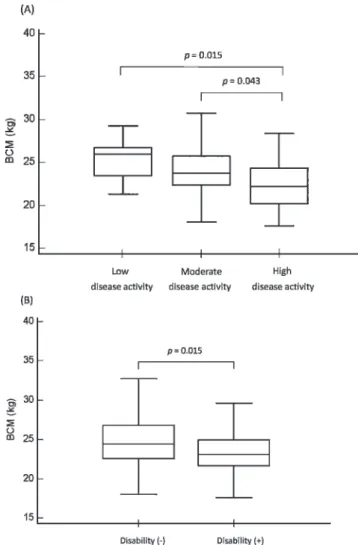
In Figure 2A, RA patients with high disease activity had lower BCMs than did those with moderate or low disease activity. Moreover, RA patients with physical dependence in terms of HAQ scores had lower BCMs than did those without a disability (Figure 2B).
DISCUSSION
Rheumatoid cachexia, characterized by the loss of BCM, leads to an increased chance of morbidity and premature mortality.6 BCM has also been reported as a valuable indicator of nutritional status, physical activity, and RA disease activity, making it a powerful predictor of outcome in various disease entities, including RA, critical illness, starvation, and aging.26,27 Anthropometric measurements
including body weight and BMI, although useful in predicting disease activity and survival in RA patients, are not sensitive to the changes in body composition that occur with aging and chronic inflammation.6 Therefore, it is important to analyze body composition using tools beyond simply measuring body weight and BMI to evaluate the impact of chronic inflammation in each individual.28 The present study is the first attempt to measure FM, SLM, and BCM, which are surrogate markers of rheumatoid cachexia, in RA patients of Asian ethnicity using BIA technology, which is quick and easy to deploy in the outpatient setting of rheumatology clinics.
Table 1 -Demographic data, comorbidities and body compositions of 149 patients with rheumatoid arthritis (RA) and 53 unrelated healthy control subjects (HC)#.
Factors RA (n = 149) HC (n = 53)
Age at study entry (years) 56.68¡12.52 60.11¡8.94 Gender (male, %) 18 (12.1) 7 (13.2) BMI (kg/m2) 24.08
¡4.23 25.20¡3.46 WC (cm) 79.72¡10.28 88.04¡9.84** HC (cm) 92.94¡8.55 92.38¡7.10 Waist-to-hip ratio 0.86¡0.07 0.95¡0.06** ESR (mm/hr) 33.12¡23.56 NA
CRP (mg/dl) 1.60¡9.09 NA
DAS28 4.84¡2.96 NA
HAQ 1.08¡0.81 NA
FM (kg) 21.37¡8.26 21.63¡6.46 FM index (kg/m2) 8.79¡3.53 9.06¡3.01 SLM (kg) 35.40¡5.21 36.70¡5.23 SLM index (kg/m2) 14.44
¡1.52 15.18¡1.35** BCM (kg) 24.11¡3.64 25.12¡3.62
DM 6 (4.1) 4 (7.5)
Hypertension 54 (37.2) 17 (32.1)
Smoking 11 (7.6) 2 (3.8)
#Data are presented as mean¡SD or number (percentage); NA: not applicable;
BMI: body mass index; WC: waist circumference; HC: hip circumference; WHR: waist-to-hip ratio; ESR: erythrocyte sedimentation rate; CRP: C-reactive protein; DAS28: 28-joint disease activity score; HAQ: health assessment questionnaire; FM: fat mass; SLM: skeletal lean mass; DM: diabetes mellitus.
**p,0.001, HC versus RA patients, determined by independent sample t-test or chi-squared test.
Investigations of differences in the body compositions of RA patients and healthy control subjects are inconclusive in the literature.6 Our results and those of previous studies found no difference in the BMI values of RA patients and healthy control subjects.3,7The loss of lean body mass or BCM
in RA patients has previously been measured using a variety of techniques, including anthropometric measurements, DXA, and potassium-40.3,7,29 The increased prevalence of skeletal mass loss and fat mass gain in RA patients is related to joint deformity, physical inactivity, and poor clinical outcomes.9 Therefore, it is crucial to recognize abnormal body composition phenotypes as early as possible. By using BIA, a simple and reliable body composition measurement, our study observed reduced SLM indexes and BCM values in RA patients when compared with healthy control subjects.
Whether FM is increased or not in RA patients has been controversial in the past. A non-significant increase in fat mass has been reported in previous studies,29 while Roubenoff et al reported a reduction in FM.7 However, Stavropoulos-Kalinoglou et al found that at a given BMI, RA patients exhibited higher proportions of body FM than healthy control subjects.30In the present study, the FMs of the RA group and the healthy control group were indis-tinguishable. The diverse results regarding fat mass in RA patients may be due to the different ethnicities, patient characteristics, and methods of measurement used in different studies.
The central pathogenesis of RA involves chronic inflam-mation due to overproduction of the inflammatory cytokines
TNF-a and IL-1b, which are also critical to whole body protein degradation and muscle wasting.1Significant corre-lations have been reported between rheumatoid cachexia and disease activity, including the number of swollen joints, CRP and ESR.7Our results demonstrate a significant association among the loss of BCM observed through BIA, the ESR and the DAS28, one of the most commonly utilized scoring systems for evaluating RA disease activity.22
In RA, functional limitations to daily activity originate mainly from joint pain, swelling, and deformity.31However, decreased SLM may contribute to a substantial loss of muscle strength and endurance and result in decreased manual dexterity, difficulty in locomotion, reduced work productivity, and impaired quality of life.32A recent study exploring the association between body composition and disability in RA provided the valuable finding that loss of SLM in the arms and legs is strongly linked to functional limitation.33In the present study, we found that in Chinese
Table 2 -Comparison of clinical characteristics,
anthropometric measurements and body compositions of RA patients with diffebody cell mass (BCM) levels#.
BCM,median (n = 79) BCM§median (n = 70)
Age (years) 60.14¡11.45 9 (11.4) 21.86¡2.36
0.87¡0.08 40.10¡27.33
0.75¡1.39 5.36¡3.79 1.26¡0.79 3.97¡0.44 23.11¡3.75 19.77¡7.05 8.44¡3.21 32.22¡3.39 13.66¡1.10 6.09¡2.39 54 (68.4)
52.70¡12.59** 9 (12.9) 26.65¡3.13**
0.89¡0.07 25.09¡14.85**
0.44¡0.81 4.23¡1.21* 0.87¡0.79* 4.17¡0.51* 25.18¡4.50* 23.17¡9.15* 9.19¡3.85 38.98¡4.53** 15.32¡1.45** 5.64¡3.05
41 (62.1) Male (n, %)
BMI (kg/m2) WHR ESR (mm/hr) CRP (mg/dl) DAS28 HAQ
Albumin (mg/dl) BCM (kg) FM (kg) FM index SLM SLM index
Prednisolone (mg/day) TNF-ainhibitors (n, %)
DM 2 (2.5) 4 (5.7)
Hypertension 33 (41.7) 21 (30.0)
Smoking 5 (6.3) 6 (8.6)
#Data are presented as mean¡SD or number (percentage). RA: rheumatoid arthritis; BCM: body cell mass; BMI: body mass index; WHR: waist-to-hip ratio; ESR: erythrocyte sedimentation rate; CRP: C-reactive protein; DAS28: 28-joint disease activity score; HAQ: health assessment questionnaire; FM: fat mass; SLM: skeletal lean mass; TNF-a
inhibitors: tumor necrosis factor-ainhibitors; DM: diabetes mellitus.
The median BCM values were 23.4 and 29.2 in females and males, respectively.
*p,0.05,
**p,0.001, BMC,median vs. BCM§median RA patients,p-values.
determined by independent sample t-test or chi-squared test.
RA patients, loss of BCM is significantly associated with disability in terms of HAQ scores.
Cigarette smoking has been demonstrated to increase the rest energy expenditure of RA patients, which could potentiate rheumatoid cachexia in these patients.34
Moreover, smoking has been reported to be associated with reduced BMI and body fat, while heavy smoking has been linked with lower muscle mass in RA patients.35 In our study, the fraction of smokers among the RA patients appeared to be higher than that of the healthy control subjects (7.6% vs. 3.8%, respectively), although statistical significance was not achieved. The higher proportion of smokers could partly explain the decreased SLM indexes of RA patients. However, there was no difference in the number of participants with higher and lower BCM values. This study does have some limitations. First, the study design was cross-sectional, which may limit the applic-ability of the results. However, the study results demon-strated close associations between BIA-derived body composition parameters and several clinical variables in RA patients. Second, body compositions were assessed by BIA, a method that has not been specifically validated in the RA population. Nevertheless, BIA provides a rapid and simple way to identify patients at risk of rheumatoid cachexia in outpatient settings. Third, this study was an observational investigation, and the effects of appropriate intervention for rheumatoid cachexia remain to be eluci-dated. Therefore, a prospective, controlled study with intervention programs is needed.
CONCLUSIONS
Loss of BCM is associated with disease activity and disability in Chinese RA patients. BIA may be a quick, convenient and inexpensive tool to assess body composition and facilitate early recognition of rheumatoid cachexia by rheumatologists during everyday clinical practice.
ACKNOWLEDGEMENT
The authors are grateful to the Biostatistics Task Force of Taichung Veterans General Hospital, Taichung Taiwan, ROC for statistical analysis for this study.
REFERENCES
1. Rall LC, Roubenoff R. Rheumatoid cachexia: metabolic abnormalities, mechanisms and interventions. Rheumatology (Oxford). 2004;43:1219-23, doi: 10.1093/rheumatology/keh321.
2. Roubenoff R. The pathophysiology of wasting in the elderly. J Nutr. 1999;129 (Suppl 12):256-9.
3. Roubenoff R, Roubenoff RA, Cannon JG, Kehayias JJ, Zhuang H, Dawson-Hughes B, et al. Rheumatoid cachexia: cytokine-driven hyper-metabolism accompanying reduced body cell mass in chronic inflamma-tion. J Clin Invest. 1994;93:2379-86, doi: 10.1172/JCI117244.
4. Paget SJ. Nervous mimicry of organic diseases. Lancet. 1873;2:727-729, doi: 10.1016/S0140-6736(02)69188-3.
5. Kotler DP. Cachexia. Ann Intern Med. 2000;133:622-34.
6. Summers GD, Deighton CM, Rennie MJ, Booth AH. Rheumatoid cachexia: a clinical perspective. Rheumatology (Oxford). 2008;47:1124-31, doi: 10.1093/rheumatology/ken146.
7. Roubenoff R, Roubenoff RA, Ward LM, Holland SM, Hellmann DB. Rheumatoid cachexia: depletion of lean body mass in rheumatoid arthritis. Possible association with tumor necrosis factor. J Rheumatol. 1992;19:1505-10.
8. Rall LC, Roubenoff R. Rheumatoid cachexia: metabolic abnormalities, mechanisms and interventions. Rheumatology (Oxford). 2004;43:1219-23, doi: 10.1093/rheumatology/keh321.
9. Giles JT, Ling SM, Ferrucci L, Bartlett SJ, Andersen RE, Towns M, et al. Abnormal body composition phenotypes in older rheumatoid arthritis
patients: association with disease characteristics and pharmacotherapies. Arthritis Rheum. 2008;59:807-15, doi: 10.1002/art.23719.
10. Marcora SM, Lemmey AB, Maddison PJ. Can progressive resistance training reverse cachexia in patients with rheumatoid arthritis? Results of a pilot study. J Rheumatol. 2005;32:1031-9.
11. Marcora SM, Chester KR, Mittal G, Lemmey AB, Maddison PJ. Randomized phase 2 trial of anti-tumor necrosis factor therapy for cachexia in patients with early rheumatoid arthritis. Am J Clin Nutr. 2006;84:1463-72.
12. Metsios GS, Stavropoulos-Kalinoglou A, Douglas KM, Koutedakis Y, Nevill AM, Panoulas VF, et al. Blockade of tumour necrosis factor alpha in rheumatoid arthritis: effects on components of rheumatoid cachexia. Rheumatology. 2007;46:1824-7, doi: 10.1093/rheumatology/kem291. 13. Kyle UG, Genton L, Hans D, Karsegard L, Slosman DO, Pichard C.
Age-related differences in fat-free mass, skeletal muscle, body cell mass and fat mass between 18 and 94 years. Eur J Clin Nutr. 2001;55:663-72, doi: 10. 1038/sj.ejcn.1601198.
14. Pichard C, Kyle UG. Body conposition measurements during wasting diseases. Curr Opin Clin Nutr Metab Care. 1998;1:357-61, doi: 10.1097/ 00075197-199807000-00008.
15. Slosman DO, Casez J-P, Pichard C, Rochat T, Fery F, Rizzoli R, et al. Assessment of whole-body composition with dual-energy X-ray absorp-tiometry. Radiology. 1992;185:593-7.
16. Ellis KJ. Human body composition: in vivo methods. Physiol Rev. 2000;80:649-80.
17. Arnett FC, Edworthy SM, Bloch DA, McShane DJ, Fries JF, Cooper NS, et al. The American Rheumatism Association 1987 revised criteria for the classification of rheumatoid arthritis. Arthritis Rheum. 1988;31:315-24, doi: 10.1002/art.1780310302.
18. Bedogni G, Malavolti M, Severi S, Poli M, Mussi C, Fantuzzi AL, et al. Accuracy of an eight-point tactile-electrode impedance method in the assessment of total body water. Eur J Clin Nutr. 2002;56:1143-8, doi: 10. 1038/sj.ejcn.1601466.
19. Gibson AL, Holmes JC, Desautels RL, Edmonds LB, Nuudi L. Ability of new octapolar bioimpedance spectroscopy analyzers to predict 4-component–model percentage body fat in Hispanic, black, and white adults. Am J Clin Nutr. 2008;87:332-8.
20. Vo¨lgyi E, Tylavsky FA, Lyytika¨inen A, Suominen H, Ale´n M, Cheng S. Assessing body composition with DXA and bioimpedance: effects of obesity, physical activity, and age. Obesity (Silver Spring). 2008;16:700-5, doi: 10.1038/oby.2007.94.
21. Kotler DP, Burastero S, Wang J, Pierson RN Jr. Prediction of body cell mass, fat-free mass, and total body water with bioelectrical impedance analysis. Effects of race, sex, and disease. Am J Clin Nutr. 1996;64 (Suppl 3):489-97.
22. Prevoo ML, van ’t Hof MA, Kuper HH, van Leeuwen MA, van de Putte LB, van Riel PL. Modified disease activity scores that include twenty-eight-joint counts. Development and validation in a prospective long-itudinal study of patients with rheumatoid arthritis. Arthritis Rheum. 1995;38:44-8.
23. Van Gestel AM, Haagsma CJ, Van Riel PLCM. Validation of rheumatoid arthritis improvement criteria that include simplified joint counts. Arthritis Rheum. 1998;41:1845-50, doi: 10.1002/1529-0131(199810)41:10, 1845::AID-ART17.3.0.CO;2-K.
24. Fries JF, Spitz P, Kraines RG, Holman HR. Measurement of patient outcome in arthritis. Arthritis Rheum. 1980;23:137-45, doi: 10.1002/art. 1780230202.
25. Sokka T, Krishnan E, Ha¨kkinen A, Hannonen P. Functional disability in rheumatoid arthritis patients compared with a community population in Finland. Arthritis Rheum. 2003;48:59-63, doi: 10.1002/art.10731. 26. Wang Z, St-Onge MP, Lecumberri B, Pi-Sunyer FX, Heshka S, Wang J,
et al. Body cell mass:model development and validation at the cellular level of body composition. Am J Physiol Endocrinol Metab. 2003;286:E123-8, doi: 10.1152/ajpendo.00227.2003.
27. Roubenoff R, Rall LC. Humoral mediation of changing body composition during aging and chronic inflammation. Nutr Rev. 1993;51:1-11, doi: 10. 1111/j.1753-4887.1993.tb03045.x.
28. Roubenoff R, Heymsfield SB, Kehayias J, Cannon JG, Rosenberg IH. Standardization of nomenclature of body composition. Am J Clin Nutr. 1997;66:192-6.
29. Roubenoff R, Walsmith J, Lundgren N, Snydman L, Dolnikowski G, Roberts S. Low physical activity reduces total energy expenditure in women with rheumatoid arthritis: implications for dietary intake recommendations. Am J Clin Nutr. 2002; 76:774-9.
30. Stavropoulos-Kalinoglou A, Metsios GS, Koutedakis Y, Nevill AM, Douglas KM, Jamurtas A, et al. Redefining overweight and obesity in rheumatoid arthritis patients. Ann Rheum Dis. 2007;66:1316-21, doi: 10.1136/ard.2006.060319. 31. Aletaha D, Smolen J, Ward MM. Measuring function in rheumatoid
arthritis: identifying reversible and irreversible components. Arthritis Rheum. 2006;54:2784-92, doi: 10.1002/art.22052.
33. Giles JT, Bartlett SJ, Andersen RE, Fontaine KR, Bathon JM. Association of Body Composition With Disability in Rheumatoid Arthritis: Impact of Appendicular Fat and Lean Tissue Mass. Arthritis Rheum. 2008;59:1407-15, doi: 10.1002/art.24109.
34. Metsios GS, Stavropoulos-Kalinoglou A, Nevill AM, Douglas KMJ, Koutedakis Y, Kitas GD. Smoking significantly increases basal metabolic
rate in patients with rheumatoid arthritis. Ann Rheum Dis. 2008;67:70-3, doi: 10.1136/ard.2006.068403.