DO:
D 10.1590/S1516-14392011005000086
Effect of Silica Nanoparticles and BTCA on Physical Properties of Cotton Fabrics
Gobi Nallathambia*, Thangavelu Ramachandranb, Venkatachalam Rajendranc, Rajagoundar Palanivelud
a
Department of Textile Technology, Anna University, Chennai, 6000025, Tamilnadu, India
bKarpagam Institute of Technology, Coimbatore, Tamilnadu, India
c
Centre for Nano Science and Technology
d
Department of Chemistry, K.S. Rangasamy College of Technology,
Tiruchengode, Tamilnadu, India
Received: May 7, 2011; Revised: Dctober 4, 2011
Silica nanoparticles particles were synthesized from rice hulls and characterized. The particles were found to be amorphous in nature, ranging in size from 50 to 100 nm. The concentration of silica nanoparticles, pH and curing time were taken as independent variables to design the experiment. Box-Behnken method has been used
to derive the experimental plan and ifteen experiments were conducted. Regression equations have been formed
with the dependent and independent variables and the results of all possible combinations have been derived. The combination of optimized concentration of BTCA and SHP were used as crosslinking agent and catalyst respectively and silica nano particles were used to enhance the physical properties of the cotton fabric. The effect of pH and curing time on physical properties were analysed by FTOR studies. By ranking method the best
combination of process parameters were identiied. From this study, it was observed that higher concentration of
silica nanoparticles with BTCA improve the crease recovery angle and tensile strength. FTOR studies revealed that the increase of pH and curing time increases the ester carbonyl band intensity ratio.
Keywords: silica nanoparticles, BTCA, box Behnken method, crease recovery
*e-mail: [email protected]
1. Introduction
Finishing is a process step to add value to the textile product.
It is classiied into two categories such as physical inishes and chemical inishes. Functional inishes are one of the chemical inishes
incorporated into the textile materials to enhance the functional and comfort properties1. Nanotechnology has the potential to create new bulk materials with new bulk properties in textile coating and
inishing2. Nano particles can provide high durability for fabrics, because of its larger surface area-to-volume ratio and high surface
energy. These can present better afinity for fabrics and leading to
an increase in durability without affecting their breathability or hand feel3-5.
Cotton is poor in crease resistance due to its free hydroxyl groups. To enhance the crease recovery property of cotton, the free hydroxyl groups are either removed or cross linked by applying formaldehyde and non formaldehyde based cross linking agents. The hazardous nature of the formaldehyde cross linking agents is replaced by non formaldehyde cross linking agents such as citric acid and BTCA (1,2,3,4-butanetetracarboxylic acid). The decrease of whiteness index of cotton fabric treated with citric acid tends to increase the usage of BTCA.
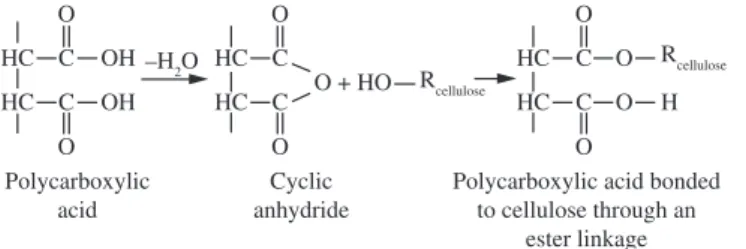
The mechanism of cross linking of cellulose with polycarboxylic acids is given in Figure 1. The mechanism of polycarboxylic acids
is carried out in two steps by cellulose esteriication. In the irst step
the formation of a cyclic anhydride intermediate by the dehydration of two carboxyl groups is carried out. On the second step the ester crosslinks are formed by the reaction between the anhydride with cellulose6. Polycarboxylic acid esterifies cellulose through the formationof a ive-membered cyclic anhydride intermediate by the dehydrationof two adjacent carboxyl groups7. The formation of cyclic anhydrides at lower temperatures is slow without catalyst, but the
catalyst sodiumhypophosphite (SHP) accelerates the cyclic anhydride process8,9. High curing temperature and high BTCA concentration reduce the tensile strength and increase the crease recovery angle10. The whiteness index of the treated fabrics seems to decrease as the concentration of cross linkers increases11-15. The quantity of the cyclic anhydride intermediate formed in a cotton fabric increased as the pH
of a inish bath was reduced from 4.5 to 1.5[16,17].
The metal oxide nanoparticles such as SiD2, TiD2, ZnD and Fe2D3 are used as UV blocking agents, antimicrobial agents, water repellents etc.18-20.
The thermodynamic affinity of fibres form noncovalent interactions such as dipolar–dipolar and hydrogen bond, should be the key interactions for the adhesion of silica particles. The Si–D–cellulose covalent bonds in coated cellulose fabrics, make less contribution towards the adhesion of particles. Moreover, the cellulose in cotton (∼98%) fabric plays a decisive role in the intensity of covalent bond between the cellulosic hydroxyl group and –Si–DH in silica particles21,22. The bond formation can improve the crease
resistance property of the cotton fabrics. The crease recovery inishing
process with DMEU, tetraethoxysilane (TEDS) and isoproponal at various volumes improved the crease resistance and tensile strength23.
In most of the techniques to synthesis the nano silica, the base
2.1. Quality factor and ranking method
Quality factor has been derived for fabric properties which consist of the importance of each property given by this experiment. Higher priority has been given to crease recovery angle and surface coating processes generally reduce the strength behavior and permeability of the fabric. Hence it is considered next to crease recovery respectively.
Equation 2 has been used to calculate the quality factor. The quality
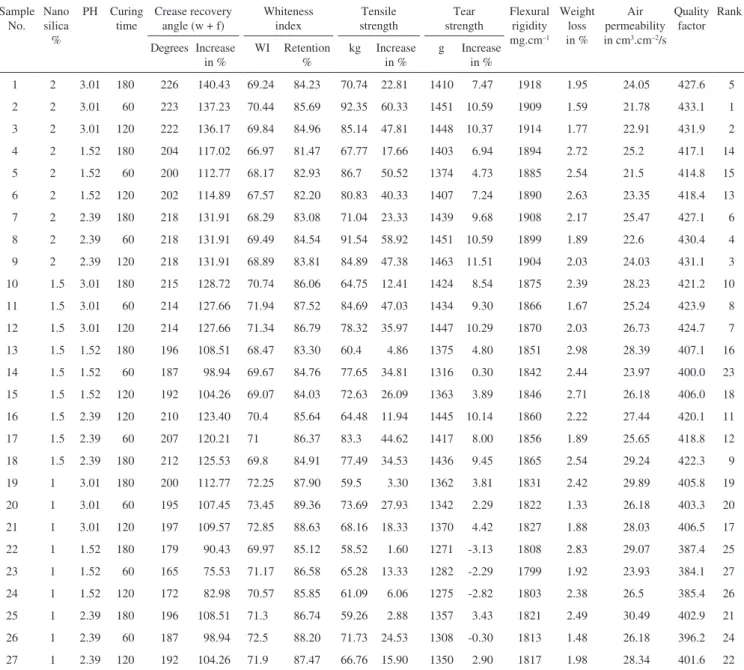
factor has been ranked and it is given in Table 4.
X = a 0.3 + b 0.2 + c 0.15 + d 0.1 + e 0.1 + f 0.05 + g 0.1 (2)
Where X = quality factor
• a = crease recovery angle in degrees • b = whiteness index
• c = tensile strength in kg • d = tearing strength in g • e = lexural rigidity in g.cm–1
• f = weight loss due to abrasion in g • g = air permeability in cm3.cm–2/s
3. Results
3.1. Characterization of silica nanoparticles
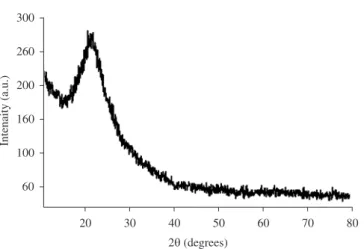
The synthesized silica nanoparticles were characterized by X-ray Diffractometer (XRD) using CuKα (λ = 1.54 Å) as a radiation source. The XRD patterns of the silica nanoparticles obtained from rice hulls is shown in Figure 2. The powder diffraction pattern indicates a broad peak at 2θ = 22°, which reveals the amorphous nature of the silica
nanoparticles. Further, the XRD pattern conirms the absence of any
ordered crystalline structure.
High Resolution Transmission Electron Microscope (HRTEM) was used to characterize the particle size and the image of nano particles are shown in Figure 3. Ot shows that the particles size is below 100 nm.
3.2. Analysis of physical properties
The physical properties of the coated and uncoated fabrics were
analysed and are given in Table 1. Regression equations were derived
for each property and are given in Table 3. The results of all possible combinations of process parameters have been derived and are given in Table 4.
3.3. FTIR analysis of coated fabric
The infra red spectroscopy data demonstrated that ester cross
linkages in a inished cotton can be examined and evaluated on a semiquantitative basis by measuring the ester band intensity and
carbonyl band intensity ratio (ester/carboxylate). The carbonyl band intensity ratio (ester/ carboxylate) is a function of the average number of ester groups formed for each BTCA molecule, so it represents the effectiveness of this bonded BTCA molecule as a crosslinking agent17.
2. Experimental
Amorphous silica nanoparticles were prepared by thermal degradation method from natural resource of rice hull. The rice hulls were rinsed, dried and aged at 80 °C for 1 hour and converted to micro
particles. The particles were reluxed with 10% HCl for 30 minutes and dried at 80 °C. The residue was kept in a mufle furnace at
750 °C for 3 hours to convert nano particles. The synthesized silica nanoparticles were characterized by X-Ray Diffractometer
(LabX XRD-6000) to ind out the nature of the particles. Scanning
Electron Microscope (HOTACHO S-3400 SEM) and High Resolution Transmission Electron Microscope (FEO Quanta FEG 200) are used
to ind out the size of the silica nanoparticles.
Three levels and three variables were selected to design the experiment by Box-Behnken method and it is given in Table 1. Fifteen different combinations of experiments were derived and conducted, each combination has different process parameters such as concentration of silica nanoparticles, pH and curing time and it is given in Table 2. On each experiment, the pad solution contains different concentration of silica nanoparticles (1, 1.5 and 2%), 1,2,3,4-butanetetracarboxylic acid (BTCA) 6.5% and sodium hypophosphite (SHP) (both from Sigma-Aldrich) 4.5% with a fabric softener of silicone emulsion( 1%, Finox HSS), acrylic binder (Texacryl binder ELT) and wetting agent (0.1%, Lissapol-N). The pH (1.52, 2.39 and 3.01) of the each experiment varied as per the experimental plan. The prepared solution has been coated on the surface of cotton fabric (134 ends.inch–1, 64 picks.inch–1, 120 g.m–2, 40 × 40 seconds count and plain weave) to impart crease recovery
property by pneumatic padding mangle with the material-to-liquor
ratio of 1:5 and 100% wet pickup was maintained for all experiments.
Then, it was squeezed and dried at 85 °C for 5 minutes and subsequently cured at 180 °C at different curing intervals of
60, 120 and 180 seconds. The cured fabrics were treated with 0.1 M NaDH solution at room temperature for two minutes to convert the free carboxyl groups to carboxylate, rinsed with cold water and dried at 80 °C for 5 minutes.
A quadratic polynome was used to analyze the relationship of
each response with the three independent variables. The multiple
polynomial regression equation was used to derive the regression co-eficients to analyse the fabric properties and is given in Equation 1.
3 3 3
2
0 i i i j i ij i i
i 1 i 1 i 1
i j
Y b b x b x b x x
= = =
<
= + ∑ ∑ +∑
(1)
where b0, bi, bii and bij are the co-eficients of the regression equations, i, j are integers and Y is the response of the dependent variable.
The physical properties of treated and untreated fabrics were tested as per ASTM test methods such as crease recovery angle (D 1295-67), tensile strength (D 5035-95), tearing strength (D 1424-96), weight loss
due to abrasion (D 4966-98), air permeability (D 737-96), lexural
rigidity (D 1388-08) and whiteness index (E 313-98) and the results are given in Table 2.
Figure 1. The mechanism of cross linking of cellulose and polycarboxylic acids.
Table 1. Experimental plan of process parameters with different levels for silica nanoparticles and BTCA coating process.
Variables Process parameters Levels
–1 0 +1
X1 Concentration of silica
nanoparticles (%) 1 1.5 2
X2 pH 1.52 2.39 3.01
carboxyl carbony band at 1725 cm–1[17].The conversion of carbonyl to carboxylate reaches maximum when the pH of the BTCA solution is 3.0117. When the carbonyl band intensity ratio increases, the cross linking increases. Ot is evident that the crease recovery angle has been increased proportionally. Choosing the optimum pH range will
reduce the quantity of BTCA for desirable fabric performance, thus
reducing the cost of non formaldehyde agents17. Figure 4 shows the FTOR spectroscopy of silica nanoparticles and
BTCA coated fabrics with different pH and curing time. From the
igure it was observed that the carbonyl band at 1722 to 1735 cm–1 represents the carbonyl of ester while the band at 1577 to 1586 cm–1 and it represents the carbonyl of carboxylate17. The above two are the basic forms of the free carboxylic acids.
Table 5 shows that the values of ester carbonyl band intensity and carbonyl band intensity ratio. The values for the above are 0.516 to 0.545 and 0.619 to 0.636 respectively. By increasing the curing time from 60 to 180 seconds and the pH value of 1.52 to 3.01 with the BTCA concentration of 6.5%, the ester carbonyl band intensity and carbonyl band intensity ratio were increased. Carboxyl is the predominant species in the BTCA solution when the pH ranges from 1.52 to 2.39 which is demonstrated by the intense
Figure 2. XRD pattern of silica nanoparticles.
Figure 3. HR TEM image of silica nanoparticles.
Table 2. Properties of untreated, silica nanoparticles and BTCA coated samples.
Sample No.
Process parameters Nano
Silica %
pH Curing
time in seconds
Crease recovery angle
(w + f)
Whiteness index
Tensile strength in kg
Tear strength
in g
Flexural rigidity (mg.cm–1)
Weight loss (%) due to
abrasion
Air permeability (cm3.cm–2/s)
U1 - - - 94 82.2 57.6 1312 1622 1.49 26.25
T1 1 1.52 120 180 71.5 63.4 1314 1822 2.93 26.20
T2 2 1.52 120 200 68.2 66.3 1386 1891 2.58 21.30
T3 1.5 1.52 180 196 69.1 62.5 1374 1838 2.64 24.30
T4 1.5 1.52 60 192 70.2 64.7 1365 1832 2.50 24.89
T5 2 2.39 180 221 67.2 71.2 1461 1916 2.05 21.90
T6 1 2.39 180 194 70.5 65.4 1340 1820 2.16 26.30
T7 2 2.39 60 218 68.5 69.3 1442 1902 1.95 21.78
T8 1 2.39 60 189 72.3 64.2 1335 1826 1.98 26.80
T9 1.5 3.01 60 212 72.5 68.5 1415 1843 1.64 24.30
T10 1.5 3.01 180 215 71.8 65.2 1424 1876 2.48 24.60
T11 2 3.01 120 225 70.5 73.5 1485 1920 1.84 21.90
T12 1 3.01 120 201 72.5 67.1 1398 1824 1.74 26.30
T13 1.5 2.39 120 205 69.8 67.8 1407 1856 1.82 24.90
T14 1.5 2.39 120 207 70.2 67.5 1405 1860 1.89 24.50
T15 1.5 2.39 120 205 70.1 67.4 1405 1859 1.85 24.80
Table 3. Regression equations for silica nanoparticles and BTCA coated fabric properties.
S. No. Property Regression equation R R2 F-ratio
1. Crease recovery
angle
Y = 101.277 X1 + 67.022X2 + 0.264 X3 −18.367 X12 − 8.896X 2
2
− 4.110X32 − 0.0801X
1X2 − 0.045 X2X3
1.000 0.935 2572
2. Whiteness index Y = 72.462 − 3.008X1 − 1.526X2 − 0.010X3 0.897 0.805 15.17
3. Tensile strength Y = 45.899X1 + 21.343X2 + 0.161X3 − 6.658X1
2 − 2.857X 2
2
− 0.001X32 − 1.854X
1X2 − 0.029X1X3 − 0.015X2X3
0.999 0.722 1048
4. Tear strength Y = 761.826X1 + 458.910X2 + 3.031X3 − 151.203X1
2 − 60.028X 2
2
− 0.005X32 − 56.395X
1X2 − 0.505X1X3 − 0.385X2X3
1.000 0.690 1135
5. Weight loss Y = 3.839X1 − 1.048X2 + 0.012X3 − 0.832X1
2 + 0.184X 2
2
− 0.241X1X2 − 0.006X1X3 + 0.001X2X3 0.987 0.539 49
6. Flexural rigidity Y = 1683.152 +86.75X1 + 15.997X2 + 0.074X3 0.966 0.933 50.75
7. Air permeability Y = 15.388X1 + 11.210X2 + 0.067X3 − 5.032X1
2 − 1.744X 2
2
− 1.32X1X2 − 0.012X1X3 − 0.008X2X3 0.999 0.846 767
Table 4. Calculated silica nanoparticles and BTCA coated fabric properties using regression equations.
Sample No.
Nano silica %
PH Curing
time
Crease recovery angle (w + f)
Whiteness index
Tensile strength
Tear strength
Flexural rigidity mg.cm–1
Weight loss in %
Air permeability in cm3.cm–2/s
Quality factor
Rank
Degrees Oncrease in %
WO Retention
%
kg Oncrease
in %
g Oncrease
in %
1 2 3.01 180 226 140.43 69.24 84.23 70.74 22.81 1410 7.47 1918 1.95 24.05 427.6 5
2 2 3.01 60 223 137.23 70.44 85.69 92.35 60.33 1451 10.59 1909 1.59 21.78 433.1 1
3 2 3.01 120 222 136.17 69.84 84.96 85.14 47.81 1448 10.37 1914 1.77 22.91 431.9 2
4 2 1.52 180 204 117.02 66.97 81.47 67.77 17.66 1403 6.94 1894 2.72 25.2 417.1 14
5 2 1.52 60 200 112.77 68.17 82.93 86.7 50.52 1374 4.73 1885 2.54 21.5 414.8 15
6 2 1.52 120 202 114.89 67.57 82.20 80.83 40.33 1407 7.24 1890 2.63 23.35 418.4 13
7 2 2.39 180 218 131.91 68.29 83.08 71.04 23.33 1439 9.68 1908 2.17 25.47 427.1 6
8 2 2.39 60 218 131.91 69.49 84.54 91.54 58.92 1451 10.59 1899 1.89 22.6 430.4 4
9 2 2.39 120 218 131.91 68.89 83.81 84.89 47.38 1463 11.51 1904 2.03 24.03 431.1 3
10 1.5 3.01 180 215 128.72 70.74 86.06 64.75 12.41 1424 8.54 1875 2.39 28.23 421.2 10
11 1.5 3.01 60 214 127.66 71.94 87.52 84.69 47.03 1434 9.30 1866 1.67 25.24 423.9 8
12 1.5 3.01 120 214 127.66 71.34 86.79 78.32 35.97 1447 10.29 1870 2.03 26.73 424.7 7
13 1.5 1.52 180 196 108.51 68.47 83.30 60.4 4.86 1375 4.80 1851 2.98 28.39 407.1 16
14 1.5 1.52 60 187 98.94 69.67 84.76 77.65 34.81 1316 0.30 1842 2.44 23.97 400.0 23
15 1.5 1.52 120 192 104.26 69.07 84.03 72.63 26.09 1363 3.89 1846 2.71 26.18 406.0 18
16 1.5 2.39 120 210 123.40 70.4 85.64 64.48 11.94 1445 10.14 1860 2.22 27.44 420.1 11
17 1.5 2.39 60 207 120.21 71 86.37 83.3 44.62 1417 8.00 1856 1.89 25.65 418.8 12
18 1.5 2.39 180 212 125.53 69.8 84.91 77.49 34.53 1436 9.45 1865 2.54 29.24 422.3 9
19 1 3.01 180 200 112.77 72.25 87.90 59.5 3.30 1362 3.81 1831 2.42 29.89 405.8 19
20 1 3.01 60 195 107.45 73.45 89.36 73.69 27.93 1342 2.29 1822 1.33 26.18 403.3 20
21 1 3.01 120 197 109.57 72.85 88.63 68.16 18.33 1370 4.42 1827 1.88 28.03 406.5 17
22 1 1.52 180 179 90.43 69.97 85.12 58.52 1.60 1271 -3.13 1808 2.83 29.07 387.4 25
23 1 1.52 60 165 75.53 71.17 86.58 65.28 13.33 1282 -2.29 1799 1.92 23.93 384.1 27
24 1 1.52 120 172 82.98 70.57 85.85 61.09 6.06 1275 -2.82 1803 2.38 26.5 385.4 26
25 1 2.39 180 196 108.51 71.3 86.74 59.26 2.88 1357 3.43 1821 2.49 30.49 402.9 21
26 1 2.39 60 187 98.94 72.5 88.20 71.73 24.53 1308 -0.30 1813 1.48 26.18 396.2 24
4.2. Influence of process parameters on whiteness index
Citric acid is one of the nonformaldehyde cross linking agents, the cotton fabric yellowing caused by citric acid at elevated temperatures and the yellowness increases as curing temperature, curing time, and CA concentration increase. Using sodium hypophosphite as a catalyst causes less fabric yellowing than monosodium phosphate. Therefore, yellowing caused by citric acid and other hydroxyl multi functional carboxylic acids can probably be attributed to the formation of unsaturated polycarboxylic acids26.
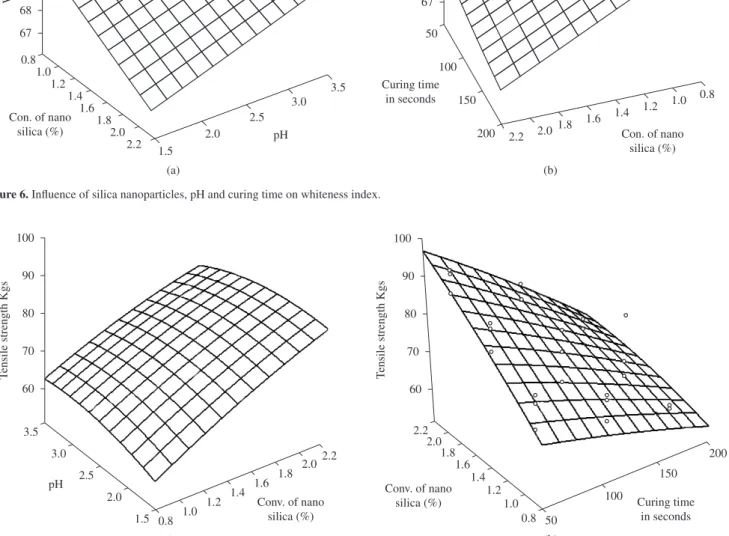
High acidity of chemicals is a source of causing fabric tendering and yellowing27, hence the pH increases the acidity level reduces and the whiteness of the fabric has been increased and it is shown in Figure 6. The increase in curing time and silica nanoparticles concentration gradually reduces the whiteness index of the fabric. The reduction of whiteness index up to 19% is due to higher concentration of silica nanoparticles, higher curing time and lower pH.
4.3. Influence of process parameters on tensile strength
Cross linking between cellulose molecules causes stiffening
of the cellulosic macromolecular network and ibre embrittlement,
thus reducing the mechanical strength of the treated cotton28. The increase in pH improves the tensile strength of the fabric due to its decrease of acidic nature of the solution. The acidity of the cross linking treatment had a severe effect on the reduction of strength of the treated cotton fabrics and trapping of nano metal oxide particles
4. Discussion
4.1. Influence of process parameters on crease recovery
angle
Nanometregrade metal oxides such as TiD2, Ag, MgCl2, SiD2 and ZrD2 are used as a co-catalyst along with non formaldehyde cross linking agents to improve the crease recovery properties of cotton fabric25. As the particle size of the TiD
2 is in nano-scale, the nano TiD2 could ill the amorphous region of the CellOH, and hence, the presence of nano TiD2 inside the ibre would probably restrict the
molecular movement of cellulose25.
Silica nanoparticles intrude more easily into the interior of
cotton ibre and adhere more tightly to the ibre structure21. Ot was observed that, the increase of concentration of silica nanoparticles contributes more to increase the crease recovery angle of the fabric
due to restriction of the molecular movement in the ibre structure
than pH. During the curing process, the polycarboxylic acid reacts with the cellulose molecules of cotton fabric most probably through the formation of cyclic anhydrides as reactive intermediates, which, in turn, esterify cotton cellulose. Due to increase of ester carbonyl band intensity ratio while increasing the pH from 1.52 to 3.01, the crease recovery property has also been increased17. The increase in curing time increased the crease recovery angle due to the formation of more
esteriication of cellulose and the Figure 5 shows its contribution is
minimum when compared to silica nanoparticles and pH.
Table 5. Inluence of curing time and pH on ester carbonyl intensity and carbonyl band intensity ratio of Silica nanoparticles and BTCA treated fabric.
Samples S1 S2 S3 S4 S5 S6 S7 S8 S9
pH 1.52 2.39 3.01
Curing time 60 120 180 60 120 180 60 120 180
Ester carbonyl band intensity 0.516 0.519 0.524 0.527 0.529 0.532 0.536 0.540 0.545
Carbonyl band intensity ratio (Ester/Carboxylate) 0.619 0.623 0.626 0.610 0.612 0.615 0.629 0.632 0.636
Figure 6. Inluence of silica nanoparticles, pH and curing time on whiteness index.
Figure 7. Inluence of Silica nanoparticles, pH and curing time on tensile strength.
improves the strength of the fabric27. Hence, the higher concentration of nano metal oxides results increases the strength of the cotton fabric and it is shown in Figure 7 The increase of curing time reduced the
tensile strength of fabric due to more esteriication (acid dehydration
at high temperatures and high curing time) and cross linking, when it was treated with BTCA/SHP. The same trend has been followed for tear strength.
The investigated process parameters showed insigniicant effect on properties such as lexural rigidity, weight loss due to abrasion
and air permeability
5. Conclusions
The silica nanoparticles were synthesized by thermal degradation method from natural resource such as rice hull and the particles are amorphous in nature with the size of 50 to 100 nm. Silica nanoparticles particles along with optimized concentration of
BTCA of 6.5% as a cross linking agent and optimized concentration of SHP of 4.5% as a catalyst were applied on the cotton fabric as per the experimental plan. The BTCA and SHP accelerates the
esteriication of cellulose to form more number of cross links between
the molecules. The effect of curing time and pH on ester carbonyl intensity ratio has been studied and the ester carbonyl intensity ratio
signiicantly increases while increasing the pH value and curing time.
The combination of crosslinking of cellulose and trapping of nano
silica particles signiicantly increases the crease recovery angle of the fabric. The higher pH level and lower curing time signiicantly
retains the whiteness index of the fabric, since the curing process contributes maximum to reduce the whiteness index of the fabric.
The tensile strength of the fabric was signiicantly increased due to the intreraction of nano silica with cotton ibres and other process
parameters. The weight loss of the fabric was increased in the range
14. Franklin WE, Madacsi JP and Rowland SP. Recurable Durable-Press Fabrics Part OO: Recurability of Fabrics Treated with Methylol Reagents and Polycarboxylic Acids. Textile Research Journal. 1972; 42(9):553-557. http://dx.doi.org/10.1177/004051757204200907
15. Schramm C, Binder WH and Tessadri R. Durable Press Finishing of Cotton Fabric with 1,2,3,4-Butanetetracarboxylic Acid and TEDS/GPTMS. Journalof Sol-Gel Science and Technology. 2004; 29(3):155-165. http:// dx.doi.org/10.1023/B:JSST.0000023850.97771.7d
16. Yang CQ. Effect of pH on Non-formaldehyde durable press inishing of cotton fabric: FTOR spectroscopy study. Textile Research Journal. 1993; 63(12):706-711. http://dx.doi.org/10.1177/004051759306301202
17. Yang CQ. Effect of pH on Non-formaldehyde durable press inishing of cotton fabric : FTOR spectroscopy study. Textile Research Journal. 1993; 63(7):420-430. http://dx.doi.org/10.1177/004051759306300707
18. Alterman DS. and Chun KW. Encapsulated particles. 1978. Patent
US4142734.
19. Wang S, Hou W, Wei L, Jia H, Liu X and Xu B. Antibacterial activity of nano-SiD2 antibacterial agent grafted on wool surface. Surface and Coating Technology. 2007; 202(3):460-473. http://dx.doi.org/10.1016/j. surfcoat.2007.06.012
20. Yuranova T, Mosteo R, Bandara J, Laub T and Kiwi J. Photocatalytic Discoloration of Drganic Compounds on Dutdoor Building Cement Panels Modiied by SiO2-TiO2 Photoactive Coatings. Journal of Molecular Catalysis A: Chemical. 2006; 244(1):160-168. http://dx.doi.org/10.1016/j. molcata.2005.08.059
21. Li F, Xing Y and Ding X. Silica Xerogel Coating on the surface of natural and synthetic fabrics. Surface and Coating Technology. 2008; 202(19):4721-4727. http://dx.doi.org/10.1016/j.surfcoat.2008.04.048
22. Jasiorski M, Bakardijeva S, Doroszkiewicz W, Brzeziński S, Malinowska G, Marcinkowska D et al. Properties and applications of silica Submicron powders with surface Ag nanoclusters. Materials Science-Poland. 2004; 22(2):137-144.
23. Huang KS, Nien YH, Hsiao KC. and Chang YS. Application of DMEU/ SiD2 Gel solution in the antiwrinkle inishing of cotton fabrics. Journal
of Applied Polymer Science. 2006; 102(5):4136-4143. http://dx.doi. org/10.1002/app.24246
24. Kalapathy U, Proctor A and Shultz J. An improved method for production of silica from rice hull ash’, Bio-resource Technology. 2000; 85(3):285-289. http://dx.doi.org/10.1016/S0960-8524(02)00116-5
25. Yuen CWM, Ku SKA, Li Y, Cheng YF, Kan CW, Choi PSR. Omprovement of wrinkle-resistant treatment by nanotechnology. Journal of The Textile Institute. 2009; 100(2):173-180. http://dx.doi. org/10.1080/00405000701661028
26. Lu Y and Yang CQ. Fabric Yellowing Caused by Citric Acid as a Crosslinking Agent for Cotton. Textile Research Journal. 1999; 69(9):685-690. http://dx.doi.org/10.1177/004051759906900909
27. YL Lam, CW Kan and CWM Yuen. Wrinkle-resistant inishing of cotton fabric with BTCA - the effect of co-catalyst. Textile Research Journal. 81(5):482-493. http://dx.doi.org/10.1177/0040517510380777
28. Charles Qixiang Yang, Weishu Wei and Lickield G.C. Mechanical Strength of durable Press inished cotton Fabric. Textile Research Journal. 2000; 70(2):143-147. http://dx.doi.org/10.1177/004051750007000209
rigidity and air permeability characteristics of the fabric was observed.
There is no signiicant difference and speciic trend. The concentration
of silica nanoparticles of 2%, pH of 3.01 and curing time of 60 seconds observed as best combination to impart crease recovery
inish. The Fourier Transform Infra Red spectrometer (FTIR) studies
revealed that the formation of ester carbonyl band and carboxylate band intensity ratio. Both were increased by increasing the pH vale from 1.52 to 3.01 and the curing time from 60 to 180 seconds. The increased crease recovery angle of the fabric is due to the formation of more cross links, silica nanoparticles trapping and also noticed that the increase in ester carbonyl intensity from 0.516 to 0.547 and carboxylate band intensity ratio from 0.619 to 0.637.
References
1. Saravanan D. Functional inishing of garments An Overview. Asian Dyer. 2007; 43-51.
2. Michal Werner Schmitt and Yoram Benjamin. Small particles for high performance-nano technology in textile inishing. Asian Textile Journal. 2008; 17(3):39-41.
3. Wong YWH, Yuen CWM, Leung MYS, Ku SKA. and Lam HLO. Selected applications of nanotechnology in textiles. AUTEX Research Journal. 2008; 6(1):1-8.
4. Textor T, Schröer F and Schollmeyer E. Functionalisation of textiles with
nanotechnology. Materials Research Society Symposium Proceedings.
2006; 920:0920-S01-02.
5. Patel BH. and Chattopadhyay DP. Nano - particles and their uses in textiles. AsianDyer. 2008; 53-58.
6. Yang CQ and Wang X. Formation of Cyclic Anhydride Ontermediates and Esteriication of Cotton Cellulose by Multifunctional Carboxylic Acids: An Onfrared Spectroscopy Study. Textile Research Journal. 1996; 66(9):595-603. http://dx.doi.org/10.1177/004051759606600908
7. Xiaohong G and Yang CQ. FTOR Spectroscopy Study of the Formation of Cyclic Anhydride Ontermediates of Polycarboxylic Acids Catalyzed by Sodium Hypophosphite. Textile Research Journal. 2000; 70(1):64-70. http://dx.doi.org/10.1177/004051750007000110
8. Yang CQ. FT-OR Spectroscopy Study of the Ester Crosslinking Mechanism of cotton Cellulose. Textile Research Journal. 1991; 61(8):433-440. http:// dx.doi.org/10.1177/004051759106100801
9. Brodmann GL. Performance of Nonformaldehyde Cellulose Reactants. AATCCReview.1990; 22(11):13-16.
10. Xu W and Li Y. Cotton Fabric Strength Loss from Treatment with Polycarboxylic Acids for Durable Press Performance. Textile Research Journal. 2000; 70(11):957-961. http://dx.doi. org/10.1177/004051750007001104
11. Bilgen M, Hauser P and Smith B. Oonic crosslinking of cellulose. Indian Journal of Fibre and Textile Research. 2006; 31(3):363-368
12. Franklin WE, Madacsi J and Rowland SP. Recurable Durable-Press Fabrics Part OOO: Textile, Chemical, and Recuring Properties of Fabrics Treated
with DMDHEU and Polycarboxylic Acids. Textile Research Journal.
1973; 43(6):361-366. http://dx.doi.org/10.1177/004051757304300609 13. Franklin WE, Madacsi JP and Rowland SP. Recurable Durable-Press