ISSN 0104-6632 Printed in Brazil
www.abeq.org.br/bjche
Vol. 31, No. 02, pp. 429 - 438, April - June, 2014 dx.doi.org/10.1590/0104-6632.20140312s00002328
Brazilian Journal
of Chemical
Engineering
EMULSIFYING PROPERTIES OF MAILLARD
CONJUGATES PRODUCED FROM SODIUM
CASEINATE AND LOCUST BEAN GUM
F. A. Perrechil
1,2, R. C. Santana
1,3, D. B. Lima
1, M. Z. Polastro
1and R. L. Cunha
1*1
Department of Food Engineering, Faculty of Food Engineering, Phone: + (55) (19) 35214047, Fax: + (55) (19) 35214027, University of Campinas (UNICAMP), 13083-862, Campinas - SP, Brazil.
E-mail: [email protected] 2
Currtent address: Institute of Environmental, Chemistry and Pharmaceuticals Sciences, Federal University of São Paulo (UNIFESP), Diadema - SP, Brazil.
3
Current Address: Universidade Federal do Espírito Santo, (UFES), Centro Universitário Norte do Espírito Santo (CEUNES), Departamento de Engenharias e Tecnologia, (DETEC),
BR 101 Norte, Km 60, Bairro Litorâneo, CEP 29932-540, São Mateus - ES, Brasil.
(Submitted: October 9, 2012 ; Revised: June 19, 2013 ; Accepted: July 23, 2013)
Abstract - Emulsifying properties of sodium caseinate - locust bean gum Maillard conjugates produced at different temperatures (54 – 96 °C), protein/polysaccharide ratios (0.3 – 1.0) and reaction times (1 – 24 hours) were evaluated. Conjugate formation was confirmed by formation of color and high molecular weight fractions and the decrease of the αs- and β-casein bands. The emulsions stabilized by Maillard conjugates showed good stability. The mean droplet diameter (d32) tended to decrease with the increase of incubation time and temperature, except at extreme conditions (24 hours and 90 °C or 96 °C) when the partial degradation of the conjugates was probably favored, resulting in phase separation of emulsions. The emulsion viscosity decreased with the increase in the protein/polysaccharide ratio and with the degradation of the conjugates. The conditions used in the experimental design made the optimization of the conjugate production viable, which showed greater emulsifier properties than the pure protein under acid conditions.
Keywords:Maillard reaction; Emulsion; Rheology; Protein; Polysaccharide.
INTRODUCTION
Emulsions consist of two immiscible liquids (usually oil and water) with one of the liquids dis-persed in the other one as small (0.1–100.0 μm) spheri-cal droplets. Emulsions are generally thermodynami-cally unstable systems, but they can be kinetithermodynami-cally stabilized for a reasonable period of time by adding substances known as emulsifiers and/or thickening agents prior to homogenization (McClements, 2005). Nowadays many industries, especially the food in-dustry, have a growing interest in the replacement of synthetic emulsifiers and thickening by natural ones, such as proteins and polysaccharides (Huck-Iriart et al., 2011).
Polysaccharides are hydrophilic macromolecules
used to stabilize emulsions by viscosity modification or gelation of their continuous phase (Dickinson, 2003). Locust bean gum (LBG) is a neutral polysaccharide
composed of a 1-4-linked β-D-mannan backbone with
1-6-linked α-D-galactose side groups (Dea and
bind-ing, thickening and gelation properties (Mulvihill, 1989). However, the emulsifying properties of so-dium caseinate decrease at acid pH. Around its isoelec-tric point (pH 4.6), the net attractive forces between the casein molecules increase, resulting in a self-association of the adsorbed and non-adsorbed protein components (Allen et al., 2006), which could lead to emulsion destabilization.
Conjugation of the protein to a polysaccharide can improve its functional properties, such as solu-bility around its isoelectric point (Chevalier et al., 2001; Kato, 2002; Oliver et al., 2006a; O’Regan and Mulvihill, 2009; Yadav et al., 2010) and its emulsi-fying properties (Shepherd et al., 2000; Kato, 2002; Neirynck et al., 2004; Mu et al., 2006; Akhtar and Dickinson, 2007; O’Regan and Mulvihill, 2009; Xu
et al., 2012). The formation of
protein–polysaccha-ride conjugates by Maillard-type reactions is a chemi-cally safe method, being suitable for food applica-tions. These conjugates are produced by the con-densation of the carbonyl group of a reducing end sugar with an unprotonated amino group of the protein (mainly the ε-amino group of a lysine resi-due), forming a Schiff base with the release of water. The Schiff base subsequently cyclizes to the corre-sponding N-glycosylamine, which then undergoes an irreversible Amadori rearrangement (Ames, 1992). The covalent bonds between the protein and polysac-charide are very stable against changes in pH, tem-perature or ionic strength (Dickinson, 1993; Dickinson and Euston, 1991). In the final stage of the Maillard reaction, the Amadori compound may undergo several irreversible degradation reactions, giving many colored and water-insoluble, poorly-characterized com-pounds called melanoidins (Friedman, 1996; Yadav
et al., 2010). At the advanced stages of the Maillard reaction, the conjugates show reduced emulsifying activity and stability when compared with conjugates at the early stages (Corzo-Martínez et al., 2011).
Several proteins and carbohydrates have been combined in these conjugates by using the Maillard reaction. Specifically the casein, caseinate-dextran (Fechner et al., 2007), caseinate-maltodextrin (Shepherd
et al., 2000; O’Regan and Mulvihill, 2009, 2010),
casein-glucose (Gu et al, 2009) and casein-dextran
(Aminlari et al., 2005; Mu et al., 2006) conjugates were studied. These conjugates showed better emul-sifying/stabilizing properties when compared to the pure protein, mainly at pH values close to the isoelec-tric point. The Maillard reaction rate is affected by many factors, such as temperature, pH, protein-polysaccharide ratio, relative humidity and intrinsic properties of the reagents (Oliver et al., 2006a).
Thus, the aim of this work was to study the effect of temperature, protein/polysaccharide ratio and re-action time on the formation of sodium caseinate (Na-CN) - locust bean gum (LBG) conjugates. An
experimental factorial design was used to formulate the Na-CN – LBG conjugates, which were character-ized by electrophoresis and color analyses. The conjugates were used as emulsifiers of oil-in-water emulsions and their efficiency was evaluated by stability, rheological and droplet size measurements on the emulsions.
MATERIALS AND METHODS Materials
The ingredients used to prepare the systems were casein (Art.-No. C7078, CAS 9000-71-9, Sigma-Aldrich Co., USA), locust bean gum (LBG) (Sigma-Aldrich Co., USA) and soybean oil (Soya, Bunge Ali-mentos S.A., Brazil). The moisture and ionic calcium contents of the casein powder were 6.5% and 0.14%, respectively. Sodium azide (Merck, Germany) was added to the emulsions to prevent microbial growth.
Preparation of Biopolymer Solutions
The aqueous sodium caseinate (Na-CN) solutions were prepared by dispersing casein in deionized water using a magnetic stirrer and heating at 50 °C during 3 hours. The pH was constantly adjusted to 7.0 using 10 M NaOH. Polysaccharide solutions were prepared by dispersing the LBG powder in deionized water at room temperature, followed by a heating step up to 80 °C for 30 minutes under mechanical stirring. After the heat treatment, the solutions were cooled to room temperature in an ice bath.
Preparation of Na-CN − LBG Conjugates
Protein and polysaccharide solutions were mixed in different ratios at room temperature using mag-netic stirring and then these mixtures were freeze-dried. The dry powders were incubated at fixed tem-peratures for 1, 3 and 24 hours under a relative hu-midity of 79% provided by a saturated KBr solution (Akhtar and Dickinson, 2007). The protein/poly-saccharide ratio and temperature of incubation were determined according to an experimental design (section 2.4). The conjugation degree of the resultant Maillard reaction was analyzed by electrophoresis and color evaluation.
Experimental Design
the trials, including two central points and two axial points, giving a total of 10 combinations (Table 1). Analysis of variance was used to detect effects sig-nificant at p < 0.1. Statistica 5.5 software (Statsoft, USA) was used to analyze the results.
Table 1: Coded and real values of the independent variables used for experimental design.
Coded values Real values Trial Temperature Na-N/LBG
ratio
Temperature (°C)
Na-CN/LBG ratio
1 -1 -0.6 60 0.50 2 +1 -0.6 90 0.50 3 -1 +1 60 0.88
4 +1 +1 90 0.88
5 -1.41 0 54 0.65
6 +1.41 0 96 0.65
7 0 -1.41 75 0.30 8 0 +1.41 75 1.00
9 0 0 75 0.65
10 0 0 75 0.65
Polyacrylamide Gel Electrophoresis
SDS-polyacrylamide gel electrophoresis (PAGE) was carried out to identify conjugates, following the method of Laemmli (1970). The conjugates were di-luted with an equal volume of pH 6.8 buffer (62.5 mM Tris-HCl, 20% glycerol, 2% SDS, 0.05% bromophenol blue) and applied to the polyacrylamide gels. Com-mercial molecular weight markers (molecular weight range between 6.0 and 181.5 kDa) (Sigma-Aldrich Co., USA) and a solution of 6% (w/v) sodium ca-seinate were also applied to the gels. These were run at 120 V through the stacking (4% polyacrylamide) and separating (12% polyacrylamide) gels using a Mini Cell Protean electrophoresis unit (Biorad Laboratories, USA). The gels were stained with 0.25% (v/v) Coomassie Brilliant Blue, in ethanol:acetic acid: water (45:10:45, v/v), followed by destaining with acetic acid:ethanol:water (5:10:85, v/v).
Color Measurements
The color of the conjugate powders was measured using an Ultra Scan Vis 1043 colorimeter (Hunter Lab, USA), with the CIELab scale (L*, a*, b*). The color measurements were expressed in terms of the b* value (+b*=yellow and -b*=blue).
Emulsion Preparation
Aqueous solutions were prepared by dissolution of the conjugate powders in deionized water using magnetic stirring at room temperature for
approxi-mately 3 hours. After the dissolution, sodium azide (0.02% w/v) was added and the pH adjusted to 3.5 with 1.5 M HCl. Oil-in-water (O/W) emulsions were prepared by homogenizing the soybean oil in the aqueous solutions with an Ultra Turrax model T18 (IKA, Germany) at 14000 rpm for 4 minutes. The conjugate and oil concentrations were fixed at 1% (w/v) and 30% (v/v), respectively, for all systems. The emulsions were evaluated in relation to stability, microstructure and rheology.
Evaluation of Emulsion Stability
Immediately after preparation, 10 mL of each emulsion was poured into a cylindrical glass tube (internal diameter = 15.5 mm, height = 65 mm), sealed with a plastic cap and stored at 25 °C for a period of 4 days. After storage, some emulsions separated into a top cream phase and a bottom serum phase. The creaming stability was measured by the height of the serum layer (H) with the storage time. The creaming
index (CI) was reported as CI (%) = (H/Ho) × 100,
where Ho represents the initial height of the emulsion (Keowmaneechai and McClements, 2002).
Optical Microscopy and Image Analysis
The microstructure of emulsions was evaluated one day after their preparation. For this, the samples were placed on slides, covered with cover slips and observed using a conventional optical microscope: Carl Zeiss Model mf-AKS 24 x 36 EXPOMET (Zeiss, Germany) with 40x objective lens.
The microscopy images were analyzed with the public domain software Image J v1.36b (http://rsb. info.nih.gov/ij/). Micrographs were transformed into 8-bit grey scale binary images of 640x480 pixels and were then segmented by ‘thresholding’. The thresh-old was set from the median of the grey level
histogram of each image (Pugnaloni et al., 2005).
During this process, pixels were deemed to be detected only if their grey value was lower than the threshold setting. The pixel-scale values were con-verted into microns by a scaling factor. The droplet areas were then measured and the volume-surface
mean diameter (d32) of the emulsion droplets was
calculated considering spherical shape, according to Equation (1).
3 i i 32 2
i i n d d
n d Σ =
Σ (1)
Rheological Measurements
Rheological measurements on the emulsions were made using a modular compact rheometer Physica MCR301 (Anton Paar, Germany). All measurements were made 1 day after emulsion preparation at 25 °C using a 5 cm parallel plate geometry with a gap of 200 μm. Flow curves were obtained between 0 and 300 s-1.
Statistical Analysis
Significant differences between color, droplet size and rheological parameters were determined by the Tukey test. Statistical analyses were performed using the software Statistica 5.5 (Statsoft Inc., Tulsa, USA) and the level of confidence was 90%.
RESULTS AND DISCUSSION Characterization of the Conjugates SDS-PAGE Analysis
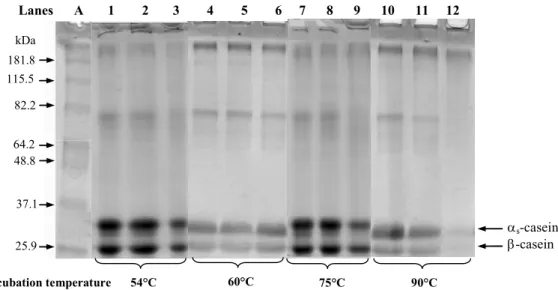
SDS-PAGE analysis was used to evaluate the covalent coupling between Na-CN and LBG for different conditions of temperature, protein/polysac-charide ratio and incubation time. Figure 1 shows
molecular weight distributions of the conjugates formed at different temperatures and incubation times. The behavior was the same independent of the pro-tein/polysaccharide ratio. The formation of Na-CN/ LBG conjugates was suggested by the presence of bands with molecular weights higher than 182 kDa and some protein fractions visualized at the interface of the stacking and separating gels, indicating the presence of materials with very high molecular weight developed after covalent attachment between the protein and polysaccharide (Hakkak and Al-Hakkak, 2010; O’Regan and Mulvihill, 2010; Miralles
et al., 2007). Moreover, the bands ascribed to αs- and
β-casein (between 25.9 and 37.1 kDa) gradually dis-appeared with reaction time, especially for conju-gates produced at 24 hours of incubation and at higher temperatures of reaction (lanes 9 and 12 of Figure 1). Despite the increase of conjugate forma-tion with the increase of incubaforma-tion time and tem-perature, the residual presence of αs and β-caseins bands in the samples prepared at 54, 60 and 75 °C (Figure 1) indicated that not all the protein had reacted with the polysaccharide and that the formation of conjugates was probably not totally complete under these heating conditions (Fechner et al., 2007; Akhtar
and Dickinson, 2007). The bands of κ-casein were
not detectable due to the lower molecular weight of this fraction (~19kDa).
181.8
115.5
25.9 37.1 48.8 64.2 82.2
Lanes A 1 2 3 4 5 6 7 8 9 10 11 12
αs-casein
β-casein
kDa
Incubation temperature 54°C 60°C 75°C 90°C
Color
The formation of conjugates was confirmed by the increase of the b*-value (Table 2), as observed by others authors (O’Regan and Mulvihill, 2009; Einhorn-Stoll et al., 2005). The b*-values of these materials are an indicator of the yellow color result-ing from the Maillard-reaction (Einhorn-Stoll et al., 2005). The increase of the b*-values was verified mainly after 24 hours of incubation (Table 2). The standardized effects of temperature and Na-CN/LBG ratio on the conjugate color can be visualized in Figure 2. At 1 hour of incubation time, none of the variables showed a significant effect (p < 0.1) on the b*-value. At 3 hours of incubation time, temperature showed a positive linear effect, while at 24 hours, the temperature showed a higher positive (linear and quadratic) effect on the b*-value, in accordance with the SDS-PAGE results (Figure 2). Thus, the increase of temperature favored the occurrence of the Maillard reaction. The Na-CN/LBG ratio did not show a significant effect on the conjugate color at any temperature or incubation time.
Table 2: Influence of processing conditions on the b*-value of powder conjugates.
Incubation Time Trial Temperature
(°C)
Na-CN/LBG
ratio 1 h 3 h 24 h
1 60 0.50 3.83a 3.85a 4.51b
2 90 0.50 4.06a 4.81a 6.84b
3 60 0.88 3.93a 4.39a 5.23b
4 90 0.88 3.91a 5.27b 7.88c
5 54 0.65 4.44a 3.99a 5.25b
6 96 0.65 5.66a 7.36b 8.80c
7 75 0.30 4.90a 4.37a 6.08b
8 75 1.00 2.56a 2.50a 3.70b
9 75 0.65 4.55a 4.68a 3.23b
10 75 0.65 4.11a 4.60a 4.06a
Different superscript letters indicate significant difference (p > 0.1) between systems at the same line.
-4.3 -2.15 0 2.15 4.3 6.45
T TxT R RxR TxR
S
ta
n
d
a
rd
ized
e
ff
e
ct
es
ti
m
a
te
p = 0.10
p = 0.10
Figure 2: Standardized effects of temperature (T) and Na-CN/LBG ratio (R) on color (b*-value) of conju-gates. Incubation time: (□) 1 h, (■) 3 h and (■) 24 h.
Evaluation of Emulsifying Properties of the Con-jugates
Stability of Emulsions Stabilized by Na-CN – LBG Conjugates
Emulsions were prepared using Na-CN – LBG conjugates as emulsifiers. The evaluation of stability showed that the emulsions were stable up to 4 days of storage, with the exception of emulsions stabilized by conjugates prepared at higher temperatures (90 and 96 °C) and incubation time (24 hours), which showed phase separation. Trials 2, 4 and 6 (Table 1) at 24 hours of incubation time led to emulsions with values of the creaming index (CI) of 22%, 28% and 30%, respectively, after 4 days of storage. This oc-curred because the Maillard reaction probably proceeded faster at higher temperatures, leading to an irreversible degradation of conjugates, giving many colored and water-insoluble compounds called malanoidins (Yadav et al., 2010). However, the con-jugates prepared at 1 and 3 hours using the same conditions of temperature and Na-CN/LBG ratio produced stable emulsions. These results indicated that emulsions stabilized by Na-CN – LBG conju-gates were highly stable, even when produced using a rotor-stator homogenizer (Ultra Turrax), which did not occur for the emulsions stabilized by non-conju-gated Na-CN and LBG containing low concentra-tions of polysaccharide (< 0.8% w/v) (Perrechil and Cunha, 2010).
Droplet Size of Emulsions Stabilized by Na-CN – LBG Conjugates
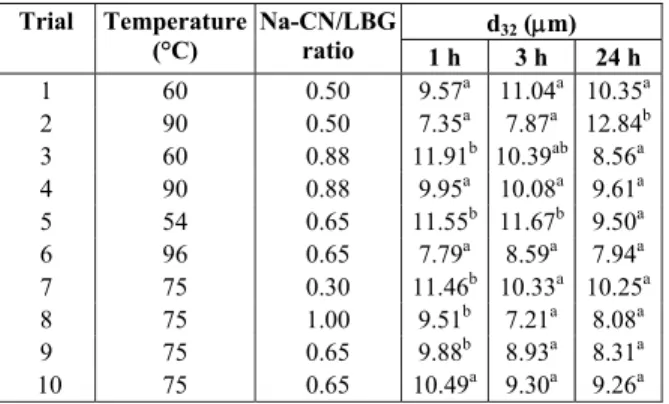
The evaluation of the mean droplet diameter (Table 3) showed that all emulsions were comprised of droplets with d32 between 7.35 μm and 12.84 μm, which were smaller than those of emulsions stabi-lized only by sodium caseinate at pH values of 3.7
and 2.7 (~14 μm) (Perrechil and Cunha, 2010). The
smallest oil droplet (7.79 μm) was produced for the highest temperature (96 °C) and 1 hour of incubation time. Comparing the droplet diameters for different
incubation times, it was found that d32 tended to
Table 3: Mean droplet diameter (d32) of emulsions
stabilized by Na-CN – LBG conjugates.
d32 (μm)
Trial Temperature (°C)
Na-CN/LBG
ratio 1 h 3 h 24 h
1 60 0.50 9.57a 11.04a 10.35a
2 90 0.50 7.35a 7.87a 12.84b
3 60 0.88 11.91b 10.39ab 8.56a
4 90 0.88 9.95a 10.08a 9.61a
5 54 0.65 11.55b 11.67b 9.50a
6 96 0.65 7.79a 8.59a 7.94a
7 75 0.30 11.46b 10.33a 10.25a
8 75 1.00 9.51b 7.21a 8.08a
9 75 0.65 9.88b 8.93a 8.31a
10 75 0.65 10.49a 9.30a 9.26a
Different superscript letters indicate significant difference (p > 0.1) for the mean droplet diameter (d32) between systems in the same row.
However, for the conjugates produced at higher temperatures (90 and 96 °C), the diameters were similar or tended to increase with time (Table 3). This occurred due to the degradation of the protein-polysaccharide conjugates under these extreme con-ditions of heat treatment, confirming the results of emulsion stability. The same effect was verified for conjugates of egg white and pectin produced by Maillard reaction at 60 °C and a relative humidity of 79 °C, which showed improved emulsification proper-ties up tol 12 hours of incubation time, after which emulsions with larger oil droplets were produced (Al-Hakkak and Al-Hakkak, 2010).
Evaluating the effects of variables (temperature and protein/polysaccharide ratio) on the mean drop-let diameter (d32) of emulsions (Figure 3), it was veri-fied that only the temperature showed a significant effect (linear) for 1 hour and 3 hours of incubation.
-4.30 -2.15 0.00 2.15 4.30
T TxT R RxR TxR
S
ta
n
d
a
rd
ized
ef
fect
es
ti
m
a
te
p = 0.10
p = 0.10
Figure 3: Effects of temperature (T) and protein/ polysaccharide ratio (R) on droplet diameter (d32) for emulsions stabilized by conjugates. Incubation time: (□) 1 h, (■) 3 h and (■) 24 h.
This negative effect means that an increase in temperature led to smaller droplets, which is in
accord with the results in Table 3. However, no variable showed a significant effect for the reaction time of 24 hours. This probably occurred because, at this incubation time, some conjugates were still being produced, while those prepared at higher temperatures were degraded in the final stage of the Maillard reaction.
Rheology
Rheological measurements indicated that all emulsions showed shear-thinning behavior (i.e., the apparent viscosity decreased with increasing shear rate). This behavior is the most common for emulsions and can occur for a variety of reasons, such as the changes of spatial distribution, the alignment of non-spherical droplets or deformation and disruption of flocs with the shear application (McClements, 2005).
The data of shear stress (σ) versus shear rate (
γ
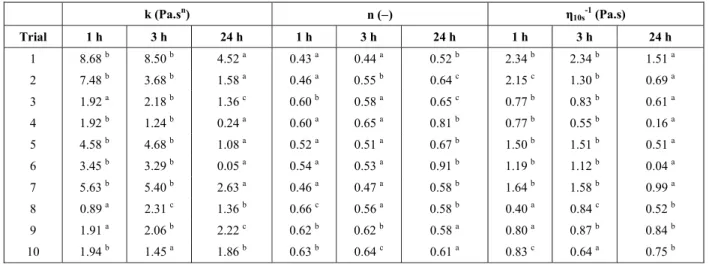
)were fitted to the power law model (σ = ⋅ γk n). Table 4 shows the values of the consistency index (k) and the flow behavior index (n) obtained from the fitting of the flow curves. In addition, the apparent viscosity at 10 s-1 (η10s
-1
) (Table 4) was evaluated. This shear rate was chosen because it is typical for food processes such as flow under gravity. The results showed that n tended to increase, while k and η10s-1 had a tendency to decrease upon increasing the incubation time. The Maillard conjugate formation can be associated with an increase of the solution viscosity when compared to untreated proteins (Manzocco and Maltini, 1999; Oliver et al., 2006b; Hiller and Lorenzen, 2010) due to the increase of the molar mass of the ingredients (Hiller and Lorenzen, 2010). Nevertheless, the emulsion viscosity decreased with incubation time, probably due to the reduction of free polysaccharide in solution and to the partial Maillard conjugate degradation, as suggested in the previous discussion. We can assume that the improvement in the emulsifying properties is not due to the increased continuous phase viscosity, but to the molecular properties of the covalently-linked conjugate (Kim et al., 2003).
Na-CN/LBG ratio (positive effect) (Figure 4(a)), indicating that the conjugates containing a higher amount of protein led to greater n. However, at 24 hours of incubation time, only the temperature showed a negative effect, i.e., the shear-thinning be-havior became less pronounced with the increase of temperature (Figure 4(a)).
The protein/polysaccharide ratio showed a linear and negative effect on the apparent viscosity of the emulsions stabilized by the conjugates produced at 1,
3 and 24 h incubation time (Figure 4(b)). In this case, lower values of the protein/polysaccharide ratio, i.e., higher amounts of polysaccharide, were responsible for the increase of viscosity. On the other hand, the temperature showed a significant negative effect on the viscosity of emulsions stabilized by conjugates at 24 hours of incubation time (Figure 4(b)). The increase of temperature decreased the viscosity (and increased n), probably due to conjugate degradation after 24 hours of incubation time.
Table 4: Values of consistency index (k), flow behavior index (n) and apparent viscosity at 10 s-1 (η10s-1) of
emulsions stabilized by Na-CN – LBG conjugates at pH 3.5
k (Pa.sn) n (−) η
10s-1 (Pa.s)
Trial 1 h 3 h 24 h 1 h 3 h 24 h 1 h 3 h 24 h
1 8.68 b 8.50 b 4.52 a 0.43 a 0.44 a 0.52 b 2.34 b 2.34 b 1.51 a
2 7.48 b 3.68 b 1.58 a 0.46 a 0.55 b 0.64 c 2.15 c 1.30 b 0.69 a
3 1.92 a 2.18 b 1.36 c 0.60 b 0.58 a 0.65 c 0.77 b 0.83 b 0.61 a
4 1.92 b 1.24 b 0.24 a 0.60 a 0.65 a 0.81 b 0.77 b 0.55 b 0.16 a
5 4.58 b 4.68 b 1.08 a 0.52 a 0.51 a 0.67 b 1.50 b 1.51 b 0.51 a
6 3.45 b 3.29 b 0.05 a 0.54 a 0.53 a 0.91 b 1.19 b 1.12 b 0.04 a
7 5.63 b 5.40 b 2.63 a 0.46 a 0.47 a 0.58 b 1.64 b 1.58 b 0.99 a
8 0.89 a 2.31 c 1.36 b 0.66 c 0.56 a 0.58 b 0.40 a 0.84 c 0.52 b
9 1.91 a 2.06 b 2.22 c 0.62 b 0.62 b 0.58 a 0.80 a 0.87 b 0.84 b
10 1.94 b 1.45 a 1.86 b 0.63 b 0.64 c 0.61 a 0.83 c 0.64 a 0.75 b
Different letters indicate significant difference (p > 0.05) for the consistency index (k), flow behavior index (n) and apparent viscosity between systems in the same row.
-4.3 -2.15 0 2.15 4.3
T TxT R RxR TxR
S
ta
n
d
a
rd
ize
d
ef
fe
ct
es
ti
m
a
te
p = 0.10
p = 0.10
-4.3 -2.15 0 2.15 4.3
T TxT R RxR TxR
S
ta
n
d
a
rd
ized
e
ff
ec
t es
ti
m
a
te
p = 0.10
p = 0.10
(a) (b)
Figure 4: Effects of protein/polysaccharide ratio (R) and temperature (T) on (a) flow behavior index (n) and (b) apparent viscosity at 10 s-1 (η10s-1) for conjugates prepared at different incubation times: (□) 1 h, (■) 3 h and (■) 24 h.
The study of sodium caseinate – LBG conjugates from the Maillard reaction showed that sodium ca-seinate was successfully conjugated to LBG and the covalent linkage was confirmed by SDS-PAGE and color evaluation. The properties of these conjugates were influenced by the temperature of the Maillard reaction, the protein/polysaccharide ratio and the in-cubation time. In general, the inin-cubation time (1 and 3 hours) and temperature of reaction favored the conjugate formation, which produced stable emul-sions with smaller droplet size. However, 24 hours of incubation time at high temperatures produced unsta-ble emulsions with lower viscosity, less pronounced shear-thinning behavior and bigger droplet sizes, suggesting partial conjugate degradation. From these results, extreme conditions of temperature and incu-bation time can be identified as the process limita-tions. The protein/polysaccharide ratio only signifi-cantly affected the rheological properties of the emulsions. The decrease of the Na-CN/LBG ratio (increase of polysaccharide content) led to more viscous emulsions with more pronounced shear-thin-ning behavior (lower n values). From these results, it is possible to choose the adequate conjugates to obtain stable emulsions with the desired rheological behavior. In addition, these conjugates are an excel-lent alternative to substitute pure proteins and syn-thetic emulsifiers in emulsions produced under acid conditions (pH 3.5).
ACKNOWLEDGEMENTS
The authors would like to thank CNPq (304611/
2009-3 and 473412/2009-8) and FAPESP (2007/ 58017-5) for the financial support.
NOMENCLATURE
CI creaming index %
d32 mean droplet diameter µm
di droplet diameter µm
H height of serum layer mm
Ho initial height of emulsions mm
k consistency index Pa.sn
LBG locust bean gum
n flow behavior index
Na-CN sodium caseinate
ni number of droplet
R protein/polysaccharide ratio
T temperature °C
Greek Symbols
γ shear rate s-1
η10s-1 apparent viscosity at 10s -1
Pa.s
σ shear stress Pa
REFERENCES
Akhtar, M. and Dickinson, E., Whey protein-malto-dextrin conjugates as emulsifying agents: An alternative to gum Arabic. Food Hydrocolloids, 21, 607-616 (2007).
Al-Hakkak, J. and Al-Hakkak, F., Functional egg white – pectin conjugates prepared by controlled Maillard reaction. Journal of Food Engineering, 100, 152-159 (2010).
Allen, K. E., Dickinson, E. and Murray, B., Acidified sodium caseinate emulsion foams containing liquid fat: A comparison with whipped cream. LWT – Food Science and Technology, 39, 225-234 (2006). Ames, J. M., The Maillard Reaction. In Biochemistry
of Food Proteins, Hudson, B. J. F., (Ed.), Elsevier Science Publishers, London, p. 99-153 (1992). Aminlari, M., Ramezani, R. and Jadidi, F., Effect of
Maillard-based conjugation with dextran on the functional properties of lysozyme and casein. Journal of the Science of Food & Agriculture, 85, 2617-2624 (2005).
Chevalier, F., Chobert, J. M., Popineau, Y., Nicolas, M. G. and Haertlé, T., Improvement of functional properties of β-lactoglobulin glycated through the Maillard reaction is related to the nature of the sugar. International Dairy Journal, 11, 145-152 (2001).
Corzo-Martínez, M., Soria, A. C., Villamiel, M., Olano, A., Harte, F. M. and Moreno, F. J., Effect of glycation on sodium caseinate – stabilized emul-sions obtained by ultrasound. Journal of Dairy Science, 94, 51-58 (2011).
Dea, I. C. M. and Morrison, A., Chemistry and inter-actions of seed galactomannans. Advances in Carbohydrate Chemistry and Biochemistry, 31, 241-312 (1975).
Dickinson, E. and Euston, S. R., Stability of Food Emulsion Containing Both Protein and Polysac-charide. In Food Polymers, Gels and Colloids, Dickinson, E., (Ed.), The Royal Society of Chem-istry, London, p. 132-146 (1991).
Dickinson, E., Hydrocolloids at interfaces and the influence on the properties of dispersed systems. Food Hydrocolloids, 17, 25-39 (2003).
Dickinson, E., Protein-Polysaccharide Interactions in Food Colloids. In Food Colloids and Polymers: Stability and Mechanical Properties, Dickinson, E. and Walstra, P., (Eds.), The Royal Society of Chemistry, Cambridge, p. 77-93 (1993).
Einhorn-Stoll, E., Ulbrich, M., Sever, S. and Kunsek, H., Formation of milk protein-pectin conjugates with improved emulsifying properties by con-trolled dry heating. Food Hydrocolloids, 19, 329-340 (2005).
Fechner, A., Knoth, A., Scherze, I. and Muschiolik, G., Stability and release properties of double-emulsions stabilized by caseinate-dextran conju-gates. Food Hydrocolloids, 21, 943-952 (2007). Friedman, M., Food browning and its prevention: An
overview. Journal of Agricultural and Food Chemistry, 44, 631-653 (1996).
Glicksman, M., Gum Technology in the Food Indus-try. Academic Press, New York (1969).
Gu, F., Abbas, S. and Zhang, X., Optimization of Maillard reaction products from casein-glucose using response surface methodology. LWT – Food Science and Technology, 42, 1374-1379 (2009).
Hiller, B. and Lorenzen, P. C., Functional properties of milk proteins as affected by Maillard reaction induced oligomerisation. Food Research Interna-tional, 43, 1155-1166 (2010).
Huck-Iriart, C., Álvarez-Cerimedo, M. S., Candal, R. J. and Herrera, M. L., Structures and stability of lipid emulsions formulated with sodium casein-ate. Current Opinion in Colloid & Interface Science, 16, 412-420 (2011).
Kato, A., Industrial application of Maillard-type protein–polysaccharide conjugates. Food Science and Technology Research, 8, 193-199 (2002). Keowmaneechai, E. and McClements, D. J.,
Influ-ence of EDTA and citrate on physicochemical properties of whey protein-stabilized oil-in-water emulsions containing CaCl2. Journal of Agricul-tural and Food Chemistry, 50, 7145-7153 (2002). Kim, H. J., Choi, S. J., Shin, W.-S. and Moon, T. W.,
Emulsifying properties of bovine serum albumin-galactomannan conjugates. Journal of Agricul-tural and Food Chemistry, 51, 1049-1056 (2003). Laemmli, U. K., Cleavage of structural proteins
during the assembly of the head of bacteriophage T4. Nature, 227, 680-685 (1970).
Manzocco, L. and Maltini, E., Physical changes induced by the Maillard reaction in a
glucose-glycine solution. Food Research International, 32, 299-304 (1999).
McClements, D. J., Food Emulsions: Principles, Practice, and Techniques. CRC Press, Washington (2005).
Miralles, B., Martínez-Rodríguez, A., Santiago, A., van de Lagemaat, J. and Heras, A., The occurrence of a Maillard-type protein-polysaccharide reaction
between β-lactoglobulin and chitosan. Food
Chemistry, 100, 1071-1075 (2007).
Mu, M., Pan, X., Yao, O. and Jiang, M., Acidic
so-lution properties of β-graft-dextran copolymer
prepared through Maillard reaction. Journal of
Colloid and Interface Science, 301, 98-106
(2006).
Mulvihill, D. M., Casein and Caseinates: Manufac-ture. In Developments in Dairy Chemistry – 4. Functional Milk Proteins, Fox, P. F., (Ed.), Elsevier Applied Science, London, p. 97-130 (1989). Neirynck, N., van der Meeren, P., Gorbe, B., Dierckx,
S. and Dewettinck, K., Improved emulsion stabi-lizing properties of whey protein isolate by con-jugation with pectins. Food Hydrocolloids, 18, 949-957 (2004).
O’Regan, J. and Mulvihill, D. M., Heat stability and freeze–thaw stability of oil-in-water emulsions stabilized by sodium caseinate–maltodextrin con-jugates. Food Chemistry, 119, 182-190 (2010). O’Regan, J. and Mulvihill, D. M., Preparation,
charac-terization and selected functional properties of sodium caseinate-maltodextrin conjugates. Food Chemistry, 115, 1257-1267 (2009).
Oliver, C. M., Melton, L. D. and Stanley, R. A., Cre-ating proteins with a novel functionality via the Maillard Reaction: A review. Critical Reviews in Food Science and Nutrition, 46, 337-350 (2006a). Oliver, C. M., Melton, L. D. and Stanley, R. A.,
Functional properties of caseinate glycoconju-gates prepared by controlled heating in the “dry” state. Journal of the Science of Food and Agri-culture, 86, 732-740 (2006b).
Perrechil, F. A. and Cunha, R. L., Oil-in-water emul-sions stabilized by sodium caseinate: Influence of pH, high-pressure homogenization and locust bean gum addition. Journal of Food Engineering, 97, 441-448 (2010).
Pugnaloni, L. A., Matia-Merino, L. and Dickinson, E., Microstructure of acid-induced caseinate gels containing sucrose: Quantification from confocal microscopy and image analysis. Colloid Surface B, 42, 211-217 (2005).
Food Hydrocolloids, 14, 281-286 (2000).
van Aken, G. A. and van Vliet, T., Flow-induced coalescence in protein-stabilized highly concen-trated emulsions: Role of shear-resisting connec-tions between the droplets. Langmuir, 18, 7364-7370 (2002).
Xu, D., Wang, X., Jiang, J., Yuan, F. and Gao, Y., Impact of whey protein – Beet pectin conjugation
on the physicochemical stability of β-carotene
emulsions. Food Hydrocolloids, 28, 258-266 (2012).
Yadav, M. P., Parris, N., Johnston, D. B., Onwulata, C. I. and Hicks, K. B., Corn fiber gum and milk protein conjugates with improved emulsion
stability. Carbohydrate Polymers, 81, 476-483