ISSN 0104-6632 Printed in Brazil
www.abeq.org.br/bjche Vol. 33, No. 02, pp. 383 - 389, April - June, 2016
dx.doi.org/10.1590/0104-6632.20160332s20140245
*To whom correspondence should be addressed
Brazilian Journal
of Chemical
Engineering
EFFECT OF SORBENT PORE VOLUME ON THE
CARBONATION REACTION OF LIME WITH CO
2
S. M. M. Nouri
1*and H. Ale Ebrahim
21
Chemical Engineering Department, Hakim Sabzevari University, Sabzevar, Khorasan, 9617976487, Iran. Phone: + 985144012864; Fax: + 985144012850
E-mail: [email protected]
2
Chemical Engineering Department, Petrochemical Centre of Excellency, Amirkabir University of Technology, 424 Hafez Ave,Tehran, 15875-4413, Iran.
Phone: 00982166499066; Fax: 00982166405847 E-mail: [email protected]
(Submitted: December 25, 2014 ; Revised: April 23, 2015 ; Accepted: May 6, 2015)
Abstract - The reaction of calcium oxide with carbon dioxide is one of the most important methods for the capture and concentration of greenhouse gas from the flue gases of industrial plants. In this work, the carbonation reaction of CaO obtained from various sources with CO2 was investigated by a thermogravimetric
method. These sources include commercial lime or CaO, CaCO3, Ca(OH)2, CaC2O4.H2O, a synthesized
nanoporous sorbent, limestone and acetic acid washed limestone. The effect of structural parameters of the sorbents on the reactivity and CO2 capture capacity were studied using pore size distribution data. Also, the
changes in the solid texture during the carbonation reaction were investigated. It was found that there is a direct relation between the pore volume of the sorbents and their reactivity. It was found that sintering is one of the main reasons for decreased activity in the carbonation/calcination cycles.
Keywords:CO2+CaO reaction; Thermogravimetric Analyzer; Calcium-based sorbents; Pore size distribution.
INTRODUCTION
Global accumulation of CO2 greenhouse gas in the
atmosphere has increased from 280 ppm in around 1860 to approximately 316 ppm in 1957 and rapidly to 390 ppm in 2010 (Kenarsari et al., 2013). Fossil fuels are the dominant form of energy utilized in the world (86%), and are responsible for more than 75% of the current CO2 emission (Houghton et al., 2001).
The need to reduce CO2 emissions is globally
ac-cepted and represents the driving force to reconsider the environmental aspects of current technologies used for power generation plants (Herzog, 2001).
The use of CaO as a regenerable CO2 sorbent has
been reported from several works. For example, a process using twin circulating fluidized bed reactors for the large scale carbon dioxide capture from flue
gas by lime has been proposed (Shimizu et al., 1999). Also, the reversible carbonation-calcination reactions of calcium oxide have been suggested as the basis of energy storage systems (Aihara et al., 2001), and as the basis of a moderate temperature separation of CO2 for hydrogen purification (Silaban,
Narcida and Harrison, 1996). The effective capture of CO2 by CaO has been demonstrated in a fluidized
bed reactor or carbonation site (Abanades et al., 2004). The reacted sorbent is then transferred to an-other fluidized bed reactor (calciner) operating at higher temperatures (>900 ºC) to produce a concen-trated (>95%) CO2 stream (Hughes et al., 2005, Lu,
38 b p op m b w fu tu in ti an o ex w (G m 5 an b p ra m ti tu (K ri p 2 re th th o m th A in se w p is g fr g th so d si in ti 84 There are onation conv ore size dis perating tem many studies ased sorben were extended
uture applica uring CO2.
There are n activity of ion cycles. T
nd surface a f the synthet xample, a sy was produced
Gupta and F mesoporous s -20 nm wou nd, thus, pro etter stability rovide suffic ate of reacti ment between ion cycles w
ure capacity a Kuramoto et
The carbon iods, a fast k roduct layer 009). The fi eaction betw he formation he reaction r f apparent r mation of a c
he onset of Abanades, 20
ncomplete co econd stage with respect t arent activity s an importan reenhouse ga In this wo rom various
ravimetric m he reactivity orbents was
ata. Also, th ize distributi nvestigated. ions-carbona many factor version, incl stribution, an mperature an
found that t nts decrease d. This is a m ation of CaO
some efforts the sorbent The focus is area to incre tic sorbents t ynthesized hig
d from prec Fan, 2002). T
structure with uld be less su ovide higher
y. This struc cient surface ion. The int n consecutive was also emp
and enhance
al., 2003, M nation reacti kinetic contr r diffusion c rst step invo ween CO2 and
n of a CaCO3
rate consider reaction rate
ritical produ a slow rea 005). Moreov
onversion ph due to the h to CaO (abo y of lime fo nt factor for as concentrat ork, the car sources was method. The y and CO2
s studied us he changes in on during th Finally, the c ations of calc
rs which det luding sorben nd reaction nd reaction t the capture c ed when op
major challe O-based techn
s for decreas during carbo s on increasi ase conversi to enhance th gh surface ar cipitated calc
This study su h a pore size usceptible to r CO2 captur
cture would e area to en termediate h e carbonation ployed to imp e durability o
anovic and A on consists o rol step follo control stage olves a rapid d CaO. In th
3 product lay
rably. The su e is explain uct layer of a action period ver, pore mo henomena ca
high molar r out 2.2). The r the CO2 re
the carbonat tion process. rbonation re s investigate effect of so capture ca sing pore si
n the solid te he carbonatio
cyclic behav cium carbona
S. M. M.
Brazilian Jou
ermine the c nt surface ar conditions l time. Howev capacity of C peration cyc enge against nology for c
sing the fall-onation-calci ing its poros ion, and des he stability. F rea CaO sorb cium carbon uggested tha e range betwe o pore blocka re capacity a also be able nsure the ra hydration tre
n and regene prove CO2 c
of CaO sorbe Anthony, 200 of two main owed by a sl e (Grasa et
d heterogeneo he second sta
yer slows do udden transit ed by the f about 50 nm d (Alvarez a uth closure a an occur in ratio of CaC erefore, the emoval react tion-calcinat .
eaction of C ed by a therm
olid textures apacity of ize distribut exture and p on reaction w vior for calci ate was studi
. Nouri and H. Al
urnal of Chemica
car-rea, like ver, CaO cles the cap--off ina-sity sign For bent nate at a een age and e to apid eat- era- cap-ents 8). pe-low al., ous age, own tion for-for and and the CO3 ap-tion tion CaO mo-on the tion pore were ina-ed. stu 1. lyz ST for we MP abo nu is h of tem sw N2 per ob sta Fig me cal wa the a h rea wa the nit flo be X le Ebrahim al Engineering EXPE
The flow di udy of the Ca This system zer (TGA) TA-1500). Hi
r the experi eight) were m
Pa in a cylin out 1 mm th um basket cel heated under 20 oC /min mperature. A witched to a
2) or gas 2 an
rature. At th tained versu ant temperatu
gure 1: Flow ental study.
For some s lcination trea as accomplis e above men highly porou action with C as decreased en sweep ga trogen with ow meter con calculated a 2 w i wCO w M w M
where wi is
ERIMENTA
iagram of th aO+CO2 reac
m consists of from Rheo igh purity CO
ments. Slab made by pre ndrical die w hickness. The
ll in the therm r an inert gas
up to the de After five reacting gas nd reaction b his condition us time by th
ure.
w diagram of
samples (suc atment at 900 shed in the t ntioned carbo us CaO samp CO2. After ca
d to the carb as switched
a pre-defin ntrollers. Th as a function
wCaO purity
the initial w
AL PROCED
he system for ction is prese f a thermogr ometric Scie O2 and nitrog
pellets (abo essing sampl
with 10 mm e pellet is pu
mogravimete s stream (gas esired isother
minutes, th s mixture (1 begins at the n, the weigh hermogravim
f the system
h as calcium ºC under a n thermogravim onation reacti
le was prepa alcination, th bonation tem
to a mixtur ned concentr he reaction c of weight ga
weight of calc
DURE
r experiment ented in Figu avimetic An entific (mod gen were use out 120mg e powder at m diameter an ut on the plat er. The syste s 1) at the ra rmal operatin he system 10% CO2/90
e desired tem ht changes a metry at a co
for the exper
m carbonate) nitrogen strea meter prior ion. Therefor ared in-situ f he temperatu mperature an re of CO2 an
ration by tw conversion ca ain as below:
(
Effect of Sorbent Pore Volume on the Carbonation Reaction of Lime with CO2 385
Brazilian Journal of Chemical Engineering Vol. 33, No. 02, pp. 383 - 389, April - June, 2016
MwCO2 is the molecular weight of CO2. Nitrogen
adsorption was used to evaluate the pore size distri-butions of the samples (pellets after decomposition) and their specific surface areas. The pore size distri-butions were determined according to the HK+BJH model for micro-meso pores, respectively. Also, the BET method was used to determine the specific sur-face of the samples.
The various types of lime used in this work as starting materials for investigating the carbonation reaction behavior were as follows:
A) Commercial lime (CaO, Merck Art. No.102109). B) CaO from calcination of calcium carbonate (CaCO3, Merck Art. No.102059).
C) CaO from calcination of natural limestone. The natural limestone used in this work was from Abyek mine. The XRF analysis of this sorbent is shown in Table 1.
Table 1: XRF analysis of limestone sample from Abyek mine, Iran.
CaO Al2O3 SiO2 MgO K2O LOF
Composition %
52.7 0.710.61 0.071.87 45.3
D) CaO from calcination of limestone washed with acetic acid solution. For this sample, 105 g lime-stone was added to 500 mL of 3M acetic acid. The reaction time was about 3 h. Then it was filtered and dried at 120 ºC for 4 h.
E) CaO from decomposition of commercial cal-cium hydroxide (Ca(OH)2, Merck Art No. 102047).
F) CaO from decomposition of commercial calcium oxalate (CaC2O4.H2O, Aldrich).
G) CaO from calcination of a synthesized nano calcium carbonate. This sample was prepared by reaction of calcium nitrate with sodium bicarbonate solutions under ultrasonic treatment (Nouri, Ale Ebrahim and Naser Nejad, 2014).
RESULTS AND DISCUSSION
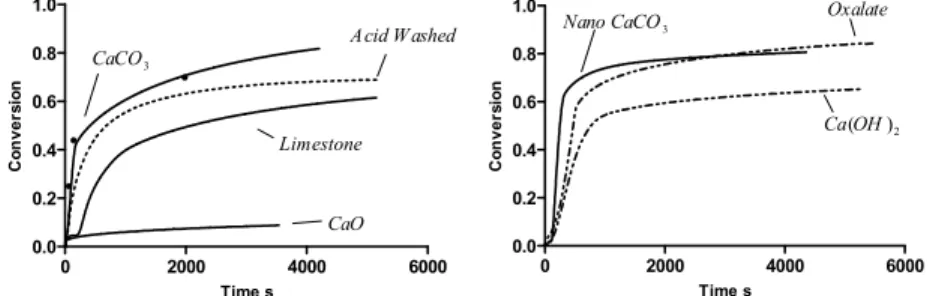
The carbonation reactions were carried out in the TGA at 650 ºC. The conversion-time profiles of dif-ferent sorbents are shown in Figure 2. It is clear that the reactivity and CO2 capture capacity of the
differ-ent sorbdiffer-ents are not similar.
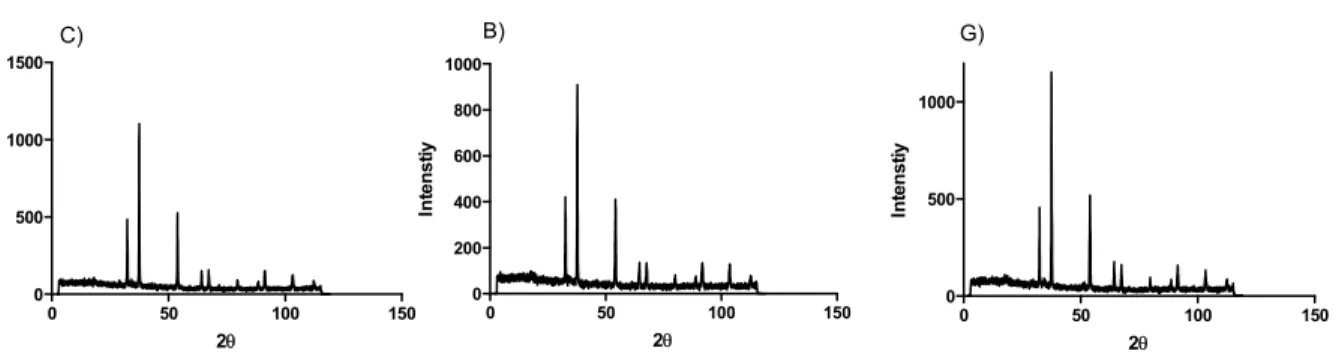
The differences in the reactivity are due to the differences in the sorbent textures. The XRD (X-Ray Diffraction) patterns show that the crystal size and structure of the sorbents are almost the same (Figure 3). Therefore, the surface reaction rate of calcium oxide with CO2 is not different for the various
sorbents. The pore size distributions of calcium ox-ides obtained by calcination of various sources are shown in Figure 4. Also, Table 2 shows the pore volume values and BET surface areas of the different sorbents. There is a direct relation between the pa-rameter β (which is the pore volume of the sorbent per unit surface) and the reactivity of the sorbent, especially in the fast stage of reaction (about the first 200 s of reaction). As can be seen in Figure 2, the sorbents obtained from calcium oxalate and nano calcium carbonate show the best performance, espe-cially in the fast stage of carbonation. The fast reac-tion period is practically important in order to main-tain the reactor sizes economically feasible.
0 2000 4000 6000
0.0 0.2 0.4 0.6 0.8 1.0
CaO Limestone 3
CaCO
A cid W ashed
Time s
C
o
n
v
e
rs
io
n
0 2000 4000 6000
0.0 0.2 0.4 0.6 0.8 1.0
2
( )
Ca OH 3
Nano CaCO Oxalate
Time s
C
o
n
v
e
rs
io
n
Figure 2: Conversion-time profiles for different sorbents reacting with 10% CO2 at 650 oC
Table 2: Structural parameters of the different sorbents.
A B C D E F G B after 12 cycles
VP (cm3/g) 0.204 0.275 0.24 0.34 0.372 0.474 0.49 0.128
SBET (m2/g) 83.84 82.01 111.8 101.7 113.2 134 136.8 0.78
386 S. M. M. Nouri and H. Ale Ebrahim
Brazilian Journal of Chemical Engineering
0 50 100 150
0 500 1000 1500
C)
2
In
te
n
s
ti
y
0 50 100 150
0 200 400 600 800 1000 B)
2
In
te
n
s
ti
y
0 50 100 150
0 500 1000
G)
2
In
te
n
s
ti
y
Figure 3: The XRD patterns for calcium oxides obtained from sources C, B, and G.
The overall reaction rate is a function of sur-face reaction kinetics, diffusion through the CaCO3
product layer surrounding the CaO grains, diffusion through the macropores of the pellet, and the gas film around the pellet. In the fast kinetic control stage, the thickness of the CaCO3 product layer is
thin. Thus, the sorbent with higher surface area and pore volume shows higher reactivity because there is more space for the surface reaction. The sudden change in the reaction rate can be explained by the change in the morphology of the sorbent during the reaction.
1 10 100 1000 10000
0.000 0.002 0.004 0.006 0.008 0.010
(A)
Pore d A
d
V
/d
D
c
c
/A
/g
r
1 10 100 1000 10000
0.000 0.002 0.004 0.006 0.008 0.010
(B)
Pore d A
d
V
/d
D
c
c
/A
/g
r
1 10 100 1000 10000
0.000 0.002 0.004 0.006 0.008 0.010
(C)
Pore d A
d
V
/d
D
c
c
/A
/g
r
1 10 100 1000 10000
0.000 0.002 0.004 0.006 0.008 0.010
(D)
Pore d A
d
V
/d
D
c
c
/A
/g
r
1 10 100 1000 10000
0.000 0.002 0.004 0.006 0.008 0.010
(E)
Pore d A
d
V
/d
D
c
c
/A
/g
r
1 10 100 1000 10000
0.000 0.002 0.004 0.006 0.008 0.010
(F)
Pore d A
d
V
/d
D
c
c
/A
/g
r
1 10 100 1000 10000
0.000 0.002 0.004 0.006 0.008 0.010
(G)
Pore d A
d
V
/d
D
c
c
/A
/g
r
al se 2 re p th P p o T fu ca fr b T ti th it ca n fa b ca th o F so ce cr is d ca ar C b T a V SB V b ca m o p d th The effect ll reaction r earchers (Alv
008, Mess, esults showe
roduct layer he fast an Perlmutter, 19
acity in the f porosity re Thus, the max
unction of th an be seen rom calcium onate show h The nanoporo
ion rate in th he second sta ts microporou
The chang arbonation r itrogen adso ace areas we
onate (B) at alcium oxide he fast stage
f the second Fig. 2). Table orbent B in eeds, the po reased propo shing the par ioxide captu annot be see rea paramete CaCO3 prod
locked bottle
Table 3: Stru t different r
VP (cm3/g) BET (m2/g)
VP/SBET (106 cm)
Moreover, onation of t alcium carbo mogravimetry f the samp eriods for tw efined as 15 he carbonati
E
Brazi
t of product l rate has been
varez and Ab Sarofim an ed that there r which is th
d slow sta 983) claimed fast stage de elated to the
ximum conv he pore volum
in Figure 3 m oxalate and higher perfor ous sorbent a he fast initial age is lower us morpholo ge in the so reaction wa orption. The ere obtained t the differen e, b) after rea e, c) the tran
d stage (the e 3 shows th
these condi ore volume ortionally. It rameter β, w ure capacity en for the por ers. It seems duct layer
e neck to ope
uctural par reaction poin
Point a 0.275 82.01
) 0.335
the cyclic b the lime pro onate (samp y. Figure 5 p ple during t welve cycles 5 min for ea ion reaction
Effect of Sorbent
ilian Journal of C
layer thickne n investigate banades, 200 nd Longwell is a critical t he transition ages. Also, d that the C epends only pores smalle version in the me of the sm 3, calcium o
d nano porou rmance than also shows th
l stage. But which can b ogy.
lid morphol as also inve
pore volume d for calcine
nt reaction s action reache nsition point, points also he structural itions. As th per BET su confirms tha we can expec of the sorb re volume an s that the fo
causes som en.
rameters of nts.
Point b Poi
0.208 0. 73.71 78 0.282 0.2
behavior for c oduced from
le B) was s presents the w
the calcinati . The carbon ach cycle to is in the f
Pore Volume on
Chemical Enginee
ess on the ov ed by some 05, Grasa et
l, 1999). Th thickness of n point betwe
, (Bhatia a CO2 capture
on the fract er than 100 n
e fast stage i maller pores. oxides obtain us calcium c n other sorben
he highest re its reactivity be explained
ogy during estigated us e and BET s ed calcium c stages: a) fr es the middle , and d) mid can be seen l parameters he reaction p urface area at, upon dim ct lower carb bent. This tre nd BET surf ormation of me pores w
the sorbent
int c Point
.177 0.199 8.14 93.7 2265 0.213
calcination-c m calcination
tudied by th weight chan ion-carbonat nation time w
make sure t fast kinetical
the Carbonation
ering Vol. 33, No
ver- re-al., heir the een and ca-tion nm. is a As ned car-nts. eac-y in d by the sing sur- car-esh e of ddle n in s of pro- de- min-bon end face the with t B d 99 78 32 car-n of her-ges tion was that lly-con cin tio sid Fig cal and mi Fig con for cin con in sio cha Th ver de op et Al fal po pen Bu per dec see
Reaction of Lime
o. 02, pp. 383 - 3
ntrolled stag nation reactio on, but decay derable.
gure 5: Stud lcium carbo d under N2,
in under 10%
gure 6: Effe nversion at 6 r the lime p nations.
The effect nversion at 6
Figure 6. A on at a pre anged from 4 he results ob
ry similar to spite the dif erating cond
al., 2007, Fe lvarez and A lloff of the ca re mouths in n during the ut it seems riod is the m cay. The ni en in Table 2
e with CO2
89, April - June,
ge. As can be on in all the y in the car
dy of cyclic onate, calcin carbonation % CO2/N2.
ect of cycle n 650 ºC and 1 produced fro
of cycle nu 650 ºC under As this figure edefined rea 43% to abou btained in th o the publish
fferences in ditions and re ennell et al., Abanades, 20
arrying capa n carbonatio next calcina that sinterin main reason r
trogen adso 2. The decay
2016
e seen in Fig cycles goes rbonation rea
calcination-c nation condit conditions:
number on th 15 min under m calcium c
umber on th r 10% CO2/N
e shows, the action time ut 19% after
he cyclic ex hed works of the sorbent eactor chara 2007, Blame 005). One r acity is the cl n periods th ation (Fennel ng during th responsible f
rption result in the pore
3
gure 6, the ca on to compl action is co
carbonation tions: 900 º 650 ºC and 1
he carbonatio r 10% CO2/N
carbonate ca
he carbonatio N2 is indicate
e final conve (15 min) twelve cycle xperiments a
f other autho t morpholog cteristics (Su
ey et al., 201
reason for th losure of sma hat do not re
ll et al., 2007
he calcinatio for the activi
388 S. M. M. Nouri and H. Ale Ebrahim
Brazilian Journal of Chemical Engineering
of the sorbent during the cyclic reaction is obvious. During the calcination, the calcium carbonate de-composes to calcium oxide, causing micro and meso pores to be created. On the other hand, some of these pores sinter together creating macropores. This phe-nomenon decreases the activity of the sorbent during the cycles in which this decay is more rapid in the preliminary cycles. However, the difference between the final points in Gigure 6 is negligible, and thus this process approached a constant final conversion.
CONCLUSION
In this work, the rate of the carbonation reaction of lime produced from various sources was investi-gated by the thermogravimetric method. The increase in the porosity of these samples is due to the gaseous products evolved during the decomposition stage of the initial materials. Calcium oxide obtained from the calcination of calcium oxalate and nanoporous calcium carbonate show the best CO2 capture capacity
among the sorbents. The reactivity and CO2 uptake
capacity of the sorbents are proportionally related to their pore volumes and BET surface areas. The be-havior of calcium carbonate sorbent (B) during the multiple carbonation/calcination cycles was also studied. The decay in the sorbent reactivity during the cycles is one of the major problems that is still open for investigation. It seems that, during the mul-tiple calcinations, the pore structure of the sorbent is changed due to the sintering and its highly reactive microporous structure changes to a sintered macro-porous texture.
REFERENCES
Abanades, J. C., Alvarez, D., Conversion limits in the reaction of CO2 with lime. Energy Fuels, 17,
308-315 (2003).
Abanades, J. C., Anthony, E. J., Lu, D. Y., Salvador, C., Alvarez, D., Capture of CO2 from combustion
gases in a fluidized bed of CaO. AIChE J., 50, 1614-1622 (2004).
Aihara, M., Nagai, T., Matsushita, J., Negishi, Y., Ohya, H., Development of porous solid reactant for thermal-energy storage and temperature up-grade using carbonation/decarbonation reaction. Appl. Energ., 69, 225-238 (2001).
Alvarez, D., Abanades, J. C., Determination of the critical product layer thickness in the reaction of
CaO with CO2. Ind. Eng. Chem. Res., 44,
5608-5615 (2005).
Bhatia, S. K., Perlmutter, D. D., Effect of the product layer on the kinetics of the CO2-lime reaction.
AIChE J., 29, 79-86 (1983).
Blamey, J., Anthony, E., Wang, J., Fennell, P., The calcium looping cycle for large-scale CO2
cap-ture. Prog. Energ. Combust., 36, 260-279 (2010). Fennell, P. S., Pacciani, R., Dennis, J. S., Davidson,
J. F., Hayhurst, A. N., The effects of repeated cy-cles of calcination and carbonation on a variety of different limestones, as measured in a hot fluid-ized bed of sand. Energy Fuels, 21, 2072-2081 (2007).
Grasa, G., Murillo, R., Alonso, M., Abanades, J. C., Application of the random pore model to the car-bonation cyclic reaction. AIChE J., 55, 1246-1255 (2009).
Grasa, G. S., Abanades, J. C., Alonso, M., González, B., Reactivity of highly cycled particles of CaO in a carbonation/calcination loop. Chem. Eng. J., 137, 561-567 (2008).
Gupta, H., Fan, L. S., Carbonation−calcination cycle using high reactivity calcium oxide for carbon di-oxide separation from flue gas. Ind. Eng. Chem. Res., 41, 4035-4042 (2002)
Herzog, H. J., What future for carbon capture and sequestration? Environ. Sci. Technol., 35, 148A-153A (2001).
Houghton, J. T., Ding, Y., Griggs, D. J., Noguer, M.,
van der Linden, P. J., Dai, X., Maskell, K., John-son, C., Climate Change 2001: The Scientific Ba-sis. UK, Cambridge University Press (2001). Hughes, R. W., Lu, D. Y., Anthony, E. J., Macchi, A.,
Design, process simulation and construction of an atmospheric dual fluidized bed combustion sys-tem for in situ CO2 capture using
high-tempera-ture sorbents. Fuel Process Technol., 86, 1523-1531 (2005).
Kenarsari, S. D., Yang, D., Jiang, G., Zhang, S., Wang, J., Russell, A. G., Wei, Q., Fan, M., Review of re-cent advances in carbon dioxide separation and capture. RSC Adv., 3, 22739-22773 (2013). Kuramoto, K., Fujimoto, S., Morita, A., Shibano, S.,
Suzuki, Y., Hatano, H., Shi-Ying, L., Harada, M., Takarada, T., Repetitive carbonation−calcination reactions of Ca-based sorbents for efficient CO2
sorption at elevated temperatures and pressures. Ind. Eng. Chem. Res., 42, 975-981 (2003). Lu, D. Y., Hughes, R. W., Anthony, E. J., Ca-based
sorbent looping combustion for CO2 capture in
Effect of Sorbent Pore Volume on the Carbonation Reaction of Lime with CO2 389
Brazilian Journal of Chemical Engineering Vol. 33, No. 02, pp. 383 - 389, April - June, 2016
Manovic, V., Anthony, E. J., Sequential SO2/CO2
capture enhanced by steam reactivation of a CaO-based sorbent. Fuel, 87, 1564-1573 (2008). Mess, D., Sarofim, A. F., Longwell, J. P., Product
layer diffusion during the reaction of calcium ox-ide with carbon dioxox-ide. Energy Fuels, 13, 999-1005 (1999).
Nouri, S. M. M., Ale Ebrahim, H., Naser Nejad, B., Preparation of a nano CaO sorbent for improve-ment the capacity for CO2 capture reaction. Syn.
Reac. Inorg. Met., 45, 828-833 (2014).
Shimizu, T., Hirama, T., Hosoda, H., Kitano, K., Inagaki, M., Tejima, K., A twin fluid-bed reactor for removal of CO2 from combustion processes.
Chem. Eng. Res. Des., 77, 62-68 (1999).
Silaban, A., Narcida, M., Harrison, D. P., Charac-teristics of the reversible reaction between CO2(g)
and calcined dolomite. Chem. Eng. Commun., 146, 149-162 (1996).
Sun, P., Grace, J., Lim, C., Anthony, E., The effect of CaO sintering on cyclic CO2 capture in energy