93
Radiol Bras. 2012 Mar/Abr;45(2):93–97
Volume corrections factors in the measurement of
99m
Tc
and
123
I activities in radionuclide calibrators
*
Fatores de correção volumétrica na medição de atividade de 99mTc e 123I em calibradores de radionuclídeos
Amanda Ribeiro Correia1, Akira Iwahara2, Luiz Tauhata3, Eduarda Alexandre Rezende1,
Tainá Olivieri Chaves4, Antonio Eduardo de Oliveira5, Estela Maria de Oliveira5
Objective: To determine correction factors for the variation in volume of radiopharmaceuticals in containers of different geometries, comparing the influence of such factors on the determination of 99m
Tc and 123
I activity with two types of calibrators – one with ionization chamber and another with Geiger-Müller (G-M) detector –; and to evaluate calibrators performance in the measurement of 99m
Tc and 123
I activities. Materials and Methods: Eight calibrators, 10R glass vials, 3 and 5 mL plastic syringes and 99m
Tc and 123
I solutions were utilized. The correction factors were determined with basis on practical measurements of the variation in the calibrators’ response according to the volume of radionuclide solution in the glass vials. The performance was evaluated according to the acceptance criterion of ±10% accuracy required by the Brazilian standard. Results: The variation of the calibrators’ response according to the variation in radionuclide volume was reasonably greater in the calibrator with G-M detector. It was also greater for 123
I than for 99m
Tc. Conclusion:
The results confirm that the calibrators’ response depends on the radionuclide volume contained in the vials. Such dependence is more critical for the calibrators equipped with G-M detector and for 123
I as compared with 99m
Tc.
Keywords: Radionuclides calibrator; Nuclear medicine; Activity; Tc-99m; I-123.
Objetivo: Determinar os fatores de correção para a variação volumétrica dos radiofármacos contidos em recipientes de diferentes geometrias. Comparar a influência desses fatores na determinação da atividade de 99m
Tc e 123
I utilizando dois tipos de calibradores: um com câmara de ionização e outro com detector Geiger-Müller (G-M). Avaliar o desem-penho de calibradores de alguns serviços de medicina nuclear em medição de atividade de 99m
Tc e 123
I. Materiais e Métodos: Foram utilizados oito calibradores, frascos de vidro 10R, seringas de plástico de 3 e 5 mL e soluções de
99m
Tc e 123
I. Os fatores de correção foram determinados a partir das medições práticas da variação da leitura do ca-librador com a variação do volume da solução no recipiente. O desempenho foi avaliado em relação ao critério de aceitação de ±10% de exatidão exigida pela norma brasileira. Resultados: A variação da resposta do calibrador com a variação do volume do frasco foi bem maior no calibrador que utiliza G-M. Ela também foi maior para 123
I do que para
99m
Tc. Conclusão: Os resultados confirmam que a resposta dos calibradores depende do volume contido nos reci-pientes. Essa dependência é mais crítica para os calibradores equipados com detector G-M e para 123
I quando com-parado com 99m
Tc.
Unitermos: Calibrador de radionuclídeos; Medicina nuclear; Atividade; Tc-99m; I-123.
Abstract
Resumo
* Study developed at Instituto de Radioproteção e Dosimetria / Comissão Nacional de Energia Nuclear (IRD/CNEN), Rio de Janeiro, RJ, Brazil.
1. M.Sc., CNPq Fellows PhD degree, Course of Nuclear Engi-neering of the Coordination for the Program of Post-graduation in Engineering, Universidade Federal do Rio de Janeiro (COPPE/ UFRJ), Rio de Janeiro, RJ, Brazil.
2. D.Sc., Researcher at Instituto de Radioproteção e Dosime-tria / Comissão Nacional de Energia Nuclear (IRD/CNEN), Rio de Janeiro, RJ, Brazil.
3. D.Sc., Fellow, Visiting Faculty Emeritus, Fundação de Am-paro à Pesquisa do Estado do Rio de Janeiro (Faperj), Rio de Janeiro, RJ, Brazil.
4. M.Sc., Researcher, Fundação Oswaldo Cruz (Fiocruz), Rio de Janeiro, RJ, Brazil.
5. M.Sc., Researchers, Instituto de Radioproteção e Dosime-tria / Comissão Nacional de Energia Nuclear (IRD/CNEN), Rio de Janeiro, RJ, Brazil.
Mailing Address: Dr. Akira Iwahara. Instituto de Radioproteção e Dosimetria. Avenida Salvador Allende, s/nº, Jacarepaguá. Rio de Janeiro, RJ, Brazil, 22780-160. E-mail: [email protected]
Correia AR, Iwahara A, Tauhata L, Rezende EA, Chaves TO, Oliveira AE, Oliveira EM. Volume corrections factors in the measurement of 99mTc and 123I activities in radionuclide calibrators. Radiol Bras. 2012 Mar/Abr;45(2):93–97.
Comissão Nacional de Energia Nuclear (CNEN)(1) (Brazilian Nuclear Energy Com-mission) has established the limit of ±10% for accuracy in radiopharmaceuticals activ-ity measurements in radionuclide calibra-tors (also known as curiometer or dose cali-brator), while the International Atomic Energy Agency (IAEA) has established ±2% for Secondary Standards Radioactiv-ity Laboratories and ±5% for other labora-tories(2).
In order to determine the activity value in the calibrator, nuclear medicine services utilize different types of vials. The most utilized ones are the glass vials or plastic
INTRODUCTION
In nuclear medicine, the activity of a radiopharmaceutical must be measured with high accuracy in order to achieve the diagnostic or treatment objectives and, at the same time, minimize the dose to the patient, according to the basic principle of optimization in radioprotection. The regu-lating agencies have established the accu-racy limits for activity measurements in nuclear medicine procedures. In Brazil, the
syringes with different radiopharmaceuti-cal volumes. The differences in volume, geometry and composition require correc-tion of the original calibracorrec-tion factors of the calibrators. This matter has been the object of studies and discussion by several authors in the literature(3–5). Normally, a radiophar-maceutical contained in a glass vial has its activity measured in a calibrator before being administered to a patient. Later, an aliquot of such radiopharmaceutical is transferred to a plastic syringe and its ac-tivity is measured by utilizing the same calibration factor. This later value is con-sidered as being the activity administered to the patient. Thus the radioactive fluid is manipulated in different vials, with differ-ent geometries, volumes and compositions. If such differences are not taken into con-sideration and their correction factors are not previously determined for correction of the activity read on the calibrator, the pa-tient will probably be administered an in-correct activity.
The objective of the present study is to determine the correction factors that should be utilized for a correct activity measure-ment on calibrator of radionuclides origi-nated from the volumetric variation of
99mTc and 123I radiopharmaceuticals
con-tained in 3 and 5 mL plastic syringes.
MATERIALS AND METHODS
In the present study, the volume correc-tion factors were determined with basis on practical measurements of the response (activity) variation of the radionuclide cali-brator with the solution volume in the vial. Two 3 and 5 mL BD Plastipak type plastic syringes (Becton, Dickinson and Com-pany; São Paulo, SP, Brazil) were selected for the study. Such models were selected because they are widely utilized in nuclear medicine services in Rio de Janeiro. The 10R Schott type 1+ glass vials were also selected for being widely utilized by radiopharmaceuticals suppliers and radio-nuclide calibrator manufacturers(6,7). The
99mTc sources were supplied by the Instituto
de Pesquisas Energéticas e Nucleares (IPEN), São Paulo, SP, Brazil, and the 123I
sources, by the Instituto de Energia Nuclear (IEN), Rio de Janeiro, RJ, Brazil. Measure-ments were performed in three
radionu-clide calibrators: two with ionization cham-ber (IC) as detectors and the third, equipped with a Geiger-Müller detector (G-M). The 5 mL syringe and the 10R vial were initially filled with 1 mL of 99mTc solution and the
activity was measured with the three cali-brators. Subsequently, successive additions 1 mL of distilled water and new measure-ments were made until 5 mL were com-pleted. The same procedure was repeated with the 3 mL syringe, but with an initial volume of 0.5 mL and successive additions of 0.5 mL of distilled water until 3 mL were completed. The procedure was the same for
123I. In order to test the radionuclide
cali-brators’ performances, the 99mTC and 123I
solutions contained in 3 and 5 mL syringes were utilized for comparing the activities measured with the calibrators in nuclear medicine services with the activities mea-sured according to the standard reference systems of Laboratório Nacional de Metrologia das Radiações Ionizantes (LNMRI) (Brazilian Laboratory of Ionizing Radiation Metrology). The comparison cri-teria adopted for the performance analysis is the accuracy limit of ± 10% established
by CNEN, i.e., the R ratio of A activity measured by a nuclear medicine service, for the A0 activity measured by LNMRI,
adopted as a reference, which must be within the 0.90 ≤ R ≤ 1.10 interval in or-der for the performance to be consior-dered acceptable.
RESULTS
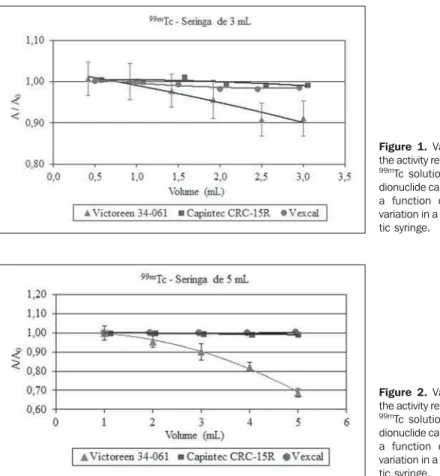
Figures 1 and 2 demonstrate the volu-metric variation results with the activity obtained for 99mTc measured with 3 and 5
mL syringes, respectively, with three differ-ent radionuclide calibrators: Capintec CRC-15R, Veccsa Vexcal and Victoreen Cal-Rad 34-061. The first two calibrators utilize ICs while the third utilizes a G-M detector. Figures 3 and 4 demonstrate the results for 123I. The A
0 activity at a
normal-ization volume V0 was utilized for
denomi-nating the graphical representation of the activity Aversus the individual volume V.
For the 5 mL syringe, the V0 was 1 mL,
while for the 3 mL syringe the V0 was 0.5
mL. Such data were utilized to obtain the ratio between A/A0versus V and a
second-Figure 1. Variation of the activity readings of a
99mTc solution with
ra-dionuclide calibrators as a function of volume variation in a 3 mL plas-tic syringe.
Figure 2. Variation of the activity readings of a
99mTc solution with
degree polynomial equation was utilized as the best approach for determining the cor-rection factors, as follows:
A/A0 = aV
2 + bV + c
where: A0 is the activity corresponding to the
normalization volume V0 and A is the
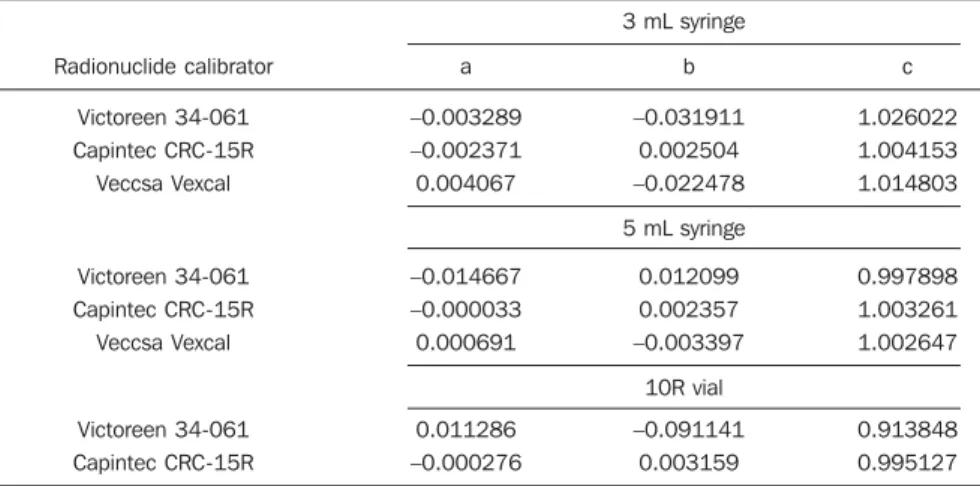
activ-ity measured in an individual volume V. Tables 1 and 2 show the coefficients of the volume correction factors for 99mTc and 123I, respectively in the 3 and 5 mL syringes
and the 10R vial. Such coefficients repre-sent the volumetric correction factors for obtaining the correct activity as the volume of the radioactive solution contained in the syringe is varied.
Plastic 3 and 5 mL syringes containing 1 mL of 99mTc and 123I with known
activi-ties were utilized to evaluate the perfor-mance of different types of radionuclide calibrators. Eight calibrators from several nuclear medicine services in the city of Rio de Janeiro participated in this performance testing, and the results analysis was based on accuracy criterion established by the CNEN Standard NN-3.05. Figures 5 and 6 show the results of this performance test for 3 and 5 mL syringes with 99mTc and 123I,
respectively. Each experimental point is the result of five repetitive measurements with the radionuclide calibrators, and the uncer-tainty bars correspond to the standard de-viation of such measurements.
DISCUSSION
For the 3 mL syringe with 99mTc, the
volume variation from 1 to 3 mL did not cause significant change in the activity measured with the Capintec and Vexcal calibrators. However the measurements with the Victoreen model presented with greater variation, reaching a value 10% lower when the volume increases from 1 to 3 mL. The same behavior was observed for the 5 mL syringe with the two calibrators with ICs, but the Victoreen model pre-sented greater volumetric dependence, with a result 30% lower for the 5 mL volume as compared with the 1 mL initial volume. In the 10R vial, also there was no significant variation in the measurements with the Capintec calibrator, and the variations with the Victoreen model were higher as com-pared with those observed in the measure-Figure 3. Variation of the
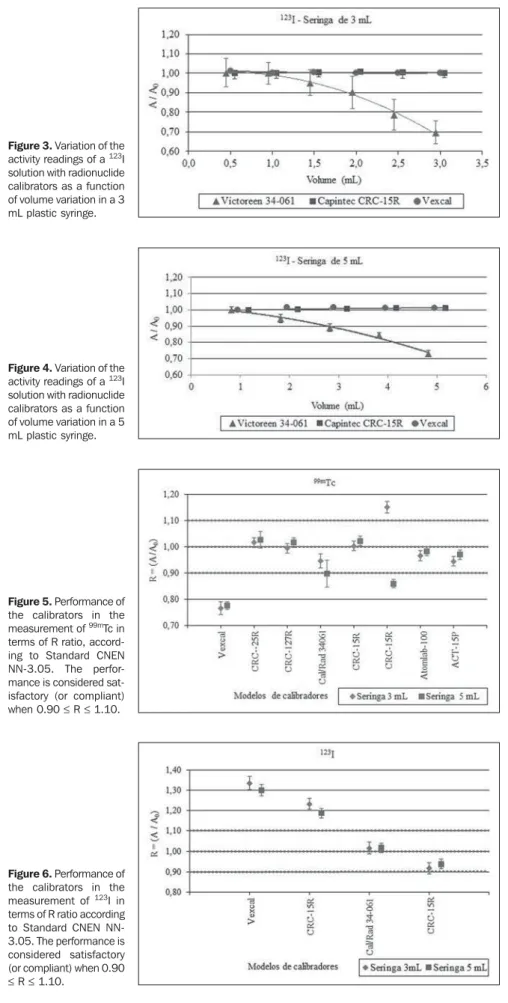
activity readings of a 123I
solution with radionuclide calibrators as a function of volume variation in a 3 mL plastic syringe.
Figure 4. Variation of the activity readings of a 123I
solution with radionuclide calibrators as a function of volume variation in a 5 mL plastic syringe.
Figure 5. Performance of the calibrators in the measurement of 99mTc in
terms of R ratio, accord-ing to Standard CNEN NN-3.05. The perfor-mance is considered sat-isfactory (or compliant) when 0.90 ≤ R ≤ 1.10.
Figure 6. Performance of the calibrators in the measurement of 123I in
terms of R ratio according to Standard CNEN NN-3.05. The performance is considered satisfactory (or compliant) when 0.90
ments in the syringes, according to coeffi-cients presented on Table 1. However, in this case, there was a reversal in the ten-dency towards activity decrease with the increase in volume, with an approximately 10% higher result when the volume is in-creased from 1 to 5 mL. On Table 1, one can observe that the a and b coefficients are
lower for the calibrators equipped with ICs utilized in the present study as compared with the one equipped with G-M detector, and the c coefficient is closer to 1 for those
equipped with ICs, confirming the lower volumetric dependence of the first ones in relation to the latter one. Such a tendency is also confirmed for 123I, as shown on
Table 2.
The behavior for 123I is similar to that for 99mTc in the three calibrator models. Again,
a higher variation was observed with the Victoreen model, in which the measured activities in the 3 and 5 mL syringes were
70% lower for both syringes, as compared with the activity of the initial volume of 1 mL. Such a greater variation in comparison with 99mTc can be explained by the high
absorption in the sample itself of numerous X-rays typical of low energy (27 to 32 keV, with approximately 87% probability of emission)(8) emitted by 123I, which
contrib-ute for producing the activity shown on the calibrator reading. The absorption is lower for 99mTc, which preferably emits 140 keV
gamma rays. Such effects may also be ob-served on the uncertainty bars, represent-ing the repeatability of experimental data measurements that are many times greater with the Victoreen model than in the Capintec one. In the case of the 10R vial, the tendency towards activity decrease was maintained with the increase in volume. However, the lowest activity was measured on an intermediate volume of 3 mL, and then increasing, demonstrating a
contradic-tory behavior. New measurements must be performed both for 123I and 99mTc to
con-firm such unexpected results. The volumet-ric correction factor coefficients presented on Tables 1 and 2 are valid only for the calibrators, types of vials and radionuclides utilized in the present study, as well as for the studied volumetric ranges. The calibra-tor owners should determine their own correction factors for each type of vial and radionuclide, with the different volumes routinely utilized in their activities.
In the evaluation of the eight calibrator’s performance in the measurement of 99mTc
activity, the authors have observed a simi-lar behavior for 3 and 5 mL syringes. Amongst the eight tested calibrators, with 16 results, only two with four results were out of the accuracy limits required by the Brazilian standard, presenting a good over-all performance. The exception was one of the CRC-15R models, which presented a contradictory behavior as compared with the others (deviation of +15% for the 3 mL syringe and –15% for the 5 mL syringe), requiring new measurements for confirma-tion of such results. In the case of 123I, only
four calibrators were evaluated, as some of them were out of service or were not cali-brated for 123I measurements at the time the
present study development. One half of the results were out of the accuracy limits of ±10%, with maximum deviation of ap-proximately +30%, while for 99mTc the
maximum deviation was -20%. More ro-bust conclusions regarding the perfor-mance cannot be generalized, since for that purpose the comparison should comprise all nuclear medicine services which utilize
99mTc and 123I in their routine activities.
CONCLUSIONS
The results of the present study confirm that the radionuclide calibrator responses depend on the volume, type of vial, and the radionuclide utilized in the measurement, with more critical results with the calibra-tors utilizing G-M deteccalibra-tors analyzed in the present study, reaching deviations of up to 70% lower as compared with the standard volume. In the performance testing, the maximum deviations were similar for both radionuclides. In order to obtain more ro-bust conclusion on activity measurements Table 2 Volumetric correction factors coefficients of a second-degree polynomial for 123I.
Radionuclide calibrator Victoreen 34-061 Capintec CRC-15R Veccsa Vexcal Victoreen 34-061 Capintec CRC-15R Veccsa Vexcal Victoreen 34-061 Capintec CRC-15R
3 mL syringe
a –0.050397 –0.002598 0.002621 –0.007684 –0.000689 –0.002474 0.006248 –0.000391 b 0.044860 –0.010525 –0.012576 –0.020918 0.016061 0.007541 –0.042279 0.005891 c 0.996044 0.995670 1.016197 1.017485 0.998927 0.991423 1.035615 0.995829 5 mL syringe
10R vial
Table 1 Volumetric correction factors coefficients of a second-degree polynomial for 99mTc.
Radionuclide calibrator Victoreen 34-061 Capintec CRC-15R Veccsa Vexcal Victoreen 34-061 Capintec CRC-15R Veccsa Vexcal Victoreen 34-061 Capintec CRC-15R
3 mL syringe
a –0.003289 –0.002371 0.004067 –0.014667 –0.000033 0.000691 0.011286 –0.000276 b –0.031911 0.002504 –0.022478 0.012099 0.002357 –0.003397 –0.091141 0.003159 c 1.026022 1.004153 1.014803 0.997898 1.003261 1.002647 0.913848 0.995127 5 mL syringe
in the syringes, the number of elements in the comparison should be higher, particu-larly for 123I. As nuclear medicine services
utilize different types of vials with variable volumes of radiopharmaceuticals, the cor-rection factors required for correct activi-ties administration, must be determined for each calibrator and radionuclide, with the objective of minimizing the administration of unnecessary doses to patients. There is no universal correction factor for each cali-brator model and make. Considering that the correct measurement of activity admin-istered to the patient is a relevant part of a nuclear medicine procedure, it is recom-mended that the regulating agency CNEN intensifies its inspections of nuclear medi-cine services to verify their compliance with the Standard NN-3.05 requirements. Another recommendation would be for a gradual replacement of calibrators equipped with G-M detectors because of their poor performance, requiring more corrections, as demonstrated by the present study as well as by other studies previously published by the authors(9–12). The present study neither endorse nor divulge any
ra-dionuclide calibrator model, but is limited to a description of the results obtained with the studied calibrators.
Acknowledgements
To IPEN/São Paulo and IEN/Rio de Janeiro, for providing the radioactive sources utilized in the present study.
REFERENCES
1. Comissão Nacional de Energia Nuclear. CNEN NN-3.05. Requisitos de radioproteção e segu-rança para serviços de medicina nuclear. Reso-lução CNEN-10/96. Brasília, DF: Diário Oficial da União, 19 de abril de 1996.
2. International Atomic Energy Agency. Quality as-surance for radioactivity measurement in nuclear medicine. Technical Reports Series no. 454. Vienna: International Atomic Energy Agency; 2006.
3. Tyler DK, Baker M, Woods MJ. NPL secondary standard radionuclide calibrator. Syringe calibra-tion factors for radionuclide used in nuclear medi-cine. National Physical Laboratory. Appl Radiat Isot. 2002;56:343–7.
4. Baker M. Calibration of the NPL secondary stan-dard radionuclide calibrator for the new 10R Schott, type 1+ vials. Appl Radiat Isot. 2005;63: 71–7.
5. Ceccatelli A, Benassi M, D’Andrea M, et al. Ex-perimental determination of calibration settings of a commercially available radionuclide
calibra-tor for various clinical measurement geometries and radionuclides. Appl Radiat Isot. 2007;65: 120–5.
6. International Organization for Standardization. ISO 8362-2003. Injection containers and acces-sories – Part 1: Injection vials made of glass tub-ing. Geneva: International Organization for Stan-dardization; 2003.
7. Schott Pharmaceutical Packaging. Ampolas feitas de vidro. [acessado em 4 de abril de 2012}. Dis-ponível em: http://schott.com/pharmaceutical_ packaging/portuguese/produts/ampoules.html.
8. Chisté V, Bé MM. Table de radionucléides. 123I.
[acessado em 4 de abril de 2012]. Disponível em: http://www.necleide.org/DDEP_WG/Nuclides/ I-123_tables.pdf.
9. Iwahara A, de Oliveira AE, Tauhata L, et al. Intercomparison of 131I and 99mTc activity
mea-surements in Brazilian nuclear medicine services. Appl Radiat Isot. 2001;54:489–96.
10. Iwahara A, de Oliveira AE, Tauhata L, et al. Per-formance of dose calibrators in Brazilian hospi-tals for activity measurements. Appl Radiat Isot. 2002;56:361–7.
11. dos Santos JA, Iwahara A, de Oliveira AE, et al. National intercomparison program for radiophar-maceutical activity measurements. Appl Radiat Isot. 2004;60:523–7.