Original article (short paper)
Sport participation motives of young Brazilian
judo athletes
Dartagnan Pinto Guedes
Northern Paraná University, Londrina, PR, Brazil
Marcelo Seiji Missaka
Filadelia University, Londrina, PR, Brazil
Abstract—The objective of this study was to identify the motives for sport participation in a sample of young judo athle-tes according to sex, age, and training history. A total of 392 subjects aged 12 to 18 years old participated in the study. Portuguese version of the Participation Motivation Questionnaire was used to identify motives for sports participation.
Boys reported giving signiicantly more importance to sports participation in terms of Competition and Skill Develop
-ment, whereas girls presented signiicantly higher ratings for Teamwork and Friendship. Motivational factors related to Achievement/Status and Fun presented signiicantly higher average ratings in younger judo athletes, whereas average ratings of Competition signiicantly increased with increasing age. Average ratings related to Fitness, Competition and Skill Development were proportionally and signiicantly higher according to training experience and training volume.
These results will contribute to establishing intervention programs designed to reduce sport dropout rates among young judo athletes.
Keywords: motivation, adolescents, adhesion, dropout
Resumo—“Motivos para a prática de judô em jovens atletas brasileiros.” Objetivo do estudo foi identiicar motivos para
prática de judô em uma amostra de jovens atletas de acordo com sexo, idade e histórico de treino. Amostra foi constituída
por 392 sujeitos com idades entre 12 e 18 anos. Motivos para prática de judô foram identiicados mediante versão tra
-duzida do Participation Motive Questionnaire. Rapazes assinalaram oferecer signiicativamente maior importância para prática de esporte nos fatores Competição e Competência Técnica, enquanto moças apresentaram valores signiicativa
-mente mais elevados nos fatores Atividade de Grupo e Ailiação. Fatores de motivação relacionados ao Reconhecimento Social e à Diversão apresentaram dimensões signiicativamente maiores nos atletas mais jovens, enquanto importância atribuída a Competição aumentou signiicativamente com a idade. Valores atribuídos a Aptidão Física, Competição e Competência Técnica foram proporcional e signiicativamente mais elevados de acordo com experiência e volume de treino. Resultados encontrados deverão contribuir para estabelecer intervenções destinadas a reduzir taxas de abandono
entre jovens judocas.
Palavras-chave: motivação, adolescentes, adesão, abandono
Resumen—“Motivos para la práctica del judo en los atletas jóvenes brasileños.” Objetivo del estudio fue identiicar
los motivos de la práctica del judo en una muestra de jóvenes atletas en función del sexo, la edad y la historia de en-trenamiento. La muestra consistió de 392 sujetos de edades comprendidas entre 12 y 18 años. Motivos para la práctica
del judo fueron identiicados por el versión traducida de lo Participation Motive Questionnaire. Los niños señalaron dar signiicativamente mayor importancia en la práctica de deporto a los factores Competición y Competencia Técnica, mientras las niñas mostraron valores signiicativamente más altos en los factores de la Actividad del Grupo y Ailiación. Factores de motivación en relación con el Reconocimiento Social y Diversión tuvieron dimensiones signiicativamente mayor en los más jóvenes, mientras importancia asignada a la Competición aumentó signiicativamente con la edad. Los valores asignados a la Aptitud Física, la Competición y Competencia Técnica fueron proporcional y signiicativamente
mayores en función de la experiencia y el volumen de entrenamiento. Los resultados deberían ayudar a establecer in-tervenciones para reducir las tasas de abandono entre los jóvenes judokas.
Introduction
The information available in the literature emphasizes the multiple
beneits of sport to promote physical, mental and social well-being at young ages (Fraser-Thomas, Côté, & Deakin, 2008). In contrast,
however, epidemiological survey have pointed out that a small portion of children and adolescents participate in regular sport pro-grams (Weinberg et al., 2000) and that, among those who begin to
do so, there is an alarming number of dropouts, with repercussions
present and in adulthood (Sirard, Pfeiffer, & Pate, 2006). In this particular, experimental evidence conirm that the motivation is key for achieving adherence to sports practice (Moreno, Cervelló, & Gonzáles-Cutre, 2007; Ulrich-French & Smith, 2009).
In view of this situation, important studies have sought to apply different theories developed in the ield of psychology that could explain adherence to sports practice (Gill & Williams, 2008). To do so, it is necessary to identify and understand the motivational factors that can cause one to sport. The identiica -tion of underlying reasons to sport enables the development of actions that promote this practice and that can allow one to fully achieve one’s proposed goals, thus enhancing a favorable
moti-vational environment and, consequently, increasing the chances
of adherence and minimizing the occurrence of possible dropouts.
Currently, the self-determination theory is the motivational
theory commonly used to understand the motives for sport
participation (Gill & Williams, 2008; Jöesaar & Hein, 2011;
Sirad et al., 2006; Weinberg et al., 2000). The basic premise of
the Self-determination theory is the association between indivi-duals’ perceptions of behaviors and different types of motives,
inluenced by social and environmental factors. These motives
constitute a continuum of self-determined behavior that includes intrinsic and extrinsic types of motivation and amotivation (Deci
& Ryan, 1985; 2000). Intrinsic motivation refers to engaging
in sport solely for the pleasure and satisfaction derived from its practice. A young athlete intrinsically motivated will participate in sports voluntarily, in the absence of material rewards or
ex-ternal constraints. In contrast, extrinsic motivation comes from
external sources, such as the lure of awards, trophies, money,
fame, praise and social approval. Interestingly, it has been found
that although extrinsic motivation is a strong motivator, it can
undermine intrinsic motivation (Vallerand, 1997). According to
the self-determination theory, behaviors associated to extrinsic motivation should cover the continuum between intrinsic mo-tivation and amomo-tivation, varying in the extent to which their
regulation is more or less self-determined: integrated, identiied, introjected, and external regulation (Deci & Ryan, 1985; 2000).
The motives of young people to participate in sport are a combination of multiple social, environmental and individual
attributes that determine the choice for a speciic modality,
persistence in sports, and engagement in more intense training to achieve high performance (Weinberg et al., 2000). In this
respect, studies investigating the motivational factors for sports participation are important since they permit to identify the reasons that lead young people to begin participating in sport activities and the factors responsible for their permanence. Although it is possible to identify common motives, studies indicate that the reasons for sport participation vary according
to the type of sport and cultural context of young people (Jöe
-saar & Hein, 2011; Sirard et al., 2006; Weinberg et al., 2000).
Studies on this subject available in the literature involve
young athletes from European (Almagro, Conde, Moreno, & Sáenz-Lópes, 2009; Buonamano, Cei, & Mussino, 1995; Cec
-chini, Méndez, & Nuñiz, 2002; Fraile & De Diego, 2006; Gary
-fallos & Asterios, 2011; Jöesaar & Hein, 2011; Jones, MacKay, & Peters, 2006; Koivula, 1999; Salselas, Gonzales-Boto, Tuero, & Marquez, 2007; Zahariadis & Biddle, 2000), North American (Gill, Gross, & Huddleston, 1983; Sirard et al., 2006; Weinberg et al., 2000), and Asian countries (Gürbuz, Altyntas, Aaci, & Hülya, 2007; Kirkby, Kolt, & Liu, 1999; Shang, 1997; Sit & Lindner, 2005; Thiborg, 2005). These studies have identiied a consistent group of motives for participation in sport. Howe -ver, extrapolation of the results to Latin American countries is
questionable due to speciic sociocultural and environmental
determinants associated to the sports participation of these
countries. In the Brazilian context, the few studies carried out
were performed with samples poorly representative of young
athletes, and the authors used designs which assessed speciic types of sports, such as basketball (Guillén-Garcia, Weis, & Na
-varro-Valdivieso, 2005; Rose Júnior, Campos, & Tribst, 2001), and swimming (Bastos, Salguero, Gonzáles-Boto, & Márques, 2008), not considering young judo athletes.
Judo is a martial art and an Olympic sport, comprising
standing and ground wrestling, in which besides technical skill and tactical strategies, particular physical and physiological characteristics are also indispensable for success in
competi-tion and for training. Competitive judo can be described as a
combative, high intensity sport in which the athlete attempts to throw the opponent onto his back or to control him during
groundwork combat (Franchini, Del Vecchio, Matsushigue, & Artioli, 2011). In Brazil, judo began with the immigration of the irst Japanese teachers at the beginning of the 20th Century,
through the teachings of the traditional model of judo. Today, judo is one of the most practiced sports by young Brazilians and the country has a great expression worldwide, evidenced by the results obtained in international competitions.
The objective of the present study was to identify the motives for sports participation in a sample of young Brazilian judoists according to sex, age, and training history. The hypothesis tested was that sex, age and indicators of training (onset of training,
training experience, training volume, and performance level) have a signiicant effect on the motives for sports participation.
The expectation was that, independently of sex and age, young judoists with a more effective training history would be more intrinsically motivated toward sports than their peers.
Methods
Participants
The reference population of the study included young athletes of both sexes ranging in age from 12 to 18 years, who had
in the south region of Brazil. Using the Human Development Index (HDI) as a reference point, Paraná is one of the most developed State of Brazil. In 2013, the mean HDI of Paraná was 0.825, which represents 104% of the national average (PNUD, 2013).
The selection of the sample occurred through a
non-probabi-lity casual sampling. For this purpose, all coaches and oficials
were contacted before the beginning of the competitions and informed about the nature and objectives of the study and the
principle of conidentiality. Next, their authorization was obtai
-ned to contact and invite the athletes and 392 subjects (163 girls and 229 boys) agreed to participate in the study by signing the
voluntary informed consent form. This sample corresponded to
about 70% of the participants in the competitions. The Research Ethics Committee of the State University of Londrina, Paraná, approved the study (Protocol 86/2009).
Procedure
The motives for sports participation were obtained by
applica-tion of the Participaapplica-tion Motivaapplica-tion Quesapplica-tionnaire (PMQ), which
was translated, adapted and validated for the young Brazilian
po-pulation (Guedes & Silverio Netto, 2013), together with additional questions regarding sex, age, and training history (age at onset of
training, training experience, training volume per week, and
perfor-mance level). The original English version of the PMQ (Gill et al.,
1983) has been one of the most frequently used and has permitted
a fairly balanced comparison between studies (Buonamano et al.,
1995; Garyfallos & Asterios, 2011; Guillén-Garcia et al., 2005; Gürbuz et al., 2007; Kirkby et al., 1999; Koivula, 1999; Salselas et al., 2007; Shang, 1997; Sirard et al., 2006; Sit & Lindner, 2005; Thiborg, 2005; Zahariadis & Biddle, 2000).
The PMQ is a 30-item questionnaire describing the possible
reasons for sports participation, to which the participant
res-ponds on a 5-point Likert scale. Respondents replied to the stem:
“I participate in sport because ... “, indicating their preference from 1 (“not at all important”) to 5 (“extremely important”).
The results of factor analysis of the Portuguese version of the PMQ indicated eight factors: Achievement/Status, Teamwork, Fitness, Competition, Skill Development, Friendship, Fun, and
Emotion reasons as basic motives for participation.
Each athlete answered individually the instrument with orientation of the same researcher. Application of the instrument in situations of pre- or post-competition stress was avoided.
Thus, the athletes answered the questionnaire when were not
in the environment of the competition, or when they were only
watching the competitions. The participants received the ques
-tionnaire with instructions and recommendations on how to ill it out. There was no time limit for completing the questionnaire.
The researcher who accompanied the data collection readily
clariied eventual doubts reported by the respondents.
Data analysis
Initially, a conirmatory factor analysis was conducted with
the maximum likelihood estimation method, to see if the factor
structure found by Guedes and Silverio Neto (2013) it the data. The it of the model was evaluated by means of the following indices (goodness-of-it indices): χ2 goodness of it statistic, χ2/df, Comparative Fit Index (CFI), Incremental Fit Index (IFI), Tucker-Lewis Index (TLI), Root Mean Square Error of Approximation (RMSEA), and Standardized Root Mean Square Residual (SRMR). Cronbach’s alpha coeficient was used to
assess the internal consistency reliability of each factor.
Next, in order to select the most appropriate statistics for
correlating intensive and selective aspects of sport participation
motivation, goodness-of-it tests (Kolmogorov-Smirnov statistic with a Lilliefors signiicance level) were used to determine whe -ther the difference between the empirical distribution function of the variables and the distribution function expected under the
hypothesis of normality was statistically signiicant. Whereas
the data showed a normal distribution we used the resources of parametric statistics. The basic descriptive parameters (mean
and standard deviation) were used to determine the importance
of the sport participation motives.
Average ratings of the motives for sport participation were
compared by multivariate (MANOVA) and univariate (ANOVA)
analysis of variance, in which the motivational factors were the dependent variables and sex, age, age at onset of training, training experience, training volume per week, and performan-ce level were the independent variables. We perform multiple
comparisons by the post-hoc Scheffé test. The various analyses were carried out with the SPSS Version 20.0.
Results
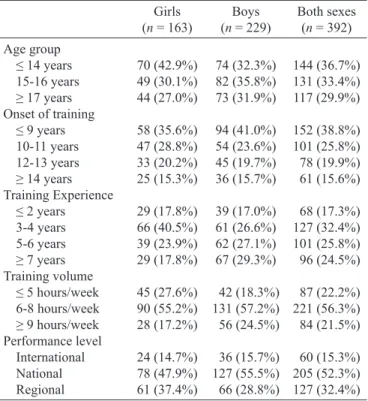
Table 1 shows the distribution of the young judo athletes included in the study according to sex, age and training history.
Among the 392 athletes studied, 42% were girls. Considering
both sexes, the three age groups showed a similar proportion of
subjects. However, a higher proportion of girls (42.9%) was ≤ 14 years, while a higher proportion of boys (67.7%) was ≥ 15
years. With respect to training history, a higher proportion of
girls (35.6%) and boys (41.0%) began training at ≤ 9 years of
age. The experience of training was shorter among girls, with
58.3% reporting ≤ 4 years of training compared to 43.6% of boys. Also, 17.8% of girls and 29.3% of boys showed a training duration ≥ 7 years. With respect to training volume, 56.3% of the participants trained 6-8 hours/week and 21.5% trained ≥ 9 hours/week. Most athletes (52.3%) had experience in national competitions. Among the remaining subjects, 32.4% and 15.3% reported experience in regional and international
competitions, respectively.
Table 3 shows the results of statistical analysis of the
moti-vational factors according to sex and age. MANOVA indicated
main effects of sex (Wilks’ lambda = .952; F = 2.404; p = .015)
and age group (Wilks’ lambda = .879; F = 3.184; p < .001). In this respect, boys reported to give signiicantly more importance
to sport participation in terms of Competition (F = 5.394; p = .021) and Skill Development (F = 5.533; p < .017), whereas girls presented signiicantly higher ratings for Teamwork (F = 9.819; p = .002) and Friendship (F = 7.715; p < .001). With respect
to age, motivational factors related to Achievement/Status (F = 4.441; p = .012) and Fun (F = 8.276; p < .001) presented signiicantly higher mean ratings in younger judoists, whereas mean ratings of Competition (F = 5.207; p = .006) signiicantly increased with increasing age. Interestingly, the most important
statistical differences in mean ratings were observed between
judoists ≤ 14 years and those ≥ 17 years. No signiicant diffe -rences in mean ratings were observed between judoists aged
15-16 years and those ≥ 17 years.
Table 2 shows the mean ratings of each motivational factor for sport participation reported by the young judoists. The most important motives were related to Skill Development (4.18 ± 0.84), Competition (4.16 ± 1.11) and Fitness (4.11 ± 0.91). The
least important motives were related to Fun (3.01 ± 1.12) and Achievement/Status (2.99 ± 1.18). The three other motivational
factors assumed an intermediate position with mean ratings obtained for Friendship (3.84 ± 1.09), Teamwork (3.79 ± 1.07) and Emotion (3.64 ± 1.12).
Girls (n = 163)
Boys (n = 229)
Both sexes (n = 392)
Age group
≤ 14 years 15-16 years ≥ 17 years
Onset of training
≤ 9 years 10-11 years
12-13 years
≥ 14 years
Training Experience
≤ 2 years 3-4 years 5-6 years ≥ 7 years
Training volume
≤ 5 hours/week 6-8 hours/week ≥ 9 hours/week
Performance level International National Regional 70 (42.9%) 49 (30.1%) 44 (27.0%) 58 (35.6%) 47 (28.8%) 33 (20.2%) 25 (15.3%) 29 (17.8%) 66 (40.5%) 39 (23.9%) 29 (17.8%) 45 (27.6%) 90 (55.2%) 28 (17.2%) 24 (14.7%) 78 (47.9%) 61 (37.4%) 74 (32.3%) 82 (35.8%) 73 (31.9%) 94 (41.0%) 54 (23.6%) 45 (19.7%) 36 (15.7%) 39 (17.0%) 61 (26.6%) 62 (27.1%) 67 (29.3%) 42 (18.3%) 131 (57.2%) 56 (24.5%) 36 (15.7%) 127 (55.5%) 66 (28.8%) 144 (36.7%) 131 (33.4%) 117 (29.9%) 152 (38.8%) 101 (25.8%) 78 (19.9%) 61 (15.6%) 68 (17.3%) 127 (32.4%) 101 (25.8%) 96 (24.5%) 87 (22.2%) 221 (56.3%) 84 (21.5%) 60 (15.3%) 205 (52.3%) 127 (32.4%) Table 1. Characteristics of the young judo athletes studied.
Motivational factor Mean ± standard deviation
Skill development
Competition Fitness
4.18 ± 0.84 a 4.16 ± 1.11 a 4.11 ± 0.91 a
Most important
Friendship
Teamwork Emotion
3.84 ± 1.09 b 3.79 ± 1.07 b 3.64 ± 1.12 b
Intermediate
importance
Fun
Achievement/Status
3.01 ± 1.12 c 2.99 ± 1.18 c
Least important Table 2. Mean ratings of the motivational factors for participation in Brazilian young judo athletes obtained by application of the Partici-pation Motivation Questionnaire.
Mean values followed by the same superscript letters did not differ
signiicantly from one another (p < .01)
Achievement/
Status Teamwork Fitness Emotion Competition
Skill
Development Friendship Fun
Sex Multivariate analysis: Wilks’ lambda = .952; F(8,383) = 2.404; p = .015
Girls 2.97 ± 1.22 4.02 ± 1.02 4.14 ± 0.84 3.69 ± 1.11 4.05 ± 1,13 4.06 ± 0.88 3.88 ± 1.07 3.06 ± 1.12
Boys 3.06 ± 1.14 3.68 ± 1.09 4.07 ± 0.94 3.62 ± 1.13 4.31 ± 1,01 4.32 ± 0.78 3.55 ± 1.13 3.02 ± 1.11
Univariate analysis F = 2.255(ns) F = 9.819
(p = .002)
F = 1.510
(ns) F = 0.384(ns) (F = 5.394p = .021)
F = 5.533
(p = .017)
F = 7.715
(p = < .001)
F = 0.151 (ns)
Age group Multivariate analysis: Wilks’ lambda = .879; F(16,764) = 3.184; p < .001
≤ 14 years 3.19 ± 1.21 3.86 ± 1.01 4.12 ± 0.87 3.56 ± 1.17 3.89 ± 1.20 4.22 ± 0.78 3.93 ± 1.20 3.23 ± 1.09 15- 16 years 2.99 ± 1.19 3.80 ± 1.03 4.13 ± 0.84 3.71 ± 1.06 4.25 ± 1.07 4.18 ± 0.83 3.84 ± 0.99 3.07 ± 1.07 ≥ 17 years 2.75 ± 1.17 3.75 ± 1.11 3.99 ± 1.03 3.69 ± 1.13 4.31 ± 1.03 4.14 ± 0.91 3.88 ± 1.10 2.68 ± 1.11 Univariate analysis F = 4.441
(p = .012)
F = 1.178
(ns) F = 2.903(ns) F = 1.757(ns) (F = 5.207p = .006)
F = 0.330
(ns) F = 1.229(ns) (F = 8.276p < .001)
Table 3. Multivariate and univariate analysis of motivational factors according to sex and age group.
The results of statistical analysis shown in Table 4 indicated signiicant main effect for the four indicators of training history on
the mean ratings of motives for participating in sport reported by the judoists. Motivational factors related to Fitness (F = 7.605; p < .001), Competition (F = 9.405; p < .001) and Skill Development (F = 4.224; p = .006) differed signiicant between ages at the onset of training. The athletes who began training at ≤ 9 years of age showed
the most important differences in mean ratings compared to those
starting at ≥ 14 years, with the observation of higher ratings in the
former. With respect to experience of training, the results showed
signiicantly and proportionally higher mean ratings of motivational
factors related to Fitness (F = 7.271; p < .001), Competition (F = 8.048; p < .001), and Skill Development (F = 8.795; p < .001) as the time of sport experience increased. However, athletes with ≤
2 years of training presented higher mean ratings of motivational factors related to Friendship (F = 4.423; p = .005) and Fun (F = 6.041; p < .001) than those with ≥ 7 years of training.
Regarding training volume, the mean ratings of moti-vational factors related to Fitness (F = 5.602; p = .001), Competition (F = 9.429; p < .001) and Skill Development
(F = 9.448; p < .001) were proportionally and significantly
higher in judoists training more hours/week compared to
those with a lower training volume. Analysis of the perfor-mance level showed a significant and proportional increase in mean ratings of motivational factors related to Fitness
(F = 5.283; p < .001), Competition (F = 7.408; p < .001),
and Skill Development (F = 6.277; p < .001) with increasing
competitive level from regional to international. The opposite was observed for motivational factors related to Achieve-ment/Status (F = 7.119; p < .001), Teamwork (F = 4.610; p = .019), Emotion (F = 4.942; p = .001), Friendship (F = 8.679; p < 0,001), and Fun (F = 3.396; p = .034). In this case,
judoists participating only in regional competitions presented significantly higher mean ratings than those participating in international competitions.
Discussion
The objective of this study was to identify the motives for sport participation in a sample of young Brazilian judo athletes according to sex, age, and training history. This approach per-mits better understanding of the motivations of young judoists and provides relevant information that contributes to promoting
Achievement/
Status Teamwork Fitness Emotion Competition
Skill
Development Friendship Fun
Onset of training Multivariate analysis: Wilks’ lambda = .913; F(24,1106) = 1.867; p = 0.010
≤ 9 years 3.13 ± 1.18 4.02 ± 0.95 4.31 ± 0.92 3.66 ± 1.19 4.41 ± 1.20 4.30 ± 0.67 3.91 ± 1.19 2.93 ± 1.23 10-11 years 3.04 ± 1.26 3.82 ± 1.11 4.17 ± 0.79 3.73 ± 1.03 4.30 ± 0.96 4.26 ± 0.81 3.99 ± 1.09 3.19 ± 1.01
12-13 years 2.87 ± 1.12 3.65 ± 1.07 3.94 ± 0.83 3.53 ± 1.07 4.12 ± 1.04 4.14 ± 0.98 3.81 ± 1.05 2.99 ± 0.99
≥ 14 years 2.82 ± 1.18 3.77 ± 1.14 3.74 ± 1.10 3.58 ± 1.15 3.87 ± 1.15 3.90 ± 0.91 3.82 ± 1.03 2.91 ± 1.15 Univariate analysis F = 2.071(ns) F = 1.833(ns) F(p = 7.605 < .001) F = .528(ns) (Fp = 9.405 < .001) (Fp = 4.224 = .006) F = .542(ns) F = 1.372(ns)
Training experience Multivariate analysis: Wilks’ lambda = .880; F(24,1106) = 2.071; p = .002
≤ 2 years 3.12 ± 1.16 3.84 ± 1.01 3.83 ± 0.81 3.58 ± 1.11 3.89 ± 1.16 3.98 ± 0.87 4.13 ± 0.98 3.21 ± 1.06 3-4 years 2.98 ± 1.23 3.86 ± 1.09 3.96 ± 1.02 3.60 ± 1.21 4.05 ± 1.15 4.08 ± 0.86 4.06 ± 1.07 3.10 ± 1.06 5-6 years 3.17 ± 1.17 3.90 ± 1.10 4.23 ± 0.75 3.62 ± 1.08 4.21 ± 1.10 4.25 ± 0.77 3.81 ± 1.25 3.07 ± 1.15 ≥ 7 years 3.23 ± 1.21 3.66 ± 1.03 4.39 ± 1.00 3.76 ± 1.08 4.37 ± 1.05 4.43 ± 0.82 3.60 ± 1.04 2.60 ± 1.12
Univariate analysis F = 2.045(ns) F = 1.724(ns) F(p = 7.271 < .001) F = 1.022(ns) (Fp = 8.048 < .001) (Fp = 8.795 < .001) (Fp = 4.423 = .005) (Fp = 6.041 < .001)
Training volume Multivariate analysis: Wilks’ lambda = .889; F(16,764) = 1.912; p = .015
≤ 5 hours/week 3.15 ± 1.18 3.87 ± 1.09 3.91 ± 0.94 3.64 ± 1.04 3.69 ± 1.09 3.83 ± 0.89 3.83 ± 1.15 2.86 ± 1.21 6-8 hours/week 3.08 ± 1.19 3.75 ± 1.05 4.05 ± 0.91 3.60 ± 1.14 3.92 ± 1.06 4.18 ± 0.81 3.85 ± 1.06 3.02 ± 1.08 ≥ 9 hours/week 3.29 ± 1.22 3.92 ± 1.17 4.21 ± 0.72 3.71 ± 1.20 4.65 ± 0.72 4.86 ± 0.73 4.03 ± 1.27 3.13 ± 1.15
Univariate analysis F = 2.131(ns) F = 1.175(ns) F(p = 5.602 = .001) F = 1.959(ns) (Fp = 9.429 < .001) (Fp = 9.448 < .001) F = 1.308(ns) F = 2.322(ns)
Performance level Multivariate analysis: Wilks’ lambda = .861; F(16,764) = 8.430; p < .001
International 2.77 ± 1.20 3.67 ± 0.99 4.23 ± 0.84 3.32 ± 1.12 4.39 ± 1.13 4.53 ± 0.64 3.63 ± 1.09 2.90 ± 1.20 National 2.96 ± 1.18 3.74 ± 1.09 4.08 ± 0.94 3.58 ± 1.09 4.15 ± 1.09 4.18 ± 0.85 3.84 ± 1.10 2.87 ± 1.11
Regional 3.22 ± 1.24 4.04 ± 1.05 3.85 ± 1.15 3.81 ± 1.12 3.72 ± 1.20 3.98 ± 0.84 4.17 ± 1.13 3.17 ± 1.15
Univariate analysis (Fp = 7.119 < .001) F(p = 4.610 = .019) F(p = 5.283 < .001) (Fp = 4.942 = .001) (Fp = 7.408 < .001) (Fp = 6.277 < .001) (Fp = 8.679 < .001) (Fp = 3.396 = .034) Table 4. Multivariate and univariate analysis of motivational factors according to training history.
sports among young people. Motivational factors were identiied
by application of the PMQ as previously translated to Portuguese and validated for the Brazilian population. The PMQ, through its translated versions adapted to different languages, is probably the most widely used instrument for the analysis of motives that lead young people to participate in sport (Buonamano et al., 1995; Garyfallos & Asterios, 2011; Guillén-Gracia et al.,
2005; Gürbuz et al., 2007; Kirkby et al., 1999; Koivula, 1999;
Salselas et al., 2007; Shang, 1997; Sirard et al., 2006; Sit & Lindner, 2005; Thiborg, 2005; Zahariadis & Biddle, 2000).
The eight-factor structure of the PMQ translated and adapted
to Portuguese by Guedes and Silverio Netto (2013) is similar
to that of the original version proposed by Gill et al. (1983)
and of most studies published that used the same experimental
design. Internal consistencies of motivational factors determined
by Cronbach’s alpha coeficient were acceptable in the current sample and higher than those of the original version. In addition, the difference between highest (.86) and lowest scores (.59) was
smaller than that obtained for the original version of the PMQ
(.78 and .30, respectively), suggesting a greater balance between
motivational factors in the translated version. The differences in the size of the rating scales used for the two versions of the PMQ and in the characteristics of the sample selected in each study
might explain these indings. The original version used a 3-point scale, whereas the present study employed a 5-point scale that provides greater discriminatory power. In addition, the original
PMQ was applied to young people engaged in summer leisure
programs (Iowa Summer Sports School), whereas the young
athletes studied here were competing at a higher level while
participating in the inal phase of the competitions organized by the Judo Federation of Parana, the main state competitions for judoists under the age of 18. As a consequence, the context of
the two studies may have tapped differences in sports interests. The present results showed that Skill Development, Compe-tition and Fitness were generally the main motivational factors for sport participation reported by the young judoists, i.e. the respondents indicated that they practice sport mainly to impro-ve and maintain their technical skills and physical condition.
Although the subjects were young athletes, these indings are
not surprising since young people who decide to practice sport favor motives that are intimately related to the success of their activity. Studies involving young people from different
socio-cultural backgrounds showed similar results (Cecchini et al.,
2002; Sirard et al., 2006; Weinberg et al., 2000).
On the other hand, motivational factors related to Fun
and Achievement/Status contributed the least to the option of sport participation by the judoists. According to the literature,
Achievement/Status is indeed considered to be of little impor-tance by young athletes for the decision to participate in sport
(Alderman & Wood, 1976; Williams & Cox, 2003). However,
no consensus exists in the literature regarding motives related to Fun. In fact, some studies reported this motive to be one of the most important for youth participation in sport (Campbell et al., 2001; Weinberg et al., 2000), whereas others were una
-ble to conirm this inding (Cecchini et al., 2002; Sirard et al.,
2006). One possible explanation for this discrepancy might be
the semantic meaning attributed to the expression “fun”. For
some young people, amusement and entertainment may not be understood as something to be enjoyed, but rather as playing, and are therefore rejected since, for them, sport is something very serious, a fact explaining the inconsistency of the results reported in the different studies.
Motivational factors related to Friendship, Teamwork and
Emotion, which are predominantly intrinsic factors, were of moderate importance for the decision of young athletes to
participate in judo and signiicantly less important than the
classical extrinsic motivational factors, Fitness, Competition and
Skill Development. These are interesting indings that should be
investigated in future studies designed to propose theoretical assumptions that assign more importance to attributes linked to the intrinsic motivation of young people when they decide
to practice sports (Gill & Williams, 2008).
Analysis of the motives for sport participation according to
sex showed that boys gave signiicantly more importance to the
motivational factors Competition and Skill Development than girls, whereas girls gave more importance to motives related to
Teamwork and Friendship. Evidence in the literature conirms
the tendency of girls to more intensely identify themselves with social and group motives for sport participation, whereas boys tend to give importance to attributes related to challenge and
striving for technical excellence (Cecchini et al., 2002; Sirard et al., 2006; Weinberg et al., 2000).
With respect to age, although the mean ratings of the motives
Achievement/Status and Fun were the lowest when compared to the other factors identiied in the study, younger judoists gave signiicantly more importance to these two factors than judoists ≥ 17 years. This inding conirms the typical predisposition of
younger people to the appreciation of the ludic component of the sport while establishing expectations of being recognized within the social context through their sports participation (Gill
& Williams, 2008). Older athletes were found to be signiicantly more motivated by factor related to Competition than those ≤ 14 years. Similar results have been reported in previous studies (Cecchini et al., 2002; Hellandsig 1998; Nigg, 2003) and can be explained by the fact that athletes ≥ 17 years attribute a more
competitive meaning to sport and that sport offers an opportunity to prove their personal competency.
Indicators of training history reported by the judoists also had
repercussions on the level of motivation for sport participation.
Judoists who began training at an early age and had a longer du
-ration of training tended to give signiicantly more importance to
motives related to Fitness, Competition and Skill Development. In
contrast, athletes who had a shorter period of training gave
signi-icantly more importance to the motivational factors Friendship
and Fun. These results are consistent with theoretical (Gill & Williams, 2008) and empirical evidence (Petherick & Weigang, 2002) reported in the literature and support the hypothesis that
beginners are typically more motivated by reasons related to fellowship and playfulness, whereas more experienced athletes preferentially search for challenges and strive for excellence in terms of technical skills and physical conditioning.
Training volume, evaluated based on the hours of training per week, was also an important attribute related to training
participation reported by the athletes. In this respect, the more
the athletes trained per week, the greater the importance attribu-ted to motivational factors relaattribu-ted to Fitness, Competition and
Skill Development. These results agree with those reported in
a few studies on this topic (Cecchini et al., 2002; Weinberg et al., 2000). However, the cross-sectional design of these studies
and of the present investigation does not permit to determine whether the motivation to search for challenges and strive for excellence in terms of technical skills and physical conditioning
is responsible for or is a consequence of the higher training vo -lume, highlighting the possible reversibility of this relationship.
Performance level was a factor that most revealed signiicant
differences in the level of motivation of young judo athletes to
participate in sport. Judoists who so far had only participated in regional competitions gave signiicantly more importance to the
factors Achievement/Status, Teamwork, Emotion, Friendship, and Fun. On the other hand, Fitness, Competition and Skill Development were signiicantly more valued by athletes who
had already participated in international competitions. These
indings agree with previous studies highlighting the concern
and attention that need to be paid to social and emotional
moti-ves in early stages of the sport career of young athletes (Gill & Williams, 2008). However, as the stages of sport performance
progress from national to international competitions, the
grea-ter requirements make motives associated with challenge and
physical and technical competence more attractive to high-per-formance young athletes.
The results of the present study have some limitations. Firs
-tly, the ability to generalize the current indings is limited by the fact that only young judo athletes participating in the inal phase of the competitions organized by the Judo Federation of
Paraná of the Parana, the main state competitions for judoists under the age of 18, were sampled. Thus, it is not known to what
extent our indings represent other universes of young judoists.
Secondly, this was a cross-sectional study, therefore not suitable to establish inferences of causality between motives and aspects
of judo practice. However, the current indings can be used to
call attention to the possible motivational factors for
partici-pation in judo among young Brazilian athletes. Furthermore, as in any study that relies on self-report, there are questions of
possible bias, including the possibility of the young athletes
overestimating or underestimating speciic behaviors associated
with participation in sports.
Conclusion
The young judoists selected for this study were motivated to participate in sport particularly for reasons related to sel-f-realization and dominance or improvement of sport skills, as well as physiological reasons related to physical conditioning, since the motivational factors Skill Development, Competition
and Fitness received the highest ratings. In addition, important
effects of sex, age and training history on the motivational
factors for sport participation were identiied. These indings
highlight the importance of sport participation motives related to the dominance and improvement of sports skills, execution
of physical exercise, and maintenance of good physical condi-tions. Thus, according to the Self-determination theory, they are behaviors of regulations less self-determined and associated to extrinsic motivation, instead of the enjoyment that the activity can provide. Within this context, interventions addressing
these motivational requirements should be offered in order to improve the social-emotional quality of routine trainings and, consequently, to increase the chance of present and future adherence to sport. Further longitudinal studies using similar
experimental designs are needed to better understand the im-pact of the interaction between sex, age and training history on
the motivational factors for sport participation during speciic
periods of the career of young athletes and in adult life.
References
Alderman, R.B., & Wood, N.L. (1976). An analysis of incentive mo
-tivation in young Canadian athletes. Canadian Journal of Applied Sports Science, 1, 169-176.
Almagro, B.J., Conde, C., Moreno, J.A., & Sáez-Lópes, P. (2009).
Analysis and comparison of adolescent athletes motivation: basketball players vs football players. Revista de Psicología del Deporte, 18(Suppl), 353-356.
Bastos, A. A., Salguero, A., Gonzáles-Boto, R., & Márquez, S. (2008). The
relationship of participation motivation to goal orientations and percei-ved physical ability in Brazilian swimmers. Psychologia, 51, 157-169. Buonamano, A., Cei, A., & Mussino, A. (1995). Participation moti
-vation in Italian Youth Sport. The Sports Psychology, 9, 265-281. Campbell, P., MacAuley, D., McCrum, E., & Evans, A. (2001). Age
differences in the motivational factors for exercise. Journal of Sport and Exercise Psychology, 23, 191-199.
Cecchini, J.A., Méndez, A., & Muñiz, J. (2002). Motives for practicing
sport in Spanish schoolchildren. Psicothema, 14, 523-531. Deci, E. L., & Ryan, R. M. (1985). Intrinsic motivation and
self-de-termination in human behavior. New York: Plenum.
Deci, E. L., & Ryan, R. M. (2000). The “what” and “why” of goal
pursuits: human needs and the self-determination theory. Psycho-logical Inquiry, 11, 227-268.
Fraile, A., & De Diego, R. (2006). Motivaciones de los escolares eu -ropeos para la práctica del deporte escolar. Revista Internacional de Sociología, 64, 85-109.
Franchini, E., Del Vecchio, F.B., Matsushigue, K.A., & Artioli, G. (2011). Physiological proiles of elite judo athletes. Sports Medi-cine, 41, 147-166.
Fraser-Thomas, J., Côté, J., & Deakin, J. (2008). Understanding dro -pout and prolonged engagement in adolescent competitive sport.
Psychological of Sport and Exercise, 9, 645-662.
Garyfallos A., & Aaterios P. (2011). Motivation of 10-12 years old Cypriot students toward sports participation. Journal of Physical Education and Sport, 11, 401-405.
Gill, D.L., Gross, J.B., & Huddleston, S. (1983). Participation motivation
in youth sports. International Journal of Sport Psychology, 14, 1-14. Gill, D.L., & Williams, L. (2008). Psychological Dynamics of Sport
and Exercise. 3ª Edition. Champaign, Illinois: Human Kinetics. Guedes, D.P., & Silverio Netto, J.E. (2013). Participation Motivation
Questionnaire: tradução e validação para uso em atletas-jovens brasi -leiros. Revista Brasileira de Educação Física e Esporte, 27, 137-148. Guillén-Gracía, F., Weis, G., & Navarro-Valdivieso, M. (2005). Motivos
Gürbuz, B., Altyntas, A., Aaci, F., & Hülya, A. (2007). Participation motives of 9-15 years old Turkish soccer players. Journal of Sports Sciences and Medicine, 10(Suppl), 88-91.
Hellandsig, E. T. (1998). Motivational predictors of high performance
and discontinuation in different types of sports among talented teenage athletes. International Journal of Sports Psychology, 29,
27-44.
Jöesaar, H., & Hein, V. (2011). Psychosocial determinants of young
athletes’ continued participation over time. Perceptual and Motor Skills, 113, 51-66.
Jones, G. W., MacKay, K. S., & Peters, D. M. (2006). Participation
motivation in martial artists in the west midlands region of England.
Journal of Sports Science and Medicine, 5, 28-34.
Kirkby, R. J., Kolt, G. S., & Liu, J. (1999). Participation motives of young Australian and Chinese gymnasts. Perceptual and Motor Skills, 88, 363-373.
Koivula, N. (1999). Sport participation: differences in motivation
and actual participation due to gender typing. Journal of Sport Behavior, 22, 360-380.
Moreno, J.A., Cervelló, E., & Gonzáles-Cutre, D. (2007). Analizando la motivación en el deporte: un estudio a través de la teoría de la
autodeterminación. Apuntes de Psicología, 25, 35-51.
Nigg, C.R. (2003). Do sport participation motivations add to the abi -lity of the transtheoretical model to explain adolescent exercise behavior? International Journal of Sport Psychology, 34, 208-225. Petherick, C.A., & Weigang, D.A. (2002). The relationship of dispo -sitional goal orientations and perceived motivational climates on indices of motivation in male and females swimmers. International Journal of Sport Psychology, 33, 218-237.
PNUD – Programa das Nações Unidas para o Desenvolvimento. (2013). Atlas de desenvolvimento humano no Brasil 2013. Ranking do IDH dos municípios do Brasil. Brasília: PNUD.
Rose Júnior, D., Campos, R. R., & Tribst, M. (2001). Motivos que
llevan a la práctica del baloncesto: un estudio con jóvenes atletas brasileños. Revista de Psicología del Deporte, 10, 293-304. Salselas, V., Gonzalez-Boto, R., Tuero, C., & Marquez, S. (2007). The
relationship between sources of motivation and level of practice in young Portuguese swimmers. Journal of Sports Medicine and Physical Fitness, 47, 228-233.
Shang, C.M. (1997). A study on the motivation of middle school students in participating in track and ield competitions. Chinese Electronic Periodical Service, 22, 375-386.
Sirard, J.R., Pfeiffer, K.A., & Pate, R.R. (2006). Motivational factors
associated with sports program participation in middle school students. Journal of Adolescent Health, 38, 696-703.
Sit, C. H. P., & Lindner, K. J. (2005). Motivational orientations in youth
sport participation: using Achievement Goal Theory and Reversal Theory. Personality and individual Differences, 38, 605-618. Thiborg, J. (2005). Fotbollsspelares personlighet, motiv och moral I
idrotten. Sektionen Lek, Fritid och Hälsa: Högskolan i Malmö. 41-60. Ulrich-French, S., & Smith, A.L. (2009). Social and motivational
predictors of continued youth sport participation. Psychology of Sport and Exercise, 10, 87-95.
Vallerand, R. J. (1997). Towards a hierarchical model of intrinsic and extrinsic motivation. In M. P. Zanna (Ed.), Advances in experimen-tal social psychology (pp. 271-359). New York: Academic Press. Weinberg, R., Tenenbaum, G., McKenzie, A., Jackson, S., Ashel, M.,
Grove, R., & Fogarty, G. (2000). Motivation for youth participation
in sport and physical activity: relationships to culture, self-reported activity level, and gender. International Journal of Sport Psycho-logy, 31, 321-346.
Williams, L., & Cox, A. (2003). The relationship among social moti -vational orientations, perceived social belonging and motivation -related outcomes. Journal of Sports and Exercise Psychology, 25(Suppl), S7-S8.
Zahariadis, P.N., & Biddle, S.J.H. (2000). Goal orientation and par -ticipation motives in physical education and sports: Their rela-tionship in English schoolchildren. The Online Journal of Sport Psychology, 2, 1-12.
Authors’ note
Dartagnan Pinto Guedes is afiliated with the Center for Research in Health Sciences, Northern Paraná University, Londrina, PR, Brazil. Marcelo Seiji Missaka is afiliated with the Faculty of Physical Edu
-cation and Sport, Filadelia University, Londrina, PR, Brazil.
Declaration of conlicting interests
Authors declare no conlicts of interest with respect to the research,
authorship, and/or publication of this article.
Acknowledgments
The primary author is supported by Brazilian National Board for Scientiic and Technological Development—CNPq (Protocol no. 304973/2013-0).
Corresponding author Dartagnan Pinto Guedes
Rua Ildefonso Werner 177, Condomínio Royal Golf, Londrina, Paraná 86055-545, Brasil.
E-mail: [email protected]
Manuscript received on August 23, 2014 Manuscript accepted on December 16, 2014