Original article (short paper)
Step-count guidelines referenced on 60-minutes of
moderate/vigorous physical activity
Fabio Eduardo Fontana
University of Northern Iowa, Cedar Falls, IA, USA
Michael Pereira da Silva
Federal University of Paraná, Curitiba, PR, Brazil
Ripley Marston Kevin Finn
University of Northern Iowa, Cedar Falls, IA, USA
Jere Gallagher
University of Pittsburgh, Pittsburgh, PA, USA
Abstract—The purpose of this study was to establish step-count guidelines for sixth-grade students and assess the ability of step-counts to discriminate between students achieving and not achieving 60-minutes of moderate to vigorous physical activity daily. 201 sixth-grade students completed the study. They wore a pedometer and an accelerometer at the waist level for one full day. ROC curves were used to establish step-count guidelines and determine the diagnostic accuracy of step-counts. Sixth grade students need 12,118 steps/day to reach adequate daily levels of physical activity. The AUC indicated good diagnostic accuracy of step-counts.Suggested step-count guidelines can be a useful tool for identifying children who need to increase their daily levels of physical activity. The step-count cutoff proposed in this study is adequate for discriminating between sixth grade students reaching and not reaching recommended levels of physical activity.
Keywords: physical activity assessment; surveillance; exercise guidelines; step-count cutoff
Resumo—“Diretrizes de contagem de passos referenciadas em 60 minutos de atividade física de intensidade moderada e vigorosa.” O objetivo deste estudo foi estabelecer diretrizes de passos por dia para estudantes da sexta série escolar e avaliar a possibilidade da contagem de passos para discriminar estudantes que atendem ou não a recomendação de 60 minutos diários de atividade física de moderada a vigorosa intensidade. 201 estudantes completaram o estudo. Ele usaram pedômetros e acelerômetros na cintura por 1 dia inteiro. Curvas ROCforam utilizadas para estabelecer diretri-zes e precisão diagnóstica da contagem de passos. A AUC indicou boa capacidade diagnóstica da contagem de passos. Para atender níveis adequados de atividade física, 12.118 passos/dia são recomendados para estudantes da sexta série.
Recomendações de contagem de passos sugeridas podem ser uma ferramenta útil para identiicar crianças que necessi -tam aumentar seu nível diário de atividade física. O ponto de corte de passos/dia proposto neste estudo é adequado para discriminar estudantes de sexta série que atendem ou não níveis recomendados de atividade física.
Palavras-chave: avaliação de atividade física, monitoramento, recomendações de exercícios, pontos de corte de conta-gem de passos
Resumen—“Directrices de recuento de pasos referenciadas en 60 minutos de actividad física de intensidad moderada a vigorosa.” El propósito de este estudio fue a establecerse directrices de pasos/día para los estudiantes de sexto grado y evaluar la capacidad de pasos/día para discriminar entre los estudiantes que alcanzan y no alcanzan 60 minutos de
actividad física moderada a vigorosa. 201 estudiantes de sexto grado inalizaron el estudio. Ellos usaran un podómetro
y un acelerómetro en el nivel de la cintura por un día completo. Se utilizaron curvas ROC para establecerse directrices y la exactitud diagnóstica de pasos/día. Para alcanzar un nivel adecuado de actividad física, se recomienda 12.118 pa-sos/día. El AUC mostró buena capacidad diagnóstica de papa-sos/día. Directrices de pasos/día sugeridos pueden ser una
herramienta útil para la identiicación de los niños que necesitan incrementar sus niveles de actividad física. El punto de
corte de pasos/día propuesto es adecuado para discriminar entre los estudiantes que alcanzan y no alcanzan a los niveles recomendados de actividad física diario.
Introduction
The increasing childhood obesity rate has intensiied the focus
on physical activity as a major public health initiative (Byr-d-Williams et al., 2010; Miller, Rosenbloom, & Silverstein, 2004; Moore et al., 2003). Identiication of children with ina -dequate levels of physical activity is necessary for surveillance and screening purposes. Duration, frequency, and intensity of physical activity are the components of current physical activity guidelines. The U.S. Department of Health and Human Services (2008) recommends that children acquire a minimum of 60-mi-nutes of moderate to vigorous aerobic physical activity daily. However, children, adolescents or their parents may not easily understand the existing guidelines. Recollection of physical activity duration and understanding of physical activity
inten-sity are dificult tasks. Physical activity recall, a widely used
procedure to assess physical activity behavior, is questionable since children and adolescents typically spread their activity throughout the day (Edmunds, Roche, & Stratton, 2010). Be-sides, to objectively measure physical activity intensity and duration, expensive equipment (i.e. accelerometers, heart rate monitors) is necessary.
Pedometers are an attractive alternative to identifying children not reaching adequate levels of physical activity. Al-though they only provide a measure of total physical activity, pedometers are inexpensive, easy to use, and correlate strongly
with accelerometry and heart rate monitoring (Tudor-Locke,
Williams, Reis, & Pluto, 2002). Pedometers have also been useful tools in physical activity interventions (Kang, Marshall,
Barreira, & Lee, 2009; Lubans, Morgan, & Tudor-Locke, 2009; Schoield, Mummery, & Schoield, 2005). Restructuring the
current guidelines to step-counts can simplify physical
acti-vity guidelines. Making physical actiacti-vity guidelines a more
viable resource for the assessment of physical activity habits may increase the adoption of step-count guidelines among physical activity interventionists for identifying whether children and adolescents are achieving recommended levels of physical activity.
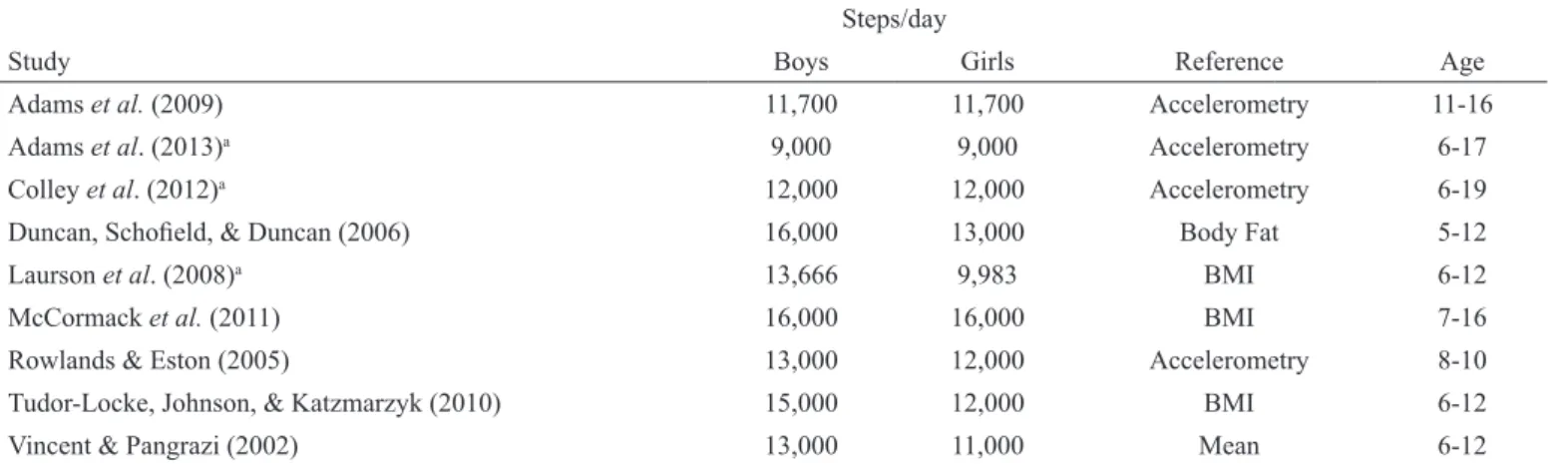
Previous studies have established step-count guidelines for children (Table 1). However, the guidelines vary
consi-derably (9,000-16,000 steps/day). The irst study to propose
step-count guidelines selected the cutoffs arbitrarily based on the mean steps achieved by the participants in the study (Vincent & Pangrazi, 2002). The mean step-count of the sample tested may not correspond to adequate physical ac-tivity levels. A series of studies was conducted using BMI as the reference variable to determine step-count cutoffs (Laurson et al., 2008; McCormack, Rutherford, Giles-Corti,
Tudor-Locke, & Bull, 2011; Tudor-Locke et al., 2004), but BMI often misrepresents the weight problem of children due to its inability to account for maturation status and muscle mass (Nihiser et al., 2007). Duncan, Schoield, and Duncan
(2007) improved upon the use of BMI by choosing body fat percentage as the criterion variable to select cutoffs, but neither BMI nor body fat are direct measures of physical acti-vity behavior, and the correlation between body composition measures and physical activity behavior has generally been
weak (Ribeiro et al., 2003; Wittmeier, Mollard, & Kriellaars, 2008). Several of these studies also determined step-count cutoffs by multiples of 1,000 steps (Duncan et al., 2007;
McCormack et al., 2011; Rowlands & Eston, 2005; Tudor
-Locke et al., 2004; Vincent & Pangrazi, 2002), which may
signiicantly misrepresent the assessment of physical activity habits (i.e. error = +/- 450 steps/day).
Steps/day
Study Boys Girls Reference Age
Adams et al. (2009) 11,700 11,700 Accelerometry 11-16
Adams et al. (2013)a 9,000 9,000 Accelerometry 6-17
Colley et al. (2012)a 12,000 12,000 Accelerometry 6-19
Duncan, Schoield, & Duncan (2006) 16,000 13,000 Body Fat 5-12
Laurson et al. (2008)a 13,666 9,983 BMI 6-12
McCormack et al. (2011) 16,000 16,000 BMI 7-16
Rowlands & Eston (2005) 13,000 12,000 Accelerometry 8-10
Tudor-Locke, Johnson, & Katzmarzyk (2010) 15,000 12,000 BMI 6-12
Vincent & Pangrazi (2002) 13,000 11,000 Mean 6-12
Table 1. Step-count guidelines suggested across research studies.
aThese studies suggested several different cutoff points. Adams et al. (2009) developed cutoffs for overweight adolescents only. The table indicates
the cutoff based on the Freedson 4 METS equation, but they also suggested 10,000 steps/day based on the Freedson 3 METS equation. Adams et al. (2013) suggested speciic cutoffs depending on the equation used to translate counts/min into moderate and vigorous physical activity (Freed -son 3 and 4 METS, and Even-son), whether the step-counts measured via accelerometers were adapted to a pedometer scale, and two age groups (children vs. adolescents). The table indicates the cutoff based on the adaptation of uncensored step-counts cutoffs to pedometer counts. Colley
et al. (2012) suggested 12,000 steps/day for simplicity of use, but their actual cutoffs ranged between 11,290 and 12,512 steps/day depending on
More recent studies referenced step-count cutoffs on 60-minutes of moderate to vigorous activity measured through accelerometry (Adams, Caparosa, Thompson, & Norman, 2009;
Adams, Johnson, & Tudor-Locke, 2013; Colley, Janssen, & Tremblay, 2012; Rowlands & Eston, 2005). Step-count cutoffs
proposed in two studies were based on small sample sizes (Adams et al., 2009; Rowlands & Eston, 2005). Sample sizes
in two other studies were large and representative (Adams et al., 2013; Colley et al., 2012). Colley et al. (2012) suggested 12,000 for Canadian boys and girls ages 6 to 19. However, similar to studies referencing step-count cutoffs on BMI (Dun-can et al., 2007; Laurson et al., 2008; McCormack et al., 2011;
Rowlands & Eston, 2005; Tudor-Locke et al., 2004; Vincent & Pangrazi, 2002), step-count guidelines were based on a sample with a broad developmental range, although children at diffe-rent chronological ages show diffediffe-rent physical activity habits (Troiano et al., 2008) and physical development levels (Malina, Bouchard, & Bar-Or, 2004).
Studies basing cutoff decisions on the achievement of 60-minutes of moderate to vigorous physical activity generally used accelerometers to determine step-counts (Adams et al., 2013; Colley et al., 2012). Colley et al. (2012) used Actical
accelerometers, but there is a lack of studies investigating how
step-counts measured by Actical accelerometers translate into steps measured by research-quality pedometers (Adams et al., 2013). Adams et al. (2013) used Actigraph accelerometers, but Actigraph accelerometers and research-quality pedometers may produce discrepant step-counts. Daily step-counts measured by accelerometers seem to result in higher scores due to higher sensibility to detect low frequency physical activity (Masurier
& Tudor-Locke, 2003; McClain, Sisson, Washington, Craig, & Tudor-Locke, 2007; Tudor-Locke, Ainsworth, Thompson, &
Matthews, 2002). Adams et al. (2013) proposed a step-count
cutoff range of 11,500-13,500 steps/day for U.S. children and 11,500-14,000 steps/day for U.S. adolescents. Multiple tech
-niques (i.e. Evenson and Age-speciic Freedson 4 METS) and
unadjusted accelerometer step-counts determined this range. To increase the applicability of guidelines, the authors offered a third cutoff of 9,000 steps/day for pedometer-determined
steps based on the reduction of 2,500 steps from the lower end
of the accelerometer unadjusted step-count guideline ranges
(11,500 steps/day). Two-thousand and ive-hundred steps were the estimated counts in low frequency physical activity (< 500
counts/minute) based on investigations conducted using adult
participants (Tudor-Locke, Johnson, & Katzmarzyk, 2009,
2011). Additionally, the selection of the lower end of the sug-gested step-count ranges was arbitrary.
The purpose of this study was to establish step-count guidelines for sixth-grade students and assess the ability of step-counts to discriminate between students reaching and not reaching 60-mi-nutes of moderate or higher physical activity daily. This project improved on the development of previous step-count guidelines by using pedometers to measure daily step-counts, recommending
grade speciic step-count cutoffs and proposing a single gender-combined step-count cutoff. Pedometers are more likely to be used
to measure daily step-counts during interventions than accelero-meters considering that acceleroaccelero-meters have the added advantage
of estimating intensity of physical activity. Restricting the age span of participants to 11 and 12 year-olds allows for a sample of participants developmentally more homogeneous than samples used in some previous studies (Colley et al., 2012; Duncan et al., 2007; Laurson et al., 2008; McCormack et al., 2011; Tudor-Locke et al., 2004; Vincent & Pangrazi, 2002). The use of accelerometry
as the reference measure justiies the proposal of a single step-count
cutoff for male and female students. It is common for accelerometry equations to be sex inclusive when determining physical activity
intensity. This includes the age-speciic Freedson 4 METS adopted
in this paper (Troiano et al., 2008).
Methods
Participants
Two hundred and twenty-six sixth-grade students from three US-Midwest towns were invited to participate in the study. Two cities comprised a midsize urban center, and the third was an average size rural community. Sixth graders comprised the sample population due to evidence that physical activity levels start to show a more pronounced decline during this age period (Nader, Bradley, Houts, McRitchie, & O’Brien, 2008; Troiano et al., 2008). We applied the following exclusion criteria during statis-tical analyzes to the data of participants who had: a. incomplete activity log; b. less than 10 hours of accelerometer wear (Troiano
et al., 2008); c. equipment malfunction; d. age outside the typical range for sixth graders of 11- to 12-years of age. We obtained institutional review board approval (University of Northern Iowa, Approval number 09-0213, 3/8/2012), student written assent and parental written informed consent prior to the start of the study.
Procedures
We used Actigraph GT3X accelerometers and YAMAX SW-200 pedometers for data collection. Validity evidence strongly supporting the use of Actigraph accelerometers to estimate youth physical activity habits (Trost, Mciver, & Pate,
2005), and YAMAX SW pedometers to count steps has been
previously provided (Bassett et al., 1996; Crouter, Schneider,
Karabulut, & Bassett, 2003; Schneider, Crouter, Lukajic, &
Bassett, 2003). To ensure pedometer accuracy, before and after each data collection any instrument that failed the 100-step test (+/- 2 100-steps) was eliminated. The ActiLife software (v4.4.1) computed the intensity level of accelerometer counts/
minute recorded for the vertical axis based on the age-speciic Freedson 4 METS cut points (Freedson, Pober, & Janz, 2005). Counts/minute cutoffs for 11-year olds were ≤100 counts/min for sedentary, >100 counts/min for light, ≥ 2059 for moderate, ≥ 4832 for heavy, and ≥7605 for very heavy physical activity. Counts/minute cutoffs for 12-year olds were ≤100 counts/min for sedentary, >100 counts/min for light, ≥ 2220 for moderate, ≥ 5094 for heavy, and ≥7956 for very heavy physical activity.
Height was measured to the nearest centimeter (cm) in stocking feet with the participant standing upright against a lexible, nonelastic
anthropometric tape placed on a wall one hundred centimeters from
the loor. A digital scale (Seca 770, Hamburg, Germany) measured weight to the nearest kilogram. BMI was calculated as weight (kg)/
height (m)2 and compared to CDC guidelines (Nihiser et al., 2007). During training, participants were familiarized with the pro-cedures of the study. Each participant received an activity log, a YAMAX SW-200 pedometer, and a GT3X Actigraph accelero-meter. The pedometer and accelerometer were attached side by side to an elastic belt and positioned on the belt relative to the participant’s dominant side of the body with the accelerometer closer to the center of the body. We taught participants how to put the belt on, so the devices were on the dominant side of the
body. Participants were asked to wear them for one day during all waking hours except during any aquatic activity such as swim
-ming or showering. More speciically, they were asked to, upon waking, put the belt on, reset the pedometer, and record the time on an activity log. At the end of the day, we asked participants to record on the activity log the number of steps taken during the
day, the time the pedometer was removed, and whether either mo-nitor was removed for more than 30 minutes throughout the day,
along with the time and reason for removing it. Lastly, we asked
students to return the pedometer, accelerometer, and activity log
to the physical education ofice the day following data collection.
Statistical analyses
The participants were classiied into adequate (minimum of 60
minutes of moderate/vigorous physical activity) and inadequate (less than 60 minutes of moderate/vigorous) levels of physical
activity based on recommendations by the U.S. Department of Health and Human Services (2008). Subsequently, the Receiver Operating Characteristic (ROC) curve evaluated the diagnostic ac-curacy of pedometer step-counts and determined optimal step-count cutoffs using the two groups constructed based on accelerometry. Diagnostic accuracy, ability of step-counts to discriminate between adequate and inadequate levels of physical activity, was based on the area under the curve (AUC). Optimal cutoff points were set
based on the Youden Index (⌡= sensitivity + speciicity – 1). The
Youden index represents the farthest point on the ROC curve from
chance (Akobeng, 2007). Sensitivity referred to the proportion of children with inadequate, and speciicity to the proportion of chil
-dren with adequate levels of physical activity, correctly classiied
by pedometer step-counts. We determined the optimal step-count cutoff for the overall sample of participants (boys and girls
combi-ned). For procedural check purposes, we also determined separate
optimal step-count cutoffs for males and females. We conducted the statistical analyses using Analyse-it for Windows (v. 2.22).
Results
Of the 226 students who started the study, data for
twenty-ive participants were excluded from analysis (Nfemales = 12; Nmales = 13). Twelve participants did not return the activity
log or returned incomplete logs, ive wore accelerometers that
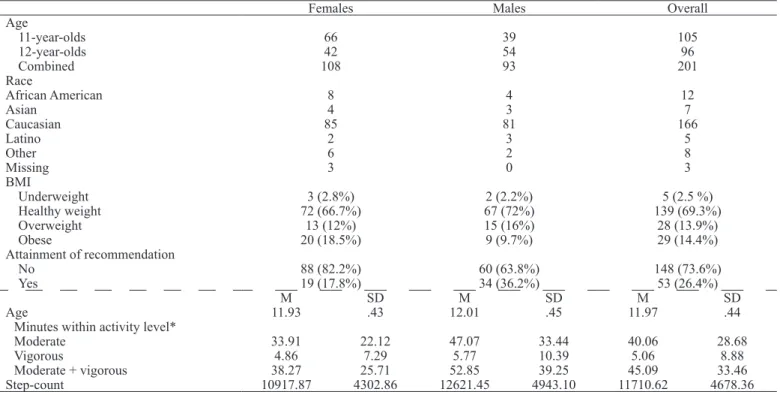
malfunctioned, three wore the accelerometer for less than 10 hours, four students were older than 12-years of age, and one student was younger than 11-years of age. The remaining 201 participants constituted the sample used for statistical analyses. Table 2 describes the characteristics of the participants included in the data analyses.
Females Males Overall
Age
11-year-olds 66 39 105
12-year-olds 42 54 96
Combined 108 93 201
Race
African American 8 4 12
Asian 4 3 7
Caucasian 85 81 166
Latino 2 3 5
Other 6 2 8
Missing 3 0 3
BMI
Underweight 3 (2.8%) 2 (2.2%) 5 (2.5 %)
Healthy weight 72 (66.7%) 67 (72%) 139 (69.3%)
Overweight 13 (12%) 15 (16%) 28 (13.9%)
Obese 20 (18.5%) 9 (9.7%) 29 (14.4%)
Attainment of recommendation
No 88 (82.2%) 60 (63.8%) 148 (73.6%)
Yes 19 (17.8%) 34 (36.2%) 53 (26.4%)
M SD M SD M SD
Age 11.93 .43 12.01 .45 11.97 .44
Minutes within activity level*
Moderate 33.91 22.12 47.07 33.44 40.06 28.68
Vigorous 4.86 7.29 5.77 10.39 5.06 8.88
Moderate + vigorous 38.27 25.71 52.85 39.25 45.09 33.46
Step-count 10917.87 4302.86 12621.45 4943.10 11710.62 4678.36
Table 2. Demographic characteristics of participants included in data analysis (n = 201).
Discussion
Identifying children not reaching adequate levels of physical activity may help parents, teachers, and health professionals be more proactive about physical activity. The U.S. Department of Health and Human Services (2008) recommends a minimum of 60-minutes of moderate to vigorous physical activity daily. However, intensity
is not easily understood and duration is dificult to recall by children
and adolescents (Goodman, Daniels, Meigs, & Dolan, 2007; Sallis, Buono, Roby, Micale, & Nelson, 1993). This paper restructured the guidelines based on duration and intensity of physical activity
to relect step-counts. The 12,118 steps/day guideline is a useful framework to determine whether 11 and 12 year-old children are
reaching adequate levels of physical activity, so changes to physical activity habits can be implemented when necessary.
We proposed a single step-count cutoff that was independent
of sex due to the use of the Age-speciic Freedson 4 METS pro -cedure to estimate physical activity intensity. The counts/minute cutoffs associated with different physical activity intensities under this equation are the same regardless of the sex of participants. The results of this study also provide support for the selection of a single step-count cutoff point. The overall step-count cutoff
(12,118 steps/day) was remarkably similar to the sex-speciic cutoffs for males (12,118 steps/day) and females (12,605 steps/
day). In the study, boys and girls participated in similar pro-portions of moderate and vigorous physical activity. Out of the overall participation in activity equal or above moderate levels, boys and girls spent 89.06% and 88.61% on moderate and 10.92% and 11.39% in vigorous physical activity respectively. Finally, other studies using accelerometry have also suggested a single step-count cutoff for males and females. Adams et al. (2009) de-veloped a single step-count cutoff for overweight boys and girls. Adams et al. (2013) and Colley et al. (2012) developed separate cut points for boys and girls, but suggested a single cutoff due to how similar the cutoffs were for both sexes.
Step-count cutoff Sensitivity Speciicity Youden index
1332 0.0 1.0 0.0
1833 .007 1.0 .007
3018 .014 1.0 .014
3635 .020 1.0 .020
4263 .027 1.0 .027
…
11186 .703 .868 .571
11219 .709 .868 .577
11222 .716 .868 .584
11304 .723 .868 .591
11425 .730 .868 .598
11436 .736 .868 .604
11563 .743 .868 .611
11580 .750 .868 .618
11613 .750 .849 .599
11987 .757 .849 .606
12070 .764 .849 .613
12088 .770 .849 .619
12118 .777 .849 .626
12130 .777 .830 .607
12201 .784 .830 .614
12504 .784 .811 .595
12536 .791 .811 .602
12605 .797 .811 .609
12633 .797 .792 .590
12642 .804 .792 .597
12825 .811 .792 .603
12890 .811 .774 .584
13067 .818 .774 .591
13074 .824 .774 .598
13094 .824 .755 .579
13096 .824 .736 .560
11186 .703 .868 .571
…
23020 .986 .057 .043
24026 .993 .057 .050
24677 .993 .038 .031
27562 .993 .019 .012
30000 1.0 .019 .019
Table 3. Sensitive and speciicity scores across sex-combined
step-count cutoff points.
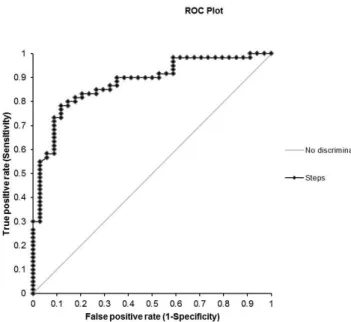
Figure 1. ROC curves for step-counts (AUC= .85).
The AUC was equal to .85 for the overall sample of sixth
grade students (p< .01, 95% CI= .79 - .9; Figure 1), .88 for
males (p< .01, 95% CI= .81 - .95), and .80 for females (p<
.01, 95% CI= .81 - .95). The optimal step-count cutoff point
for the overall sample of sixth grade students was equal to
12,118 steps/day (Table 3). Sex speciic cutoffs were respec
-tively 12,118 and 12,605 steps/day for males and female sixth
Comparison of step-count guidelines suggested by this study to guidelines proposed in past studies (Duncan et al., 2007; Laurson et al., 2008; McCormack et al., 2011; Rowlands &
Eston, 2005; Tudor-Locke et al., 2004; Vincent & Pangrazi, 2002) is compromised by the use of different methodologies. Compared to the studies using BMI as the reference criterion, the step-count cutoffs proposed here are lower than previously proposed guidelines for boys, and similar to guidelines propo-sed for girls (Table 1). Interestingly, cutoffs suggested in this
paper are remarkably similar to the cutoff suggested by other
studies using accelerometry as the reference criterion (Adams
et al., 2009; Colley et al., 2012; Rowlands & Eston, 2005). The
recommendation made by this paper was within the range of accelerometer measured steps/day recommended by Adams et al. (2013), but lower than the pedometer scaled steps/day made by the same authors. The pedometer scaling procedure used by Adams et al. (2013) was developed for adults (Tudor-Locke et al., 2009, 2011), and may need to be subjected to additional testing using an array of different brands of accelerometers and pedometers. Previous accelerometry-based studies reinforce the use of 12,118 steps/day to discriminate among sixth-grade students achieving and not achieving 60-minutes of moderate to vigorous physical activity daily.
The use of step-count guidelines to identify whether children are reaching physical activity recommendations will produce
misclassiications. Pedometer step-counts are indirect measures
of physical activity duration and intensity and do not measure non-locomotor forms of physical activity such as swimming
and biking. The fact that step-count guidelines in this study
showed good ability to discriminate among sixth-grade students reaching and not reaching 60-minutes of accelerometer deter-mined daily moderate to vigorous physical activity (AUCoverall
= .85) is worth noting. Not only did step-count guidelines
adequately differentiate between children with adequate and inadequate levels of physical activity, but they were also a convenient strategy in the assessment of physical activity habits in children. Pedometers are inexpensive, and their output is
simple to understand (Tudor-Locke, Williams, Reis, & Pluto,
2002). Thus, we recommend the use of 12,118 steps/day as an important initial epidemiological step to identify children with low levels of physical activity.
Future studies on this topic should focus on the development
of age-speciic guidelines for a broader developmental spectrum.
Due to differences in physical development (Malina et al., 2004) and physical activity habits (Nader et al., 2008; Troiano et al.,
2008), developing age-speciic guidelines may be necessary for
improving the accuracy of step-count cutoff points. A table of cutoff points by chronological age can simplify the use of step-count recommendations by parents, school, and professionals dealing with pediatric populations.
This study is not without limitations. The participants were selected exclusively from the Midwest, and the ethnic propor-tions in the US population were not adequately represented. In addition, accelerometry is not a gold standard to classify physical activity levels, and different equations can produce different cutoff points. However, a measure of physical activity levels that contains no error does not currently exist. In fact,
we believe a strength of the paper was the use of the Freedson
age-speciic 4 METS as a single procedure to determine phy -sical activity intensity. Adams et al. (2013) suggested separate step-count cutoff ranges for children and adolescents developed based on different procedures of assigning intensity to counts/
min (Evenson and Freedson age-speciic 3 and 4 METs). Wi -thout a consensus about the best equation to estimate physical activity intensity, there are advantages to suggesting a range of step-count cutoff points. However, the use of a range may under-mine the applicability of step-count cutoffs in physical activity interventions. Requiring parents, schools, and professionals dealing with pediatric populations to select the optimal point within a range of cutoff points may not be realistic. Hence, the researchers of this study opted to develop a single step-count cutoff point for sixth-grade students based on a well-accepted youth equation to determine moderate to vigorous physical activity. Several previous studies recommended the use of the
Freedson age-speciic 4 METs for the determination of youth
physical activity (Adams et al., 2013; Mattocks et al., 2007; Treuth et al., 2004; Troiano et al., 2008).
Using pedometers to measure steps directly in normative studies may be another advantage of this paper. Studies em-ploying similar methodological procedures decided for the use of accelerometers to measure daily steps (Adams et al., 2009, 2013; Colley et al., 2012). Accelerometer and pedometer step-counts may not be congruent. In fact, a well-designed study by Adams et al. (2013) suggested a pedometer friendly version of their accelerometer developed step-count cutoff to incre-ase the practically of their step-count recommendation. This
pedometer friendly version did not count steps taken below a threshold of 500 counts/min. Previous studies have suggested
that accelerometers are more sensitive to count steps in low frequency. However, the choice of frequency was determined
using adult participants (Tudor-Locke et al., 2009, 2011). In any case, using pedometers to measure daily steps in studies developing step-count guidelines seems more appropriate than basing step-counts on accelerometer readings. Interventionists
are less likely to use accelerometers, which measure frequency,
duration and intensity of physical activity, to estimate physical activity behavior. The use of the more practical and inexpensive pedometers to develop step-count cutoffs is expected to improve the generalizability of the proposed step-count guidelines to physical activity interventions.
It is common for studies measuring physical activity habits to recommend a minimum of four days of physical activity
monitoring (Tudor-Locke, Ainsworth, et al., 2002). However, it is important to emphasize that the concern of this project is not with the description of the physical habits of the partici-pants. Thus, frequency of physical activity is not an important variable for the study. This study focused exclusively on the duration and intensity of physical activity recommendations suggested by the U.S Department of Health and Human Services (2008). One day of measurement was appropriate
for the identiication of step-counts corresponding to the
accumulation of 60-minutes of moderate or higher physical activity, and it has been replicated previously (Adams et al.,
References
Adams, M. A., Caparosa, S., Thompson, S., & Norman, G. J. (2009). Translating physical activity recommendations for overweight adolescents to steps per day. Preventive Medicine, 37, 137–140.
doi:10.1016/j.amepre.2009.03.016
Adams, M. A., Johnson, W. D., & Tudor-Locke, C. (2013). Steps/
day translation of the moderate-to-vigorous physical activity
guideline for children and adolescents. International
Jour-nal of Behavioral Nutrition and Physical Activity., 10, 49.
doi:10.1186/1479-5868-10-49
Akobeng, A. K. (2007). Understanding diagnostic tests 3: Receiver
operating characteristic curves. Acta Paediatrica, 96, 644–647. doi:10.1111/j.1651-2227.2006.00178.x
Bassett, D. R., Ainsworth, B. E., Leggett, S. R., Mathien, C. A., Main,
J. A., Hunter, D. C., & Duncan, G. E. (1996). Accuracy of ive electronic pedometers for measuring distance walked. Medicine and Science in Sports and Exercise, 28, 1071–1077.
Byrd-Williams, C. E., Belcher, B. R., Spruijt-Metz, D., Davis, J. N., Ventura, E. E., Kelly, L., … Goran, M. I. (2010). Increased physical activity and reduced adiposity in overweight Hispanic adolescents. Medicine and Science in Sports and Exercise, 42,
478–484. doi:10.1249/MSS.0b013e3181b9c45b
Colley, R. C., Janssen, I., & Tremblay, M. S. (2012). Daily step target to measure adherence to physical activity guidelines in children.
Medicine and Science in Sports and Exercise, 44, 977–982.
doi:10.1249/MSS.0b013e31823f23b1
Crouter, S. E., Schneider, P. L., Karabulut, M., & Bassett, D. R. (2003). Validity of 10 electronic pedometers for measuring steps, distance, and energy cost. Medicine and Science in Sports and Exercise, 35,
1455–1460. doi:10.1249/01.MSS.0000078932.61440.A2 Duncan, J. S., Schoield, G., & Duncan, E. K. (2006).
Pedometer-determined physical activity and body composition in New Ze-aland children. Medicine and Science in Sports and Exercise, 38,
1402–1409. doi:10.1249/01.mss.0000227535.36046.97
Duncan, J. S., Schoield, G., & Duncan, E. K. (2007). Step count recom -mendations for children based on body fat. Preventve Medicine,
44, 42–44. doi:10.1016/j.ypmed.2006.08.009
Edmunds, S., Roche, D., & Stratton, G. (2010). Levels and patterns of physical activity in children and adolescents with type 1 diabetes and associated metabolic and physiologic health outcomes. Journal of Physical Activity and Health, 7, 68–77.
Freedson, P., Pober, D., & Janz, K. F. (2005). Calibration of Acce
-lerometer Output for Children. Medicine and Science in Sports
and Exercise, 37(Supplement), S523–S530. doi:10.1249/01. mss.0000185658.28284.ba
Goodman, E., Daniels, S.R., Meigs, J.B., & Dolan, L.M. (2007). Instability in the diagnosis of metabolic syndrome in
adoles-cents. Circulation, 115, 2316-2322. doi:10.1161/CIRCULATIO
-NAHA.106.669994.
Kang, M., Marshall, S. J., Barreira, T. V, & Lee, J.-O. (2009). Effect of pedometer-based physical activity interventions: a meta-analysis.
Research Quaterly for Exercise and Sport, 80, 648–655. Laurson, K. R., Eisenmann, J. C., Welk, G. J., Wickel, E. E., Gentile,
D. A., & Walsh, D. A. (2008). Evaluation of youth pedometer-de-termined physical activity guidelines using receiver operator cha-racteristic curves. Preventive Medicine, 46, 419–424. doi:10.1016/j.
ypmed.2007.12.017
Lubans, D. R., Morgan, P. J., & Tudor-Locke, C. (2009). A systematic
review of studies using pedometers to promote physical activity among youth. Preventive Medicine, 48, 307–315. doi:10.1016/j.
ypmed.2009.02.014
Malina, R. M., Bouchard, C., & Bar-Or, O. (2004). Growth,
matu-ration, and physical activity (2nd ed., p. 712). Champaign, IL: Human Kinetics.
Masurier, G. C. L., & Tudor-Locke, C. (2003). Comparison of pedo -meter and accelero-meter accuracy under controlled conditions.
Medicine and Science in Sports and Exercise, 35, 867–871.
doi:10.1249/01.MSS.0000064996.63632.10
Mattocks, C., Leary, S., Ness, A., Deere, K., Saunders, J., Tilling, K.,
… Riddoch, C. (2007). Calibration of an accelerometer during free-living activities in children. International Journal of Pediatric Obesity, 2, 218–226. doi:10.1080/17477160701408809
McClain, J. J., Sisson, S. B., Washington, T. L., Craig, C. L., &
Tudor-Locke, C. (2007). Comparison of Kenz Lifecorder EX
and ActiGraph accelerometers in 10-yr-old children. Medicine
and Science in Sports and Exercise, 39, 630–638. doi:10.1249/ mss.0b013e3180313056
McCormack, G. R., Rutherford, J., Giles-Corti, B., Tudor-Locke, C., &
Bull, F. (2011). BMI-referenced cut-points for recommended daily pedometer-determined steps in Australian children and adolescents.
Research Quaterly for Exercise and Sport, 82, 162–167.
Miller, J., Rosenbloom, A., & Silverstein, J. (2004). Childhood obesity. Journal of Clinical Endocrinology and Metabolism, 89,
4211–4218. doi:10.1210/jc.2004-0284
Moore, L. L., Gao, D., Bradlee, M. L., Cupples, L. A., Sundarajan-Ra-mamurti, A., Proctor, M. H., … Ellison, R. C. (2003). Does early physical activity predict body fat change throughout childhood?
Preventive Medicine, 37, 10–17.
Nader, P. R., Bradley, R. H., Houts, R. M., McRitchie, S. L., & O’Brien, M. (2008). Moderate-to-vigorous physical activity from ages 9
to 15 years. JAMA, 300, 295–305. doi:10.1001/jama.300.3.295
Nihiser, A. J., Lee, S. M., Wechsler, H., McKenna, M., Odom, E., Reinold, C., … Grummer-Strawn, L. (2007). Body mass index measurement in schools. Journal of School Health, 77, 651–671; quiz 722–4. doi:10.1111/j.1746-1561.2007.00249.x
Ribeiro, J., Guerra, S., Pinto, A., Oliveira, J., Duarte, J., & Mota, J. (2003). Overweight and obesity in children and adolescents: relationship with blood pressure, and physical activity. Annals of Human Biology, 30, 203–213.
Rowlands, A. V, & Eston, R. G. (2005). Comparison of accelerometer
and pedometer measures of physical activity in boys and girls, ages 8-10 years. Research Quaterly for Exercise and Sport, 76,
251–257.
Sallis JF, Buono MJ, Roby JJ, Micale FG, Nelson JA. (1993). Seven-day recall and other physical activity self-reports in children and ado-lescents. Medicine and Science in Sports and Exercise, 25, 99-108.
Schneider, P. L., Crouter, S. E., Lukajic, O., & Bassett, D. R. (2003).
Accuracy and reliability of 10 pedometers for measuring steps over
a 400-m walk. Medicine and Science in Sports and Exercise, 35,
1779–1784. doi:10.1249/01.MSS.0000089342.96098.C4 Schoield, L., Mummery, W. K., & Schoield, G. (2005). Effects of a
controlled pedometer-intervention trial for low-active adolescent girls. Medicine and Science in Sports and Exercise, 37, 1414–1420.
Treuth, M. S., Schmitz, K., Catellier, D. J., McMurray, R. G., Murray,
D. M., Almeida, M. J., … Pate, R. (2004). Deining accelerometer
thresholds for activity intensities in adolescent girls. Medicine and Science in Sports and Exercise, 36, 1259–1266.
Troiano, R. P., Berrigan, D., Dodd, K. W., Mâsse, L. C., Tilert, T., & McDowell, M. (2008). Physical activity in the United States
measured by accelerometer. Medicine and Science in Sports and
Exercise, 40, 181–188. doi:10.1249/mss.0b013e31815a51b3 Trost, S. G., Mciver, K. L., & Pate, R. R. (2005). Conducting Acce
-lerometer-Based Activity Assessments in Field-Based Research.
Medicine and Science in Sports and Exercise, 37(Supplement),
Tudor-Locke, C., Ainsworth, B. E., Thompson, R. W., & Matthews,
C. E. (2002). Comparison of pedometer and accelerometer measures of free-living physical activity. Medicine and Scien-ce in Sports and Exercise, 34, 2045–2051. doi:10.1249/01.
MSS.0000039300.76400.16
Tudor-Locke, C., Johnson, W. D., & Katzmarzyk, P. T. (2009). Acce
-lerometer-determined steps per day in US adults. Medicine and
Science in Sports and Exercise, 41, 1384–1391. doi:10.1249/ MSS.0b013e318199885c
Tudor-Locke, C., Johnson, W. D., & Katzmarzyk, P. T. (2010). Ac -celerometer-determined steps per day in US children and youth.
Medicine and Science in Sports and Exercise,42, 2244–2250.
doi:10.1249/MSS.0b013e3181e32d7f
Tudor-Locke, C., Johnson, W. D., & Katzmarzyk, P. T. (2011). Rela -tionship between accelerometer-determined steps/day and other accelerometer outputs in US adults. Jorunal of Physical Activity and Health., 8, 410–419.
Tudor-Locke, C., Pangrazi, R. P., Corbin, C. B., Rutherford, W. J.,
Vincent, S. D., Raustorp, A., … Cuddihy, T. F. (2004). BMI-refe-renced standards for recommended pedometer-determined steps/ day in children. Preventive Medicine, 38, 857–864. doi:10.1016/j.
ypmed.2003.12.018
Tudor-Locke, C., Williams, J. E., Reis, J. P., & Pluto, D. (2002). Utility
of pedometers for assessing physical activity: convergent validity.
Sports Medicine, 32, 795–808.
U.S. Department of Health and Human Services. (2008). 2008 Physical Activity Guidelines for Americans. Washington, DC. Retrieved from http://www.health.gov/paguidelines/guidelines/chapter3.aspx Vincent, S. D., & Pangrazi, R. P. (2002). An examination of the ac-tivity patterns of elementary school children. Pediatric Exercise
Science, 14, 4320441.
Wittmeier, K. D. M., Mollard, R. C., & Kriellaars, D. J. (2008). Physical
activity intensity and risk of overweight and adiposity in children. Obesity (Silver Spring), 16, 415–420. doi:10.1038/oby.2007.73
Authors’ note
Fabio Eduardo Fontana, Ripley Marston, and Kevin Finnare afiliated with the School of Health, Physical Education, and Leisure Services, University of Northern Iowa, Cedar Falls, IA, USA.
Michael Pereira da Silva is afiliated with theCenter for Exercise and Sports, Federal University of Parana, Curitiba, Brazil.
Jere Gallagher is afiliated with the Health and Physical Activity De -partment, University of Pittsburgh, Pittsburgh, PA, USA.
Corresponding author
Fabio Fontana
School of Health, Physical Education, and Leisure Services, Univer-sity of Northern Iowa, 203 Wellness/Recreation Center, Cedar Falls,
IA 50614, USA, phone (319) 273-6854, fax (319) 273-5958, e-mail
Acknowledgments
This study was supported by a faculty fellowship award from the University of Northern Iowa.
The authors have no conlict of interest to declare.
Conlict of interest
The authors declare that they have no conlict of interest.
Manuscript received on October 18, 2013 Manuscript accepted on December 16, 2014
Motriz. The Journal of Physical Education. UNESP. Rio Claro, SP, Brazil