Analysis of incidents notifi ed in a general hospital
Análise da ocorrência de incidentes notifi cados em hospital-geral
Análisis de la ocurrencia de incidentes notifi cados en hospital-general
Mirela Lopes de Figueiredo
I,II, Carla Silvana de Oliveira e Silva
I,II,
Maria Fernanda Santos Figueiredo Brito
II, Maria D’Innocenzo
II Universidade Federal de São Paulo, Paulista Nursing School,
Postgraduate Program in Health Sciences. São Paulo, Brazil.
II Universidade Estadual de Montes Claros, Center for Biological and Health Sciences, Department of Nursing.
Montes Claros, Minas Gerais, Brazil.
How to cite this article:
Figueiredo ML, Oliveira e Silva CS, Brito MFSF, D’Innocenzo M. Analysis of incidents notified in a general hospital. Rev Bras Enferm [Internet]. 2018;71(1):111-9. DOI: http://dx.doi.org/10.1590/0034-7167-2016-0574
Submission: 11-23-2016 Approval: 04-05-2017
ABSTRACT
Objective: To evaluate the incidents spontaneously notii ed in a general hospital in Minas Gerais. Method: Retrospective, descriptive, quantitative study performed at a general hospital in Montes Claros – Minas Gerais State. The sample comprised 1,316 incidents reported from 2011 to 2014. The data were submitted to descriptive statistical analysis using Statistical Package for the Social Sciences version 18.0. Results: The prevalence of incidents was 33.8 per 1,000 hospitalizations, with an increase during the investigation period and higher frequency in hospitalization units, emergency room and surgical center. These occurred mostly with adult clients and relative to the medication supply chain. The main causes were noncompliance with routines/protocols, necessitating changes in routines and training. Conclusion: There was a considerable prevalence of incidents and increase in notii cations during the period investigated, which requires the attention of managers and hospital staff. Nevertheless, we observed development of the patient safety culture.
Descriptors: Patient Safety; Safety Management; Quality of Health Care; Quality Assurance in Health Care; Nursing.
RESUMO
Objetivo: avaliar os incidentes notii cados espontaneamente em um hospital-geral de Minas Gerais. Método: estudo retrospectivo, descritivo, quantitativo, realizado em hospital-geral de Montes Claros - MG. A amostra foi composta de 1316 incidentes notii cados entre 2011 a 2014. Os dados foram submetidos à estatística descritiva no softwareStatistical Package for the Social Sciences versão 18.0. Resultados: A prevalência de incidentes foi de 33,8 por 1.000 internações, tendo sido evidenciados aumento ao longo do período investigado e maior frequência nas unidades de internação, no setor de emergência e centro cirúrgico. Houve maior ocorrência em clientes adultos e relativos à cadeia medicamentosa. As principais causas foram o descumprimento da rotina/protocolo, sendo necessárias mudanças na rotina e no treinamento. Conclusão: Houve
considerável prevalência de incidentes e aumento de notii cações no período investigado, o que requer atenção dos gestores e colaboradores, apesar de observado o desenvolvimento da cultura de segurança do paciente.
Descritores: Segurança do Paciente; Gestão da Segurança; Qualidade da Assistência à Saúde; Garantia da Qualidade dos Cuidados de Saúde; Enfermagem.
RESUMEN
INTRODUCTION
Safety has a particular relevance in health care and, in this sense, the patient safety culture in an institution has a great im-pact on the quality of care(1). Hospital institutions are
increas-ingly concerned about ensuring quality care for their clients. In this context, patient safety has been highlighted with the implementation of measures to prevent exposure to risks, as well as harm resulting from health care. The hospital space presents numerous health risks to patients, which can aggra-vate their health status. It is the responsibility of professionals to identify risks in each unit, to guarantee the clients’ safety and restoration of their health, besides avoiding or minimizing possible intercurrences during their stay in the institution(2-3).
In October 2004, the World Health Organization (WHO) established the “Global Patient Safety Alliance”, which aims to raise awareness for improved safety in care, as well as the development of health care policies and strategies(4). The
de-velopment of a safety culture, the practice of record taking, discussion of the circumstances in which incidents occur, as well as the professional and organizational conduct in these cases, are a path to be followed for the transformation of real-ity in health institutions. The occurrence of incidents can be
minimized through changes in managerial and professional at-titudes, strengthening of leadership and knowledge, improved accessibility, quality and use of medical and hospital material, and competent and productive maintenance of professionals(5).
The WHO emphasizes that adverse events should be wide-ly researched, encompassing: from the factors that contribute to their occurrence, characteristics of the patients, type of in-cident observed, detection mechanisms, factors that can miti-gate events, evolution of the patients, organizational follow-up; to improvement actions, their implementation and results from these actions(6). In addition, there is a greater awareness
at the national level that professionals need to be trained re-garding the measures to be taken in the face of failures, as well as being encouraged to take an honest attitude towards error, without fear of punishment and to be effectively involved in patient care(7).
Another important factor is the need to implement a notifi-cation culture in the institutions so that information on failures or incidents and adverse events are clear and complete, al-lowing a better analysis of their causes(8). However, a punitive
culture still prevails in situations that culminate in errors or adverse events. In this context, communication barriers imply greater adverse occurrences, since feedback of information on the consequences of adverse events and the proposal of more effective alternatives for their management does not occur, which in turn prevents a satisfactory resolution(3,7).
Thus, it is fundamental to incorporate the issue of patient quality care and safety into the governmental and academic agenda, as well as the training and updating of professionals regarding the importance of reliable and complete registra-tion in health informaregistra-tion systems. Periodic re-evaluaregistra-tions of information systems are also necessary in order to be effective mechanisms for measuring the performance and quality of the services offered. Such measures impact the restructuring of health services, with a particular focus on the quality of care, and not only on reimbursement for services rendered(9).
Track-ing incident-related factors is difficult, as recent studies point to flaws in record keeping, making it impossible to investigate further into causes and consequences. However, the simple act of recording shows that health professionals recognize and identify the incident, in order to adopt preventive measures for possible corrections, reduction and/or elimination, and also to follow the development of actions to improve health practice(10).
The present study aimed to evaluate the spontaneously re-ported incidents in a general hospital in Minas Gerais.
METHOD
Ethical aspects
The ethical procedures were followed, according to Resolu-tion nº 466, of December 12, 2012. The research project was approved by the Research Ethics Committee of the Federal Uni-versity of São Paulo (UNIFESP), on October 10, 2013. Formal au-thorization to carry out the study was obtained from the hospital.
Design, place of study and period
This is a retrospective and descriptive study, with a quantita-tive approach, performed in a philanthropic, tertiary level, gen-eral-hospital, located in the city of Montes Claros, Minas Gerais State, with a capacity of 360 beds and an average of 10,245 pa-tient days per month. It has certifications as a teaching hospital and is Accredited with Excellence by the Organização Nacional de Acreditação (ONA) [National Accreditation Organization], besides being part of the Rede Sentinela [Sentinel Network]. The institution is a reference throughout the region of Northern Minas Gerais and South of Bahia State. It attends a population that sur-passes 1.5 million inhabitants for medium and high complexity attendance in various specialisms, namely: neurology, cardiol-ogy, gynecolcardiol-ogy, obstetrics, oncolcardiol-ogy, orthopedics, general prac-tice, pediatrics, burn treatment, hemodynamics, chemotherapy, radiotherapy, renal replacement therapy/hemodialysis.
In 2005, the hospital senior management, decided to seek ONA certifications, with a focus on improving the quality of care provided to patients. From then on, the Quality Office (QO) was created, with responsibility for the hospital’s quality
Mirela Lopes de Figueiredo E-mail: [email protected]
CORRESPONDING AUTHOR
Hubo considerable prevalencia de incidentes y aumento de notiicaciones en el período investigado, lo que requiere atención de los gestores y colaboradores, a pesar de observado el desarrollo de la cultura de seguridad del paciente.
and risk management guidelines. The QO consists of a quality manager, a nurse, three administrative staff and two nursing students. It is subordinated, hierarchically to a Quality Board.
Notification of incidents is carried out spontaneously and anonymously by completing a computerized file, denominated the Notification Form, available on the SAS Interact system. This software is used for strategy management, operational perfor-mance management, quality management, skills and risks. They can be performed on any computer of the institution. After re-ceiving the Notification Cards online, the QO classifies the type of incident, once the register is accepted by the system it assigns a person responsible for follow-up, sets the date for analysis and manages the deadlines. Usually, the person in charge is the su-pervisor or manager of the sector where the incident occurred. After analysis, the incidents are presented to the Risk Committee, composed of the manager and nurse of the QO, by profession-als representing various areas, such as the ombudsman, nursing coordination, clinical and care director, and representatives of the sector in which the incident occurred. This commission then validates or not the analysis performed.
The data were collected by the researcher and a properly trained auxiliary, from March to December 2015.
Sample, inclusion and exclusion criteria
This study analyzeda total of1,340 spontaneous reports of incidents recorded from 2011 to 2014. Probabilistic type sam-pling was used with the stratified random samsam-pling method and proportional sharing. In this sense, each year constituted a popu-lation stratum and their respective numbers of incidents corre-sponded to the sample units, which were drawn according to the listing in the hospital database. The confidence level was set at 95% with margin of error of plus or minus 2 percentage points. It was necessary to exclude 24 notifications due to insufficient details, incomplete entries or because they were discarded by the QO as “rants” (according to the description in the notification). Thus, the final sample amounted to 1,316 spontaneous reports.
Study protocol
For a better understanding of the study, some information to define the variables is needed:
• Age group: Newborns (NB) - 0 to 28 days; Child - 29 days to 12 years, 11 months and 29 days; Adolescent - 13 to 18 years, 11 months and 29 days; Adult - from 19 to 64 years, 11 months and 29 days; Elderly - over 65 years old. • Notified Sector: Emergency, Neonatal and Pediatric
In-tensive Care Center (ICU), Coronary ICU, General ICU, Semi-Intensive Care Unit, Hospitalization Units, Pediat-rics, Nursery, Maternity, Obstetric Center (OC), Surgical Center (CC), Transfusion Agency, Nephrology, Oncol-ogy, Clinical Directorate, Nutritional Therapy, Clinical Engineering, Hospitality, Ambulatory and other Diag-nostic Services (endoscopy, graphic methods).
• Shift: Morning - from 07:00 to 12:59; Afternoon - from 13:00 to 18:59 minutes; Night - from 19:00 to 06:59. • Days of the week: Sunday, Monday, Tuesday,
Wednes-day, ThursWednes-day, Friday and Saturday.
• Type of harm: Degree I: catastrophic, involves the occur-rence of death associated with the event; Degree II: per-manent harm; Degree III: temporary harm. It is necessary to be clear, to generate new care behavior, to cause injury, to increase the days of hospital stay, to cause serious psy-chological harm; and Grade IV: does not affect the client (near miss).
• Types of incidents: Drug supply chain (steps - prescription, dispensing, preparation, administration, checking and dispensing); Fall (bed, chair, own height, bathroom); Pres-sure ulcer (PU) (PU, Braden - low risk, moderate risk, high risk); Other skin lesions; Surgical procedure (relation with laterality); Transfusion process; Unplanned withdrawal of catheter, drain, tube or catheter; Identification of patient; Loss of sample; Bruise; Extravasation; Delay in exam/pro-cedure completion; Prolonged fasting; Failure to release the technical report; Evasion; Technical or equipment/ma-terial handling failure; Failure to identify maequipment/ma-terial/instru- material/instru-ments; Related to childbirth; Nutritional therapy; Health-care related infection; Failure during technique, procedure or transportation; Death and Others.
• Causes: Six types of causal factors - Task or Technology Factors (absence of routine/protocol, inadequate func-tioning of materials/equipment) - were considered based on QO guidelines; Workplace factors (overloading, in-adequate staffing, inin-adequate physical environment); Individual Factors (employee/team insufficient training, omission, noncompliance with routine/ protocol); Time Factors (communication failure); Organizational and Management Factors (absence of equipment/materials); Patient Factors (inherent patient risk).
• Actions: Perform training or guidance, follow the exist-ing routine/protocol, modify routine/protocol, create and deploy form/check list, perform process interaction, acquire/requisition material/equipment and/or staff, clinical director intervention, perform preventive/cor-rective maintenance of equipment/materials.
Since it was a free text for the presentation of the event, writ-ten by the notifying professionals, the classification of types and causes was carried out by the first researcher, using the definitions in Resolution RDC No. 36, dated July 25, 2013(11), in addition
to those defined in the literature, in addition to the researcher’s personal experience for comprehending the reported situations.
In this research, concepts were adopted according to the in-ternational taxonomy of patient safety, published by the World Health Organization (WHO)(11): Patient safety - minimizing the
incident): circumstance in which there was significant potential for harm, but the incident did not occur; Adverse reaction: unex-pected harm resulting from a justified action, in which the correct process was followed for the context in which the event occurred; Error: defined as a failure to execute a plan of action as intended or an incorrect plan; Harm - impairment of the structure or func-tion of the body and/or any effect thereof, including illness, injury, suffering, death, disability or dysfunction, and may be physical, social or psychological.
The data collection was done by reading the information sheets and recording the information in an Excell® spread-sheet prepared for the study.
Analysis of results and statistics
After data collection, the data were organized into a data-base in the Excell® program and later exported to the Statistical Package for the Social Sciences (SPSS) software version 18.0, in which the analyzes were performed using descriptive statistics.
RESULTS
The sample analyzed in this study was composed of 1316 incidents reported spontaneously in the period from 2011 to 2014 in the general hospital. The prevalence reached 33.8 occurrences per 1,000 admissions. It was observed that the
number of notifications increased over the years: 20.4%; 18.5%; 44.8%; and 48.2% in 2011, 2012, 2013 and 2014, re-spectively. The most frequently reported types of incidents were those related to the medication supply chain (18.9%), followed by pressure ulcers (13.4%) and failures during technique/proce-dure/transportation (11.7%), as presented in Table 1.
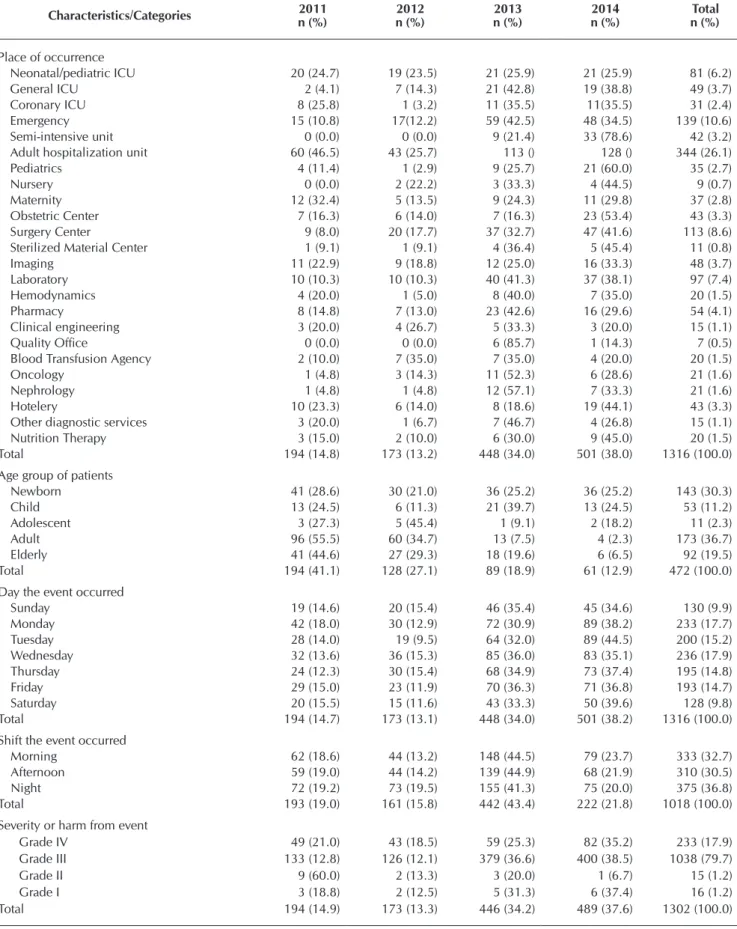
In relation to the sectors involved for the analysis of occur-rences, the highest number of reports were presented by the hospitalization units (21.1%), followed by emergency (10.6%) and surgical centers (8.6%). Regarding the shift, 36.8% of the incidents occurred at night, 32.7% in the morning shift and 30.5% in the afternoon, but only 77.4% of the reports analyzed contained this information. Regarding incidents ac-cording to age group, the most affected were adults (36.7%), followed by newborns (30.3%) and elderly (19.5%); however, only 35.9% of the notifications contained such information. There was a significant reduction in the recording of this data over the years, due to a change in the electronic form in 2012, when the specific field ceased to exist. When analyzed the type of harm caused, the incidents generated mainly tempo-rary harm (79.6%), followed by Near misses or no harm inci-dents (17.9%). These results are presented in Table 2.
Incidents involving the medication supply chain were the most frequent and these were classified mainly as Grade III, 82.2% (Table 3).
Table 1 – Types of incident according to year of occurrence, Montes Claros, Minas Gerais, Brazil, 2015
Type of event
Year of occurrence
Total n (%) 2011
n (%)
2012 n (%)
2013 n (%)
2014 n (%)
Medication supply chain 46 (18.5) 27 (10.8) 70 (28.1) 106 (42.6) 249 (100.0)
Falls 22 (28.9) 9 (11.8) 27 (35.5) 18 (23.7) 76 (100.0)
Pressure ulcer 0 (0.0) 25 (14.2) 85 (48.3) 66 (37.5) 176 (100.0)
Other skin lesions 7 (20.0) 7 (20.0) 9 (25.7) 12 (34.3) 35 (100.0)
Surgical procedure 9 (12.2) 10 (13.5) 23 (31.1) 32 (43.2) 74 (100.0)
Transfusion process 3 (8.8) 9 (26.5) 6 (17.6) 16 (47.1) 34 (100.0)
Patient identiication 3 (12.5) 4 (16.7) 7 (29.2) 10 (41.7) 24 (100.0)
Sample loss 4 (23.5) 4 (23.5) 4 (23.5) 5 (29.4) 17 (100.0)
Hematoma 0 (0.0) 1 (5.3) 12 (63.2) 6 (31.6) 19 (100.0)
Extravasation 0 (0.0) 3 (21.4) 6 (42.9) 5 (35.7) 14 (100.0)
Delay in performing exam/procedure 15 (12.4) 12 (9.9) 46 (38.0) 48 (39.7) 121 (100.0)
Prolonged fasting 3 (13.6) 2 (9.1) 12 (54.5) 5 (22.7) 22 (100.0)
Evasion 8 (42.1) 4 (21.1) 4 (21.1) 3 (15.8) 19 (100.0)
Technical, equipment or material handling failure 4 (22.2) 5 (27.8) 4 (22.2) 5 (27.8) 18 (100.0)
Failure to identify material or instrument 2 (6.5) 0 (0.0) 10 (32.3) 19 (61.3) 31 (100.0)
Related to childbirth 5 (25.0) 6 (30.0) 8 (40.0) 1 (5.0) 20 (100.0)
Nutrition therapy 6 (15.8) 7 (18.4) 11 (28.9) 14 (36.8) 38 (100.0)
Health Care Related Infection 0 (0.0) 0 (0.0) 4 (28.6) 10 (71.4) 14 (100.0)
Failure during technique, procedure, or transport 25 (16.2) 14 (9.1) 49 (31.8) 66 (42.9) 154 (100.0)
Failure to release technical report 3 (12.0) 2 (8.0) 6 (24.0) 14 (56.0) 25 (100.0)
Unplanned removal of probe, drain, tube, or catheter 22 (28.6) 15 (19.5) 25 (32.5) 15 (19.5) 77 (100.0)
Death 0 (0.0) 2 (20.0) 6 (60.0) 2 (20.0) 10 (100.0)
Others 7 (14.3) 5 (10.2) 14 (28.6) 22 (46.9) 49 (100.0)
Table 2 – Annual characteristics of incidents according to place of occurrence, age group affected, day, shift and severity or harm, Montes Claros, Minas Gerais, Brazil, 2015
Characteristics/Categories 2011 n (%)
2012 n (%)
2013 n (%)
2014 n (%)
Total n (%)
Place of occurrence
Neonatal/pediatric ICU 20 (24.7) 19 (23.5) 21 (25.9) 21 (25.9) 81 (6.2)
General ICU 2 (4.1) 7 (14.3) 21 (42.8) 19 (38.8) 49 (3.7)
Coronary ICU 8 (25.8) 1 (3.2) 11 (35.5) 11(35.5) 31 (2.4)
Emergency 15 (10.8) 17(12.2) 59 (42.5) 48 (34.5) 139 (10.6)
Semi-intensive unit 0 (0.0) 0 (0.0) 9 (21.4) 33 (78.6) 42 (3.2)
Adult hospitalization unit 60 (46.5) 43 (25.7) 113 () 128 () 344 (26.1)
Pediatrics 4 (11.4) 1 (2.9) 9 (25.7) 21 (60.0) 35 (2.7)
Nursery 0 (0.0) 2 (22.2) 3 (33.3) 4 (44.5) 9 (0.7)
Maternity 12 (32.4) 5 (13.5) 9 (24.3) 11 (29.8) 37 (2.8)
Obstetric Center 7 (16.3) 6 (14.0) 7 (16.3) 23 (53.4) 43 (3.3)
Surgery Center 9 (8.0) 20 (17.7) 37 (32.7) 47 (41.6) 113 (8.6)
Sterilized Material Center 1 (9.1) 1 (9.1) 4 (36.4) 5 (45.4) 11 (0.8)
Imaging 11 (22.9) 9 (18.8) 12 (25.0) 16 (33.3) 48 (3.7)
Laboratory 10 (10.3) 10 (10.3) 40 (41.3) 37 (38.1) 97 (7.4)
Hemodynamics 4 (20.0) 1 (5.0) 8 (40.0) 7 (35.0) 20 (1.5)
Pharmacy 8 (14.8) 7 (13.0) 23 (42.6) 16 (29.6) 54 (4.1)
Clinical engineering 3 (20.0) 4 (26.7) 5 (33.3) 3 (20.0) 15 (1.1)
Quality Ofice 0 (0.0) 0 (0.0) 6 (85.7) 1 (14.3) 7 (0.5)
Blood Transfusion Agency 2 (10.0) 7 (35.0) 7 (35.0) 4 (20.0) 20 (1.5)
Oncology 1 (4.8) 3 (14.3) 11 (52.3) 6 (28.6) 21 (1.6)
Nephrology 1 (4.8) 1 (4.8) 12 (57.1) 7 (33.3) 21 (1.6)
Hotelery 10 (23.3) 6 (14.0) 8 (18.6) 19 (44.1) 43 (3.3)
Other diagnostic services 3 (20.0) 1 (6.7) 7 (46.7) 4 (26.8) 15 (1.1)
Nutrition Therapy 3 (15.0) 2 (10.0) 6 (30.0) 9 (45.0) 20 (1.5)
Total 194 (14.8) 173 (13.2) 448 (34.0) 501 (38.0) 1316 (100.0)
Age group of patients
Newborn 41 (28.6) 30 (21.0) 36 (25.2) 36 (25.2) 143 (30.3)
Child 13 (24.5) 6 (11.3) 21 (39.7) 13 (24.5) 53 (11.2)
Adolescent 3 (27.3) 5 (45.4) 1 (9.1) 2 (18.2) 11 (2.3)
Adult 96 (55.5) 60 (34.7) 13 (7.5) 4 (2.3) 173 (36.7)
Elderly 41 (44.6) 27 (29.3) 18 (19.6) 6 (6.5) 92 (19.5)
Total 194 (41.1) 128 (27.1) 89 (18.9) 61 (12.9) 472 (100.0)
Day the event occurred
Sunday 19 (14.6) 20 (15.4) 46 (35.4) 45 (34.6) 130 (9.9)
Monday 42 (18.0) 30 (12.9) 72 (30.9) 89 (38.2) 233 (17.7)
Tuesday 28 (14.0) 19 (9.5) 64 (32.0) 89 (44.5) 200 (15.2)
Wednesday 32 (13.6) 36 (15.3) 85 (36.0) 83 (35.1) 236 (17.9)
Thursday 24 (12.3) 30 (15.4) 68 (34.9) 73 (37.4) 195 (14.8)
Friday 29 (15.0) 23 (11.9) 70 (36.3) 71 (36.8) 193 (14.7)
Saturday 20 (15.5) 15 (11.6) 43 (33.3) 50 (39.6) 128 (9.8)
Total 194 (14.7) 173 (13.1) 448 (34.0) 501 (38.2) 1316 (100.0)
Shift the event occurred
Morning 62 (18.6) 44 (13.2) 148 (44.5) 79 (23.7) 333 (32.7)
Afternoon 59 (19.0) 44 (14.2) 139 (44.9) 68 (21.9) 310 (30.5)
Night 72 (19.2) 73 (19.5) 155 (41.3) 75 (20.0) 375 (36.8)
Total 193 (19.0) 161 (15.8) 442 (43.4) 222 (21.8) 1018 (100.0)
Severity or harm from event
Grade IV 49 (21.0) 43 (18.5) 59 (25.3) 82 (35.2) 233 (17.9)
Grade III 133 (12.8) 126 (12.1) 379 (36.6) 400 (38.5) 1038 (79.7)
Grade II 9 (60.0) 2 (13.3) 3 (20.0) 1 (6.7) 15 (1.2)
Grade I 3 (18.8) 2 (12.5) 5 (31.3) 6 (37.4) 16 (1.2)
Total 194 (14.9) 173 (13.3) 446 (34.2) 489 (37.6) 1302 (100.0)
Table 4 presents the causes and actions for incidents cited in the spontaneous reports studied. The main events were related to noncompliance with the routine/protocol (368, 29.7%). It is pertinent to clarify that 18.5% of the notifications did not contain a description of the cause of the incident and consequently this data could not be analyzed.
The actions proposed to prevent recurrence of incidents were described in 80.9% of the notifications analyzed, according to Table 5. The most frequently cited were: modify the routine/pro-tocol 399 (30.1%), provide guidance 280 (21.1%), and training 224 (17%).
Table 3 – Types of event according to severity or harm, Montes Claros, Minas Gerais, Brazil, 2015
Type of event
Severity or harm
Total n (%) Grade IV
n (%)*
Grade III n (%)
Grade II n (%)
Grade I n (%)
Medication supply chain 40 (16.2) 203 (82.2) 3 (1.2) 1 (0.4) 247 (100.0)
Falls 19 (25.0) 57 (75.0) 0 (0.0) 0 (0.0) 76 (100.0)
Pressure ulcer 0 (0.0) 174 (100.0) 0 (0.0) 0 (0.0) 174 (100.0)
Other skin lesions 1 (3.3) 29 (96.7) 0 (0.0) 0 (0.0) 30 (100.0)
Surgical procedure 12 (16.2) 58 (78.4) 2 (2.7) 2 (2.7) 74 (100.0)
Transfusion process 10 (29.4) 24 (70.6) 0 (0.0) 0 (0.0) 34 (100.0)
Patient identiication 13 (54.2) 11 (45.8) 0 (0.0) 0 (0.0) 24 (100.0)
Sample loss 3 (18.8) 13 (81.2) 0 (100.0) 0 (0.0) 16 (100.0)
Hematoma 0 (0.0) 18 (94.7) 1 (5.3) 0 (0.0) 19 (100.0)
Extravasation 0 (0.0) 13 (100.0) 0 (0.0) 0 (0.0) 13 (100.0)
Delay in performing exam/procedure 18 (14.9) 101 (83.5) 1 (0.8) 1 (0.8) 121 (100.0)
Prolonged fasting 0 (0.0) 19 (95.0) 0 (0.0) 1 (5.0) 20 (100.0)
Evasion 7 (36.8) 11 (57.9) 1 (5.3) 0 (0.0) 19 (100.0)
Technical, equipment or material handling failure 5 (27.8) 12 (66.7) 1 (5.5) 0 (0.0) 18 (100.0)
Failure to identify material or instrument 21 (67.7) 10 (32.3) 0 (0.0) 0 (0.0) 31 (100.0)
Related to childbirth 7 (35.0) 12 (60.0) 1 (5.0) 0 (0.0) 20 (100.0)
Nutrition therapy 8 (21.1) 29 (76.3) 1 (2.6) 0 (0.0) 38 (100.0)
Health Care Related Infection 3 (21.4) 11 (78.6) 0 (0.0) 0 (0.0) 14 (100.0)
Failure during technique, procedure, or transport 30 (19.6) 116 (75.8) 3 (2.0) 4 (2.6) 153 (100.0)
Failure to release technical report 5 (20.0) 20 (80.0) 0 (0.0) 0 (0.0) 25 (100.0)
Unplanned removal of probe, drain, tube, or catheter 4 (5.2) 72 (93.5) 1 (1.3) 0 (0.0) 77 (100.0)
Death 0 (0.0) 3 (30.0) 0 (0.0) 7 (70.0) 10 (100.0)
Others 27 (55.1) 22 (44.9) 0 (0.0) 0 (0.0) 49 (100.0)
Total 233 (17.9) 1038 (79.6) 15 (1.2) 16 (1.3) 1302 (100.0)
Table 4 – Cause of the events, Montes Claros, Minas Gerais, Brazil, 2015
Causes n %
Lack of routine 32 2.6
Noncompliance with routine 368 29.7
Ineficient Routine 251 20.3
Overload 38 3.1
Inadequate scaling 45 3.6
Untrained employee/team 80 6.5
Lack of attention/omission 43 3.5
Communication failure 170 13.7
Inappropriate physical environment 8 0.6
Inherent patient risk 109 8.8
Absence of equipment/material/medication 84 6.8
Inadequate operation of materials/equipment 10 0.8
Total 1238 100.0
Tabela 5 – Proposed action to prevent recurrence of incidents, Montes Claros, Minas Gerais, Brazil, 2015
Action n %
Carry out training 224 17.0
Provide counseling 280 21.1
Follow routine 192 14.5
Modify routine 399 30.1
Create/implement form/check list 43 3.2
Perform process interaction 35 2.6
Acquiring/ordering material/staff/personnel 127 9.5
Intervention by clinical director 22 1.7
Perform preventive/corrective maintenance 4 0.3
No action 314 19.1
Total 1416 100.0
DISCUSSION
The findings of this study on the prevalence of incidents and their evolution in the period evaluated can be considered high and show a worrying reality, which should be analyzed carefully. Similar results were also found in the literature. In Brazil, in par-ticular, research carried out in three teaching hospitals in Rio de Janeiro identified an incidence of 7.6% of patients who suffered adverse events, 66.7% of which were considered preventable(12).
South of the country showed that the prevalence of reported inci-dents reached 1.1% of all admissions(13). Research that measured
the prevalence of adverse events in five Latin American countries showed that of a total of 11,379 inpatients, 1191 had at least one adverse event. The estimated point prevalence reached 10.5%, more than 28% of these caused disability and 6% were associated with patient death(14). Internationally, between 2.9% and 16.6% of
hospitalized patients are affected by adverse events such as peri- and postoperative complications, medication errors, health care-related infections or bed falls(15).
In terms of the temporal evolution of spontaneous notifica-tion of incidents verified in the present work, the significant increase with the passage of time could demonstrate greater professionals maturity and adoption of the safety policy. A similar study, which analyzed notifications that occurred be-tween 2008 and 2012, also indicated an increase in the num-ber of reported incidents(13).
In Brazil, research that evaluated the frequency of screening for potential adverse outcomes in admissions to the Unified Health System, including admissions of adults in the medical and surgi-cal clinics, showed relevant results: a frequency of 3.6 potential adverse outcomes was found per 1,000 hospitalizations for both clinics, higher in the medical clinic (5.3 per 1,000) compared to the surgical (1.3 per 1,000). In the medical clinic, the elderly were predominant; with longer average hospital stay, higher mortality rate and lower total cost of hospitalization. The most frequent ad-verse tracing factor was hospital-acquired pneumonia. The high-est hospitalization expenses were related to hospital sepsis. Poten-tial adverse outcome scanners presented high chances of death, even with the introduction of variables such as intensive care and surgery. Thus, the high frequency of adverse outcomes in hospi-talizations signals the need to develop monitoring strategies and improvements aimed at patient safety(9).
Another study analyzed the characteristics of avoidable ad-verse events among inpatients based on the medical records sampled at three teaching hospitals in the state of Rio de Ja-neiro. The results were similar to those found in the present study. In the sample of 1,103 patients, 65 preventable adverse events were identified among the 56 patients who were vic-tims of this type of incident. Healthcare associated infections accounted for 24.6%; Surgical and/or anesthetic complica-tions, 20.0%; Harm due to delay or failure in diagnosis and/ or treatment, 18.4%; Pressure ulcers, 18.4%; Complications of venipuncture, 7.7%; Harm due to falls, 6.2%; and harm consequent to drug administration, 4.6%. It should be noted that avoidable adverse events accounted for an additional 373 days of hospital stay. This characterization indicates that hos-pital managers and health professionals involved in inpatient care should prioritize the available and consolidated actions with a view to reducing such events, these include, hand hy-giene, pressure ulcer prevention, encouragement of adher-ence to the protocol and clinical guidelines, and the establish-ment of continuing education programs for health workers(16).
The high proportion of patients with preventable incidents and adverse events expresses the relevance of the problem and the urgency for actions that minimize the occurrence of unnecessary and avoidable harm to the patient. However, it
should be emphasized that comparison between the results of this study with others is impaired because of different meth-ods for incident identification and because of the specific characteristics of hospitals studied.
There are several methods of detecting these incidents, each with its advantages and disadvantages, such that an analysis of spontaneous notifications is only one of these. Throughout the world, voluntary notification is the most commonly used, because it is simpler and less expensive. However, there is still underreporting, despite recommendations that such infor-mation is not used for disciplinary and punitive purposes. In addition, other limitations of this method include absence of adequate information systems, fear of litigation, reluctance to report one’s own mistakes, insufficient knowledge about the importance of events, and a lack of effective change following notification. Nevertheless, this method of communication is the most useful to provide behavioral changes, demonstrat-ing the benefits of producdemonstrat-ing incident reports, since it allows learning from personal mistakes. The presence of a multi-pro-fessional volunteer safety team can facilitate the preparation of reports and promote the creation of a safety culture(13,17).
In addition, it is considered necessary to elucidate concepts on the subject, which should be performed by risk managers or service leaders in the area of quality management and patient safety. An approach of all staff members to the content and tax-onomy of patient safety is important for a universal language to be adopted and for mutual understanding in the correct commu-nication of incidents, errors and adverse events in the service(7).
The hospitalization units, emergency department and sur-gical center were the sectors responsible for most of the no-tifications, which is in line with the results of another study in which the hospitalization, intensive therapy and intensive care units accounted for the largest number occurrences of this nature. The higher frequency in hospitalization units may be related to the greater number of beds and, consequently, to a higher number of patients attended(13).
In the present investigation, adults were the most affected by incidents, whereas in another study the presence of reported incidents predominated among patients aged 13 to 59 years, 377 (51.8%); while those aged 60 years or over were involved in 303 (41.6%) of the reported incidents(13). Research performed in
Spain observed a prevalence in patients over 62 years of age(18).
The medication supply chain involved most of the incidents reported by the professionals in this study, which highlights the complexity of the medication system and the need for special at-tention to make this safer. In the literature, medication errors are responsible for disturbing findings: they are present in 16.7% of all incidents, ranking the second most frequent(13). In another
study, these corresponded to 62.7%(19). Likewise, in a survey
car-ried out in Spain, the finding of 5.21%, also underscored this as one of the most frequent types of incident(18). A study carried out
Awareness of the types of errors prevalent in the hospital and of the subsystems involved is fundamental for improve-ment in the medication administration process. However, there is evidence that practitioners do not know all medica-tion errors, which leads to poor reporting (19). In addition, the
observed number of incidents involving medications suggests that it is even greater in other contexts that do not share the level of quality seen in the scenario of the institution studied in the present research. Thus, it is necessary to implement a method for identifying adverse drug events and reviewing the medication system in the institution; these are measures that favor the monitoring and implementation of defense mecha-nisms, barriers and protection for improvement of patient safe-ty. It is important to highlight the impact of medication supply chain incidents on nursing care, since when these occur, it is necessary to monitor the patient due to adverse events, as well as prolong the hospitalization time, intervene with other medications and sometimes even subject the patient to inva-sive procedures(21).
The hospital professionals in the scenario of this research, through spontaneous notifications, indicated the main causes for the occurrence of incidents were factors related to noncom-pliance with the routine/protocol and also outlined actions that they consider pertinent to avoid recurrence of incidents, such as: modifications to the routine/protocol, and provide orientation and training. The national and international litera-ture on the subject corroborates these findings(1-3,6,8,22). Human
resources and quality management managers should be in continuous contact with the hospital staff in order to obtain feedback on patient safety in terms of training and manage-ment of teams. Through this interaction, it will be possible to develop policies, strategies and provide the necessary support in case of incidents, whenever detected. Although it has not been predominant, work overload must be prevented, which requires a detailed and dynamic analysis of the peculiarities of each sector(6), in addition to adequate staffing(2).
Studies in Sweden(1) and Iran(3) have shown that cultural
change is a challenge and takes up time in the hospital routine. The practice of permanent education, in this context, allows a re-flection on the various issues that are present in the daily practice. Ensuring patient safety requires a variety of actions, from profes-sional training to changing health practices. In order to provide quality care, it is necessary that the work processes be reviewed, and have properly qualified and trained health professionals. It is also important for the institution to provide technologies that favor this improvement. These recommendations are indicated in
national(2,8) and international studies(1,3), collaborating to prevent
incidents and their recurrence (3).
Study limitations
The results should be considered in the light of certain limitations. It is a cross-sectional study, which evaluated only the association between variables, without the possibility of defining a causal relationship. The sample, although repre-sentative, was restricted to a single hospital, which hinders the generalization of the results. In important variables, under-reporting was frequent, which may have made it difficult to obtain a more accurate vision of the reality studied.
Contributions to Nursing, health or public policy
This research provided a comprehensive analysis of inci-dents in a general hospital and reiterated the potential of spon-taneous reporting as a mechanism that contributes to patient safety. It is believed that the results may favor greater knowl-edge on the topic and form a basis to guarantee quality care, mainly through a greater awareness of the professionals and managers regarding the implementation of notification culture in the institutions, in order to stimulate appropriate manage-ment of the incident and overcome the fear of punishmanage-ment.
CONCLUSION
The study allowed an evaluation of incidents reported sponta-neously in a general hospital. The results showed a considerable prevalence of incidents and an increase in the number of notifica-tions during the investigation period. This revealed a reality that requires special attention from the managers and collaborators. However we observed the development of patient safety culture and a greater degree of maturity among the health professionals.
A relevant situation was also verified in the hospitalization units; the emergency and surgical centers were responsible for most notifications; for adult clients and the medication sup-ply chain, which involved most of the reported incidents, the results reaffirm the complexity of the medication system and the need for strategies to make it safer. In addition, the main causes of incidents involved noncompliance with the routine/ protocol, and professionals suggested some actions to avoid their recurrence, such as changing the routine/protocol and providing guidance and training.
This situation reveals that cultural change is a challenge that demands time in the routine of hospitals, besides the implemen-tation of various effective actions that guarantee patient safety.
REFERENCES
1. Burström L, Letterstål A, Engström ML, Berglund A, Enlund M. The patient safety culture as perceived by staff at two different emergency departments before and after introducing a flow-oriented working model with team triage and lean principles: a repeated cross-sectional study. BMC Health Serv Res [Internet]. 2014[cited 2016 Jan 18];14(296):1-12. Available from: http:// bmchealthservres.biomedcentral.com/articles/10.1186/1472-6963-14-296
3. Jahromi ZB, Parandavar N, Rahmanian S. Investigating factors associated with not reporting medical errors from the medical team’s point of view in Jahrom, Iran. Global J Health Sci[Internet]. 2014[cited 2016 Jan 22];6(6):96-104. Available from: https:// www.ncbi.nlm.nih.gov/pmc/articles/PMC4825519/pdf/GJHS-6-96.pdf
4. Pancieri AP, Santos BP, Avila MAG, Braga EM. Safe surgery checklist: analysis of the safety and communication of teams from a teaching hospital. Rev Gaúcha Enferm[Internet]. 2013[cited 2016 Mar 11];34(1):71-8. Available from: http://dx.doi.org/10.1590/ S1983-14472013000100009
5. Paranaguá TTB, Bezerra ALQ, Camargo e Silva AEB, Azevedo Filho FM. Prevalence of no harm incidents and adverse events in a surgical clinic. Acta Paul Enferm [Internet]. 2013[cited 2015 Oct 12];26(3):256-62. Available from: http://dx.doi.org/10.1590/ S0103-21002013000300009
6. Novaretti MCZ, Santos EV, Quitério LM, Daud-Gallotti RM. Sobrecarga de trabalho da Enfermagem e incidentes e eventos adversos em pacientes internados em UTI. Rev Bras Enferm [Internet]. 2014[cited 2016 Jan 19];67(5):692-9. Available from: http://dx.doi. org/10.1590/0034-7167.2014670504
7. Leitão IMTA, Oliveira RM, Leite SS, Sobral MC, Figueiredo SV, Cadete MC. Análise da comunicação de eventos adversos na perspectiva de enfermeiros assistenciais. Rev Rene [Internet]. 2013[cited 2016 Jan 19];14(6):1073-83. Available from: http://www. periodicos.ufc.br/index.php/rene/article/view/3713/2933
8. Rocha JP, Silva AEBC, Bezerra ALQ, Sousa MRG, Moreira IA. Eventos adversos identificados nos relatórios de enfermagem em uma clínica pediátrica. Cienc Enferm [Internet]. 2014[cited 2016 Jan 14];20(2):53-63. Available from: http://dx.doi.org/10.4067/ S0717-95532014000200006
9. Dias MAE, Martins M, Navarro N. Adverse outcome screening in hospitalizations of the Brazilian Unified Health System. Rev Saúde Pública [Internet]. 2012[cited 2016 Jan 22];46(4):719-29. Available from: http://dx.doi.org/10.1590/S0034-89102012005000054 10. Carneiro FS, Bezerra ALQ, Silva AEBC, Souza LS, Paranaguá TTB, Branquinho NCSS. Eventos adversos na clínica cirúrgica de um hospital universitário: instrumento de avaliação da qualidade. Rev Enferm UERJ [Internet]. 2011[cited 2016 Jan 19];19(2):127-33. Available from: http://www.facenf.uerj.br/v19n2/v19n2a06.pdf
11. Brasil. Ministério da Saúde. Agência Nacional de Vigilância Sanitária. Resolução - RDC nº 36, de 25 de julho de 2013. Institui ações para a segurança do paciente em serviços de saúde e dá outras providências. Brasília (DF): Ministério da Saúde, 2013. 12. Mendes W, Martins M, Rozenfeld S, Travassos C. The assessment of adverse events in Brazilian hospitals. Int J Qual Health Care
[Internet]. 2009 [cited 2016 Jan 19];21(4):279-84. Available from: http://intqhc.oxfordjournals.org/content/21/4/279.full.pdf 13. Lorenzini E, Santi JAR, Báo ACP. Patient safety: analysis of the incidents notified in a hospital, in south of Brazil. Rev Gaúcha
Enferm [Internet]. 2014 [cited 2016 Jan 21];35(2):121-7. Available from: http://dx.doi.org/10.1590/1983-1447.2014.02.44370 14. Aranaz-Andrés JM, Aibar-Remón C, Limón-Ramírez R, Amarilla A, Restrepo FR, Urroz O, et al. Prevalence of adverse events
in the hospitals of five Latin American countries: results of the ‘Iberoamerican study of adverse events’ (IBEAS). BMJ Qual Saf. 2011;20(12):1043-51.
15. Magalhães AMM, Dall’Agnol CM, Marck PB. Nursing workload and patient safety - a mixed method study with an ecological restorative approach. Rev Latino-Am Enfermagem [Internet]. 2013[cited 2016 Jan 19];21(spe):146-54. Available from: http:// dx.doi.org/10.1590/S0104-11692013000700019
16. Mendes W, Pavão ALB, Martins M, Moura MLO, Travassos C. The feature of preventable adverse events in hospitals in the State of Rio de Janeiro, Brazil. Rev Assoc Med Bras [Internet]. 2013[cited 2016 Jan 19];59(5):421-8. Available from: http://dx.doi. org/10.1016/j.ramb.2013.03.002
17. Garrouste-Orgeas M, Philippart F, Bruel C, Max A, Lau N, Misset B. Overview of medical errors and adverse events. Ann Intensive Care [Internet]. 2012[cited 2016 Jan 17];2(1):1-9. Available from: https://www.ncbi.nlm.nih.gov/pmc/articles/PMC3310841/ pdf/2110-5820-2-2.pdf
18. Merino P, Álvarez J, Martín MC, Alonso, Gutiérrez S. Adverse events in Spanish intensive care units: the SYREC study. Int J Qual Health Care [Internet]. 2011[cited 2016 Jan 19];24(2):105-13. Available from: http://intqhc.oxfordjournals.org/content/ intqhc/24/2/105.full.pdf
19. Camerini GF, Silva DL. Segurança do paciente: análise do preparo de medicação intravenosa em hospital da rede sentinela. Texto Contexto Enferm [Internet]. 2011[cited 2016 Jan 19];20(1):41-9. Available from: http://dx.doi.org/10.1590/ S0104-07072011000100005
20. Grimes TC, Duggan CA, Delaney TP, Graham IM, Conlon KC, Deasy E, et al. Medication details documented on hospital discharge: cross-sectional observational study of factors associated with medication non-reconciliation. Br J Clin Pharmacol [Internet]. 2011[cited 2016 Jan 19];71(3):449-57. Available from: https://www.ncbi.nlm.nih.gov/pmc/articles/PMC3045555/pdf/ bcp0071-0449.pdf
21. Roque KE, Melo ECP. Avaliação dos eventos adversos a medicamentos no contexto hospitalar. Esc Anna Nery Rev Enferm [Internet]. 2012 [cited 2016 Jan 19];16(1):121-7. Available from: http://dx.doi.org/10.1590/S1414-81452012000100016