MODELLING THE DYNAMICS OF
SECURIZITATING NATIONAL IDENTITIES
Martin Neumann*
1
Institute for Sociology, RWTH Aachen University
1
Aachen, Germany
Regular article Received: 13. December 2011. Accepted: 10. January 2012.
ABSTRACT
Using the example of conflict escalation in former Yugoslavia, a common framework of the mechanisms leading to conflict escalation is developed in this paper. Escalation of ethno-nationalist violence is described as an endogenous feature of the nation. The principle of the nation may succeed in being an organising principle for integrating large-scale social groups. However, it may also generate the extreme event of ethno-nationalist violence. The architecture of a simulation model is described to test the extreme event hypothesis.
KEY WORDS
Yugoslavia, conflict escalation, securizitation, extreme events, nationalism
CLASSIFICATION
ACM: D.2.2, I.2.0, I.2.11, I.6, J.4 APA: 2910, 2930, 2960, 3040 JEL: C63, D74, P20
INTRODUCTION
Twenty years ago, a war broke out in the midst of Europe: unlike the peaceful secession of Czechoslovakia, for instance, which occurred at around the same time, the breakdown of Yugoslavia was extremely violent. It was the first time the phenomenon of war had occurred in Europe since World War II. What is more, the series of wars went hand in hand with serious crimes that captured the attention of the world community. It is tempting to state that a number of these crimes were of a rather different nature to war crimes committed in conventional interstate wars. While conventional wars are characterised by the order and command structure of the armed forces (although it might have been questioned inasmuch, people took advantage of it), the Yugoslavian case provided a paradigm for so-called „new
wars‟ [1]: in fact, most attempts to recruit Serbian people to serve in the army to fight these wars failed. Desertion was more the rule than the exception [2]. On the other hand, actions and – in particular, crimes – were undertaken by citizens who were not part of any organised armed forces1. People chose voluntarily (and not by command) to commit crimes in the name
of the nation. In the process, the events in Yugoslavia changed the dominant perspective on security issues. While the Cold War era was dominated by a focus on state issues, the Yugoslavian case changed the perspective from the state to society [3]. While not uncontested [4, 5], this went along with a new awareness of a seemingly increasing number of ethnic conflicts [6-9]. Thus, these wars provide a new perspective on the old question of why people should die (and murder) for an obviously symbolic construct such as the nation.
The fact that these wars now lie roughly 20 years in the past may give us the opportunity to reconsider them from a more distant perspective. Since the wars have already been the subject of numerous detailed scientific investigations, no completely new or different facts and causes are expected to be uncovered. Yet it remains controversial whether Yugoslavia should not have been an impossibility in the first place (the „ancient hatred‟ hypothesis) [10] or whether it was a victim of Machiavellian politics (the „manipulation‟ hypothesis) [2]. However, historical explanations typically focus on the question of why and how a particular event (in this case: the wars) were realised. This overlooks that peace is also an event that is in need of an explanation [11-13]. It is a different question to ask: Why was Yugoslavia possible in the first place? In fact, until the 1980s it was the most developed south-east European country and one of the first candidates to join the European Union. The purpose of this article is to provide a joint framework to explain peace and conflict by considering crimes in the name of a nation (or an ethnic group) as an extreme event of a self-organised process. We shall follow the perspective pioneered by [14] to apply the theory of self-organised criticality [15] to security issues. While [14] focused on interstate war, this approach will be extended here to ethno-nationalist secession and civil wars. It is well-known that nationalism and racism have been the cause of numerous massacres. Nevertheless, compared to ordinary times, ethnic massacres are rare events. By the 19th century at the latest, the nation-state had become the dominant mode of the organisation of political regimes. Numerous nation-states exist quite peacefully. This means that exogenous causes should not be sought2,but that such events should be regarded as an endogenous feature of the system. It will thus be asked how
„ethnic‟ conflicts may – or may not – arise from the particular organisation of political regimes, known as nation-states. This leads to the hypothesis that the very same structures that generate social order (by the principles of the nation) can also generate anomic social conflicts.
this third section it will be argued that the statistical investigation is in need of a simulation approach to define a basic population, and the motivation behind the modelling concept will be given. Fourthly, the model architecture will be outlined. The paper finally concludes with an outlook on general insights.
TRADITIONAL EXPLANATIONS
In the following, we will give a brief sketch of the events leading to the initial phase of the conflict escalation until ethnic homogenisation took place for the first time. An overview of the explanations will then be given.
THE CONFLICT ESCALATION
The constitution of 1974 described Yugoslavia as a multi-national federal republic, consisting
of six republics. Each republic comprised one of Yugoslavia‟s constituent nations. The
territories of the republics were drawn along historically established borderlines. This goes back to the history of the founding of the first Yugoslavian state after World War I. During the wars in the 1990s, Yugoslavia collapsed along these borderlines. In the following, a brief overview of the escalation process will be given up to when the point of no return was reached. Subsequently, a brief classification of the core explanations in the literature will be outlined [16, 17].
Soon after Tito‟s death in 1980, rumblings could be heard in Kosovo in 1981 [18, 19] that went hand in hand with ethnic tensions between the Albanian and Serbian inhabitants of the
region. After Tito‟s death, nationalist movements emerged in the political landscape. The
beginning of the conflict was triggered by a power struggle within the Yugoslavian
Communist Party about Tito‟s legacy. Formerly, communist politicians took advantage of
ethnic sentiments, allowing them to organise loyalty with an ethnic agenda. In particular,
Milosevic‟s rise to power is well documented [20]. Essential elements of his strategy provoked nationalist prejudices and attempts to establish Serbian dominance among the federal republics. Particularly well known is the speech he delivered in April 1987 in Kosovo
Polje when he promised the local Serbs that „no one should beat you‟. He was able to
stimulate mass movements in Montenegro and the Vojvodina, bringing liegemen of Milosevic into power [21]. The power struggles at the end of the 1980s still took place within the Yugoslavian Communist Party, culminating in a congress of the Communist Party on 22 January 1990. Yet the first free elections in the individual republics brought nationalist parties into power, albeit often with only marginal majorities. In April 1990, Franjo Tudjman won the first free elections in Croatia3. This created a situation in which Yugoslavia had been described as a hot iron between Tudjman and Milosevic as hammer and anvil [22]. Nevertheless, the degree of ethnic mobilisation in the population was rather small. Even in 1990, the results of opinion polls in Bosnia revealed that more than 90 % considered ethnic relations in their neighbourhood to be good, even though there were already political tensions at the political level [23].
resulting from conflicting loyalties and territorial claims. A further stage was reached on 26/27 August 1991, when the first ethnic homogenisations took place in the small village of Kijevo, inhabited mainly by Croatians [19]. After the village had been attacked by the Yugoslavian Army, a paramilitary militia of the Krajina Serbs invaded the village and displaced the Croatian population, destroying their houses. The militia consisted of the local Krajina Serbs, civilians who were not integrated into the command structure of the
Yugoslavian army. As characteristic for the militia‟s course of action, they prewarned the
Serbian inhabitants of the village, who chose not to pass on the information to their Croatian neighbours. This modus operandi turned out to be a template for later ethnic homogenisations in Bosnia-Herzegovina [19].
At this point, a stage was reached in which civilians were mobilised for the war and even to actively participate in war crimes. Presumably, a point of no return had been reached when social order disintegrated into an anomic state. The puzzling question is how people became attuned to commit such crimes.
TRADITIONAL EXPLANATIONS
This was a very brief description of the early phase of the Yugoslavian wars. Several explanations for the wars can be found in the literature. These explanations can essentially be differentiated into two accounts: one line of reasoning aims to identify the conditions that led to conflict; the other class of investigations concentrates on analysing the mechanisms of the conflicts.
Conditions
Explanations that investigate the conditions that led to conflict can be differentiated into whether they focus on international or internal conditions.
International situation. One condition that can be identified is the international situation [24, 25]. At the end of the Cold War, international relations were in a phase of destabilisation. For example, some authors stress that the early acceptance of Slovenia and Croatia by the European Union, particularly enforced by Germany, yet without possessing regulatory powers when the war escalated, was partially responsible for the escalation [26]. The unclear and too weak mandate of UN soldiers is another example. Although these factors can explain the possibility of the escalation, they cannot explain why it took place in the first place. This line of reasoning provides a prime example of explaining violent crises by „external shocks‟. The radical change of the international situation provides a condition beyond the influence of the state that has to face its consequences.
Internal (economic) situation. We therefore have to explore the internal conditions of the Federal Republic of Yugoslavia. Classical political economy calls for an investigation of the economic situation. In fact, Yugoslavia underwent a serious economic crisis in the 1980s [27]. From the mid 1980s, Yugoslavia suffered from declining production volumes. Likewise, the republic had to face a dramatic increase in the inflation rate. In 1989, there was even a hyperinflation of 2700 %. Together with the stagnation of wages, this caused a dramatic decrease in the standard of living. Moreover, the combination of these factors resulted in a dramatic increase in state debt. In other words, political collapse went hand in hand with economic collapse.
conditions, in particular if this change is very rapid, is an example of an external treatment. It may induce several actions in individuals facing this treatment, ranging from deprivation to violence. However, this cannot explain why the violence took place along national borderlines5. Both the international situation and economic performance provide conditions for an increasing likelihood of violence6. However, they do not identify mechanisms that generate specific violent actions.
Mechanisms
At the level of explanatory accounts focusing on mechanisms, again two dimensions can be differentiated: those that focus on a political level and those that explore the matter on a cultural level.
Political level. The first and obvious answer is the recourse to voluntary action of political actors. A description of political events provides empirical material for an analysis of the political agenda and strategies of the political actors involved [2, 18]. There can be no doubt
that in the 1980s and early 1990s actors from the centre of the political élite consciously
escalated the crisis of the Federal Republic to reinforce their personal political power. A
considerable part of the political élite gained personal advantage from the political collapse of
the Federal Republic [21]. Again, these accounts emphasise the effects certain actions by politicians have on certain political systems. In this respect, this explanatory account can be compared to changing (economic) living conditions: replacing peaceful politicians by irresponsible political entrepreneurs can also be regarded as an external shock. However, this account does not answer the question why Yugoslavia was possible in the first place. We must ask why nationalist politicians became successful at a particular point of history.
Cultural level. This question is addressed by recourse to Balkan history, which has become a prominent mode of explanation. This approach emphasises the culturally entrenched „ancient
hatred‟ of the Balkan peoples as the driving force behind the conflict escalation. Wars in the
very early history of the region, such as the battle at Kosovo Polje [29, 30], served as a demonstration of the impossibility of Yugoslavia becoming a nation-state. It is claimed that an explanation has to take into account cultural ties and frontiers. In fact, conflicts crystallised along the borderlines of the different religions [31] and different languages [32] within the Federal Republic. This explanation has become prominent in both journalistic and scientific discourse [10, 33]. However, this explanation is intimately related to the ideological self-justification of the political actors and does not answer the question why these ideologies became successful at a particular point in history. Recourse to cultural legacy is indeed an endogenous explanation but leaves open the question of how and why Yugoslavia became possible in the first place.
THEORY OF THE NATION-STATE
While it remains controversial whether ethnic awareness is an ancient phenomenon7, it is widely acknowledged that nation-states are a modern invention [34, 35]. By the 19th century at the latest, the nation-state had become the dominant mode of the organisation of political regimes. Even though the process of globalisation now undermines the foundations of nation-states, no alternative mode of the organisation of political regimes is currently in sight. Nonetheless, appeals to national identities are able to evoke sentiments that can elicit – sometimes dramatically cruel – action.
In the 1980s, the theory of the state became dominated by constructivist approaches [34-38]. A brief sketch of the constitutive elements of this theoretical account enables us to identify central elements of the mechanisms of the operational principles of modern nation-states. Following this framework, two dimensions will be distinguished below: a cultural and a political dimension [39].
THE CULTURAL LEVEL OF THE NATION
The cultural dimension of the nation-state can be characterised as providing a form of social
integration. In feudal times, kingdoms were established by „the grace of god‟. Religion not
only provided ruling authorities with legitimacy, but also organised social cohesion by
ideological ties and elements of social service. Following Nietzsche‟s famous phrase „god is dead‟, this mode of integrating large social groups collapsed in the 19th
century. In this respect, the nation-state evolved as a functional equivalent8. National states established a particular form of what was termed „imagined communities‟ [34]. The characteristic of these communities is a sense of belonging to the nation as a kind of group. This refers to psychological principles. Such a community is constructed using the example of small groups, however, extending this idea to large social groups. The nation is regarded
qualitatively as the union of a certain „ethnic group‟, not merely as the sum of the people
inhabiting a certain territory. It is therefore called a „community‟. Since it is actually
impossible to know all of the national group members personally, Anderson talks of
„imagined‟ communities. However, the idea of a national community calls on the nation-state to provide some kind of security for the vagaries of life. State duties and responsibilities range from policing to aging and health care. A prominent example from the 20th century is the welfare state.
However, the nation also has an emotional dimension. The idea of a nation typically goes hand in hand with some kind of myths surrounding its origin [37, 40]. The mechanisms to construct the imagination of a community with unknown strangers are described by cultural sociology as symbolic constructs, such as monuments, flags, etc. [41]. The construction of national monuments enables tradition to be invented [37]. During the 19th century, historical monuments where erected all over Europe for national heroes of ancient times, describing these individuals as founders of the respective nation. Such culturally entrenched symbols provide narratives for which people are ready to live and die for [41], providing culturally shared patterns to interpret and evaluate the world. Hence, the ruling system of the nation-state
is associated with a form of identity. While the relation between the political élite and a
In principle, the cultural dimension becomes effective by framing individual cognitive and emotional dispositions in a commonly shared manner. „Ancient hatred‟ has to be activated as a motivational force for an action by a specific individual who believes this semantic category to be true. Both actions and emotions (as a motivational force for actions) are features of individuals. However, the cultural construction of the semantic category of a nation was a historical process. This framework enables the cultural dimension of the nation to be integrated into the framework of social psychology [42-44], in particular, the social identity approach [45, 46]. The national identity can be described as a form of social identity. Social Identity is a psychological mechanism that not only generates solidarity, but that also provides culturally shared patterns to interpret the world by providing categorisations [45]. Categorisations generate a semantically structured environment, including the social environment. For instance, an individual might be characterised as a male Australian surfer [45]. This description includes the categories male, Australian and surfer. Only such culturally constructed semantic categories enable us to distinguish between Serbs and Croats, for instance.
THE POLITICAL LEVEL OF THE NATION
By contrast, the political dimension of the nation can be characterised as providing legitimacy for the ruling authority [47]. Max Weber defined power as the chance that an individual can get his point across in a social relationship even against resistance, regardless of what the chance is based on [48]. However, if political power is not built purely on coercion, some kind of motivation has to be provided for the individual to obey the ruling authority. Compared to pure coercion, legitimate power has the advantage of reducing the costs required to establish power. Consider again the example that kingdoms were established by
„the grace of god‟ in feudal times. Thus religion was not only an instrument to organise social
cohesion, but also to legitimise political power. The French Revolution may serve as a prime example that this kind of legitimisation has lost its persuasive power [35, 49]. Again, the idea of a nation provides an alternative: in modern times, god is replaced by the sovereignty of the people as the legitimate source of political power. Various versions of this principle have been formulated: beginning with Thomas Hobbes, a number of theories have been formulated based on the idea of a social contract. Later, this was often associated with democracy. Again, the French Revolution is the prime example. Yet, the principle of the sovereignty of the people need not be democratic. Neither Hobbes nor later Carl Schmitt [50], for instance, were democrats. However, the example of Carl Schmitt illustrates the role of the nation in the framework of the principle of the sovereignty of the people. Namely, the question has to be asked: Who are the people? It is now very easy to identify the people with the nation. The nation therefore provides a source to legitimate political power.
However, in contrast to the idea of a world community, a nation does not include all members of the human species. This refers to the fact that the nation has been described not only as an imagined but also as a circumscribed community [34]. The formation of national states established borderlines between the states that are not completely arbitrary (even though there were considerable changes), as was the case with feudal states. The national state is regarded as the state of a constituent nation. Such a nation, however, is restricted in space. Historical investigations have distinguished two modes of the formation of nation-states: a state-to-nation and a state-to-nation-to-state principle of state-to-nation building [51]. These modes have also been termed the western and eastern mode, which can be differentiated along the principles of citizenship law. The state-to-nation principle refers to the ius soli principle that individuals residing within the borderlines of the state territory are the citizens of a state. Historically, Western European countries such as Spain or France already established a certain territory in
state building. In East Europe, however, no such homogeneous state territories were established (at least: not everywhere) prior to the emergence of the nation. On the one hand, the emergence of the idea of a German nation blew up the borderlines of pre-existing territorial states. On the other hand, in the feudal empires of the Austrian monarchy and the Ottoman Empire, nations were „born‟ within the larger empires. This mode of state building implies that a nation might exceed the borderlines of a certain territory; it can also imply that a state may include mixed nations [51, 52], an example of which is former Yugoslavia. This
is the „eastern mode‟ of state building, associated with the ius sanguinis principle that citizenship is based on a birth principle. The semantic category of a nation therefore provides a means for inclusion and exclusion.
SECURIZITATION OF THE NATION
To sum up, the idea of a nation can generate social integration by providing a socio-cultural identity at a cultural level and a specific form of legitimacy for power built on this very socio-cultural identity at a political level. However, the very same principle can also develop a highly critical potential by providing mechanisms leading to the emergence of ethno-nationalist violence. This can be analysed in the framework of the theory of securitization [53]. The theory of securitization addresses the question of how security issues arise on a political agenda. Securitization is described as a speech act that declares an object of communication as being under threat9. For instance, the slogan „save the whales‟ can be described as a securitization act. Successful securitization can then generate the perception of an emergency situation, calling for rapid, urgent reaction. This legitimises extreme means outside the normal order of the normative structure of society. The central components of successful securitization are “existential threats, emergency action, and effects on inter-unit relations by
breaking free of rules” [3; p.514]. Securitization therefore also provides perceived competence
– and thus legitimate power – for those political entrepreneurs who successfully communicate the aversion of the threat. These are typically the very same people who claim the existence of a security challenge in the first place. In principle, anything can become an object of securitization. However, it is essential that the speech act succeeds in convincing the audience. At this point, it is important for the nation to be an emotionally entrenched cultural categorisation. This improves the chance of the successful communication that the imagined community of a nation is indeed under threat. In contrast to state security, which threatens the sovereignty of the state, societal security [3] addresses the issue of social identity. This means that the sense of we-ness of a nation is under threat [3]. This sense of we-ness builds on the cultural dimension of the nation. The nation therefore provides a means for political entrepreneurs and career aspirants to promote their career advancement by stimulating nationalist sentiments. Using these mechanisms, the idea of a nation can enfold its critical potential. If it can be successfully communicated that the we-ness of the nation is in danger, it may be perceived as a legitimate means to avert this threat by measures such as ethnic homogenisation. This seems to be a particular danger faced by newly formed democracies [54, 55]. The political level of the analysis of the mechanisms of conflict escalation can thus be traced back to the potential securitization of the nation by political leaders, which would not be possible without the cultural dimension of the nation.
dependent on being accepted as a legitimate authority. The legitimacy of political power is dependent on being perceived as a representative of the sovereign. In a world of nation–states, the sovereign is the nation. On the other hand, this enables the emergence of a political agenda to declare the nation as being under threat. Enforcing nationalist sentiments is an option to legitimate claims of power. Reference to the nation can then enfold emotional power, undermining the normative basis of social order. This enables an endogenous explanation to be made of both peace and conflict. The very principle that facilitates social integration also provides the components that allow for its destruction.
ETHNO-NATIONALIST WAR AS EXTREME EVENT
In abstract terms, the relation between legitimacy and power can be described as a recursive function. It is a well-known fact that recursive functions often exhibit strange behaviour. Thus, the hypothesis formulated above suggests viewing the breakdown of the precarious stability of inter-ethnic relations10 as extreme events from the perspective of systems of self-organised criticality [15]. Examples investigated within the framework of extreme event statistics so far include earthquakes, volcanism [56] and speculative bubbles in financial markets [57]. Although the probability of these events occurring is small, the risks involved are high. Extreme events cannot be treated as statistical outliers because they are not due to chance, but are manifestations of the complexity of the systems [58]. This implies a different statistical model to the traditional ballot box model of classical probability theory. In terms of experimental statistics of the treatment and the control group, the occurrence of extreme events is not a feature of any treatment. This would be an exogenous explanation. In self-organised systems, extreme events are not due to exogenous treatments; they are a feature of the system itself, i.e. the control group.
Complex systems of self-organised criticality exhibit characteristic statistical patterns, such as unpredictable volatilities and power law distributions [58-60]. The power law distribution is the central statistical instrument to describe extreme events. For event classes that follow a power law distribution, it holds that the size of an event is inversely related to its frequency. These statistical patterns enable us to test the hypothesis that ethnic conflicts are extreme events of the self-organisation of the nation-state. Namely, it has to be examined whether such patterns can be detected in the data. Since Richardson‟s [61, 62] early investigations, it has been established that the distribution of the size of interstate wars follows a power law distribution. In [14] a framework was developed to account for the mechanisms that drive interstate war, leading to a power law distribution of casualties. This refers explicitly to the theory of self-organised criticality. [63] indicate that power law distributions can also be detected in civil wars. It is thus a well-known fact that, on a macro level, many aspects of conflicts can be described by extreme event statistics. This provides evidence that the ordering principle of the nation also enables an integration of large-scale social groups that is only of precarious stability. The recursive relation between cultural and political dynamics provides theoretical evidence that ethno-nationalist conflicts might well be an extreme event generated by the very mechanisms of this ordering principle.
However, the basic population has to be defined in order to undertake a statistical examination. At this point, it has to be borne in mind that the basic population is not restricted to instances of conflicts. The hypothesis that social conflict and social integration are due to the same sources implies that the basic population cannot concentrate on an
the limits of the basic population. It would obviously be incorrect to simply include all states in the basic population. As the example of feudal states illustrates, states do not need to be based on the principle of the nation. The question of defining a basic population is more intricate in the case of this hypothesis since we must determine which cases count as nationalist modes of social integration. Moreover, the time span poses problems: for instance, should Yugoslavia be counted as an instance of successful social integration (which it had been for 40 years), or is it a case of the reverse category?
The problem of defining a basic population can be solved by an experimental setting, using a social simulation framework. First of all, this guarantees that statistical patterns are indeed manifestations of the system simply because they are a result of the mechanisms implemented in the model. Moreover, since a simulation model represents a stationary process, it allows the question to be integrated into the framework of quasi-ergodic processes. [64]. According to the quasi-ergodic hypothesis, the pathway of a trajectory comes arbitrarily close to any point of the phase space. Following this framework, the probability that a critical zone will be reached increases over time. This can be investigated by repeated runs of the same simulation model with different parameter settings to investigate possible developmental pathways of the model assumptions. The basic population is then the number of simulation runs. While the simulation runs are stochastically independent, they are nevertheless a result of the same underlying structure. This guarantees that the different simulation runs are different possibilities of the same generating conditions.
This allows for counterfactual thought experiments with what could be denoted as possible histories of the model. In this case, the distribution of the time until the model runs into a conflict mode can be observed (cf. [65]):
the number of simulation runs generate a sequence X1, …., Xn with a distribution F of the
waiting time until a conflict mode is reached. The distribution F can then be examined, with M = maxX1, …., Xn it can then be asked whether the probability p that M is smaller
or equal to a certain threshold z holds.
Since the simulation runs are stochastically independent, this can be calculated according to the theoretical conditions to generate a power law distribution. This requires that the single probabilities are independent. This in turn implies that the probabilities are multiplicative and the probability can be calculated as a power law distribution:
p(M≤ z) = p(X1≤ z) * …* p(Xn≤ z) = F(z)n (1)
Yet the counterfactual approach does not allow for a conventional post-hoc validation of simulation results by comparing them with real-world data. The research question is directed at the variability of simulation results. However, the possible developmental pathways of the model cannot be compared with a set of possible histories of a real-world case. Obviously, only one history exists. In this case, two possible options exist:
2) The second option is to base empirical validity not on the simulation results, but on the model assumptions. This suggests following the KIDS (Keep It Descriptive, Stupid) [67] principle as a modelling strategy. The KIDS principle recommends not using the principle of simplicity as a starting point for model development. Rather, models should be built on as much evidence of any kind as possible. The single elements provide evidence for the model, because they are taken from an empirical case. This enables experimentation with these model assumptions to rely on the validity of the singular assumptions. For this
purpose, the complexity of a historical situation has to be dissected into single „atomic‟
elements that can be evaluated with regard to their face validity [68]. These „atomic‟ elements can then be the subject of experimental variation. This enables us to characterise developmental pathways of the real structures of the system by isolating atomic elements and to investigate the model behaviour in the absence or under the variation of these elements. The validity of counterfactual experiments can then rely on the validity of these atomic elements11.
3) These experiments can then be used to test the hypothesis: it can be investigated whether the simulation runs with different parameter combinations in fact reveal a power law distribution. This would in turn provide credibility for the hypothesis. The experimental question is then to compare the relative sizes of regions of stability and instability of the developmental pathway of the trajectory [69].
Such an approach requires the selection of a case study. In fact, the series of inter- and intra-state wars in former Yugoslavia provide a well-documented example. This allows for the formulation of model assumptions based on detailed pieces of empirical evidence. These wars culminated along the borderlines of ethnicity and went hand in hand with serious war
crimes such as ethnic homogenisation. Located in Southeast Europe, the „Balkan Wars‟ were
fought in a region that historically belongs to the tradition of the European nation-state, the so-called eastern mode of nation building. Thus they provide a clear example of the case under scrutiny. Moreover, in the mid 1980s Yugoslavia was one of the most liberal, well-developed Eastern European states. Even two years before the sudden outbreak of war, it remained unanticipated by foreign policy analysts and the citizens themselves. In the same manner, the later sudden outbreak of violence in Kosovo in 2004 (i.e. a considerable time after the wars) also remained unanticipated. However, extreme events and unpredictable volatility are typical features of complex systems [58, 60]. This bears evidence of the hypothesis that it is an extreme event. This in turn can be explained by the hypothesis that the same mechanisms that in normal cases support social integration can also be detected in the outbreak of ethnic violence. Moreover, the ambiguous and cautious reaction of the international community at the outbreak of the conflicts [70] made clearly visible the internal mechanisms of the escalation process up to a point of no return. For this reason, the wars in former Yugoslavia lend themselves for selection as a case study.
THE MODEL ARCHITECTURE
In the following, an overview of the model architecture will be given, cf. [17]. We will outline how the atomic elements are derived from the evidence of the case. It has to be emphasised that only the processes of the early phases of conflict escalation, and not the entire wars, will be considered. Later stages of wars were increasingly influenced by military
considerations. The „military logic‟ has a momentum that differs from the question under
consideration. For the question of whether and how the nation-state can promote social integration and social conflicts (i.e. social disintegration), the early phase is critical. This is
the region of the „social phase space‟ in which the bifurcation to peace or conflict can be
GENERAL DESIGN
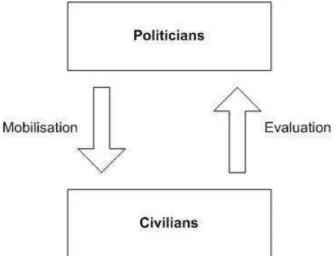
To represent the interaction between the cultural and the political dynamics, the model
consists of two types of agents: the political élite and the local population. Politicians are
modelled as more complex actors. Local citizens, modelled as simpler actors, exist in greater numbers. However, the two types of actor are structurally coupled. This reflects the recursive
feedback between the two kinds of dynamics. On the one hand, politicians‟ careers are
dependent on mass support; on the other hand, the mobilisation of mass support stimulates the mobilisation of individual identities. Thus the driving forces of the model are political
career aspirations at the level of the political élite and the mobilisation of ethnic identities at
the level of the local population. This reflects the fact that the career of, for instance, Milosevic, was promoted by his ability to stimulate mass demonstrations [21], encouraging a political climate for conflict escalation.
Figure 1. Relation of the two agent types of the model.
ACTOR MODELS
The aim to promote a personal political career can be described as a rational motivation. On the other hand, ethnographic accounts [71] have described the involvement of the local population in war crimes as emotionally driven. To represent the different motivation of citizens and politicians, the two agent classes are modelled using different actor models. Politicians can be represented by the standard model of the rational actor model. Here the theory of subjective expected utilities (SEU), originally developed by [72] can be utilised. The goal of these agents is to make career advancements. However, these career aspirants are in competition with one another. Unsuccessful politicians are replaced by new up-and-coming politicians. In the first instance, these imitate the successful politicians. The criterion of the rivalry is their popularity within the population. Thus, politicians are opportunists who aim to maximise their support. However, the strategic evaluation is undertaken in three dimensions: Political atmosphere: this is measured by support for a certain type of speech.
Credibility: this is a function of a politician‟s personal history. A politician is no longer credible if he or she changes the political agenda too frequently.
The emotional motivation of the population can be represented following the theory of the
„identity preserver‟, popularised by [73]. This actor model can be illustrated by a scale with two containers representing two different value orientations (Fig. 2) [74]. Civil values can roughly
be described as an orientation on the idea of Yugoslavism („unity and brotherhood‟) [75]. However, at the time of conflict escalation, issues of political and economic reforms were an
urgent topic of public debate. This is also covered by the heading „civil values‟. On the other
hand, the value of ethnic identity represents the pride of the nation and the meaningfulness ascribed to this issue. Opinion polls indicate that roughly 10 % to 15 % of the population regarded this as a prime issue [2]. In principle, however, individuals possess both types of value orientation. However, the strength of the respective value orientation may differ. This is represented by the amount to which each container is filled, as illustrated in Fig. 2.
Figure 2. Actor model of civilians.
SCHEDULING
The overview in Fig. 3 highlights the fact that the model scheduling consists of two phases: a state of social order and an anomic state. In principle, the recursive feedback loop between politicians and citizens indicated by the two upward and downward bars may be maintained in the state of social order. This is a rather general mechanism, not specific to the Yugoslavian case. However, under certain circumstances (in which, again, both levels of politicians and citizens are involved) the model may enter the anomic state. The concrete mechanisms for the transition into the anomic state are specific for the Yugoslavian case. Following the KIDS principle, they are derived from the circumstances of the first time ethnic homogenisations took place in the conflict surrounding Krajina Serbs, described in Section 2. In the following, the individual steps will be explained in more detail.
1st step: political mobilization
Politicians hold speeches to organise support. These speeches can appeal to either civil values or the national identity of the respective nation. Six different nations existed in Yugoslavia. In the first round the type of speech is selected randomly. People all over simulated
„Yugoslavia‟ are able to hear the speeches. One example would be that the speeches are
Figure 3. Overview of the Scheduling.
are randomly distributed. The evaluation is undertaken by calculating the distance of the type of speech from their conviction.
However, people are not isolated, but live in neighbourhoods and have networks of friends. People discuss their evaluation of the speeches in these networks. This represents the idea that the success of political campaigns becomes the topic of public debate, causing people to decide whether or not to support the speeches. Support is signalled by participating in demonstrations in favour of the politician. The decision can be based on two grounds: first, individuals can
strongly support the speech, regardless of their friends‟ opinions. This is the case when the distance between their conviction and the speech is rather low. In this case, they participate in the demonstration alone. Second, after the discussion people can decide to join a demonstration as part of a group. In this case, the majority of the group moderately favours the speech, i.e. the average distance is considerable, but on the positive axis. Participating in these demonstrations enforces value preferences. This represents the fact that, in particular at the beginning of the conflicts, Yugoslavia faced a series of huge mass demonstrations. A prime example to illustrate
this basic idea is Milosevic‟s well-known speech in Kosovo, in which he addressed the Serbs living in this region, stating that nobody should beat them. This speech, delivered at a mass demonstration, was broadcast on the news, and stimulated reactions all over Yugoslavia. The last point is important insofar as a speech does not only have a regional effect. It enabled Milosevic to become well known throughout Yugoslavia. It was the take-off of his career. However, while he became popular among a certain subpopulation of the Serbian people, he became the subject of fear and anger in the other Yugoslavian nations.
2nd step: political conflicts – securitization
politicians who changed from a communist to a nationalist agenda. It is crucial for the particular case of Yugoslavia that the agenda of politicians is recognisable across the Federal Republic. Moreover, people of different nationalities lived in different republics. Thus, an appeal to a certain type of nationalism is recognisable also by people living outside that
particular republic. For instance, Milosevic‟s appeal to Serbian nationalism („nobody should beat you‟) was recognised by people of all nationalities in all of the republics, and therefore
also by Serbs resident outside Serbia. This had the effect that the Serbian politician Milosevic was regarded as their representative by a group of people living outside Serbia, namely the
„Krajina Serbs‟ living in Croatia. This was a cause of political conflict. To abstract from this particular case, in the model an alarm function for the rise of a political conflict is activated if a nationalist politician gains support outside the territory of his or her home republic (Fig. 4).
Figure 4. Generation of political conflicts.
3rd step: conditions for violence
Now the conditions for violent conflict escalation are given. Three conditions can be derived from the empirical case:
Opportunities: These are given by political conflicts, providing an atmosphere in which, for instance, violence may no longer be subject to criminal prosecution.
Complicity: It is curious that a further condition was a constant characteristic of the ethnic homogenisations in former Yugoslavia, namely, a certain degree of complicity by the local population [19, 76]. Again and again, the militia planning to attack a certain village
warned the inhabitants of their „own‟ nationality. These could have warned their
neighbours of different nationality, but they chose not to. They often even participated in the looting that took place after the attack. This behaviour pattern is modelled as an agent with an eventually only modest degree of ethnic mobilisation, but also only a modest degree of mobilisation of civil values.
4th step: anomic system state
If these conditions are fulfilled, the model reaches the anomic state. The militia undertake ethnic homogenisations within its local neighbourhood, including murder and displacement. Survivors flee in the direction of the territory of their ethnicity. The refugee population provides a source of sometimes strongly radicalised nationalists; if these find collaborators, they accompany a militia. However, it has to be emphasised that the specific actions and tactics of certain militia are not the focus of this investigation. Instead, the guiding question is whether and how such an anomic system state can be reached in the first place.
CONCLUSION AND OUTLOOK
Although the wars in former Yugoslavia have been studied extensively, how the extreme outbreak of violence was possible remains a controversial question. The manipulation hypothesis claims it has to be traced back to Machiavellian politics. This builds on the evidence that ethnic relations were described as unproblematic, even at the time of already
emerging political conflicts, and the „national question‟ was perceived as urgent by only a small minority. In fact, politicians used nationalist rhetoric as a device to gain access to power. On the other hand, the ancient hatred hypothesis builds on the evidence that violence was undertaken deliberately by civilians. This is then traced back to the numerous wars between the Yugoslavian nations stored in the collective memory.
Explanations of these wars typically introduce certain factors that differ from the situation of peace. For instance, these may be economic shocks or the appearance of certain politicians. This can be characterised as an exogenous explanation. However, civilisations are continuously faced with the problem of integrating large-scale social groups. The nation-state has established an ordering principle that is an essential element to solve this problem. Yet, it can be suspected that such an ordering principle will tend towards a stable equilibrium. Evidence from interstate wars indicate that international relations are a system of self-organised criticality. A theoretical examination of how the organising principle of the nation may generate social integration suggests that this ordering principle also develops a system of self-organised criticality. This implies that social order may revert to an anomic state. This was observed, for instance, in former Yugoslavia. This is an endogenous explanation of ethno-nationalist violence, as a manifestation of the complexity of the system. This can be tested by the simulation framework developed here: politicians indeed have the capacity to provoke nationalist (as well as civil) sentiment. This reflects the intuition of the manipulation hypothesis. However, they are not an
exogenous „shock‟, but are generated endogenously in the model. People select their
The fact that the Yugoslavian case is well documented suggests its use as proof of the concept. However, the idea of the nation is of a much wider scope. It is misleading to presume that such violence may only happen on the Balkans. Conflicts involving an ethnic dimension are observed all over the world. Presumably, not all of these conflicts involve a political dimension comparable to this case. [6, 77] provides detailed evidence of instances that may be explained purely on a cultural level. However, a number of these conflicts do involve a political dimension. It can be presumed that these cases exhibit a recursive feedback relation between cultural and political dynamics, as described here. For instance, the number of partly „frozen‟ ethno-nationalist conflicts in the post-Soviet area may well be driven by comparable dynamics. While the specific mechanisms that drive the model from the state of social order into an anomic state are derived from detailed evidence from the empirical case, the mechanisms that generate the feedback loop between the political and cultural level are rather general (Fig. 3). For instance, the emergence of nationalist political parties can be observed across the European Union. This may well be an instance of such a feedback loop. While the details of the mechanisms of the transition to the anomic state cannot be generalised to this case, its possibility may provide awareness of the fragility of stability. There may then be hope that the study of the past violence in Yugoslavia will help to prevent future disasters. A simulation study enables us to detect escalation paths and stable pathways, and eventually early warning signals. A systemic view shows at least that we humans are not condemned to violence. At first sight, this might be counterintuitive. However, while self-organised criticality suggests that retaining civil life is critical, the criticality also shows that it is open to the freedom of human will.
ACKNOWLEDGMENTS
I would like to thank two anonymous reviewers for valuable comments and suggestions improvement. Remark no. 10 is due to a suggestion of a reviewer. The author remains responsible for all flaws and mistakes.
REMARKS
1
A minor example is that the republics that left the Yugoslavian Federation were armed to a large extent by labour migrants [21].
2In the economic literature, this is typically referred to as „shocks‟. For a discussion of
endogenous versus exogenous origins of economic crises, compare [78]. However, an endogenous explanation by no means implies rejecting the explanations identified in the literature. On the contrary, it needs to be explained how they can be integrated by showing how they are generated by the operational principles of the nation-state.
3
Milosevic went on to win three consecutive elections in Serbia. 4
However, the first victims of the war were found in Belgrade: the Serbian media reported untruthfully that peaceful, helpless Serbs had been murdered by Croats. When the lie was exposed, mass demonstrations were held in protest of Milosevic. In the course of the conflict, a policeman and a demonstrator died.
5
For instance, while the most divergent economic conditions were between Slovenia and the Kosovo region, the most extreme violence took place within the republic of Bosnia-Herzegovina. 6
Further conditions have been identified in geographic circumstances [5]. Yet, recourse to constant (and indeed: endogenous) geographical factors cannot explain peace, i.e. why – in this case – Yugoslavia was a functioning state for 40 years.
7
Most prominently advocated by [79]. 8
9
Within the framework of theories of ethnic conflicts, this account is usually characterised as belonging to the constructivist camp. However, it also has an instrumentalist aspect, as it emphasises – eventually instrumentalist – political action. The most prominent antithetic account is the primordialist theory of [77].
10
So far, the theory of extreme events has not been applied to mass-mobilization in times structural ruptures of social structure. Empirical research suggests that it is an extreme event [80, 81]. However, so far it has not been inquired empirically whether the time scales of the occurrence of such events can be modelled by extreme event statistics.
11Such an experimental approach is closely related to Ragin‟s re
-evaluation of social inquiry [82]
and was already suggested by Max Weber‟s study of historical causality [68].
12In fact, a number of criminals, such as the „Arkan tigers‟ were actually also involved in war
crimes. Criminal motivation is not represented here.
REFERENCES
[1] Münckler, H.: Die neuen Kriege. Rowohlt, Hamburg, 2002,
[2] Gagnon, V.P.: The myth of ethnic war: Serbia and Croatia in the 1990s. Cornell University Press, London, 2004,
[3] Williams, M.: Words, Images, Enemies: Securitization and International Politics. International Studies Quarterly 47(4), 511-531, 2003,
[4] Gilley, B.: Against the concept of ethnic conflict. Third world quarterly 25(6), 1155-1166, 2004,
[5] Fearon, J. and Laitin, D.: Ethnicity, Insurgency and Civil War. American Political Science Review 97(1), 75-90, 2003,
[6] Horowitz, D.L.: The Deadly Ethnic Riot. University of California Press, Berkeley, 2001, [7] Kaplan, R.D.: The coming anarchy.
The Atlantic Monthly 273(2), 44-76, 1994,
[8] Klinke, A.; Renn, O. and Lehners, J.P., eds.: Ethnic Conflicts and Civil Society. Ashgate Publishing Ltd, Aldershot, 1997,
[9] Wallensteen, P. and Sollenberg, M.: After the Cold War: Emerging patterns of armed conflict 1989-94.
Journal of Peace Research 32(3), 345-360, 1995,
[10] Kaplan, R.D.: Balkan Ghosts: A journey through history. St. Martin‟s Press, New York, 1994,
[11] Cioffi-Revilla, C.: Politics and Uncertainty: Theory, Models and Applications. Cambridge University Press, Cambridge, 1998,
[12] Cioffi-Revilla, C.: War and warfare: Scales of conflict in long-range analysis.
In: Denemark, R.A.; Friedman, J.; Gills, B.K. and Modelski, G., eds.: World System History: The Social Science of Long-Term Change. Routledge, London, pp. 253-272, 2000,
[13] Midlarsky, M.: Systemic Wars and Dyadic Wars: No Single Theory. International Interactions 16, 171-81, 1990,
[14] Cederman, L.E.: Modeling the Size of Wars: From Billiard Balls to Sandpiles. American Political Science Review 97(1), 135-150, 2003,
[15] Bak, P.: How nature works: The science of self-organised criticality. Copernicus, New York, 1996,
[16] Neumann, M.: Complexity of Social Stability: A Model-to-Model Analysis of Yugoslavia’s decline.
Interdisciplinary Description of Complex Systems 5(2), 92-111, 2007,
[17] Neumann, M.: Pathways to ethnic cleansing.
In: Ernst, A. and Kuhn, S., eds.: Proceedings of the 3rd World Congress on Social Simulation WCSS2010. CD-ROM edition, Kassel, 2010,
[18] Melcic, D., ed.: Der Jugoslawien-Krieg. Handbuch zu Vorgeschichte, Verlauf und Kosequenzen. Westdeutscher Verlag, Opladen, 1999,
[19] Rathfelder, E.: Der Krieg an seinen Schauplätzen.
In: Melcic, D., ed.: Der Jugoslawien Krieg. Handbuch zu Vorgeschichte, Verlauf und Konsequenzen. Westdeutscher Verlag, Opladen, pp. 344-361, 1999,
[20] LeBor, A.: Milošević. A biography. Yale University Press, New Haven, 2002,
[21] Silber, L. and Little, A.: Yugoslavia: death of a nation. Penguin, New York, 1997,
[22] Djuric, R. and Bengsch, B.: Der Zerfall Jugoslawiens. Morgenbuch Verlag, Berlin, 1992,
[23] Calic, M.: Der Krieg in Bosnien-Herzegowina. Surkamp, Frankfurt a. M., 1995,
[24] Gow, J.: Triumph of the Lack of Will. International Diplomacy and the Yugoslav War. Hurst & Company, London, 1997,
[25] Woodward, S.: Balkan Tragedy: Chaos and Dissolution after the Cold War. The Brooking Institution, Washington D.C., 1995,
[26] Korczynski, N.: Deutschland und die Auflösung Jugoslawiens: Von der territorialen
Integrität zur Anerkennung Kroatiens und Sloweniens. Studien zur Internationalen Politik 1/2005, 2005,
[27] Djekovic, L.: Der kurze Atem der Selbstverwaltung: Eine Volkswirtschaft zwischen Dauerkrise und gescheiterten Reformen.
In: Furkes, J. and Schlarp, K.H., eds.: Jugoslawien: Ein Staat zerfällt. Reinbeck, Hamburg, pp. 134-164, 1992,
[28] Sekulić, D.: The Creation and the Dissolution of the Multinational State: The Case of Yugoslavia.
In: Stone, J. and Rutledge, D., eds.: Race and Ethnicity: Comparative and Theoretical Approaches. Blackwell, Melbourne, pp. 219-231, 2003,
[29] Lampe, J.: Yugoslavia as History: Twice there was a country. Cambridge University Press, Cambridge, 1996,
[30] Roggeman, H.: Krieg und Frieden auf dem Balkan. Arno Schmitz, Berlin, 1993,
[31] Bremer, Th.: Die Religionsgemeinschaften im ehemaligen Jugoslawien.
In: Melcic, D., ed.: Der Jugoslawien-Krieg: Handbuch zu Vorgeschichte, Verlauf und Konsequenzen. Westdeutscher Verlag, Opladen, pp. 235-254, 1999,
[32] Katicic, R.: Jugoslawien im Lichte seiner Sprachen.
In: Melcic, D., ed.: Der Jugoslawien-Krieg: Handbuch zu Vorgeschichte; Verlauf und Konsequenzen. Westdeutscher Verlag, Opladen, pp. 255-267, 1999,
[33] Vulliamy, E.: Seasons in Hell: Understanding Bosnia’s War. St. Martin‟s, New York, 1994,
[34] Anderson, B.: Imagined communities. Reflections on the origin and spread of nationalism. Verso, London, 1983,
[35] Hobsbawm, E. Nation und Nationalismus: Mythos und Realität seit 1780. Campus, Frankfurt a.M., 2004,
[36] Gellner, E.: Nations and Nationalism. Oxford University Press, Oxford, 1983,
[38] Tilly, C., ed.: The formation of national states in western Europe. Princeton University Press, Princeton, 1975,
[39] Cederman, L.E.: Nationalism and Bounded Integration: What it would take to construct a European Demos.
European Journal of International Relations 7(2), 139-174, 2001, [40] Berding, H., ed.: Mythos und Nation.
Surkamp, Frankfurt a.M., 1996,
[41] Griswold, W.: Cultures and Societies in a Changing World. Pine Forge Press, Thousand Oaks, 1994,
[42] Bloom, W.: Personal Identity, National Identity and International Relations. Cambridge University Press, Cambridge, 1990,
[43] Cruz, C.: Identity and Persuation. World Politics 52(3), 275-312, 2000,
[44] Forbes, H.D.: Ethnic Conflict: Commerce, Culture, and the Contact Hypothesis. Yale University Press, New Haven, 1997,
[45] Hogg, M. and Abrams, D.: Social Identifications. A social psychology of intergroup relations and group processes.
Routledge, New York, 1988,
[46] Liebkind, K.: Ethnic identity: Challenging the boundaries of social psychology.
In: Breakwell, G., ed.: Social psychology of identity and the self concept. University of Surrey Press, Guildford, pp. 147-185, 1992,
[47] Weichlein, S.: Nationalbewegungen und Nationalismus in Europa. WGB, Darmstadt, 2006,
[48] Weber, M.: Wirtschaft und Gesellschaft. Oldenbourg, Munich, 2011,
[49] Hroch, M.: Das Europa der Nationen. Die moderne Nationenbildung im europäischen Vergleich.
Vanderhoeck & Ruprecht, Göttingen, 2005, [50] Schmitt, C.: Der Begriff des Politischen.
Duncker & Humblot, Berlin, 1932,
[51] Schieder, Th.: Nationalismus und Nationalstaat: Studien zum nationalen Problem im modernen Europa.
Vanderhook & Ruprecht, Göttingen, 1992,
[52] Altermatt, U.: Das Fanal von Sarajevo: Ethnonationalismus in Europa. Schöningh, Paderborn, 1997,
[53] Buzan, B.; Waever, O. and de Wilde, J.: Security: a new framework for analysis. Lynn Rienner Publishers, Boulder, 1998,
[54] Mann, M.: The dark side of democracy: explaining ethnic cleansing. Cambridge University Press, Cambridge, 2005,
[55] Snyder, J.: From Voting to Violence: Democratization and Nationalist Conflict. W.W. Norton & Company, New York, 2000,
[56] Jensen, H.J.: Self-organised criticality: emerging complex behaviour in physical and biological systems.
Cambridge University Press, Cambridge, 1998,
[57] Sornette, D.: Why stock markets crash. Critical events in complex financial systems. Princeton University Press, New York, 2003,
[58] Jentsch, V.; Kantz, H. and Albeverio, S.: Extreme Events: Magic, Mysteries and Challenges. In: Albeverio, S.; Jentsch, V. and Kantz, H., eds.: Extreme events in nature and society. Springer, Berlin, pp. 1-18, 2006,
[59] Limpert, E.; Staehl, W. and Abbt, M.: Log-normal distributions across the sciences: keys and clues.
[60] Moss, S. and Edmonds, B.: Sociology and Simulation – Statistical and Qualitative Cross-Validation.
American Journal of Sociology 110(4), 1095-1131, 2005,
[61] Richardson, L.: Variation of the Frequency of Fatal Quarrels with Magnitude. American Statistical Association 43, 523-546, 1948,
[62] Richardson, L.: Statistics of Deadly Quarrels. Quadrangle Books, Chicago, 1960,
[63] Cioffi-Revilla, C. and Midlarsky, M.: Highest-Magnitude Warfare: Power Laws, Scaling, and Fractals in the Most Lethal International and Civil Wars.
In: Diehl, P. ed.: Toward a Scientific Understanding of War: Studies in Honor of J. David Singer. University of Michigan Press, Ann Arbor, pp. 3-27, 2003,
[64] Sklar, L.: Physics and Chance.
Cambridge University Press, Cambridge, 1993,
[65] Albeverio, S. and Piterbarg, V.: Mathematical methods and concepts for the analysis of extreme events.
In: Albeverio, S.; Jentsch, V. and Kantz, H., eds.: Extreme Events in Nature and Society. Springer, Berlin, pp. 47-68, 2006,
[66] Lim, M.; Metzler, R. and Bar-Yam, Y.: Global pattern formation and ethnic/cultural violence. Science 317(5844), 1540-1544, 2007,
[67] Edmonds, B. and Moss, S.: From KISS to KIDS –an ‘anti-simplistic’ modelling approach. In: Davidsson, P. et al., eds.: Multi Agent Based Simulation 2004. Springer, Lecture Notes in Artificial Intelligence 3415, pp. 130-144, 2005,
[68] Weber, M.: Objektive Möglichkeit und adequate Verursachung in der historischen Kausalbetrachtung.
In: Winckelmann, J., ed.: Gesammelte Aufsätze zur Wissenschaftslehre. Mohr, Tübingen, pp. 266-290, 1968,
[69] Nowak, A.; Vallacher, R.R.; Bui-Wrzosinska, L. and Coleman, P.T.: Attracted to conflict: A dynamical perspective on malignant social relations.
In: Golec, A. and Skarzynska, K., eds.: Understanding social change: Political psychology in Poland. Nova Science Publishers Ltd., Hauppauge, pp. 33-49, 2007,
[70] Oether, S.: Völkerrechtliche Rahmenbedingungen und die Staatengemeinschaft.
In: Melic, D., ed.: Der Jugoslawien-Krieg. Handbuch zu Vorgeschichte, Verlauf und Konsequenzen. Westdeutscher Verlag, Opladen, pp. 485-502, 1999,
[71] Wilmer, F.: The Social Construction of Man, the State, and War. Routledge, London, 2002,
[72] Savage, L.: The Foundations of Statistics. Wiley, New York, 1954,
[73] Schimank, U.: Handeln und Strukturen. Einführung in eine Akteurtheoretische Soziologie. Juventa, Munich, 2000,
[74] Oberschall, A.: The manipulation of ethnicity: from ethnic cooperation to violence and war in Yugoslavia.
Ethnic and racial studies 23(6), 982-1001, 2000,
[75] Sekulić, D.: Civic Identity and Yugoslavism – Functional Equivalents?
In: Franičević, V. and Kimura, H., eds.: Globalization, Democratization and Development: European and Japanese Views of Change in South East Europe. Masmedia, Zagreb, pp. 237-254, 2003, [76] Bringa, T. and Christie, D.: We are all neighbours.
Granada TV, 1993,
[77] Horowitz, D.L.: Ethnic groups in conflict. University of California Press, Berkeley, 1985,
[78] Sornette, D.: Endogenous versus exogenous origins of crises.
[79] Smith, A.: The ethnic origins of nations. Blackwell, London, 1986,
[80] Oberschall, A. and Kim, H.: Identity and action. Mobilization. An International Quarterly 1(1), 63-85, 1996, [81] Zolberg, A.: Moments of Madness.
Politics and Society 2(2), 183-200, 1972,
[82] Ragin, C.: Redesigning social inquiry: fuzzy sets and beyond. University of Chicago Press, Chicago, 2008.
MODELIRANJE DINAMIKE SEKURITIZACIJE
NACIONALNIH IDENTITETA
M. Neumann Institut za sociologiju, Rajnsko-Westfalska tehnička visoka škola –Sveučilište u Aachenu
Aachen, Njemačka
SAŽETAK
Na primjeru eskalacije sukoba u bivšoj Jugoslaviji, u ovom radu razvijen je zajednički okvir za mehanizme koji
dovode do eskalacije sukoba. Eskalacija etno-nacionalističkog nasilja opisana je kao endogena značajka naroda.
Princip naroda može postati organizirajući princip za integraciju velikih društvenih grupa. Međutim, on također može generirati ekstremne događaje etno-nacionalističkog nasilja. Opisana je arhitektura simulacijskog modela
kojim se provjerava hipoteza ekstremnih događaja.
KLJUČNE RIJEČI