882 Brazilian Journal of Physics, vol. 36, no. 3B, September, 2006
D
0Energy Spectrum in In(Al)As/Ga(Al)As Quasi-One-Dimensional Nanorings
Javier Betancur, William Guti´errez, Ilia D. Mikhailov, and Harold Paredes Escuela de F´ısica, Universidad Industrial de Santander, A. A. 678 Bucaramanga
Received on 8 December, 2005
We analyze the spectrum of a neutral donor located inside or outside of a finite-barrier toroidal-shaped nanor-ing whose radius is much larger than the height. We derive a one-dimensional wave equation which describes the low-lying donor levels corresponding to the slow electron motion along the ring, by using the adiabatic ap-proximation. Numerical solution of this equation has been obtained by using the trigonometric sweep method. The dependence of the energy spectrum on the donor position, radius and height ring has been studied.
Keywords: Nanorings; Energy spectrum
I. INTRODUCTION
Quasi-two-dimensional self-assembled quantum dots (SAQDs) with different shapes but always with large base radius-height aspect ratio have been fabricated in the last decade by solid-source molecular-beam epitaxy, using the Stransky-Krastanov growth mode. A possibility of growing of self-organizedInAsring-like dot resembling a “volcano”, with typical sizes: 60-140 nm in outer diameter and 2nm in height, has been reported in Refs. [1, 2]. Reduction of the dimensionality up to one within a very narrow nanoring, allow us, on the one hand, to modify essentially the energy spectrum of the particles confined within the heterostructure making it more stable and, on the other hand, to use simple theoretical models and similar methods to those applied recently to solve exactly the problem of two electrons in one-dimensional nanoring [3]. Analysis of these models allows us to observe clearly the transformation of the energy spectrum from rotor-vibration one to another Wigner crystal, provided by the strong competition between the kinetic energy and Coulomb interaction terms in Hamiltonian.
A most simple few-particle system for which one can ob-serve clearly such transformation presents a neutral donor,D0
located within or outside of a very narrow ring. Previously, the ground state energy of the shallow donors located in dif-ferent parts of a quantum ring (QR) with rectangular cross section has been calculated in Ref. [4] by using a variational procedure. A detailed study of the ground state energies of on-and off-axis neutral and negatively charged donors in ax-ially symmetrical quantum dots with large base radius-height aspect ratio has been presented recently in Ref. [5]. Both in Ref. [4] and Ref. [5] a variational procedure has been used and the donor excited states have not been considered. In this paper we propose a simple method based on the adiabatic ap-proximation for calculating the low-lying energy levels of the off-axisD0in a narrow toroidal-shaped nanoring and to ana-lyze the quantum-size effects related to this part of the energy spectrum.
II. THEORY
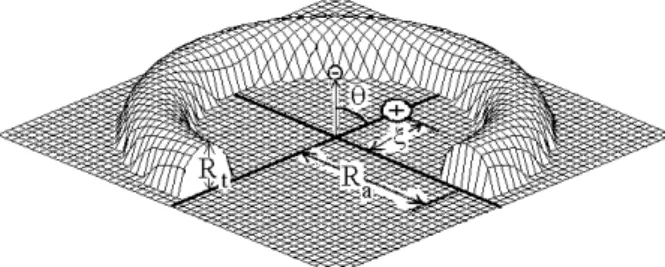
We consider a model of toroidal-shaped QR generated by the revolution of a cross section radiusRt aroundzaxis (Fig.
1). The circle is centered at the media distanceRafrom the axis. It is supposed that the donor is located at the symme-try plane and its position is given by the distanceξfrom the axis.The confinement potential due to the conduction band discontinuity in the junctions of QR is given in cylindrical co-ordinates by the piecewise constant functionV(ρ,z)which is equal to zero within the torus and equal toV0outside of it.
FIG. 1: Schematic representation of the QR model.
Initially, for heuristic purposes, we consider the case of a very narrow QR ¡
Rt→0; V0→∞;R2tV0→const¢, for
which the renormalized Hamiltonian (multiplied by squared ring radius) for a off-axis donor in the effective mass approx-imation, can be written as:
˜
H=HR2a=−∂θ∂22 +V˜C(θ); −π≤θ<π ˜
VC(θ) =−2Ra .p
1+β2−2βcosθ; β=ξ± Ra
(1)
Here we use the effective atomic units, in which the effec-tive RydbergRy∗=m∗e4/2~2ε2and the effective Bohr ra-diusa0∗=ε~2/m∗e2are taken as the energy and length units,
respectively. The eigenvalues ˜Emof the renormalized Hamil-tonian (1) are measured in units ofRy∗a0∗2.
Javier Betancur et al. 883
of the levels with negative energies and a distribution typical for hydrogen-like shallow donor confined in one-dimensional heterostructure. One can see that there are only two particu-lar cases for which the Hamiltonian (1) describes a rigid rotor independently of the ring radius: asβ→0 (on-centre donor) and asβ→∞(ring without donor). In both cases the eigen-functions areϕ±m(θ) =exp(±imθ)corresponding to double degenerated levels with energies:
˜
Em=m2−2Ra; (β→0); m=0,±1,±2, . . . ˜
Em=m2; (β→∞); m=0,±1,±2, . . . (2) In the intermediate case for any finite value ofβthe poten-tial ˜VC(θ)in Eq. 1 is even and there are two sets of eigenfunc-tions of the Hamiltonian given by the even and odd funceigenfunc-tions respectively. The even functions always give the lower ener-gies than corresponding odd functions due to the smaller av-eraged separation between electron and donor. The splitting between even and odd levels decreases asβ→0 orβ→∞
and the corresponding wave functions transform into linear combinations of the rigid rotor degenerated eigenfunctions,
ϕ+(θ) +ϕ−(θ) and ϕ+(θ)−ϕ−(θ), respectively. On the other hand, the splitting between even and odd levels increases drastically as the donor approaches to the ring (β→1)due to the fact the odd states become unstable and their energies tend sharply to−∞.
One can see that forβ=1the confining potential given by Eq. 1, ˜VC(θ) =Ra±¯¯sinθ±2
¯
¯is similar to a hypothetical model of the one-dimensional hydrogenic atom, ˜VC(θ) =2Ra
± |θ|, with periodic conditions. It is well known that the energies of the even states of the one-dimensional hydrogenic atom are given by the same relation that of three-dimensional hydro-genic atom:
Em=−R2a ±
m2; (β→1); m=1,2,3, . . . (3) For a narrow but finite thickness ring the renormalized Hamiltonian of donor can be written as:
˜ H=−1
˜ ρ2 ∂
2
∂θ2−1ρ˜∂∂ρ˜ρ˜∂˜∂ρ− ∂
2
∂˜z2+Uc(ρ˜,z˜,θ) +V(ρ˜,z)˜ ; ˜
ρ=ρ±
Ra; ˜z=z±Ra
(4)
whereUc(ρ˜,z˜,θ) is the electron-donor interaction potential given by
Uc(ρ˜,z˜,θ) =−2Ra Áq
˜
z2+ρ˜2+β2−2βρ˜cosθ (5)
Doing ˜ρ=1+x˜one can see that for very narrow rings ¡
Rt±Ra<<1¢the electron location is restricted by the condi-tions: ˜x<<1; ˜z<<1. It means that the motion in the radial andzdirections is rapid whereas the rotation along the ring is slow and the standard adiabatic approximation procedure can be used in order to separate the slow motion corresponding to the low-lying energy levels from the rapid motions. It can be
shown that the consistent application of the adiabatic approx-imation to the Hamiltonian (4) provides the one-dimensional wave equation for slow motion along the ring which coincides completely with the equation (1) with the only difference, the effective potential of the Coulomb interaction ˜VC(θ)in Eq. 1 should be substituted by
˜ VC(θ) =
∞ Z
0
r f02(r)dr 2π Z
0
dϕUc(1+rcosϕ,rsinϕ,θ) (6)
wheref0(r)is the well known ground state wave function for
the electron in two-dimensional circular quantum well of the radiusRtand the barrier heightV0, which is expressed in terms
of the Bessel functions.
III. RESULTS
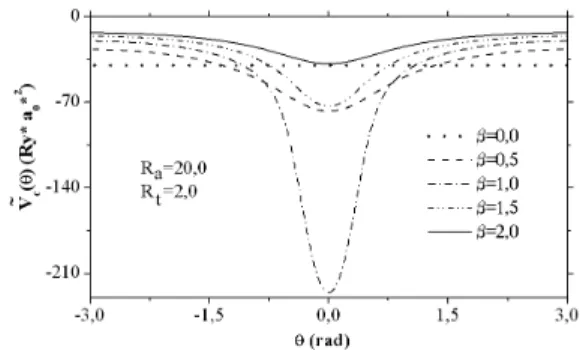
The relations (2) and (3) were used to check the calculation results for the low-lying energies in a narrow ring. The effec-tive potential of the Coulomb interaction given by the relation (6) forRa=20,0a∗0andRt=2,00a∗0, and some different
val-ues ofβare shown in Fig. 2. Asβtends to zero or infinity the behavior of the curves is similar(V =const). For inter-mediate values ofβthe curves of the potential has only one minimum corresponding toθ=0 which becomes more and more profound asβ→1.
FIG. 2: Effective periodic potential curves ˜VC(θ) (−π<θ<π) given
by the relation (6) for different values ofβ.
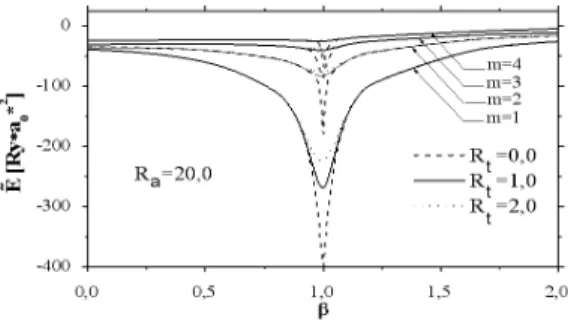
Calculation results of the renormalized energies as a func-tion of the distance from the donor posifunc-tion to the axis(ξ) for some low-lying levels corresponding to odd wave func-tions, are presented in Figs. 3 y 4, for Ra=10,0a0∗ and Ra=20,0a0∗, respectively. Dashed lines in these figures
884 Brazilian Journal of Physics, vol. 36, no. 3B, September, 2006
FIG. 3: D0 low-lying renormalized energies as a function of the
distance from the donor position to the axis of the ring with radius Ra=10,0a0∗and different cross section radiiRt.
It is seen that qualitatively the behavior of the curves for differentRt is similar, only the curves becomes smoother as the cross section radius increases. Also one can see that quan-titatively the renormalized energies are in a good concordance with the simplified theoretical one-dimensional model given by the Hamiltonian (1). For the on-center donor(β=0,0)the positions of the energy levels on the extreme left side of Fig-ures 3 and 4 coincide exactly with the renormalized energies given by the relation (2).
FIG. 4: Identical to Fig. 3, butRa=20,0a0∗
With displacement of donor from the axis to the center QR as the parameterβincreases from 0 to 1, the energies decrease and tend to minimum values which coincide almost exactly with those given by the relation (3). As the parameterβfurther increases from 1 to infinity the energies become to grow and they tend on the right-side of Figs. 3 and 4 to the values given by the second relation (1).
The dependence of the renormalized energies of the four low-lying levels of the donor located at the center of the QR (ξ=Ra=20,0a0∗)on the cross section radiusRtis shown in
FIG. 5:D0low-lying renormalized energies as a function of the QR cross section radius forRa=20,0a0∗andβ=1,0.
Fig. 5. One can compare these values with those of the one-dimensional hydrogen-like atom given by the relation (3). As senθ/2∼=θ/2 there is an excellent concordance for the ground state energy, but this approximation is very poor for excited states. In spite of the difference between two models related to periodic frontier conditions in the case of donor in QR the coincidence of the ground state energy shows a similitude of these two one-particle problems. Separation between the elec-tron and donor grows with increasing of the ring cross section. Therefore, all energy levels in Fig. 5 climb asRtincrease. Fur-ther, asRt reaches the Bohr radius the energy growing ceases and they become almost independent ofRt.
In conclusion we propose a simple method based on the adiabatic approximation for calculating the energies of the low-lying levels of the off axis donor in a narrow quantum ring. In spite of many technological, we believe that semi-conductor nanorings remain interesting to be exploited in the: telecommucication industry, high-electron mobility transistor (HEMT), free-space microwave transmission, quantum op-tics, quantum computing, semiconductor spintronics, etc.
Acknowledgements
This work was financed by the Industrial University of Santander (UIS) through the Direcci´on General de Investiga-ciones (DIF Ciencias, Cod. Cod. 5124) and the Excellence Center of Novel Materials ECNM, under Contract No. 043-2005 and the Cod. No. 1102-05-16923 subscribed with COL-CIENCIAS
[1] A. Lorke, R. J. Luyken, A. O. Govorov, J. P. Kotthaus, J. M. Garcia, and P. M. Petroff, Phys. Rev. Lett.84, 2223 (2000).
Javier Betancur et al. 885
D. Granados and J. M. Garcia, Appl. Phys. Lett.82, 2401 (2003). [3] J.-L. Zhu, Z. Dai, and X. Hu, Phys. Rev. B68, 045324 (2003). [4] A. Bruno-Alfonso and A. Latg´e, Phys. Rev. B61, 15887 (2000)