Brazilian Journal of Physics, vol. 35, no. 3B, September, 2005 757
Trace Element Concentration in S˜ao Francisco River Water Using
STXRF and PIXE Techniques
F. R. Espinoza-Qui˜nones, S. M. Palacio, R. M. Galante, F. L. Rossi, D. C. Zenatti, I. R. A. Pereira, R. A. Welter, N. Rossi, C. L. Obreg´on, J. M. T. de Abreu,
N´ucleo de Biotecnologia e Desenvolvimento de Processos Qu´ımicos - NBQ, Universidade Estadual do Oeste do Paran´a -UNIOESTE/Campus de Toledo, PR, Brasil
M. A. Rizzutto, N. Added, and M. H. Tabacniks Instituto de F´ısica, Universidade de S˜ao Paulo, S˜ao Paulo, SP, Brasil
Received on 9 June, 2005
Trace element concentrations in water from S˜ao Francisco River using Particle Induced X-ray Emission (PIXE) and Synchroton Total Reflection X-ray Fluorescence (STXRF) techniques are measured. The main objective of this work was to characterize and to monitor the trace elements in the water of S˜ao Francisco River, as well as to provide valuable information about the levels of metallic ions pollutants. Water samples were collected monthly at five locations along the course of the river from July 2003 to April 2004. As an internal standard, 11.6 ppm of Yttrium was added to 10 ml of the water sample. The PIXE and TXRF measurements were performed at the Ion Beams and Materials Laboratory (LAMFI) and the Brazilian National Synchrotron Light Laboratory (LNLS), using a proton beam and a polychromatic X-ray beam, respectively. Si(Li) detectors were used to collect the X-ray spectra. Due to the excellent detection limits of the PIXE and STXRF analysis, up to 15 elements were quantified. The highest total content of Cr, As, Cu and Zn detected in river water are above the limits recommended by the environmental legislation.
I. INTRODUCTION
The search and identification of trace elements in the envi-ronment is an important field of modern science. The growing interest about trace elements in biological materials is just another indicator of the needs in modern biological and en-vironmental science. It is recognized that the trace elements diversity is essential for life and great effort is being made to understand its actions. It is known that low trace elements are essential for life, yet in excess they may also be toxic [1].
During the last two decades, there has been considerable development in the sampling and analytical techniques for the measurement of trace elements in the environment. Ion Beam Analysis (IBA) methods and X-ray Fluorescence (XRF) with its as Total Reflection XRF, TXRF, and Synchrotron To-tal Reflection XRF, STXRF, have been shown to be powerful methods for measuring trace element content in soils, sedi-ments, water and air particulates [2, 3]. These techniques have the advantage of speed, sensitivity, simplicity, and the ability to analyze mixtures without prior treatment or sepa-ration. In this work, water samples from the S˜ao Francisco River were analyzed for trace elements at the X-ray fluores-cence beam line installed at the 2.5-GeV Brazilian Synchro-tron Light Source [4–7].
II. MATERIALS AND METHODS
A. Sample collection locations
The S˜ao Francisco river hydrographic basin is located in the southern region of Brazil in the western part of the State of Paran and drains an area of approximately 2200km2over
an extension of 150km.
Five sampling sites were installed along the river stream in order to monitor systematically the levels of heavy metals and identify potential pollution sources in the freshwater ecosys-tem of the S˜ao Francisco basin. The sampling sites 1 and 2 are located before and after the point where Antas river rea-ches the S˜ao Francisco river, respectively. A protocol was set up for monthly collection of water samples and for measuring heavy metal concentrations. A map of the area under investi-gation with the localization of the sampling sites is shown in Figure 1.
A total number of 60 water samples were collected from July 2003 to April 2004.
B. Target Preparation
Standard stock solution (11.6x10³mg l−1) of yttrium was prepared dissolving quantitatively a 50 g Merck package Y(NO3)3.6H2Oin Ultra Pure Milli-Q water. The solution was stored in an acid-washed volumetric flask. A 10µlof yttrium stock solution was added in an aliquot of 10mlof each sam-ple. A 5µlfrom the resulting solution was pipetted on 2.5µm thick kimfol (C16H14O3) stretched on plastic rings (φ25mm and 2mmthick), and 3mmthick acrylic disks, and left to dry at ambient temperature in a clean box.
758 F.R. Espinoza-Qui˜nones et al.
FIG. 1: Map of S˜ao Francisco hydrological basin showing the loca-tion of the five sampling sites.
C. Instrumentation
The PIXE measurements using a 2.39 MeV proton beam were done at the Ion Beams and Materials Laboratory (LAMFI) of the Physics Institute of the University of S˜ao Paulo [9]. Typical beam currents, of few nA, were used to reduce dead time and signal pile-up. The X-rays were recor-ded using two Si(Li) detector with FWHM resolution of about 145 eV MnKαplaced at 120oand 90oto the beam direction.
The STXRF measurements were carried out using the poly-chromatic X-ray beam, with maximum energy of 20 keV, of the XRF line, at the National Laboratory of Synchrotron Light (LNLS), located in Campinas-SP [4]. A Si(Li) detector, with 160 eV FWHM Mn-Kα line, surrounded by tantalum colli-mators and placed at 90oto the incident beam, was used for X-Ray detection.
For both techniques, the X-ray spectra were analyzed using the AXIL program [10].
D. Quantitative analysis by PIXE and STXRF
In the PIXE technique, the effective yield of the K and L x-ray series were performed using a set of calibrated thin films from Micromatter Co. USA. To determine the elemental sen-sitivity curve of the STXRF system, several single element standard solutions with atomic number in the range of inte-rest were prepared with well-defined concentrations ranging (from 1 to 10µg ml−1). All standard solutions were spiked with the same amount of Yttrium solution as well as the water samples.
III. RESULTS
Typical X-ray spectra for STXRF and PIXE obtained from river water samples are shown in Figure 2, with prominent pe-aks for the K X-ray lines of K, Ca, Cr, Mn, Fe, Ni, Cu, Zn and
Y, the internal standard element. Backgrounds were subtrac-ted in theKα areas that were used to calculate the elements concentrations of the samples.
FIG. 2: Comparison of the TXRF and PIXE spectra for the same water sample on acrylic disk and Kimfoil.
The relative elements concentrations were calculated using the following relation [6].
CZ= IZ IS
YS YZ
CS
whereYS/YZis a ratio derived from effective yield curve,IS/IZ is a ratio representing the relative-to-Yttrium fluorescence in-tensity of the element,CZ is the element concentration (µg ml−1), andCSis the Yttrium internal standard concentration (11.6µg ml−1).
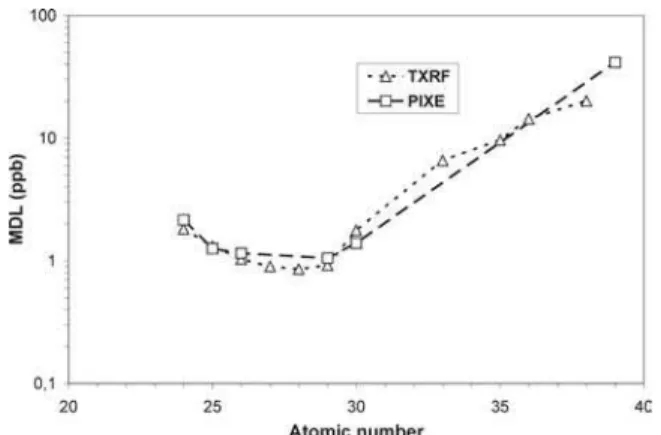
The minimum limit of detection criterion of 3√BG, where BG is the number of counts of the background under the peak, was adopted. As shown in Figure 3, the minimum detection limits for the TXRF and PIXE techniques down to 1ng ml−1 (ppb) were achieved around the iron element.
FIG. 3: Curve of the Minimum Detection Limit for TXRF and PIXE techniques.
Brazilian Journal of Physics, vol. 35, no. 3B, September, 2005 759
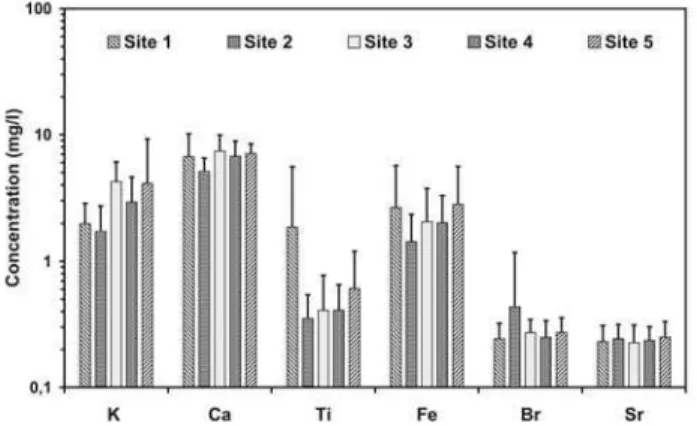
concentration values for the macro elements such as K, Ca, Ti and Fe and for the trace elements Br and Sr were summa-rized in Figure 4, which compares the average trace element concentrations at all stations.
FIG. 4: Mean (±SD) concentration values (inmg/l) for the macro elements K, Ca, Ti and Fe and the trace elements Br and Sr, obtained in the five sampling sites.
IV. DISCUSSION
It can be seen from Figure 5 that the concentrations of total copper in river water at all sites are much higher than the 20 ppb recommended by the Brazilian environmental legislation [11] for river water class II. Except for Cu, all other elements show average concentrations below the allowed limits. Howe-ver, at some sites, the upper limits of Cr, Zn, and As are above the allowed limits. This is certainly a matter of concern which indicates urgent need to start controlling pollution sources to avoid future problems.
Concentration values of zinc exhibited significant increase at sites 3, 4 and 5, above the 180 ppb recommended by the Brazilian legislation. The highest value of zinc was found in site 1. This may be attributed to anthropogenic sources from the Cascavel city.
It was observed that the highest chromium concentration at site 5 has reached 100 ppb, which is two times the maximum permissible concentration in drinking water, recommended by the World Health Organization [12] and the Brazilian Environ-mental Legislation [11] for the hexavalent form in river water. This contaminant could be an industrial effluent from the tan-neries located after the site 3 near to Toledo city.
At sites 1 and 3, the upper limits of arsenic are much higher than the 50 ppb recommended by the Brazilian legislation.
The highest values of arsenic were found at sampling site 3 which is downstream the ending of Toledo river, receiving the addition of partially untreated urban and industrial effluents from Toledo city. This element may also be associated with the run-off from agricultural lands located into the Toledo and Lopei river basins.
FIG. 5: Mean (±SD) concentration values (in ng/ml) for Cr, V, Ni, Cu, Zn and As, obtained in the five sampling sites compared to the limit recommended by the Brazilian Environmental Legislation (BEL).
V. CONCLUSION
The present work is the first attempt to identify trace ele-ments in the S˜ao Francisco River of the Brazilian state of Pa-ran´a. The main metallic pollutants detected in S˜ao Francisco River water were Cu and Cr. The highest total content of these metallic pollutant was found in site 5 located next to the en-ding of S˜ao Francisco River. A major portion of Cr pollutant is believed to come from tanneries discharges into the S˜ao Fran-cisco river. The occurrence of cromium above the prescribed limits indicates the necessity of improve techniques for indus-trial waste treatment. Because metals tend to accumulate in the river sediment, plants and fishes, investigations of trace elements in these ecosystems are also in progress.
Acknowledgments
We thank LNLS (Laborat´orio Nacional de Luz S´ıncrotron) for financial support of the D09-XRF 1979 and 2240 projects. The Environmental Research Group of Western Parana State University is grateful to LAMFI staff for operating the acce-lerator. The authors MAR, NA, MHT thank to FAPESP and CNPq for financial support.
[1] P. A. Amundesen, F. J. Staldvik, A. A. Lukin, N. A. Kashulin, O. A. Popova, and Y. S. Reshetnikov, Sci. Total Environ.201,
224 (1997).
760 F.R. Espinoza-Qui˜nones et al.
Spectrometry, Marcel Dekker, New York (1993). [3] K. G. Malmqvist, Nucl. Instr. and Meth.B85, 84 (1994). [4] C. A. Perez, M. Radtke, H. J. Sanchez, H. Tolentino, R.
Neu-enshwander, W. Barg, M. Rubio, M. I. S. Bueno, I. M. Rai-mundo, and J. R. Rohwedder,Synchrotron Radiation: Beam line Instrumentation and Experiments, X-Ray Spectrometry28, 320 (1999).
[5] K. P. Koutsenogii,SRXRF in Ecology, Nucl Instr. and Meth.
A448, 425 (2000).
[6] K. Baur, S. Brennan, D. Werho, L. Moro, and P. Pianetta, Recent Advances and Perspectives in Synchrotron Radiation TXRFNucl. Instr. and Meth.A467-468, 1198 (2001).
[7] R. Klockemkamper, and A. Von Bohlen,Elemental Analysis of Environmental Samples by Total Reflection Fluorescence: a
Review, X-ray Spectrometry25, 156 (1996).
[8] S. M. Simabuco, and E. Matsumoto,Synchrotron radiation to-tal reflection for rainwater analysisSpectrochimica ActaB 55, 1173 (2000).
[9] M. H. Tabacniks, University of S˜ao Paulo, Physics Institute Re-port1469, 50 (2000).
[10] P. Van Espen, K. Janssens, and I. Swenter,AXIL X-Ray Analysis software, Canberra Packard, Benelux.
[11] Conselho Nacional do Meio Ambiente (CONAMA),
Resoluc¸˜ao no. 20, Minist´erio do Desenvolvimento Urbano e Meio Ambiente, Brasilia, (1986).