Article
J. Braz. Chem. Soc., Vol. 22, No. 6, 1056-1060, 2011. Printed in Brazil - ©2011 Sociedade Brasileira de Química 0103 - 5053 $6.00+0.00
A
*e-mail: [email protected]
A Selective Flotation-Spectrophotometric Method for the Determination of Nickel
using Dimethylglyoxime
Hamid Hashemi-Moghaddam*
Department of Chemistry, Islamic Azad University Damghan Branch, PO Box 36716-39998, Damghan, Iran
Um método simples e seletivo para a separação e pré-concentração de níquel foi desenvolvido. O método é baseado na lotação de um complexo de Ni e dimetilglioxima (DMG) na interface de uma solução aquosa com n-hexano. O complexo Ni-DMG foi separado e determinado por espectrofotometria. A lotação quantitativa do complexo foi possível no intervalo de pH de 9-12. O método é simples e livre da interferência de todos os cátions e ânions e apresenta um grande intervalo linear. O procedimento foi aplicado com sucesso na determinação de traços de níquel em águas de poços e águas residuais de um processo de eletrodeposição. A exatidão do método foi avaliada usando material de referência certiicado (NIST 864) e enriquecendo as amostras com diferentes quantidades de Ni2+.
A simple and selective method for separation and preconcentration of nickel has been developed. The method is based on the lotation of a complex of Ni and dimethylglyoxime (DMG) at the aqueous solution-n-hexane interface. The complex was separated and Ni determined spectrophotometrically by DMG after addition of oxidizing agent. The quantitative lotation of the complex was possible in the pH range of 9-12. The method is simple and free from the interference of all cations and anions and has a wide linear range. The procedure was successfully applied to the determination of trace amounts of nickel in well water and waste water in coating plant. The method’s accuracy was investigated by using standard reference materials alloys (NIST 864) and by spiking the samples with different amounts of Ni2+.
Keywords: lotation, spectrophotometry, dimethylglyoxime, nickel
Introduction
Nickel is an important constituent of several steel alloys. Its determination is required to control both raw material and industrial products.1 In addition it is readily encountered in
the environment, which enters from land-based resources, such as oxidic and sulide ores or industrial sources, such as spent catalysts, alloy scrap, sludge, dust, and wastewater.2
Dimethylglyoxime (DMG) is widely used and for the spectrophotometric determination of nickel3,4 it has also
been used for separation and preconcentration of Ni by liquid-liquid extraction5 or solid phase extraction6-8 but all
of these separation methods suffer from lack of selectivity. For example, metal ions such as Ni(II), Pb(II), Mn(II), Bi(III), Co(II), Cd(II), Zn(II), and Fe(II) could interfere at concentrations higher than 5 mg L−1 in solid phase
extraction of Ni2+ using DMG as a complexing agent.8
This paper deals with a selective and simple method for separation and preconcentration of Ni with DMG.
F l o t a t i o n s p e c t r o p h o t o m e t r y a l l ow s o n e t o preconcentrate the trace elements in various materials.9–24
Primary investigations showed that the none of two usual complexes of Ni and DMG could not loat completely in interface of liquid and organic phase due to solubility in water and organic phase of Ni(Dm)3
2− and Ni(HDm) 2,
respectively. Thus a different complex of Ni and DMG was studied. As it observed, in more basic pHs, a different complex could be formed that is loated in interfaces of two phases. This complex is formed very fast and metal ions (e.g., Fe2+, Co2+ and Cu2+) which form colored,
Experimental
Materials
The solutions were prepared with freshly deionized water and chemicals of analytical reagent grade. The 1.000 g L−1
Ni standard stock solution was prepared by dissolving 6.7300 g (NH4)2Ni(SO4)2•6H2O (Merck, Germany) in water
containing 2 mL of concentrated H2SO4 and completing
the volume to one liter with water. The 2% (m/v) dimethylglyoxime solution was prepared by dissolution of an appropriate amount of reagent in 250 mL of a 2.0 mol L−1
NaOH solution. Potassium persulfate, 4% (m/v) solution, freshly was prepared. Sodium borate- boric acid buffer (pH 10.0). This solution was prepared by dissolving 12.78 g of sodium borate (Merck) in 100 mL of water, followed by the addition and dissolution of 6.18 g of boric acid (Merck) and was diluted to 1000 mL.
The standard reference material with certiied values was the NIST 864 (New York, USA) Inconel 600. The materials were dissolved in concentrated HCl and HNO3 acids. 25
Sample collection
Wastewater samples were collected from a nickel-chrome electroplating plant in Damghan, Iran. The samples were put in plastic containers initially rinsed three times with the wastewater.
Sample preparation
The waste water and well water samples were iltered through a 0.45 µm membrane ilter paper. An aliquot of the iltered sample (10 mL) was put into a 250 mL conical lask and digested with 5 mL mixture of concentrated nitric acid (65%, v/v) and perchloric acid (70%, v/v). When digestion was complete, 10 mL of 0.5 mol L−1 HCl was added to
redissolve the residue and the resultant solution iltered into a 50 mL volumetric lask.
Apparatus
Cary 100 (Varian, Australia) spectrophotometer with a quartz cell (10.0 mm optical path) was employed for nickel determinations. A pH meter, Metrohm744A, was used for pH measurements.
Procedure
To the solution containing not more than 50 µg of Ni, 5 mL of 0.02 mol L−1 EDTA solution and 10 mL of
boric acid/sodium borate buffer was added. The solution was transferred to a 250 mL separating funnel; then 2 mL dimethylglyoxime (2%, m/v) and 10 mL n-hexane were added sequentially. The funnel was stoppered, vigorously shaken for 2 min, then left to rest for a few minutes. As soon as the loating layer had settled at the organic interface, both the upper organic and lower aqueous layers were discarded by slowly opening the cock of the funnel. Then, for dissolving the loated complex, which was completely adhering to the inner walls of the funnel, 4 mL 2 % (m/v) of DMG, 1 mL of 4% (m/v) persulfate solution and 2.5 mL of concentrated NH3 solution were added successively.
The obtained solution was quantitatively transferred into a 25 mL lask and diluted to the mark with water. Finally, the absorbance at 445 nm against water was measured.
Results and Discussion
The reaction between Ni and dimethylglyoxime is a well established process. DMG reacts with Ni ions in a neutral or ammoniacal medium to form a pink, locculent precipitate which has been the basis of the well known gravimetric method for determining nickel. The nickel dimethylglyoximate chelate is soluble in CHCI3 and other
non polar organic solvents. The extraction of Ni(HDm)2
is primarily important in the separation of nickel, but relatively large quantities of nickel have been determined by means of the pale yellow chloroform solution of Ni(HDm)2. Also in an alkaline medium and in the presence
of oxidants, nickel forms a brown-red, water soluble DMG-complex, which is the basis of the very popular method for determining nickel. In this complex, nickel is in the IV oxidation state, and the anionic complex has the formula Ni(Dm)3
2−.3 Primary investigation showed that any of each
two complexes could not loat completely in the interface of liquid and organic phase because of solubility in water and organic phase of Ni(Dm)32− and Ni(HDm)2, respectively.
Thus a different complex of Ni and DMG was studied. As it was observed, in more basic pH and with DMG, which dissolved in NaOH solution a different complex could be formed that is loated in interfaces of two phases.
Ni2+ + 2DH
2 Ni(DH)2 + 2H+
Ni(DH)2 + 2OH− [NiD2]2− + 2H2O ( in alkaline solution)
Ni2+ + 2DH
2 + 2OH− [NiD2]2− + 2H+ + 2H2O
difficulties still encountered in the identification of a “metastable” complex are not early understood.26
The various parameters such as pH, shaking times and the concentration of the ligand, which inluence the lotation and spectrophotometric determination of nickel, were optimized.
Optimization
The effect of the pH on the lotation of the complex was investigated by varying the pH of Ni(II) solution (1.7 × 10⁻⁶ mol L−1) in the range from 4 to 12 before the
addition of the organic phase. The results in Figure 1, indicates that the maximum absorbance occurs at pH above 9. The decrease in absorbance at lower pH values was attributed to the protonation of the weakly basic coordination group of ligand and also because in neutral pH Ni(HDm)2 could be formed, which is dissolved somewhat
in n-hexane. In the subsequent work, pH 10 was selected.
Fast formation of Ni-DMG complex and no solubility of complex in n-hexane are depending on the kind of DMG solvent. If DMG is dissolved in ethanol, eficiency of lotation would be low but lotation eficiency increase in more basic solvents because of increasing polarity of Ni-DMG complex. The effect of the agitation time on the lotation was studied by varying the shaking time between 10 and 180 s. The result of the investigation indicates that the time of 60 s is suficient for the quantitative formation and lotation of the complex.
The effect of the DMG concentration on the lotation of the complex was studied over the concentration range of 0.1 × 10⁻⁵ to 1 × 10⁻³ mol L−1. As shown in Figure 2,
maximum absorbance occurs to DMG concentrations above 2 × 10⁻⁴ mol L−1. Since by increasing the concentration
of Ni(II) ions, a greater amount of DMG was required, a solution with 4 × 10⁻⁴ mol L−1 DMG was chosen for further
investigations.
Flotation of the complex was investigated with several organic solvents. It was found that the absorbance depends
on the solvent. For example, at the optimum conditions, the absorbance values for the lotation of 4 × 10⁻⁶ mol L−1
Ni(II) with cyclohexane, n-heptane, and n-hexane were 0.438, 0.462 and 0.486, respectively. In addition, quicker separation between the phases was observed using n-hexane. Thus, it was chosen for the further investigations. Furthermore, the complex is dissolved somewhat in solvent such as, toluene, xylene and chloroform.
A possible concern was whether a high enrichment factor could be realized. This was investigated by carrying the lotation processes and varying the volume of the aqueous solution between 20 and 250 mL, while maintaining the amounts of nickel and the organic-phase constant. It was found that the lotation process was quantitative over the range of 20-150 mL of the aqueous phase. A higher volume, however, resulted in a decrease in the eficiency of the lotation process.
Analytical performance
Under the optimum conditions, a linear calibration curve was obtained for Ni(II) over the range from 1 × 10⁻⁶ to
2 × 10⁻⁵ mol L−1, with the correlation coeficient (r) of 0.9973
(A = 5.42 × 10⁴ [Ni] – 0.0463, where A is the absorbance
and [Ni] is the concentration in mol L−1). The apparent
molar absorptivity at 445 nm was 5.42 × 10⁴
L mol−1 cm−1
for a 100 mL aliquot of the aqueous phase and a path length of 1 cm. The relative standard deviation (n = 6) at 4 × 10⁻⁶ mol L−1 of Ni2+ for a 100 mL sampling volume
was 2.7% and the detection optical limit is deined as the sample concentration giving a signal equal to the blank average signal (25 blank) plus three times the standard deviation of the blanks was found to be 1.7 × 10⁻⁷ mol L−1.
Interferences
The most significant interferences for the nickel determination with DMG are Cu2+, Co2+ and Fe2+ that
Figure 1. Effect of pH on the lotation process at the conditions where: [Ni(II)] =4 × 10⁻⁶ mol L−1 and [DMG] = 4 × 10⁻⁴ mol L−1.
produce stable complexes with the organic reagent. But, for example, although the copper complex of dimethylglyoxime is certainly more stable thermodynamically than the nickel complex, the latter is far more insoluble because of the special features of the packing of discrete molecules in the crystal lattice which provides strong axial Ni–Ni bonds through the lattice.26 So, in this lotation method, complexes
of Cu2+, Co2+ and Fe2+ with DMG could not be loated in
interface of two phases and have not any interference in the determination of Ni2+. In the case of palladium, it produces
a yellow precipitate from weak acid solution however it could be loated partially but this yellow complex could not interfere in lotation spectrophotometric determination of Ni by dimethylglyoxime. In addition, usually the concentration of Pd is very low in environmental samples. Formation of insoluble compounds was prevented in the alkaline medium by adding 5 mL of 0.02 mol L−1 EDTA solution.
Application
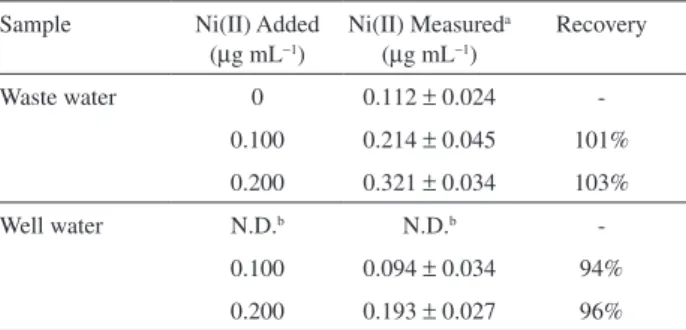
To validate the methodology, the proposed method was applied to different environmental samples for Ni determination. The wastewater was collected from an electroplating plant. Along with the samples, several known amounts of Ni(II) were spiked to examine the reliability of the method (Table 1).
Furthermore, the accuracy of the method was investigated by analysis of standard reference materials alloys (NIST 864) by flotation spectrophotometry method. The certiied Ni was 73.10%, and Ni found was 73.04 ± 0.08%, in good agreement with the certiied value at the 95% conidence level.
Conclusion
In a different way, a complex of Ni with dimethylglyoxime was formed in order to separate and preconcentrate Ni ions by lotation spectrophotometric method. High tolerance to
interference matrix ions in different samples, selectivity and a low cost are the main beneits of the presented method. Low detection limit and high tolerance to interferences from the matrix allow application of the proposed procedure for Ni determination in a large range of samples. Besides of presenting an analytical method for nickel determination, preparation and separation of new complexes of Ni and DMGis possible with this method.
Though the spectroscopic evidence indicated the presence of various nickel-DMG complexes with different ratios of metal to ligand (1:2 and 1:4) in solution, the difficulties still encountered in the identification of “metastable” complex are not early understood.27
Acknowledgments
We are grateful to the Pars Material Research and Testing (PMRT) for valuable technical assistance.
References
1. Martelli, P. B.; Reis, B. F.; Korn, M.; Ruini, I. A.; J. Braz. Chem. Soc. 1997, 8, 479.
2. Jung, M. J.; Venkateswaran, P.; Lee, Y. S.; J. Ind. Eng. Chem. (Seoul, Repub. Korea)2008,14, 110.
3. Marczenko, Z.; Balcerzac, M.; Separation, Preconcentration and Spectrophotometry in Inorganic Analysis, Elsevier:London, 2000; p. 290.
4. Booth, E.; Strickland, J. D. H.; J. Am. Chem. Soc.1953,75, 3017.
5. Yonezawa, C.; Sagawa, T.; Hoshi, M.; Tachikawa. E.; J. Radioanal. Chem. 1983,8, 7.
6. Shemirani, F.; Zamani M.; Jamali, M. R.; Iran. J. Chem. Chem. Eng.2003,22, 55.
7. Gazda, D. B.; Fritz, J. S.; Porter, M. D.; Anal. Chim. Acta2004, 508, 53.
8. Ali, A.; Ye, Y.; Xu, G.; Yin, X.; Zhang, T.; Microchem. J.1999, 63, 365.
9. Marczenko, Z.; Crit. Rev. Anal. Chem.1981,11, 195. 10. Marczenko, Z.; Jaroz, M.; Analyst 1981, 106, 751.
11. Kalinowski, K.; Marczenko, Z.; Mikrochim. Acta 1985,85,167. 12. Marczenko, Z.; Jankowski, K.; Anal. Chim. Acta1985,176, 185. 13. Kalinowski, K.; Marczenko, Z.; Anal. Chim. Acta1986, 186,
331.
14. Mathew, L.; Reddy, M. L. P.; Ramamohan, M. L. P.; Prasad, M. L. P.; Lyer, C. S. P.; Damodaran, A. D.; Mikrochim. Acta1997, 127, 125.
15. Bhagavathy, V.; Prasada Rao, T.; Damodaran, A. D.; Anal. Chim. Acta 1993, 280, 169.
16. Chamsaz, M.; Arbab-Zavar, M. H.; Hosseini, M. S.; Anal. Lett. 2000,33, 1625.
Table 1. Determination of nickel in real samples
Sample Ni(II) Added (µg mL−1)
Ni(II) Measureda
(µg mL−1)
Recovery
Waste water 0 0.112 ± 0.024
-0.100 0.214 ± 0.045 101%
0.200 0.321 ± 0.034 103%
Well water N.D.b N.D.b
-0.100 0.094 ± 0.034 94%
0.200 0.193 ± 0.027 96%
17. Chamsaz, M.; Hosseini, M.S.; Arbab-Zavar, M. H.; Chem. Anal.
2004,49, 241.
18. Hosseini, M. S.; Nasseri, Y.; Anal. Sci. 2003, 19, 1505. 19. Hosseini, M. S.; Hashemi-Moghaddam, H.; Anal. Sci.2004,
20, 1449.
20. Hosseini, M. S.; Hashemi-Moghaddam H.; Talanta2005,67, 555.
21. Hosseini, M. S.; Hashemi-Moghaddam H.; Bull. Korean Chem. Soc.2005,26, 1529.
22. Hosseini, M. S.; Hashemi-Moghaddam, H.; Kardan-Moghaddam, G.; Ann.Chim. (Rome, Italy) 2007,97, 17.
23. Shabazi, Z.; Dadfarnia, S.; Shabani, A. M. H.; Jafari, A. A.; J. Anal. Chem. 2008, 63, 446.
24. Pourreza, N.; Parham H.; Mirzavand P.; J. Chin. Chem. Soc. 2009,56, 785.
25. Rudolf, B.; A Handbook of Decomposition Methods in Analytical Chemistry, International Textbook Company Ltd., 1979. ch. 4.
26. Irving, H. M. N. H.; Pure Appl. Chem. 1978, 50, 1129. 27. Sivaramakrishna, A.; Rao, V. J.; Muralikrishna, U.; Moss, J. R.;
Transition Met. Chem.(Dordrecht, Neth.) 2008, 33,475.
Supplementary Information
S
I
J. Braz. Chem. Soc., Vol. 22, No. 6, S1-S2, 2011. Printed in Brazil - ©2011 Sociedade Brasileira de Química 0103 - 5053 $6.00+0.00
*e-mail: [email protected]
Identiication of (1
R
, 2
S
)-Grandisal and (1
R
, 2
S
)-Grandisol in
Pissodes castaneus
Male-Produced Volatiles: Evidence of a Sex Pheromone
Francisco A. Marques,*,a Scheila R. M. Zaleski,b Sonia M. N. Lazzari,b Gustavo Frensch,a Grece A. Senhorini,a Beatriz H. L. N. S. Maia,a
Armin Tröger,c Wittko Francke,c Edson T. Ieded and Kenji Morie
aDepartamento de Química, Universidade Federal do Paraná, P.O. Box 19081, 81531-990 Curitiba-PR, Brazil
bDepartamento de Zoologia, Universidade Federal do Paraná, P.O. Box 19020, 81531-980 Curitiba-PR, Brazil cInstitute of Organic Chemistry, University of Hamburg, Martin-Luther-King-Platz 6, D-20146,
Hamburg, Germany
dLaboratório de Entomologia, Empresa Brasileira de Pesquisa Agropecuária, P.O.Box 319,
83411-000, Colombo-PR, Brazil
ePhotosensitive Materials Research Center, Toyo Gosei Co., Ltd., 4-2-1 Wakahagi, Inzai-shi,
Chiba 270-1609, Japan
![Figure 2. Effect of DMG concentration on the determination of Ni(II) at the conditions where: pH = 10 and [Ni] = 4 × 10 -6 mol L -1 .](https://thumb-eu.123doks.com/thumbv2/123dok_br/18995385.462032/3.892.79.399.478.668/figure-effect-dmg-concentration-determination-ni-ii-conditions.webp)