An Analysis on Single and Central Diffractive Heavy Flavour
Production at Hadron Colliders
M. V. T. Machado
Universidade Federal do Pampa, Centro de Ciˆencias Exatas e Tecnol´ogicas Campus de Bag´e, Rua Carlos Barbosa, CEP 96400-970, Bag´e, RS, Brazil
(Received on 20 March, 2008)
In this contribution results from a phenomenological analysis for the diffractive hadroproduction of heavy flavors at high energies are reported. Diffractive production of charm, bottom and top are calculated using the Regge factorization, taking into account recent experimental determination of the diffractive parton density functions in Pomeron by the H1 Collaboration at DESY-HERA. In addition, multiple-Pomeron corrections are considered through the rapidity gap survival probability factor. We give numerical predictions for single diffrac-tive as well as double Pomeron exchange (DPE) cross sections, which agree with the available data for diffracdiffrac-tive production of charm and beauty. We make estimates which could be compared to future measurements at the LHC.
Keywords: Heavy flavour production; Pomeron physics; Single diffraction; Quantum Chromodynamics
1. INTRODUCTION
For a long time, diffractive processes in hadron collisions have been described by Regge theory in terms of the exchange of a Pomeron with vacuum quantum numbers [1]. However, the nature of the Pomeron and its reaction mechanisms are not completely known. Currently, a promising way to clar-ify these questions is using the hard scattering to resolve the quark and gluon content in the Pomeron [2], regarding that a parton structure is natural in a modern QCD approach to the strongly interacting Pomeron. Form the experimental point of view, observations of diffractive deep inelastic scattering (DDIS) at HERA have increased the knowledge about the QCD Pomeron, where its diffractive distributions of singlet quarks and gluons have been phenomenologically determined [3].
In hadronic collisions, a single diffractive event is charac-terized by one of the colliding hadrons emitting a Pomeron that scatters off the other hadron. Hard diffractive events with a large momentum transfer are also set by the absence of hadronic energy in certain angular regions of the final state phase space (large rapidity gaps). For events in which both colliding hadrons remain intact as they each emit a Pomeron we have the so-called central diffractive events. In the latter case, also known as double Pomeron exchange (DPE) pro-cesses, both incoming hadrons are quasi-elastically scattered and the final states system in the center region is produced by Pomeron-Pomeron interaction.
Here, we concentrate on the single diffractive processes p+p(p¯)→p+J/Ψ[ϒ] +X and the central diffractive re-actions, p+p(p¯)→ p+J/Ψ[ϒ] +p(p¯). The diffractive heavy quarkonium production has drawn attention because their large masses provide a natural scale to guarantee the ap-plication of perturbative QCD. There are several mechanisms proposed for the quarkonium production in hadron colliders [4, 5], as the color singlet model, the color octet model and the color evaporation model. An important feature of these perturbative QCD models is that the cross section for quarko-nium production is expressed in terms of the product of two gluon densities at large energies. This feature is transferred to
the diffractive quarkonium production, which is now sensitive to the gluon content of the Pomeron at small-xand may be particularly useful in studying the different mechanisms for quarkonium production.
In order to do so, we will use the hard diffractive factoriza-tion, where the diffractive cross section is the convolution of diffractive parton distribution functions and the corresponding diffractive coefficient functions. At high energies there are im-portant contributions from unitarization effects to the single-Pomeron exchange cross section. These absorptive correc-tions cause the suppression of any large rapidity gap process, except elastic scattering. In the black disk limit the absorp-tive corrections may completely terminate those processes. This partially occurs in (anti)proton–proton collisions, where unitarity is nearly saturated at small impact parameters [6]. These multiple-Pomeron contributions depends on the partic-ular hard process and it is called survival probability factor, which are important for the reliability of theory predictions.
The present contribution is organized as follows. In next section, we present the main formulas to compute the in-clusive and diffractive cross sections for heavy quarkonium hadroproduction. We also present the parameterization for the diffractive partons distribution in the Pomeron, extracted recently in DESY-HERA, and theoretical estimations for the gap survival probability factor. In the last section we present the numerical results for Tevatron and perform predictions to future measurements at the LHC experiment. The compat-ibility with data is analyzed and the comparison with other approaches is considered. As an anticipation of the main re-sults, at the Tevatron the single and central diffractive J/Ψ
2. DIFFRACTIVE HADROPRODUCTION OF HEAVY QUARKONIUM
For our purpose we will use the Color Evaporation Model (CEM) [7]. The main reasons for this choice are its sim-plicity and fast phenomenological implementation, which are the base for its relative success in describing high energy data[4, 5]. In such an approach, the cross section for a pro-cess in which partons of two hadrons,h1andh2, interact to produce a heavy quarkonium state, h1+h2→H(nJCP) +X, is given by the cross section of open heavy-quark pair produc-tion that is summed over all spin and color states. All infor-mation on the non-perturbative transition of theQQ¯pair to the heavy quarkoniumHof quantum numbersJPCis contained in the factorFnJPCthata prioridepends on all quantum numbers
[7],
σ(h1h2→H[nJCP]X) =FnJPCσ¯(h1h2→QQ X¯ ), (1) where ¯σ(QQ¯)is the total hidden cross section of open heavy-quark production calculated by integrating over theQQ¯ pair mass from 2mQto 2mO, withmOis the mass of the associated
open meson. The hidden cross section can be obtained from the usual expression for the total cross section to NLO. These hadronic cross sections inppcollisions can be written as
σpp(√s,m2Q) =
∑
i,j=q,q,gZ
dx1dx2fip(x1,µ2F)f p j(x2,µ
2
F)
× σbi j(√s,m2Q,µ2F,µ2R), (2)
wherex1andx2are the fractional momenta carried by the col-liding partons and fipare the proton parton densities. The par-tonic cross sections are known up to NLO accuracy [8]. Here, we assume that the factorization scale,µF, and the
renormal-ization scale,µR, are equal. We also takeµ=2mQ, using the
quark massesmc=1.2 GeV andmb=4.75 GeV, which
pro-vide an adequate description of open heavy-flavour produc-tion [8]. The invariant mass is integrated over 4m2c≤sˆ≤4m2D in the charmonium case and 4m2
b≤sˆ≤4m2B for ϒ
produc-tion. The factorsFnJPC are experimentally determined [9] to
beF11−−≈2.5×10⁻²forJ/ΨandF11−−≈4.6×10−2forϒ. These coefficients are obtained with NLO cross sections for heavy quark production [9].
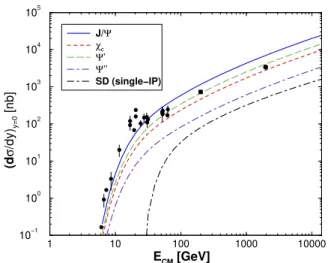
The agreement with the total cross section data is fairly good. The lowxregion is particularly relevant forJ/Ψ pro-duction at the LHC as well as at Tevatron. For charmonium production, theggprocess becomes dominant and informa-tion on the gluon distribuinforma-tion is of particular importance. In Fig. 1, the differential cross section dσpNdy→J/Ψ|y=0is shown as a function of center of mass energy, √s. The Tevatron data indicates that correction for gluon saturation may be impor-tant in bringing the theoretical curve closer to the experimen-tal result. In particular, the typical values of Bjorken-x would bex∼2mc/√s≈7×10−4for Tevatron andx≈10−4at the
LHC taken at a relatively low momentum scaleQ2=m2Ψ=9 GeV2. In Fig. 2, the differential cross sectionB×dσpN→ϒ
dy |y=0
is presented as a function of the center of mass energy (solid line). In addition, the measured cross sections for the sum of
the threeϒstates (ϒ+ϒ′+ϒ′′) in the dilepton decay channel are shown [4]. The agreement of the CEM model with accel-erator data is very good and an extrapolation to the LHC is presented. The results give us considerable confidence in the extrapolation to the LHC energy.
2.1. Diffractive cross section - single–Pomeron exchange
For the hard diffractive processes we will consider the Ingelman-Schlein (IS) picture [2], where the Pomeron struc-ture (quark and gluon content) is probed. In the case of sin-gle diffraction, a Pomeron is emitted by one of the colliding hadrons. That hadron is detected, at least in principle, in the final state and the remaining hadron scatters off the emitted Pomeron. The diffractive cross section of a hadron–hadron collision is assumed to factorise into the total Pomeron– hadron cross section and the Pomeron flux factor [2]. The single diffractive event,h1+h2→h1,2+H[nJCP] +X, may then be written as
dσSD(h
i+hj→hi+H[nJCP] +X)
dx(IPi)d|ti|
=
FnJPC×fIP/hi(xIP(i),|ti|)σ¯
¡
IP+hj→QQ¯+X
¢ , (3) where the Pomeron kinematical variable xIP is defined as x(IPi)=s(IPj)/si j, where
q
s(IPj) is the center-of-mass energy in the Pomeron–hadron j system and √si j =√s the
center-of-mass energy in the hadroni–hadron j system. The mo-mentum transfer in the hadron ivertex is denoted by ti. A
similar factorization can also be applied to central diffrac-tion, where both colliding hadrons can in principle be de-tected in the final state. The central quarkonium production, h1+h2→h1+H[nJCP] +h2, is characterized by two quasi– elastic hadrons with rapidity gaps between them and the cen-tral heavy quarkonium products. The cencen-tral diffractive cross section may then be written as,
dσCD(h
i+hj→hi+H[nJCP] +hj)
dx(IPi)dx(IPj)d|ti|d|tj|
=FnJPC×
fIP/i(x(IPi),|ti|)fIP/j(x
(j) IP,|tj|)σ¯
¡
IP+IP→QQ¯+X¢. Here, we assume that one of the hadrons, say hadronh1, emits a Pomeron whose partons interact with partons of the hadron h2. Thus the parton distribution x1fi/h1(x1,µ
2) is replaced by the convolution between a distribution of par-tons in the Pomeron,βfa/IP(β,µ2), and the “emission rate” of Pomerons by the hadron, fIP/h(xIP,t). The last quantity, fIP/h(xIP,t), is the Pomeron flux factor and its explicit formu-lation is described in terms of Regge theory. Therefore, we can rewrite the parton distribution as
x1fa/h1(x1,µ
2) = Z dx IP
Z dβ
Z
dt fIP/h
1(xIP,t)
× βfa/IP(β,µ2)δ µ
β−xx1 IP

1 10 100 1000 10000
ECM [GeV]
10−1 100 101 102 103 104 105
(d
σ
/dy)
y=0
[nb]
J/Ψ χc Ψ’ Ψ’’
SD (single−IP)
FIG. 1: The differential cross section dσ/dy|y=0 as a function of
energy for theJ/Ψproduction (solid line). Single diffractive cross section (dot-dashed line) and accelerator data are also shown (see text).
Using the substitution given in Eq. (4), the hidden heavy flavour cross section can be obtained from Pomeron-hadron cross sections for single and central diffraction processes,
dσ¡IP+h→QQ¯+X¢ dx1dx2
=
∑
i,j=qq¯,g
fi/IP ³
x1/x(IP1);µ2F ´
x(IP1)
× fj/h2(x2,µ2F)σˆi j(sˆ,m2Q,µ2F,µ2R) + (1⇋2), (5)
and
dσ¡IP+IP→QQ¯+X¢ dx1dx2
=
∑
i,j=qq¯,g
fi/IP ³
x1/x(IP1);µ2F ´
x(IP1)
× fj/IP
³
x2/x(IP2);µ2F ´
x(IP2)
ˆ
σi j(sˆ,m2Q,µ2F,µ2R).
In the numerical calculations, we will consider the diffrac-tive pdf’s recently obtained by the H1 Collaboration at DESY-HERA [3]. The Pomeron structure function has been modeled in terms of a light flavour singlet distributionΣ(z), consisting ofu,dandsquarks and anti-quarks and a gluon distribution g(z). The Pomeron carries vacuum quantum numbers, thus it is assumed that the Pomeron quark and antiquark distributions are equal and flavour independent:qIPf =q¯IPf =2N1
fΣIP, where
ΣIPis a Pomeron singlet quark distribution andNf is the
num-ber of active flavours. Moreover, for the Pomeron flux factor, introduced in Eq. (4), we take the experimental analysis of the diffractive structure function [3], where thexIPdependence is parameterized using a flux factor motivated by Regge theory [1],
fIP/p(xIP,t) =AIP· eBIPt
x2αIP(t)−1
IP
, (6)
where the Pomeron trajectory is assumed to be linear,αIP(t) =
αIP(0) +α′IPt.
2.2. Multiple-Pomeron exchange corrections
Here, we consider the suppression of the hard diffractive cross section by multiple-Pomeron scattering effects. This is taken into account through a gap survival probability factor, <|S|2>, which can be described in terms of screening or ab-sorptive corrections [10]. This suppression factor of a hard process accompanied by a rapidity gap depends not only on the probability of the initial state survive, but is sensitive to the spatial distribution of partons inside the incoming hadrons, and thus on the dynamics of the whole diffractive part of the scattering matrix. The survival factor of a large rapidity gap (LRG) in a hadronic final state is the probability of a given LRG not be filled by debris, which originate from the soft re-scattering of the spectator partons and/or from the gluon ra-diation emitted by partons taking part in the hard interaction. Let
A
(s,b)be the amplitude of the particular diffractive pro-cess of interest, considered in the impact parameter,b, space. Therefore, the probability that there is no extra inelastic inter-action is<|S|2>= R
d2b|
A
(s,b)|2exp[−Ω(s,b)] Rd2b|
A
(s,b)|2 , (7) whereΩis the opacity (or optical density) of the interaction.We will consider the theoretical estimates for<|S|2>from Ref. [11] (labeled KMR), which considers a two-channel eikonal model and rescattering effects. The survival probabil-ity factor is computed for single, central and double diffractive processes at several energies, assuming that the spatial distri-bution in impact parameter space is driven by the slopeBof the pomeron-proton vertex. We will consider the results for single diffractive processes with 2B=5.5 GeV−2(slope of the electromagnetic proton form factor) and withoutN∗ excita-tion, which is relevant to a forward proton spectrometer (FPS) measurement. Thus, we have<|S|2>SD
KMR=0.15,[0.09]and <|S|2>CD
KMR=0.08,[0.04]for √
s=1.8 TeV (Tevatron) [√s=
14 TeV (LHC)]. There are similar theoretical estimates, as the GLM approach [12], which also considers a multi-channel eikonal approach.
3. RESULTS AND SUMMARY
For the numerical calculations, the new H1 parameteriza-tion for the diffractive pdf’s [3] has been used. The ‘H1 2006 DPDF Fit A’ is considered, with the cutxIP<0.1. The single-Pomeron results are presented in Figs. 1 and 2 forJ/Ψand
10 100 1000 10000
ECM [GeV] 10−1
100 101 102 103 104 105
B(d
σ
/dy)
y=0
[pb]
(Υ+Υ’+Υ’’)
SD (single−IP)
FIG. 2: The differential cross sectionB×dσ/dy|y=0as a function of
energy for theϒ+ϒ′+ϒ′′production (solid line). Single diffractive cross section (dot-dashed line) and accelerator data are also shown (see text).
masses and/or the renormalization scale. However, our pur-pose here is to estimate the diffractive ratiosσD/σ
tot, which
are less sensitive to a particular choice. For sake of illus-tration, we have dσ(dyJ/Ψ)|SD
y=0=85(566)nb for the energy of √
s=2 TeV and 159(1770)nb for LHC energy,√s=14 TeV. Forϒwe haveBdσ(ϒ)dy |SDy=0=11(72)pb and 35(386)pb for Tevatron and LHC, respectively. Numbers between parenthe-ses correspond to values not corrected by survival probability gap factor.
Concerning the central diffractive cross-sections, the predictions give small values. For instance, we have
dσ(J/Ψ)
dy |CDy=0=18 nb andB
dσ(ϒ)
dy |CDy=0=0.8 pb at
√s=
2 TeV. This gives little room to observe central diffractiveϒevents at the Tevatron but could be promising for the LHC. The values reach dσ(dyJ/Ψ)|CD
y=0=45 nb andB
dσ(ϒ)
dy |
CD
y=0=3 pb at √
s=14 TeV. Once again, the results corrected by multiple-Pomeron suppression factor are a factor about 1/10 lower than the usual IS model.
Let us now compute the diffractive ratios. We have defined the single diffractive ratio asRSD=ddyσ
SD
/ddyσincand the cen-tral diffractive ratio asRCD= ddyσ
CD /dσ
dy
inc
. The results are summarized in Table I, where the diffractive ratios for heavy quarkonium production are presented for Tevatron and LHC energies. The multiple-Pomeron correction factors are taken from KMR model. The numbers between parentheses repre-sent the single-Pomeron calculation. Based on these results we verify that the J/Ψ and ϒ production in single diffrac-tive process could be observable in Tevatron and LHC, with a diffractive ratio of order of 1 % or less. This is a similar ratio measured inW andZ production at the Tevatron [14]. The predictions for central diffractive scattering are still not very promising, giving small ratios. However, the study of these events is worthwhile since their experimental signals
TABLE I: Model predictions for single and central diffractive quarkonium production in Tevatron and the LHC. Numbers between parentheses represent the estimates using the single Pomeron ex-change.
√
s Quarkonium RSD(%) RCD(%)
2.0 TeV J/Ψ 0.93(6.2) 0.2(2.5)
14 TeV J/Ψ 0.50(5.9) 0.15(3.7)
2.0 TeV (ϒ+ϒ′+ϒ′′) 0.78(5.2) 0.06(0.7)
14 TeV (ϒ+ϒ′+ϒ′′) 0.39(4.3) 0.03(0.8)
are quite clear. Finally, our theoretical prediction is in good agreement with the experimental measurement of CDF [13], which foundRJSD/Ψ=1.45±0.25 %. As the main theoreti-cal uncertainty in determining the diffractive ratio is the value for the survival factor, we consider the theoretical band 0.21– 0.15 for Tevatron energy. Therefore, our prediction gives RJtheory/Ψ =1.12±0.19 %, which is consistent with the Tevatron determination.
Our calculation can be compared to available literature in diffractive heavy quarkonium production. For instance, in Ref. [15] the largepT J/Ψproduction in hard diffractive
pro-cess is computed using the color octet fragmentation mecha-nism and the normalized Pomeron flux [16]. They found a SD J/Ψcross section at largepT(≥8 GeV) of order 10 pb and
a diffractive ratioRSD=0.65±0.15 %. This is closer to our calculation for the SD ratio for Tevatron within the theoretical errors. Afterwards, in Ref. [17] the color-octet mechanism combined with the two gluon exchange model(in LO approx-imation in QCD) for the diffractiveJ/Ψproduction is con-sidered. Now, the SD cross section isσ(pp¯→J/ΨX) =66 nb. The comparison between these calculations shows the size of the large theoretical uncertainty. A related calculation, the J/Ψ+γdiffractive production, appeared in Ref. [18] based on IS model (with normalized flux [16]) and factorization for-malism of NRQCD for quarkonia production. They found
σ(pp¯→[J/Ψ+γ]X) =3.0 pb (8.5 pb) and diffactive ratio RSD=0.5(0.15)% in central region at the Tevatron (LHC). These results are somewhat still compatible with present cal-culation.
Concerning central diffraction, there are some theoreti-cal studies in literature. In Ref. [19], the DPE process, p+p(p¯)→p+χJ+p(p¯), is calculated using two-gluon
ex-change model in perturbative QCD. It is found the follow-ing DPE cross sections: σ(χc0) =735 nb andσ(χb0) =0.88 nb. In the same work, it is found that dσ(dyd pJ/Ψ+γ)
T =2 nb/GeV
andddyd pσ(ϒ+γ)
T =0.5 pb/GeV. Recently, in Ref. [20] the
double-diffractive production ofχcandχbmesons has been studied
using also the Regge formalism and pQCD (including uni-tarity corrections). They found dσ/dy|y=0=130(340) nb forχc production anddσ/dy|y=0=0.2(0.6)nb forχb
diffractive production. They found Rχc
CD=6.5(1.6) % and Rχb
CD=22(1.83)% for Tevatron (LHC). In summary, the the-oretical predictions for exclusive meson production are still quite distinct and more detailed studies are deserved.
In summary, we have presented predictions for diffractive heavy quarkonium production at the Tevatron and the LHC. We use Regge factorization, corrected by unitarity corrections modeled by a gap survival probability factor (correction for multiple-Pomeron exchange). The perturbative formalism for meson hadroproduction is based on the CEM model, which is quite successful in describing experimental results for in-clusive production. For the Pomeron structure function, re-cent H1 diffractive parton density functions have been used. The results are directly dependent on the quark singlet and gluon content of the Pomeron. We estimate the multiple in-teraction corrections taking the theoretical prediction a multi-channel model (KMR), where the gap factor decreases on en-ergy. That is, <|S|2>≃15 % for Tevatron energies going down to<|S|2>≃9 % at LHC energy (for single diffractive
process). We found that at the Tevatron single and central diffractive J/Ψ andϒ production is observable with a sin-gle diffractive ratioRSD(Tevatron)that is between 1 % (char-monium) and 0.5 % (botto(char-monium), with lower values at the LHC. In particular, we predictRJtheory/Ψ =1.12±0.19 %, which is in agreement with Tevatron measurements. The central diffractive cross sections for quarkonium production are still feasible to be measured, despite the very small diffractive ra-tios. In this case, the theoretical model dependence is still very large and detailed studies are deserved.
Acknowledgments
This work was supported by CNPq, Brazil. The author is grateful to Uri Maor and David dEnterria for useful discus-sions.
[1] P. D. B. Collins,An Introduction to Regge theory and high en-ergy physics (Cambridge University Press, Cambridge, Eng-land, 1977).
[2] G. Ingelman and P. E. Schlein, Phys. Lett. B152, 256 (1985). [3] H1 Collab., A. Aktaset al., Eur. Phys. J. C48, 715 (2006). [4] J. P. Lansberg, Int. J. Mod. Phys. A21, 3857 (2006). [5] M. Kr¨amer, Prog. Part. Nucl. Phys.47, 141 (2001).
[6] B. Z. Kopeliovich, I. K. Potashnikova, B. Povh, and E. Predazzi, Phys. Rev. Lett. 85, 507 (2000); Phys. Rev. D 63, 054001 (2001).
[7] J. F. Amundson, O. J. P. Eboli, E. M. Gregores, and F. Halzen, Phys. Lett. B390, 323 (1997); C. Brenner Mariotto, M. B. Gay Ducati, and G. Ingelman, Eur. Phys. J. C23, 527 (2002). [8] M. L. Mangano, P. Nason, and G. Ridolfi, Nucl. Phys. B373,
295 (1992); A. Petrelli, M. Cacciari, M. Greco, F. Maltoni, and M. L. Mangano, Nucl. Phys. B514, 245 (1998); S. Frixioneet al., Adv. Ser. Direct High Energy Phys.15, 607 (1998). [9] G. A. Schuler and R. Vogt, Phys. Lett. B387, 181 (1996). [10] J. D. Bjorken, Int. J. Mod. Phys. A7, 4189 (1992); Phys. Rev.
D47, 101 (1993).
[11] A. B. Kaidalov, V. A. Khoze, A. D. Martin, and M. G. Ryskin, Eur. Phys. J. C21, 521 (2001).
[12] E. Gotsman, E. Levin, U. Maor, and A. Prygarin, arXiv:hep-ph/0511060.
[13] A. A. Affolderet al.[CDF Collaboration], Phys. Rev. Lett.87, 241802 (2001).
[14] M. B. Gay Ducati, M. M. Machado, and M. V. T. Machado, Phys. Rev. D75, 114013 (2007).
[15] F. Yuan and K. T. Chao, Phys. Rev. D57, 5658 (1998). [16] K. Goulianos, Phys. Lett. B358, 379 (1995).
[17] F. Yuan, J. S. Xu, H. A. Peng, and K. T. Chao, Phys. Rev. D58, 114016 (1998).
[18] J. S. Xu and H. A. Peng, Phys. Rev. D59, 014028 (1999). [19] F. Yuan, Phys. Lett. B510, 155 (2001).
[20] V. A. Khoze, A. D. Martin, M. G. Ryskin, and W. J. Stirling, Eur. Phys. J. C35, 211 (2004).