Different Symmetry Realizations in Relativistic Coupled Bose Systems at
Finite Temperature and Densities
R. L. S. Farias, R. O. Ramos, and R. Vartuli
Departamento de F´ısica Te´orica, Universidade do Estado do Rio de Janeiro, 20550-013 Rio de Janeiro, RJ, Brazil
(Received on 17 April, 2008)
We revisited the calculation of the effective potential for self-interacting scalar field withU(1)charge at one loop approximation. We show that high charge densities can induce important changes in the phase structure of the theory. A class of very interesting phenomena appear when we introduce finite density effects, e.g. symmetry nonrestoration, inverse symmetry breaking and anticipation of the high temperature symmetry restoration. The extension of these calculations in the context of multi-scalar field theory is outlined, with the objectives of studying the effects of a finite charge on the symmetry breaking phase transition, and to learn how these effects change the number of phases allowed by the system symmetries.
Keywords: Relativistic heavy-ion collisions; Inverse symmetry breaking and symmetry nonrestoration
1. INTRODUCTION
Much work has been done exploring how field theories behave at finite temperature and densities [1–4]. The study of symmetry breaking (SB) and symmetry restoration (SR) mechanisms have proved to be extremely useful in the anal-ysis of phenomena related to phase transitions in almost all branches of physics [5]. For a large number of physical sys-tems we have a good idea, both qualitatively as quantitatively of how symmetries change as the temperature is changed. Usually, we expect that the larger is the temperature the larger is the symmetry manifested by the system and vice-versa. This behavior is expected in high energy systems like particle physics models (e.g. in the electroweak phase transition) and in lower energy systems like ones found in condensed matter (e.g. Bose-Einstein condensation in atomic gases).
An almost general rule that arises from studies of how the symmetry changes with temperature is that a symmetry which is broken at zero temperature should get restored as the temperature increases. Examples range from the traditional ferromagnet to the more up to date chiral symmetry break-ing/restoration in Quantum chromodynamics (QCD), with the transition pattern being the simplest one of going from the broken phase to the symmetric one as temperature goes from below to above some critical value and vice-versa. One very interesting counter example was shown by Weinberg in the context of multiscalar field theories at finite temperatures [6]. He has shown the possibility of appearing two very interest-ing phenomena: one that occurs when a symmetry that is not broken at low temperatures, can get broken at high tempera-tures, a phenomenon called inverse symmetry breaking (ISB), and the possibility of another case, that can happen when a symmetry that is broken at lower temperatures, may never get restored at all as we go to higher temperatures, a phenomenon called symmetry nonrestoration (SNR).
These phenomena of ISB and SNR can be found in the con-text of high energy physics due to possibility of their imple-mentation in realistic particle physics models, like in the con-text of high temperature phase transitions in the early Uni-verse [7, 8] and in applications covering problems which in-volve CP violation and baryogenesis, topological defect for-mation, inflation, etc [9]. Beside these interesting
applica-tions, there are real physical systems which do exhibit phe-nomena similar to ISB/SNR, like liquid crystals, spin glass materials and many other systems and materials [10]. One of us have recently analyzed how ISB/SNR manifest them-selves in nonrelativistic theories which may be used in con-densed matter physics [8, 11] and possible applications of ISB/SNR phenomena to a coupled two-species dilute Bose gas system [12, 13].
In this paper we are looking for the phenomena of sym-metry nonrestoration and inverse symsym-metry breaking in the context of multi-scalar field theories considering the effects of both finite temperature and density. In other words we are interested in the different symmetries realizations and the ef-fects of a finite charge on a multi-scalar field theory. After reviewing the results at finite temperature for a coupled two-scalar field model, we give the results obtained for a two-scalar self-interacting theory with a fixedU(1)charge [14] at finite temperature. The extension of these results and calculations for a multi-scalar field theory at both finite temperature and densities are then explained. Our aim here is try to understand how a nonzero charge affects the phase structure of a multi-scalar field theory, which should be of relevance in processes that may occur in heavy-ion collisions and in the early uni-verse.
2. MULTI-SCALAR FIELD THEORY: LOOKING FOR ISB AND SNR
Let us initially briefly review the symmetry broken (SB) / symmetry restoration (SR) for a self-interacting real scalar field theory at finite temperature. Then, we contrast these results with those that may originate as a consequence of having more than one scalar field with cross-couplings show-ing how phenomena ISB or SNR can emerge.
2.1. Symmetry breaking/restoration inO(N)scalar models
L
(φ) =1 2(∂φ)2
−V(φ), (1) whereφis a scalar field withNcomponents and the potential V(φ)is given by
V(φ) =1 2m
2φ2+λφ 4!φ
4. (2)
This potential is bounded ifλ>0 and depending on the sig-nal of the mass term we have the system either in the unbroken phase,¡m2>0¢, or broken phase,¡m2<0¢. By considering initially the broken phase atT=0, we have for instance that
V(φ,T=0) =−1 2m
2φ2+λφ 4!φ
4,
(3)
for which there is a nonvanishing vacuum expectation value. At finite temperature the potential acquires thermal correc-tions and, for example at high temperatures [2, 6], it (the ef-fective potential) acquires the following form
V(φ,T6=0)≃1 2 ·
−m2+λφ(N+2)
T2 72
¸
φ2+λφ 4!φ
4. (4)
From the above expression we obtain that there is a critical temperatureTcabove which the vacuum expectation value for the effective potential vanishes and the symmetry is restored, withTcgiven by
Tc= s
72m2
(N+2)λ. (5)
It is very interesting to mention that, in the perturbative regime, the dominant contribution giving Tc comes from a one-loop correction, and it is not expected to change too much due to higher order contributions.
2.2. O(N)×O(N)relativistic models
Having shown the simple one field case in the previous sub-section, let us see now how it is possible to appear different symmetry breaking/restoring patterns, like ISB and/or SNR. These phenomena were first shown possible in finite tempera-ture quantum field theory by Weinberg in 1974 [6]. Weinberg proposed the following multi-scalar field model (in either the unbroken or broken phase initially for both theφandψ direc-tions, depending on the sign in front of the mass terms),
L
(φ,ψ) = 1 2(∂µφ)2 −m
2
φ
2 φ 2
−λφ 4! ¡
φ2¢2
+1
2(∂µψ) 2
− m 2
ψ
2 ψ 2
−λψ 4!
¡
ψ2¢2
−λ 4φ
2ψ2.
(6)
The potential that appear in this Lagrangian density is boun-ded from below forλφ>0, λψ>0 andλφλψ>9λ2. One
important aspect here is that we can change the signal of the coupling constantλand the potential still remain bounded.
The thermal masses M2φ(T) and Mψ2(T) obtained from Eq. (6) can be readily obtained [7],
M2φ(T) =m2φ+ΣT
φ , (7)
Mψ2(T) =m2ψ+ΣT
ψ, (8)
whereΣT
φ and ΣTψ are the self-energies related to the fields φ andψ, respectively. We then obtain the thermal masses Mφ2(T)andMψ2(T)as given, in the high temperature approxi-mation, by
M2φ=m2φ+T 2
24 µ
λφ
N+2 3 +λN

, (9)
Mψ2=m2ψ+T 2
24 µ
λψ
N+2 3 +λN

. (10)
ForN=2 for example and using (9) and (10), we obtain the critical temperature (i=φ,ψ)
Tc,i= "
−12m2i
µ
λi 2 3+λ
¶−1#1/2
. (11)
Assumingλ<0, or in other words,|λ|>2λφ/3,
remem-bering that the boundness condition assures that|λ|<2λψ/3.
We note that by takingm2i <0 and using the equations (10) and (11), in theψsector we have SR, but in theφsector we have SNR. In the opposite case, wherem2i >0, in theψ sec-tor the system remains in the unbroken phase, while in theφ
sector we have ISB.
3. PHASE STRUCTURE AND THE EFFECTIVE POTENTIAL AT FIXED CHARGE
Having briefly discussed the effects of temperature in sym-metry restoring/breaking of symmetries, let us now see how density effects can also affect the symmetry properties of a theory. Let us briefly see the derivation of the effective poten-tial for a self-interacting scalar field theory at finite tempera-ture and density (with a fixedU(1)charge). For simplicity we restrict the calculation at the one-loop order [1, 2, 14, 16]. We start with the grand partition function,
Z(β,Ω,Ji,µ)≡Tr©
exp£
−β¡
H
′−µQ¢¤ª, (12)
whereβ is the inverse of the temperature, Ω is the volume of the system,Ji are the external sources,µ is the chemical potential,
H
is the Hamiltonian density andH
′is given byH
′=H
−βΩJi Zd3xφi(x) (13) Using standard manipulations [14] like Legendre transfor-mations we obtain the one-loop effective potential,
Veff=− 1
βΩ(ln(Z) +Jiφi) +
µQ¯
Ω , (14)
where ¯Qis a charge constraint ¯
Q≡ hQi=1
β ∂
∂µlnZ. (15)
Rewriting the trace of Eq.(12) as a functional integral (the in-dexiruns from 1 and 2) we get
Z[Ji] = Z
D
φ1D
φ2D
π1D
π2exp ½Z β0 dτ
Z d3x£
i¡
πiφ˙i¢
− (H −µQ)]ª
. (16)
The functional integral above is over two real fields (φ1,φ2) and their conjugate momenta (π1,π2). The integral overτruns from 0 toβsince we are working at finite temperature in the Matsubara imaginary time formalism [16]. The Hamiltonian density for the model is given by
H
=12(πiπi+∇φi·∇φi) +V0+ Ji
βΩφi, (17)
withφ2≡φ2
1+φ22,V0 is a quadratic potential. This Hamil-tonian is invariant under a global SO(2)symmetry which is generated by the integral over all space of the charge density
Q
≡φ1π2−φ2π1. Theπiintegrals are easily done and we can rewriteZ[Ji]as follows,Z[Ji] =N Z
D
φ1D
φ2exp(−S[φi,Ji]), (18)whereNis a constant andS[φi,Ji]is given by
S[φi,Ji] = Z β
0 dτ
Z d3x
· 1 2[
˙
φ2
1+φ˙22+ (∇φ1)2+ (∇φ2)2]
+ V0(φ) + Jiφi
βΩ+iµ(φ2φ˙1−φ1φ˙2)−
µ2φ2 2
¸ .(19)
The last two terms of Eq. (19) represent the effects of the conserved charge. We note thatµ2serves as a negative mass squared term, or in other words, we can expect spontaneous symmetry breaking whenµis greater than the mass ofφ. Per-forming the same calculations that were made in details in sectionsIIandIIIof Ref. [14], we obtain the one-loop effec-tive potential
Veff= const
βΩ +Vtree+Vthermal+Vzero point, (20)
where
Vtree=V(φ)− 1 2µ
2φ2+µQ¯
Ω , (21)
Vthermal = 1
β
Z d3k
(2π)3ln{1−exp[−βE+(k)]} × {1−exp[−βE−(k)]} , (22) and the zero point energy is given by
Vzero point= Z d3k
(2π)3
E+(k) +E−(k)
2 , (23)
where the excitation energies are given by
E± ≡ k2+µ2+1 2
µ
V′′+V′
φ

±
s
2µ2 µ
2k2+V′′+V′
φ

+1
4 µ
V′′−V′
φ
¶2 .(24)
The renormalization can be defined by introduction of coun-terterms as usual. Below we will quote directly the expression for the renormalizedVeff.
The effective potential is one adequate quantity to extract information of the phase structure (in terms of the temperature and chemical potential) and to determine the symmetry chang-ing phase transitions. In the high temperature limit we neglect the contributionVzero point, which can be justified as follows. The zero point energy term has no temperature dependence explicitly, but at highT this term will become temperature dependent due to mass renormalization, but this temperature dependence in this limit remainsλsuppressed relative to the contribution of theVthermal. So we will neglectVzero pointin our analysis of the effects of finite charge in the phase structure.
V(φ) =1 2m
2φ2+ λ 4!φ
4 (25)
Working with perturbation theory and requiring it to converge, requires that we restrict the the values allowed for the fieldφ, such that, using one naive criterium, that
λφ2
m2−µ2≪1. (26)
The information about the phase structure is in theφandµ dependence of the effective potential. The effective potential is then minimized with respect to the expectation value of the scalar field and the chemical potential. The high temperature effective potential for aSO(2)symmetry at one-loop order is given by
Veff = 1 2(m
2
−µ2)φ2+ λ 4!φ
4+µn −π
2T2 45
+ T
2
12 µ
m2+λφ 2
3 
−µ 2T2
6 , (27)
wheren=QΩ¯ is the charge density.
The phase structure depends on the minima of the effective potential. Minimizing the effective potential with respect the expectation value of the scalar field we obtain
∂Veff
∂φ =
µ
m2−µ2+λφ 6 +
λT2 18

φ. (28)
From Eq. (28), we obtain two minima: from the unbroken symmetry,φ=0, while for the broken symmetry,
φ2=
·
−m2+µ2−λT 2
18 ¸
. (29)
From the above equation we obtain the critical temperatureTc at which the vacuum expectation value vanishes,
Tc2=18
λ
¡
µ2−m2¢
. (30)
The relation between n and µ follows from minimizing the effective potential with respect toµ,
n=µφ2−∂Vthermal
∂µ . (31)
Again, we can neglect the zero point contribution. In the high temperature limit the sum of the two contributions in Eq. (31) becomes
n=µφ2−µT 2
3 . (32)
One of our motivations for this work is the application of this formalism in cosmology, as the universe expands at con-stant entropy. Using the effective potential we can evaluate the entropy densitys=−∂Veff
∂T . So, as in a expanding universe the charge per comoving volume remains constant, in our analy-sis we also consider constant volume. Keepingn/sconstant, we must require [14]
n=ηT3. (33)
Now we can writenas a function ofµ,n=f(µ), and then by using Eqs. (29) and (32) we obtain that
n=6µ
λ
¡
µ2−m2¢. (34)
The analysis of Eq. (34) can be simplified if we work in two limits: at low densityλn≪m3and at high densityλn≫m3. The high density limit is particularly more interesting since in this regimenandµare large and their effects on the phase structure of the theory is extreme.
From Eq. (34) we get
µ=
µ
λn 6
¶1/3
≫m. (35)
Using Eq. (30) we obtain
Tc2=3 µ
6n
λ
¶1/3
≫18|m 2|
λ . (36)
We see that symmetry breaking occurs much earlier at a much higher temperature, than it would in absence ofn. Next, we show some numerical results for the high density limit that follows from the analysis of the temperature and density de-pendent effective potential.
3.1. Numerical Results
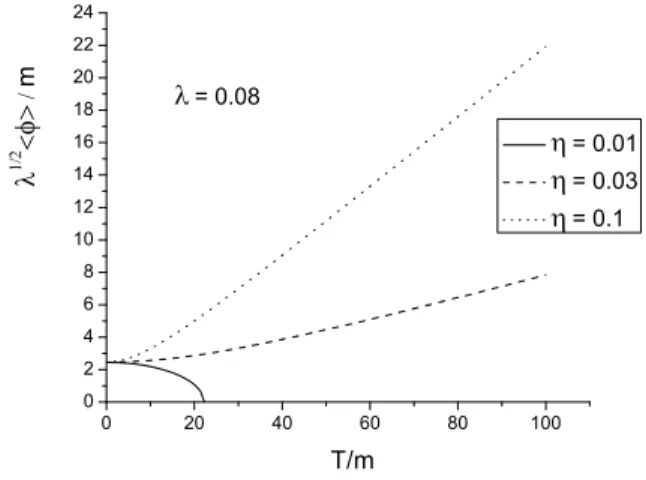
We here concentrate on the behavior of theλφ4theory with a chargen=ηT3. In Fig. (1) we see that for a small charge the spontaneously broken symmetry gets restored, as expected, at high temperatures (here we considerη=0.01). But when the charge increases (increasing the value ofη) the symme-try seems never to get restored, thus given a symmesymme-try non-restoration phenomenon analogous as the one seen in the two-field case at finite temperature only, shown in the previous section.
0 20 40 60 80 100 0
2 4 6 8 10 12 14 16 18 20 22 24
m
T/m
= 0.01
= 0.03
= 0.1 = 0.08
FIG. 1: Behavior of the expectation value of the scalar fieldhφias a function of the temperatureT for different values ofη.
0 20 40 60 80 100
0,0 0,2 0,4 0,6 0,8 1,0 1,2 1,4 1,6 1,8 2,0
<
>
/
m
;
/
m
T/m
below Tc
above Tc
< > above Tc =0.001
=0.01
m 2
>0
FIG. 2: Behavior for the expectation value of the scalar fieldhφi and chemical potentialµas functions of the temperatureT, in the unbroken phase.
4. MULTI-SCALAR FIELD THEORY AT FINITETANDµ
By extending our calculations for a coupled two complex scalar fieldsφandψ, we can consider the Lagrangian density,
L
(φ,φ∗,ψ,ψ∗) = (∂µφ) (∂µφ)∗−m2φ(φφ∗)− λφ3!(φφ ∗)2
+ (∂µψ) (∂µψ)∗−m2ψ(ψψ∗)
− λψ 3!(ψψ
∗)2
−λ(φφ∗) (ψψ∗). (37)
We can write our expressions in terms of fieldsφiandψi(i= 1,2) using the transformations
φ = √1
2(φ1+iφ2)
ψ = √1
2(ψ1+iψ2) (38)
In the Grand Canonical formalism, we introduce the chemical potentials µφ andµψ for charge conservation used for each field separately. The resulting action becomes
S = Z β
0 dτ
Z d3x
· 1 2[φ˙
2
1+φ˙22+ (∇φ1)2+ (∇φ2)2]
+ λ
4! ¡
φ21+φ22 ¢2
+Jiφi
βΩ+iµφ(φ2φ˙1−φ1φ˙2)
− µ 2
φ
2 ¡
φ21+φ22 ¢
+1
2[ψ˙ 2
1+ψ˙22+ (∇ψ1)2+ (∇ψ2)2]
+ λ
4! ¡
ψ2 1+ψ22
¢2
+Jiψi
βΩ +iµψ(ψ2ψ˙1−ψ1ψ˙2)
− µ 2
ψ
2 ¡
ψ2 1+ψ22
¢
+λ
4(φ 2
1+φ22)(ψ21+ψ22) #
. (39)
The next step consist in expanding the action to determine a expression for the effective potential. From Eq. (39) and following similar computation of the effective potential as for the one-field case, the one-loop effective potential is deter-mined by the functional partition function to one-loop order and given by
Veff(φ,ψ) = m2φ
2 ¡
φ21+φ22 ¢
+λφ 4! ¡
φ21+φ22 ¢2
+ m
2
ψ
2 ¡
ψ21+ψ22 ¢
+λψ
4! ¡
ψ21+ψ22 ¢2
+ λ
4 ¡
φ2 1+φ21
¢ ¡
ψ2 1+ψ22
¢
+1
2Tr ln ˆM, (40)
ˆ M=
−∂µ∂µ−µ2+U11φ 2iµ∂τ∂ +λ3φφ1φ2 λφ1ψ1 λφ1ψ2 −2iµ∂τ∂ +λφ
3φ1φ2 −∂µ∂µ−µ 2+Uφ
22 λφ2ψ1 λφ2ψ2
λψ1φ1 λψ1φ2 −∂µ∂µ−µ2+U33ψ 2iµ∂τ∂ +λ3ψψ1ψ2
λψ1φ2 λψ2φ2 −2iµ∂τ∂ +λ3ψψ1ψ2 −∂µ∂µ−µ2U44ψ
, (41)
where
U11φ = m2φ+λφ 2φ
2 1+
λφ
6 φ 2 2+
λ
2ψ 2,
U22φ = m2φ+λφ 2φ
2 2+
λφ
6 φ 2 1+
λ
2ψ 2,
U33ψ = m2ψ+λψ 2 ψ
2 1+
λψ
6 ψ 2 2+
λ
2φ 2,
U44ψ = m2ψ+λψ 2 ψ
2 2+
λψ
6 ψ 2 1+
λ
2φ 2.
(42)
Minimizing the effective potential in relation to φandψ, the phase structure for this theory can be determined. Accord-ing to the results of Sec. II.B, the two-field case, for a con-venient choice of couplings, can result naturally in the phe-nomena of ISB/SNR. From the discussion and analysis of the effects of a finite charge (density) these symmetry change ef-fects can appear even in the one-field case. Thus, we expect that these density effects included in Eq. (40) will strength the emergence of such phenomena in the two-field, or multi-field models. An extensive analysis of the resulting phase diagram obtained from Eq. (40) will be shown elsewhere [17].
5. CONCLUSIONS
In this work we have shown that a high charge density can induce strong changes in the phase structure of the theory.
Be-sides high temperature symmetry restoration it can also ex-hibit symmetry nonrestoration and inverse symmetry break-ing. We can look for this phenomena in different branches of physics, like condensed matter, cosmology and even in ap-plications motivated by the up to date heavy-ion collision ex-periments. Since phenomena like ISB/SNR can appear in a theory with one self-interacting complex scalar field at finite density, it is an interesting matter to explore the same phase structure behavior in models with higher field content. We are currently looking for this kind of phenomena in a multi-scalar field theory at finite temperatures and densities [17].
As a future application we intend to perform the dynam-ics of the multi-scalar field model in order to probe, dynami-cally, the emergence of such interesting phase behaviors like ISB/SNR. One step toward this comparison was done in the classical level for the self-interacting scalar field theory in Ref. [18].
Acknowledgments
The authors would like to thank FAPERJ, CNPq and CAPES for the financial support.
[1] C. W. Bernard, Phys. Rev. D.9, 3312 (1974). [2] L. Dolan and R. Jackiw, Phys. Rev. D9, 3320 (1974). [3] J. Bernstein and S. Dodelson, Phys. Rev. Lett.66, 683 (1991). [4] R. L. S. Farias, G. Krein, and R. O. Ramos, arXiv:0809.1449
(in press Phys. Rev. D).
[5] A. Linde, Rep. Prog. Phys.42, 389 (1979). [6] S. Weinberg, Phys. Rev. D9, 3357 (1974).
[7] R. O. Ramos and M. B. Pinto, Phys. Rev. D61, 125016 (2000). [8] M. B. Pinto, R. O. Ramos, and J. E. Parreira Phys. Rev. D71,
123519 (2005).
[9] R. N. Mohapatra and G. Senjanovic Phys. Rev. Lett.42, 1651 (1979); S. Dodelson and L. M. Widrow, Phys. Rev. Lett.64, 340 (1990); B. Bajc and G. Senjanovic, Nucl. Phys. Proc. Suppl. A 52, 246 (1997).
[10] N. Schupper and N. M. Shnerb, Phys. Rev. E 72, 046107 (2005).
[11] R. O. Ramos and M. B. Pinto, J. Phys. A39, 6687 (2006). [12] M. B. Pinto, R. O. Ramos, and F. F. de Souza Cruz, Phys. Rev.
A74, 033618 (2006).
[13] R. O. Ramos and M. B. Pinto, J. Phys. A39, 6649 (2006). [14] K. M. Benson, J. Bernstein, and S. Dodelson, Phys. Rev. D44,
2480 (1991).
[15] M. B. Pinto and R. O. Ramos, Phys. Rev. D61, 125016 (2000). [16] J. I. Kapusta, Phys. Rev. D24, 426 (1981); H. E. Haber and H. Weldon, Phys. Rev. Lett.46, 1497 (1981); Phys. Rev. D25, 502 (1982); J. I. Kapusta,Finite Temperature Field Theory (Cam-bridge University Press, Cam(Cam-bridge, England, 1989).
[17] R. L. S. Farias, R. O. Ramos, and R. Vartuli, in preparation. [18] R. L. S. Farias, R. O. Ramos, and L. A. da Silva,Langevin