
Forward Physics at the LHC: within and beyond the Standard Model
David d’Enterria
CERN, PH, CH-1211 Geneva 23, Switzerland E-mail: [email protected]
(Received on 4 June, 2008)
We review the detection capabilities in the forward direction of the various LHC experiments together with the associated physics programme. A selection of measurements accessible with near-beam instrumentation in various sectors (and extensions) of the Standard Model (SM) is outlined, including QCD (diffractive and elastic scattering, low-xparton dynamics, hadronic Monte Carlos for cosmic-rays), electroweak processes inγ γ interactions, and Higgs physics (vector-boson-fusion and central exclusive production).
Keywords: LHC; Forward detectors;p-p;Pb-Pb; QCD; Electroweak sector; Exclusive Higgs boson
1. INTRODUCTION
The CERN Large Hadron Collider (LHC) will deliver proton-proton, proton-nucleus and nucleus-nucleus collisions at √sNN=5.5, 8.8 and 14 TeV respectively, opening up an
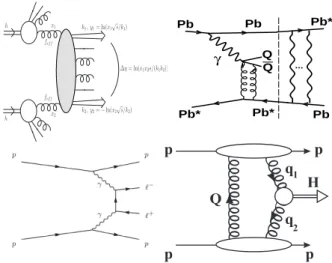
unprecedented phase-space for particle production spanning up to ∆η∼ 20 units of rapidity. Many interesting scatter-ing processes (mostly mediated by colorless exchanges) are characterized by particles emitted at very low angles with re-spect to the beam. Figure 1 shows a few representative dia-grams mediated respectively by (a) partons, (b) a photon and a Pomeron, (c) two photons, and (d) two gluons in a color-singlet state. All these processes are characterized by forward particles (jets, protons, ions) in the final-state plus an (often exclusive) system produced at more central rapidities. We present a summary of the physics programme accessible with the forward instrumentation capabilities available in the six LHC experiments: ALICE, ATLAS, CMS, LHCb, LHCf and TOTEM.
feff x2
h feff
h x1 k1, y1= ln(x1√s/k1)
k2, y2=−ln(x2√s/k2)
∆η= ln(x1x2s/(k1k2))
Pb* Pb
γ
Q Q
...
Pb*
Pb
Pb Pb*
FIG. 1: Diagrams depicting processes in p-p or Pb-Pb collisions at the LHC characterized by forward particle emission: (a) Mueller-Navelet dijets, (b) exclusive quarkonia photoproduction, (c) exclu-sive dileptons, (d) central excluexclu-sive Higgs.
η
-10 0 10
(TeV)
η
/d
tot
dE
-2
10
-1
10 1
(mrad)
θ
0
1571
2
269.0
4
36.6
6
4.9
8
0.67 0.09 η
-10 -5 0 5 10
η
/d
tot
dN
0 2 4 6 8 10
p-p @ 14 TeV [DPMJET]
FIG. 2: Pseudo-rapidity distributions for the total hadron multiplicity (top) and energy (bottom) in p-p at√s= 14 TeV as given by the DPMJET3 model [1].
1.1. Forward kinematics variables
The appropriate kinematic variables in (inelastic) hadronic collisions are the transverse momentum, pT = psinθ, and
the rapidityy=0.5 log(E+pL/E−pL)ory=atanh(pL/E),
wherepL=pcosθis the longitudinal momentum, andθis the
polar angle with respect to the beam axis. The rapidity can be thought of as the relativistically-invariant measure of the lon-gitudinal velocity. Often thepseudorapidityη= -ln tan(θ/2) orη=atanh(pL/p), which depends solely onθ, is used (note thaty≈ηfor negligible masses i.e. forE≈p, provided thatθ is not very small). From Fig. 2, one can see that particle pro-duction in hadronic collisions is peaked atη= 0 (i.e. at 90◦)1, while most of the energy is carried out by particles not far from the beam rapidity,ymax= ln(√s/mp) = 9.54 at 14 TeV. In
elastic or diffractive collisions, one deals with particles scat-tered at very small angles andηis less useful a variable (ulti-mately,η→∞forθ≈0). Instead, the FeynmanxF=2pL/√s
1Note thatdN/dy(not shown) has indeed a Gaussian shape with maximum
or equivalentlyξ≈1−xF, and the four-momentum transfer −t≈(pθ)2≈p2
T, are used.
1.2. Forward detectors at the LHC
If one (somewhat arbitrarily) defines “forward” rapidities as those beyond|η| ≈3, all LHC experiments feature forward detection capabilities without parallel compared to previous colliders (Figs. 3 and 4):
• ATLAS [3] and CMS [4, 5] not only cover the largest pT-ηranges at mid-rapidity for hadrons, electrons,
pho-tons and muons, but they feature extended instrumen-tation at distances far away from the interaction point (IP). Forward calorimetry is available at ±11 m (the FCal and HF [6] hadronic calorimeters), at ±14 m (CMS CASTOR sampling calorimeter) [7], and at
±140 m (the Zero-Degree-Calorimeters, ZDCs) [8, 9]. In addition, ATLAS has (or will have) Roman Pots (RPs) at±220,240 m [10, 11], and there are advanced plans to install a new proton-tagger system at 420 m (FP420) from both the ATLAS and CMS IPs [12].
η
-10 -8 -6 -4 -2 0 2 4 6 8 10
)
c
(GeV/
η
/d
Tdp
-1
10 1 10
2
10
3
10
4
10
ALICE ALICE / LHCb
CASTOR, T2
CASTOR, T2
HF/FCal, T1 HF/FCal, T1 ATLAS,CMS
)
η
/2 exp(-s =
max T
p p-p @ 14 TeV
ZDC, LHCf
ZDC, LHCf TOTEM RPs ALFA RPs FP420
TOTEM RPs
ALFA RPs
FP420
η
-10 -8 -6 -4 -2 0 2 4 6 8 10
)
c
(GeV/
η
/d
Tdp
-1
10 1 10
2
10
3
10
4
10
~140m-240m-420m ~14-17 m
~11 m
FIG. 3: ApproximatepT-ηcoverage of current (and proposed)
de-tectors at the LHC (adapted from [2]).
• Both ALICE [13] and LHCb [14] have forward muon spectrometers in regions, 2. η . 5, not covered by ATLAS or CMS. In addition, LHCb has good tracking, calorimetry and particle identification for the measure-ment of hadrons, electrons and photons in thisηrange; and ALICE has also ZDCs at±116 m [15].
• The TOTEM experiment [16], sharing IP5 with CMS, features two types of trackers (T1 and T2 telescopes) covering 3.1<|η|<4.7 and 5.2<|η|<6.5 respec-tively, plus proton-taggers (Roman Pots) at ±147 and
±220 m.
• The LHCf experiment [17] has installed scintilla-tor/silicon calorimeters in the same region of the AT-LAS ZDCs,±140 m away from IP1.
FIG. 4: Layout of the detectors in the CMS/TOTEM forward region at the LHC interaction point 5 [5].
A rich variety of physics measurements are accessible uti-lizing such forward instrumentation in three possible detection modes:
1. as detectors todirectly measure the 4-momentumof a given final-state produced in the reaction e.g. a jet in CASTOR, a zero-degree photon in LHCf/ZDC, or a leading proton in FP420;
2. astaggingdevices to signal the presence of a diffrac-tively or elastically scattered proton (or a neutron) in Roman Pots (or ZDCs);
3. asvetoing devices of final-state particles in the colli-sion, e.g. requiring no hadronic activity within a given (forward) rapidity range covered by one or more detec-tors.
1.3. Forward physics at the LHC
The following QCD, electro-weak, and Higgs physics topics, developed in more detail in the remainder of the document, can be studied with forward instrumentation:
exclusive photoproduction γ-p [22] and γ-A [23] processes, tagged with forward protons (neutrons) in RPs (ZDCs). Third, hadronic models of ultra-high-energy (UHE) cosmic-rays in-teractions in the upper atmosphere can be effectively tuned by measuring the forward energy (dE/dη) and particle (dN/dη) flows inp-p,p-A, andA-Acollisions [24].
b. Electroweak sector (Section 3). All charges accel-erated at very high energies generate electromagnetic fields which, in the equivalent photon approximation, can be con-sidered as (quasi-real) photon beams. A significant fraction of the p-p [22] and Pb-Pb[23] collisions at the LHC will thus involve photon interactions at TeV energies giving ac-cess to a unique programme ofγ-induced studies. In particu-lar, photon-photon interactions, tagged with forward protons (neutrons) in the RPs (ZDCs), allow one to measure the beam luminosity via the pure QED processγ γ→l+l−; or to study (anomalous) gauge boson couplings viaγ-p,γ-A→p nW, or γ γ→ZZ,WW.
c. Higgs physics (Section 4). Two mechanisms of Higgs production at the LHC are accompanied by forward parti-cle emission. First, the vector-boson-fusion (VBF) process, pp→qq→qHq, where the two valence quarks radiateW or Z bosons which merge to form the Higgs, and then frag-ment into two forward-backward jets tagged in the forward calorimeter systems. Second, the central exclusive channel, pp→pH p(diagram (d) of Fig. 1), where the Higgs boson is produced at central rapidities from the fusion of a two-gluon (color-singlet) system [25] and the interacting protons, scat-tered intact at very small angles, are measured e.g. in the planned FP420 proton spectrometer [12].
2. QCD PHYSICS
2.1. Elastic scattering
The measurement at the LHC of the total p-p cross section and of theρ-parameter (the ratio of real to imaginary part of the forward elastic scattering amplitude) provides a valuable test of fundamental quantum mechanics relations such as the Froissart bound σtot <Const ln2s, the
opti-cal theorem σtot ∼Imfel(t = 0), and dispersion relations
Refel(t=0)∼Imfel(t=0)[26]. The current extrapolations
of the total p-p cross section at the LHC (σtot = 90 –
140 mb), of which the elastic contribution accounts for about one fourth, suffer from large uncertainties due to a 2.6σ disagreement between the E710 and CDF measurements at Tevatron (Fig. 5, top).
The main goal of TOTEM experiment is to obtain a precise measurement of the total and elasticp-pcross sections over a large range of 4-momentum transfers from−t≈2·10−3GeV2 to 8 GeV2, using differentβ∗optics settings (Fig. 5, bottom).
The total p-p cross section and the LHC luminosity will be measured making use of the optical theorem via
σtot=
16π 1+ρ2·
dNel/dt|t=0
Nel+Ninel
,
L
=1+ρ2
16π ·
(Nel+Ninel)2
dNel/dt|t=0 .
40 60 80 100 120
102 103 104
ISR
best fit with stat. error band incl. both TEVATRON points
total error band of best fit
considered
total error band from all models
UA5
Cosmic-rays
[mb]
σ
E811, CDF
CDF, UA4 LHC error
s [GeV]
pp
Events / (GeV² x day)
105
106
107
108
104
10
102
103
1
0.1
10−2
−3 10
d /dt [mb / GeV²]
σ
−t [GeV²] diffractive structure
pQCD ~ |t| Coulomb − nuclear interference
(BSW model) pp at 14 TeV
−8 Pomeron exchange ~ e−B |t|
β =* 0.5 m (6):
(1): x 1 (2): x 10
(6): x 50000 (5): x 10000 (4): x 1000 (3): x 150
18 m
β =* (5):
90 m
β =* (3, 4): (1, 2):β =*1540 m
FIG. 5: Top: COMPETE predictions [27] forσtot with statistical
(blue solid) and total (dashed) errors (including the Tevatron ambi-guity) compared to existing data. Bottom: Prediction for elastic p-p scattering at the LHC with various beam optics settings [28].
Assuming an uncertainty inρ=0.12±0.02,σtot and
L
canbe measured within about 1 %. Also ATLAS plans to measure the elastic cross section with its Roman Pots [11] based on a fit of the data in the Coulomb region to
dN
dt (t→0) =
L
πµ −2α
|t| +
σtot
4π(i+ρ)e− b|t|/2
¶2
. (1)
Such a measurement requires to go down to −t ∼6.5·
10−4 GeV2(i.e. θ∼3.5µrad) to reach the kinematical do-main where the strong amplitude equals the electromagnetic one.
2.2. Hard and soft diffractive processes
Diffractive physics covers the class of inelastic interactions that contain large rapidity gaps (LRGs, ∆η&4) devoid of hadronic activity and where one or both protons emerge intact in the final state [18]. Such event topologies, with reduced QCD radiation, imply colorless exchange mediated by two or more gluons in a color-singlet state (a Pomeron, IP). Depending on the number and relative separation of the LRGs, one further differentiates between single, double, or double-Pomeron-exchange (DPE) processes (Fig. 6). The centrally produced system has a mass equal to M2≈sξ1
(M2≈sξ
of the rapidity gap is of the order of∆η∼log 1/ξ1,2.
FIG. 6: Event topologies inηvs azimuthφfor elastic and diffractive p-p interactions. Shaded (empty) areas represent particle-production (rapidity-gaps) regions [19].
The interest of diffractive processes is manifold. On the one hand, soft diffraction processes, dominated by non-perturbative (Regge) dynamics, constitute a significant frac-tion (∼20%) of the total inelastic p-p cross section. Their characterization – in particular the so-called “rapidity-gap sur-vival probability” – is important in order to have under control the backgrounds of many processes at the LHC [29]. On the other, hard diffraction processes which involve the produc-tion of a high-mass or large-pT state (QQ, jets,W,Z...) are
in principle perturbatively calculable and provide information on diffractive (or generalized) Parton Distribution Functions, dPDFs (GPDs), which describe not only the density of partons in the proton but also their correlations [30].
2.3. Parton structure and evolution at low-x
Figure 7 summarizes the methods at hand to determine the gluon densityxG(x,Q2)in the proton as a function of frac-tional momentax=pparton/pproton. The main source of
informa-tion so far onxG(x,Q2)is (indirectly) obtained from the lnQ2 slope (“scaling violations”) of theF2structure function ine
-p deep-inelastic-scattering (DIS). Additional constraints can be obtained fromF2charm[31] and diffractive photoproduction of heavy vector mesons (J/ψ,ϒ) [32] and, in particular (since xG∝FL), from the longitudinal structure functionFL.
For decreasing parton momentum fraction x, the gluon density is observed to grow rapidly. As long as the den-sities are not too high, this growth is described by the Dokshitzer-Gribov-Lipatov-Altarelli-Parisi (DGLAP) [33] or by the Balitski-Fadin-Kuraev-Lipatov (BFKL) [34] evolution equations which govern, respectively, parton radiation inQ2
and x (Fig. 8). Eventually, at high enough center-of-mass energies (i.e. at very small x) the gluon density will be so large that non-linear (gluon-gluon fusion) effects will become important [35]. A regime of saturated parton densities is thus expected for small enough xvalues at virtualities below an energy-dependent “saturation momentum” scale,Qs, intrinsic
to the size of the hadron. Saturation effects are amplified in nuclear targets because of their increased transverse parton density compared to the proton (for nuclei,Q2s ∝A1/3where A≈200 is the mass number inPborAu) [20].
x
-6
10 10-5 10-4 10-3 10-2 10-1 1
)
2
= 10 GeV
2
xG(x,Q
-1
10 1 10
2
10
)
2
= 10 GeV
2
gluon (Q
CTEQ6.1M
MRST-NLO 2004
charm 2 , F L , F 2 /dlnQ 2 dF
(di)jets
γ
prompt
Υ
,
Ψ
diffractive J/
fixed-target CERN-SppS Tevatron
RHIC HERA
HERA RHIC (γA)
A) γ LHC (
LHC
x
-6
10 10-5 10-4 10-3 10-2 10-1 1
)
2
= 10 GeV
2
xG(x,Q
-1
10 1 10
2
10
FIG. 7: Examples of measurements providing information on the gluon PDF as a function ofx[21].
FIG. 8: log(1/x)-Q2plane with the different QCD evolution regimes (DGLAP, BFKL, saturation).
In hadron-hadron collisions, information onxGcan be ob-tained in processes with prompt photons, jets, and heavy-quarks in the final state. In a 2→ 2 parton scattering theminimummomentum fraction probed when a particle of momentum pT is produced at pseudo-rapidity η is xmin =
2pT/√s exp(−η), i.e.xmindecreases by a factor of∼10 every
2 units of rapidity. Thus, forward instrumentation provides an important lever arm for the measurement of the low-x struc-ture and evolution of the parton densities. Three representa-tive low-xQCD measurements at the LHC [21] are discussed next.
•Case study I: Forward (di)jets
From the formula forxminabove, it follows that the
mea-surement of relatively soft jets withET ≈20–100 GeV in the
uncertain-ties result in variations of the jet cross sections as large as 60% (Fig. 9, top). The interest in forward jet measurements goes beyond thesingleinclusive cross sections: the production of dijets with similar ET but separated by large rapidities, the
so-called “Mueller-Navelet jets” (diagram (a) of Fig. 1) [37], is a particularly sensitive measure of BFKL [38, 39] as well as non-linear [40, 41] QCD evolutions. The large rapidity interval between the jets (e.g. up to ∆η≈ 12 in the ex-tremes of CMS forward calorimeters) enhances large loga-rithms of the type ∆η∼log(s/ET,1ET,2) which can be
ap-propriately resummed using the BFKL equation. One of the phenomenological implications of BFKL dynamics is an en-hanced radiation between the two jets which results in a larger azimuthal decorrelation for increasing∆η separations, com-pared to collinear pQCD approaches. Preliminary CMS anal-yses [36] indicate that such studies are well feasible by mea-suring jets in each one of the HF forward calorimeters (Fig. 9, bottom).
(GeV)
T
E
20 40 60 80 100
-1
GeV
η
dT
/dE
HF jets
dN
3
10
4
10
5
10
6
10
7
10
8
10
| < 5
η
jet +X , 3 < |
→
pp -1
L dt=1 pb
∫
,
PYTHIA CTEQ5L (parton-level)
PYTHIA MRST03 (parton-level)
NLO (CTEQ6M ICone R=0.5)
φ ∆
-3 -2 -1 0 1 2 3
φ∆
1/N dN/d
0 0.05 0.1 0.15 0.2 0.25 0.3 0.35 0.4 0.45
|<5.)
1,2
η
HF dijets (3.<|
<8
η ∆
7<=
<9
η ∆
8<=
<10
η ∆
9<=
Mueller-Navelet cuts
Generator-level
FIG. 9: Forward jet results in (1 pb−1) p-p collisions at √
s = 14 TeV [36]. Top: Single inclusive jet yields in the CMS forward calorimeters expected with various PDF sets. Bottom: ∆φ= (φ1−φ2)−πdistributions for dijet events passing the Mueller-Navelet cuts with separations∆η= 7.5, 8.5 and 9.5.
•Case study II: Forward heavy-quarks
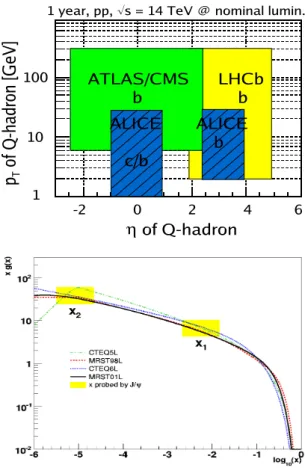
The possibility of ALICE and LHCb (Fig. 10, top) to recon-struct heavyDandBmesons as well as quarkonia in a large forward rapidity range can also add stringent constraints on the gluon structure and evolution at low-x. Studies of small-xeffects on heavy flavor production based on collinear and kT factorization, including non-linear terms in the parton
evo-lution, lead to varying predictions for the measuredcandb cross sections at the LHC [31]. The hadroproduction ofJ/ψ proceeds mainly via gluon-gluon fusion and, having a mass around the saturation scaleQs≈3 GeV at the LHC, is also a
sensitive probe of possible gluon saturation phenomena. Fig-ure 10 (bottom) shows the gluonxrange probed in p-p col-lisions producing aJ/ψinside the ALICE muon arm accep-tance (2.5.η.4). The observed differences in the underly-ing PDF fits translate into variations as large as a factor of∼2 in the finally measured cross sections [42].
FIG. 10: Top: Acceptances in(η,pT)for open charm and bottom at
the LHC [31]. Bottom: Sensitivity of the forwardJ/ψmeasurement in ALICE to variousxranges of the gluon PDF [42].
•Case study III: QQ exclusive photoproduction
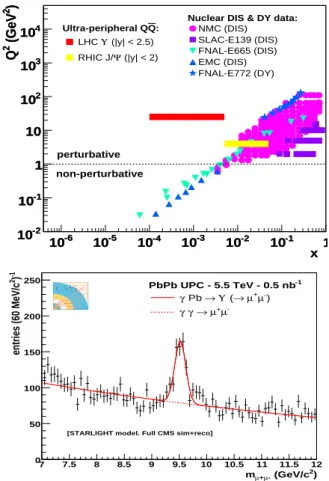
ex-clusive photoproduction of quarkonia, dijets and other hard processes [23]. This is particularly interesting with heavy-ions where, thanks to the large nuclear charge (Z = 80 for Pb), the available photon fluxes (dNγ/dω ∝Z2) allow one to
precisely probe the barely known nuclear gluon distribution (Fig. 11, top). Lead beams at 2.75 TeV have Lorentz fac-torsγ= 2930 leading to maximum (equivalent) photon ener-gies ωmax ≈γ/R∼ 100 GeV, and corresponding maximum
c.m. energies: Wγ γmax≈ 160 GeV andWγmax
-A≈ 1 TeV, i.e. 3–4 times higher than equivalent photoproduction studies at HERA. Thexvalues probed inγ-A→QQ Aprocesses (dia-gram (b) of Fig. 1) can be as low asx∼10−5[43]. ALICE, ATLAS and CMS can measure theJ/ψ,ϒ→e+e−,µ+µ− pro-duced in electromagneticPb-Pbcollisions tagged with neu-trons detected in the ZDCs. Full simulation analyses [44] indicate that CMS can measure a total yield of ∼500 ϒ’s within |η|<2.5 for the nominal 0.5 nb−1 Pb-Pbintegrated luminosity (Fig. 11, bottom). With such statistics, studies of the pT andηdistributions of theϒcan be carried out which
will help constrain the low-xgluon density in thePbnucleus. Similar exclusiveϒstudies have been conducted inp-p colli-sions [45].
x
-6
10 10-5 10-4 10-3 10-2 10-1 1
) 2 (GeV 2 Q -2 10 -1 10 1 10 2 10 3 10 4 10 x -6
10 10-5 10-4 10-3 10-2 10-1 1
) 2 (GeV 2 Q -2 10 -1 10 1 10 2 10 3 10 4
10 Ultra-peripheral QQ:
(|y| < 2.5) Υ LHC
(|y| < 2) Ψ RHIC J/
Nuclear DIS & DY data:
NMC (DIS) SLAC-E139 (DIS) FNAL-E665 (DIS) EMC (DIS) FNAL-E772 (DY) perturbative non-perturbative ) 2 (GeV/c -µ + µ m
7 7.5 8 8.5 9 9.5 10 10.5 11 11.5 12
-1)
2
entries (60 MeV/c
0 50 100 150 200
250 PbPb UPC - 5.5 TeV - 0.5 nb-1
) -µ + µ → ( Υ → Pb γ -µ + µ → γ γ
[STARLIGHT model. Full CMS sim+reco]
FIG. 11: Top: Kinematic (x,Q2) plane probed in e-,γ-A colli-sions: DIS data compared to ultraperipheral QQ photoproduction ranges [43]. Bottom: Expected dimuon invariant mass fromγPb→
ϒPb⋆on top of theγ γ→µ+µ−continuum in ultraperipheralPb-Pb collisions at√sNN=5.5 TeV [44].
Energy (eV/particle)
13 10 14 10 15 10 16 10 17 10 18 10 19 10 20 10 ) 1.5 eV -1 sr -1 sec -2
J(E) (m
2.5
Scaled flux E
13 10 14 10 15 10 16 10 17 10 18 10 19 10 (GeV) pp s Equivalent c.m. energy
2
10 3
10 104 5
10 6 10 RHIC (p-p) -p) γ HERA ( Tevatron (p-p) LHC (p-p) ATIC PROTON RUNJOB
KASCADE (QGSJET 01) KASCADE (SIBYLL 2.1) KASCADE-Grande (prel.) Akeno HiRes-MIA HiRes I HiRes II AGASA Auger 2007
FIG. 12: Top: Measured CR energy spectrum. Bottom: Pseudora-pidity energy density forp-pat√s= 14 TeV predicted by various commonly used MC models in UHE cosmic rays physics [24].
2.4. Validation of QCD Monte Carlos for UHE cosmic-rays
The LHC will not only address fundamental open questions in particle physics but will also provide valuable insights in closely related domains, such as on the origin and nature of cosmic rays (CRs) with energies between 1015 eV and the so-called “GZK-cutoff” at 1020eV, recently measured by the
HiRes [46] and Auger [47] experiments (Fig. 12, top). CR candidates are protons and nuclei as massive as iron, which generate “extended air-showers” in proton-nucleus (p-Air) and nucleus-nucleus (α-,Fe- Air) collisions when entering the atmosphere. Determination of the primary energy and mass relies on hadronic Monte Carlo codes which describe the in-teractions of the primary (dominated by forward and soft QCD interactions) in the upper atmosphere [24]. Existing MC mod-els predict energy and multiplicity flows differing by factors as large as three, with significant inconsistencies in the for-ward region. The measurement of forfor-ward particle production inp-p,p-AandA-Acollisions2at LHC energies (equivalent toElab≈1017 eV) will provide strong constraints on these
models and allow for more reliable extrapolations of the CR energy and composition around the GZK cut-off. Figure 12 (bottom) compares the predictions of QGSJET [48],
DPM-2Note that CRs interactions in the atmosphere are mostly proton-nucleus
JET [1], NEXUS [49], EPOS [50], and PYTHIA [51] for the energy flow (dE/dη) inp-pcollisions at√s= 14 TeV. In the range covered by detectors like CASTOR or TOTEM (around
|η| ≈6) and ZDC or LHCf (beyond|η| ≈8, for neutrals), the model predictions differ by up to∼60%.
3. ELECTROWEAK PHYSICS
3.1. Beam luminosity via exclusive dileptons
Two-photon dilepton production, pp→p l+l−p(diagram (c) of Fig. 1) is a useful luminosity calibration process, thanks to its precisely known (nearly pure) QED cross sec-tion [52]. Experimentally, such a process can be tagged with rapidity-gaps (“exclusivity”) conditions [45] or via forward protons [22], and has a clear signature in the exclusive back-to-back dileptons (|∆φ(l+l−)|>2.9) measured within
|η|<3. TheLPAIR [53] cross section for events where both muons havepT >3 GeV/c and can, therefore, reach the CMS
muon chambers is about 50 pb. About 710 exclusive dimuons per 100 pb−1are expected in CMS after selection cuts [45]. The resulting invariant mass distribution is shown in Fig. 13, together with the background muons from the ϒ decay and inelastic (or dissociative) dimuon events. This measurement is also easily accessible in electromagneticPb-Pbcollisions (see Fig. 11 bottom) where the dilepton continuum (thanks to theZ4photon flux enhancement factor) is much larger than in p-p.
FIG. 13: Dimuon mass distribution in photon-induced events (for 100−1 pb in p-pat√s= 14 TeV) passing the exclusivity cuts dis-cussed in [45].
3.2. New physics via anomalous gauge boson couplings
The study of the couplings of the gauge bosons (γ,W and Z) among themselves provides the most direct (yet difficult) way to test the gauge structure of the electroweak theory. Many physics scenarios beyond the SM, with novel interac-tions and/or particles, lead to modificainterac-tions of the gauge boson
self-interaction vertices. A process well-suited to testing the tripleWWγvertex is the photoproduction of singleW bosons from a nucleon in ultra-peripheralp-p[22] andA-A[54] col-lisions tagged with forward protons or neutrons (Fig. 14). A large cross section of about 1 pb is expected for large photon-proton c.m. energies,Wγp>1 TeV. In addition, the exclusive
two-photon production ofW+W−pairs probesquartic gauge-boson-couplings. The process has a total cross section of more than 100 fb, and a very clear signature. Its cross section is still about 10 fb forWγp>1 TeV showing sensitivity to physics
beyond the SM [22].
FIG. 14: Rapidity distribution of single-W photoproduction [54] in p-pat√s= 14 TeV – note that the forward protons (neutrons) fall within the RP (ZDC) acceptances.
4. HIGGS PHYSICS
4.1. Vector Boson Fusion production
The second most important production channel of the SM Higgs boson at the LHC (Fig. 15), is the vector-boson-fusion (VBF) process where twoW orZ, radiated off valence quarks, merge to produce a Higgs. The distinctive signature of VBF is the presence of two forward-backward jets from the frag-mentation of the two incoming quarks. The importance of forward calorimetry proves crucial to select VBF events. The average separation of these jets is ∆η≈5 and, thus, VBF events are usually tagged in ATLAS and CMS by jets de-tected in the FCal and HF calorimeters. Such a distinct event topology reduces efficiently a significant fraction of the Higgs backgrounds (e.g. tt¯,WW orW,Z+n jwhich are character-ized by jets at central rapidities, see Fig. 16) making the qq H→qqWW andqq H→qqττdiscovery channels at the LHC [55, 58].
4.2. Central exclusive production
Central exclusive production (CEP) is defined as a process of the type pp→p⊕X⊕p, where X is a fully measured simple state such asχc,b, jet-jet (j j),γ γ, H, ... and ’⊕’
(GeV)
H
M
80
100
120
140
160
180
200
(fb)
σ
-1
10
1
10
2
10
3
10
4
10
5
10
=14 TeV s H+X), → (pp σ
H → gg
qq H → qq
W
H
→ ’ q q
Z H → q q
t t H → q gg,q b
b H →
q gg,q
H
→ qb
H
→ γ γ
p H p
→
pp
NLO, MRST02/04
FIG. 15: Cross sections for the SM Higgs versusMhin nine different
production channels at the LHC, from [56] (σpH pis from [12], and σγ γ→Hfrom [57]).
0 0.01 0.02 0.03 0.04 0.05
-4 -2 0 2 4
η
Arbitrary units
FIG. 16: Typical pseudorapidity distribution of the jets in VBF Higgs events and intt¯background events [58].
production (diagram (d) of Fig. 1) has attracted significant experimental and theoretical interest for various important reasons [12, 25]. First, to a very good approximation in CEP the primary active di-gluon system obeys a Jz = 0,
C-even, P-even, selection rule (whereJz is the projection of
the total angular momentum along the proton beam axis). This selection rule readily permits a clean determination of the quantum numbers of any new resonance by measuring the azimuthal correlations of the scattered protons. Second, because the process is exclusive, the energy loss of the outgoing protons is directly related to the invariant mass of the central system,M2≈sξ1ξ2, allowing an excellent mass
measurement (σM ∼2 GeV/c2) irrespective of the decay
mode of the central system. Third, thanks to the spin selec-tion rule a large fracselec-tion of QCD producselec-tion is suppressed
resulting in a very favorable 1:1 signal-to-background. The expected SM cross sections are of order 3–10 fb (Fig. 15) although, in certain regions of the minimal supersymmetric extension of the SM (MSSM, at high tanβ and small MA)
with enhanced Higgs coupling to fermions, they can be a factor of 10–100 larger [59].
FIG. 17: Top view of the proposed FP420 system at 420 m from AT-LAS and CMS IPs (zoom shows the support table with one detector section) [12].
For a Higgs mass close to the LEP limit,MH≈120 GeV/c2,
the optimal proton tagging acceptance is beyond the current Roman Pots at 220,240 m. The proposed FP420 detector sys-tem [12] – a magnetic spectrometer consisting of a moveable silicon tracking system and fast ˇCerenkov detectors located in a 12-m region at about 420 m from the ATLAS and CMS IPs (Fig. 17) – allows for the detection of both outgoing protons scattered by a few hundredsµrads (i.e. 3 – 9 mm) relative to the LHC beam line. A measurement of the protons rela-tive time of arrival in the 10 ps range is required for matching them with a central vertex within∼2 mm, which will enable the rejection of a large fraction of the pile-up background at high-luminosities. Under such circumstances, the Higgs bo-son line-shape can be reconstructed in the otherwise (difficult) bb¯channel with a 3σor better significance with an integrated luminosity of 60 fb−1(Fig. 18).
M (GeV)
100 110 120 130 140 150
)
-1s
-2
cm
33
N events (3 years at 2x10
0 2 4 6 8 10 12 14 16
FIG. 18: Expected mass fit for the MSSM h → bb¯ decay (Mh= 120 GeV/c2), measured with FP420 in 60 fb−1integrated
Summary
Many interesting scattering processes at the LHC – medi-ated by colorless exchanges (photons, heavy gauge-bosons, Pomerons, di-gluons in a color-single-state) – are open to study at TeV energies for the first time, thanks to detec-tor instrumentation at low angles with respect to the beam. We have reviewed the near-beam instrumentation capabili-ties (at pseudo-rapidicapabili-ties |η|> 3) and the associated “for-ward” physics programme of the various LHC experiments in various sectors and extensions of the Standard Model. The varied and unique set of measurements accessible in the QCD (diffractive, low-x, hadronic MCs for cosmic-rays), electroweak (exclusive dileptons, gauge couplings), Higgs (vector-boson-fusion and exclusive production) and beyond
the SM (anomalous couplings, exclusive MSSM Higgs) sec-tors, provides a powerful and complementary way to ex-plore the particles and interactions of nature at energies never reached before.
Acknowledgments
I would like to thank the organisers of LAWHEP’07 – in particular Beatriz Gay-Ducati, Magno Machado and Carlos A. Garcia-Canal – for their kind invitation to an stimulating physics school. Special thanks due to Michele Arneodo and Albert de Roeck for valuable discussions. Work supported by the 6th EU Framework Programme contract MEIF-CT-2005-025073.
[1] S. Roesler, R. Engel and J. Ranft, arXiv:hep-ph/0012252 (2000).
[2] R. Orava, J. Lamsa, Diffraction’06 Int. Workshop (2006). [3] ATLAS: Detector and Physics performance TDR,
CERN/LHCC-99-14 (1999).
[4] CMS Physics TDR, Volume I: Detector Performance and Soft-ware, CERN/LHCC-2006-001(2006).
[5] M. Albrow et al. [CMS/TOTEM Collabs.], CERN-LHCC-2006-039 (2006).
[6] A. S. Ayanet al., J. Phys. G30N33 (2004). [7] X. Aslanoglouet al., Eur. Phys. J. C52, 495 (2007).
[8] S.N. Whiteet al.[ATLAS Collaboration], CERN-LHCC-2007-001.
[9] O. A. Grachovet al.[CMS Collaboration], AIP Conf. Proc.
867, 258 (2006).
[10] C. Royon [RP220 Collaboration], arXiv:0706.1796 [physics.ins-det].
[11] S. Ask [ATLAS Collaboration], Proceeds. DIS’07 arXiv:0706.0644 [hep-ex].
[12] M.G. Albrow et al. [FP420 R&D Collaboration], arXiv:0806.0302 [hep-ex].
[13] F. Carminatiet al.[ALICE Collaboration], J. Phys. G30, 1517 (2004).
[14] LHCb, Reoptimised Detector Design and Performance TDR, CERN/LHCC 2003-030, (2003).
[15] ALICE TDR: Zero degree calorimeter (ZDC), CERN-LHCC-99-05 (1999).
[16] V. Berardiet al.[TOTEM Collaboration], CERN/LHCC-2004-002 (2004).
[17] Technical Design Report of the LHCf experiment, CERN-LHCC-2006-004 (2006).
[18] M. Arneodo and M. Diehl, arXiv:hep-ph/0511047 (2005). [19] K. Goulianos, arXiv:0707.1055 [hep-ex] (2007).
[20] See e.g. F. Gelis, T. Lappi and R. Venugopalan, Int. J. Mod. Phys. E16, 2595 (2007).
[21] D. d’Enterria, Eur. Phys. J. A31, 816 (2007).
[22] J. Favereauet al., CP3-08-04 (June 2008), to be submitted to Eur. Phys. J. C.
[23] A. Baltzet al., Phys. Rept.458, 1 (2008).
[24] D. d’Enterria, R. Engel. T. McCauley and Tanguy Pierog, Pro-ceeds. QM08; arxiv:0806.0944.
[25] A. De Roeck, V. A. Khoze, A. D. Martin, R. Orava, and M. G. Ryskin, Eur. Phys. J. C25, 391 (2002).
[26] C. Bourrely, N. N. Khuri, A. Martin, J. Soffer and T. T. Wu, arXiv:hep-ph/0511135 (2005).
[27] J. R. Cudellet al.[COMPETE Collaboration], Phys. Rev. Lett.
89, 201801 (2002).
[28] G. Anelliet al.[TOTEM Collaboration], arXiv:hep-ex/0602025 (2006).
[29] M. G. Ryskin, A. D. Martin and V. A. Khoze, Eur. Phys. J. C
54, 199 (2008).
[30] M. Diehl, Phys. Rept.388, 41 (2003).
[31] J. Baines et al., Proceeds. HERA-LHC Workshop, hep-ph/0601164 (2006).
[32] A. D. Martin, C. Nockles, M. G. Ryskin and T. Teubner, Phys. Lett. B662, 252 (2008).
[33] V.N. Gribov and L.N. Lipatov, Sov. Journ. Nucl. Phys.15, 438 (1972); G. Altarelli and G. Parisi, Nucl. Phys. B 126, 298 (1977); Yu. L. Dokshitzer, Sov. Phys. JETP46, 641 (1977). [34] L.N. Lipatov, Sov. J. Nucl. Phys.23, 338 (1976); E.A. Kuraev,
L.N. Lipatov and V.S. Fadin, Zh. Eksp. Teor. Fiz72, 3 (1977); I.I. Balitsky, L.N. Lipatov, Sov. J. Nucl. Phys.28, 822 (1978). [35] L. Gribov, E. M. Levin and M. G. Ryskin, Phys. Rept.100, 1
(1983); A. H. Mueller and J. w. Qiu, Nucl. Phys. B268, 427 (1986).
[36] S.Cerci and D. d’Enterria, Proceeds. QM’08, arxiv:0806.0091, Indian J. Phys, to appear.
[37] A. H. Mueller and H. Navelet, Nucl. Phys. B282, 727 (1987) [38] V. Del Duca and C. R. Schmidt, Phys. Rev. D49, 4510 (1994). [39] A. Sabio Vera, F. Schwennsen, Nucl. Phys. B776, 170 (2007);
Nucl. Phys. B746, 1 (2006).
[40] C. Marquet and C. Royon, Nucl. Phys. B739, 131 (2006); and arXiv:0704.3409 [hep-ph].
[41] E. Iancu, M. S. Kugeratski and D. N. Triantafyllopoulos, arXiv:0802.0343 [hep-ph].
[42] D. Stocco [ALICE Collaboration], High energy QCD Work-shop, ECT*, Trento (2007).
[43] D. d’Enterria, Proceeds. Photon’07, Nucl. Phys. B Proc. Suppl. to appear; arXiv:0711.1123.
[44] D. d’Enterria (ed.), [CMS Collaboration], J. Phys. G34, 2307 (2007).
[45] J. Hollar, S. Ovyn and X. Rouby [CMS Collaboration], CMS PAS-DIF-07-001.
[46] R. Abbasiet al.[HiRes Collaboration], Phys. Rev. Lett.100, 101101 (2008).
[astro-ph].
[48] S. Ostapchenko, AIP Conf. Proc. 928, 118 (2007), and refs. therein.
[49] T. Pieroget al., Nucl. Phys.A715, 895 (2003).
[50] K. Werner, T. Pierog, AIP Conf.Proc. 928, 111 (2007), and refs. therein.
[51] T. Sjostrandet al., JHEP05026 (2006)
[52] D. Bocian and K. Piotrzkowski, Acta Phys. Polon. B352417 (2004).
[53] J. Vermaseren, Nucl. Phys. B229, 347 (1983) [54] U. Dreyer, PhD thesis, Univ. Basel, 2007.
[55] G. L. Bayatianet al.[CMS Collaboration], J. Phys. G34, 995 (2007).
[56] M. Spira, A. Djouadi, D. Graudenz, and P. M. Zerwas, Nucl. Phys.B453(1995).
[57] E. Papageorgiu, Phys. Lett. B352, 394 (1995).
[58] S. Asaiet al.[ATLAS Collaboration], Eur. Phys. J. C32S2, 19 (2004).
[59] S. Heinemeyeret al., Eur. Phys. J. C53, 231 (2008).
![FIG. 4: Layout of the detectors in the CMS/TOTEM forward region at the LHC interaction point 5 [5].](https://thumb-eu.123doks.com/thumbv2/123dok_br/18982877.457700/2.892.78.445.493.801/fig-layout-detectors-totem-forward-region-interaction-point.webp)
![FIG. 5: Top: COMPETE predictions [27] for σ tot with statistical (blue solid) and total (dashed) errors (including the Tevatron ambi-guity) compared to existing data](https://thumb-eu.123doks.com/thumbv2/123dok_br/18982877.457700/3.892.469.793.70.505/compete-predictions-statistical-dashed-including-tevatron-compared-existing.webp)


![FIG. 15: Cross sections for the SM Higgs versus M h in nine different production channels at the LHC, from [56] (σ pH p is from [12], and σ γ γ → H from [57])](https://thumb-eu.123doks.com/thumbv2/123dok_br/18982877.457700/8.892.88.436.75.433/fig-cross-sections-higgs-versus-different-production-channels.webp)
