Arterial Hypertension and Family Care: Care Provided to
Hypertensive Individuals in a Small Municipality in Southern Brazil
Luciano Burigo de Sousa, Regina Kazue Tanno de Souza, Maria José Scochi
Universidade Estadual de Maringá - Londrina, PR - Brazil
objective: Based on the analysis of indicators which express the rationale of the actions of the program, we developed a cross-sectional study to assess the performance of a Family Healthcare Team as regards the care provided to individuals with arterial hypertension living in a small municipality.
Methods:The study carried out was based on the analysis of the records (Record A) of SIAB (Primary Care Information System) of 418 individuals suffering from arterial hypertension, of 351 records stored in the primary healthcare center, and of 376 interviews with individuals living in the area under the team’s care, in the year 2003. The following variables were studied: gender, age, family income, housing conditions, health services used, presence of diabetes mellitus, coverage and concentra-tion of care.
results: Women above 60 years of age prevailed. They were 65.7% of the cases. The arterial hypertension prevalence rate was 18%, and was different for both genders: for women it was 22.3%. The coverage was 64.1% for appointments with doctors, 32.4% for appointments with nurses, and 36.4% for home visits. The information on files revealed that 25.8% of hypertensive individuals did not receive care in 2003 and 52.7% did not receive care in the last semester. The concentration of care was below the recommendation.
conclusion: The information showed that the organization of health care does not reflect the rationale of health surveillance in that services focus mostly on meeting spontaneous demand, which in turn reflects unpreparedness as to the use of informa-tion systems for the planning and evaluainforma-tion of acinforma-tions.
Key words:Arterial hypertension, program actions, family health, information system.
correspondência: regina Kazue tanno de souza •
The growing importance of circulatory system diseases in the epidemiological profile of the Brazilian population as of the 1960’s has prompted the proposal of official documents to inform the programming and implementation of systematic activities to improve the cardiovascular health of individuals. In this scenario, the control of arterial hypertension is an important factor to avoid this type of conditions1,2.
The Operational Healthcare Guidelines of Brazil’s Single Health System (NOAS/SUS)3 stresses the control of arterial
hypertension as part of the minimum strategic actions which are the responsibility of the municipalities. This control is to be implemented by diagnosing cases, registering individuals, active search, treatment and educational activities.
These actions which are to be carried out by the Family Healthcare Program (FHP) are considered by the Ministry of Health as the major strategy that guides the organization of primary care. We notice that although the guideline provides for the surveillance of the health of families and their environment, by and large individuals with arterial
hypertension have no ties with the healthcare units2.
In many situations, care is provided in a nonsystematic manner or in emergency facilities. We identified difficulties for the healthcare network to act based on risk criteria. The teams are not prepared to act in a programmed fashion, and demand-based care stands out rather that its alternative, that is the organized offer of care and the provision of programmed care. This expresses the lack of planning for a population and unpreparedness as regards the monitoring and evaluation of the effectiveness of the actions implemented.
As Sala et al4 highlight, assessing the performance of
healthcare services is currently a need for those proposals seeking to improve the quality of healthcare. Therefore, based on the analysis of capture and coverage of the programmed demand for arterial hypertension, of the concentration of some types of healthcare, and of the status of follow-up indicators for the actions implemented as established in the Primary Care Organization Manual5, this study assesses the performance
The second stage of the collection comprised the review of the records by the FHT physician to complement data. He reviewed 296 files. It is worth highlighting that although the 351 people included in the study had records in the healthcare unit, problems with filing and other difficulties which made it impossible to locate the files prevented us from obtaining data relating to all the variables studied. The processing of data was carried out using the Statistica 6.0 package.
The analysis of results was carried out based on the following definitions:
- Ability to identify/capture the program’s demands for arterial hypertension based on the prevalence of the said condition when the CHAs contacted the families; therefore, not always the diagnosis was confirmed by a physician.
- The coverage rate was obtained by dividing the number of people in the population studied who visited a physician or nurse at least once during 2003 by the total number of people included in the study.
- Concentration of care, number of visits with physician or nurse during 2003 and which were duly recorded in the patient’s record.
- Control of arterial hypertension – the categories for analysis were defined according to the classification presented in the 4th Brazilian Guidelines on Arterial Hypertension7.
Results
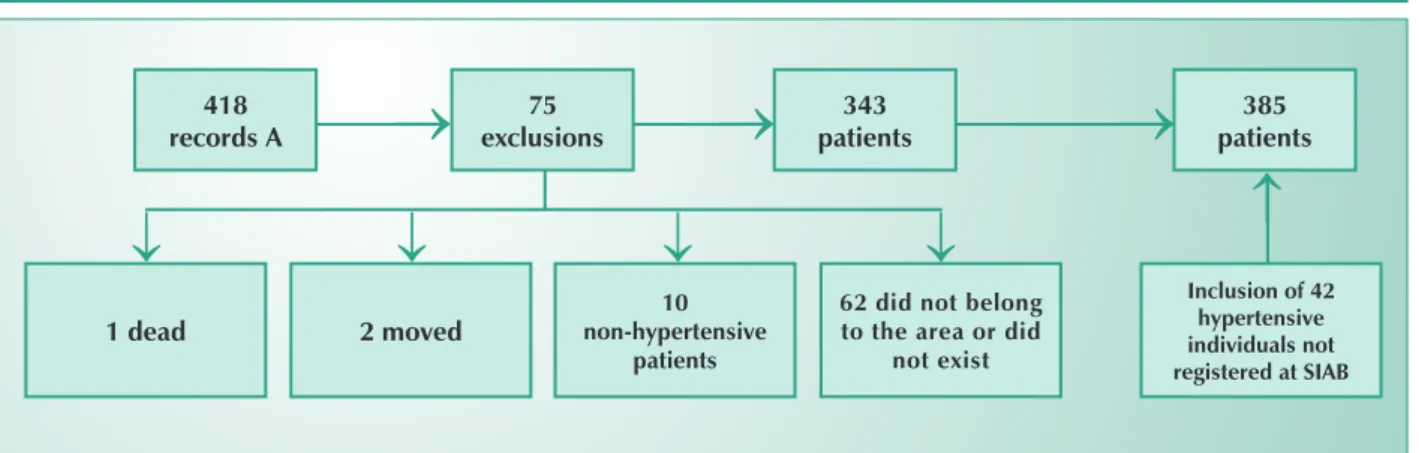
to progressivo das taxas de acordo com a faixa etária e as razOf the 418 people registered at SIAB in 2003 as individuals with arterial hypertension, 75 were not included in the population studied for the following reasons: one individual died before 2003; two moved to an area outside the area served by the healthcare team; ten for lack of confirmation of arterial hypertension in the records of the healthcare unit; and 62 who were registered in the system as residents of the area but could not be found by the community agents in the addresses of record. Consultation of another source of data (records of the activities of community health agents) revealed that 42 cases which had not been included in Record A were being followed up as if they were hypertensive.
Inclusions and exclusions did not take place in a uniform manner in the five micro-areas covered by the family healthcare teams because 69.7% of the inclusions and 80.9% of the exclusions occurred in a micro-area. Therefore, the population of the study comprised 385 individuals who lived in the area of operation of the FHT, and who at some time reported having arterial hypertension and were being followed up by the CHAs in 2003.
The study revealed an index of identification/capture (reported prevalence) of 12.6% of individuals with arterial hypertension among the residents of the FHT area. When we considered individuals who were twenty years old or older, the index rose to 18%. The identification varied according to gender and age group. For female subjects, the reported prevalence rate was 22.3%; for male subjects it was 13.2% (1.67 ratio). We observed a progressive increase of the rates with the increase of age and reasons of prevalence, in that the reference age group was from twenty to thirty-nine. In the other southern Brazil as regards the provision of care to individuals
with arterial hypertension.
Using the propositions of Sala et al6 as regards the guiding
categories for assessment of efforts which are organized based on health needs and on systematic follow-up, we analyzed indicators which reflect to what extent the work of a team reflects the rationale of care based on the principle of health surveillance and programmed actions.
Methods
The study was conducted in a small municipality, with a population of approximately 15,000 inhabitants, in the northwestern region of the state of Paraná, in the south of Brazil. The health system comprises a public hospital and five Family Healthcare Teams which serve 100% of the inhabitants.
The population studied comprised individuals who reported arterial hypertension in the year 2003, who were registered at the Primary Healthcare Information System (SIAB), and lived in the urban region under the responsibility of a family healthcare team.
The source of data comprised the information of record A of SIAB, the note pad of the Community Healthcare Agents (CHA) used to record their daily activities, in the records of patients stored in the Primary Healthcare Unit and the interviews carried out in the home of patients.
The variables studied were gender, age, literacy, family income, number of people in the family, housing conditions, presence of diabetes mellitus, healthcare service used, coverage, concentration of care.
Initially we requested the consent of the person in charge of the institution to carry out the collection of data. After the authorization had been granted, the project was sent to the Permanent Ethics Committee for Research Involving Human Beings of Universidade Estadual de Maringá for approval, which was granted by opinion n.082/2004 - COPEP.
During the data collection phase, the starting point was the identification of people recorded as suffering from arterial hypertension in the records (SIAB’s Record A). Once we had the identification data such as gender, age, address, we checked these records against the records of daily activities included in the note pad of CHAs and we excluded those people who, although they appeared in the records, they did not confirm having arterial hypertension when visited at home or were not residents of the area under the care of the Family Healthcare Team in 2003. Additionally we included people who were not registered in the information system but who were recorded in the records of the CHAs. Therefore we made a list with 385 people, with their name, gender and address, according to the information recorded in the note pad of the CHAs (Fig.1).
age groups, i.e. from forty to forty-nine, fifty to fifty-nine, and sixty or above, the ratios were 5.6; 10.7 and 24.3 respectively. No case was observed in the under-twenty group. The age varied between 21 to 103 years, with a mean of 63.6 and a standard deviation of 13.8 years. There was a predominance of older people (65.7% were sixty or above) and of women, who accounted for 64.7% of the cases (Tab.1).
As regards the social and demographic profile, we observed a low level of schooling, and more than 80% had completed the fourth grade at most, of which half are illiterate. As regards the number of people living in the household, 11.6% live alone and most live in households with another person or with another two people (62.7%). As regards their housing conditions, 1.1% live in households with up to two rooms, and approximately 90% live in households with five or more rooms. The family income of 71.7% of the interviewees was of two minimum salaries at most, and 9% reported a family income above five minimum salaries. As regards the use of health services, 91.8% of the interviewees reported using the Single Health System (SUS), 5% of the users had health plans (HMOs) with full coverage and 6.4% had partial coverage plans. The use of private healthcare services was mentioned in 17.2% of the cases (Tab. 2).
Among the 385 subjects studied, the reported prevalence of diabetes mellitus was 16.4%. We observed the occurrence of four deaths (mortality rate of 10.4 per thousand), thirteen
references to hospitalization due to acute myocardial infarction and 23 due to stroke. In the last visit, more than 59% of these patients presented elevated arterial pressure with 50.9% having systolic pressure above 139 mmHg and 36.9% having diastolic pressure above 89 mmHg (Tab. 3).
As regards the time [of existence] of arterial hypertension, more than 38% reported suffering from the condition for less than six years. As regards the day of the last visit to the healthcare unit, the patient’s records revealed that 25.8% were not served in 2003 and only 52.7% were served (in the healthcare unit or at home) in the last semester.
Among the subjects identified as suffering from arterial hypertension, the coverage of the Primary Healthcare Unit in 2003 was 64.1% for visits with a physician, 32.4% for visits with a nurse and 36.4% for home visits. As regards the concentration of physician visits, 35.9% never saw a physician; 31.4% saw the physician up to two times and 21.5% saw a physician between three and five times. In 5.6% of the records, there were entries for more than seven visits for this same purpose. As regards visits with a nurse, the coverage was smaller, and 67.6% of the individuals never saw a nurse, although in one case, there were nine visits recorded. As regards home visits, 36.4% of the users received home visits, and in five cases (1.3%) the number of visits was above six (Tab. 4).
Discussion
Male Female total
Age group n Prevalence n Prevalence n Prevalence
20 a 39 7 1.6 11 2.5 18 2.0
40 a 49 17 8.3 31 13.7 48 11.1
50 a 59 19 13.6 47 28.0 66 21.4
60 e + 93 37.5 160 58.8 253 48.7
Total 136 13.2 249 22.3 385 18.0
*rural area excluded.
** = n. of individuals with hypertension/n. of individuals living in the area X 100
table 1 – reported rate of prevalence** for sAh (%)
Fig. 1 – Flowchart of the definition of the population studied.
75 exclusions 418
records A
343 patients
385 patients
10 non-hypertensive
patients
2 moved
62 did not belong to the area or did
not exist
1 dead
inclusion of 42 hypertensive individuals not registered at siAb
←
←
←
←
←
←
←
The analysis of exclusions (75) and inclusions (42) reveals a discrepancy between the records of the SIAB and the records of the CHAs’ note pad. This situation probably arises from the lack of use of these data according to the objectives established in the SIAB Manual, which was originally designed to produce reports and help the teams, the primary healthcare units and the municipal administration monitor the activities and assess their quality8.
It is worth highlighting that in the health facilities studied, no CHA had access to the consolidated data, and for this reason they [the CHAs] established a parallel record system (the note pad) to follow up of the families under their care. Other reasons, possibly related to the low reliability of SIAB’s data, have to do with the fact that other members of the team did not use them and that CHAs were not subject to supervision. This makes it difficult for the agents to learn their responsibilities and oftentimes fills their time with activities which are unrelated to the objectives of the family healthcare program. This situation is also illustrated by the fact that 40.3% of illiterate people were found in the interviews, almost twice the number recorded in SIAB’s records.
As regards the social and demographic characteristics of the population studied, there were 49.4% of households with one or two dwellers, a fact due to the high average age of the population and to the fact that children had left home to start new families or moved to another municipality in search of jobs. The average number of individuals per household (2.8) was lower than the data included in the Brazilian Household Survey9, that presents an average of 3.4 for the Brazilian
population in general and 3.3 for the southern region. Family income was also lower than the family income of the Brazilian population, with 71.7% of the interviewees having a family income of up to two minimum salaries, as compared to 27.8% of reported for the Brazilian population and 22.2% for the southern region10. This may probably be explained by the high
rate of old people. The low income, as well as the percentage of illiteracy reveals the worse social and economic conditions of the individuals suffering from arterial hypertension who reside in the area under the care of the team as compared with the Brazilian population.
The 18% reported prevalence rate for arterial hypertension (for the age group of twenty years and above) observed in the study in the area under the care of the family healthcare team, although above the prevalence of the municipality which is of 16.4%8, may be underestimated, as it is lower than the 20% presented by the Ministry of Health5 for this age group. The
4th Brazilian Guidelines on Arterial Hypertension mention a
prevalence rate between 23.3% and 43.9%7.
The trend of growth of arterial hypertension with age is in agreement with similar studies4,6,11,12. Analyzing the female
population in isolation, the prevalence rate of 22.3% is closer to the rate reported in the literature. For the male population, the rate found was considerably low (approximately 13.2%). These results differ from those found in the study carried out in Araraquara SP, where Lolio et al12 found rates of 32% for the
male population and 25.3% for the female population. The underidentification of males found in this study is probably due to the fact that men seek healthcare facilities
characteristics number* %
schooling (years of study)
None 152 40.3
1 to 4 years 152 40.3
5 to 8 years 38 10.1
9 to 12 years 25 6.6
Above 12 years 10 2.7
total* 377 100.0
n. of dwellers in the household
1 43 11.6
2 140 37.8
3 92 24.9
More than 3 95 25.7
total* 370 100.0
n. of rooms in the household
1 to 2 4 1.1
3 to 4 39 10.5
5 to 6 180 48.7
7 to 8 108 29.2
More than 8: 39 10.5
total* 370 100.0
Family income (salaries)
Up to 2 264 71.7
More than 2 to 5 71 19.3
More than 5 to 10 24 6.5
More than 10 to 20 7 1.9
More than 20 2 0.6
total 368 100.0
use of the Primary healthcare unit
No 31 8.2
Yes 347 91.8
total 378 100.0
use of private healthcare plan (hMo)
Total coverage 19 5.0
Partial coverage 24 6.4
No use of private healthcare plan 334 88.6
total 377 100.0
use of private health services
No 312 82.8
Yes 65 17.2
total 377 100.0
*Cases ignored were excluded
less than women, for Sala et al13 observed a higher demand
from women in a Primary Healthcare Unit in the district of Butantã, in São Paulo. Additionally, according to Almeida et al14, women tend to inform on health conditions more than
men. Above 75, the prevalence of hypertension observed in the male population approached the prevalence observed in the female population.
A possible explanation would be the fact that older men present a higher rate of comorbidity, which prompts them to seek a healthcare facility, and to the fact that they have more time available when they reach this age.
This situation, however, gives rise to concerns: the lower prevalence reported by men suggests that young adults, especially males, face barriers when they need to use healthcare services. The difficulties in accessing the services and behavioral aspects that drive patients to spontaneously
characteristics number* %
Death in 2003
No 374 98.9
Yes 4 1.1
total 378 100.0
hospitalization due to AMi
No 364 96.6
Yes 13 3.4
total 377 100.0
hospitalization due to stroke
No 354 93.9
Yes 23 6.1
total 377 100.0
Diabetes
Yes 63 16.4
No 320 83.6
total 383 100.0
time of hypertension
Up to 5 years 137 38.2
6 to 10 years 121 33.8
11 to 15 years 50 14.0
16 to 20 years 25 7.0
21 to 25 years 14 3.9
26 to 30 years 6 1.7
More than 30 years 5 1.4
total 358 100.0
systolic pressure level (mmhg)
Lower than 140 137 49.1
140 to 159 92 33.0
160 to 179 28 10.0
Higher than or equal to 180 22 7.9
total 279 100.0
Diastolic pressure level (mmhg)
Lower than 90: 176 63.1
90 to 99 56 20.1
100 to 109: 30 10.7
Higher than or equal to 110 17 6.1
total 279 100.0
controlled blood pressure **
Yes 114 40.9
No 165 59.1
total 279 100.0
* Ignored cases excluded. **Systolic pressure lower than 140 and diastolic pressure lower than 90mmHg.
table 3 – characteristics of the disease in hypertensive individuals
care provided número %
n. of visits with physician
None 135 35.9
1 e 2 118 31.4
3 to 5 81 21.5
6 and 7 21 5.6
8 and more than 8 21 5.6
total 376 100.0
n. of visits with nurse
None 254 67.6
1 to 2 87 23.1
3 to 5 31 8.2
6 to 7 3 0.8
8 and more than 8 1 0.3
total 376 100.0
n. of home visits
None 239 63.6
1 to 2 98 26.1
3 to 5 34 9.0
6 to 7 5 1.3
total 376 100.0
Quarter of last visit
No visit 97 25.8
January to March 30 8.0
April to June 51 13.5
July to September 77 20.5
October to December 121 32.2
total 376 100.0
*Ignored cases excluded.
seek preventive or curative care are factors that may influence the prevalence of complications in target organs in arterial hypertension15.
The capture mechanisms defined by the team, which are based on reported morbidity have shown to be insufficient, since, according to the study carried out by Oliveira & Nogueira16 in a nearby municipality, the estimated prevalence
was 35.3%; the authors also observed that 53.4% of hypertensive subjects were unaware of their condition.
These observations acquire greater relevance when we consider that the percentage of use of the SUS is above 90%, well above the percentage published in the Brazilian Household Survey9. According to this survey, 49.3% of the
people who saw a doctor in the two weeks prior to the interview went to SUS facilities. For patients with chronic conditions such as hypertension, the percentage of use of public health services reached 53.1%. In our study, even among those 8.2% who said they had not used the SUS, 12.9% went at least once to the Primary Healthcare Unit.
Additionally, among those who said they used private healthcare services (17.2%), 44.6% had been to the Primary Healthcare Unit and of these, 20% went there from three to five times. The analysis of the characteristics reveals a low-income population that relies heavily on SUS for healthcare, since only a small portion of them has access to health services other than the public ones.
The coverage per visit was low, as almost 36% of the individuals with arterial hypertension never had a doctor’s appointment ; for nurse visits, this percentage was even higher (67.6%).
In a study carried out in São Paulo5, with subjects suffering
from chronic conditions (hypertension and diabetes), it was observed that 47.9% of these patients had between three and five visits. The difference between the numbers of this study can be explained by the lack of systematization of the care provided to individuals with chronic conditions, such as arterial hypertension, despite the myriad official documents on the topic and especially on primary care1,2,5.
In the case of home visits, the coverage of medical visits is in line with the expected, in view of the priority given to families with bed-bound members and members on home care.
As stressed by Sala et al13, a substantial coverage for
individuals at risk for cardiovascular diseases is essential to the observation of significant changes in the epidemiological profile, since the group of individuals at risk for cardiovascular diseases does not account for the majority of the cases of the disease, as it is smaller in size than the low-risk group of individuals (who are often times not targeted by health programs).
The difficulty in changing the model of care becomes clear when we analyze the data relating to the last visit, as only 32% of the interviewees were served in the last quarter of 2003. These results reveal a difficulty in effecting the standards and standardized procedures although they were officially established in 1983 with the publication of the “Guide for the Control of Arterial Hypertension”1.
As regards effectiveness, i.e., the measure of the attainment
of the strategic results observable in the users of the services, the indicator, in the case of the control and treatment of hypertension, has been the coefficient of hospitalization due to stroke and acute myocardial infarction (AMI)5,6.
Therefore, as regards AMI cases, there may have been overidentification of AMI cases, since there was no case of death as a result of this condition in 2003. Other ischemic heart diseases may have been mistaken for AMI. As regards stroke cases, the same may have occurred, as there was just one case of death due to this condition and the Ministry of Health2 makes reference to a mortality rate of 50% in the
first month among those affected. The results obtained by the account given by the interviewees suggest low reliability as to this aspect and points to the need for the team to use different information systems such as the Mortality (SIM) and the Hospitalization (SIH) systems when monitoring complications.
As regards deaths, two individuals died due to neoplasic diseases, one due to stroke, and one due to causes unknown to the study. The mortality rate found (10.6 per one thousand inhabitants) was not above the 10.8 per thousand found for the population in general of the health team studied. A higher mortality rate was expected in view of the arterial hypertension and of the age of the people included in the study. However, the value found was greater than the mortality rate of 7.6 per one thousand inhabitants of the municipality, according to official data, and those of the country and state (6.3 per one thousand and 6.2 per one thousand respectively). The rates observed for the population studied probably reflect the reality since, because death is a major event, to the familiaries and communities, the interviewee would not fail to inform it and the results obtained probably have to do with fluctuations that may occur in mortality data between one year and the other, when the number of events is much reduced.
Hospitalization cases, however, as well as the problems regarding the reliability of SIAB’s data endorse the need for using multiple information systems when planning actions to prevent overestimation and undernumbering.
The high number of patients with altered blood pressure, although most of them were undergoing some kind of treatment, demonstrates the lack of effectiveness of the care provided to these patients. Just as is the case with hypertension, there may be faults in the control of other chronic diseases (diabetes, dyslipidemias, obesity), which considerably increases the risk of cardiovascular complications. The problems found may not be specific of the care provided to hypertensive individuals, but reflect the difficulty in implementing an alternative model of care. The importance of reorganizing the work based on health-related needs and of acting on the rationale of health surveillance and of actions programmed becomes clear. The need for defining the scope of care as regards the population (registration of users) becomes apparent so that the reality of families especially as regards their social, economic, cultural, demographic and epidemiological characteristics may become known and enable the provision of total care to the population registered as prescribed by the Practical Guide of the Family Health Program3. Another interesting point has to
guarantee, to the population and to the family healthcare teams, that problems will be addressed and treatment will be continued.
The underidentification of hypertension cases, especially among males, is another impediment to the effective provision of care to the population. In order to overcome this difficulty, it is necessary to intensify active search of diagnosis because, as stressed by Almeida and al14, self-reported morbidity tends
to underestimate the prevalence of arterial hypertension. The reported prevalence of 18%, the low coverage of
services, just as the inadequate amount of care, result from the lack of an assessment practice geared at the actions collectively implemented by the team, and this is why the information services available are not valued. These systems should be seen as a tool to assess and plan activities. Their importance should be stressed and they should not be filled in with the mere objective of obtaining federal funding. According to Pinheiro & Escosteguy17, it is necessary to integrate the assessment of
health service quality into planning and decision making at the local level, so as to enable the improvement of quality in the provision of health services.
References
1. Ministério da Saúde. Guia para o controle de Hipertensão Arterial. Brasília: Ministério da Saúde; 1983.
2. Ministério da Saúde. Plano de reorganização da atenção à hipertensão arterial e ao diabetes mellitus. Brasília: Ministério da Saúde; 2001.
3. Ministério da Saúde. Departamento de Atenção Básica. Guia Prático do Programa de Saúde da Família. Brasília: Ministério da Saúde; 2001.
4. Sala A, Cohen DD, Dalmaso ASW, Lima AMM. Teixeira RR. Avaliação do processo de atendimento a pacientes portadores de doença crônico-degenerativa em uma unidade básica de saúde. Rev Saúde Pública 1993; 27: 463-71.
5. Ministério da Saúde. Manual para a Organização da Atenção Básica. Brasília: Ministério da Saúde; 1999.
6. Sala A, Nemes Filho AN, Eluf-Neto J. Avaliação da efetividade do controle da hipertensão arterial em unidade básica de saúde. Rev Saúde Pública. 1996; 30:161-7.
7. IV Diretrizes Brasileiras de Hipertensão Arterial. Campos do Jordão. São Paulo, 2002.
8. Ministério da Saúde. SIAB: manual do Sistema de Informação da Atenção Básica. Brasília: Ministério da Saúde; 2003.
9. Pesquisa Nacional por Amostra de Domicílios Fundação IBGE. Rio de Janeiro; Brasil: Pesquisa Nacional por Amostra de Domicílios, 1998.
10. Censo Demográfico. Fundação IBGE. Rio de Janeiro, Brasil: Censo demográfico, 2002.
11. Piccini RX, Victora CG. Hipertensão arterial sistêmica em uma área urbana no sul do Brasil: prevalência e fatores de risco. Rev Saúde Pública. 1994; 28: 261-7.
12. Lolio CA, Pereira JCR, Lotufo PA, Souza JMP. Hipertensão arterial e possíveis fatores de risco. Rev Saúde Pública.1993; 27: 357-62.
13. Sala A, Nemes MIB, Cohen DD. Metodologia de avaliação do trabalho na atenção primária a saúde. Cad Saúde Pública.1998; 14: 741-51.
14. Almeida MF, Barata RB, Montero CV, Silva ZP. Prevalência de doenças crônicas auto – referidas e utilização de serviços de saúde, PNPD/1998, Brasil. Ciênc Saúde Coletiva. 2002; 7: 743-56.
15. Noblat ACB, Lopes MB, Lopes GB, Lopes AA. Complicações da Hipertensão Arterial em Homens e Mulheres Atendidos em um Ambulatório de Referência. Arq Bras Cardiol. 2004; 83: 308-13.
16. Oliveira RZ, Nogueira JL. Hipertensão arterial no município de Cianorte, Estado do Paraná, Brasil. Acta Scientiarum. 2003; 25: 71-9.