Session editor: Alfredo José Mansur ([email protected])
Associate editors: Desiderio Favarato ([email protected]), Vera Demarchi Aiello ([email protected])
Mailing address: Alfredo José Mansur InCor Av. Dr. Enéas C. Aguiar, 44 -05403-000 - São Paulo, SP, Brazil
English version by Stela Maris C. e Gandour
Case 4/2001 - A sixty-four-year-old woman with Chagas’ disease, who underwent implantation of a permanent cardiac pacemaker and evolved with rapidly progressive heart
failure (Heart Institute (Incor), University of São Paulo Medical School, Brazil)
Clinicopathologic Session
A 64-year-old female patient sought medical assis-tance at our hospital due to dyspnea on light exertion and even at rest.
The patient had been experiencing dyspnea on stre-nuous exertion since the age of 52 years, which progressed in 10 years to dyspnea on light exertion and even orthopnea. On physical examination (9/1/97), her pulse was regular, her heart rate was 56bpm, and her blood pressure was 140/170mmHg. Her lung examination was within the normal range. The cardiac ictus could be felt on the left 6th in-tercostal space over the length of 2 fingertips. A systolic thrill was palpated on the 6th intercostal space. The cardiac sounds were normal. A systolic cardiac murmur (++/4) was heard on the mitral area and a diastolic cardiac murmur was heard on the aortic area. The abdominal examination was within the normal range and no edema of the lower limbs was observed.
The chest X-ray showed enlargement of the cardiac silhouette (++++/4) and normal pulmonary fields.
Electrocardiography (8/27/97) showed an ectopic atrial rhythm, a P-R interval of 0.12 s, an initial disturbance of ventricular depolarization (initial QRS blurring in II, III, aVF, and V2), disorder of heart conduction of the antero-superior left bundle-branch and the right branch, and alterations in ventricular repolarization (fig. 1).
The laboratory tests (8/27/97) were as follows: hemo-globin, 13.6g/dL; hematocrit, 39%; serum creatinine, 0.7mg/ dL; serum sodium, 141mEq/L; and serum potassium,
4.5mEq/L. The serum tests for Chagas’ disease were positive.
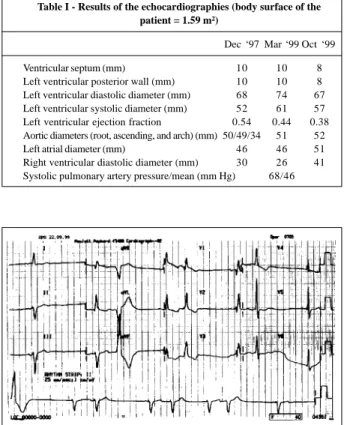
The diagnosis of heart failure due to Chagas’ cardiom-yopathy was established and the patient was prescribed 37.5mg of captopril and 25mg of hydrochlorothiazide daily. Echocardiography (12/18/97) showed diffuse hypoki-nesia of the left ventricle, ectasia of the aortic root, moderate regurgitation of the aortic and mitral valves, and pulmonary hypertension. The measurements are shown in table I.
Chest tomography (3/31/99) revealed ectasia of the aortic root (52.66mm) and the following preserved diame-ters: ascending aorta (39.79mm), aortic arch (31.12mm and 25.76mm), descending aorta (26.27mm), and thoracoab-dominal transition (21.4mm).
The symptoms subsided, as did the dyspnea on moderate exertion. After 10 months, however, the dyspnea became more severe, being triggered on minimum exertion, and even orthopnea occurred (Sept ‘98). The patient then sought medical care, and an irregular cardiac rhythm was observed.
Electrocardiography (9/3/98) showed an irregular rhythm of the atrial pacemaker with junctional escapes and ventricular premature depolarizations, QRS duration of 0.12 s, anterosuperior left bundle-branch block and block of the right branch (fig. 2).
Two months later, the patient required hospitalization (from 11/17/98 to 12/10/98) for control of heart failure.
On physical examination (11/17/98), the patient had an irregular pulse, heart rate of 56 bpm, blood pressure of 110/ 80mmHg, crepitant rales in the base of her thorax, irregular cardiac rhythm due to frequent premature depolarizations, and a systolic murmur in the mitral and tricuspid areas. Her liver was palpated 1.5cm from the right costal margin, and edema (+++/4) of her lower limbs was present. The patient was receiving 0.25mg of digoxin, 50mg of captopril, and 40mg of furosemide daily. These daily doses were later
Fernando Medeiros, Luiz Alberto Benvenuti, Roberto Costa
São Paulo, SP - Brazil
modified to 0.125mg of digoxine, 75mg of captopril, and 80mg of furosemide, and hydrochlorothiazide/amiloride (50mg/5mg) was added.
Electrocardiography (11/17/98) showed an ectopic atrial rhythm with atrial and isolated premature ventricular depolarizations. Anterosuperior left bundle-branch block and block of the right branch were observed.
Laboratory tests (Nov ‘98) were as follows: hemo-globin, 13.9g/dL; hematocrit, 42%; 4,800 leukocytes/mm³; 111,000 platelets/mm³; urea, 84 mg/dL; creatinine, 0.9mg/dL; sodium, 137mEq/L; and potassium, 3.7mEq/L. The uri-nalysis was as follows: density, 1.007; pH of 7.0; proteinuria of 0.2 g/L; 1,000 leukocytes/mL; and 11,000 erythrocytes/ mL. The laboratory tests remained unchanged during the entire hospitalization.
In the medical visits that followed hospitalization, the patient remained very physically limited with dyspnea on mild exertion and orthopnea. Three months later, she was hospitalized again to control heart failure (3/4/99), and by then she also complained of pain in her right hemithorax and dysphagia.
The physical examination at that time (3/4/99) showed an irregular pulse, heart rate of 82bpm, and blood pressure of 100/70mmHg. Crepitant rales could be heard in the base of her thorax. The heart examination showed irregular beats and a systolic murmur (++/4) in the mitral area. The liver was tender and could be palpated 6 cm from the right costal margin. Edema (++/4) of the lower limbs was present.
Electrocardiography (3/4/99) showed an ectopic atrial rhythm, frequent atrial and ventricular premature depolari-zations, and disorder of the intraventricular conduction of the stimulus with anterosuperior left bundle-branch block and block of the right branch.
Echocardiography (3/22/99) showed diffuse hypo-kinesia and dilation of the left ventricle, moderate aortic and mitral insufficiency, dilated and hypokinetic right ventricle, pulmonary hypertension, and aneurysm of the thoracic aorta, with no signs of dissection (tab. I).
The symptoms subsided, and the patient remained asymptomatic on usual exertion until September ’99, when she had a marked worsening, which required a new hospitalization. Bradycardia was detected, and the possibility of digitalis intoxication was considered.
The laboratory tests (9/22/99) were as follows: hemo-globin, 13.6 g/dL; hematocrit, 41%; 6,500 leukocytes/mm³; 80,000 platelets/mm³; INR of 1.67; rate of the activated partial thromboplastin times of 1.09; and the following serum levels of urea, 78mg/dL; of creatinine, 1.1mg/dL; of glucose, 84mg/dL; of sodium, 137mEq/L; and of potassium of 4.5mEq/L. During hospitalization, an increase in the levels of urea (up to 165mg/dL) and of creatinine (up to 2.5mg/dL) was observed, with further normalization. The serum level of digoxin was 0.9ng/mL.
Electrocardiography (9/22/99) showed atrioven-tricular dissociation with junctional escape and captures simulating atrial bigeminy (fig. 3).
Fig. 1 - Electrocardiogram (8/27/97). Ectopic atrial rhythm, block of the right branch and of the anterosuperior left bundle-branch.
Fig. 2 - Electrocardiogram (9/3/98). Fluctuating rhythm in the atrial pacemaker, block of the right branch and of the anterosuperior left bundle-branch.
Fig. 3 - Electrocardiogram (9/22/99). Atrioventricular dissociation with junctional escape and captures simulating atrial bigeminy.
Table I - Results of the echocardiographies (body surface of the patient = 1.59 m²)
Dec ‘97 Mar ‘99 Oct ‘99
Ventricular septum (mm) 10 10 8
No regression of the block was observed with the atropine test (9/22/99). The patient then underwent implan-tation of a provisional external cardiac pacemaker. In the following days, the periods of bradycardia with escapes persisted with a heart rate of 39bpm; the long-lasting electrocardiography (Holter system) (9/30/99) showed a sinus rhythm with a frequent need for ventricular stimulus by an artificial pacemaker. We observed 11,573 ventricular extrasystoles (541/h) as follows: 10,344 isolated, 593 in pairs, 14 episodes of ventricular tachycardia, the longest with 4 beats at the rate of 182bpm, 310 atrial extrasystoles, 310 isolated, 7 in pairs, and 7 atrial tachycardias, the longest with 10 beats and the most rapid at a rate of 142bpm.
Permanent implantation of an artificial pacemaker was indicated in VVIR stimulation mode (10/1/99).
The patient was discharged from the hospital with amelioration of the symptoms (10/7/99) and the following prescriptions: 150mg of hydralazine, 40mg of furosemide, 120mg of isosorbide dinitrate, and 400mg of amiodarone daily.
Two weeks later (10/21/99), the patient sought medical assistance due to dyspnea on minimal exertion and orthop-nea, and intense fatigue for 3 days.
The physical examination (10/21/99) showed an intensely dyspneic patient, with a pulse of 72bpm and blood pressure of 126/58mmHg. Her lung examination showed crepitant rales in the inferior third of the thorax. Her cardiac auscultation revealed cardiac sounds of reduced intensity and a systolic murmur (+++/4+) in the entire precordium, more audible in the left sternal margin. The abdominal examination was impaired due to the patient’s intense dyspnea. Edema in the lower limbs (+++/4) was present. A few minutes after admission, the patient had arterial hypotension (blood pressure of 80/40mmHg), intensification of the dyspnea, marked sweating, and hypoxemia (O2 saturation of 90% with O2mask). The patient underwent orotracheal intubation for respiratory support.
Electrocardiography (10/21/99) revealed an artificial pacemaker with normal function and periods of proper cardiac rhythm (atrial fibrillation) (fig. 4).
The results of the laboratory tests of this hospi-talization are shown in table II.
On the second day of hospitalization, dyspnea and hypoxemia improved and the patient was extubated. The administration of the following drugs was maintained: dopamine, dobutamine, furosemide, and enoxaparin. The diagnosis of bronchopneumonia was established, and 2g of ceftriaxone per day were started.
The patient progressed with a significant impro-vement of the dyspnea when, on the 6th day of hospi-talization, she complained of anxiety, thoracic oppression, pain in the dorsum, and hemoptysis. From this day on, the patient’s general condition worsened, with persistent dyspnea and appearance of petechiae and ecchymoses in the trunk. The patient remained on vasoactive substances. The echocardiography (10/26/99) revealed diffuse hypokinesia and marked dilation of the left ventricle, moderate aortic and mitral insufficiency, dilated and hypokinetic right ventricle, pulmonary hypertension, and aneurysm of the thoracic aorta, with no signs of dissection (tab. I). Cardiopulmonary arrest followed, which did not respond to the resuscitation maneuvers, and death occur-red (11/7/99).
Discussion
Clinical features - Chagas’ disease, which results
from infection by the Trypanosoma cruzi protozoan, was named after the Brazilian physician Carlos Chagas, who described the disease and its causal and transmitting agents for the first time 1.
We should differentiate the immunological sign of the infection caused by the parasite, which manifests as positive serological findings, from the clinical disease.
The countries with the highest prevalence of T. cruzi Fig. 4 - Electrocardiogram (10/21/99). Normally functioning pacemaker; the base
rhythm is atrial fibrillation.
Table II - Laboratory tests performed during the last hospitalization
10/21/99 11/1/99 11/6/99
Hemoglobin (g/dL) 14.5 13.1 11.8
Hematocrit (%) 44 39 36
MCV (mm³) 100 98 97
MCH (pg) 33 33 32
Leukocytes/mm³ 7,600 9,500 8,300 Platelets/mm³ 135,000 50,000 52,000
Urea (mg/dL) 199 196 153
Creatinine (mg/dL) 2 1.7 1.5
Glucose (mg/dL) 37 87
CPK UI/L 85
Sodium (mEq/L) 135 145
Potassium (mEq/L) 4.5 4.1
D dimer of fibrin positive PT (s) 35.8 (15.8) 18 (12.3)
INR 2.87 2.11
APTT (s) 47 (27) 33.5
Ratio of the times 1.74 1.24 Urine I
Density 1020
pH 5.5
Proteinuria (g/L) 0.59
Urobilinogen 1/40
Leukocytes/mL 18,000
infection include Brazil, Argentina, Chile, Bolivia, and Vene-zuela. In the American continent, 15 million people are esti-mated to be infected 2. A recent Brazilian study found 1.0% of possible blood donors with positive serological reactions for Chagas’ disease 3.
The manifestation of the chronic disease has a consi-derable geographic variation. In Brazil, heart diseases and dilations of the digestive tract are common, and, frequently, one patient may have both types of involvement. Chagasic megaesophagus and megacolon, however, are more common in Venezuela, Colombia, and Panama. On the other hand, cardiomyopathy has relatively high, moderate, and low prevalences, respectively, in those countries. In general, the frequency of heart disease in seropositive patients in Central America and Mexico is low, even though the seropositive rates in these countries are comparable to those in South American countries.
The natural history of Chagas’ disease is charac-terized by 3 phases: acute, latent, and chronic. The disease is transmitted to human beings (usually under the age of 20 years) by the conenose or kissing bug (triatomine bug) that hosts the parasite in its gastrointestinal tract and eliminates it in its feces close to the site of a bite in a human being. The parasite penetrates the vertebrate’s body through the area of skin disruption 4. This process of contamination may result in unilateral periorbital edema or palpebral edema also called Romaña’s sign; on the other hand, penetrating through the skin may result in a lesion called chagoma. Even though less common, transmission may also occur through blood transfusion5 or congenitally. Acute infection may occur in about 10% of the cases, and it is fatal in appro-ximately 10% of the patients. Clinical manifestations include fever, myalgia, sudoresis, hepatoesplenomegaly, myo-carditis with heart failure, and, occasionally meningoen-cephalitis. Younger children more commonly develop the acute disease and its clinical manifestations, and, usually, become more severely ill than adults do 6,7.
In Brazil, 25% to 30% of the people affected by Chagas’ disease have cardiac involvement, 10% develop significant heart disease, and 60% have the undetermined form of the disease 8. Electrocardiographic alterations usually appear at this stage of the disease and constitute an evident indicator of the possible final clinical cardiac disease and of an increase in mortality.
The disease then has a latent phase, in which no clinical symptoms are found. The undetermined form of Chagas’ disease is characterized by absence of symptoms and at least 2 positive serologic reactions with the follo-wing normal tests: electrocardiography, radiography with contrast medium, and endoscopy 9,10.
The chronic phase usually manifests as a cardiac disease in the 3rd and 4th decades of life, on average 20 years after the initial infection. Approximately 30% of the infected individuals develop chronic Chagas’ disease, whose manifestations comprise a broad spectrum, from the asymptomatic patient with electrocardiographic alterations to those patients with advanced disease, which is
charac-terized by cardiomegaly, congestive heart failure, arrhy-thmias, thromboembolic phenomena, and sudden death.
The central paradox in the pathogenesis of this disease is the negative correlation between the severity of the disease and the level of parasitemia. Parasites are not commonly found in patients with the disease; therefore, an autoimmune mechanism has been proposed for Chagas’ disease 11,12.
In the animal model, lymphocytes are able to damage normal cells of the host, maybe because of a cross-reaction with the antigens of the T. cruzi and striated muscle 13. A number of antibodies against the sarcoplasmatic reticulum of the myocyte, laminin, and other constituents have also been implicated in the pathogenesis of Chagas’ myocar-ditis. The acute phase is believed to result from the release of components of the host cells modified by the parasite, which become immunogenic. Another hypothesis suggests that cardiac parasympathetic denervation leads to chronic Chagas’ disease 14,15. Yet, another hypothesis relates chaga-sic heart disease to alterations in the microcirculation 16.
The clinical manifestations of the chronic phase include anginal thoracic pain, symptomatic disorder of the conduction system and sudden death, and progressive chronic heart failure with predominance on the right side in advanced cases. Therefore, even though pulmonary congestion may be occasionally observed, the most common findings usually include fatigue due to a reduction in cardiac output, peripheral edema, ascites, and hepatic congestion. Autonomous dysfunction is common with marked abnormalities in cardiac rhythm triggered by several maneuvers. Electrocardiographic changes are the rule, particularly in patients seropositive to the antigens of the T.
cruzi. Right bundle-branch block and anterosuperior left
bundle-branch block are the most common findings in patients with chronic Chagas’ disease.
Ventricular arrhythmias are noteworthy. Premature ventricular depolarizations are commonly observed accom-panied by frequent polymorphic extrasystoles and ven-tricular tachycardia intervals.
On electrocardiographic evolution, ventricular arrhy-thmias precede the atrial ones, and the right disorders and blocks and the partial atrioventricular block precede the complete left branch block. Therefore, the following electro-cardiographic findings are considered evidence of severe heart disease and a sign of a poor prognosis: left branch block, atrial fibrillation, atrial flutter, electrically inactive zones, and 2nd and 3rd degree atrioventricular blocks 17.
fibrillation on electrocardiography. Age may also be con-sidered an aggravating risk factor, because sudden death is 5 times more prevalent in the age bracket from 40 to 50 years than in that from 0 to 19 years, particularly among male patients who have alterations in ventricular repolarization, right branch block, and electrically inactive areas 18,19.
Ventricular arrhythmias are particularly common during or right after exercise, and they occur in most patients undergoing exercise testing 20.
Ventricular tachycardia induced by electrophysiology is more common in patients with evidence of abnormalities in conduction seen on the electrocardiogram, with low ejection fraction, and with apical aneurysm of the left ventricle.
Thromboembolic phenomena are frequent com-plications that occur in 50% of patients.
In regard to the echocardiographic findings of advanced cases, we can cite dilated cardiomyopathy, and around 10% to 15% of the asymptomatic patients have apical dyskinesia.
Even though chronic chagasic heart disease may be accompanied by great lethality, most individuals with this pathology may have a favorable outcome and a good survi-val. Classical longitudinal studies have reported a mortality of 5% per year in the age bracket from 30 to 50 years, while another study reported a mortality of 1% per year among in-dividuals older than 30 years. When heart failure is present, the prognosis is poor with a 50% mortality in 4 years 21.
Prospective and broader studies, however, are requi-red for identifying more accurately the subgroups of poorer evolution and the respective factors that determine it.
The patient is a 64-year-old female with a diagnosis of chagasic heart disease, who evolved in functional class III, according to New York Heart Association classification, with several episodes of heart failure decompensation, which required frequent hospital admissions. In September ’99, the patient experienced advanced atrioventricular block, which required implantation of a permanent pacemaker. On the basis of these data and according to the natural evolution of chagasic heart disease, we considered the possibility of a patient in an advanced phase of this disease, who also had another concomitant affection not related to chagasic heart disease, an aneurysm of the ascending thoracic aorta with a valvar dysfunction of the insufficiency type. Because our patient had no antecedents of hypertension and no other systemic signs of atherosclerosis, the probable causes of the aneurysm of the ascending aorta are as follows: 1) cystic medial necrosis, which is the most common cause of aneurysm of the ascending aorta, usually associated with systemic arterial hypertension; 2) less frequently, a disease of the extracellular matrix, such as Marfan’s syndrome and Ehlers-Danlos syndrome; 3) and atherosclerosis, which most commonly involves the abdominal aorta. Rarer causes of aortic aneurysm are associated with systemic inflammatory diseases, such as ankylosing spondylitis, the juvenile form of rheumatoid arthritis, Takayasu’s arteritis, or infectious causes, such as mycotic aneurysms, which are usually related to infectious endocarditis.
After a period of heart failure progression, pain in the
right hemithorax and dysphagia appeared. These symp-toms may be correlated to expansion of the aortic aneurysm or to episodes of pulmonary thromboembolism, because the patient was at high clinical risk for thromboembolic phe-nomena, with progressive worsening of the congestive heart failure, and she also had clinical and echocar-diographic findings suggestive of pulmonary hypertension. In October ’99, 2 weeks after implantation of a perma-nent pacemaker, the patient returned to the hospital seve-rely decompensated with acute pulmonary edema and cardiogenic shock. At that time, the mitral insufficiency became clinically worse, with an increase in the intensity of the murmur. In regard to this decompensation, the patient’s prior handling for permanent pacemaker implantation is noteworthy, because it might have facilitated the insta-llation of an eventual infectious endocarditis, even in the absence of other important clinical findings of infectious endocarditis, such as fever. Another important point to be remembered is the possible displacement of thrombi in the right cardiac cavities due to the implantation of the electrodes of the pacemaker.
Despite initial clinical improvement, the patient evolved with oppressive thoracic pain associated with hemoptysis, progressive clinical deterioration, and appea-rance of petechiae and ecchymoses. At that time, the clinical and laboratory findings were compatible with disseminated intravascular coagulation, with clinical signs of bleeding, appearance of ecchymoses and petechiae, evidence of hematuria on the urinalysis, a progressive decrease in the platelet count, an increase in the prothrombin and activated thromboplastin times, and presence of D dimers of fibrin. We also observed a progressive anemia with a decrease in the levels of hemoglobin from 13.1 to 11.8 in 5 days. Disseminated intravascular coagulation may manifest in a relatively light form with subclinical manifestations, or in a form with explosive manifestations, usually associated with high mortality. In this case, disseminated intravascular coagulation may be secondary to an endothelial lesion associated with a possible rupture of an aortic aneurysm or the formation of hematomas that may occur with expansion of the aneurysm. Disseminated intravascular coagulation may also be associated with massive thromboembolisms and infectious endocarditis.
(Dr. Fernando Medeiros)
Diagnostic hypotheses: 1) Chagas’ disease; 2)
pul-monary thromboembolism; 3) rupture of an aneurysm of the thoracic aorta; 4) infectious endocarditis.
(Dr. Fernando Medeiros)
Autopsy
could be seen. The tip of the catheter of the transvenous pacemaker was firmly impacted in the right side of the ventricular septum, where a small thrombus was present. However, a large thrombus was detected around the cathe-ter of the pacemaker in the right atrium, where it was also adhered, close to the right atrial appendage (fig. 6). A focal organized thrombosis was present in the right ventricular apex, and a focal organizing thrombosis was present in the left atrial appendage. The microscopic examination of the myocardium revealed foci of mild myocarditis constituted by mononuclear cells, and areas of interstitial fibrosis.
The gross examination of the lungs showed extensive and recent bilateral pulmonary thromboembolism, which was more marked on the right side, with multiple areas of recent hemorrhagic infarct, mainly in the right inferior lobe (fig. 7 and 8). The microscopic examination revealed the presence of some organizing thromboemboli in the bran-ches of the pulmonary arteries.
Other significant findings of the postmortem exa-mination were the following: mild chronic passive con-gestion of the liver and lungs; mild thickening of the free margin of the mitral and aortic valves, consequent to dilation of the valvar rings; and dilation of the ascending aorta, whose diameter at the level of the valvar ring measured 4.5cm.
(Dr. Luiz Alberto Benvenuti)
Anatomicopathological diagnoses: 1) Chronic
cha-gasic cardiomyopathy; 2) thrombosis around the catheter of the pacemaker; 3) massive pulmonary thromboembolism.
Comments of the specialist in artificial cardiac sti-mulation
The patient is a 64-year-old female with dilated cha-Fig. 5 - Gross appearance of the heart with enlargement of the volume, globoid form,
and the extracardiac segment of the catheter of the pacemaker. Fig. 6 - View of the opened right cardiac chambers, where one can see a large atrial thrombus around the catheter of the pacemaker (arrow) and a small thrombus associated with the tip of the catheter (arrow heads).
gasic cardiomyopathy and aneurysm of the ascending aorta, who also had mitral and aortic valvular heart disease secondary to dilation of the valvar rings. The patient had a long evolution with progressive congestive heart failure, requiring frequent adjustments in the medication.
After the diagnosis of bradyarrhythmia (sinus bra-dycardia, junctional escapes, atrioventricular block of nodal behavior), supraventricular paroxysmal tachycardia, and complex ventricular arrhythmia, she was referred for artificial cardiac stimulation. She underwent, at first, implantation of a temporary ventricular pacemaker, and later, implantation of a permanent ventricular endocardial pacemaker.
The patient evolved with severe dyspnea, requiring artificial ventilation. She was readmitted to the hospital on the 20th day after pacemaker implantation and died 2 days later due to hypoxemia.
The autopsy showed pulmonary thromboembolism and thrombi in the right and left atria; the right atrial thrombus also involved the catheter of the permanent pacemaker.
The 2 following points are worth discussing: 1) the first is the permanent cardiac artificial stimulation mode indicated for this patient; 2) the second involves the genesis and prophylaxis of pulmonary thromboembolism.
In regard to the first point of discussion, the stimu-lation mode indicated for the patient, enough evidence exists that individuals with disease of the sinus node and an implanted pacemaker stimulating the atrial chamber (purely atrial or atrioventricular) have a lower incidence of episo des of paroxysmal atrial fibrillation, of chronic atrial fibrillation, and of cerebral thromboembolism than indi-viduals with ventricular pacemakers do 22-26. In the specific case of our patient, an atrioventricular pacemaker could be very useful in preventing atrial fibrillation, because an advanced atrioventricular block already existed.
The occurrence of pulmonary thromboembolism in this patient is also of note. Far from being a less expected fact, the prophylaxis of thromboembolism in this type of pa-tient should be aimed at. As the papa-tient had dilated
cardio-myopathy and also disease of the sinus node with atrial ar-rhythmia, her chances of developing pulmonary thrombo-embolism should be higher. In addition to these 2 factors, we also had the presence of the central venous catheters, of the electrode of the temporary pacemaker, and the electrode of the permanent pacemaker.
In the specific case of the permanent pacemaker, an elevated incidence of thrombosis of the subclavian vein has been recently reported, with or without clinical mani-festation of deep venous thrombosis of the upper limbs. In a study carried out in our service, digital phlebography performed 6 months after implantation of the pacemaker showed varied degrees of stenosis of the subclavian vein in approximately half of the patients. Severe alterations, such as total thrombosis with collateral circulation, were found in approximately 10% of the patients. Multivariate analysis showed that these findings were more frequent in in-dividuals with severe ventricular dysfunction and in those who underwent implantation of a temporary pacemaker prior to a permanent one. At the moment, we are starting to establish a protocol aiming at the prophylaxis of the thrombosis of the subclavian vein in individuals with permanent pacemakers.
The discussion of this clinical case represents an excellent opportunity for rethinking the use of anticoagu-lation in these patients.
(Dr. Roberto Costa)
Comments
Our patient is a female with chronic chagasic car-diomyopathy, in its arrhythmogenic and congestive form, who underwent implantation of a permanent transvenous pacemaker for treating atrioventricular block. The formation of thrombi around the catheter, particularly in the right atrium, generated massive pulmonary thromboembolism, which constituted the terminal cause of death.
Catheters of transvenous pacemakers may be asso-ciated with venous atrial or ventricular thrombi. Almeida et al 27 reported 2 autopsies where thrombi associated with the catheter of a pacemaker were observed, and where pul-monary thromboembolism was directly related to death in a patient who also curiously had chronic chagasic car-diomyopathy. Pulmonary thromboembolism, however, is considered a rare complication of the use of transvenous pacemakers in case series abroad. Analysis of 81 autopsies performed in 649 patients, in whom a permanent trans-venous pacemaker had been implanted, revealed the occurrence of pulmonary thromboembolism in only 3 patients, of whom only 1 had his death directly related to this latter pathology 28. However, if we consider specifically chronic chagasic cardiomyopathy, we know of no study that assesses the incidence of thrombosis and pulmonary embolism associated with the catheters of a pacemaker.
(Dr. Luiz Alberto Benvenuti) Fig. 8 - Microphotograph of lung showing recent thromboembolism (asterisk) of a
1. Prata A. Evolution of the clinical and epidemiological knowledge about Chagas disease 90 years after its discovery. Mem Inst Oswaldo Cruz 1999; 94(suppl I): 81-8.
2. Dias JCP, Schofield CJ. The evolution of Chagas disease (American Trypno-somiasis) control after 90 years since Carlos Chagas discovery. Mem Inst Oswaldo Cruz 1999; 94(suppl I): 103-121.
3. Bonametti AM, Castelo Filho A, Ramos LR, Baldy JL, Matsuo T. Infecção por
Trypanosoma cruzi em candidatos a doador de sangue. Rev Saúde Pública
1998; 32: 566-71.
4. Galvão C, Jurberg J, Carvallo RU, et al. Distribuição geográfica e dispersão alti-latitudinal de alguns gêneros e espécies da tribo Triatomini Jeannel, 1919 (Hemiptera, Reduviidae, Triatominae). Mem Inst Oswaldo Cruz 1998; 93: 33-7. 5. Moraes-Souza H. Chagas infection transmission control: situation of transfu-sional transmission in Brazil and other countries of Latin America. Mem Inst Oswaldo Cruz 1999; 94 (suppl. I): 419-23.
6. Chapadeiro E. Clinical evolution and morbi-mortality in Chagas disease. Mem Inst Oswaldo Cruz 1999; 94(suppl I): 309-10.
7. Parada H, Carrasco HA, Anez N, Fuenmayor C, Inglessis. Cardiac involvement is a constant finding in acute Chagas’ disease: a clinical, parasitological and histopathological study. Int J Cardiol 1997; 60: 49-54.
8. Borges-Pereira J. Doença de Chagas humana estudo da infecção crônica, morbidade mortalidade em Virgem da Lapa, MG, Brasil (1976-1996). Rev Soc Bras Med Trop 1997; 30: 535-6.
9. Ribeiro ALP, Rocha MOC. Forma indeterminadada doença de Chagas: considerações acerca do diagnóstico e do prognóstico. Rev Soc Bras Med Trop 1998; 31: 301-14.
10. Ianni BM. Forma indeterminada da doença de Chagas. Avaliação evolutiva de parâmetros clínicos, eletrocardiográficos e ecocardiográficos. Rev Soc Bras Med Trop 1998; .31: 107-8.
11. Higuchi ML. Human chronic Chagasic cardiopathy: participation of parasite antigens, subsets of lymphocytes, cytokines and microvascular abnormalities. Mem Inst Oswaldo Cruz 1999, 94(suppl.1): 263-7.
12. Tafuri, WL. Immunopathology of Chagas disease - A historical overview. Mem Inst Oswaldo Cruz 1999; 94(suppl.1): 247-8.
13. Soares MBP, Santos RR. Immunopathology of cardiomyopathy in the experi-mental Chagas disease. Mem Inst Oswaldo Cruz 1999; 94(suppl.1): 257-62. 14. Köberle F. Enteromegaly and cardiomegaly in Chagas’ Disease. Gut 1963; 4:
399-405.
15. Amorim DS, Marin-Neto JA. Functional alterations of the autonomic nervous system in Chagas’ heart disease. São Paulo Med J 1995; 113: 772-83. 16. Ramos SC, Rossi MA. Microcirculation and Chagas’ disease: hypothesis and
recent results. Rev Inst Med Trop 1999; 41: 123-9.
17. Pimenta J, Valente N, Miranda M. Evolução clínica a longo prazo, correlacio-nando a presença de bloqueios da condução intraventricular em pacientes chagásicos e não chagásicos assintomáticos. Rev Soc Bras Med Trop 1999; 32: 621.
18. Lopes ER. Sudden death in patients with Chagas disease. Mem Inst Oswaldo Cruz. 1999; 94(Suppl 1): 321-31.
19. Manzullo EC, Chuit R. Risk of death due to chronic Chagasic cardiopathy. Mem Inst Oswaldo Cruz 1999; 94(Suppl 1): 317-20.
20. de Paola AA, Gomes JA, Terzian AB, Miyamoto MH, Martinez Fº EE. Ventricular tachycardia during exercise testing as a predictor of sudden death in patients with chronic chagasic cardiomyopathy and ventricular arrhythmias. Br Heart J 1995; 74: 293-5.
21. Mady C, Cardoso RH, Barretto AC, da Luz PL, Bellotti G, Pileggi F. Survival and predictors of survival in patients with congestive heart failure due to Chagas’ cardiomyopathy. Circulation 1994; 90: 3098-102.
22. Andersen HR, Nielsen JC, Thomsen PE, et al. Long-term follow up of patients from a randomised trial of atrial versus ventricular pacing for sick-sinus syndrome. Lancet 1997; 350 (9086): 1210-16.
23. Gregoratos G, Cheitlin MD, Conill A, et ai. ACCIAHA guidelines for implan-tation of cardiac pacemakers and antiarrhythmia devices: a report of the American College of Cardiology/American Heart Association Task Force on Practice Guidelines. (Comittee on Pacemaker Implantation) Circulation 1998, 97: 1325-35.
24. Jabangir A, Shen WK, Neubauer SA, et al. Relation between mode of pacing and long-term survival in the very elderly. J Am Coll Cardiol. 1999; 33: 1208-16. 25. Sutton R, Bourgeois I. Cost benefit analysis of single and dual chamber pacing for
sick sinus syndrome and atrioventricular block. An economic sensitivity analysis of the literature. Eur Heart J 1996; 17: 574-82.
26. . Tung RT, Shen WK, Hayes DL, et al. Long-term survival after permanent pa-cemaker implantation for sick sinus syndrome. Am J Cardiol 1994; 74: 1016- 20. 27. Almeida EA, Souza ML, Lopes MAS, et al. Complicações dos marcapasso transvenosos. Considerações a propósito de dois casos de necropsia. Arq Bras Cardiol 1986; 46: 255-8.
28. Siddons H. Deaths in long-term paced patients. Br Heart J 1974; 36: 1201-9.