The progressive chronic spastic myelopathies of un-known etiology (MUE) is a continuous challenge in clini-cal neurology of the northern countries and in the tropics. In the XIX century they were denominated as spastic tetraparesis1, spasmodic spinal paraparesis2 and spasmodic tabes dorsalis3 of unknown etiology or supposedly associ-ated with syphilis and malaria but without confirmation. The XX century brought an increased interest for these myelopathic forms. Scott4 (1918) described, in Jamaica, the “syndrome of central neuritis”, consisting in spastic-ity, ataxia and gait disturbance, supposedly associated with toxic or infectious factors. Minchin5 (1940) described, in India, the “syndrome of lathyrism without lathyrism”, con-sisting in spastic paraparesis with pyramidal signs, nor-mal sensibility, nornor-mal force of the upper limbs with, how-ever, hyperreflexia. In England, Marshall6 (1955) reported on a series of 52 cases of “spastic paraplegia of unknown etiology” and the follow-up of them allowed to define diagnosis in 27 cases as disseminated sclerosis (10), tu-mor (7) prolapsed disc (3), syringomyelia (1), cervical cord lesion (2) and paraplegia with dementia (4). The remain-ing 25 cases were further reinvestigated without deter-mining their cause and “still defined their etiology or di-agnosis 10 or more years after the onset of the illness”. Cruickshank7 (1956) described, in Jamaica, cases of pro-gressive chronic spastic paraparesis with sphincter and sensory disturbances, and in 1964, Montgomery et al.8 analyzed 206 cases denominated as “Jamaican
neuropa-thy” which included a group with ataxia and another group (181 cases) with spasticity; the autopsy of 11 cases of this later group revealed a chronic meningomyelitis with perivascular lymphocytic infiltrate in the spinal cord and less involvement of the brain. They supposed it could be due to syphilis. In 1969, Mani et al.9 described, in the South of India, 35 cases of spastic paraparesis, which they coined, for the first time, the term Tropical Spastic Paraplegia, and they thought it was possibly due to a “slow-virus”.
In the 70’s, Spillane, in a treatise on tropical neurol-ogy, assembled the different reports on these obscure myelopathies in Asia and Africa10. In the 80’s, reports from South America11-13 and South Africa14 evidenced the pres-ence of these conditions in these regions, supposedly as-sociated to possible toxic factors or yaws.
Then, these previous and historical studies supposed diagnoses such as multiple sclerosis (MS), syphilis, vita-min-B deficiency, schistossomiasis, toxic factors or viral disease, without confirmation, remaining them as myelo-pathies of unknown etiology
Myelopathies of unknown etiology (MUE)
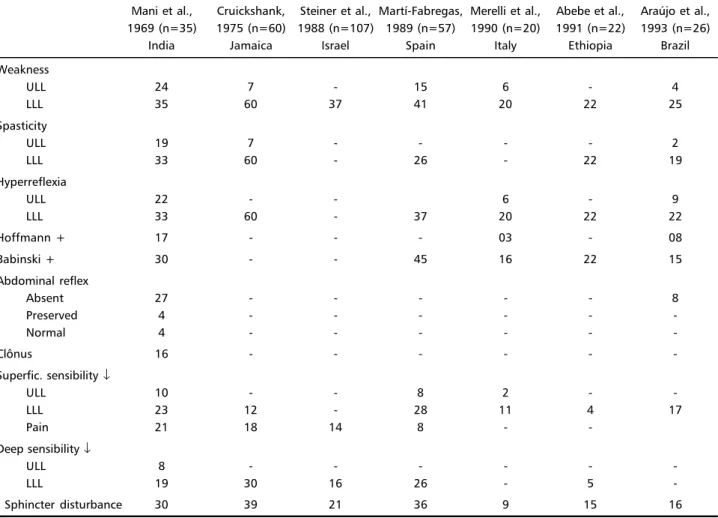
In order to better define the characteristics of the MUE a survey of the literature, from different countries and continents was carried out (Table 1).
In India Mani et al.9 analyzed 35 cases of unexplained paraplegia of gradual onset. They were 23 males and 12
1Service of Neurology (University Hospital) / Laboratory of Experimental Neurology (Department of Physiology and Pharmacology), Federal University of Ceará, Brazil; 2Service of Neurology, Catholic University of Louvain, Louvain, Belgium
Received 17 October 2000, received in final form 14 December 2000. Accepted 19 December 2000.
Dr. Carlos Maurício de Castro Costa – Laboratório de Neurologia Experimental e Neurofisiologia/ DFF/FM/UFC – Rua Cel. Nunes de Melo, 1127 – 60430-270 Fortaleza CE - Brasil. Fax: 55 85 288 8333. E-mail: [email protected]
HTLV-I NEGATIVE TROPICAL SPASTIC PARAPARESIS
A scientific challenge
Carlos Mauricio De Castro-Costa
1, Herwig Carton
2, Terezinha J. T. Santos
1ABSTRACT – We reviewed the historical, clinical and etiological aspects of the progressive chronic spastic myelopathies of unknown etiology, disserting on the clinical similarities between HTLV-I seropositive and seronegative tropical spastic paraparesis (TSP), as well as focusing on the PCR studies of the seronegative TSP.
KEY WORDS: myelopathies of unknown etiology, TSP, HTLV-I, seronegative, PCR.
Paraparesia espástica tropical HTLV-I negativa: um desafio científico
RESUMO – Fazemos uma revisão dos aspectos históricos, clínicos e etiológicos das mielopatias espásticas crônicas progressivas de causa desconhecida, dissertando sobre as semelhanças clínicas entre a paraparesia espástica tropical (PET) soro-positiva e soro-negativa para HTLV-I, focalizando também os estudos sobre PCR na PET soro-negativa.
290 Arq Neuropsiquiatr 2001;59(2-A)
females, with a mean age of 39 years. All patients pre-sented chronic and slowly progressive symmetrical or asymmetrical stiffness or weakness with pyramidal signs in the lower limbs, associated with sensory deficit in 3/4 of the cases; these symptoms were distal in both limbs, with predominance of the lower limbs without, clear-cut segmental level. Pain was reported in 60% of the cases. The majority (80%) of cases also had sphincter disturbance and part of men had impotence. Most of them were fol-lowed-up for around 48 months and no remission or re-lapse occurred. The analysis of these cases excluded sub-acute combined degeneration of the cord, lathyrism, multiple sclerosis, syphilitic meningomyelitis, adhesive arachnoiditis, pellagra, cranio-vertebral anomalies (Table 1). Cruickshank15, in a neurological retrospective analysis of 206 cases of Jamaican neuropathy, showed that the spastic group with negative VDRL (60 cases) was charac-terized by weakness and pyramidal signs in the lower (100%) and upper (13%) limbs with less involvement of peripheral nerves (21%) than in the Indian cases. Pain was present in 30% of the patients. The sphincters were im-paired in 65% of the cases (Table 1).
Steiner et al.16 analyzed the causes and clinical fea-tures of chronic progressive myelopathy in 107 patients from Israel, based upon the presence or absence of
oligoclonal immunoglobulin (Ig). The presence of it sug-gested a diagnosis of MS in 70 patients (65%), while the remaining 37 (35%) were considered MUE. The MUE pa-tients differed from the MS papa-tients in the milder disabil-ity and shorter disease course, in the former. These MUE patients were mostly males (68%) and exhibited motor weakness (100%), sensory impairment (65%) and sphinc-ter dysfunction (57%) (Table 1).
In Spain Martí-Fabregas et al.17 studied 264 consecu-tive cases of myelopathy, from which 57 cases remained undiagnosed. They were 29 males and 28 females with a mean age of onset of 37.9 years. Clinically they evidenced mostly asymmetrical weakness (71%) involving the upper (26%) and lower (72%) limbs with pyramidal signs pre-dominant in the lower limbs. Moreover they showed dis-turbances of superficial and deep sensibility with dorsal (mostly), cervical and lumbar levels. Sphincter disturbance was present in 63% of them. The follow-up and subse-quent exams (evoked potentials, CSF analysis, myelogra-phy and MRI) evidenced that 15 (26%) cases were defi-nite MS, 8 (14%) probable MS, 7 (12%) acute myelopa-thies, and 21 (37%) remained undiagnosed. They sug-gested then that the clinical follow-up and MRI could help to diagnose half of the patients the majority being MS (Table 1).
Table 1. Chronic myelopathies of unknown etiology: an analysis of the literature.
Mani et al., Cruickshank, Steiner et al., Martí-Fabregas, Merelli et al., Abebe et al., Araújo et al., 1969 (n=35) 1975 (n=60) 1988 (n=107) 1989 (n=57) 1990 (n=20) 1991 (n=22) 1993 (n=26)
India Jamaica Israel Spain Italy Ethiopia Brazil
Weakness
ULL 24 7 - 15 6 - 4
LLL 35 60 37 41 20 22 25
Spasticity
ULL 19 7 - - - - 2
LLL 33 60 - 26 - 22 19
Hyperreflexia
ULL 22 - - 6 - 9
LLL 33 60 - 37 20 22 22
Hoffmann + 17 - - - 03 - 08
Babinski + 30 - - 45 16 22 15
Abdominal reflex
Absent 27 - - - 8
Preserved 4 - - -
-Normal 4 - - -
-Clônus 16 - - -
-Superfic. sensibility ↓
ULL 10 - - 8 2 -
-LLL 23 12 - 28 11 4 17
Pain 21 18 14 8 -
-Deep sensibility ↓
ULL 8 - - -
-LLL 19 30 16 26 - 5
-Sphincter disturbance 30 39 21 36 9 15 16
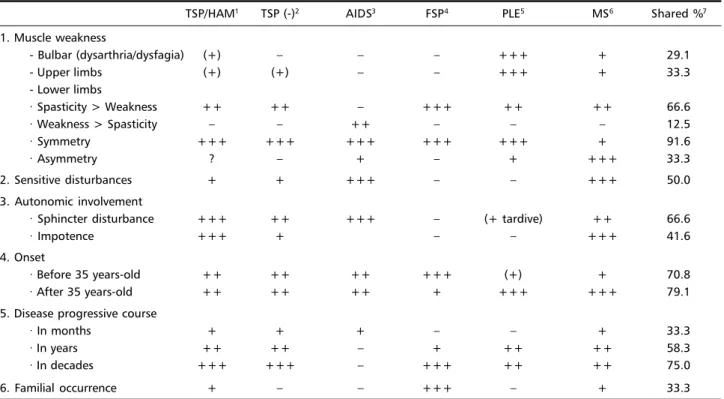
Table 2. HTLV-I myelopathy (TSP/HAM): differential diagnosis.
TSP/HAM1 TSP (-)2 AIDS3 FSP4 PLE5 MS6 Shared %7
1. Muscle weakness
- Bulbar (dysarthria/dysfagia) (+) – – – +++ + 29.1
- Upper limbs (+) (+) – – +++ + 33.3
- Lower limbs
· Spasticity > Weakness ++ ++ – +++ ++ ++ 66.6
· Weakness > Spasticity – – ++ – – – 12.5
· Symmetry +++ +++ +++ +++ +++ + 91.6
· Asymmetry ? – + – + +++ 33.3
2. Sensitive disturbances + + +++ – – +++ 50.0
3. Autonomic involvement
· Sphincter disturbance +++ ++ +++ – (+ tardive) ++ 66.6
· Impotence +++ + – – +++ 41.6
4. Onset
· Before 35 years-old ++ ++ ++ +++ (+) + 70.8
· After 35 years-old ++ ++ ++ + +++ +++ 79.1
5. Disease progressive course
· In months + + + – – + 33.3
· In years ++ ++ – + ++ ++ 58.3
· In decades +++ +++ – +++ ++ ++ 75.0
6. Familial occurrence + – – +++ – + 33.3
1Tropical Spastic Paraparesis / Myelopathy associated to HTLV-I; 2TSP HTLV-I negative; 3AIDS Vacuolar Myelopathy; 4Familial Spastic Paraparesis; 5Primary
Lateral Sclerosis; 6Multiple Sclerosis; +++, 100%; ++, 75%; +, 50%; (+), 25%.
In Italy Merelli et al.18 analyzed clinically 20 patients with myelopathy of unknown origin from whom 12 were males and 8 females with a mean age of 41 years. All patients had weakness and hyperreflexia of the lower limbs, with Babinski sign in 80% of the cases while only 30% had weakness and hyperreflexia of the upper limbs, with Hoffmann sign in 15% of the patients. Sensory im-pairment was present in the lower (55%) and upper (10%) limbs. There was as well sphincter dysfunction (45%) and impotence (25%) (Table 1).
In Ethiopia Abebe et al.19 described the clinical fea-tures of 22 patients with tropical spastic paraparesis, from whom, only 2 had anti-HTLV-I antibodies. They were 16 males and 6 females with a mean age of 26 years at on-set. All cases had pyramidal signs in the legs, touch and pain sensitivity impairment in 18% and vibration and
po-sition sense impairment in 22% of the cases. Sphincter disturbance was present in 68% of the patients (Table 1). In Brazil Araújo et al.20 studied 26 cases of spastic para-paresis of obscure origin for whom, other etiologies were clinically and laboratorially excluded. They were 17 males and 9 females, with a mean age of 41.6 years at onset. They showed, clinically, paresis (96%) and spasticity (73%) of the lower limbs and paresis (15%) and spasticity (7%) of the upper limbs. Seventy-six per cent of the patients had spastic gait. Hyperreflexia was evidenced in the lower (84%) and upper (34%) limbs. Bilateral Babinski (57%) and Hoffmann (30%) signs were also present. Sensory signs were evidenced in 65% of the patients. Autonomic dys-function (bladder dysdys-function, constipation, penile impo-tence) was evidenced in 69% of the patients (Table 1).
In this survey of the literature on series of chronic MUE Table 3. HTLV-I positive and negative tropical spastic paraparesis: comparative analysis of the literature.
Araújo et al., De Castro-Costa et al., Andrade-Filho et al.,
1993 (n=60) 1994 (n=31) 1996 (n=62)
Symptoms Pos. Neg Pos. Neg. Pos. Neg.
Motor 21 11 6 15 17 45
Pain 7 7 6 1
-Autonomic 6 0 1 2 17 45
Signs
Pyramidal 34 26 13 18 17 45
Sphincter 32 16 11 17 17 45
Sensitive 15 7 4 4 13 36
-292 Arq Neuropsiquiatr 2001;59(2-A)
one may conclude that their presence is universal and that the analysis of different series show that most of the pa-tients are young men with clinical signs and symptoms predominant in the lower limbs and variable sensory, sphincter and impotence disturbances, showing, this way, a clinical similarity. In addition, for part of the cases an etiology is found only after long time, and for the remain-ing, the diagnosis still remains unknown or obscure.
TSP/HAM: a retroviral (HTLV-I) etiology
In this context of undefined etiology for these forms of obscure myelopathies, a consistent etiological factor was finally found when Gessain et al.21 in Martinique, and Osame et al.22, in Japan, described the association of the Tropical Spastic Paraparesis (TSP) to the retrovirus HTLV-I for part of their cases and denominated them as TSP/HAM (Tropi-cal Spastic Paraparesis / HTLV-I associated myelopathies). This association became in fact important since a world meta-analysis carried out by León et al.23 showed that among 2,811 patients with TSP or chronic idiopathic spas-tic paraparesis, 1,261 (44.9%) were HTLV-I positive (TSP/ HAM). Moreover recently Osame24 estimates to exist, up to now, more than 3,000 cases of TSP/HAM in the world.
TSP/HAM differential diagnosis
This way, a differential diagnosis of TSP/HAM with other clinically similar neurological entities, should be looked for. Among these the main similar neurological conditions are vacuolar myelopathy of AIDS, familial spastic para-paresis, primary lateral sclerosis, spinal form of multiple sclerosis, and HTLV-I negative TSP (Table 2). The clinical analysis of these conditions evidences that the clinical as-pects which are shared by all these diseases are the pre-dominance of spasticity on weakness in the lower limbs, symmetry of symptoms, sensitive and autonomic distur-bances, age, and their chronic and progressive course. On the other hand the symptoms and signs that differentiate them are bulbar impairment, weakness of upper limbs, predominance of weakness on spasticity, asymmetry of symptoms, short course of the disease and familial occur-rence (Table 2). When looked individually, some aspects should be underlined in the differential diagnosis of TSP/ HAM and these specific conditions. The AIDS myelopathy is tardive and has short evolution besides the seropositiv-ity for HIV. The familial spastic paraparesis (FSP) is rarer than TSP/HAM and, besides the “pure form”, the “com-plicated” FSP is associated with mental retardation, optic atrophy, ataxia, distonia, dysarthria and peripheral neur-opathy. The primary lateral sclerosis (PLS) is rare, present-ing tetraparesis associated to accentuated spasticity of the lower limbs, pseudo-bulbar signs and absence of sphinc-ter disturbance. The spinal form of multiple sclerosis is rarely isolated and mostly associated with, even silent, optic nerve, brainstem and cerebral lesions as shown by MRI. Moreover apart the progressive form most of them evi-denced periods of relapse and remission characteristic of MS and not of TSP/HAM. In addition MS also seems to be rarer than TSP/HAM in the endemic regions of HTLV-I25.
HTLV-I seronegative TSP: clinical studies
In the world meta-analysis of León et al.23, it is shown that among 2,811 TSP patients 1,550 (55.1%) patients are HTLV-I seronegative and still remain without diagno-sis as a group which could be called non-HAM TSP. In fact, even in the original description of Gessain et al.21 (1985) this group appears. In Gessain’s series of 17 TSP patients, 10 were HTLV-I positive and the remaining 7 (41.1%) pa-tients were HTLV-I seronegative TSP. In a Brazilian meta-analysis De Castro-Costa et al.26 also showed that among 433 cases of TSP, 276 (63.7%) were HTLV-I negative. More recently Zaninovic27 reported on a surprisingly high per-centage (from 56% to 100%) of HTLV-I seronegative TSP in 14 tropical and non-tropical countries.
Thus TSP/HAM and HTLV-I seronegative TSP seem to be most closesy related albeit possibly of different etiology.
Moreover a comparative analysis of some series of HTLV-I negative TSP and TSP/HAM20,26,28 showed that there is a similitude of symptoms and signs between both forms, with a slight difference in the autonomic and sphincter symptomatology (Table 3). This similarity had already been evidenced by Bhagavati et al.29 in a previous work.
HTLV-I seronegative TSP: molecular studies
Since TSP/HAM and HTLV-I seronegative TSP seem to be clinically similar, the etiology, however, is the critical point. In this sense, some molecular studies have been carried out to test a possible retroviral etiology for these HTLV-I seronegative cases.
Nishimura et al.30 studied one case of HTLV-I serone-gative TSP patient from South India who presented a slowly progressive paraparesis, and from whom HTLV-I pol and tax viral sequences were detected in DNA from fresh pe-ripheral blood lymphocytes by polymerase chain reaction (PCR) and liquid hybridization techniques. In addition a long-term CD4+ T-cell line was established from these lym-phocytes from which the DNA was amplified and portions of the HTLV-I LTR’U3, pol, env and tax regions were se-quenced with an homology of 98.8% to the prototype HTLV-I, demonstrating this way the presence of HTLV-I in this seronegative TSP patient (Table 4).
A rq N e u ro p siq u ia tr 2 0 0 1 ;5 9 (2 -A ) 2 9 3 ) a i d n I ( . l a t e a r u m i h s i N 3 9 9 1 , 0 7 8 -7 6 8 : 4 3 l o r u e N n n A ) n a e b b i r a C ( . l a t e e k n e a D 4 9 9 1 , 3 4 9 -1 4 9 : 9 6 1 s i D t c e f n I J ) e l i h C ( . l a t e z e r i m a R 8 9 9 1 , 3 1 8 1 -1 1 8 1 : ) 6 ( 6 3 l o i b o r c i M n i l C J ) l i z a r B ( . l a t e a t s o C -o r t s a C e D 5 9 9 1 , 8 1 3 -5 1 3 : ) 2 ( 1 1 v o r t e R m u H s e R S D I A s t n e i t a p f o º N ) x ( e g A ) x ( t e s n o f o e g A 1 6 4 1 2 1 0 6 5 1 1 . 5 5 2 1 5 . 2 4 s i s e r a p a r a p e v i s s e r g o r p y l w o l S L L
R →LLL→ULLs e c n a b r u t s i d r e t c n i h p s o N g n i w o l l a w s d n a h c e e p s o N s r o t c a f k s i r o N e h t f o y t i c i t s a p s l a c i r t e m m y s a e v i s s e r g o r P , n i a p k c a b w o l , t n e m e v l o v n i m r a t f e l , s g e l n o i t i r u t c i m f o y c n e g r u , r a b l u b o d u e s p : ) 5 1 / 7 ( t n e m e v l o v n i n i a r B r e t c n i h p s , a i s e n i k s y d , n a i n o s n i k r a p e c n a b r u t s i d s i s e r a p a r a p e v i s s e r g o r p y l w o l S s i s e r a p i r d a u q c i t s a p S s L U > s L L a i x e l f e r r e p y H i k s n i b a B l a r e t a l i B g n i k r e j w a j k s i r B f o s s e n k a e w d n a a i x e l f e r r e p y h , y t i c i t s a p S s b m i l r e w o l s b m i l r e w o l e h t n i s m o t p m y s l a d i m a r y P ) 2 1 / 3 ( s b m i l r e p p u e h t n i d n a ) 2 1 / 2 1 ( y t i l a m r o n b a y r o s n e s o
N Nosensoryabnormality
l a m r o n F S C ) -( L R D V ) B W ( F S C / m u r e S ) -( I -V L T H l a m r o n : m a r g o l e y M l a m r o n : I R M d r o c l a n i p S / d a e H l a m r o n : G M N E r o f t p e c x e , l a m r o
N ↑IgG
e v i t i s o P e v i t a g e N n o i g e r l a c i v r e c e h t n i . t n e d n i e l p i t l u M l a m r o n : I R M l a c i v r e C ) B W / e c n e c s e r o u l f o n u m m i ( e v i t a g e N 4 2 p , 9 1 p : e r u t l u c s e t y c o h p m y L 3 D
C +,CD4+,CD8-,IL2R+phenotypes
) s e n i l l l e c -T + 4 D C m r e t -g n o l ( v n e , l o p , R T L r o f s r e m i r p : R C P s n o i g e r x a t d n a A N D L B P h s e r F s n o i g e r x a t d n a l o p r o f s r e m i r p : R C P A N D L B P h s e r F , e s a e t o r p , l o p , g a g , R T L 5 r o f s r e m i r p : R C P 3 R T L d n a x a t , v n e , l o p , g a g : d e i f i l p m a s e c n e u q e S 5 r o 3 R T L t o n t u b , x a t , v n e , e s a e t o r p A N D s a w x a t y l n O R T L d n a x a t r o f s r e m i r p : R C P e n o l c I -V L T H o t y g o l o m o H d e i f i l p m a % 8 9 > : ) 1 -K T A ( 0 1 : R C
P 5cells
s n o i g e r l o p n a x e r / x a t r o f s r e m i r P s u r i v o r p I I / I -V L T
294 Arq Neuropsiquiatr 2001;59(2-A)
Ramirez et al.32 studied 15 HTLV-I seronegative TSP patients from Chile. Clinically 8 patients presented para-paresis with spasticity, hyperreflexia, bilateral Babinski signs and some sphincter disturbances. In addition to the spastic paraparesis the other 7 patients had brain involve-ment. For molecular studies the DNA was extracted from purified PBMC and regions of tax and LTR genes were tried to be amplified by PCR. The results showed that only a region of the tax gene was amplified and not the LTR gene suggesting, this way, the presence of a defective HTLV-I provirus in 10 out 15 seronegative TSP patients namely those who mainly had spinal and brain involvement (Table 4).
De Castro-Costa et al.33 studied 12 HTLV-I seronega-tive TSP patients from Brazil who clinically presented signs and symptoms typically of TSP without brain involvement, and tried to detected the proviral genome with PCR in the tax/rex and pol parts of the HTLV proviral genome. How-ever, no HTLV-I or provirus was detected (Table 4).
Thus, the analysis of the molecular and clinical studies of HTLV-I seronegative TSP shows, divergent results.
In all studies the number of patients is still limited, and from the clinical point of view some studies such as in the Chilean series also show mixed cases with typical and atypical signs and symptoms of TSP. Moreover a long/ term study has not yet been carried out with repetitive clinical, serological and PCR evaluations. On the other hand, the PCR studies were divergent in their results show-ing the presence of complete, defective or absent HTLV-I provirus.
In conclusion further studies on HTLV-I seronegative TSP cases should include a long-term clinical and labora-torial follow-up of the patients and their relatives the build-ing-up of long-term T-cell lines and the use of repeated PCRs, the use of primers for related retroviruses or other viruses and the search for other co-factors or etiologies. So, TSP still goes on as scientific stimulus and challenge.
Acknowledgements - We wish to thank Dr. David Neil Criddle for linguistic revision of the manuscript and Mr. Silvio Costa for this accurate typewriting of this text on a wordprocessor.
REFERENCES
1. Charcot JM. Sclérose des cordons latéraux de la moelle épinière chez une femme hystérique atteinte de la contracture permanente des quatre membres. Bull Soc Med Hop (Paris) 1865;Suppl. 2:24-42.
2. Erb WA. Uber einen wenig bekannten spinalen Symptomen-komplex. Klin Wochenschr 1875;12:357-359.
3. Marie, Pierre. Huitième leçon: Tabes dorsal spasmodique. In Leçons sur les Maladies de la Moelle. Paris: G. Masson, 1892:87-96. 4. Scott HH. An investigation into an acute outbreak of “central
neuri-tis”. Ann Trop Med Parasitol 1918;12:109-116.
5. Minchin RLH. Primary lateral sclerosis of South India: lathyrism with-out lathyrism. BMJ 1940;1:253-255.
6. Marshall J. Spastic paraplegia of middle age: A clinicopathological study. Lancet 1955;1:643-646.
7. Cruickshank EK. A neuropathic syndrome of uncertain origin: review of 100 cases. West Indian Med J 1956;5:147-158.
8. Montgomery RD, Cruickshank EK, Robertson WB, McMenemy WH. Clinical and pathological observation on Jamaican neuropathy: a re-port of 206 cases. Brain 1964;87:425-460.
9. Mani KS, Mani AJ, Montgomery RD. A spastic paraplegic syndrome in South India. J Neurol Sci 1969;9:179-199.
10. Spillane JD. Tropical Neurology. London: Oxford Univ. Press, 1973. 11. Zaninovic’ V, Biojo R, Barreto P. Paraparesia espástica del Pacífico.
Colombia Med 1981;12:111-117.
12. Román GC, Román LN, Spencer PS, Schoenberg BS. Tropical spastic paraparesis: a neuroepidemiological study in Colombia. Ann Neurol 1985;17:361-365.
13. Spina-França A, Salum PNB, Limongi JCP, Berger A, Losso ER. Mielopatias: aspectos diagnósticos. Arq Neuropsiquiatr (São Paulo) 1988;38:260-366.
14. Wallace ID, Cosnett JE. Unexplained spastic paraplegia. South Af-rica Med J 1983;63:689-691.
15. Cruickshank EK. A neurological retrospect of Jamaica. West Indian Med J 1975;24:3-15.
16. Steiner I, Feir G, Soffer D, Pleet AB, Abramsky O. Chronic progres-sive myelopathy: its relation to the spinal progresprogres-sive form of mul-tiple sclerosis. Acta Neurol Scand 1988;77:152-157.
17. Martí-Fabregas J, Martínez JM, Lila I, Escartin A. Myelopathy of un-known etiology. Acta Neurol Scand 1989;80:455-460.
18. Merelli E, Sola P, Montagnani G. Is myelopathy of unknown origin related with tropical spastic paraparesis and myelopathy associated with human T cell lymphotropic virus type I? Eur Neurol 1990;30:112-114.
19. Abebe N, Haimanot RT, Gustafsson A, Forsgren L, Denis F. Low HTLV-I seroprevalence in endemic tropical spastic paraparesis in Ethiopia. Trans R Soc Trop Med Hyg 1991;85:109-112.
20. Araújo AQ-C, Afonso CR, Schor D, Andrada-Serpa MJ. Spastic para-paresis of obscure origin: a case-control study of HTLV-I positive and negative patients from Rio de Janeiro, Brazil. J Neurol Sci 1993;116:165-169.
21. Gessain F, Barin J, Vernant JC et al. Antibodies to human T-lymphotropic virus type I in patients with tropical spastic parapare-sis. Lancet 1985;2:407-409.
22. Osame M, Usuku K, Izumo S et al. HTLV-I associated myelopathy: a new clinical entity. Lancet 1986;1:1031-1032.
23. León-S FE, De Castro-Costa CM, Gaffga M. Discrepancy, coincidence or evidence in chronic idiopathic spastic paraparesis throughout the world: a meta-analysis of 2811 patients. Arq Neuropsiquiatr 1997;55:530-535.
24. Osame M. The recent advances of HAM/TSP research. Rinsho Shinkeigaku 1999;39:1200-1202.
25. Carton H. Mielopatías virales y no virales. In Zaninovic’ V, De Castro Costa CM (eds.). La PET/HAM – La Paraparesia Espástica Tropical o Mielopatía asociada con el HTLV-I. Cali: Fundación MAR-Colciencias, 1998:1-11.
26. De Castro-Costa CM, Carton H, Goubau P, D’Almeida JAC. Brazil-ian studies on tropical spastic paraparesis: a meta-analysis. Arq Neuropsiquiatr 1994;52:585-591.
27. Zaninovic’ V. On the etiology of tropical spastic paraparesis and hu-man T-cell lymphotropic virus-I-associated myelopathy. J Infec Dis 1999;3:168-177.
28. Andrade-Filho AS, Brites C, Santos SRS et al. HTLV-I/II as a com-mon etiology of myelopathies in Bahia, Brazil. Braz J Med Biol Res 1996;29:757-761.
29. Bhagavati S, Ehrlich G, Kula RW et al. Detection of human T-cell lymphoma/leukemia virus type I DNA and antigen in spinal fluid and blood of patients with chronic progressive myelopathies. New England J Med 1988;318:1141-1147.
30. Nishimura M, Mingioli E, McFarlin DE, Jacobson S. Demonstration of human T-cell lymphotropic virus type I (I) from an HTLV-I seronegative South HTLV-Indian patients with chronic, progressive spas-tic paraparesis. Ann Neurol 1993;34:867-870.
31. Daenke S, Parker CE, Niewiesk S, Newsom-Davis J, Nightingale S, Bangham CRM. Spastic paraparesis in a patient carrying defective human T-cell leukemia virus type I (HTLV-I) provirus sequences but lacking a humoral or cytotoxic T-cell response to HTLV-I. J Infect Dis 1994;169:941-943.
32. Ramirez E, Cartie r L, Rios M, Fernandez J. Defective human T cell lymphotropic virus type I (HTLV-I) provirus in 10 Chilean serone-gative patients with tropical spastic paraparesis or HTLV-I-associ-ated myelopathy. J Clin Microbiol 1998;36:1811-1813.